by Khaled Abu Toameh
Do the Arabs and Muslims — or the Europeans — really believe that creating a Palestinian state would automatically produce peace?
The foreign ministers of Jordan, the United Arab Emirates, Indonesia, Pakistan, Turkey, Qatar, Saudi Arabia, and Egypt accused Israel of "violating" international law and undermining efforts to implement the Board of Peace's recently published "Roadmap for Completing the Implementation of President Trump's Comprehensive Peace Plan in Gaza." They also called for those responsible for "grave violations" to be held accountable.
The ministers forgot to mention that Hamas, by refusing to disarm and continuing to hold on to power in the Gaza Strip, is the party committing "grave violations."
If accountability is important, why does it apply only to Israel?
Where is the demand that Hamas be held accountable for bringing death and destruction upon the Palestinians of the Gaza Strip by launching its invasion of Israel?
Why not issue a clear demand that Hamas surrender all its weapons? The omission is especially disturbing because three of the countries represented in the statement – Turkey, Qatar and Pakistan – are members of Trump's Board of Peace and are supposedly helping to bring security and stability to the Gaza Strip.
Do the Arabs and Muslims — or the Europeans — really believe that creating a Palestinian state would automatically produce peace? Who would prevent Hamas and Palestinian Islamic Jihad from taking over such a state? Who would confiscate their weapons? Who would prevent Iran or Turkey from supplying Palestinian proxies with weapons, money and training? Who would guarantee that a future Palestinian state would not be used to launch more October 7-style attacks against Israel?
Israel withdrew every soldier and expelled every Jewish resident from the Gaza Strip in 2005. Palestinians subsequently had an opportunity to demonstrate what self-rule could look like. Hamas won the 2006 Palestinian Authority parliamentary election and seized full control of the Gaza Strip the following year.
Instead of turning the Gaza Strip into a model of prosperity and coexistence, Hamas transformed it into a base for terrorism against Israel. Why should Israel be expected to repeat this "experiment" on a much larger and more dangerous scale — either in Gaza or in the West Bank, overlooking major Israeli population centers?
Peace will not come from ignoring Hamas, demonizing Israel and Jews, or repeating slogans about a "two-state solution" as though October 7 had never happened. It will come only when the international community — including Arab and Islamic countries — makes it clear that armed jihadist organizations cannot be allowed to control Palestinian territory, possess private armies, or determine the future of Israelis and Palestinians through terrorism. That would be a far more useful message for Arab and Islamic governments to deliver than yet another communique condemning Israel.
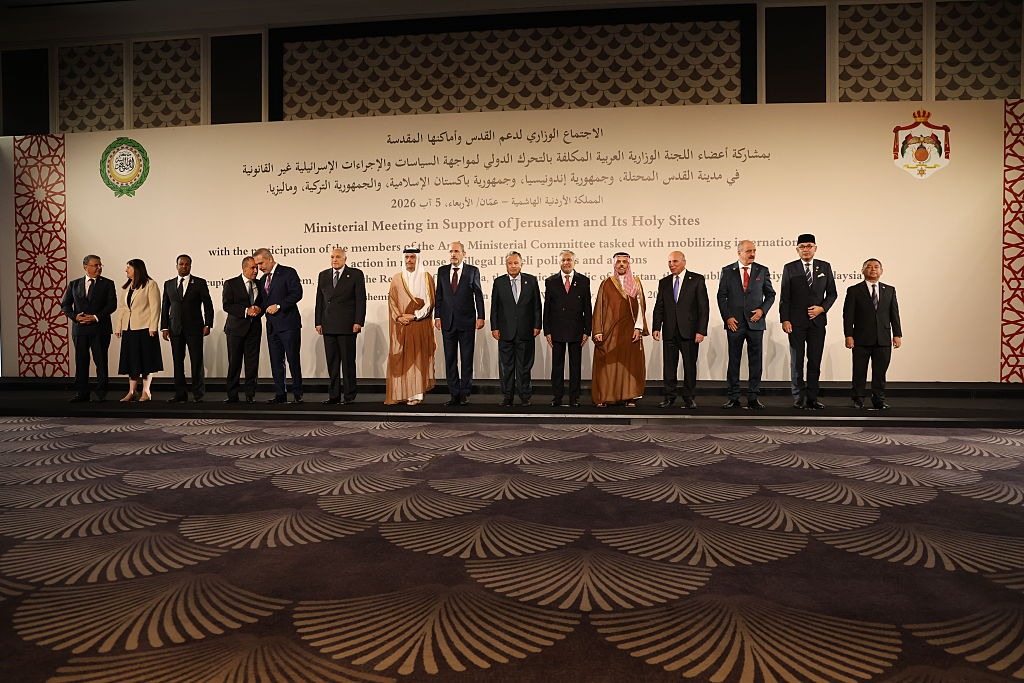
Foreign ministers of Arab and Islamic countries gathered in Jordan on August 5 and 6 to issue yet another series of condemnations of Israel. Reading their statements, one could easily conclude that there is only one party responsible for violence, instability, and suffering in the Middle East: Israel.
Hamas? Barely relevant. The Hamas-led October 7, 2023 massacre? Apparently not worth mentioning. Palestinian terrorism and incitement against Israel? Not on the agenda. The need to dismantle Hamas and other Palestinian terrorist groups? Evidently not a priority.
What about Iran, the principal sponsor of Islamist terrorist organizations throughout the Middle East? What about Hezbollah, which joined the war against Israel immediately after October 7? What about the Iran-backed Houthis in Yemen, who have launched missiles and attack drones into Saudi Arabia and Israel, and attacked international shipping?
Evidently, they too are not worthy of the ministers' attention.
There was no condemnation of Iran and its network of terrorist proxies, even though they have all played, and continue to play, a major role in destabilizing the Middle East and turning several Arab countries into arenas for Tehran's regional ambitions. There was no demand that Hezbollah surrender its weapons to the Lebanese army. No demand that the Houthis halt their attacks. No demand that Iran stop funding, arming, and supporting terrorist groups dedicated to attacking Israel and undermining Arab states.
Instead, once again, the messaging coming from Arab and Islamic countries was clear: the problem is Israel.
This selective outrage is not merely hypocritical; it is dangerous. By concentrating their attacks on Israel while largely ignoring Iran and Islamist terrorist groups such as Hamas, Hezbollah, and the Houthis, Arab and Islamic governments are reinforcing the extremists' narrative that Israel, rather than jihadist terrorism and Iranian interference, is the principal source of instability in the Middle East.
The foreign ministers of Jordan, the United Arab Emirates, Indonesia, Pakistan, Turkey, Qatar, Saudi Arabia, and Egypt accused Israel of "violating" international law and undermining efforts to implement the Board of Peace's recently published "Roadmap for Completing the Implementation of President Trump's Comprehensive Peace Plan in Gaza." They also called for those responsible for "grave violations" to be held accountable.
The ministers forgot to mention that Hamas, by refusing to disarm and continuing to hold on to power in the Gaza Strip, is the party committing "grave violations."
If accountability is important, why does it apply only to Israel?
Where is the demand to hold Hamas accountable for the October 7, 2023 massacre, when Hamas terrorists and other Palestinians invaded Israel, murdered 1,200 Israelis and foreign nationals, wounded thousands more, and kidnapped 251 men, women and children, dragging some of them into the Gaza Strip as hostages? Where is the demand that Hamas be held accountable for bringing death and destruction upon the Palestinians of the Gaza Strip by launching its invasion of Israel?
The ministers warned that Israeli actions could undermine the second phase of US President Donald J. Trump's 20-point peace plan for the Gaza Strip. According to their own statement, this phase includes provisions concerning the collection of weapons from Hamas and other Palestinian factions.
Why not issue a clear demand that Hamas surrender all its weapons? The omission is especially disturbing because three of the countries represented in the statement – Turkey, Qatar and Pakistan – are members of Trump's Board of Peace and are supposedly helping to bring security and stability to the Gaza Strip.
How can anyone be expected to trust these countries when their governments participate in meetings and statements that condemn Israel while failing to demand that Hamas disarm unconditionally?
If Turkey, Qatar and Pakistan want to play a constructive role in the Gaza Strip, they should start by telling Hamas publicly: "The game is over. Hand over your weapons, dismantle your military and security apparatuses, and relinquish control of the Gaza Strip."
Instead, their statements send Hamas exactly the opposite message: that Israel, and not the terrorist group that initiated the October 7 war, remains the principal culprit.
The August 5 meeting in Amman was even more revealing. Foreign ministers of Arab and Islamic states condemned what they described as "Israeli policies and measures aimed at altering the Arab Islamic and Christian identity of occupied Jerusalem," accused Israel of "violations at the blessed Al-Aqsa Mosque/Al-Haram Al-Sharif [the Temple Mount]," and referred to Jews peacefully visiting the Temple Mount compound as "incursions by extremist settlers."
Such language in this region is not just totally inaccurate, it is a threat.
Jews — who have lived in the area for nearly 4,000 years, as opposed to Muslims' 1,400 years — have a profound religious and historical connection to Jerusalem and the Temple Mount. Portraying Jewish visitors collectively as "extremists" and their presence as an "incursion" is precisely the type of inflammatory speech that Palestinian terrorist organizations have repeatedly — and dishonestly — used to incite violence against Israel and Jews.
The foreign ministers warned that Israeli policies concerning Islamic holy sites constitute a provocation against approximately two billion Muslims and could lead to a religious conflict.
Instead of lowering the flames, such fabrications pour fuel on them.
What, in fact, do Jews do when they visit the Temple Mount? They enter through designated gates under Israeli police supervision and walk along specified routes around the outdoor compound. They do not enter Al-Aqsa Mosque or the Dome of the Rock. They do not arrive armed to attack Muslim worshippers or seize the mosques.
There is nothing inherently anti-Muslim about allowing Jews and other non-Muslims to visit the Temple Mount. For decades, non-Muslims – including Christian tourists and Jews – have been permitted to visit the Temple Mount during designated hours. A Jewish civilian walking peacefully around a site that is sacred to Judaism is no more an "incursion" than a Muslim visiting a holy site outside the Muslim world.
Hamas and other Islamist terrorist organizations have long attempted to portray their conflict with Israel as a religious war over Jerusalem and Al-Aqsa Mosque. When Arab and Islamic governments employ similar lies, they reinforce the false narrative used by extremists to recruit terrorists and justify attacks against Jews.
The Arab and Islamic governments also repeated their support for the establishment of an "independent, sovereign Palestinian state" and described a "two-state solution" as the only path toward peace.
Nearly three years after October 7, 2023, this formula deserves rather more scrutiny. Do the Arabs and Muslims — or the Europeans — really believe that creating a Palestinian state would automatically produce peace? Who would prevent Hamas and Palestinian Islamic Jihad from taking over such a state? Who would confiscate their weapons? Who would prevent Iran or Turkey from supplying Palestinian proxies with weapons, money and training? Who would guarantee that a future Palestinian state would not be used to launch more October 7-style attacks against Israel?
The experience of the Gaza Strip should instead have led to serious reflection. Israel withdrew every soldier and expelled every Jewish resident from the Gaza Strip in 2005. Palestinians subsequently had an opportunity to demonstrate what self-rule could look like. Hamas won the 2006 Palestinian Authority parliamentary election and seized full control of the Gaza Strip the following year.
Instead of turning the Gaza Strip into a model of prosperity and coexistence, Hamas transformed it into a base for terrorism against Israel. Why should Israel be expected to repeat this "experiment" on a much larger and more dangerous scale — either in Gaza or in the West Bank, overlooking major Israeli population centers?
Peace will not come from ignoring Hamas, demonizing Israel and Jews, or repeating slogans about a "two-state solution" as though October 7 had never happened. It will come only when the international community — including Arab and Islamic countries — makes it clear that armed jihadist organizations cannot be allowed to control Palestinian territory, possess private armies, or determine the future of Israelis and Palestinians through terrorism. That would be a far more useful message for Arab and Islamic governments to deliver than yet another communique condemning Israel.
- Follow Khaled Abu Toameh on X (formerly Twitter)
Khaled Abu Toameh is an award-winning journalist based in Jerusalem.
Source: https://www.gatestoneinstitute.org/22782/arab-islamic-peace-ignore-hamas-blame-israel

No comments:
Post a Comment