Sunday, February 23, 2020

Socialism Makes People Do Strange Things - Bruce Thornton


by Bruce Thornton


What does the most troubling political phenomenon of postwar America portend for November and beyond?


Apart from the bizarrerie of Trumpophobia, the wide-spread Democrat  attraction to socialism is the strangest political phenomenon of postwar America. In 2016, the ascent of Bernie Sanders, the inconsequential senator from Vermont, bespoke a more limited audience comprising mainly millennials for whom politics is a marker of personal identity. Now we’re seeing a slate of primary candidates who all embrace socialist policies far to the left of Barack Obama’s public persona. What does this phenomenon portend for November and beyond?

Certainly the mainstream Democrats who rigged the 2016 primary on behalf of Hillary Clinton are nervous. Old Clinton wrangler James Carville is alarmed: He called Sanders’ supporters a “cult,” and prophesied that if Sanders runs against Trump, it would bring on “the end of days.” Sanders responded by calling Carville a “political hack,” a moniker Carville embraced as superior to being a political amateur and a “communist.”

For other Democrats, Sanders vs. Trump would reprise storied Democrat wipeouts like 1972 and 1980. Nor do polls suggest that socialism’s appeal has increased: 53% of those recently polled by Gallup said they would not support a “generally well-qualified socialist” for president, whereas 90% would support a black, Catholic, Hispanic, female, or Jewish one. The U.S.’s historical, and exceptional, resistance to socialism still seems to hold.

Moreover, the policies being bruited by the primary candidates are preposterously utopian and simply unaffordable. The bill just for the Green New Deal, forgiving $1.5 trillion in student debt, and Medicare For All tops $100 trillion. No proposal for financing the cost has passed the laugh test. Most are variations of the “make the rich pay their fair share” cliché, meaning various tax-hikes that would stop the current record-setting economic boom in its tracks. The reality is, the top 10% of earners just don’t have enough money. We could confiscate outright all the wealth of America’s 707 billionaires, $3 trillion, and still not be able even to fund the federal government’s FY 2020 budget estimate of $4.7 trillion.

Nor can those evil corporations that create jobs and wealth be tapped for more funds. The Fortune 500 wealthiest companies are worth $22.6 trillion, just about enough to cover the fed’s total debt of $22.7 trillion rising as we speak. And of course, then the economy would implode. Nor can raising the corporate tax rate generate the money socialists need to fund their proposals. After all, Trump’s reduction of corporate rates has contributed to economic growth, more jobs, higher tax revenues, and wage-gains for workers. Why would voters want to throw that all away to achieve some vague idea of “social justice”?

The only way to begin to cover the new socialists’ extravagant policies would require taxing more people than just the top half of earners, as we do now, and throwing in a regressive consumption tax at a rate comparable to the average European VAT tax rate of 23%. And it’s questionable even those Draconian, growth-killing levels of taxation could fund even a fraction of the current socialist proposals.

These policies, then, are obviously not the product of reason or mathematics or even common sense. They are instead a narcotic for those in thrall to the doctrine of income egalitarianism, an imagined paradise on earth of the sort found in millenarian cults, an ersatz faith, and a fashion accessory for the badly educated and angst-ridden. That’s why the historical record of socialism’s bloody failures cuts no ice with the true believers. Even if we set aside the most destructive manifestations of collectivist ideologies like Soviet and Maoist communism, the progressive version of socialism that has developed in the U.S. over the last century offers no evidence that supports expanding progressive policies even further.

Indeed, as historian Amity Shlaes has documented in two books, progressivism’s biggest political successes, FDR’s New Deal and LBJ’s Great Society, have been real-world failures. It’s not just the moral hazard of getting citizens hooked on benefits funded by redistributing wealth from the productive, memorably expressed in Kipling’s line “All men are paid for existing and no man must pay for his sins.” Worse, these programs are on track to bankrupt the country. Along with interest on the debt, for the time being serviced at atypically low interest rates, these programs are eating up more than two-thirds of the annual budget. An aging population that is living longer and taking the lion’s share of health-care spending guarantees that without reform current spending is unsustainable. It is the height of irrationalism, or a sign of political duplicity, that all the current Democrat primary candidates are proposing policies that will worsen this fiscal disaster.

Just as revealing of irrationalism or simple incoherence is the hypocrisy of millionaire candidates like Bernie Sanders, Joe Biden, and Elizabeth Warren, beneficiaries of free-market capitalism who bite the hand that feeds them. It doesn’t matter if they’re sincere but just poorly educated, or lacking in self-awareness, or fully aware of their hypocrisy and willing to promise anything to get power. The effect on the rest of us if one of them wins in November will still be devastating.

But establishment Democrats who are terrified of Bernie Sanders have ratcheted up the irrationalism by turning to billionaire Michael Bloomberg. They have already changed rules for participating in debates to accommodate him, and there are rumors that the DNC is attempting to fix the race as it did in 2016 to benefit Hillary Clinton. Their “moderates” Joe Biden and Elizabeth Warren having faltered, the goal now is to prevent an unapologetic, Soviet Union honeymooning, serial commie thug admirer, and in-your-face avowed socialist from sending Trump back to the White House.

This is an issue not of principle but of expediency. Smarter Democrats like James Carville know the nationwide antipathy to socialism requires a leader like Barack Obama who can lie smoothly on the campaign trail, and then once elected pursue a Fabian strategy of incremental change, just as Obamacare was the first step towards the full-blown government-run health care now being touted by the Democrat primary candidates.

But Michael Bloomberg? The guy who thinks the worst presidential candidate ever should be considered for his vice president? The eighth richest man in the U.S.? How well will that sit with the “woke” socialist class-warriors? Not even their skills at cognitive dissonance can rationalize that level of hypocrisy. This is the party that, with “maverick” John McCain’s help, passed the McCain-Feingold bill that violated the First Amendment by restricting donations to candidates, a bill that fortunately was overturned in the Citizens United case. Since then undoing that decision has been a staple of Democrat campaign rhetoric, ostensibly to keep plutocratic money from corrupting our elections.

Now some are turning to a plutocrat worth $62 billion who can literally buy if not the election, at least the candidacy. It’s no coincidence that eight mayors who have endorsed Bloomberg run cities that have received grants from Bloomberg philanthropies. And it doesn’t hurt that Bloomberg has been generous to Democrats, spending $110 million in 2019 on Democrat Congressional candidates. And that’s just a sample of his politicized charity––$2.3 billion in 2018 alone–– documented by the New York Times, which concludes that his philanthropy “has also secured the allegiance or cooperation of powerful institutions and leaders within the Democratic Party who might take issue with parts of his record were they not so reliant on his largess.” And don’t forget, with his $60 billion, Bloomberg can also afford to run slews of campaign ads night and day, like his $11 million Superbowl ad supporting gun control with a misleading statistic, or his latest calling out Bernie Sanders for his supporters’ thuggish tweets that threaten violence against the Berne’s opponents.

And it’s not as though Bloomberg is so eminently qualified to do anything other than make a whole bunch of money. As mayor of New York he was the beneficiary of Rudy Guliani’s policing tactics like stop-and-frisk that reduced violent crime and rescued the city from its Death Wish and Taxi Driver dystopian squalor. Bloomberg looks good only when he is compared to current mayor Bill de Blasio, he of the reverse Midas touch who is not smart or principled enough to stick with a policy that reduces murders of the mostly black and Latinos he claims to champion.

But that policy success, no matter how much a consequence of not squandering a political inheritance, has been repudiated by Bloomberg himself as “racist” during a groveling, cringe-inducing apology before well-heeled black “leaders.” He’s also had to disavow some crude and exaggerated, yet essentially true, statements about black crime and its black victims he made in a speech, and insulted black and Latino men by saying they “don’t know how to behave in the workplace.” Such displays of contrition are patently a tactic for attracting black votes, and bespeak a lack of integrity. If Bloomberg sincerely believed a policy that has saved thousands of black lives was “racist,” we would have heard about it long before he decided to run for president.

Instead, it has been Exhibit A in his res gestae that supposedly qualify him to be president. Without it, what else does he have? Regulating the size of soda portions? Hectoring citizens about their salt intake? Threatening to gut the Second Amendment? The “woke” base will like these technocratic intrusions on our freedom, and won’t be troubled by Bloomberg’s praise for China’s autocrat Xi Jinping, or his claim that Xi is “not a dictator” but is accountable to his people. But while their class envy might give a pass to a mere millionaire like Bernie, an entitled, multi-billionaire, ex-Republican, and obvious opportunist is beyond the pale.

Moreover, Bloomberg is now feeling the ire of “woke” women after the Washington Post last week published an exposé of his history of crude sexual jokes––so many that an employee put together and circulated a 34-page booklet including some of them–– and allegations of discrimination against women that has created a “hostile environment, artifacts of a workplace employees said was saturated with degrading comments,” the Times writes, and “a culture of sexual harassment and degradation.” He also told a female employee to “kill it” after learning she was pregnant. And yes, evangelical pro-abortion Dems will not be deterred by the hypocrisy of condemning Bloomberg for honestly saying what they have enthusiastically supported doing for years. If Bloomberg gains enough traction to threaten Bernie, will we see the Salemite MeToo# packs––whom Bloomberg has criticized in public–– swarm him as they did Brett Kavanaugh? Elizabeth Warren has already called on Bloomberg to release two women from non-disclosure agreements so she can learn the lurid details they are hiding.

It is a flashing neon sign of how irrational the Democrats have become that some are pinning their hopes on a billionaire with a long record of opportunism and crude, misogynist behavior that they’ve spent more than three years condemning Trump for. But the specter of a President Sanders frightens them with visions of just how much more socialism will be hated after it is inflicted on Americans, half of whom already despise progressivism, socialism lite.

But the really troubling issue is the continuing allure of a politico-economic system that fails on both counts: growing the economy and protecting individual freedom.  We can relish the discomfort of the Democrats who are being squeezed between a radical, noisy base and a more Fabian “moderate” strategy of inflicting socialism on us by the political equivalent of slowly raising the temperature of a pot of water with a frog in it.

Right now, no Democrat in the race poses a realistic challenge to Donald Trump. But anything can happen in this crazy political world, as Trump’s improbable election in 2016 proved. We shouldn’t let overconfidence fueled by the progressives’ egregious hypocrisy and buffoonery abet the party of socialism in duplicating that political earthquake.

* * *
Photo by Cop Paris


Bruce Thornton is a Shillman Journalism Fellow at the David Horowitz Freedom Center.

Source: https://www.frontpagemag.com/fpm/2020/02/socialism-makes-people-do-strange-things-bruce-thornton/

Follow Middle East and Terrorism on Twitter


Arab-American Researchers: Any Palestinian Leader To Make Real Peace With Israel Will Be Assassinated Like Sadat - MEMRI


by MEMRI

"[T]he Arabs are 'mentally and culturally disposed' to refuse to accept the right of Israel to exist".


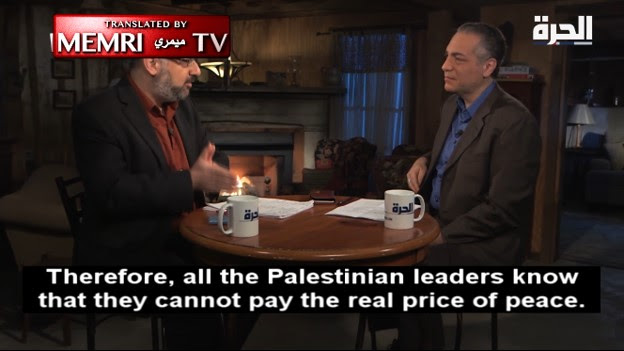
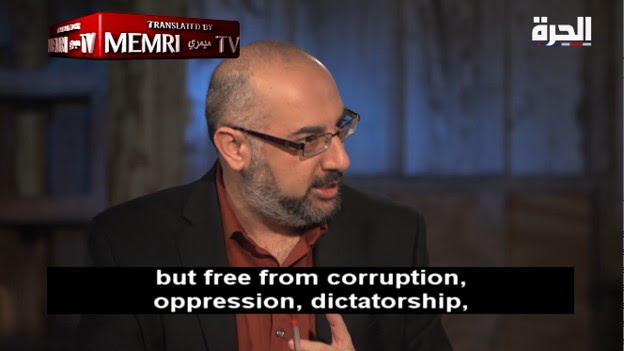
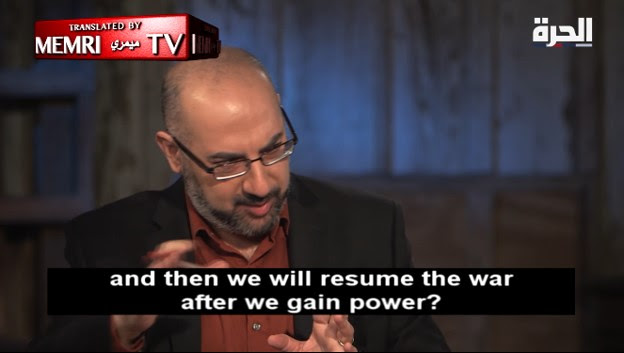
On their Al-Hurra (U.S.) TV show, Syrian-American human rights activist Ammar Abdulhamid and Egyptian-American researcher Samuel Tadros spoke about the Deal of the Century. Egyptian-American Samuel Tadros said that if people really want a "free Palestine" they should demand a Palestinian state that is free, not only from Israeli occupation, but free from the corruption, oppression, and dictatorship, which exist in Arab countries. Syrian-American human rights activist Ammar Abdulhamid said that it was the Arabs who started the Arab-Israeli conflict by rejecting the U.N. Partition Plan in 1947. Tadros asked whether the Arabs really want peace with Israel. He suggested that what the Arabs want is a truce and they will resume war with Israel after they regain power. He said that currently they are dealing with Israel because they are weak and have no choice. He continued to say that support for the Right of Return for Palestinian refugees means the rejection of the State of Israel and changing the country's demographics. Abdulhamid added that the Arabs are "mentally and culturally disposed" to refuse to accept the right of Israel to exist. Later on in the show, Tadros said that the "hands of the Palestinian leadership are tied." They know that any leader who comes up with a final peace accord with Israel will be assassinated, like Egyptian President Anwar Sadat. He said: "All the Palestinian leaders know that they cannot pay the real price of peace." The show aired on February 6, 2020. For more from Ammar Abdulhamid and Samuel Tadros, see also MEMRI TV clip No. 7438 and MEMRI Special Dispatch No. 8246.

Click here to view this clip on MEMRI TV 


Samuel Tadros: "What will we gain if we add to the 21 Arab states a 22nd state with the same corruption, oppression, and so on? If the people really demand a free Palestine, it means that it should be free not just from the Israeli occupation, but free from corruption, oppression, dictatorship, and all those [negative] things that exist in our countries."


m7818.JPG


m7818a.jpg


[...]


Ammar Abdulhamid: "It was the Arab countries that turned against the international legitimacy in 1948. The Arab-Israeli conflict was started by the Arab countries when they rejected the U.N. Partition Plan and declared war against Israel."


[...]


Samuel Tadros: "Do we really want peace with Israel? Do we want peace or do we want a hudna [truce] and then we will resume the war after we gain power? Is it just that we are weak and have no choice but to deal with them, or do we really accept the idea of permanent peace and a final resolution of our conflict with them? This is the basic question that we refuse to answer. If, for example, you refuse to recognize Israel as a Jewish state and want the [Palestinian] refugees to return to it, it means that you do not accept Israel and you want to change it demographically, through the return of the [Palestinian] refugees. This is a basic question that the Palestinian leadership must answer."


m7818b.JPG


m7818c.jpg


Ammar Abdulhamid: "I believe that we all know the answer, which is that until now, the existence of Israel and its right to exist is still not recognized [by the Arabs]. We are mentally and culturally disposed to this refusal."


[...]


Samuel Tadros: "The hands of the Palestinian leadership are tied. They know that any Palestinian leader who agrees to sign a final peace accord with Israel will be assassinated. They have Sadat as an example. 


m7818d.jpg


"On the one hand, we say that Sadat saw the future when he signed a peace accord and regained all the Egyptian lands. He also invited the Palestinians to join in. They had a chance to join the negotiations but they rejected it. On the other hand, look at how Sadat ended his life. With a bullet. Therefore, all the Palestinian leaders know that they cannot pay the real price of peace."


m7818e.jpg


Ammar Abdulhamid: "This is exactly the problem. We talk about martyrdom, and say that we are willing to be martyred in order to plant the Palestinian flag in Jerusalem, and so on. But ultimately, it appears that we are not willing to be martyred or to make the brave decision that requires concessions."


MEMRI

Source: https://www.memri.org/tv/arab-american-researchers-not-want-peace-israel-respite-fight-palestinian-leader-assasinated-sadat

Follow Middle East and Terrorism on Twitter


Philip Haney, a genuine Obama whistleblower, found dead at age 66 - Peter Barry Chowka


by Peter Barry Chowka

Friends doubt suicide verdict, pointing out he was a devout Christian and had “never been happier”


Philip Haney, an expert on Islamic extremism who was a founding member of the Department of Homeland Security in 2003 and who became a prominent critic of President Obama’s questionable management of the agency after he retired in 2015, died from a single gunshot wound on February 21. Haney’s body was found lying on the ground outside his car in the small California town of Plymouth, east of Sacramento.
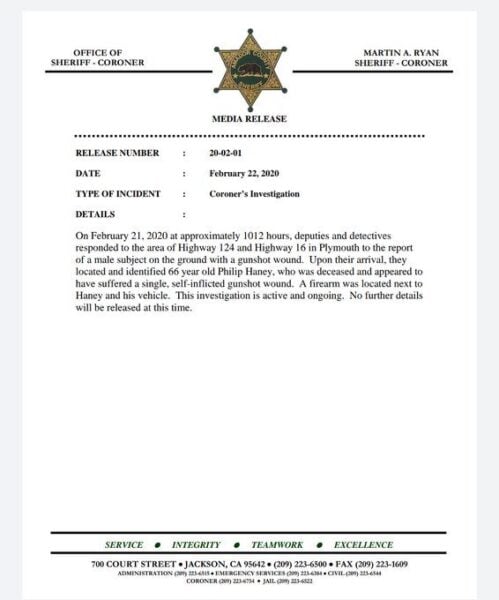
On Saturday afternoon, as the news of Haney’s death began to be reported, initially in social media and the new media and then more widely, the local Sheriff’s Office of Amador County issued a statement based on the local “Coroner’s Investigation:”
On February 21, 2020 at approximately 1012 hours, deputies and detectives responded to the area of Highway 124 and Highway 16 in Plymouth to the report of a male subject on the ground with a gunshot wound.
Upon their arrival, they located and identified 66-year-old Philip Haney, who was deceased and appeared to have suffered a single, self-inflicted gunshot wound.
A firearm was located next to Haney and his vehicle. This investigation is active and ongoing. No further details will be released at this time.
A number of people were skeptical of the conclusion that Haney took his own life. For example, investigative journalist and Fox News contributor Sara A. Carter tweeted at 11:09 AM ET on Saturday morning:
Somebody I deeply respected and considered a friend Phil Haney – a DHS whistleblower during the Obama Admin was apparently killed yesterday in Southern [sic] California. Pray for his family and pray they find the person who murdered him. Still trying to get confirmation on details
Carter’s tweet was quoted in a story at Fox News published around 7 PM ET Saturday.
In 2016, one year after he retired from government service, Haney published a book, See Something, Say Nothing: A Homeland Security Officer Exposes the Government's Submission to Jihad. The book was extremely critical of President Barack Obama and his administration. Haney appeared several times on Fox News, including on Hannity (June 14, 2016) and Fox & Friends.
An article at Law Enforcement Today on Saturday noted:
Haney, who is credited with helping capture more than 300 jihadists, is best known for blowing the whistle on the Obama administration for shutting down an investigation he was leading that could have potentially stopped, among others… the terrorist attack in San Bernardino.
That attack, occurring on December 2, 2015, left 14 people dead and 22 seriously injured from gunshot wounds at the Inland Regional Center in San Bernardino.
On June 28, 2016, Haney testified before the U.S. Senate Judiciary Committee. His opening statement, which is available online, was titled “Willful Blindness: Consequences of Agency Efforts To Deemphasize Radical Islam in Combating Terrorism.”
Philip Haney testifies before the Senate Judiciary Committee June 28, 2016
Screen shot from Fox News

Haney appeared frequently as a guest on new media platforms, including extensive interviews with John B. Wells on Caravan to Midnight (subscription required) and on The Hagmann Report (audio podcast of July 14, 2017 interview here). On January 4, 2018, Haney made his second appearance (video here) on The Hagmann Report, in the third hour long segment following my own in the program’s second hour. Although we were both guests on the program that evening, I did not have a chance to engage Haney as our segments were self-contained.
Friends of Haney discounted the initial report that Haney, a devout Christian, committed suicide. According to Law Enforcement Today:
Friends of Haney told us that they spoke with Haney earlier this week and he’d “never been happier.” They’ve suggested there’s absolutely no way he would have taken his own life… and reinforce that he’s had many enemies since he blew the whistle on the Obama administration. . .
In 2018, Haney told Intercessors for America prayer activists that he had been working on a “special assignment” in Minnesota to stop Rep. Keith Ellison from being elected Minnesota’s Attorney General. As we approach the 2020 elections, friends of Haney’s told us he was planning on doubling down on efforts to “protect America from progressive leftists socialists”.

Peter Barry Chowka is a veteran journalist who writes about politics, media, popular culture, and health care for American Thinker and other publications. Peter's website is http://peter.media. His new YouTube channel is here. Follow Peter on Twitter at @pchowka.

Source: https://www.americanthinker.com/blog/2020/02/philip_haney_a_genuine_obama_whistleblower_found_dead_at_age_66.html

Follow Middle East and Terrorism on Twitter


The massive, but reversible, defeats of Iran and Turkey - Caroline Glick


by Caroline Glick

If the strategic processes now taking place with regard to Israel's two most formidable adversaries aren’t given time to mature, they can and likely will be undone.


With our attention focused on other things—Israel’s elections, the legal fraternity’s aggressive lawfare against Israeli Prime Minister Benjamin Netanyahu, U.S. President Donald Trump’s peace plan, to name just a few—profound strategic shifts have upended the strategic balance in the Middle East. 

Israel’s two most formidable adversaries—Iran and Turkey—both came up short in their quests for regional domination, and Israel is reaping the rewards of their losses. 

Two weeks ago, Netanyahu held a previously unannounced meeting in Uganda with Sudanese President Abdel Fattah Abdelrahman Burhan. Instant commentaries presented the meeting as a salutary side product of the Trump plan, but the truth is much more significant. The sight of the two leaders sitting next to one another, smiling, made heads explode from Tehran to Ramallah. The Netanyahu-Burhan meeting was no mere byproduct of a peace plan. It was a long-planned and hoped-for result of a set of policies that, aided by good fortune, dealt a cataclysmic blow to Iran and its terrorist proxies in Gaza, Lebanon, Iraq, Syria and Yemen. 

Until last April, Sudan was ruled for 30 years by Omar al-Bashir. Bashir, an Islamist, was a major sponsor of global terrorism. From 1991-1995, Al-Qaeda was headquartered in Khartoum.

Al-Bashir was also a close ally of Iran. He permitted the Iranian regime to use Sudanese ports to move weapons to Hamas and the Palestinian Authority, to Hezbollah in Lebanon and to the Assad regime in Syria. Al-Bashir also allowed the Iranians to use Sudanese territory to surround Saudi Arabia, to transfer weapons to the Houthis in Yemen and to threaten the Saudi port in Jeddah, outside of Mecca, and to threaten Saudi oil platforms at Yanbu. 

In December 2018, disgusted by rampant corruption and human rights abuses, the Sudanese people rose up against their leaders. For five months, massive anti-government protests were held throughout the country. Responding to public pressure, last April the Sudanese military overthrew al-Bashir.

The units that overthrew al-Bashir were supported by the Gulf states, Egypt, the United States and, according to some reports, Israel. The new regime, which is pledged to transition to some form of democracy within two years, is supported by these governments.

Al-Bashir, for his part, was supported by Iran, Qatar and Turkey. His removal was a huge blow to all three. For the Iranian regime, his removal from power by forces allied with Iran’s bitter enemies was arguably a greater loss than the death of of terror master Qassem Soleimani and his lieutenants last month in a U.S. drone strike in Baghdad. The loss of Sudan calls into question Iran’s ability to maintain its regional campaigns.

Consider its positions in two of its satrapies—Iraq and Lebanon.

Among the people killed along with Soleimani was Abu Mahdi al-Muhandis, the commander of Iran’s Shi’ite militias in Iraq. This week, The Guardian reported that in the wake of their deaths, Iraqi Prime Minister Adel Abdul Mahdi sent his top adviser to Beirut to meet with Hezbollah chief Hassan Nasrallah. Mahdi is an Iranian proxy. His representative beseeched Nasrallah to take command of the Shi’ite militias in Iraq that Soleimani and Muhandis had directed. Nasrallah acceded to the request, but apparently fearing that he would end like Soleimani if he began flying around to rally the troops, said that he would run the militias by remote control from Beirut.

Nasrallah’s decision to take control over Iran’s proxy forces in Iraq endangers Lebanon. The more the evidence piles up that Lebanon is a Hezbollah-controlled Iranian colony, the more likely it becomes that the United States will end all its military and civilian assistance to Lebanon.

After a long delay, last month U.S. Secretary of State Mike Pompeo approved the transfer of military and civilian aid to Lebanon. That approval is already being questioned and conditioned in the Senate. Without U.S. assistance, the Lebanese economy will crumble.

Like Sudan before it, for the past four months, Lebanon has experienced mass anti-regime protests throughout the country. Long-serving Prime Minister Saad Hariri resigned last October in a bid to quell the protests, but his resignation had little effect. The protests have continued since. They didn’t diminish with the appointment of Hariri’s replacement Hassan Diab, who was hand-picked by Hezbollah.

In the last week, Iran’s Foreign Minister Mohammad Javad Zarif and its speaker of the parliament Ali Larijani both visited Beirut and promised financial assistance. But Iran is in no position to keep such promises. U.S. economic sanctions have dried up Iran’s coffers. The deeper Hezbollah is pulled into Iran’s wars in Syria and Iraq, the worse off Lebanon will be. And the worse the situation becomes in Lebanon, the less likely it becomes that Hezbollah will risk starting a war with Israel.
‘ErdoÄŸan is boxed in and has no good options’
This then brings us to Iran’s frenemy, Turkey.

In a paper published last week by the Moshe Dayan Center for Middle East and Africa Studies, Turkey scholar Dr. Soner Cagaptay described how, over the past decade, Turkish President Recep Tayyip ErdoÄŸan has made and lost a series of strategic gambles that have diminished Turkey as a regional player.

ErdoÄŸan views himself as a neo-Ottoman ruler and the head of the Muslim Brotherhood. As such, at the outset of the war in Syria, ErdoÄŸan bet on the Sunnis. With halting, lackadaisical U.S. support, he formed the Free Syria Army. The FSA was presented as a coherent fighting force with the will and capacity to defeat Assad and his Iranian patrons, but it was nothing of the sort. The FSA, dominated by the Muslim Brotherhood, was a hodgepodge of fighters with no coherent ideology or operational plan. Over time, it was eclipsed by Islamic fanatics who used the FSA organizational framework to form what became the Islamic State (ISIS).

Since ErdoÄŸan supports Islamists, he placed no limits on the entry of foreign fighters to Turkey en route to Syria. From 2013 to 2015, the Turkish side of the Turkish-Syrian border became the logistical base and economic hub of ISIS in Syria.

International revulsion at the barbarism of ISIS compelled the Obama administration to send forces to Syria to fight it. The United States forged an alliance with the Kurdish YPG militia to advance this aim. The YPG is a spinoff of the Turkish Kurdish PKK, which the Turks consider an existential threat. The U.S. partnership with the YPG, forged as a consequence of Turkey’s indirect sponsorship and facilitation of ISIS, significantly strained U.S.-Turkish relations.

To fight the U.S.-allied Kurds, ErdoÄŸan betrayed Washington and tried to make a deal with Russia and Iran at the Kurds’ expense.

Angered by Turkey’s embrace of Russia and by regime-incited anti-Americanism that fomented the arrest and judicial persecution of American pastor Andrew Brunson, last year President Trump imposed economic sanctions on Turkey that nearly destroyed the economy.

Today, ErdoÄŸan is in a new mess of his own design. In the battle for Idlib, Turkish forces are pitted against their erstwhile Russian, Iranian and Syrian partners. The Americans have publicly sided with the Turks, but to receive more than rhetorical support from Washington, ErdoÄŸan will be forced to undermine his own tenuous ties with Russian President Vladimir Putin still further.

Which brings us to the self-inflicted mess ErdoÄŸan has created for himself in the Eastern Mediterranean.

ErdoÄŸan’s Muslim Brotherhood sympathies made him the greatest supporter of Mohamed Morsi’s Muslim Brotherhood regime in Egypt in 2012. When the Egyptian military deposed the Morsi government in 2013, Turkish-Egyptian relations became openly hostile.

In part to undermine Turkish power, Egyptian President Abdel Fattah el-Sisi has forged close ties with other Mediterranean Basin countries—and Turkish foes—Greece, Cyprus and Israel. Supported by the Trump administration, the burgeoning alliance between these four states has led to joint military exercises between Egypt, Cyprus and Greece on the one hand and Israel, Greece and Cyprus on the other. It also is the context in which Egypt signed a deal to import Israeli natural gas. The Israeli-Cypriot-Greek gas pipeline to Europe will bypass Turkey.

To extricate Turkey from the regional isolation he induced, last December ErdoÄŸan signed a maritime cooperation agreement with the Tripoli-based Libyan government. The Tripoli-based government is at war with the Tabruk-based Libyan government supported by Egypt, the UAE and Russia. Today, Tabruk-based forces are advancing in their offensive against Tripoli.

To save his allies in Tripoli, ErdoÄŸan will need Putin’s help. And if he receives it, it will further weaken his ties with America.

In other words, ErdoÄŸan is boxed in and has no good options.

Then there is the Turkish economy. As a Chatham House report on the Turkish economy published early this week showed, Turkey’s government stimulus-induced inflation and cheap credit are positioning the Turkish lira for another collapse. The political implications of another economic meltdown, just two years after the last one, are self-evident.

Israel and the Sunni Arab states, as well as the United States, are enjoying the benefits of the Iranian and Turkish defeats. This owes in great part to the strategic priorities their leaders have adopted. Netanyahu, Trump, el-Sisi and the other allied leader have placed a premium on defeating and weakening their enemies. New leaders, with different strategic priorities, are liable to squander these gains and even reverse them.

During the Munich Security Conference last weekend, Sen. Chris Murphy, (D-Conn.) met secretly with Iranian Foreign Minister Zarif. Former U.S. Secretary of State John Kerry and other Democratic senators reportedly also participated in the meeting. After the U.S. media reported that the secret conclave had taken place, Murphy acknowledged his participation. He argued that the Trump administration’s maximum pressure strategy is a complete failure—even as Iran’s regional position is collapsing in broad daylight.

Last year, the Democratic National Committee passed a resolution committing the next Democratic administration to restore the Obama administration’s nuclear deal with Iran. All of the Democratic presidential candidates have expressed varying degrees of commitment to the pledge.

Since leaving office, Kerry has remained in contact with Zarif and has reportedly advised him about how to ride out the economic sanctions imposed by the Trump administration in order to survive into the next Democratic administration.

As for Israel, earlier this week, Blue and White Party leaders Benny Gantz and Yair Lapid harshly criticized Netanyahu for maintaining close ties with Trump. Both men pledged to cultivate Israel’s relations with the Democrats.

Gantz’s top adviser, Yoram Turbovich, was Ehud Olmert’s chief of staff during his tenure as prime minister. Last week Olmert traveled to America as the guest of J Street, which in turn enjoys close relations with radical, anti-Israel Democrats. Gantz’s campaign strategist Joel Benenson served in the same role for Barack Obama in 2008 and 2012 and for Hillary Clinton in 2016.

If the next Israeli government prioritizes good relations with pro-Iranian Democrats over defeating Israel’s enemies, it will necessarily undermine the strategic windfall we are now experiencing. Nothing happens by accident. If the strategic processes now taking place don’t have the time to mature, they can and likely will be reversed.

This article first appeared in Israel Hayom.


Caroline Glickk is an award-winning columnist and author of “The Israeli Solution: A One-State Plan for Peace in the Middle East.”

Source: https://www.jns.org/opinion/the-massive-but-reversible-defeats-of-iran-and-turkey/

Follow Middle East and Terrorism on Twitter


Palestinians Condemn US for Offering to Help - Khaled Abu Toameh


by Khaled Abu Toameh

It is as if someone applies for a loan from a bank but demands that the bank accept his or her demands, and not the other way around. Usually, those who offer the money have the right to set the conditions.

  • Palestinians, in short, are saying that they refuse to accept funding by any party that does not accept their conditions and demands.
  • It is as if someone applies for a loan from a bank but demands that the bank accept his or her demands, and not the other way around. Usually, those who offer the money have the right to set the conditions.
  • For the Palestinians, it seems, the opposite is true. They seem to believe that they are the ones entitled to set conditions to those who are offering to improve their living needs and help them march towards prosperity and a better future for their children.
  • Palestinian leaders know that their society is floundering in every possible way. Yet, rather than welcoming the proposed US programs, they are condemning the Americans and inciting their people against the US administration for even making such a generous offer. This is precisely the disastrous dynamic that decades ago landed the Palestinian people in their quagmire, and it is precisely the same dynamic that keeps them trapped in that morass.

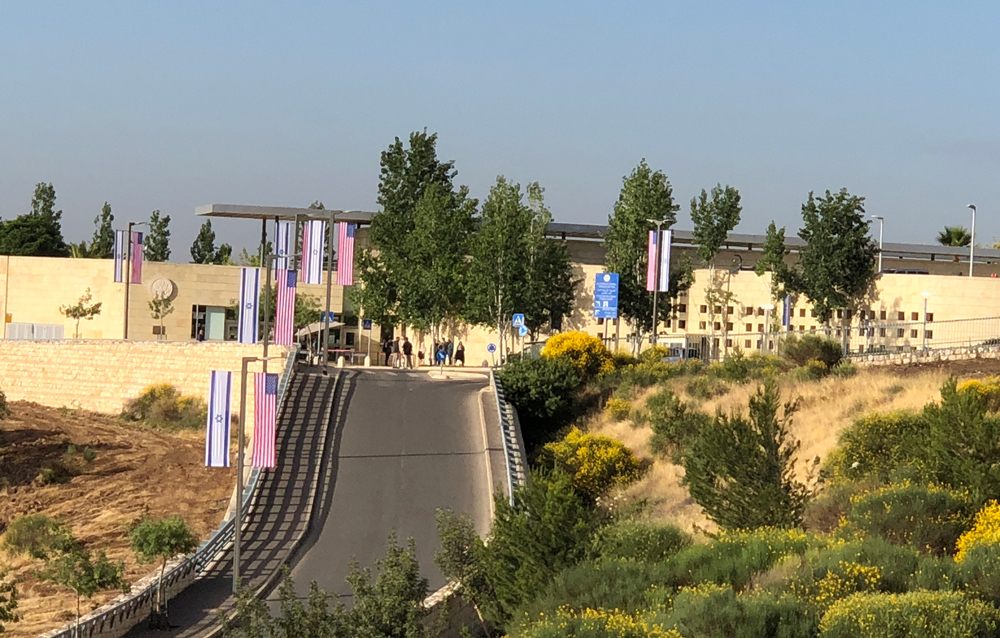
The US Embassy in Israel (pictured) has a Palestinian Affairs Unit that regularly offers Palestinians grants and funding opportunities that include, for students, US higher education and scholarships. But in response to the US offer of grants and funding opportunities, some Palestinian officials have warned their people not to deal with the US Embassy. (Image source: US Embassy in Israel/Wikimedia Commons)

Palestinian leaders have gone to great lengths to explain their opposition to US President Donald Trump's recently unveiled plan, "Peace to Prosperity," for Middle East peace.

While these leaders are entitled to oppose Trump's vision for peace, it is not clear why they are also rejecting US financial aid to Palestinians. By rejecting it, Palestinian leaders are denying their people the right to a better life and a strong economy.

The US Embassy in Israel has a Palestinian Affairs Unit that regularly offers Palestinians grants and funding opportunities that include, for students, US higher education and scholarships.

Recently, the Unit announced an open competition for grants to Palestinian individuals and not-for-profit organizations to implement activities that advance the organization's or individual's goals -- particularly if those goals include a comprehensive, lasting, negotiated peace between Israelis and Palestinians, a prosperous, stable, and transparent Palestinian society, economy and system of governance.

The program's main objectives are to provide students with the skills and experiences that will make them more competitive for higher education and work opportunities; build a culture of mentorship that cultivates leaders in Palestinian society, education and business; encourage citizens' engagement in participatory governance; foster entrepreneurship, critical thinking and problem-solving skills among the youth and between diverse communities, and to promote understanding, tolerance, pluralism and shared values.

The US Embassy's Palestinian Affairs Unit also announced a new funding opportunity to establish English-language summer camps for young Palestinians, and an open competition for Palestinian organizations to hold a conference on social media marketing for e-commerce.

These programs seem intended for the benefit of Palestinian youths. You would think that, notwithstanding political differences or controversy surrounding a peace plan, any leader who actually cared about the well-being of his or her people would welcome such an offer. You would be wrong.

Decisions, it seems, do not work that way when it comes to Palestinian political activists and leaders, who have been boycotting the US administration since December 2017, when President Trump announced that Washington recognized Jerusalem as Israel's capital.

In response to the US offer of grants and funding opportunities, some Palestinian officials have warned their people not to deal with the US Embassy.

One official, Ra'fat Elayan, a senior representative of the Palestinian Authority's Fatah faction, headed by President Mahmoud Abbas, issued a warning to Palestinians not to accept any funding from the US. "The Palestinians," Elayan said, noting that Palestinians opposed moving the US Embassy from Tel Aviv to Jerusalem, "consider the US Embassy as a new settlement in the heart of Jerusalem."

The programs announced by the US Embassy in Jerusalem, he added, "are aimed at passing the Deal of the Century, [the Trump peace plan] that depicts the [Israeli-Palestinian] conflict as a humanitarian issue, and not a political one."

In 2018, the Palestinians had similarly condemned the Trump administration for its decision to halt funding for Arab hospitals in Jerusalem.

At the time, President Trump, as part of a review of foreign aid, had ordered $25 million, earmarked for the care of Palestinians in east Jerusalem hospitals, to be reallocated. "As a result of that review, at the direction of the President, we will be redirecting approximately $25 million originally planned for the East Jerusalem Hospital Network," a State Department official had said. "Those funds will go to high-priority projects elsewhere."

The Palestinian Foreign Ministry had immediately denounced the decision and said it was part of a US attempt to "liquidate the Palestinian cause."

The Palestinians were also angry the same year when the Trump administration announced that it would redirect $200 million in Palestinian economic support funds for programs in the West Bank and Gaza Strip, and cut all funding to the United Nations Relief and Works Agency for Palestine Refugees (UNRWA).

Strangely, then, the Palestinians condemned the US administration for halting funds to hospitals and UNRWA, but now the leaders are condemning the US Embassy for offering grants and funding to Palestinian individuals and organizations.

According to the same Fatah official, Elayan, the US Embassy's latest offer to fund non-governmental organizations "comes at the expense of Palestinians' political rights." He added, "There is a clear decision by the Palestinian leadership to sever relations with the US administration. Palestinians must not deal with the announcements made by the US Embassy."

Even more strange is the response of the Palestinian NGO Network (PNGO) to the US Embassy's projects supporting the Palestinian community, institutions and individuals. PNGO said in a statement:
"The [US Embassy] announcement involves an awful lot of insolence and surprise, especially in light of what was announced by US President Donald trump on January 28 in the White House under the title of the political aspect of the Deal of the Century, which aims to liquidate the Palestinian issue, legitimate rights guaranteed under international laws, self-determination, and national independence...
"PNGO views this stark announcement as a continuation of the frank conformity in the positions of the American administration and the Israeli occupation government towards the Palestinian people, which reflects the true intentions of the American administration to replace the legitimate rights of Palestinians with alleged economic peace. With these moves, the American administration ignores the efforts of the institutions of the Palestinian society which were blackmailed through USAID projects and its known conditions."
The strange part is that Palestinian NGOs are usually the main beneficiaries of the US financial aid.

This time, however, PNGO called on Palestinians to boycott the US projects and said it would continue to work with other Palestinian institutions to thwart the projects proposed by the US.

Palestinians, in short, are saying that they refuse to accept funding by any party that does not accept their conditions and demands.

It is as if someone applies for a loan from a bank but demands that the bank accept his or her demands, and not the other way around. Usually, those who offer the money have the right to set the conditions.

For the Palestinians, it seems, the opposite is true. They seem to believe that they are the ones entitled to set conditions to those who are offering to improve their living needs and help them march towards prosperity and a better future for their children.

By rejecting the Trump plan even before it was published, Palestinian leaders may have missed not only a chance to end the conflict with Israel, but also to bring better times for their people.

That is what happens when leaders put themselves leagues ahead of the well-being of their citizens. Palestinian leaders know that their society is floundering in every possible way. Yet, rather than welcoming the proposed US programs, they are condemning the Americans and inciting their people against the US administration, for even making such a generous offer. This is precisely the disastrous dynamic that decades ago landed the Palestinian people in their quagmire, and it is precisely the same dynamic that keeps them trapped in that morass.

  • Follow Khaled Abu Toameh on Twitter

Khaled Abu Toameh, an award-winning journalist based in Jerusalem, is a Shillman Journalism Fellow at Gatestone Institute.

Source: https://www.gatestoneinstitute.org/15628/palestinians-condemn-american-help

Follow Middle East and Terrorism on Twitter


Georgetown’s Hamas-linked Bridge Initiative hosts prof who says US war on terror is a manifestation of Islamophobia - Robert Spencer


by Robert Spencer

[N]o resistance to the global jihad whatsoever is allowed, no matter how tepid, half-hearted, or fantasy-based. It’s all “Islamophobia.”-

See? It’s as I’ve been pointing out for years: for the Hamas-linked Bridge Initiative, a program of the bought-and-paid-for Georgetown University, and for establishment academics such as Nazia Kazi, no resistance to the global jihad whatsoever is allowed, no matter how tepid, half-hearted, or fantasy-based. It’s all “Islamophobia.”


“Islamophobia Permeates Foreign Policy, Speaker Says,” by Jaime Moore-Carrillo, The Hoya, February 21, 2020 Leave a Comment

Young U.S. citizens risk forgetting how post-9/11 U.S. policies have harmed Muslim communities at home and abroad, author and researcher Nazia Kazi said at a Wednesday event.

After terrorist organization Al Qaeda attacked U.S. military and economic targets Sept. 11, 2001, the U.S. launched a decadeslong effort to neutralize terror threats across the globe. U.S. counterterrorism efforts, which remain a centerpiece of U.S. foreign policy, focus on Islamic fundamentalist organizations in the Middle East. Experts, pundits and policymakers have criticized the undertaking — dubbed the war on terror — for its allegedly unclear goals and problematic methods.

The U.S. government’s war on terror is a manifestation of Islamophobia, according to Kazi. U.S. citizens must recognize state actions can qualify as Islamaphobic to begin to counter bigotry more broadly.

“If we are to understand Islamophobia at all, we must push ourselves to think beyond the actions of bigoted individuals, and we must push ourselves to understand the roots of their hate,” Kazi said. “We must push ourselves to see the Islamophobia that is perpetrated by the state and all too often paid for by our tax dollars. And most importantly, we must push ourselves to see our own tragic and often invisible complicity.”

The post-9/11 expression “never forget” has been used to justify and mask U.S. foreign policy blunders, according to Kazi.

“‘Never forget’ is the brand name of 9/11, and as a slogan ‘never forget’ is on par with ‘Just Do It,’ and we have to ask: If ‘Just Do It’ makes us go out and buy Nikes, then when it comes to ‘never forget,’ what exactly are we being sold?” Kazi said. “‘Never forget’ functions ideologically, making sure we do forget — that we forget the uneasy global histories that have better memory, a more nuanced, contextual memory would force us to remember.”

Kazi serves as an assistant professor of anthropology at Stockton University, a public university in New Jersey, where she studies Islamophobia and U.S. foreign policy. Her 2018 book “Islamophobia, Race, and Global Politics” discusses the intersection of Islamophobia and U.S. foreign policy, according to the publisher’s website….

The event, titled “Islamophobic Nationalism and Forgetfulness in the Terror Decades,” was hosted by the Bridge Initiative, a university research group that investigates Islamophobia, in the Intercultural Center. During the event, Kazi discussed the diverse manifestations of Islamophobia in the United States, especially in the foreign policy arena.

U.S. society has glossed over unflattering aspects of U.S. foreign policy after 9/11 through slanted ceremonies and educational programs, according to Kazi. She referenced the United States’ often overlooked support for Saudi Arabia and CIA sponsorship of mujahideen fighters in Afghanistan from 1979 to 1989, instances she said reflected United States’ willingness to compromise purported U.S. human rights values for political ends.

“These are not the histories that make it into our social studies books. They might not even be the histories you expected to hear at a university lecture on Islamophobia. But there are ideological underpinnings at the heart of U.S. empire building,” Kazi said. “It might begin to help us understand how it is that generations of Americans have come to see their country as a global force for good or a hapless victim of evil, but never, to quote Martin Luther King Jr., as ‘the greatest purveyor of violence’ on Earth.”


Robert Spencer

Source: https://www.jihadwatch.org/2020/02/georgetowns-hamas-linked-bridge-initiative-hosts-prof-who-says-us-war-on-terror-is-a-manifestation-of-islamophobia

Follow Middle East and Terrorism on Twitter


Iran elections: Hardliners heading toward landslide victory - News Agencies , Israel Hayom Staff


by News Agencies , Israel Hayom Staff

First partial results from the country's parliamentary elections indicate a strong showing by hardliners, after more than 7,000 potential candidates had been disqualified, most of them reformists and moderates.


Iran elections: Hardliners heading toward landslide victory
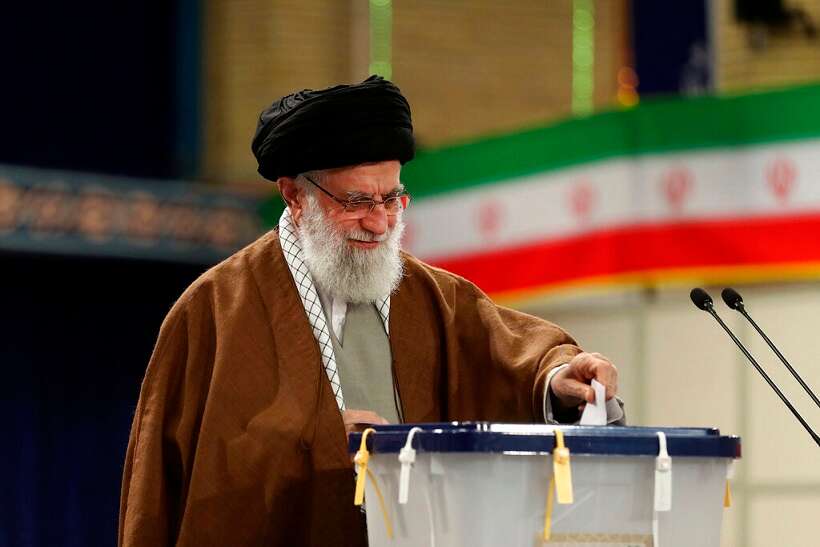
Iranian leader Ayatollah Ali Khamenei casts his ballot in the parliamentary elections, in Tehran, Friday | Photo: (Office of the Iranian Supreme Leader via AP)
Iranian state TV on Saturday announced the first partial results from the country's parliamentary elections, indicating a strong showing by hardliners in the capital Tehran, although authorities have not released full results or the all-important turnout figure.

Voters had limited options on Friday's ballot, as more than 7,000 potential candidates had been disqualified, most of them reformists and moderates. Among those disqualified were 90 sitting members of Iran's 290-seat parliament who had wanted to run for re-election.

Although the final tally was still not released, a lower-than-usual turnout would signal widespread dissatisfaction with the state of the economy and the ways in which the government has handled a range of crises.

State TV, without providing the number of votes, announced the names of the leading candidates in Tehran's 30 parliamentary seats. All were hardliners led by Mohammad Bagher Qalibaf, who is expected to be the next parliament speaker.

Some early results announced by the Interior Ministry indicated that the hard-line loyalists to supreme leader Ayatollah Ali Khamenei were gaining a majority in the 290-seat parliament.

"So far, 42 seats of the parliament had been won outright by candidates," state TV said. According to a Reuters tally of those results, over 80% of them are loyalists to Khamenei.

Looming over the election was the threat of the new coronavirus. Many voters headed to the polls with face masks on, and some pharmacies ran out of masks and hand sanitizer amid the election-day rush.

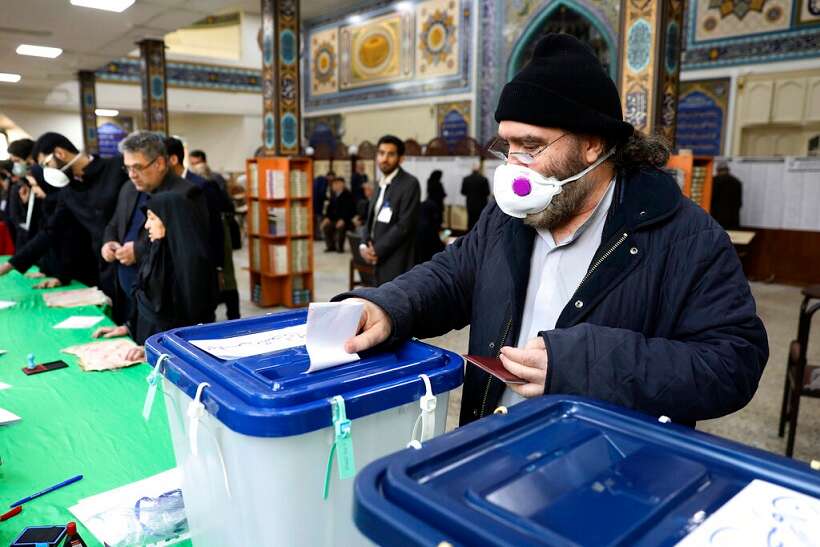
Amid the global coronavirus scare, a voter wearing a medical mask casts his ballot in the parliamentary elections in a polling station in Tehran, Friday ((AP/Vahid Salemi)

So far, there have been six virus deaths, at least five from among the 28 confirmed cases in Iran, including two deaths on election day. Two fatalities were reported on Saturday.

By comparison, the 2016 parliamentary election saw 62% turnout. On Friday, election officials kept the polls open an extra five hours in an effort to boost turnout. Iran's leadership and state media had urged people to show up and vote, with some framing it as a religious duty.

A parliament stacked with hard-liners could tilt public policy debates away from engagement with the United States. Tensions between Washington and Tehran have been high since 2018, when President Donald Trump withdrew the US from Iran's nuclear agreement with world powers, and imposed sanctions that have forced Iran's economy into recession. Iranians have seen the price of basic goods skyrocket, inflation and unemployment rise and the local currency plummet.

The economic woes faced by ordinary Iranians fueled anti-government protests in November. International human rights groups say at least 300 people were killed in those protests.

A more hard-line parliament could also favor expanding the budget of the Islamic Revolutionary Guard Corps. The Guard's Quds Force, responsible for the Islamic republic's foreign operations, was formerly led by Iran's top general, Qassem Soleimani. He was killed by the US in an airstrike in January.

That strike led to a tense confrontation in which Iranian forces accidentally shot down a Ukrainian passenger plane after it took off from Tehran, killing all 176 people on board. Most of those killed were Iranian.

The shoot-down, and attempts by officials to initially conceal the cause of the crash, sparked public anger and protests in Iran.

A more hard-line parliament could lead to increased social and cultural restrictions as well. Pressure from conservatives in recent years has led authorities to ban concerts and block Facebook, Twitter and YouTube.


News Agencies , Israel Hayom Staff

Source: https://www.israelhayom.com/2020/02/23/iran-counts-votes-in-election-stacked-in-favor-of-hard-liners/

Follow Middle East and Terrorism on Twitter