by Yoel Guzansky
Opinion: As powerful moral voices speak out in Israel and some view the protests as a historic moment, Gulf states remain largely silent, not out of support for the regime, but out of fear
On its face, the Arab Gulf states should be the first to welcome any American move that erodes the Iranian regime. This is a regime that has turned interference in its neighbors’ affairs into a method of governance; that has financed, armed and directed militias in Lebanon, Iraq, Yemen and Syria; that openly threatens the regional order; and that steadily develops nuclear and missile capabilities, while Gulf capitals are closer to Tehran than to Tel Aviv, their infrastructure is concentrated and exposed, and their air defense umbrella is nowhere near Israel’s.
And yet, precisely now, as Washington weighs the option of a U.S. strike on Iran, unusual warnings are being heard from Riyadh, Doha and Muscat. The same states that for years identified Iran as the central strategic threat to their security are now working to block military action against it. This is the heart of the Gulf paradox.
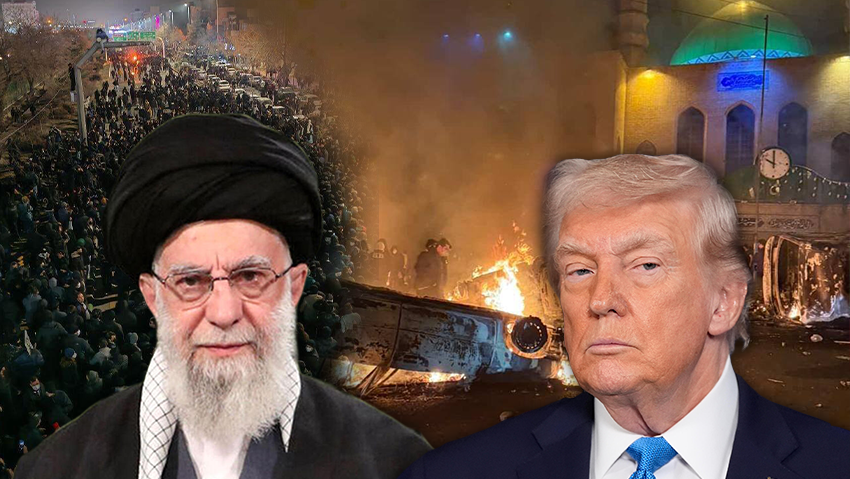
(Photo: AP Photo/Alex Brandon, AFP/HO/KHAMENEI.IR)
On one hand, the desire is clear: a different Iranian regime. Less ideological, less revolutionary, one that does not see the Gulf states as legitimate targets for pressure, extortion or punishment, and that does not build its regional power through armed proxies or subversion against Gulf governments. The Gulf states also understand well that Iran’s continued progress in nuclear and missile capabilities shifts the balance of power against them, not as an abstract strategic concept, but as a concrete threat to oil fields, ports, desalination facilities and coastal cities.
On the other hand, that same threat is also the main reason for caution. Unlike Israel, the Gulf states are neighboring Iran. Most of their population, economy and infrastructure are concentrated in narrow coastal strips exposed along the Gulf. They experienced firsthand Iran’s missile and drone attack on Saudi Aramco facilities in 2019 and drew a simple lesson: even a “limited” Iranian response could be devastating.
Added to this is a no less profound concern: the collapse of the Iranian regime. Contrary to common belief in the West, Gulf states do not see a rapid collapse of the Islamic Republic as a desirable scenario. For them, an uncontrolled fall of the regime could ignite broad instability: internal succession struggles, the disintegration of governing institutions, the rise of even more extreme actors, potential refugee flows and, above all, the loss of a clear address for managing crises.
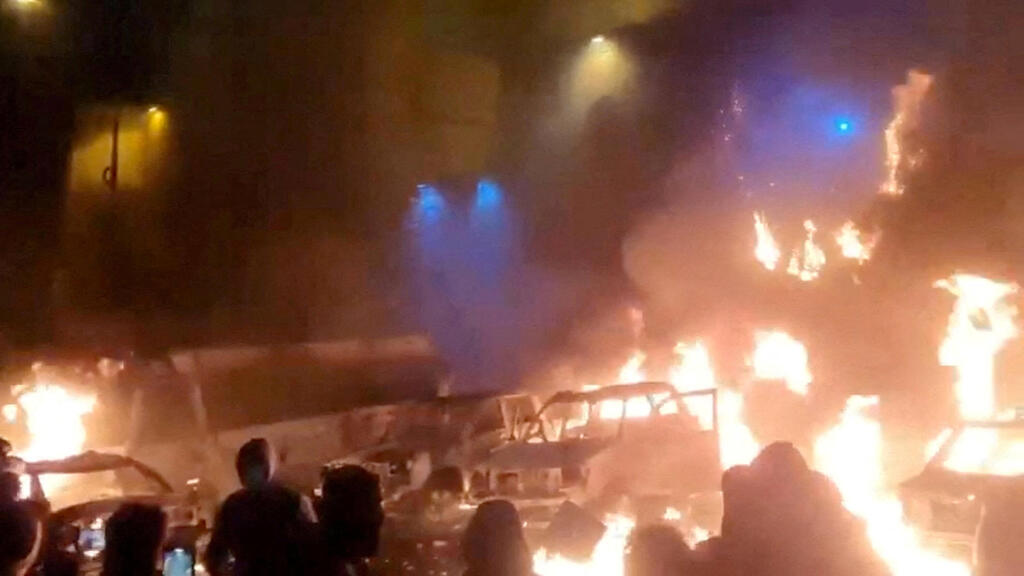
(Photo: Social Media/via Reuters)

(Photo: Anonymous/Getty Images)
From this has emerged in recent years a policy that can be described as detente. The renewal of relations between Saudi Arabia and Iran under Chinese mediation, the UAE’s quiet dialogues with Tehran and the caution of Qatar and Oman do not stem from illusions about the nature of the Iranian regime, but from a cold recognition of Iran’s clear superiority over them. This caution also explains the Gulf silence in the face of waves of protests in Iran. While powerful moral voices are heard in Israel and some see the protests as a historic opportunity, the Gulf states almost entirely refrain from public criticism, not out of support for the regime, but out of fear.
From their perspective, open encouragement of regime change could be perceived in Tehran as hostile interference, at a time when it is far from clear that the protest movement will succeed. By the same logic, they now oppose a U.S. strike. Not because they believe such a move is unjustified in principle, but because they are convinced the immediate price would be paid first and foremost by them. Iran may struggle to strike the United States directly, but striking the Gulf — via missiles, drones, maritime sabotage or regional proxies — is an available, familiar and inexpensive option.
The Gulf paradox, then, is not a contradiction but a strategy. The Gulf states yearn for a change in Iranian behavior. They fear a strong, revolutionary Iran, but also a disintegrating one. In the final analysis, they prefer a weakened, restrained but functioning Iran to an injured, enraged and unpredictable Iran.
For Washington and for Jerusalem, this is an important lesson. The Middle East of 2026 is no longer divided into clear camps of “for” and “against” Iran. The Gulf states operate first and foremost according to a logic of stability, survival and economics. Those who ignore this paradox risk not only misreading their positions but also underestimating the regional cost of any hasty military move.
Dr. Yoel Guzansky is head of the Gulf Program at the Institute for National
Security Studies at Tel Aviv University and a senior fellow at the
Middle East Institute in Washington, D.C.
Source: https://www.ynetnews.com/opinions-analysis/article/hkkcembrbe

No comments:
Post a Comment