by Lawrence A. Franklin
The main reason for the charge of Maduro's illegitimacy stems from the view that Venezuela's presidential elections have been fraudulent. Opposition protests have failed to dislodge the socialist regime, which has so far been sustained by Chinese loans, Russian weapons and Cuban troops.
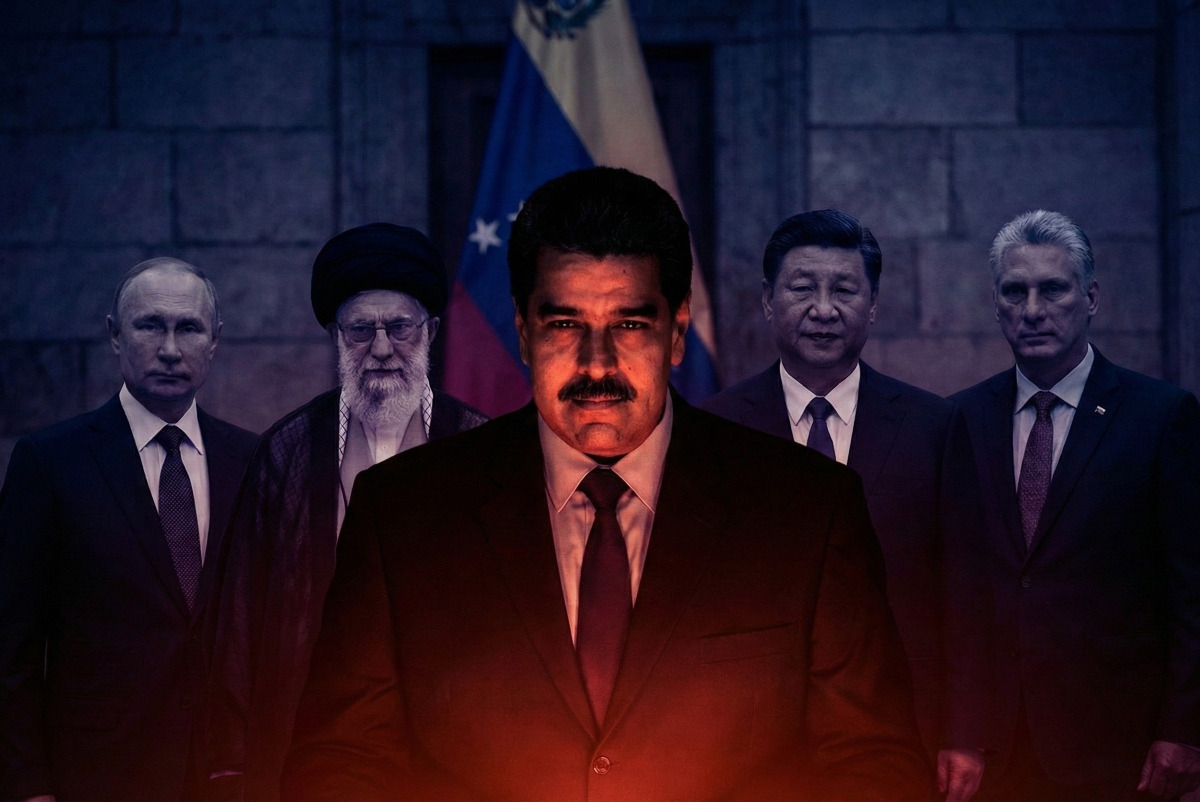
Perhaps more significant to US strategic interests [than Venezuela's trafficking illegal drugs] is Maduro's cooperation with an anti-American alliance of autocracies, including Russia, Cuba, China and Iran.
Iran's regime, both before and after a number of visits to Venezuela, delivered military drones to Venezuela and has been strengthening Venezuela's military, thereby enabling Venezuela to threaten its neighbors, including Guyana, Trinidad and Colombia, as well as the US.
Cuba's role in Venezuela is even more invasive than that of Iran.
Russia's role in helping to buttress Maduro's regime includes arms sales, joint army and air force exercises, Russian naval warship visits, and the stationing of Russian defense advisors in Venezuela. In turn, Russia receives Venezuelan oil at below-market prices.
China has extended an estimated $60 billion in loans to Venezuela.
The main reason for the charge of Maduro's illegitimacy stems from the view that Venezuela's presidential elections have been fraudulent. Opposition protests have failed to dislodge the socialist regime, which has so far been sustained by Chinese loans, Russian weapons and Cuban troops. The Venezuelan people, disenfranchised and disarmed, have, in addition, been bullied into submission by regime-sponsored neighborhood revolutionary leftist gangs called "colectivos."
The Trump administration appears to be hoping that its current sanctions on Venezuela will be harsh enough for Maduro's supporters to oust him without the US having to become militarily involved. Trump recently suggested the possibility of a land invasion, about which he did not sound overly enthusiastic. If nothing is done, however, Maduro will simply continue to wreck the formerly wealthy country while its people carry on in squalor.
US President Donald J. Trump's condemnation of Venezuela's illegal leader Nicolás Maduro includes his regime's facilitation of trafficking illegal drugs into the United States. The leader of Venezuela's democratic opposition, Nobel Peace Prize laureate Maria Corrina Machado, has accused Maduro of being chief of a criminal narcotics organization, Cartel de los Soles ("Cartel of the Suns"). US military forces have destroyed several speedboats laden with cocaine and other illegal drugs leaving Venezuelan ports.
Perhaps more significant to US strategic interests is Maduro's cooperation with an anti-American alliance of autocracies, including Russia, Cuba, China and Iran. The US has deployed military aircraft and a fleet of 22 warships to the area, to which Russian President Vladimir Putin has responded by "signal[ing] its willingness to supply Venezuela with advanced hypersonic missiles, including the nuclear-capable Oreshnik."
Maduro's regime is also alleged to have helped arm a terrorist faction of the Colombia-based Marxist terrorist group, the Revolutionary Armed Forces of Colombia (FARC), in its decades-long campaign to overthrow Colombia's government. Venezuela's regime also reportedly has ties to Hezbollah drug-trafficking organizations, which have cells in Venezuela and Colombia.
Iran's regime, both before and after a number of visits to Venezuela, delivered military drones to Venezuela and has been strengthening Venezuela's military, thereby enabling Venezuela to threaten its neighbors, including Guyana, Trinidad and Colombia, as well as the US. Iranian and Russian military advisors have directed military drills on land and in the seas adjacent to Venezuela. Iran's Islamic Revolutionary Guard Corps (IRGC) has delivered several high-speed missile attack boats to Venezuela.
Iran and Venezuela also long ago established an air bridge between Tehran and Caracas. The flights are manned by Iranian crews and enable both countries to maintain secrecy in the global transport of weapons and terrorist operatives. In 2022, IRGC-linked aircraft flew several missions carrying only Iranian and Venezuelan nationals. One aircraft was a formerly Iranian-owned Boeing 747 with no cargo aboard.
During Maduro's visit to Iran in 2022, the two countries signed a cooperation treaty, which includes agreements on science and technology as well as deals on agriculture, communications, culture and tourism. The Maduro regime has been so welcoming to Iranian intelligence agents that some of Hezbollah's long-established Latin American network at the tri-border nexus of Brazil, Argentina and Paraguay has been overtaken by Hezbollah activities on Venezuela's Margarita Island.
Venezuela's startling provision of one million hectares (roughly 2.5 million acres; nearly 4,000 square miles) of farmland to Iran in 2022 was kept under wraps until Iranian agrarian economist Ali Revanizadeh disclosed it to the Venezuelan media.
The land grant was ostensibly to be used to grow staple crops such as corn and soybeans, allowing water-starved Iran to better feed its population, now in the throes of a crushing drought. Iran's current use of Venezuela, however (here, here and here), combined with the IRGC, raises the possibility that Iran and its surrogate terrorist groups such as Hezbollah and Hamas might be using the vast acreage for military and terrorist operations.
Iran's alliance with Venezuela most importantly provides Tehran with opportunities to target US interests in Latin America and the southern United States. More than 1,500 Iranians attempted to enter the US through the southern border under the Biden administration; 700 were released into the US. It is unclear if these illegal aliens may well be manning Iranian terrorist cells in the US, or commissioned to execute intelligence or terrorist-support operations.
Maduro's links to Iranian intelligence agencies are, in addition, being used to execute operations inside the US. Iranian terrorists planned to kidnap anti-Islamic regime activist Masih Alinejad from her Brooklyn home, and transport her by speedboat to Venezuela.
Latin America's Iranian Hezbollah network appears to be propping up the Maduro regime in an oil-for-gold scheme.
Cuba's role in Venezuela is even more invasive than that of Iran. US sources relate that there are about 15,000 Cubans in Venezuela. Some are counterintelligence officers, whose job is to purge any Venezuelan military officers whose loyalty to Maduro is found suspect. One source claims that Maduro's personal bodyguards are also mostly Cuban. Venezuela reportedly hosts Cuban infantry troops commanded by two Cuban generals. Havana has also dispatched to Venezuela doctors, teachers, nurses and engineers. These Cubans are presumably helping to fill the void left by Venezuela's middle-class professionals who fled abroad.
Russia's role in helping to buttress Maduro's regime includes arms sales, joint army and air force exercises, Russian naval warship visits, and the stationing of Russian defense advisors in Venezuela. In turn, Russia receives Venezuelan oil at below-market prices.
China has extended an estimated $60 billion in loans to Venezuela. Beijing's investments in Venezuela are largely tied to the country's oil industry. Some of Venezuela's debt is being serviced by deliveries of petroleum to China. As other sectors of Venezuela's economy continue to decline, the Maduro government may be forced to pay back its debts to China by transferring more of his country's sovereign assets to Beijing.
More than fifty countries in the free world consider the Maduro regime illegitimate. This view also seems to be shared by millions of Venezuelans, nearly eight million of whom have fled the country's political oppression and economic collapse.
The main reason for the charge of Maduro's illegitimacy stems from the view that Venezuela's presidential elections have been fraudulent. Opposition protests have failed to dislodge the socialist regime, which has so far been sustained by Chinese loans, Russian weapons and Cuban troops. The Venezuelan people, disenfranchised and disarmed, have, in addition, been bullied into submission by regime-sponsored neighborhood revolutionary leftist gangs called "colectivos."
The massive interference in Venezuela's affairs by adversaries of the US should raise concerns for the continent's democracies and whether Caracas is still independent. American and Latin American democratic states need to monitor how much Venezuelan sovereignty has already been surrendered to authoritarian enemies of freedom. Venezuela's comprehensive links with its authoritarian allies must be severed forcibly if necessary, to protect US interests and preserve the Monroe Doctrine.
The Trump administration appears to be hoping that its current sanctions on Venezuela will be harsh enough for Maduro's supporters to oust him without the US having to become militarily involved. Trump recently suggested the possibility of a land invasion, about which he did not sound overly enthusiastic. If nothing is done, however, Maduro will simply continue to wreck the formerly wealthy country while its people carry on in squalor.
Dr. Lawrence A. Franklin was the Iran Desk Officer for
Secretary of Defense Rumsfeld. He also served on active duty with the
U.S. Army and as a Colonel in the Air Force Reserve.
Source: https://www.gatestoneinstitute.org/22083/venezuela-alliances

No comments:
Post a Comment