Sunday, July 28, 2013

Thoughts on the Release of 104 Palestinian Murderers


by Daniel Pipes


Israeli leaders have a long history of making lopsided trades with their Arab enemies. These include:
1985 – 1,150 prisoners for 3 captured Israelis
2000 – 450 Arab prisoners for 3 Israeli bodies and a kidnapped Israeli;
2008 – 5 Arab prisoners (including the psychopath Samir al-Kuntar) and 199 Arab bodies for 2 Israeli bodies;
2011 – 1,027 Palestinian prisoners for Gilad Schalit.
I strenuously opposed these unbalanced exchanges (e.g., the Schalit one), even as I acknowledged the honorable Israeli intent not to abandon soldiers.

But there is nothing redeeming whatsoever in the exchange that Prime Minister Binyamin Netanyahu proposed today, releasing 104 murderers as a good-will gesture to encourage the Palestinian Authority to negotiate. Netanyahu justified this decision on the basis that "sometimes prime ministers are forced to make decisions that go against public opinion - when the issue is important for the country."

This is a specious argument. Much more persuasively, Deputy Defense Minister Danny Danon argues that this gesture "is a prize for the Palestinians, just for their willingness to sit with us at the negotiating table. This defines future standards of far-reaching concessions by Israel, vis-à-vis ridiculous demands by the other side." Danon rightly calls the release of dozens of terrorists who have the blood of hundreds of Israelis on their hands "lunacy."

Lunacy, but also immorality. The exchange betrays the families of victims and it betrays Israel's allies. It is a repugnant action.

To those who would excuse Netanyahu on the grounds that he feels pressure from the U.S. government, I reply: this a lame excuse, for Israelis can and have often stood up to misguided American leaders; further, it appears to be inaccurate, for Netanyahu has recently suggested that, under the spell of the Ben-Gurion complex, has himself become convinced of the need for a Palestinian state in the West Bank.

One consolation is that the Israeli body politic has changed views: where as it approved the 2008 swap by a nearly 2-1 ratio, polling shows a 9-to-1 disapproval of the release of the 104. (July 27, 2013)


Daniel Pipes

Source: http://www.danielpipes.org/blog/2013/07/thoughts-on-the-release-of-104-palestinian

Copyright - Original materials copyright (c) by the authors.

The Rouhani Fan Club Jamboree


by Jonathan S. Tobin


The foreign policy establishment found a new hero. No, it’s not Secretary of State John Kerry. Kerry is being backed by most of the talking heads even as he charts a course for disaster in the Middle East. But as much as people like Aaron David Miller and Fareed Zakaria are working hard to vouch for what even they acknowledge to be a fool’s errand, the secretary is nowhere near as popular in the press these days as Hassan Rouhani, the president-elect of Iran. Evidence of this was seen yesterday in the New York Times when it published a front-page puff piece in the form of its Saturday profile that any liberal American politician would sell his soul for. According to the Times, Rouhani is the sort of “can do” politician that can make things happen in Iran, utilizing his close ties with the country’s supreme leader, Ayatollah Ali Khamenei. Rouhani comes across in the piece as so pragmatic and moderate that it makes you wonder how it is that relations with the Islamic Republic can be so strained with such people running Iran.

The reason for the enthusiasm in Washington and in the liberal press for Rouhani isn’t a puzzle. By portraying the man elected to the largely symbolic post of president of Iran as a man of peace, some hope to not merely defuse tensions between Iran and the West over the regime’s nuclear program but to revive support for diplomacy. Since it has long since been made clear that Iran regards such talks as merely a means to stall the West while it gets closer to achieving its nuclear goal, belief in more talks with Iran is a tough sell. But Rouhani is supposed to change all that and offer President Obama a plausible option for avoiding the use of force in order to make good on his promise never to allow Iran to go nuclear.

The only problem with this formulation is that the closer you look at it him, the less moderate he sounds. Indeed, as the Times profile makes clear, for all of the bouquets being thrown in Rouhani’s direction, it’s fairly obvious that his main virtue is that he is not Mahmoud Ahmadinejad.


For eight years, Rouhani’s predecessor has been a convenient symbol of everything that is hateful about Iran’s government. Ahmadinejad’s open anti-Semitism and Holocaust denial transformed him into a cartoon character villain in the West who symbolized the extreme nature of the Iranian government. Though Rouhani’s election is seen as a rebuke to Khamenei, allowing the loopy-looking Ahmadinejad to be replaced with someone who is viewed as a moderate in the West is the smartest thing the supreme leader has done in years. As bizarre as Ahmadinejad’s rants were, he was merely the public face of a government run largely by others that embodied the same ideology he espoused.
But even the proofs offered of Rouhani’s moderation and pragmatism undermine the narrative that he offers a way out for Obama. The lead of the profile cites Rouhani’s ability to use his access to Khamenei in order to gain approval for a tentative deal that would have ended Iran’s enrichment of uranium. That was quite a feat, but as the article points out later, the achievement was meaningless. The Iranians soon reneged on their agreement in what many in Tehran admitted was part of a strategy to entice the West into talks that would help them run out the clock on their nuclear program. Agreeing to the terms that Rouhani accepted was as much a ruse as all the other deals Western diplomats thought they had reached with Iran over the years. Though the Times refloats the self-serving analysis of European diplomats that sought to vindicate their negotiating strategy in which Rouhani is depicted as an honest interlocutor who was just “too optimistic,” he was, in fact, just the star in a clever piece of theater served up by the ayatollahs.

That Rouhani is just as much if not more of a front man for Khamenei’s regime is also obvious. He was, as the Times admits, a close follower of Ayatollah Khomeini and a supporter, not a critic or opponent, of Iran’s theocratic rule. His differences with some of the powers that be in Tehran are tactical and largely aimed at improving Iran’s image in order to better fool the West, not changing its policies.

That the truth about Rouhani has nothing much to do with his image is immaterial to those who want to allow Iran’s nuclear threat to become a reality. After eight years of scaring the West with Ahmadinejad, Iran has finally caught on to the wisdom of offering it a “good cop” who can be sold as the man to talk to in order to get a nuclear deal that will absolve Obama of his promise and remove the possibility of a U.S. attack on its nuclear facilities. Doing so could gain them as much as a year or even more if they play their cards right in the coming months during which they can get even closer to the nuclear capability that will render any talk of Western action moot. No wonder those who wish to revive the talk of containment that President Obama renounced last year have made Rouhani their man of the hour.
 
Jonathan S. Tobin

Source: http://www.commentarymagazine.com/2013/07/28/the-hassan-rouhani-fan-club-jamboree-iran-nuclear/

Copyright - Original materials copyright (c) by the authors.

Jihadists Bombing the Buddhists


by Bill Warner


The jihadists -- on this occasion the Indian Mujahadeen -- are at it again. On a Sunday in July nine bombs went off in Buddhism's most sacred place, Bodh Gaya in India. The jihadists said the bombing was in retaliation for the Buddhists resisting jihad in Myanmar. This would be the equivalent of bombing the Wailing Wall, St. Paul's Cathedral, Bethlehem or the Kabbah. But, since Buddhists are the least political of all religions, the media barely noticed.


This jihad attack may have long term consequences for jihad, due to favorable attitudes toward and perceptions of Buddhists, and who Buddhists are. Buddhism is the pet religion of the media, Leftists, Progressives and Liberals, and even those who are right of center find it hard to dislike Buddhism. Buddhism is truly the religion of peace, not like that other "religion of peace" with the jihad doctrine and 1400 years of conquest.


But the Left and Liberals are also the apologists for Islam, and one of the ways apologists deny the brutality of Islam is to attack its victims as somehow deserving of the jihadist attacks. When Christians are killed every week by jihadists, the leftist types justify it because of the Crusades and other wars by nations that are primarily Christian. When 30 Christian children are murdered in Nigeria, it is considered payback for the Crusades. (The Crusades lasted for 300 years and the last one was 800 years ago.) And any Jews killed are payback for the purported Israeli persecution of the so-called Palestinians. Put another way, the apologists for Islam figure that most of those who are killed in jihad deserve it.


So, the apologists for Islam are in a quandary. Jihad is hurting Buddhists, but it would be bigoted to complain about it. The denial machine is set to spin -- those jihadists were not real Muslims or else they were just a few crazies.


A second problem for the apologists is their theory that if Muslims are treated right, they won't be violent. This is the "treat the Palestinians right and they will do right" theory of dealing with Islam. This gets expanded to the theory that all Islamic violence is due to how the Palestinians are treated. Well, bombing Buddhists in India has no connection to Palestine.


Many Buddhists are absolute pacifists who hold to the "if you do good, good will come to you" school of politics. The problem is that such Buddhists usually cannot figure out why Muslims believe that being a Buddhist is evil. They may be ignorant of Islamic doctrine that says that the only good that can come out of a Buddhist is submission to Islam.


Buddhist doctrine holds that we need both compassion and wisdom. But the wisdom aspect does not seem to be highlighted when the Dalai Lama says that the attacks are "very sad" while noting that it could be an act of a "few individuals" and "shouldn't be considered something serious."


If the Dalai Lama would pick up the clue phone, he would hear this: "Hello, the Buddhism that you practice, Vajrayana Buddhism, came from the Swat Valley in Afghanistan and where is Buddhism now? It has been annihilated from Afghanistan by jihadists. That same doctrine of jihad is annihilating Buddhists in Thailand today. Is that sad enough for you?" Jihad seeks to annihilate all religions in the territory that Muslims enter. And that should be considered as something serious.


But bombing Bodh Gaya has a down side for the jihadists. A few of the usual apologists may decide that if jihad means bombing Buddhists, then maybe, just maybe, there is something fundamentally wrong with Islam. Islam's apologists have a lot more trouble in justifying the justice of jihad against Buddhists since the jihad is against their own political alliance.


So bombing Buddhists may be a tactical victory, but it could a long-term strategic error but, only if the Buddhists and the apologists pay attention to murder of their own. 


Bill Warner, Director-Center for the Study of Political Islam bw@politicalislam.com; www.politicalislam.com

Source: http://www.americanthinker.com/2013/07/the_jihadists_--_on_this.html

Copyright - Original materials copyright (c) by the authors.

North African Media Predicts Decline Of Political Islam


by A. Mahjar-Barducci


The following are three articles from Tunisia and Morocco analyzing both the ouster in Egypt of president and Muslim Brotherhood official Muhammad Mursi and the protests in Turkey against Prime Minister Recep Tayyip Erdogan's Islamist AKP. The articles discuss what lessons Tunisia and Morocco – whose prime ministers are members of Islamist parties – can learn from the recent events in Egypt and Turkey.
"Egypt-Tunisia: The Announced End Of Political Islam" – Rachid Barnat, Kapitalis, Tunisia, July 2, 2013
Tunisian journalist Rachid Barnat argues in the Tunisian media outlet Kapitalis that the Arab Spring has the capability to open the people's eyes to the drawbacks of political Islam. He writes that if the Islamist parties in Tunisia and Egypt had not been elected, people would still be wondering what it would be like to have them in power, and that after the Islamists came to power, people saw that they acted just like the ousted dictators and tried to impose Islamist totalitarian rule. He goes on to predict that political Islam will decline, and that its ideology will disappear, whether peacefully or painfully.
The following are excerpts of his article: 
"The Islamists…Renewed The Practices Of The Dictators"
"Some are complaining and regretting that the revolutions have given birth to Islamist powers. [But] they are wrong. At the very least, the Arab Spring [revolutions] are of great merit in that they opened up the eyes of the people of the country concerned, as well as eyes of the people worldwide, regarding political Islam.
"It is a good thing that following the fall of dictators in Tunisia and Egypt some Islamists were elected and elevated to power, by either an absolute or a relative majority…Obviously, for those countries it was not such a good thing, because within a few [short] months, these Islamists, some of whom pretend to be 'moderate,' drove their countries into a real decline, particularly economically and socially. We need only look at the situation of Tunisia and Egypt these days to ascertain, without the need for expertise, the [magnitude of] the decline that was caused in such a short time.
"These Islamists, while pretending to be 'moderate', very quickly – I should say, immediately – revived the practices of the [ousted] dictators: nepotism – that is, the appointment of friends and family members with no proven competence – as well as racketeering and corruption, the instrumentalization of justice [to enforce their ideology and interests], and attacks on [civil] liberties!
"While all this was really bad for the countries, it was also a boon, since the people were able to see what the Islamists can do when they are in power. The people also realized that these 'pious men' were merely ambitious hypocrites, and that what interested them was not their countries' supreme interests, but power, money, racketeering, and favors for friends and family.
"What I am saying is that this was a lesson to all, and an excellent thing. Had the Islamists never come to power, not only would they have been able to continue presenting themselves as victims, but people would have gone on believing in the miracles that they promise.
"When A Party Is Based On Religion, It Cannot Be Moderate"
"The people saw them [the Islamists] at the helm! And this is good. People could also understand that this lesson will leave important marks, meaning that when a party is based on religion, it cannot be moderate nor allow liberties, and that deep inside, it has a totalitarian nature, since it is supposed to implement God's word, basing [everything] on the shari'a which, according to Islamists, is the continuation [of God's word], as [affirmed by] the 'scholars' who interpreted the Koran! As such, the shari'a is as immutable as the Koran! But this way of confounding the word of man with that of Allah is an absolute heresy!
"People could also understand that there is nothing worse than utilizing the word of God in order to rule. These Islamists, due to their incompetency and their abuses of all kinds, have also shown to an increasingly large number of people that religion should not interfere with politics and that it should remain where it is supposed to stay: in the hearts of people and in the mosques!
"As a last consideration, Islamists, unintentionally, promoted, like nobody had done before, the idea of a secular state in Arab countries....
"I Predict, Today, The fall Of Political Islamism"
"I am convinced that Islamism will be defeated without violence, through the electoral process, or else violently in the event that it does not accept the popular will; it will die of the same death as did inhuman ideologies. It is bound to the cemetery of the great liberty killer ideologies such as fascism, communism, pan-Arabism and pan-Islamism.
"Aren't we already seeing the first signs of this decline before the final fall?...The current events in Egypt, with the Tamarrud movement against Islamists, represent one more sign. I predict, today, the fall of political Islamism – tomorrow, the day after tomorrow, in a few years. Likely via a painful process? I don't know. However, such a liberty-killer ideology, so deadly, so backward, that brings absolutely nothing in terms of progress, cannot have a future!
"And beware of those who, for their personal ambitions or because they are not up to what history expects of them, are willing to make unnatural alliances with Islamists. Neither the peoples nor history will forgive them."
"Turkey: Would Erdogan's Fall Represent A Fatal Blow To The Myth Of 'Political Islam?'"– Tunisie Numerique, Tunisia, June 2, 2013
In an editorial, the Tunisian media outlet Tunisie Numerique argues that the U.S. and Europe pushed the Arab Spring countries to follow Turkey as a model for their post-revolution governments. Turkey, it says, embodied "the possible and even fortunate" union between political Islam and a civil and democratic state. It adds that after the protests that started in Turkey on May 28,2013, initially to protest against the urban development plan for Istanbul's Taksim Gezi Park and subsequently to protest against AKP policies, it became clear that the Turkish model of the post-revolution Islamist regimes is falling apart. 
The following are excerpts of the editorial:
"Turkey, with its AKP and its [Prime Minister Recep Tayyip] Erdogan, is shaken. Are we on the verge of witnessing the fall of a myth?
"Incidentally, this country [Turkey] had been indicated, by the beginning of what it was agreed would be called the 'Arab Spring,' as an example to be followed. It embodied the possible, and even fortunate, union between political Islam and a civil and democratic state. 
"By now, we know that the instigators of the so-called springtime had done all they could in order to place on the thrones unsuited Arab leaders, namely Islamists, insisting that all they had to do was to imitate Turkey and its policy...
"Likewise, it was evident that these Islamists, who had been put into power, were charged with a mission that consisted of introducing the reforms necessary to promote the so-very-cherished dream of a new world order – something that the old leaders of these countries had completely failed to produce...
"It was this mission, with which the newly appointed leaders were charged, and it was also their agenda, that induced the superpowers [i.e. the U.S. and Europe]to close their eyes to the too-numerous 'misdemeanors' of these Islamist governments. In most cases, they [the superpowers] limited themselves to issuing 'minor' reprimands or to just tickling their ears a little – and, above all, they always raised the example of the 'Turkish miracle,' in order to ask for more patience while waiting for the completion of the mission, which evidently was greatly delayed. 
"[However,] it looks as though these new leaders are so in love with their new roles, and keep on telling everybody about their supposed 'legitimacy,' that they have ended up believing that they have [legitimacy]. The reality is that these Islamists are not loved by the population like they, and the superpowers, thought.
"But all of a sudden, at this stage of the process, it is the very model for these regimes [i.e. Turkey] that is crumbling..."
"The Lessons Of Cairo"– Fahd Iraqi, Tel Quel, Morocco, July 10, 2013
In his column in the Moroccan weekly Tel Quel, Fahd Iraqi argues that Moroccan Prime Minister Abdelillah Benkirane, who is also the of the Islamist party PJD, is following in the footsteps of Muhammad Mursi. According to Iraqi, PM Benkirane is acting like the guide of a religious brotherhood that is operating in order to remain in command for as long as possible. He writes:
"Unfortunately, [Moroccan PM] Benkirane Seems To Be Following In Mursi's Footsteps"
"By all evidence, Morocco is not Egypt. Certainly, [Morocco Prime Minister] Abdelilah Benkirane is not risking being ousted by the army, as in the case of Muhammad Mursi. Obviously, there is almost no chance in our country for a petition to gain 22 million signatures. Furthermore, there is no risk that we will see thousands of our countrymen camping out in a public square, as [Egyptians did] in Tahrir Square, in order to demand the resignation of our elected head of government. But this does not stop a parallel from being drawn between the two countries, [nor does it mean] that Abdelilah Benkirane shouldn't learn some lessons from the hardships recently experienced by his Egyptian 'brother.'
"Muhammad Mursi succeeded in creating a united front against himself. The Muslim Brotherhood leader, who promised to defend the democratic ideals of the January 25 revolution, and to be president of all Egyptians, very quickly showed his real face. His regime's liberty-killing and authoritarian moves gave him the image of a bearded man [i.e. Islamist] who aims to hijack the gains of the revolution for the benefit of a religious brotherhood and its political offshoots. At the same time, his cohorts' inexperience, or rather its incompetence, deceived a population that sought greater social justice. 
"As a result, the Egyptian youth took to the streets; the opposition united in a coalition against the president; the religious leaders of Al-Azhar and of the Coptic Church disavowed him; and the army brusquely relieved him of his duties by force of arms.
"Unfortunately, Abdelilah Benkirane seems to be following in the footsteps of his Egyptian counterpart [i.e. Mursi]. Furthermore, he is not the head of state – he is merely the head of the government. This is surely what protects us against any attempt by his party to gain hegemony. But at the same time, Benkirane has taken hostage the small democratic measures gained by the [Moroccan] popular uprising of February 20 [2011]....
"The Street Gives The Power, But It Can Also Take It Away"
"Concerning socio-economic achievements, Benkirane's performance is not very glittering. So far, he has maintained his great popularity thanks only to a tried and true discourse of victimization. In this discourse, obscure forces are preventing him from going forward, and are obstructing his introduction of the necessary reforms. But as time goes by, this excuse is bound to become less and less convincing. His own electorate will likely surrender to the fact that Benkirane and his cohorts are incapable of solving their day-to-day problems. When the next elections come, it should not be assumed that they will again express their confidence in his party.
"Generally speaking, every day Abdelilah Benkirane is cutting [more of his] ties with his supporters – and fundamentally he is the one at fault. Like Muhammad Mursi, he is acting like the guide of a religious brotherhood [a reference to the Muslim Brotherhood], that is operating in order to remain in command [for as long as possible], rather than as the head of the executive power that is willing to rally Moroccans around a project [i.e. vision] of society that is responsive to the [people's] expectations and that respects plurality. 
"Today, [Benkirane's] conduct is successful thanks to a [rather] petty approach: He avoids being at odds with the only institution that can oust him – the monarchy. He seems to forget that it was the mobilization in the streets, via he February 20 movement, that allowed the setting in motion of the process that made it possible for his party to triumph in the elections. 
"This second act of the Egyptian revolution should remind us that the street gives the power, but it can also take it away again...."

A. Mahjar-Barducci is a research fellow at MEMRI.

Source:http://www.memri.org/report/en/0/0/0/0/0/0/7300.htm

Copyright - Original materials copyright (c) by the authors.

The Association of the Gulf States with Israel


by Michael Curtis


Calls for a BDS (Boycott, Divestment, and Sanctions) against Israel continue to be voiced among mainstream churches, mainstream media, celebrities like Alice Walker, teachers' unions such as that in Ireland, anti-Israeli politicians, and the narrow-minded academics who are paid to be supposedly open-minded.  It is refreshing to learn from recent revelations, largely ignored by mainstream media, that the boycott by Arab nations against Israel is more honored in the breech than in the observance.


Arab nations, mainly the oil-rich majority-Sunni countries of the Gulf Cooperation Council GCC), have become increasingly aware that the danger to them and to their existence comes not from Israel, but from Iran, with its aggressive Shia leadership and nuclear threat, and from Islamist extremists becoming more prominent in a number of countries.  Indeed, the very existence of the GCC stems from initial appreciation of that threat.  It was founded in May 1981 by six countries (Bahrain, Kuwait, Oman, Qatar, United Arab Emirates [UAE], and Saudi Arabia) in the context of concern about the Shia Islamist extremists coming to power in Iran and by the Iran-Iraq War.


Though technically the GCC is a loose political and economic alliance based on similar political and cultural identities of the six countries, a common concern was the need to provide a better security framework for them.  In spite of publicly stated differences with Israel, the GCC countries have secretly exchanged with it security and intelligence information and options for policy concerning that threat.  Israel has been asked by the GCC to be one of its links to the United States.


In general, the GCC has over the years adhered to an anti-Israel position and even to anti-Semitic utterances.  Yet that position was sometimes qualified not only by moderation for practical reasons, but to a considerable degree by dislike of the GCC for Yasser Arafat for the support he gave to Iraqi president Saddam Hussein, who had invaded Kuwait, and by their disquiet when Iraqi scud missiles fell on Riyadh, Saudi Arabia, as well as on Tel Aviv.  Some small normalization of relationships took place after the signing of the Oslo Accords and the Declaration of Principles between Israel and the Palestinians in September 1993, and again after Israel withdrew from the Gaza Strip in 2005.  The Gulf States promised to end the secondary and tertiary Arab boycott against Israel.


The GCC can be considered less hostile to Israel than are other Arab countries.  None of them has waged war against Israel, though Saudi Arabia did send token forces in the Arab-Israeli wars.  None of them has territory contiguous with Israel or has any practical reason for conflict with it.  However, since the members of the GCC can conduct their own foreign policies, their relationships with Israel are not identical, and some of them are more cordial toward Israel than others.


An unexpected and unintended consequence of the increasing Iranian threat has been the opening of some sort of dialogue between the Gulf countries and Israel. This has taken two forms: the creation of a "virtual embassy;" and secret relations between the countries.


The virtual embassy is the opening of an Israeli Twitter account named "Israel in the GCC" to conduct a dialogue with people in the six countries.  This outreach campaign towards the Arab countries was devised by Gary Koren, a member of the Israeli Foreign Office, who is soon to become ambassador to the Czech Republic.


Relationships and trade with Arab countries is not new.  Israel had diplomatic representation in Oman until 2000, when the second Intifada and violence in Palestinian territories began.  Oman for many years maintained trade relations with Israel, though they were not publicly announced.  Israel had a trade office in Doha in Qatar until 2009, when it was closed because of opposition to Operation Cast Lead, begun in Gaza against Hamas.  The two countries had signed an important deal on gas in 1994.  Qatar has discussed with Israel the reopening of its trade mission.


The diplomatic ties between Israel and Egypt and Jordan remain, but at present there are no official diplomatic relations with any Gulf state.  However, that has not prevented meetings and direct dialogue on regional and security issues between Bahrain and the UAE and Israel.  The UAE has allowed Israeli representatives to enter the country for global conferences.  Israeli government ministers visited Abu Dhabi and Qatar in 2010. The UAE has also facilitated Israeli business activity in the Gulf countries.  Israeli exports to those countries, usually through third parties, now amount to at least $500 million a year.  Saudi Arabia in 2005 repeated the unfulfilled promise to end boycotts, secondary and tertiary, on non-Israeli companies that do business with Israel.


Qatar has called for the revival of the 2002 Arab Peace Initiative, originally proposed by Prince Abdullah of Saudi Arabia and calling for normalization of relations between Israel and the Arab and Muslim countries.  Qatar's proposal was made in a modified form more acceptable to Israel.  Instead of insisting on the 1949 demarcation line as final borders, Qatar recommended "comparable and mutually agreed minor swaps of the land."


All this does not entail harmony.  The Gulf Cooperation Council welcomed the European Union plan in June 2013 to have its 28 members ban the products from Israel settlements.  Qatar provides funding for Hamas, including $400 million pledged in 2012.  The Gulf States will not publicly normalize a relationship with Israel until a final-status Israeli-Palestinian agreement has been reached.  Nevertheless, the informal contacts between the GCC and Israel will continue for a number of reasons.  Relationships, as so often in international relations, have been based on mutual interests, not on ideology.  Nor have the Gulf countries expressed any real concern for the Palestinians.  The GCC, weak states in terms of defending themselves, internally because of the high proportion of foreign workers in their population, and externally, view Israel as an important key to closer relations with, be on good terms with, and hope for potential help from the United States for protection.  Ties already exist with Israel in matters of defense and security.  Above all, the Gulf States appreciate of Iran as a common threat to all the parties.  It would be wise for Israel to seize the opportunity and strengthen even further its ties with the GCC.


Michael Curtis

Source: http://www.americanthinker.com/2013/07/the_association_of_the_gulf_states_with_israel.html

Copyright - Original materials copyright (c) by the authors.

Waiting for Captain America


by Gary C. Gambill


In April, Jordan's King Abdullah came to Washington and passionately urged the United States to become "captain of the team" supporting Syrian rebels fighting to oust President Bashar Assad. Though he got his wish with the Obama administration's June 13 announcement that it will begin providing direct military aid to the Free Syrian Army, the diminutive monarch has a strange understanding of teamwork. When the Los Angeles Times subsequently published an article detailing how CIA instructors were on the ground in Jordan training rebels, the king's prime minister told reporters straight-faced that there is "no training … whatsoever of Syrian opposition forces" in Jordan, and insisted that his government is "not interfering in the incidents under way in Syria."

The rebels' other major Arab sponsors display similar duplicity. Qatar and Saudi Arabia have been willing to covertly arm and equip Syrian rebels, but unwilling to do so openly, even as they urge Washington to pick up the banner and run with it.

The trend is not new. For decades, Sunni-led Arab governments shied away from openly challenging Tehran and its proxies, while privately pressing the United States to contain and roll back the so-called "Shiite crescent" stretching from Iran through Iraq and Syria to Lebanon.

Though partly attributable to concerns about strong popular sympathies for the Iranian-led "resistance" axis and restive Shiite minorities at home, the tiered statecraft of Arab leaders also reflected hard-nosed politico-strategic calculations geared more toward leveraging American pressure than adding to it. The Saudis, for instance, discretely encouraged the Bush administration's high-profile efforts to pull Lebanon out of the Syrian-Iranian orbit from 2004 to 2008, while maintaining courteous diplomatic relations with Tehran (and with Assad, apart from one 18-month interlude) and making low-profile efforts to support their local clients.

Political constraints are even less of a factor for Arab leaders now that the Sunni Arab street has been brought squarely into agreement with them on the perils of Iranian regional ambitions. Concerns about Iranian subversion of Arab Shiites may discourage open participation in a bloody sectarian war, but they don't explain why Arab governments haven't been doing everything possible covertly to support the rebels.

Given ample resources, a rebel coalition drawing support from Syria's two-thirds Sunni Arab majority is sure to eventually win a war of attrition against pro-regime forces recruited primarily from Alawites comprising one-eighth of the population. The problem is that they haven't been given ample resources – least of all money (the most important resource of all in a country with less and less of a gun shortage). Lack of funds is the main reason why the rebels still field substantially fewer combatants than the regime by most estimates, despite their enormous demographic advantage.

The reluctance of Arab regimes to support the rebels full throttle owes much to their anticipation that America will eventually intervene to stem the regional spillover (an expectation entirely consistent with the Obama administration's gradually deepening commitment to the rebel cause over the past two years). Their primary concern is not to accelerate the inevitable collapse of Syria's minoritarian autocracy – it is to reap the greatest possible share of the spoils from it, at the least possible expense. This means giving various insurgent factions enough arms and financing under the table to win their respective loyalties and keep them fighting until America steps in, but not enough to enable an outright rebel victory.

Although Arab leaders are telling Washington that a larger American footprint in Syria will facilitate a peaceful solution to the war, their privately expressed faith in the palliative impact of U.S. intervention in the Arab world is disingenuous. Arab leaders aren't waiting for Captain America because they think he will save the day. They are waiting because they want someone else to take responsibility for the horrific violence they know will yet be required to decisively defeat their enemy.


Gary C. Gambill is an associate fellow at the Middle East Forum.

Source: http://www.meforum.org/3562/waiting-for-captain-america

Copyright - Original materials copyright (c) by the authors.
Once a Terrorist, always a Terrorist


by Nadav Shragai


Beyond the grave immorality involved in releasing murderous terrorists from prison -- not in exchange for a living or dead soldier or within the framework of a peace agreement -- but only so that the Palestinians will sit in the same room with us to talk; and beyond turning the law and the court's decision into a "joke," the bitter taste, humiliation and insult felt by the bereaved families about to witness their children's killers set free by the Israeli government -- is one fact that must serve as the determining factor, even for those who are ignoring all the other good reasons: Released terrorists return to killing and hurting us. That is how it was, how it is, and how it shall be.

Our distant history is familiar: Many of the perpetrators and murderers of the two intifadas and multitude of terrorist attacks were released in previous peace deals and "gestures." Recent history is less known: Dozens of the prisoners released in the last deal, for Gilad Schalit, have also returned to involvement in terrorist activity. Some have already been detained again.

One of the more prominent figures among them is Hamas operative Iman Alshrawni, who in 2002 was sentenced to 38 years in prison for his involvement in a terrorist attack that wounded 20 people in Beersheba. He was released in October 2011, signed an agreement to refrain from terrorist activity, but returned to his old ways and was arrested again at the beginning of 2012. In prison he began a hunger strike and Israel allowed him to go to Gaza. He recently told a Lebanese television station that he is back to working for Izzedine al-Qassam, Hamas' military wing. 

"Old" Iman is relevant to us because he is the same age as many of the "old" killers who the government, under American pressure, will ask for authorization Sunday morning to release. Some of the members of Hamas terrorist cells operating near Nablus and Hebron, arrested by the Israel Security Agency, were also released in the Schalit deal. These cells planned a series of devastating bombings and kidnappings.

The Palestinian street does not see the release of prisoners as an act of mending fences, conciliation or restraint, as some in Israel fool themselves in believing. From their point of view, this is a victory for them and a defeat for us. The message they receive is that terrorism pays off, that it can be implemented accordingly -- as a supplementary act to be used before or after negotiations to gain more from the talks or even to stop them.

Contrary to the common perception, history teaches us that a diplomatic process and peace talks actually encourage terrorism. Those who oppose peace, such as the killers Israel is setting free, will be the first to act against this process and return to terrorism. That is how it has always been. That is how it will continue to be. Releasing these murderers will galvanize them and lead to more spilled blood in our streets.

Nadav Shragai

Source: http://www.israelhayom.com/site/newsletter_opinion.php?id=5149

Copyright - Original materials copyright (c) by the authors.

Ankara Warns Kurds against Secession in North Syria


by Thair Abbas


Syrian Kurdish group seeking to form government, constitution for Kurdish state 
 
Kurdish opposition fighters attend a ceremony on July 18, 2013, in the northern Syrian border village of al Qamishli. (AFP)
Kurdish opposition fighters attend a ceremony on July 18, 2013, in the northern Syrian border village of Al-Qamishli. (AFP)

Istanbul, Asharq Al-Awsat—Ankara is cautiously observing the latest developments in areas with Kurdish majorities in the north of Syria, fearing they will spill over onto Turkish territory.
The Turkish government announced yesterday that a Turkish boy had been killed after being injured by a stray bullet fired from Syria. This comes amid Kurdish accusations that Ankara is supporting Islamist militants who are targeting the Kurds.

Ankara fears Kurdish secessionist ambitions, particularly following reports of attempts to set up a semi-autonomous Kurdish region in the country that would see the Kurds granted their own government.

Official Turkish sources informed Asharq Al-Awsat that the presence of separatist movements or a semi-autonomous administrative region along the border represents a “red line” for Ankara. The latest Turkish statement comes following reports of the Kurdistan Workers’ Party (PKK), which is designated a terrorist group by Ankara, securing a strong presence in these border regions.
Despite the Syrian Kurds’ continuous denial of their intention to set up a semi-autonomous or autonomous state, Ankara remains concerned about their presence in the border area.

A Turkish foreign ministry official speaking to Asharq Al-Awsat on the condition of anonymity said that Ankara has confirmed information that the Syrian Kurds are seeking to establish a state, and warned them against “secessionist ambitions.” He said that these ambitions will only serve to drag the region into further chaos.

The official said that the Turkish military build-up in the region is in order to “protect the Turkish people following repeated attacks on Turkish territory.”

The Turkish source refused to comment on prospective Turkish military intervention to prevent the establishment of a Kurdish state, but revealed that the Turkish government intends to ask parliament to renew the Turkish military’s mandate to conduct operations on Syrian territory if necessary.
The official said: “The government will request authorization, but this doesn’t meant that we will enter Syria tomorrow.”

Turkish prime minister Recep Tayyip Erdoğan chaired a high-level security meeting to discuss the “worrying” situation in Syria earlier this week. The meeting was attended by the heads of the Turkish border patrol and intelligence services to discuss the situation on the ground in Syria and the responses available to Ankara.

The Syrian Kurdish Democratic Union Party (PYD), an affiliate of the PKK, has sought to form a government and constitution for a Kurdish state in northern Syria.

PYD official Jafar Akash informed Asharq Al-Awsat: “On the ground, there are no military movements or preparations. However, in the event that Turkey takes a step in our direction, we will respond strongly to any attack or invasion of Kurdish soil.”

He added: “There are many attempts from Turkey to abort the Kurdish experiment in western Kurdistan. The Al-Nusra Front’s attacks against us are part of Turkish attempts to strike our areas and leadership. Recently, we noticed that such groups have greater access to heavy weapons, including vehicles and rockets. They can only have obtained such weapons from a sovereign state,” he added.
Akash claimed, “We have imprisoned many soldiers from these groups and they confessed that Turkey was supporting them.”

The PYD official also told Asharq Al-Awsat: “Turkey has turned some Kurdish groups and parties against us, after we announced that we intend to build legitimate and democratic institutions in our liberated lands. We will also seek to gain electoral legitimacy through organized parliamentary elections leading to the formation of a local government.”

While stressing that the PYD does not wish to attack any other party or neighboring state, and that its main concern is establishing an administration in Kurdish areas and gaining legitimacy from the people, Akash also stressed that the party is ready to counter any future Turkish attack.


Thair Abbas

Source: http://www.aawsat.net/2013/07/article55311310

Copyright - Original materials copyright (c) by the authors.

At least 80 killed in Egypt's fresh unrest: Health Ministry


by Ahram Online

Health Ministry and Brotherhood officials provide tally of deaths during Saturday violence in Cairo, numbers of injured differ widely

Cairo clashes
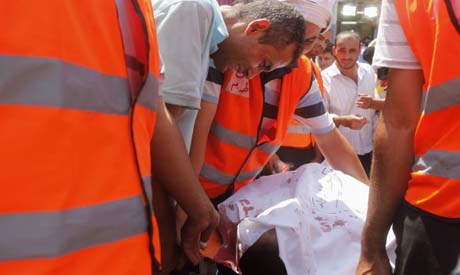
A supporter of deposed President Morsi looks at body of relative carried by ambulance attendants from field hospital near scene of clashes between pro-Morsi protesters and police in Nasr city, east of Cairo, July 27, 2013 (Photo: Reuters)
The death toll from Friday and Saturday's clashes in Egypt has risen to 80, according to a Health Ministry official Khaled El-Khatib.

Seventy-two of the casualties fell during violence between police and pro-Morsi supporters on the fringes of a month-long sit-in held by the president's loyalists in northern Cairo.

Eight people were killed in Egypt's Mediterranean city of Alexandria during deadly clashes between loyalists and foes of Egypt's ousted Islamist present Mohamed Morsi.

The official put the tally of injured at 792 nationwide, including 411 in clashes near the pro-Morsi sit-in in Cairo's Nasr City neighborhood.

A spokesman from Morsi's Muslim Brotherhood, Ahmed Aref, said 66 people had been killed and another 61 were on life support machines.

He told reporters that more than 4,000 were wounded by tear gas and bullet or birdshot wounds.

The Brotherhood's official website, however, said at least 200 people had been killed and some 5,000 wounded.

The bloodshed has thrown Egypt into deeper turmoil weeks after the country's Islamist president was overthrown by the army in the wake of mass protests against his rule.

The unrest, resulting from mounting polarisation between factions opposing and supporting Morsi, has claimed the lives of dozens and wounded hundreds since Morsi's expulsion from the presidency. 
 

Ahram Online

Source: http://english.ahram.org.eg/NewsContent/1/64/77565/Egypt/Politics-/At-least--killed-in-Egypts-fresh-unrest-Health-Min.aspx

Copyright - Original materials copyright (c) by the authors.

'Netanyahu is encouraging terror by releasing killers'


by Dan Lavie, Yori Yalon and Israel Hayom Staff


Dozens gather at the Prime Minister's Office to protest against plan to release Palestinian prisoners ahead of peace talks • Naftali Bennett: Anyone on the other side who demands the release of murderers is not worthy of being called a partner.


"We will do whatever it takes." Dozens of demonstrators protesting a planned prisoner release in Jerusalem on Sunday
Photo credit: AFP


Dan Lavie, Yori Yalon and Israel Hayom Staff

Source: http://www.israelhayom.com/site/newsletter_article.php?id=10991

Copyright - Original materials copyright (c) by the authors.