Sunday, September 6, 2026

Witkoff and Kushner make first Kyiv visit for peace talks - Barak Ravid


by Barak Ravid

This is Witkoff and Kushner's first trip to Ukraine despite months of negotiating with both sides and multiple trips to Russia.


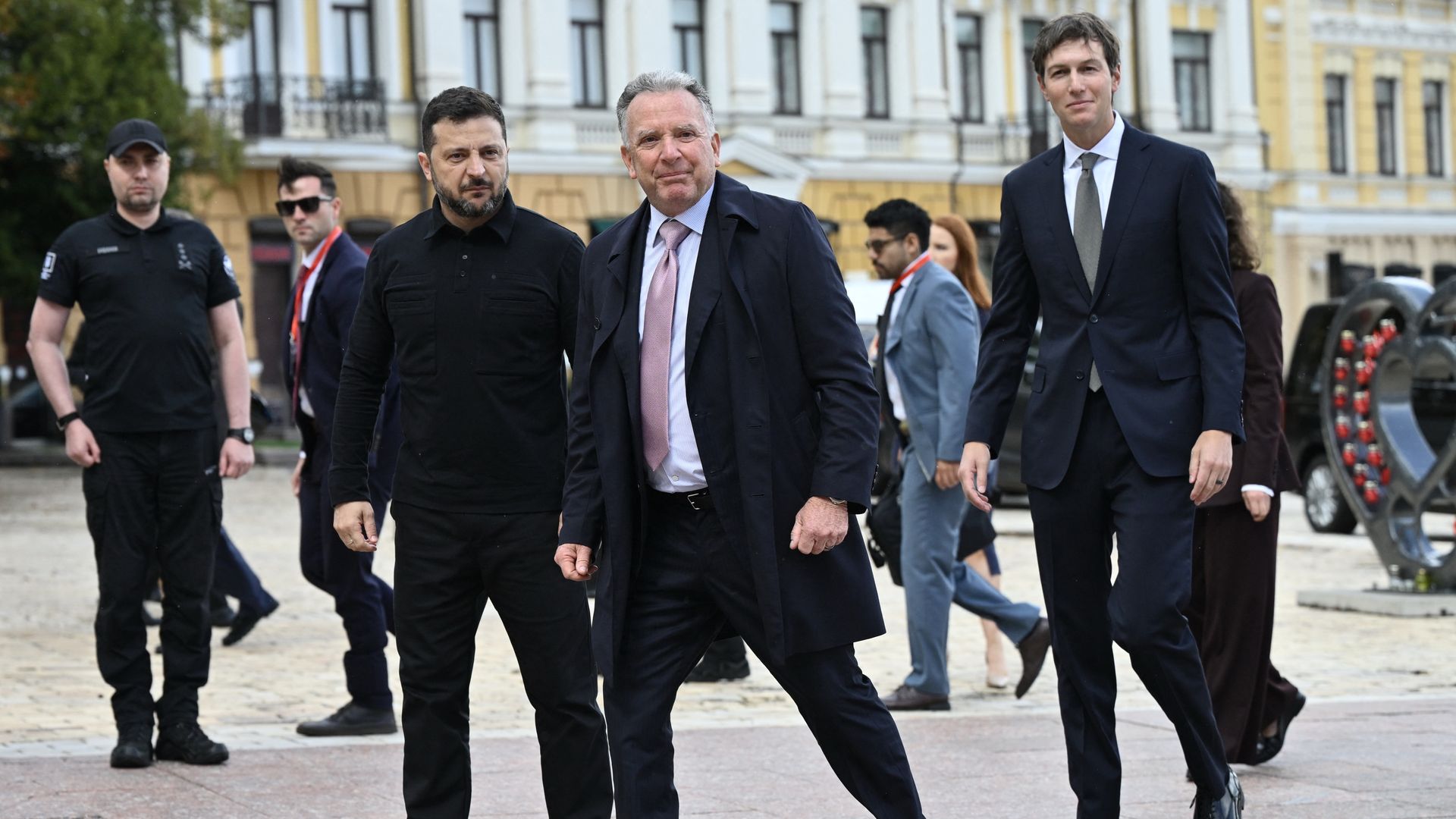
Zelensky walks alongside Witkoff and Kushner outside a government building in Kyiv.
Ukrainian President Volodymyr Zelensky (left) welcomes Steve Witkoff (center) and Jared Kushner in Kyiv on Sunday ahead of talks on efforts to end the war with Russia. Photo: Genya Savilov/AFP via Getty Images

President Trump's envoys Steve Witkoff and Jared Kushner arrived in Kyiv on Sunday for diplomatic talks aimed at resuming negotiations between Russia and Ukraine.

Why it matters: Kushner and Witkoff traveled to Kyiv right after talks with Russian President Vladimir Putin in Moscow. This is Witkoff and Kushner's first trip to Ukraine despite months of negotiating with both sides and multiple trips to Russia.

  • Sunday also marked the highest-level visit by a U.S. official to Ukraine since Trump started his second term.

Driving the news: U.S. and Russian officials offered positive assessments of Kushner and Witkoff's three-hour meeting with Putin on Saturday.

  • "Kushner and Witkoff are making an effort, and we are making progress," a Russian official said.
  • A White House official said Witkoff, Kushner and Putin discussed "plans for next steps, which will be announced in the coming weeks."
  • Witkoff, Kushner and their team left Moscow on Saturday night, landed several hours later in Poland, and then traveled by land to Kyiv.

Zoom in: Zelensky discussed Ukrainian preparations for continuing the war through the winter, a source familiar with the meetings said. Kushner and Witkoff stressed they want a breakthrough before winter, the source said.

  • Witkoff and Kushner met twice with Zelensky and his senior advisers. National security advisers from the U.K., France and Germany joined a third meeting.
  • After the second meeting with Zelensky, Trump's envoys said they were "encouraged by the substantive discussion" and looked forward to making more progress.

What they're saying: A second source who participated in Sunday's talks said the meetings "went well" and that Kushner and Witkoff want to work with the parties on a "refreshed" peace proposal.

  • "Things may move in a good direction if there's a follow-up by all parties involved," the source said.

Editor's note: This is a breaking news story and will be updated. 


Barak Ravid

Source: https://www.axios.com/2026/09/06/witkoff-kushner-kyiv-ukraine-peace-talks

Follow Middle East and Terrorism on Twitter

The Militant Republic of Iran - ISW


by ISW

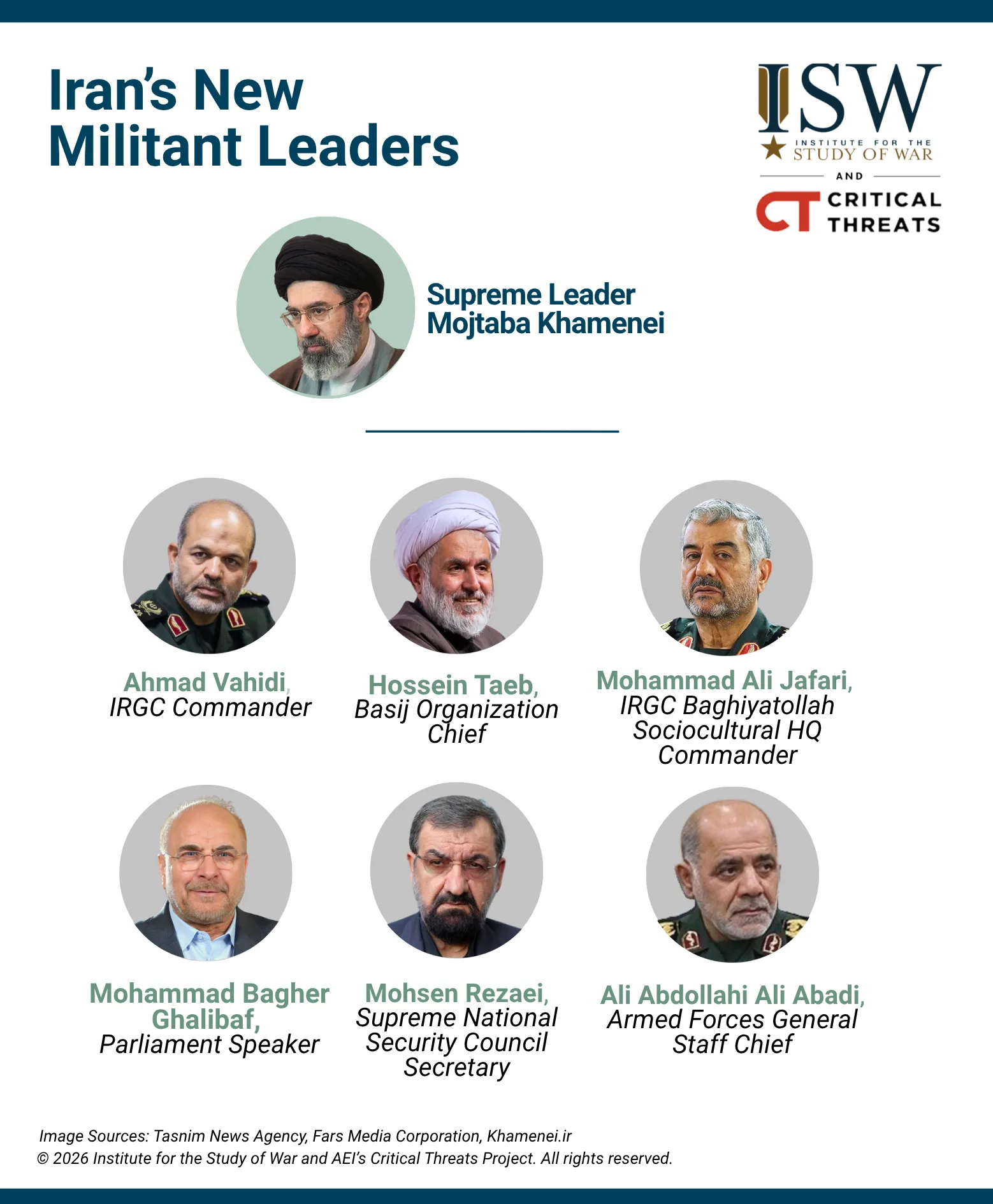
Iranian Supreme Leader Mojtaba Khamenei appointed top military leaders in early August, empowering a new cadre of hardline figures from the Islamic Revolutionary Guards Corps


Iranian Supreme Leader Mojtaba Khamenei appointed top military leaders in early August, empowering a new cadre of hardline figures from the Islamic Revolutionary Guards Corps (IRGC).[1] The appointments are part of a larger turnover in Iranian military leadership driven by US and Israeli decapitation strikes in 2025 and 2026.[2] The newly ascendent figures are just as aggressive and uncompromising — if not more so — than their predecessors. They form the new nucleus of Iranian decision-making and bring their own ideas and tendencies to the intra-regime discourse. An understanding of these figures is therefore critical to thinking about the new Iranian regime. This piece examines those individuals — Ahmad Vahidi, Hossein Taeb, Mohammad Ali Jafari, Mohammad Bagher Ghalibaf, Mohsen Rezaei, and Ali Abdollahi Ali Abadi — to help inform future analysis on Iranian behavior.

Many of the newly empowered figures are close allies of Mojtaba and engineered his selection as supreme leader in March 2026. Vahidi, Taeb, Jafari, and Ghalibaf reportedly pressured members of the Assembly of Experts — the regime body responsible for choosing the supreme leader — to pick Mojtaba, in some cases threatening assembly members and their families.[3] Mojtaba has since returned the favor by elevating these figures and other key IRGC officers into positions of power.

This has effectively brought a specific faction of especially dangerous, repressive, and corrupt IRGC figures to the top of the regime and granted them even greater influence than they already had. As discussed below, the IRGC figures now dominating Iranian decision-making have abetted the worst regime behaviors over the decades. They have overseen foreign terror operations, brutal protest crackdowns, and the abuse of their positions to enrich themselves and those close to them. Though Iran will certainly remain a strategic threat to the United States and its partners for the foreseeable future, the fundamental shape and character of that threat will change as these new figures take personal control of the regime.

 Iran's New Militant Leaders

Ahmad Vahidi

Vahidi has served as IRGC commander since March 2026 and has a long history of supporting some of the vilest regime behaviors domestically and abroad.[4] Vahidi joined the IRGC around the outset of the Iran-Iraq War, serving in its intelligence service.[5] Vahidi quickly rose through the ranks, becoming the IRGC intelligence chief after only a few years.[6] Vahidi organized the intelligence service into several divisions, including those for Lebanon, the Arabian Peninsula, Afghanistan, and special operations, among others.[7] Vahidi gave special attention to Lebanon and was one of the five Iranian figures who played a key role in the establishment of Lebanese Hezbollah in the early 1980s.[8] Vahidi was implicated in the Hezbollah attack on the US Marine Barracks in 1983, killing hundreds of American service members and wounding many more.[9]

Vahidi’s “successful service” in Lebanon paved the way for him to become the first commander of the IRGC Quds Force — the service responsible for clandestine operations and support to foreign militias — in 1988.[10] The Quds Force was the organizational successor of the intelligence service that Vahidi led previously.[11] In his role as Quds Force commander, Vahidi expanded the reach of the IRGC and oversaw terror attacks on foreign soil, including the bombing of a Jewish cultural center in Argentina in 1994.[12] The International Criminal Police Organization issued a Red Notice — a non-binding arrest warrant — for Vahidi in 2007 for his involvement in the attack.[13]

Vahidi has been extensively involved in domestic repression in more recent years. Vahidi served as interior minister, overseeing the Law Enforcement Command (LEC) during the Woman, Life, Freedom Movement in 2022-23.[14] Vahidi was responsible for “brutal actions” against protesters, including the use of lethal force.[15] Vahidi also served as the IRGC deputy commander during the most recent round of large-scale protests in December 2025 and January 2026, during which the regime killed tens of thousands of citizens over just a few days.[16] These experiences demonstrate Vahidi’s deep commitment to the revolution and readiness to use extreme violence against large numbers of civilians to preserve it.

Vahidi has played a dominant role in Iranian decision-making in more recent months, becoming an IRGC commander at the beginning of the war and driving Iranian efforts to control the Strait of Hormuz.[17] Vahidi has overseen the IRGC missile and drone attacks across the Middle East and opposed more pragmatic Iranian officials, such as President Masoud Pezeshkian, from compromising with the United States.[18] Vahidi was likely involved in the decision to recall the Iranian negotiating team from Islamabad during the first round of talks in April 2026, reportedly because negotiators “deviated” from their mandate.[19] If Vahidi was involved, it reflects efforts to enforce a hardline, uncompromising negotiating position.

Mojtaba formalized the appointment of Vahidi to IRGC commander in August 2026, bestowing on him the rank of major general and instructing him to enhance Iranian deterrence and prepare for “powerful offensive operations against the enemy.”[20] The unusual Iranian emphasis on offensive operations has supplied Vahidi a mandate to focus on power projection, preemptive operations, and other means to threaten US and partner interests abroad.

Hossein Taeb

Mojtaba appointed Hossein Taeb as Basij Organization chief, empowering a close ally and notoriously hardline figure with extensive experience in domestic repression.[21] The Mojtaba-Taeb relationship dates back to their time in the Habib Ibn Mazaher Battalion of the IRGC 27th Mohammad Rasoul Ollah Division during the Iran-Iraq War.[22] Mojtaba and Taeb have been close since then and collaborated on several occasions, such as during the crackdown on the Green Movement in 2009.[23] Taeb was Basij chief at the time as well, overseeing the use of extreme violence against protesters.[24] Then-Supreme Leader Ali Khamenei soon thereafter appointed Taeb to lead the newly established IRGC Intelligence Organization, which he led from 2009 to 2022.[25] The IRGC Intelligence Organization under Taeb was responsible for monitoring domestic discontent, threatening and arresting political dissidents, suppressing protest activity, and combating “Western cultural infiltration and moral offenses.”[26] Taeb also used his experience in domestic repression to help the Bashar al Assad regime crush protests at the onset of the Syrian civil war.[27]

Like Vahidi, Taeb has been involved in terror operations abroad in his capacity as IRGC Intelligence Organization chief. He has been implicated in plots to harm Israeli officials and civilians, including a plan to kidnap and attack Israeli diplomats and tourists in Turkey in 2022.[28] Then-Supreme Leader Ali Khamenei dismissed Taeb after the failed operation in Turkey and the continued Israeli assassination of prominent Iranian officials.[29]

The appointment of Taeb to again lead the Basij marks his return to prominence. Mojtaba, in appointing Taeb, instructed him to develop a “popular intelligence network . . . and use new technologies for popular confrontation against enemy threats.”[30] Iranian state media interpreted this mandate as meant to expand the role of the Basij in monitoring the population through local intelligence networks.[31] Taeb is uniquely well-suited for this task given his unique experience in the Basij and IRGC Intelligence Organization and overseeing collaboration between them. The IRGC Intelligence Organization under Taeb collaborated closely with the Basij to collect information on citizens and potential political opposition.[32]

Mohammad Ali Jafari

Jafari is another major IRGC figure close to Mojtaba, though he has not yet received any new official appointment. Jafari is a prominent Iranian military thinker who has led doctrinal change and adaptation over his career. Jafari is best known for developing Mosaic Defense, which is the operational concept and reorganization plan that the IRGC prepared to defend against a potential US ground invasion.[33] Jafari developed Mosaic Defense in response to the US invasions of Afghanistan and Iraq in 2001 and 2003, respectively, and would later institutionalize the concept when he became IRGC commander in 2007.[34] Mosaic Defense involves the decentralization of the IRGC Ground Forces, embedding its formations in population centers and preparing them for a guerrilla defense against invading American forces.[35]

Jafari played a prominent role in domestic repression during his tenure as IRGC commander from 2007 to 2019. He declared that the primary mission of the IRGC was to confront “internal threats” in his first speech as IRGC commander.[36] He proceeded to focus on preparing the IRGC for protest crackdowns, coopting the distribution of IRGC ground units across Iranian cities and towns as part of Mosaic Defense to position those units to use extreme violence against protesters. Jafari also oversaw the integration of Basij paramilitary elements into the IRGC Ground Forces and the expansion of the IRGC’s involvement in local politics and socio-cultural affairs.[37] The IRGC under Jafari brutally suppressed the Green Movement in 2009 and the Dey Protests in 2017-18.

Jafari led the IRGC through the peak of its intervention in the Syrian civil war, where the IRGC demonstrated a nascent capacity for expeditionary ground operations.[38] The IRGC Ground Forces — in collaboration with the IRGC Quds Force — deployed division and brigade elements to Syria to integrate with the Syrian Arab Army and other pro-Assad and Iranian-backed militias.[39] The IRGC ground units assumed a leading role in the defense of the Assad regime and the fight against the Islamic State and other Syrian opposition groups.[40] The IRGC ground deployments peaked around 2015-16.[41] This episode marked the first major combat operations that the IRGC Ground Forces conducted since the Iran-Iraq War.[42]

Jafari has focused further on socio-cultural engineering and political interference since the end of his tenure as IRGC commander. Then-Supreme Leader Ali Khamenei appointed Jafari as commander of the IRGC Baghiyatollah ol Azam Socio-Cultural Headquarters in 2019, tasking him with countering enemy “soft war.”[43] Iranian officials use that term to refer to the use of non-military tools, such as information operations, to reduce public support for the regime and corrupt Iranian society with Western and liberal values. The IRGC socio-cultural headquarters under Jafari has produced and disseminated regime propaganda, organized pro-regime events, and interfered in elections to advantage hardline candidates.[44] Such interference manifested as intimidating voters, mobilizing regime supporters to vote, and manipulating in-person ballots.[45] Jafari has also worked with Taeb to ensure their desired electoral outcomes.[46] Jafari has thus eroded the already extremely thin veneer of a democratic process in Iran, paying little-to-no regard for the popular preferences.

Jafari has advocated for a hardline negotiating position since the war began. He has argued that Iran should refrain from negotiations until the United States meets several preconditions, such as stopping Israeli operations against Lebanese Hezbollah, lifting sanctions, paying war reparations, and recognizing Iranian sovereignty over the Strait of Hormuz.[47] Jafari has essentially argued for the United States to surrender and concede on all of the core Iranian demands before negotiations even occur.

Mohammad Bagher Ghalibaf

Ghalibaf is a prominent IRGC-officer-turned-politician who has amassed considerable influence under Mojtaba. Ghalibaf is the current parliament speaker and has led negotiations with the United States.[48] He has long-standing ties with Mojtaba, Taeb, Jafari, and other senior IRGC figures. He is often characterized as a relative pragmatist given his general preference for resolving tensions diplomatically. This preference should not be interpreted as a genuine desire to reset the Iranian relationship with the United States, however. It derives from his understanding of the requirements for political survival and regime stability.

Ghalibaf began his career in the IRGC, where he supported domestic repression. He fought in the Iran-Iraq War, during which he cultivated close relationships across the IRGC, and later commanded the IRGC Air Force from 1997 to 2000.[49] In 1999, Ghalibaf was one of 24 IRGC officers, including Jafari, who signed a letter to then-President Mohammad Khatami threatening to intervene unilaterally if he did not crush ongoing student protests.[50] The letter accused Khatami of betraying the revolution and warned that IRGC patience was waning.[51] Ghalibaf later boasted that he personally beat students with a baton during the protests.[52] Ghalibaf further supported repression when he led the LEC from 2000 to 2005 and oversaw its crackdown on protests in 2003.[53] At the time, Ghalibaf requested permission from the Supreme National Security Council to use lethal force against protesters.[54]

Ghalibaf entered politics in 2005 and has since become the face of financial corruption in Iran. While serving as Tehran mayor from 2005 to 2017, Ghalibaf funneled 3.5 million US dollars to his wife’s “charity,” offered Tehran properties to regime officials at discounted prices, and used Tehran Municipality money to fund his unsuccessful 2017 presidential campaign.[55] Ghalibaf was also implicated in a multi-billion dollar embezzlement scheme involving Yas Holding, which prompted fierce infighting among IRGC leadership.[56] Ghalibaf separately received tremendous public backlash in 2022, when his family returned to Iran from a shopping spree in Turkey with suitcases full of purchased goods, showcasing the extreme economic disparity between ordinary Iranians and the ruling elite.[57]

Ghalibaf has consolidated significant political power since becoming parliament speaker in 2020 and even more so since the war began. He has begun to function as an executive-like authority comparable to the Iranian president.[58] Ghalibaf has continued to advocate for negotiations with the United States but does not appear to be influential enough to drive the regime toward serious concessions.[59]

Mohsen Rezaei

Rezaei was the first individual to receive an appointment from Mojtaba after he became supreme leader, highlighting the central position that Rezaei has claimed in the new regime. Mojtaba selected Rezaei as his personal military adviser and later as his representative to and secretary of the Supreme National Security Council.[60] Rezaei aligns with the hardline faction and has supported a maximalist and uncompromising negotiating position through the war, including the demand to permanently control the Strait of Hormuz.[61]

The appointments mark Rezaei’s return to prominence in a manner similar to Taeb’s. Rezaei is best known for commanding the IRGC from 1981 to 1997, leading the force through the Iran-Iraq War and the early years of Ali Khamenei’s tenure as supreme leader.[62] Like Vahidi, the International Police Organization issued a Red Notice for Rezaei for his involvement in the terror attack in Argentina in 1994.[63] While leading the IRGC, Rezaei had a strained relationship with Ali Khamenei that persisted through the following decades.[64] After serving as IRGC commander, Ali Khamenei allowed Rezaei to rotate across policy jobs, remaining part of the official establishment, but not a crucial decisionmaker in the way that he was previously. Rezaei launched several presidential campaigns but never seemed to secure the endorsement of Ali Khamenei, who preferred others.[65]

Rezaei has indicated support for the acquisition of nuclear weapons. Rezaei described the need for a “holy Islamic bomb” in 2005, according to Israeli media.[66] Rezaei has, in more recent days, asked rhetorically why Iran should refrain from acquiring a nuclear weapon.[67]

Ali Abdollahi Ali Abadi

Mojtaba appointed Abdollahi as chief of the Armed Forces General Staff (AFGS), making him formally the senior-most Iranian officer and responsible for cooperation and coordination between the IRGC and Artesh.[68] Abdollahi has spent much of his career working closely with Ghalibaf, serving as his deputy in the IRGC Air Force and again in the LEC.[69] Abdollahi thus facilitated the LEC crackdown on the protests in 2003 alongside Ghalibaf. Abdollahi later became deputy interior minister for security and law enforcement affairs in the Mahmoud Ahmadinejad administration in 2009, again tasking him with domestic repression, especially during the Green Movement.[70]

Abdollahi has more recently served in senior joint staff positions, giving him leadership experience at the highest Iranian military echelons. During this time, Abdollahi worked on readiness and defense industrial affairs and later became the third-in-command in the AFGS.[71] During the 12-Day War, Abdollahi became the commander of the Khatam ol Anbia Central Headquarters, which is the senior-most operational headquarters and is responsible for joint and wartime operations.[72] Abdollahi retained that command while Mojtaba made him AFGS chief. Mojtaba has tasked Abdollahi with merging the AFGS and Khatam ol Anbia Central Headquarters, returning them to something resembling their pre-2016 structure, and streamlining military decision-making.[73]


ISW

Source: https://understandingwar.org/research/middle-east/the-militant-republic-of-iran/

Follow Middle East and Terrorism on Twitter

Peace with the Islamic Republic of Iran is a Fantasy - Nima Gholam Ali Pour


by Nima Gholam Ali Pour

Can the US no longer defeat its enemies? Has the regime of the mullahs transformed Iran into a country that can actually defy the US?


  • At some point, people will also ask the obvious question: if the US had military dominance, why is the regime still in power? This is a regime that defied America yet remains in power. What does that mean? Can the US no longer defeat its enemies? Has the regime of the mullahs transformed Iran into a country that can actually defy the US? If so, then they have fulfilled the promise they made to the people in 1979. Iran was supposed to become a country that would not be ruled by "American imperialism." Through the Islamabad MOU, the mullahs have fulfilled that promise.

  • What people in Iran see is that the United States made promises that this regime would be removed from power. The US and Israel did everything they could and failed. The Islamabad MOU gives the impression that Iran is the victor dictating its terms to the US. All of this provides a great deal of legitimacy to a regime whose ideology is based on hostility toward the US and Israel.

  • The Islamabad MOU will not lead to peace.

  • Every Friday, the regime's supporters chant, "Death to America, Death to Israel." The regime does not promise welfare reforms or tax cuts. Its ideology is hostility toward the United States and Israel -- and by appearing as the victor in this war, it has gained legitimacy.

  • This is an aggressive regime that will start more wars and that must be removed from power.

  • Peace with the Islamic Republic of Iran is a fantasy. Both Obama and Trump appear to have embraced that fantasy, and future generations, along with the Iranian people, will pay the price for it.

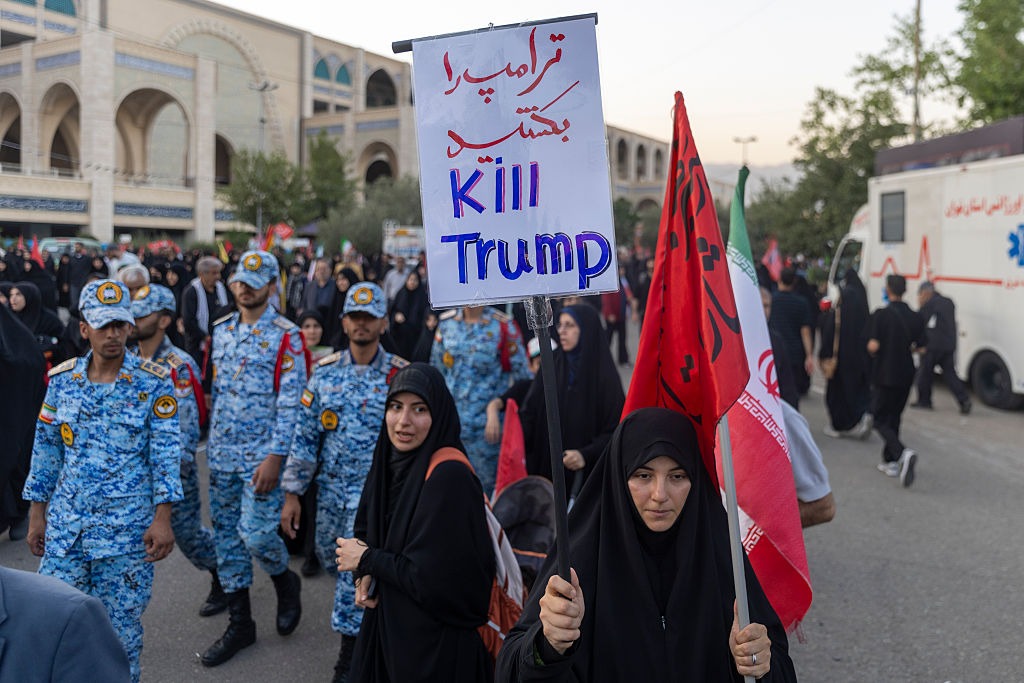
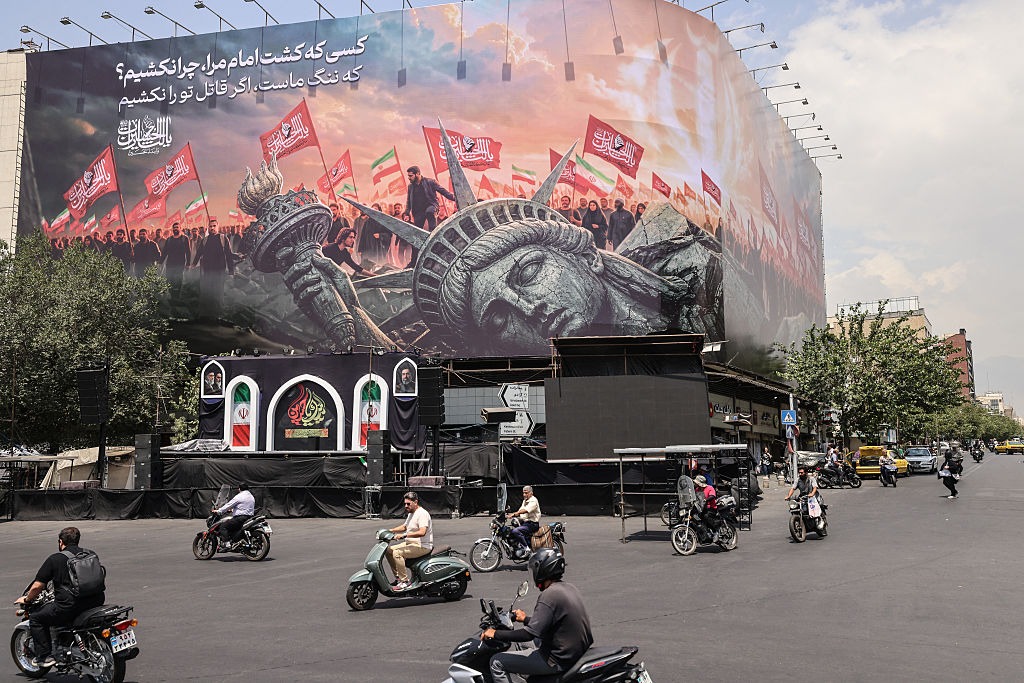
Every Friday, the Iranian regime's supporters chant, "Death to America, Death to Israel." They do not promise welfare reforms or tax cuts. The regime's ideology is hostility toward the United States and Israel -- and by appearing as the victor in this war, it has gained legitimacy. Pictured: An anti-American billboard at Enghelab Square in Tehran on August 3, 2026. (Photo by Atta Kenare/AFP via Getty Images)

The US and Israeli military conflict with Iran, which began on February 28 and does not appear to have come to an end, was a complete failure for both the United States and Israel. If this has not yet been recognized by everyone because the current US administration needs to portray itself as victorious for the midterm elections, it is nevertheless important to see this reality.

The Islamic Republic of Iran has so far emerged as the victor from this military conflict. The Islamabad Memorandum of Understanding (MOU) cements the current regime in Iran and its legitimacy among the enemies of the United States and Israel, especially jihadists. President Donald Trump himself keeps repeating that he is not seeking regime change in Iran.

In the public narrative, a military victory for the Islamic Republic has always been defined as the defense of Iranian territory and the survival of the Islamist regime. This definition also applied when Iraq invaded Iran in 1980.

Although the US did not play a direct role in the Iran-Iraq War, events involving the US were nevertheless used to portray the inconclusive outcome of the war as evidence that the Iranian regime had stood up to "American imperialism" and survived.

The same military figures who, by their own account, stood up to "American imperialism" during the Iran-Iraq War later went on to wage proxy wars across the Middle East and continued their war against the US in Iraq by killing many American soldiers. The Islamic Revolutionary Guard Corps' Qasem Soleimani, Mohammed Bagher Ghalibaf, Abbas Araghchi, and Ali Larijani are all veterans of the Iran-Iraq War. The examples of such veterans within the Iranian regime are countless – and they believe they already defeated "American imperialism" once by repelling Saddam Hussein's invasion of Iran.

Now that they have defended their regime and Iranian territory for a second time, they naturally believe that they have defeated "American imperialism" again. It does not matter that the US has decimated the regime's leadership and achieved military dominance. As in the Iran-Iraq War, the deaths of political and military leaders were portrayed as acts of martyrdom, and in the current narrative of the Islamic Republic, dying as a martyr is considered an honor.

The military dominance of the United States and Israel will be compared to the Battle of Karbala in 680, where Imam Hussein was defeated by the vastly superior army of Caliph Yazid. The argument will be that Iran was an underdog, just like Imam Hussein, but that "the truth" and what was "morally right" ultimately triumphed.

This is the theological message at the heart of the story of Karbala. It was used by the regime even when the Iran-Iraq War was going in Iraq's favor.

Of course, one may ask whether the Iranian people will embrace these religious messages once again, 38 years after the end of the Iran-Iraq War. That is by no means certain. The regime, however, has not fallen. When a person is portrayed as a martyr over and over again through parades, films, and books, people eventually begin to accept that narrative. A repeated lie eventually becomes an indisputable truth. That is how propaganda works.

At some point, people will also ask the obvious question: if the US had military dominance, why is the regime still in power? This is a regime that defied America yet remains in power. What does that mean? Can the US no longer defeat its enemies? Has the regime of the mullahs transformed Iran into a country that can actually defy the US? If so, then they have fulfilled the promise they made to the people in 1979. Iran was supposed to become a country that would not be ruled by "American imperialism." Through the Islamabad MOU, the mullahs have fulfilled that promise.

One can, of course, debate and question all of this. What people in Iran see is that the United States made promises that this regime would be removed from power. The US and Israel did everything they could and failed. The Islamabad MOU gives the impression that Iran is the victor dictating its terms to the US. All of this provides a great deal of legitimacy to a regime whose ideology is based on hostility toward the US and Israel.

Even if the Iranian people are dissatisfied with the regime, they see that it can defend Iran's territorial integrity and deliver on what it promises -- which has always been to defy the United States and "American imperialism."

Every Friday, the regime's supporters chant, "Death to America, Death to Israel." The regime does not promise welfare reforms or tax cuts. Its ideology is hostility toward the United States and Israel -- and by appearing as the victor in this war, it has gained legitimacy.

We never needed to end up in this situation at all. Even without being a military expert, it was obvious from the outset that the US had no plan for how to remove the Iranian regime when the war began at the end of February. There was no step-by-step roadmap from the start of the operations to the fall of the regime.

After the Twelve-Day War last year, it became clear that for such a scenario to be feasible, it would be necessary to arm volunteers from the Iranian diaspora. That is why in August, I wrote the following:

"Regime change can happen if all the necessary conditions are in place. This means Middle East-based exiled Iranian opposition groups that wish to remain relevant must be prepared to move into Iran when armed intervention is needed to aid in regime change. It also means that the countries in the region that want regime change in Iran must facilitate the movement of Iranian opposition groups within and across their borders, and enable them to be armed and trained for such a mission.

"The next time Iran is in a war like the recent conflict, Iranian opposition groups must be on the ground, armed and ready to support regime change and exploit the vulnerabilities that emerge in the wake of airstrikes."

It was always obvious that the American and Israeli militaries would not be able to overthrow the regime. It was always obvious that, if regime change were the objective, this would require a prolonged conflict. It was always obvious that the American political climate and economic realities would not permit a prolonged war with Iran. As a result, there was never a realistic plan for removing the current regime.

The Islamabad MOU will not lead to peace. The Iranian regime will continue to advance its interests and expand its influence. Despite this war, the regime still wields significant influence in Iraq, Yemen and Lebanon. This regime is far from defeated as a regional power.

This is an aggressive regime that will start more wars and that must be removed from power. Therefore, the Iranian opposition must be armed if regime change is ever to become possible. It is only Iranians who are prepared to sacrifice their lives to liberate Iran in a prolonged war, which will be bloody because the mullahs' regime has nowhere to flee and will fight to the last man.

War will come. Peace with the Islamic Republic of Iran is a fantasy. Both Obama and Trump appear to have embraced that fantasy, and future generations, along with the Iranian people, will pay the price for it.


Nima Gholam Ali Pour
is a Member of the Swedish Parliament

Source: https://www.gatestoneinstitute.org/22679/peace-with-islamic-republic-of-iran

Follow Middle East and Terrorism on Twitter

The ‘Trouble’ With Theory - Roger Kimball

by Roger Kimball

Theory, which once betokened an attunement or congruence with reality, now signifies a willful imposition.


My old friend Jeremy Black, the dazzlingly prolific English historian, has an excellent piece in this month’s edition of The Critic on the history profession’s newfound infatuation with “theory.” In some ways, as Black notes, the interest in theory is a sort of revival. “Theory” was all the rage in the 1980s and 1990s, not only in history but throughout the humanities.

As I have noted elsewhere, if there were a Society for the Prevention of Cruelty to Words, “theory” would long ago have been granted protected status as an Abused Noun. Academics wishing to use the word would be required to apply for a special license, submit character references from three persons never convicted of exposure to graduate-school education, and contribute to a fund for other unfortunate words. The case of “theory” is especially sad, because in it we have an example of serial abuse: first by the professors of literature, then the professors of history, “cultural studies,” and kindred interdisciplinary redoubts, and lately by art historians.

“Theory” has a complicated history. It derives from a Greek word meaning “to look at, behold.” “Theory” in this sense implies a certain passivity on the part of the beholder: a theory gave us access not to something we made but to something we received when properly attentive. Today, however, we use “theory” in a sense close to the opposite of this etymological meaning. A “theory” nowadays is not so much what we see or behold as a mental scaffolding we imagine or project in order to account for what we see or behold. In short, theory, which once betokened an attunement or congruence with reality, now signifies a willful imposition.

Still, in normal parlance, “theory” remains a perfectly respectable word. It has plenty of legitimate colloquial uses: “I have a theory about that,” someone says, meaning that he has an idea about what happened and why. We also regularly distinguish between theory—the way things are supposed to happen—and practice—the way they in fact do happen (the idea being that there is often a disjunction between the two). “That’s all very well in theory,” you say, meaning that in practice things are likely to turn out rather differently.

We also use “theory” in a more formal sense, meaning, as The American Heritage Dictionary explains:

Systematically organized knowledge applicable in a relatively wide variety of circumstances, esp. a system of assumptions, accepted principles, and rules of procedure devised to analyze, predict, or otherwise explain the nature or behavior of a specified set of phenomena.

“Theory” in this sense is part of the drama of rational inquiry. A theory is not just idle speculation but a carefully formulated set of hypotheses offered as a possible explanation of something. A theory has a tentative or adventurous side—it advances beyond the facts in its effort to explain them—but its legitimacy is measured primarily by its honesty and allegiance to the truth.

The truth? You can almost feel the shudder of horror cascading through the professoriate: imagine someone so naïve as to speak of “the truth”! They don’t do truth in the fashionable precincts of the academy today. They do “theory.” You even encounter people who use “theorize” as a transitive verb: “So-and-so theorizes the idea of freedom” (or art, nature, cookery, whatever), meaning that So-and-so embellishes whatever it is with a skein of owlish verbal irrelevancies. “Truth” is rarely spoken of, and then only in deprecatory scare quotes.

Have you noticed how widespread the use of those instruments of epistemic deflation is? I have mentioned it in this column previously. The practice is positively epidemic. And why not? A simpler method of neutralizing or ironizing meaning can hardly be imagined. Never speak of virtue when you can say “virtue”; a bit of reasoning is not logical, but only “logical”; the procedure in question is not sound, but merely “sound.”

And so on. It works with words of cognitive failure, too: don’t say that an argument is refuted, only that it is “refuted.” To appreciate what is at stake, consider the difference between fresh fish and “fresh” fish: the difference is difficult to define, perhaps, but easy to smell. The marvelous thing about this use of scare quotes is that it allows you to insinuate doubt without positively asserting anything at all. You don’t declare that “X” is not true, merely that “X is ‘true.’”

“Theory” in the fashionable new sense is scarcely imaginable without such weapons of semantic sabotage. And this was only to be expected. For theory as practiced in the academy today is primarily an instrument of politics, not inquiry. It is meant to insinuate a subplot of unacknowledged motives behind every declaration. When you hear—as you are always hearing these days—someone say that truth is “socially constructed,” that “knowledge is a function of power,” etc., it is a good bet that in the next sentence he is going to offer you a dollop of “theory” to support his claim.

What sort of theory? People who go in for this sort of thing are fond of asserting that “everything is political,” meaning that the ideal of disinterested inquiry is little more than a charade. How could it be otherwise, they argue, since all our acts are by definition our acts, i.e., self-interested?

Thinkers at least as far back as Joseph Bishop Butler (1692–1752) have exposed the confusion that lies behind the “strange affection in many people of explaining away all particular affections and representing the whole of life as nothing but one continued exercise in self-love.”

There are three main sources feeding the confusion. The emotional or characterological source is programmatic cynicism. The notion that selfishness is universal and unremitting is as much a matter of temperament as conviction. The idea appeals especially to those clever people who view every ideal as a blind and every value as a rationalization of some interest.

The second source of the confusion is a common but fatal logical solecism, namely the tendency to milk tautological premises for real-life conclusions. The Australian philosopher David Stove (1927–1994) drew on Butler’s classic argument when he pointed out that the “everything-is-political, all-acts-are-self-interested” attitude, though positively de rigueur among trendy academics today, rests on this fundamental logical mistake. As Stove observes,

It plainly does not follow from the tautology, “No man can act intentionally except from some interest which he has,” that “No man can act intentionally except from motives of self-interest.” That inference belongs to exactly the same class as the atrocious (though ever popular) inference from “Whatever will be, will be,” to “All human effort is ineffectual.” . . . If you set out from a tautological premise you cannot validly infer from it any conclusion which is not itself tautological.

The possible objects of a man’s interests, motives, or desires, are inexhaustibly various. Among them may be, to wreck revenge on a particular man, to gain the love of a particular woman, to serve his country, to experience the love of God, to understand contemporary physics . . . the list is endless. But it can perfectly well happen, and often does happen, that a man pursues one or more of these “particular” passions without regard to his own interests.

As Butler himself put it, “It is not because we love ourselves that we find delight in such and such objects, but because we have particular affections towards them. . . . Everything is what it is, and not another thing.”

The third main source of the conviction that “everything is political” and that truth is culpably underdressed unless it appears in deflationary scare quotes is that curiously popular form of epistemological gloominess that Stove calls “cognitive Calvinism.” “Calvinists,” Stove observes,

believe in the total depravity of human nature: if an impulse is one of ours, it is bad, because it is one of ours. The argument,

Our knowledge is our knowledge,

So,

It is not knowledge of real things,

could seem valid only to someone who felt that any knowledge we have could not be the real thing, because we have it.

Stove’s criticisms of “cognitive Calvinism” and the arguments supporting it occur in an essay attacking idealism. But it is important to note that the arguments he attacks are by no means propounded only by idealists. Indeed, in one version or another, such reasoning, as Stove points out, “is common to all the main varieties of cognophobe who now make up the staff of the faculties of arts in Western universities; and none of these is idealistic, even by implication.”

As an example, let me turn to Keith Moxey, for many years a professor of art history at Barnard College. As I noted when I first wrote about Professor Moxey, he is only a minor star in the academic firmament. But he glows with a wholly characteristic—not to say utterly predictable—light. His books are a compendium of fashionable academic clichés both in attitude (polysyllabic leftism) and in argument (off-the-rack items from the lexicon of deconstruction).

In short, Professor Moxey is a sort of five-and-dime deconstructionist, recapitulating all the standard postmodernist arguments as a music box plays its repertoire of tunes: mechanically, with a distinct lack of sonority, but also with no wrong notes. Which is why his work provides such a good introduction to the temperament and the intellectual weather of contemporary art history: there are no surprises—just pages and pages of received ideas, neatly arranged, undisturbed by anything resembling a doubt, scruple, or hesitation.

Especially pertinent is Professor Moxey’s book The Practice of Theory: Poststructuralism, Cultural Politics, and Art History (1994). Professor Moxey has two basic contentions in this book. You can already guess what they are. Yes: one is that no “cultural practice”—the writing of history, for example—can be understood “without reference to theory.” And the second is that “All cultural practice is shaped by political considerations.” It’s not a matter of “Where have you heard that before?” but “Where have you not?”

People who are new to this mode of argument might be tempted to ask, with respect to the first contention, precisely what theory is necessary to understand, say, Caesar’s commentaries on the war in Gaul or Gibbon’s Decline and Fall of the Roman Empire. Those are indubitably examples of “cultural practice” (let’s cut to the chase and call it by its old name, “history”). People have been reading and understanding Caesar and Gibbon (for example) for many, many years without even a soupçon of theory. Or have they? Perhaps people have been deluded from time immemorial and only now, fifteen minutes ago when the Age of Theory dawned, have they come to understand these (and all other) authors? What do you think?

Professor Moxey’s book raises other questions, too. For example, with respect to the second contention, one might ask exactly what “political considerations” impinge upon the study of calculus, say, or the writing of lyric poetry, or, indeed, the painting or interpretation of pictures? Between us, Professor Moxey has no good answers to these embarrassing questions—which is not surprising because there are no good answers to them. But even to ask such questions shows that you are insufficiently attuned to the theoretical Weltanschauung Professor Moxey recommends. Read on, and you will see how pointless it is to object. “Derrida has shown”—doesn’t your heart leap up at that phrase?—

Derrida has shown that language is incapable of conveying the type of meaning that is usually ascribed to historical narratives. According to Derrida, linguistic signs are arbitrary constructs whose significance is impermanent and unstable. Language functions to suggest an absent presence of meaning. That is, the meanings of linguistic representations are always illusory, since they depend on metaphysical claims that cannot be substantiated.

It would make an instructive—but also a very long—parlor game to enumerate all the things that have gone wrong in these few sentences. One might begin by asking in what sense Derrida can be said to have “shown” anything about the subject at hand. “Argued,” possibly; “contended,” no doubt. But “shown”? That word carries with it an implication of cognitive success. But has Derrida succeeded in demonstrating that “language is incapable of conveying the type of meaning that is usually ascribed to historical narratives”?

Think about that. The “type of meaning . . . usually ascribed to historical narratives” is contingent truth, as in the statement “Caesar crossed the Rubicon in 49 B.C.” If Professor Moxey were right, then Derrida would have shown that such statements are “arbitrary constructs.” But of course he showed no such thing, for the simple reason that such statements are not “arbitrary constructs” but true or false depending upon the facts of the case. (Here’s another “linguistic sign”: “This bottle contains aspirin.” What if it contained arsenic instead? If Derrida had really shown that linguistic signs were “arbitrary constructs,” he could have no grounds to complain about false advertising when he swallowed the contents.) How about the assertion that “the meanings of linguistic representations are always illusory”? Either it is false, in which case we can have done with it, or it is true—in which case it is, once again, false, because it contradicts itself. Oh dear.

Professor Moxey believes that he can sidestep such difficulties (actually, they are refutations, but let that pass) by the clever expedient of giving up on truth.

Only if it is possible to get it right, to find the “truth,” can we have criteria by which to choose between alternative interpretations. If we claim there is no truth to be found, then we cannot be accused of not having a means of establishing what the truth might be.

But you might, Professor, be open to other accusations. We’ve already touched on the issue of self-contradiction. Take the claim “there is no truth to be found”—is that statement true? We’ve seen what follows if it is. And you might also, Professor, be open to the accusation of disingenuousness, preening self-importance, and a settled unwillingness to be (in Hume’s phrase) a “candid reasoner.” For if you were right, there could be no reason to prefer your interpretation over anyone else’s since ex hypothesi there are no criteria “by which to choose” one interpretation over another. (It is also worth pointing out that criteria needn’t be exhaustive to be useful: we often can discriminate between better and worse descriptions of something without necessarily having access to a perfect description.)

Of course, Professor Moxey doesn’t really believe that there are no criteria to which we can appeal in preferring one description to another. He clearly has his preferences, and he has easily enumerated reasons for his preferences. It’s just that they are not intellectual or aesthetic reasons. Like his masters Jacques Derrida and Michel Foucault, Professor Moxey pretends that basic mental hygiene—beginning with a respect for evidence and sound reasoning—is unimportant. What matters is politics—plus a measure of self-aggrandizement—not truth. So his “criteria” are simply political desiderata. “The abandonment of an epistemological foundation for art history,” he writes, means that “historical arguments will be evaluated according to how well they coincide with our political convictions and cultural attitudes.” How about his students’ art history papers? Were they, too, “evaluated according to how well they coincide” with Professor Moxey’s “political convictions and cultural attitudes”? How could it be otherwise, if Professor Moxey is right? It’s something that parents may wish to ponder as they make out their tuition checks.

The bottom line: since we no longer care about truth (that’s what Professor Moxey means by abandoning an “epistemological foundation”), we can accept or reject arguments solely on the basis of whether they accord with our political interests. It follows that art history—like all forms of “cultural practice”—is at its bottom “a form of political intervention” that takes part in “the processes of cultural transformation which characterize our society.”

Now political intervention can be a good thing; it can be a bad thing. It depends, obviously, on the nature of the particular intervention. But is political intervention, be it ever so beneficent, something with which our professors of art history should concern themselves in their capacity as professors of art history, i.e., as teachers and scholars?

It is also worth asking exactly what sort of politics Professor Moxey advocates. As it happens, it is in answering this—or, rather, in assiduously failing to answer it—that Professor Moxey for once demonstrates some moxie. For although he early and often indicates his distaste for “conservatives,” he is impishly evasive when it comes to spelling out what sort of “political intervention” he favors. He calls for “a politically committed form of art historical interpretation” but says almost nothing about the nature of that commitment beyond “recognizing that politics is concerned with issues of race, class, and gender.” Since political fashions change quite rapidly, Professor Moxey’s vagueness is prudent. Clearly he is “on the Left,” hence the mantra about “race, class, and gender.” But that is hardly more than an empty shibboleth, a bit of ideological flag-waving. Professor Moxey’s call for a “politically committed” art history that leaves the nature of the commitment unspecified and the very possibility of history in doubt may be intellectually fatuous, but it is politically cunning, for it enables him to absorb many minor adjustments in political orientation without ceasing to be “cutting edge.”

Keith Moxie is but a tiny blip on the radar screen of higher education in the more fashionable precincts of the academy today. But he, as I say, is a wholly characteristic one. Jeremy Black is to be congratulated for reminding us how widespread and intellectually damaging this revival of “postmodernist hash” has been. 


Roger Kimball

Source: https://amgreatness.com/2026/09/06/the-trouble-with-theory/

Follow Middle East and Terrorism on Twitter
Iran’s Ring of Fire Now Ashes - Clarice Feldman


by Clarice Feldman

Iran is rapidly being consumed in the flames it lit.


The mullahcracy had the swell idea of avoiding accountability for attacks on Israel. They would surround Israel with well-armed proxies to do their dirty work. Hezb’allah in Lebanon, Hamas in Gaza, Houthis in the Red Sea, militias in Iraq and Syria, and allied forces in the West Bank. They would assert hegemony over the Middle East and choke off petro products to the world by blockading the Strait of Hormuz.

As it stands today, military action by the U.S. and Israel and economic warfare by the Treasury have nearly extinguished these fires. Iran is broke; they alone are being blockaded in the Strait with no means to earn oil revenue. Inflation is so great the rial is valueless (now over two million to the U.S. dollar). Most of its leadership is dead. Its navy has been sunk. Its radar and missile capacities are virtually nonexistent. It’s a defenseless sitting duck. Except for torturing and murdering its own citizens, it poses no real threat to anyone. It lacks allies it once assumed and is disintegrating rapidly. It is being consumed in the flames it lit.

Hezb’allah

A key component of the ring plan was Hezb’allah in Lebanon. This week, at Ali-Al-Taher, it fell to Israeli forces. Iran had called the security of this base a red line, which Israel crossed at its peril. There was no offensive move by Iran after the base fell. 

 A 20-year IRGC military project has fallen to Israel, exposing just how badly the Islamic Republic’s regional deterrence has eroded.

Ali al-Taher was not simply another Hezbollah position. It was a deeply buried Iranian-backed military complex, reportedly cut 30–50 meters into rock, with command rooms, weapons stores, generators, living quarters, kitchens and clinics. It served as a headquarters for Hezbollah’s Badr Unit, responsible for the sector north of the Litani.

Its location was strategic. The ridge overlooks Nabatieh, the Litani, approaches to Iqlim al-Tuffah and toward the Hula Valley, forming part of the military architecture intended to threaten northern Israel.

But Israel did not fight the battle the fortress was built for. It isolated it and waited. [snip] 

  • Roughly 30–40 Hezbollah fighters were reportedly trapped underground, while resupply drones were intercepted and access routes cut.  
  • Israeli drones were pushed into the shafts as the siege continued for months, denying Hezbollah the costly ground assault the complex was designed to force.  
  • By mid-August, the Islamic Republic reportedly warned that a full Israeli assault would trigger a large-scale Iranian response.

Israel crossed the red line anyway and established operational control over the ridge.

That is what makes this far bigger than Hezbollah losing another position.

Advertisement

The Islamic Republic spent decades building its “ring of fire” so its enemies would have to fight heavily fortified proxy armies before the war ever reached Iran. Ali al-Taher was exactly the kind of position that doctrine was supposed to make nearly untouchable.

Instead, Israel developed a method for defeating it without paying the price the IRGC intended: surround it, sever its logistics, dominate the air above it and wait.

That method can be repeated against other underground Hezbollah positions.

And the political damage may be even greater. The Islamic Republic publicly attached its credibility to a red line and then watched that red line get crossed.

Hamas has been devastated. The Syrian land bridge has been shattered. Hezbollah has lost much of its old command structure. Now one of the most important surviving pieces of the Islamic Republic’s military architecture in Lebanon has fallen.

The “ring of fire” was built to protect the Islamic Republic. Increasingly, the Islamic Republic cannot even protect the ring.

At its peak, Iran pumped between 700 million and a billion dollars annually into the Hezb’allah project. Iran ‘s financial straits and the difficulty of transmitting funds may have made it impossible to meet Hezb’allah’s present survival needs.

The Islamic Republic did not finance Hezbollah merely as a militia. Iranian wealth paid for the parallel state around the militia: salaries, reconstruction, loans, social services and the patronage that helped Hezbollah maintain loyalty.

Now the Islamic Republic itself is being squeezed by collapsing oil revenue, a devastated rial, extreme inflation and increasingly aggressive financial restrictions.

[snip]

Now the patron is running short of money, the flagship proxy is rationing what remains, and the empire Iran was impoverished to build is becoming increasingly difficult to sustain.

The PMF Militia in Iraq and the Houthis in Yemen

Hezb’allah is not the only proxy in trouble. The Iraqi militia and the Houthis are being dismantled, sped up by the economic collapse of Iran. The regime is struggling, in fact, to make payments even to its domestic forces of repression.

In Gaza, anti-Hamas militias and the IDF are picking off Hamas leaders, and breaking out of the IDF cordon seems unlikely.

No Significant Allies in Sight

At the outset, some pundits believed there was a meaningful Russia-China-North Korea-Iran alliance which would come to Iran’s defense. Didn’t happen. 

China has sold them out and is locking in deals with Saudi Arabia and the rest of the region. The Islamic Republic is becoming irrelevant by the day.

Russia has skedaddled:

Russia is bailing out of Iran, like it did 17 days before the 40-day war between Iran and US-Israel. A Russian private jet just pulled the last remaining Russian technicians out of Bushehr and Asaluyeh. Dexter Air Taxi flight DXT9686 (RA-02786) headed back to Russia. The rats are leaving the sinking ship. Even Moscow won’t stay. The occupying Islamic regime in Tehran is being abandoned in real time.

Both countries valued their own interests in energy supplies, trade, and avoiding a fight with the U.S. as more important than partnering with Iran. The scary scenario by some commentators about a Russian and Chinese clash with the U.S. proved as baseless as Iran’s threat to choke the flow of oil to the world. (Millions of gallons of oil -- except for Iran’s -- now flow through the Strait.)

Bessent Cuts the Lifeline

No longer can Iran count on money flowing to it through hidden financial lifelines. The U.S. Treasury has located these conduits and is shutting them out of the U.S. financial system.

Bessent told the news service CNBC on Thursday that the US would apply the “toughest sanctions in history” on Iran, its adversary in a nearly six-month-long war.

“It is a one-two punch. We have the blockade [on Iran], and we are going to have the toughest sanctions in history,” Bessent said. “It is going to work in Iran, and we are going to collapse this regime.”

He then offered a warning to the members of the international community that they too could face economic penalties if they continue to trade with Iran.

“We’re going to them and saying: You’re either with us or against us,” Bessent said. “If you insist on doing business with them -- either transferring money, buying oil, doing seaborne ship transport -- then the US Treasury and the US government, they will put its full might and force towards enforcing against you.”

He billed the US’s strategy as the “greatest coordinated economic isolation in the history of the world”.

“It is time for our allies and the rest of the world to make a decision,” Bessent added. 

The biggest sanctions so far announced have been against the Turkiye-based Golden Global Yatirim Bankasi Anonim Sirkati, which had been established to enable the transfer of hundreds of millions of dollars of Iranian oil revenues from China to Turkey. From there, it had been converted to cash and gold accessible to the IRGC and its proxies. Bessent told the news service CNBC on Thursday that the U.S. would apply the “toughest sanctions in history” on Iran, its adversary in a nearly six-month-long war.

The Turkish Bank is just the beginning. 

OPERATION ECONOMIC OUTCAST IS ISOLATING THE IRANIAN REGIME

Announced by Secretary Bessent on August 24, 2026, dubbed Economic D-Day, Operation Economic Outcast is severing the remaining economic lifelines that sustain the Iranian regime. Treasury has mapped the networks, facilitators, and financial channels that Iran uses to smuggle oil, evade sanctions, and fund terror. Working with partners across the U.S. government, the European Union, United Kingdom, Gulf partners, and others, Treasury is targeting any source of the regime’s illicit revenue, as well as its sanctions evasion schemes to move funds.

Operation Economic Outcast significantly expanded sanctions risk for those who continue to choose to do business with Iran. Treasury warned that any entity facilitating money laundering or sanctions evasion on behalf of Iran risks being cut off from the U.S. financial system. It also expanded secondary sanctions exposure for those who continue doing business with the Iranian regime and will accelerate the pace of U.S. enforcement. More information on Operation Economic Outcast is available here.

Because Iran is already subject to comprehensive U.S. sanctions, in order to generate revenue and transfer funds abroad, it relies on multi-jurisdictional shadow banking networks that often provide key access to U.S. dollar correspondent banking relationships. Iran uses these shadow banking networks to launder funds, procure weapons, and bankroll its regional terrorist proxy groups. These networks rely on financial institutions such as Golden Global Bank, and Operation Economic Outcast will continue to identify these banks and remove their access to the U.S. dollar.

The Iranian regime is now at its weakest point, and we hope that the country’s beleaguered citizens are being covertly armed and aided in achieving regime change before the country is totally destroyed by these theocratic monsters. 


Clarice Feldman

Source: https://www.americanthinker.com/articles/2026/09/iran-s-ring-of-fire-now-ashes/

Follow Middle East and Terrorism on Twitter

‘Breaking Dawn 2.0': IDF launches surprise country-wide drill - Joshua Marks, Amelie Botbol


by Joshua Marks, Amelie Botbol

Military commanders mobilized reserve units and tested sudden war plans ahead of the High Holidays.


Members of Katzrin’s emergency response squad train with Israeli soldiers during a joint military exercise by the IDF’s 210th Golan Division in Katzrin, Golan Heights, Sept. 2, 2026. Photo by Michael Giladi/Flash90.

The Israel Defense Forces launched an unannounced nationwide readiness drill early on Sunday morning to test its preparedness for a sudden, large-scale multi-front conflict ahead of the upcoming High Holidays, according to an army statement.

Under the direction of the IDF Chief of Staff Lt. Gen. Eyal Zamir, the General Staff surprise exercise—dubbed “Breaking Dawn 2.0"—evaluates the military headquarters, command decision-making and rapid deployment capabilities across multiple operational sectors.

As part of the drill, senior commanders throughout regional commands, branches and directorates were summoned, while standby forces mobilized and reserve readiness underwent review. Zamir observed operations from both the military’s underground Supreme Command Post and positions in the field.

The IDF noted that the public may observe increased movement of ground security forces and aircraft nationwide during the drill, emphasizing that the maneuvers do not stem from an active security emergency.

Conducted under the Operations Directorate’s scheduled training program, the exercise tests updated operational plans and incorporates tactical lessons learned from combat across various fronts following the Oct. 7, 2023, Hamas-led massacre.

IDF Comptroller officers in both active-duty and reserve service are actively inspecting units and headquarters throughout the country to review compliance and operational readiness.

The military is facing a “tense and volatile period” on all war fronts, Zamir said on Sunday during a situational assessment held as part of the exercise.

“We are preparing for the upcoming holiday period,” Zamir said, referring to Rosh Hashanah, which will be celebrated on Sept. 12–13. He noted that the military continues to draw lessons from the war, adding that “the baseline posture of the entire IDF is readiness for a surprise attack.”

The nationwide exercise tests readiness across every branch and echelon, from the General Staff to tactical field units, and ensures operational orders remain up to date, the chief of staff said. The assessment also evaluated how commands handle an emerging multi-front scenario under diverse operational conditions.

Hanan Gefen, a former commander of the Israel Defense Forces’ Unit 8200 signals intelligence unit, told JNS that there is a need for closer coordination not only among military forces but also with police, first responders and emergency services that would be called upon during a major terrorist attack.

He said areas such as Eilat and other parts of southern Israel that were not directly exposed on Oct. 7 must also be incorporated into such coordination efforts, particularly given their long and remote borders and relatively sparse population centers.

Gefen said that the Oct. 7 attack exposed a total collapse of Israel’s defense systems. For two or three days, he said, defensive efforts did not come through the traditional command-and-control structure but instead relied on local initiatives, including those led by civilians who played a critical role.

“Even today, we cannot appreciate or understand the full extent of these local initiatives. This is the major lesson learned,” he said.

Gefen emphasized that Sunday’s drill sends a broader message to Israel’s enemies, including Hezbollah, against which Israel is operating covertly on the ground and dismantling strategic strongholds; Hamas, whose head of internal security was recently captured; and Iran, a major state sponsor of terrorism.

“These messages hit very hard. The main overall message, though, is that Israel is acting thoroughly and regrouping,” he said.

Nitzan Nuriel, former director of the Counter-Terrorism Bureau in the Prime Minister’s Office, told JNS that any military exercise that is publicized is intended to send a message, demonstrate power and showcase capabilities.

“It’s not only about us, it’s about our neighbors. In every exercise we publish, there are messages to our allies and enemies,” he said.

To Israel’s allies, Nuriel said, the message is that over the past three years, Israel has achieved significant military accomplishments, and it continues to improve its capabilities, making it a powerful partner.

“To our enemies, the message is: Yes, we have been fighting for three years, but we know what we are fighting for. We are not tired, and we feel capable of taking care of our security if needed,” he said.

“I believe that the Syrian regime may be eyeing more options in case talks between us do not move forward. Hezbollah and many other players, even Turkey, need to receive those messages from us,” Nuriel said.

In addition to the nationwide readiness check, the military announced on Sunday that it will launch a large-scale exercise in the Eilat region and the Jordan Valley.

The drill, led by the 80th “Edom” Division, begins on Monday and will run for several days. Starting Sunday, residents may notice heavy movement of security forces, aircraft and naval vessels, according to the IDF.

Soldiers will rehearse scenarios including a surprise attack and infiltrations of Israeli territory by air, sea and land. The exercise will test the defense of border communities, including the resort city of Eilat, along with force readiness and air and naval integration.

Troops will also drill operational coordination with the Israeli Air Force and Israeli Navy, as well as the Israel Police and the Magen David Adom emergency response organization.

IDF chief: Israel ‘fundamentally changed its security doctrine’ after Oct. 7

Zamir said on Sept. 3 that Israel “fundamentally changed” its security doctrine during the three-year war that followed the “failure” of the Oct. 7 attacks.

There is no more “ignoring and no containment; there is the removal of threats before they materialize. We are engaged in a continuous process of learning, drawing lessons and implementing them,” Zamir said at a recognition event for IDF troops and security forces, organized by the State Employees’ Union, according to the IDF Spokesperson’s Unit, which did not specify the location of the conference.

“For more than a thousand days, the State of Israel has been engaged in a prolonged, unprecedented and multi-front campaign for our existence and our homeland,” the military chief was quoted as saying.

Zamir stressed that over the course of the war, Israel’s security forces “have removed real existential threats that had been built up against us for years. We have proven that the IDF’s long arm is powerful, determined and capable of reaching anywhere to strike those who seek to harm us.”

He went on to say that the military must be expanded with the necessary manpower and equipped with advanced capabilities to meet its evolving missions, while at the same time, the state’s “highest obligation” is to care for those who serve in the IDF.

These include mandatory service personnel, career service personnel, reservists and IDF employees, “who are the foundation of our strength and the secret to our power,” Zamir said.

“This is a generation of courageous and fearless troops whose achievements will be recorded in the annals of Jewish history,” he continued.

Upon receiving an award of appreciation, the military chief stated, “I stand here solely as the commander of hundreds of thousands of troops and officers—both in mandatory service and the reserves—who carry the security of the state on their shoulders every day, hour by hour.”

This award “belongs to the reservists who left behind their homes, families and careers and reported for duty out of a profound sense of mission; it belongs to the families who provide them with unwavering support, and to the fallen and wounded who have paid the highest price. I am merely the representative of an entire military that operates with dedication, determination and humility, and I accept this recognition in their name and because of them.”


Joshua Marks, Amelie Botbol

Source: https://www.jns.org/news/israel-news/idf-launches-surprise-country-wide-drill

Follow Middle East and Terrorism on Twitter
Delta and United returning to Israel - Etgar Lefkowits


by Etgar Lefkowits

Delta Air Lines is resuming service to Tel Aviv on Sunday with a daily flight from New York’s John F. Kennedy International Airport.


U.S. carriers, led by Delta and United, are resuming service to Israel this week, following summer suspensions caused by the war in Iran.

Delta Air Lines is resuming service to Tel Aviv on Sunday with a daily flight from New York’s John F. Kennedy International Airport.

United Airlines will restart service on Tuesday, and will offer two daily flights from its hub at Newark Liberty International Airport in New Jersey. A third flight operating four times weekly is scheduled to begin in November.


Etgar Lefkowits

Source: https://www.jns.org/live/breaking-news#000001a0-7758-daa4-abfd-775d3ec30000

Follow Middle East and Terrorism on Twitter
The union that could skyrocket Winter, Smotrich and Feiglin - Israel National News


by Israel National News

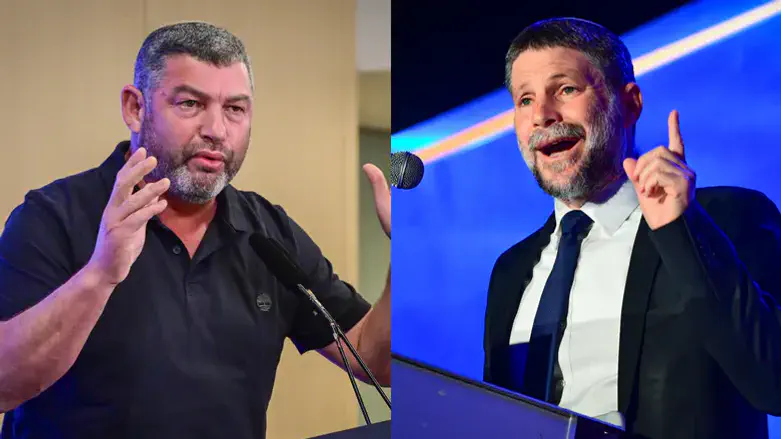
Kan News poll puts Eisenkot’s Yashar first with 23 seats, while a potential union of Winter, Smotrich and Feiglin would win 11 seats.


סמוטריץ' ווינטר
Smotrich and Winter                                                                  Avshalom Sassoni/Flash90

Gadi Eisenkot's Yashar party led Kan News' Sunday election poll, conducted by Dudi Hasid and the Kantar Institute, with 23 seats, followed closely behind by the Likud, with 20 seats. Naftali Bennett's Together Party received 13 seats.

Hilli Tropper's addition to Yashar did not affect the party's seats compared to the outcome of the previous Kan poll.

Following the three leading parties, the poll gave the Democrats and United Torah Judaism eight seats each and Otzma Yehudit, Yisrael Beytenu, and Shas seven seats each.

The Religious Zionist party, running with Moshe Feiglin's Zhut, received six seats. Closing out the list with four seats each are Ofer Winter's Amcha Yisrael party and the new union between Yoaz Hendel's Reservists and Prof. Yaron Zelekha's Economic Party.

Among the Arab parties, the Joint List (Hadash, Ta'al, and Balad) receives seven seats, while the United Arab List (Ra'am) receives six. Blue and White does not pass the electoral threshold.

Looking at blocs, Prime Minister Netanyahu's supporters receive 52 seats, while the bloc led by Eisenkot receives 51. The Arab parties together receive 13 seats.

Sunday's Kan poll also found that a union between Ofer Winter, Smotrich's Religious Zionists, and Feilglin's Zehut would win 11 seats. 


Israel National News

Source: https://www.israelnationalnews.com/news/432801

Follow Middle East and Terrorism on Twitter
War With Iran: Time for a Rethink - Amir Taheri


by Amir Taheri

[The Khoneinists] need the war to continue to justify their failure in all domains and their repression of dissidents.


  • The leftover Khomeinists... want the war to continue at a low intensity to keep their claim of "resistance" alive and postpone the inevitable volcano of popular anger against their ramshackle rule.

  • They need the war to continue to justify their failure in all domains and their repression of dissidents.

The leftover Khomeinists... want the war to continue at a low intensity to keep their claim of "resistance" alive and postpone the inevitable volcano of popular anger against their ramshackle rule. Pictured: Supporters of the Iranian regime commemorating the late Supreme Leader Ali Khamenei at the Imam Khomeini Mosalla Grand Mosque in Tehran, on July 14, 2026. (Photo by Majid Saeedi/Getty Images)

Long before some American politicians and pundits were beating the drums for war against Iran, Victor Davis Hanson reminded his readers that two of the nine "landmark battles in the rise to Western power" were against Persia.

The battles mentioned by the respected military historian were in Salamis, where the Greek city-states, led by Athens, sunk the Persian fleet, and Gaugamela, where Alexander of Macedonia defeated Darius III.

The late Republican Senator Lindsey Graham, a vocal advocate of an attack on Iran, wrote in March 2026 that neutralizing Iran was the key to "ending a 2,000-year-long conflict."

Last week, Trump ordered a strike on rocket launchers on the Iranian island of Larak, which was supposed to be the opening salvo in a fresh round of attacks.

However, it quickly became apparent that Trump had ordered the strike to send a signal to China and Russia, which were leading a summit of the Shanghai Cooperation Organisation (SCO) in Kyrgyzstan, that the war with Iran, also attending the summit, wasn't yet over.

A war that had started with unprecedented shock-and-awe intensity has morphed into a low-intensity one that could go on for months, if not years, with the protagonists losing track in the fog of war.

One might also wonder about the Ukrainization of the current war on Iran in the sense that the conflict continues at a lower, though still deadly, level with no clear objective in sight.

For the past three months, Trump at least has given top billing to his demand that the Strait of Hormuz be opened.

Regardless of punctual hitches, that has been the case for at least three weeks.

According to international navigation sources, an average of 50 to 60 ships pass through the strait daily, not yet up to what it was before the war, but far from a total shut-down.

Despite braggadocio by the aging teenagers who run the curtailed Khomeinist show in Tehran, the backlog of ships trapped in the strait is almost cleared. Oil is also flowing out at a daily average of over 8 million barrels a day.

According to Trump, all sea mines, probably imaginary, laid Iran in the strait have been cleared.

As for Tehran's boast about turning the strait into a money tree, so far no ship has paid a penny for a passage.

Israel, which the usual suspects blame as the instigator of the war, is now at the ringside wondering what to make of Trump's pirouetting.

The leftover Khomeinists have understood this and halted attacks on Israel, targeting Jordan, Bahrain and the UAE.

They want the war to continue at a low intensity to keep their claim of "resistance" alive and postpone the inevitable volcano of popular anger against their ramshackle rule.

They need the war to continue to justify their failure in all domains and their repression of dissidents. The national currency is in free fall; they blame the war. GDP has fallen by almost 6 percent in a year; they blame the war. The number of Iranians below the poverty line has jumped to 58 percent; they blame the war. Inflation has topped 60 percent; they blame the war. The central bank governor admits he is ordered to print money on a no-tomorrow basis; they blame the war.

If the war ends, the thinly disguised struggle for power within the ruling clique could break into the open. Rival factions may be forced to appeal to the people in the hope of tipping the balance in their own favor.

People may ask why the declared "Supreme Guide" -- who is in purdah, supposedly for security reasons -- doesn't show his face.

There are many cases where the end of a war leads to a change of leadership or even regime change.

Winston Churchill and Charles de Gaulle were victors in World War II, but both lost power soon after they had uncorked the champagne bottle.

In the US, President Harry S. Truman was at the helm when the last arm of the Axis was broken. But in the first post-war midterm elections, Democrats lost the House and Senate.

Today, I doubt if Volodymyr Zelensky or Vladimir Putin would be able to hang on to power for long once their war is over.

In 1981, Ruhollah Khomeini described the war started by Saddam Hussein as "a divine gift." His right-hand man, Akbar Hashemi Rafsanjani, said that without the war he wasn't sure the Islamic regime could have lasted more than a couple of years.

The leftover Khomeinists need the war, but Trump doesn't.

To start with, this is a war of choice, not of necessity, which means the average American doesn't feel threatened by ending it, nor would he feel elated by winning it.

Next, Trump won't be seeking re-election, and anyone he picks as his putative successor would be judged on his own merits and many other issues than this strange war.

Finally, Trump doesn't need a war victory to preach his gospel. Regardless of some obvious setbacks, he has a reasonable story to tell on the economy.

His campaign against illegal immigration is still popular, and his efforts to curtail elitism, often dressed as pseudo-leftist pretensions, have appeal beyond his support base once described by Hillary Clinton as a "basket of deplorables."

Since neither Trump nor anyone else knows what winning this war might mean, he has no interest in staying in the game, especially when he knows that declaring victory would expose the adversary to mortal -- possibly fatal -- danger at home.

He has weakened the Khomeinist regime to an extent unimaginable a year ago. He should now pass the ball to the Iranian people to settle their account with it.

Gatestone Institute would like to thank the author for his kind permission to reprint this article in slightly different form from Asharq Al-Awsat. 


Amir Taheri w
as the executive editor-in-chief of the daily Kayhan in Iran from 1972 to 1979. He has worked at or written for innumerable publications, published eleven books, and has been a columnist for Asharq Al-Awsat since 1987. He graciously serves as Chairman of Gatestone Europe.

Source: https://www.gatestoneinstitute.org/22840/war-with-iran-rethink

Follow Middle East and Terrorism on Twitter