Sunday, October 19, 2014

Iron Dome: "Rigged Success"? - Peter Huessy


by Peter Huessy


Critics of missile defense must have seen their whole multi-decade, multi-million dollar campaign to stop U.S. missile defenses in danger of crashing to the ground.
"All flight tests of the weapon have been rigged," William Broad, New York Times, June 9, 2000.
The success of Iron Dome apparently gave lie to the repeated claims that missile defense tests are rigged; that missile defense systems cannot work; that they do not save lives, and that the threat of rocket attacks must be dealt with through appeasement and concessions.

Imagine that hundreds of armed terrorists from ISIS are in a secure sanctuary in northern Mexico. For nearly two months in 2015, they launch 4479 rockets into the United States. Their targets are schools, hospitals, apartment buildings and day-care centers in Texas, New Mexico and Arizona.

Then imagine that not a single person is killed from this terrorist rocket barrage (although mortar fire at one border crossing kills two Americans).

Why are so few Americans harmed? A missile-defense system along America's border with Mexico was able to shoot down over 90% of the incoming rockets that were engaged, while others could be ignored as they fell harmlessly into the southwestern American desert.

Further imagine that, say, Canada helped fund such a missile-defense. Americans would be thankful for the help of its Canadian brothers and sisters; cheer the defense industry that developed the missile-defense which, as President Reagan said in 1983, allows us to protect lives rather than avenge them; and they would thank God there were so few fatalities.

The media would tell a story of success; folks would move to support further defensive missile technology, and then tell their leaders go and find ISIS and destroy every last vestige of them.

The parallel to this is exactly what took place in the skies over Israel between July 6 and August 26, 2014.

The aggressor was not ISIS but its sister terrorist group, Hamas, which launched 4479 rockets at Israel from the Gaza Strip.[1]

Ninety percent of the rockets launched by Hamas and engaged by the Iron Dome missile defense were destroyed. This defense technology was funded in part by the U.S. Department of Defense (although developed, built and used solely by Israel in 2012 in the first Gaza rocket war).
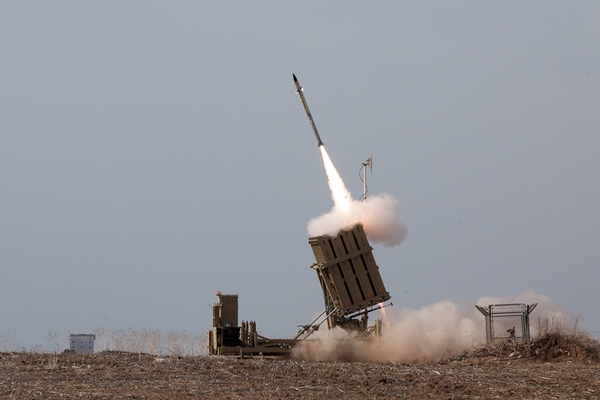
A battery of the Iron Dome missile defense system. (Image source: IDF)
There were zero Israeli fatalities from Hamas's rocket fire in areas defended by Iron Dome, although two Israelis perished and 30 Israelis were wounded, some seriously, from Hamas rockets not intercepted by Iron Dome.

News outlets such as the Wall Street Journal[2] and CNN lauded the Iron Dome's success.[3]

Other 2014 articles echoed a similar story from Time magazine on the first use of Iron Dome in 2012: that Iron Dome was the "most effective, most tested missile shield the world has ever seen."[4]

But then the story changed.

The Bulletin of the Atomic Scientists started the skeptical coverage on July 19, 2014 with a story purporting to reveal "The evidence that shows Iron Dome is not working."[5]

Reuter's David Axe followed up a week later with a story, complaining on July 25, 2014, "Israel's Iron Dome is more like an iron sieve."[6]

On July 31, 2014, the Middle East Monitor entitled a story "It is a lie to say that Iron Dome is Protecting Israelis from Hamas." [7]

Two weeks later, August 12, 2014, reporter Dylan Scott asked, "For all the Hype, Does Israel's Iron Dome Even Work?" [8]

What happened?

In America there is a strong anti-missile defense "industry." Most of the organizations that subscribe to its views are either highly skeptical of missile defenses, or oppose them altogether. [9]

Most have also worked for many years to stop, delay, or defund American missile defense deployments, especially those designed to protect the continental United States as opposed to our allies or forces overseas.

In tracking the success of the Iron Dome, in 2006, before it existed, Hezbollah, in Lebanon, launched 4200 rockets at Israel; they killed 53 people.[10]

In 2012, when Iron Dome was initially deployed with five interceptor missile batteries, Hamas launched 1600 rockets at Israel; they caused five fatalities.

In 2014, Hamas launched 4479 rockets at Israel, which was protected by nine Iron Dome batteries. The rockets caused two fatalities -- in an open area not protected by Iron Dome.

To compare: from 2006 to 2014, more rockets were fired at Israel than were launched by Nazi Germany against Great Britain in all of World War II. Yet Israel fatalities dropped from 53, to 5, to 2.

As noted by Uzi Rubin, founder and former director of the Israel Missile Defense Organization (in Israel's Ministry of Defense), in his September 12 briefing in Washington, D.C.[11], there were missile defense critics who seemed unhappy that Iron Dome appeared to work well.

Many critics of missile defense sometimes sound as if they assume that the proponents of missile defense want the U.S. to protect America all by itself -- without the help of other nations -- and without relying on arms control agreements with other countries. They thus described President George W. Bush's 2002 plan to build national missile defenses in Alaska and California as a "go it alone" strategy.

But is such a charge true? Today, the American Missile Defense Agency [MDA] website features dozens of nations with which the U.S. cooperates in pursuing joint missile-defense objectives -- precisely what missile defense critics complained was not being done.

Furthermore, simultaneously, from 2002-08 the Bush administration also significantly reduced nuclear weapons stockpiles with the Moscow Treaty between the U.S. and Russia, proving the compatibility of pursuing both missile defense and "working with others" on proliferation threats.

On July 19, 2004, for instance, former MDA Director Lt. Gen. Trey Obering noted in remarks to the Multinational Missile Defense Conference in Berlin, Germany,[12] three keys ways the US had been seeking international cooperation on missile defense during the Bush administration:
"That is why we emphasize in the Missile Defense Agency this simple axiom—geography counts. It matters where we locate the piece parts of the missile defense system. The role for our allies [emphasis added] here is obvious. Second, we need to present a united front to those who would seek to harm us with ballistic missiles. Our ability to deter attacks and dissuade other governments from investing in ballistic missiles will be significantly enhanced if we can speak through our alliances, friendships, and coalitions with a single voice. Third, cooperation means pooling our intellectual and financial resources." [Emphasis added].
* * *
According to Uzi Rubin[13], the aforementioned press reports relied on amateur videos and photographs of the missile intercepts over Israel, as well as on an examination of pictures of the "smoke contrails" of the Iron Dome interceptor and Hamas rocket explosions.[14]

Press reports also noted that much of the critical analysis of Iron Dome came from an assessment of the 2012 Gaza missile attacks, and not primarily from the 2014 rocket attacks from Gaza.[15]

National Public Radio [NPR], on its "All Things Considered" program, just three days after the beginning of the 2014 Gaza War, claimed Iron Dome did not work -- before most data from the 2014 attacks could even be fully collected and analyzed.[16]

After two months of the rocket attacks, some in the arms-control community, such as Subrata Ghoshroy of MIT, originally gave grudging praise for Iron Dome's success[17] while others, referenced such media coverage as the June 9 NPR story in concluding that the Iron Dome probably did not work.

Others concluded that even if the Iron Dome system did work, it does not make Israel any less blameworthy for protecting itself. As it was put in one essay from the Bulletin of the Atomic Scientists [18], "Israel needs to end the lockdown on Gaza." For Israel to allow enemies outspokenly dedicated to its destruction to be better able to attack it?

Still others in the arms-control community eventually went back to their ongoing, comfortable position that if it is a missile defense system, it cannot possibly work. As Philip Coyle emphasized, "No military system is 90% effective."[19]

If Iron Dome is effective, and works well, it would be a huge boost to missile defense in general and the security of the U.S. and its allies in particular.

American arms-control groups, however, have defined "effectiveness"[20] in a manner that makes achieving either workability or effectiveness for U.S. missile defenses extremely difficult.

The current missile defense of the continental United States, for example, intercepts missiles in mid-course, in space, where it is difficult to distinguish decoys and other counter measures from real warheads.

American mid-course-intercept tests have worked in 9 of 14 tests, and have overcome some key technological hurdles. But many critics continue to insist such missile defense tests are rigged and thus the missile defense technology will never demonstrate a sufficient capability to enable a high confidence in the system working. In short, its nothing but a military boondoggle.[21]

Under such assumptions, it is not surprising that as one prominent critic from the Union of Concerned Scientists [UCS], Lisbeth Gronlund claimed, missile defense was unachievable unless it was one hundred percent reliable: "It shouldn't be deployed," adding, "Something is not better than nothing."[22]

Three years later, at a May 14, 2004 UCS press conference, Gronlund said in a variation on the same theme, "No missile-defense is better than some defense," a statement echoed a week later by press conference participant Congressman Rush Holt, who called missile defense a "wasteful, dead-end program that adds nothing to our real national defense."[23]

The United States has conducted dozens of missile defense tests for a variety of systems. Such tests have been successful in 66 out of 81 attempts, including, most recently, 20 successful intercept tests in a row, including consecutively successful tests of the U.S. Navy's Aegis, and the Army's Terminal High Altitude Air Defense [THAAD] and Patriot missile defenses.

But such a success rate is still not sufficient to get the support of missile defense critics. Philip Coyle of the Center for Arms Control, for example, proclaimed at a June 4, 2014 Brookings Institution missile defense seminar that he was "surprised" that some of the American missile defense tests failed because they were all "rigged for success."[24]

As the New York Times put it in a June 9, 2000 report, "all flight tests of the weapon have been rigged". Ironically, this charge by the New York Times was made during the Clinton Administration, although subsequent reporting by the Times made it appear the "rigged" tests were solely an artifact of the subsequent George W. Bush administration missile defense program.[25]

By contrast, the success of Iron Dome upset the rhetorical apple cart of the missile-defense deniers. In the real world of an actual war, this missile defense system worked. There was nothing "rigged" about its success -- and obviously it performed in a "realistic environment."

As many members of the U.S. Congress concluded this summer after watching and hearing of Iron Dome's success, if missile defense can protect Israel, missile defense can protect America, too.[26]

The critics of missile defense must have seen their whole multi-decade, multi-million dollar campaign to stop U.S. missile defenses in danger of crashing to the ground if the American people came to believe missile defenses like Iron Dome did, in fact, work -- and work spectacularly well.
* * *
According to a briefing[27] by missile defense expert Uzi Rubin, most critics of Iron Dome were guilty of making seven key mistakes.

First, said Rubin, the pictures and videos of Iron Dome interceptors appearing to plummet to earth -- and thus giving some the idea that Iron Dome was not working -- were an optical illusion that understandably easily confused non-experts. In fact, the Iron Dome interceptors were actually homing in on their targets.

Second, the critics failed to account for nearly 4500 Hamas warheads that had to land somewhere in Israel. If they were not intercepted, where did they go?

Some Iron Dome critics, said Rubin, simply assumed that thousands of Hamas warheads, while not intercepted, either did not explode or were ineffective and thus did not cause much damage.

In fact, Rubin said, Iron Dome intercepted hundreds of Hamas rockets; others fell in open desert or vacant areas, while some did strike property and, in unprotected spaces, did cause some Israeli casualties and injuries, some serious.

By contrast, in 2006, when Israel had no missile defenses against Hezbollah rockets, many more Israelis were killed or wounded, and property damage was extensive.

Third, critics, pointing to mobile phone "pictures" of Hamas Grad rockets apparently bypassing the Iron Dome interceptors, alleged that the interceptor missile had to "hit the attacking missile head on," otherwise the attacking rocket could not be destroyed.

On July 9, for instance, three days after the Hamas rocket attacks commenced, Bob Siegel of NPR said: "As I understand it, for it to work, it actually has to hit an oncoming rocket head on." His guest assured him that he was "correct" adding, "The Iron Dome has no chance, for all practical purposes, of destroying the [Hamas] artillery rocket."[28]

According to Uzi Rubin, "the critics just got this part wrong".

What they missed, said Rubin,[29] is that Iron Dome has an "elegant capability" to destroy an adversary's rocket even if it is just nearby an incoming rocket. The interceptor, Rubin explained, must indeed "approach" the incoming rocket "head on" but does not need actually to strike the rocket at that point.

Fourth, Rubin said, damage to property in Israel was totally inconsistent with the idea that Iron Dome failed to intercept a high percent of Hamas rockets. Damage from such rocket attacks, he explained, is reimbursed by the State of Israel upon the filing of a claim, no questions asked. Even if it is not unheard of to have people fudge things and occasionally blame some "fender benders" on "rocket attacks," in 2014, despite twice as many rocket attacks as in 2012, the number of Israel property-damage claims fell by 25%.

Fifth, in 2014, despite an increase in the number and frequency of rocket attacks, Israel's fatalities fell from 53 to 2, a decrease of 97%.[30]

Sixth, in all measures of lethality, there were dramatically fewer casualties and property damage in Israel in 2014 when Iron Dome was deployed, compared to the casualties and property damage from rockets in the 2006 Lebanon War, when Iron Dome was not deployed.

Finally, Rubin explained that Israel's civil defense shelters -- often simply safe-rooms in buildings and apartments -- did not account for the low number of casualties and scarce property damage in 2014.[31] The same civil defense shelters were present in 2006 when 53 Israelis died in the missile war that year. And Israelis are not able to run for shelter faster now than in 2006.

The difference, then, between 2006 and 2014 was precisely the presence of Iron Dome.

In short, Iron Dome gave lie to the repeated claims that missile defense tests are "successful" only because they are rigged; that missile defense systems cannot work; that they do not save lives, and that the threat of rocket attacks must be dealt with through appeasement and concessions.

Missile threats from countries such as Iran and North Korea can be dealt with, at least in part, by missile defenses.

We do not have to be victims unless we choose to be. We can successfully defend ourselves.

We should, finally, ask ourselves seriously: Is "No missile-defense better than some defense"? Really?

[1] "Israeli Missile Defense" by Uzi Rubin, who founded and was the first director of the Israel Missile Defense Organization in the Israel Ministry of Defense (MOD) and is known as the "Father" of the Israeli Arrow Missile Defense… September 12, 2014 from C-Span, read more.
[2] WSJ Video, "How Israel's Iron Dome Rocket Defense System Works", July 11, 2014, noting its successful intercept rate.
[3] "How Iron Dome blocks rockets from Gaza, protects Israelis" by Michael Martinez and Josh Levs, CNN, July 9, 2014
[4] "Iron Dome: A Missile Shield That Works", Time.com, November 19, 2012,
[5] "The evidence that shows Iron Dome is not working", Bulletin of the Atomic Scientists (BAS), July 19, 2014.
[6] . "Israel's Iron Dome is more like an iron sieve", by David Axe, Reuters, July 25, 2014. Axe writes: The conclusions were based on "Careful analysis of amateur videos and photos of Iron Dome interceptions over the past three years...most of [this] data is from a previous round of fighting in 2012."
[7] "Middle East Monitor Story on Missile Defense Quotes Phil Coyle" by Alastair Sloan July 31, 2014, subtitled "It is a lie to say that Iron Dome is protecting Israelis from Hamas."
[8] In "For All The Hype, Does Israel's Iron Dome Even Work?", Talking Points Memo, August 21, 2014, Dylan Scott asks: "But what if the U.S. government is pouring hundreds of millions of dollars into a system that isn't nearly as effective as it is claimed to be?"
[9] The Arms Control Lobby Confronts Ballistic Missile Defense: Critics Torture Logic to Discredit Anti-Missile Technology, March 2003 Capital Research Center, Washington, D.C.
[10] From Uzi Rubin, September 12, 2014, "The Gaza Missile Wars", CSpan.
[11] From Uzi Rubin, September 12, 2014, "The Gaza Missile Wars", CSpan. See also "Iron Dome—Savior, or Sales Job?", by Jim Fallows, The Atlantic, July 15, 2014, and "Does Israel's US-funded Iron Dome make the world safer?" by Azriel Bermant, The Guardian, August 6, 2014.
[12] From the MDA.org website, Address by Lt.Gen (Ret) Trey Obering, USAF, former Director, Missile Defense Agency, Multinational BMD Conference, Berlin, Germany, July 19, 2004.
[13] From Uzi Rubin, September 12,2014, "The Gaza Missile Wars", CSpan.
[14] From Uzi Rubin, September 12,2014, "The Gaza Missile Wars", CSpan.
[15] Aviation Week and Space Technology, "Iron Dome -- Are The Critics On Target?" by Bill Sweetman, Aug 25, 2014.
[16] "The Rockets from Hamas, and the Iron Dome That Could Use Patching", July 9, 2014, All Things Considered, National Public Radio.
[17] "Israel's Iron Dome: A misplaced debate", Bulletin of the Atomic Scientists (BAS), July 29, 2014.
[18] "Israel's Iron Dome: A misplaced debate", Bulletin of the Atomic Scientists (BAS), July 29, 2014. See also: "More Than a Missile: Judging Iron Dome" by Zachary Goldman, August 11, 2014, Commentary;"Iron Dome: The public relations weapon" by John Mecklin, Bulletin of the Atomic Scientists (BAS). Mecklin writes: "Israel's Iron Dome rocket defense system is high-tech. So is the PR campaign around it." 27 May, 2014. And "Iron Dome Boondoggle: Has Obama Just Signed a $225M Check for a Defective Israeli Missile Shield?," DemocracyNow.org. See also David Talbot in Technology Review, "Israeli Rocket Defense System is Failing", July 10, 2014.
[19] Quoted in the Middle East Monitor story by Alastair Sloan of July 31, 2014 entitled "It is a lie to say that Iron Dome is protecting Israelis from Hamas."
[20] For an extended look at what makes missile defense effective, the June 26, 2014 update of the Institute for Foreign Policy Analysis [IFPA] Independent Working Group on Missile Defense is an excellent source as well as "The Arms Control Lobby Confronts Ballistic Missile Defense: Critics Torture Logic to Discredit Anti-Missile Technology", March 2003 Capital Research Center, Washington, D.C. See Defense Dossier, American Foreign Policy Council, February 10, 2014, "Missile Defense for Today and Tomorrow" by Rebeccah Heinrichs.
[21] Missile Defense Agency - U.S. Department of Defense test data show 65 of 79 actual tests were successful (excluding two tests where the test was aborted because the target or interceptor did not launch).
[22] At the Union of Concerned Scientists, Press Conference, on July 26, 2001. At a later Washington, D.C., UCS Press Conference, on May 14, 2004, Lisbeth Gronlund said: "No missile-defense is better than some defense."
[23] Congressman Rush Holt, (D-NJ), Congressional Record, May 21, 2004, House of Representatives. Also May 14, 2004, UCS press conference and follow-up remarks on May 21, 2004 on the floor of the House.
[24] "U.S. Missile Defense Developments: How Far? How Fast?" Brookings Institution, June 4, 2014.
[25] "Antimissile Testing is Rigged to Hide a Flaw, Critics Say," by William Broad, June 9, 2000, New York Times.
[26] "Americans Should Take Notes on Israel's Iron Dome", by Rebeccah Heinrichs , July 27, 2014, Daily Signal.
[27] From Uzi Rubin briefing in Washington, D.C. provided to over 120 top defense specialists, September 12, 2014, "The Gaza Missile Wars", CSpan.
[28] "The Rockets from Hamas, and the Iron Dome That Could Use Patching", July 9, 2014, All Things Considered, National Public Radio.
[29] From the Uzi Rubin, "The Gaza Missile Wars" September 12, 2014 briefing (picked up by C-Span).
[30] From Uzi Rubin, September 12,2014, "The Gaza Missile Wars", CSpan. The rocket attacks were 4200 in 2006 and 4479 in 2014.
[31] From Uzi Rubin, September 12,2014, "The Gaza Missile Wars", CSpan.


Peter Huessy

Source: http://www.gatestoneinstitute.org/4775/iron-dome-rigged

Copyright - Original materials copyright (c) by the authors.

Recognizing a Terror State - Steven Plaut


by Steven Plaut


palestinians_jrl109_l1h5k_16298

So let us see if we have this straight.  The British parliament decides to “recognize” the “state” of “Palestine.”    It thus reverts to exactly the same displays of courage and integrity that it showed back when Britain recognized the right to self-determination of the Sudeten Germans in 1938.   All this from Britain, the occupier of Gibraltar, the Falklands, Wales, Scotland, Ulster, and the Channel Islands.   The Brits are  joined by Sweden in a similar belch of “recognition.”  You remember Sweden, the country that was too cowardly to choose a side in either World War and that provided iron ore to feed Hitler’s war machine.  Yes, Sweden, which refuses to recognize the rights to self-determination of its own Samis, and whose journalists recycle medieval blood libels about Jews murdering gentiles and selling their body parts.   Other European countries are expected to follow.  Why “Palestine” is any more worthy of being “recognized” than ISIS, another terrorist gang claiming to be a state seeking “recognition,” is never explained.

Now an interesting twist to the story is the demonstration of the Israeli Radical Left of its contempt for democracy and for Israeli sovereignty.  The Israeli Left, led by the tenured leftists, is willing to endorse pretty much anything that is harmful to its own country.  It has been urging European countries to “recognize the state of Palestine.”   A petition was signed by dozens of Israel’s most anti-Israel academics, plus some non-academic members of the Hamas Lobby.  It was organized by Amiram Goldblum from the Hebrew University, a founder of the extremist anti-Israel “Peace Now” organization, and Alon Liel, an ex-diplomat who now teaches for some reason at Tel Aviv University.  These two were earlier among the initiators and organizers of a notorious pseudo-poll that claimed falsely to show that Israeli Jews favor “apartheid.”   That “poll” last year was an exercise in distortion and tendentious manipulation, designed to generate misleading “statistics.”  It was thoroughly discredited by serious social scientists.

Now the same “Israel is an Apartheid Regime” propaganda team is back, rallying the rest of the anti-Israel academic Left to attempt to bypass and neutralize Israeli sovereignty.   Their initiative also reflects the utter contempt and disdain that Leftists in Israel have for democracy.

No one is stopping the Radical Left in Israel from peddling its ideological wares in the marketplace of public opinion.  In fact the Radical Left exercises unchallenged control over two of Israel’s daily newspapers and also dominates all of the television and radio broadcasts.   The problem is that it has been a dramatic failure.  Its anti-Israel lobbying has fallen flat on its face.  The public simply repudiates the Left’s agenda.  Treason just has not proved to be the grand vote grabber that the Left expected.   Certainly since the outbreak of the recent battles in Gaza, almost no one in Israel still favors the so-called “Two State Solution.”  Almost no one is willing to see Israel “withdraw” from the West Bank and allow a Palestinian terror state to operate there.  Almost no one is willing to reward Hamas with “concessions.”

The Left understands that its “ideas” have been rejected by nearly the entire Israeli political spectrum.  Since it is incapable of persuading Israelis of the correctness of its agenda, it has decided instead to recruit foreign powers to “do the job” for it and bully Israel.  It demands that foreign countries and organizations hostile to Israel coerce the Jewish country into adopting the very political platform favored by the Left that is rejected by perhaps 97% of Israelis.

Goldblum, the organizer of the petition calling for European recognition of the “state of Palestine,” has a long track record of calling for Europeans to suppress and override Israeli sovereignty and impose policies upon Israel from without opposed by the bulk of Israelis.   In a notorious speech before an assembly of leftists in May 2012, Goldblum was quoted as calling upon Israel’s Left to stop wasting its time attempting to persuade the general public to embrace its political agenda, evidently because it is clear that the public will never do so.  Goldblum said he has no interest in the Israeli electorate and general public and called upon the radical Left to go directly to political groups abroad, outside of Israel, and recruit them as pressure groups to coerce Israel into accepting the agenda of the Israeli Left.

His comrades in Petitiongate are not very different.  Among the signers calling on Europeans to “recognize Palestine” are Shlomo Sand, the pseudo-historian from Tel Aviv University who is the most openly anti-Semitic “academic” in Israel, Oren Yiftachel, who has built an “academic” career by asserting that Israel is an apartheid regime, plus a gaggle of card-carrying communists, tenured anti-Semites, and Hamas aficionados.  The presence of such people on the faculties of Israeli universities tells you pretty much all you need to know about the state of academic standards here.

The only thing the signers of the petition detest more than their own country is freedom of speech.  The Israeli far Left is a fascist movement that ferociously opposes not only Israeli sovereignty but also democracy and freedom of speech for non-leftists.   Critics of leftists must be silenced and indicted, insist the Far Leftists, because the exercise of freedom of speech by non-leftists produces violence and it is a clear and present danger.

Meanwhile the number of Tenured Leftists openly calling for violence and murder grows.  The leftist Attorney General never prosecutes such people for their calls to murder.  They are just engaged in protected speech, you see, unlike Rabbis who write controversial books or Non-Leftist protesters expressing their opinions boisterously.  Many of the tenured extremists seek to suppress academic freedom for Non-Leftists, especially for critics of the Left, and also freedom of speech.  Goldblum, the initiator of the petition for “recognition of the State of Palestine,” has a long track record of filing anti-democratic harassment SLAPP suits against those who disagree with his extremist opinions.   Ben Dror Yemini, a Dean of Israeli journalism, has denounced Goldblum as an anti-democratic fanatic.

The Israeli signers of the petition calling upon European countries and others to negate Israeli sovereignty and to “recognize” the “state” of “Palestine” not only hate their own country, but they also hate basic democracy and human freedoms.   “Peace Now,” whose name in Hebrew is Shalom Achshav, should change its name to SHISIS = Subverters and Harassers of Israel and of Israelis.   It may yet merge with ISIS.  Its head should be renamed the Grand Israeli Scheisskopf.


Steven Plaut is a native Philadelphian who teaches business finance and economics at the University of Haifa in Israel.  He holds a PhD in economics from Princeton.  He is author of the David Horowitz Freedom Center booklets about the Hamas  and Jewish Enablers of the War against Israel.

Source: http://www.frontpagemag.com/2014/steven-plaut/recognizing-a-terror-state/

Copyright - Original materials copyright (c) by the authors.

Another Islamic State push to take Kobani - Rick Moran


by Rick Moran


Islamic State forces attacked the Kurdish border town of Kobani from three sides on Sunday, looking for a decisive blow against the out-gunned defenders.

Reuters:
"We had the most intense clashes of days, perhaps a week last night. (Islamic State) attacked from three different sides including the municipality building side and the market place," said Abdulrahman Gok, a journalist in Kobani.
"Clashes did not stop until the morning. We have had an early morning walk inside the city and have seen lots of damaged cars on the streets and unexploded mortar shells," he said.
CAR BOMBS
The Observatory reported two Islamic State car bombs hit Kurdish positions on Saturday evening leading to casualties. A cloud of black smoke towered over Kobani on Sunday.
A fighter from the female units of the main Syrian Kurdish militia in Kobani, YPG, said Kurdish fighters were able to detonate the car bombs before they reached their targets.
"Last night there were clashes all across Kobani ... this morning the clashes are still ongoing," she said, speaking on condition of anonymity.
The Observatory said 70 Islamic State fighters had been killed in the past two days, according to sources at the hospital in the nearby town of Tel Abyab, where Islamic State bodies are taken. Reuters cannot independently confirm the reports due to security restrictions.
The Observatory said some Syrian Arab fighters from the Revolutionaries of Raqqa Brigade, which are fighting alongside Kurdish fighters, had executed two Islamic State captives.
"One was a child of around 15 years old. They shot them in the head," he said.
Islamic State have also used executions throughout their campaigns in Syria and Iraq, killing hundreds of their enemies and civilians who are opposed to their cause, according to Islamic State videos and statements.
Hundreds of thousands have fled their advance. Turkey hosts about 1.5 million Syrian refugees, including almost 200,000 Syrian Kurds from Kobani.
Ankara has refused to rearm beleaguered Kurdish fighters, who complain they are at huge disadvantage in the face of Islamic State's weaponry, many of it seized from the Iraqi military when it took the city of Mosul in June.
Turkey views the YPG with suspicion for its long-standing links with the Kurdistan Workers Party (PKK), which has waged a 30-year armed campaign for self-rule in Turkey.
IS fighters are nothing if not relentless. Their efforts show just how important a propaganda victory would be for them if they could overrun Kobani. They would have stood up to coalition air power and overcome adversity, maintaining their aura of invincibility. On the other side of the ledger, President Obama's policy would be exposed as the hollow thing it is.

The Kurds will sell their lives dearly in protecting their city, but superior numbers and firepower is on the side of Islamic State. Whether that will be enough remains to be seen.


Rick Moran

Source: http://www.americanthinker.com/blog/2014/10/another_islamic_state_push_to_take_kobani.html

Copyright - Original materials copyright (c) by the authors.

Islamic State Working to Add Warplanes to Arsenal


by Yoni Hirsch, Eli Leon, Daniel Siryoti, News Agencies and Israel Hayom Staff


With the help of former Iraqi air force pilots, ISIS is test flying several fighter jets captured from Syrian bases • Pentagon shies from providing body count, but says several hundred ISIS fighters killed in Syrian border town in recent days.

Explosions from airstrikes on the Syria-Turkey border town of Kobani, the scene heavy fighting between ISIS and Syrian Kurds
Photo credit: Reuters

Yoni Hirsch, Eli Leon, Daniel Siryoti, News Agencies and Israel Hayom Staff

Source: http://www.israelhayom.com/site/newsletter_article.php?id=20809

Copyright - Original materials copyright (c) by the authors.

Foreign Policy takes Center Stage in US - Zalman Shoval


by Zalman Shoval


Less than three weeks before the midterm elections in the United States, the war against the Islamic State group has become one of the most significant issues in the campaign, which is in the Republicans' favor.

This is an ironic turn of events, as not long ago various political pundits and pollsters hedged that foreign policy, especially concerning the Middle East, would have little impact on the midterm elections. On the contrary, they said, the current congressional race is devoid of any ideological characteristics, and the voters are likely to make their decision based on their attitude towards U.S. President Barack Obama.

The fact that the president plays such a key role in the voters' considerations is also surprising, as midterm elections are usually decided according to local interests, rather than any wider, national interest. This time, however, the congressional race is likely to reflect the voters' confidence -- or lack thereof -- in Obama's performance.

The latter is also reflected in the American public's view of the economic situation in the U.S., where the administration has marked some positive accomplishments, including a significant drop in unemployment. While this should have helped the Democrats' prospects in the midterm elections, recent polls have found the majority of Americans do not credit Obama with this improvement. 

Two years ago, the Obama administration declared its intent to shift the focus of its foreign policy from the Middle East to Southeast Asia. This included pulling all American troops from Iraq and removing nearly all American troops from Afghanistan, as well as reducing the war on terror. 

But then, as if to mock the administration's new policies, things blew up in Obama's face: Syria plunged into a bloody civil war; U.S. Ambassador to Libya Christopher Stevens was killed in an attack on the American consulate in Benghazi; Egypt underwent a political change the U.S. failed to understand; and various al-Qaida offshoots broke free, giving birth to the formidable threat now known as Islamic State. 

The gruesome footage of Islamic State terrorists beheading hostages, including American ones, as well as the other horrific acts the group has perpetrated, shifted the needle of the political barometer in the U.S. from overall opposition to any American involvement in the Middle East, to growing -- albeit limited -- support in such involvement. 

Obama too, had come to the conclusion that the United States can no longer stand idly by, and ordered an aerial campaign against Islamic State targets, hoping military action would redeem his faltering leadership in the public's eye; but the American public's support of his decision has yet to translate into an improvement in the president's or the Democratic Party's approval ratings.

The fact that several former Washington officials recently published memoirs leveling harsh criticism at what they called the Obama administration's foreign and Mideast policy failures, did little to help the situation. Former Defense Secretary Leon Panetta, for example, said Obama had "lost his way," while former State Department official Vali Nasr slammed the president as "shallow, politically driven and uninterested in real diplomacy." Similar descriptions appeared in the memoirs of other former administration officials. 

The Republicans traditionally enjoy the American public's trust when it comes to matters of national security -- even if said trust is not always justified -- so there is little wonder why Republican candidates have been trying to milk the new and timely jihadist threat for all it is worth.

We were not the ones to point out the president's faults -- his own advisors have done so, the Republicans' campaign states. Obama, it says, is confused and does not grasp the gravity of the threat Islamic terrorism poses.

The results of November's midterm elections may not directly shape the U.S.'s foreign policy for the remainder of Obama's term in office, but they will have some impact on it, including on issues concerning Israel. 

While Obama's unprecedented security collaboration with Israel is commendable, another possible result of the midterm election is that the chaotic realities of the Middle East, and the U.S.'s concern that Islamist terrorism will reach its soil, might reflect positively on Israel's importance as a strategic ally to Washington.


Zalman Shoval

Source: http://www.israelhayom.com/site/newsletter_opinion.php?id=10269

Copyright - Original materials copyright (c) by the authors.

Iran Remains the Chief Threat in the Middle East - Efraim Inbar


by Prof. Efraim Inbar


BESA Center Perspectives Paper No. 272


EXECUTIVE SUMMARY: The novelty of the Islamic State, as well as the magnitude of the threat it poses, are greatly exaggerated. Iran remains the main threat to stability in the Middle East. Its journey toward a nuclear arsenal must be stopped.

The emergence of the Islamic State (IS) on the battlefields of the civil war in Syria, and its subsequent spectacular successes in conquering parts of Syria and Iraq, have grabbed international attention. The gruesome pictures of IS’s barbaric beheadings supplied to the international media has only added to IS’s notoriety. The Islamic State’s quest to establish a new bloody Caliphate became a cause célèbre.

Many pundits have decided that the Islamic State is fundamentally changing the Middle East and they grope for new strategies to meet the challenge. In reality, however, the novelty of the Islamic State, as well as the magnitude of the threat it poses, are greatly exaggerated.

This organization is a reflection of the rise of radical political Islam in the Middle East over the last decades. Islam has always been a central component in the identity of the peoples of the Middle East. While Egypt, Iran and Turkey succeeded in maintaining a strong ethno-statist parallel identity, most of the Arab states have failed to instill statist identities through their education system. This means that primordial identities, tribal or sectarian, usually were stronger than the demand for loyalty by the particular states.

Moreover, many of the Arab states failed to modernize and deliver basic services, allowing for alternative Islamist structures to do a better job in providing education, medical and social work services to the impoverished masses. It is worth noting that the Muslim Brotherhood was established as early as 1928. Ever since, it has developed grassroots by trying to take care of the masses, while subverting the statist order in Muslim states with the goal of building a new Caliphate. Pan Arabism – a popular ideological inclination among the Arab elites – also undermined the legitimacy of the statist order, reinforcing Pan-Islamist impulses. Among the Shiites, the religious zeal turned Iran into an Islamic Republic in 1979 that has been trying since then to export its version of radical Shiite Islam.

For decades, it was the security services, probably the only well-functioning governmental agency, which provided stability, law and order. But maintaining a monopoly over the use of force was a challenge that has not been met successfully by the statist order established after the end of World War I and it has been disintegrating for quite a while. We have seen a failed state develop – where there is no monopoly over the use of force, but a myriad of militias – in Lebanon since the 1970s. In Yemen, there was a civil war in the 1960s which created much instability to this very day. Somalia is the best know example of a failed state. Meanwhile, the Palestinian Authority turned into a battlefield among competing militias almost immediately after its establishment in 1994. Strong dictators held Libya and Iraq together, but when they were gone these states became failed political entities. The Assad republican dynasty seems to have gone in the same direction.

Therefore, the Islamic State of today, which displays religious extremism and transnational tendencies, is the result of historic dynamics in the fledgling Arab civilization. Any long term look at the performance of the Arab states could reach the gloomy conclusion that their societies are doomed to poverty and political instability for a long while yet.

While the military and political successes of the Islamic State seem remarkable, its achievements are taking place in a political limbo with no real power to oppose it. The Islamic State has not faced yet any real test in state building and in overcoming violent opposition. Therefore, it is probably much too early to conclude that the Islamic State is able to govern and impose law and order in the swaths of land it has conquered.

Will it be spared the typical processes of fragmentation taking place among radical groups? Can the Islamic State take on Turkey or Iran – the rising powers in the Muslim Middle East? Can this organization be more dangerous to Israel than Hamas – a sister radical Sunni entity?

If the Islamic State is able to consolidate its conquests into a coherent state and turns south to take the energy riches of the Gulf, then it might become a real strategic actor. But any progress toward such a scenario will galvanize tremendous opposition by the Gulf States, including Saudi Arabia. Then the huge amounts of petro-dollars will be able to buy some security in the face of such an imminent danger. Even a confused Obama administration might eventually figure out what is at stake.

Therefore, the current situation does not yet warrant a change in the strategic assessment. Much of the fragmented Arab world will be busy dealing with its domestic problems for decades, minimizing the possibility that it will turn into a formidable enemy for Israel or the West.

It is crystal clear that the Iran-led Shiite axis remains the main threat to stability in the Middle East. Iran’s journey toward a nuclear arsenal – a true game changer – must be stopped. Unfortunately, the gullible West seems to continue to appease Iran, while the “threat” of the Islamic State serves as a welcome diversion.

BESA Center Perspectives Papers are published through the generosity of the Greg Rosshandler Family


Prof. Efraim Inbar, director of the Begin-Sadat Center for Strategic Studies, is a professor of political studies at Bar-Ilan University, and a Shillman/Ginsburg fellow at the Middle East Forum

Source: http://besacenter.org/perspectives-papers/iran-remains-threat-middle-east/

Copyright - Original materials copyright (c) by the authors.

Mahmoud Abbas's TV Says Israel Poisoned Gaza Wells - Arutz Sheva


by Arutz Sheva


'Moderate' Palestinian authority revives medieval libels against Jews, says poison was used as 'war strategy'.


Poison libel on PA TV
Screenshot
Two of the most destructive anti-Semitic blood libels of the Middle Ages have been brought back to life by the Palestinian Authority to promote hatred of Israelis, reports the Palestinian Media Watch (PMW).

In July, the official PA daily wrote that Jews use the blood of Palestinian children as the ingredient in matzah – unleavened bread – for the holiday of Passover, as reported by PMW.

Last month, official PA TV revived another medieval libel reporting as news that Israel was intentionally "injecting poison" into Palestinian water sources as a "war strategy" during the recent Gaza war:

Official PA TV newsreader: "Water experts have warned of the consequences of the attack by the occupation [Israel] on water wells, as a result of its use of poisonous bombs that threaten public health..."
Official PA TV reporter: "The policy of attacking water wells is a war strategy used by the occupation in its aggression against Gaza. Not only were the people deprived of water, but poison was also injected into main [water] sources, destroying agriculture." [Official PA TV, Sept. 24, 2014]


Both these libels were used to promote hatred in the Middle Ages and led to the murder of many thousands of Jews. The non-Jewish populations felt that slaughtering Jews was justified because they believed that Jews posed an imminent threat of poisoning wells and killing non-Jewish children.

In July, Abbas' official PA daily, Al-Hayat Al-Jadida, wrote that Jews offer their God "sacrifices during Passover in the form of Matzah – unleavened bread – made from the blood of our children." This libel from the Middle Ages was used by the writer Yahya Rabah, who writes regularly for the official PA daily and is a member of the Fatah Leadership Committee in Gaza, as justification for aiming rockets at Israeli civilians during the recent Gaza war:

"We have nothing with which to speak to these Israeli murderers, who go too far with their crimes, and whose God, 'Yahweh', is called the Lord of Hosts and demands, according to The Protocols of the Elders of Zion, that they offer him sacrifices during Passover in the form of Matzah made from the blood of our children. We have nothing with which to open a dialogue but these rockets." [Al-Hayat Al-Jadida, July 12, 2014]

Yet a third classic Antisemitic libel was presented in Abbas' paper as "proof" of the Jews using blood for Matzah, namely that this practice is mentioned in The Protocols of the Elders of Zion. The Protocols were written by the Russian secret police in order to promote hatred of Jews and presented in 1903 as an authentic Jewish document detailing an alleged Jewish plan to subjugate the world.

This libel was promoted successfully by many, including Hitler, prior to World War II.

The PA, as a policy, demonizes Jews and Israelis, and PMW has shown that it regularly presents The Protocols of the Elders of Zion as an authentic Jewish work.

In addition to the classic blood libels, PMW has documented a range of original PA libels disseminated by PA officials and official media that serve to demonize Jews and Israelis and disseminate hatred.

For unexplained reasons, Israel has not made negotiations with the PA conditional on a cessation of incitement. The Israeli government has, however, set up a body whose function is the monitoring of PA incitement, and has pointed at a direct connection between incitement and murderous terror acts carried out by PA residents. 


Arutz Sheva

Source: http://www.israelnationalnews.com/News/News.aspx/186304#.VEQr4RYYjLM

Copyright - Original materials copyright (c) by the authors.

UK: Political Earthquake Next May? - Peter Martino


by Peter Martino


The United Kingdom Independence Party [UKIP] not only managed to halve the Conservative vote, but also the Labour Vote and the Liberal Democrat vote.
UKIP stands for small government, low taxes, and preservation of Britain's identity and sovereignty, values that appeal to Conservative voters; and it wants to pull the United Kingdom out of the European Union. UKIP also stands for strong policies on law and order and immigration, which appeal to the traditional old Labour heartlands.
Strategically, to pick up Labour votes, UKIP would need to move to the left, but examples in France, Switzerland, Denmark and Geert Wilders's PVV in the Netherlands, show that it is possible to attract voters from both the left and the right.

Last Thursday, the United Kingdom Independence Party [UKIP] won its first ever seat in the British House of Commons. For years, UKIP, led by the flamboyant Nigel Farage, has been a major party among the British contingent in the European Parliament, but winning a seat in the British national parliament had so far never succeeded.

Nigel Farage, leader of the United Kingdom Independence Party [UKIP] (Image source: Euro Realist Newsletter/Wikimedia Commons)
UKIP stands for the preservation of Britain's identity and sovereignty. It wants to pull the United Kingdom out of the European Union and aims for tougher immigration policies. Last August, Douglas Carswell, Member of Parliament for Clacton in Essex (a prosperous county to the East of London) defected from the Conservative Party to UKIP. Carswell had been elected for the Conservatives in 2010 with a 53% majority – a 28% lead over Labour. After his defection, he gave up his seat, so that a by-election had to be held. On October 9, Carswell was re-elected on a UKIP ticket, with 60% of the vote and a 35% lead over the Conservatives.

The interesting thing is that UKIP not only managed to more than halve the Conservative vote (from 53% to 25%) but also the Labour vote (from 25% to 11%), and the Liberal Democrat vote (from 13% to 1.5%.)

UKIP also did extremely well in the by-election in Heywood and Middleton, a constituency near Manchester in the north of England. This part of the country is a Labour Party stronghold. In 2010, Heywood and Middleton went to Labour with 40% of the vote – a 13% lead over the Conservatives.

Last Thursday, Labour won 41% of the vote, but UKIP came second with an astonishing 39%. Four years ago, the party had only received 3% of the vote. The Conservatives saw their share of the vote drop from 27% to 12%; the Liberal Democrats from 23% to 5%.

UKIP originated as a party of dissatisfied Conservative voters. However, as Nigel Farage pointed out last Friday, "UKIP is now tearing great holes in the old Labour vote." Heywood and Middleton was considered a safe Labour seat, at a time when Labour was in the opposition against an unpopular coalition government of Conservatives and Liberal Democrats.

As if last Thursday's blows to the British political establishment were not enough, on Sunday, a nationwide opinion poll revealed that one in four Britons intend to vote UKIP in next year's general elections. According to John Curtice, professor of politics at Strathclyde University, the ratings would result in UKIP winning 128 seats in the next House of Commons, against 253 seats for Labour, 187 seats for the Conservatives, 11 seats for the Liberal Democrats, and 71 seats for other parties, such as the Scottish, Welsh and Irish Nationalists and the Ulster Unionists. The Conservatives currently hold 303 seats, Labour 257 seats, the Liberal Democrats 56 seats, UKIP 1 seat, and the others 33 seats.

If this prognosis becomes reality at the next elections, which are to held by May 7, 2015 at the latest, a coalition government of the Conservatives and UKIP would still be 11 seats short of a majority. Hence, Britain would become virtually impossible to govern unless there were a coalition of Labour and the Conservatives, which is highly unlikely. However, since UKIP has not lost its momentum yet, it might very well be able to pick up an additional 11 seats from other parties than the Conservatives (read: Labour), which would result in a coalition government of the Conservatives and UKIP.

Strategically, it is currently in the interest of both the Conservatives and UKIP that UKIP move to the left in order to pick up Labour votes. Traditionally, UKIP is economically to the right. The party calls itself libertarian and stands for a small state and low taxes. These values appeal mostly to the Conservative voters. However, UKIP also stands for strong policies on law and order and immigration, which appeal to voters in the traditional old Labour heartlands. Some commentators, such as the editors of The Economist, expect that UKIP leader Farage will eventually "pull a muscle" when he tries to bend towards Labour and Tory voters simultaneously.

The examples of Marine Le Pen's National Front in France and Geert Wilders' Party for Freedom [PVV] in the Netherlands, however, show that it is possible to attract voters from both the right and the left. Mr. Wilders' party successfully combines anti-tax and anti-immigration policies. So do the Swiss People's Party [SVP] in Switzerland and the Danish People's Party [DF] in Denmark. Given the Anglo-Saxon orientation of the Dutch and Mr. Wilders' admiration for Margaret Thatcher, the PVV especially might serve as an example for UKIP.


Peter Martino

Source: http://www.gatestoneinstitute.org/4783/ukip-political-earthquake

Copyright - Original materials copyright (c) by the authors.

The Roots of Reckless Hate: Overcoming Jihad - Joshua Holdenried


by Joshua Holdenried


The barbarians are at the gates. The thunder of battle echoes throughout the city. Women and children unable to flee face the inevitable slaughter. Capable allies observe from afar, apparently unwilling to prevent the impending destruction. Hopeless, a soldier turns to his companions and asks, “So much death... what can men do against such reckless hate?”

The above scene could easily be a description of the current situation in the Syrian border town of Kobani. Kurdish fighters are battling for their lives against the Islamic State with little hope for any meaningful military aid from coalition forces.

Instead, the above scene is from Peter Jackson’s film adaptation of J.R.R. Tolkien’s fantasy novel, The Two Towers, second in The Lord of the Rings trilogy. It describes the hopelessness felt by King Théoden as he laments what appears to be the inevitable slaughter of his people at the hands of the Dark Lord Sauron -- the evil antagonist in Tolkien’s universe -- who has Théoden’s people trapped in a city-fortress.

As Sauron is an illustration of evil in a fictional universe, the Islamic State is a manifestation of evil that is all too real. Their wickedness is so base that it caused even President Obama to sound like his predecessor, George W. Bush, when he described the Islamic State as a “network of death” during the recent United Nations general assembly in New York. Considering Obama spent a lot of time critiquing Bush during past foreign policy speeches, it is strange to hear the current president use a term that sounds uncannily familiar to “axis of evil.”

As the “network of death,” the Islamic State is reigniting the dualistic worldview of good versus evil, a theme often dramatized in literature and film but rarely taken seriously in the postmodern world. It is true, globalization and the advent of the information age has revealed a complicated world that is often difficult to categorize and define. Nevertheless, the Islamic State proves one thing to be true, and that is that evil truly does exist, and the free world must come together to cast it out. With that being said, how do you combat such evil, such “reckless hate?”

Strike at the source.

Tolkien would agree, as the ultimate quest in his fantasy trilogy is not defeating Sauron militarily, but the destruction of the One Ring, which is the true source of evil in Tolkien’s universe.

In the prologue of the film adaptation of The Fellowship of the Ring, the first in the trilogy, it is revealed that Sauron “poured malice, hate, and the will to dominate all life” into the One Ring. As a result, Sauron is able to spread his influence and grow his power through the One Ring. Similarly, defeating the Islamic State on the battlefield is only addressing the symptoms of a larger problem, the source of their evil. It is a source that empowers and perpetuates the Islamic State. It is the ideology of extreme Jihad.

There have been countless discussions over the reasons behind extreme Jihad. Common explanations include poverty, lack of education, or mental instability. In other words, the argument is that circumstances drive individuals towards extremism. Nevertheless, a new study from the Queen Mary University of London concluded that “there is not a strong correlation between terrorism and poverty, lack of education, or mental instability.” Even more telling is that “terrorists are more likely to be highly educated and financially secure.” This would at least help explain the hundreds of Islamic State recruits coming from wealthy Western countries and the financial backing that the Islamic State enjoys from wealthy investors in the Arab Gulf.

The ideology of extreme Jihad is what the free world must ultimately destroy. If poverty, lack of education, or mental illnesses were the true sources of extreme Jihad, then it would make sense to focus efforts there. 

Nevertheless, if the “mounting evidence” suggests it is the pull of the ideology itself that drives members to extreme violence, then the strategy to confront this evil must be two-fold: decimate the Islamic State militarily and destroy their ideology.  

There are no clear answers on how to destroy this poisonous conception of Jihad, but a concerted effort to do so must take place before it is too late. The luxury that the characters have in Tolkien’s universe is that the source of evil is contained in an item -- the One Ring. Frodo’s race against time and his journey across Middle Earth to destroy the One Ring at its place of origin was a daunting task in itself, but at least the means to an end were known.
Oftentimes, policymakers are fixated by short-term solutions for long-term issues. This is an unfortunate side-effect of democracy, as it is often convenient to choose what makes the most sense politically rather than strategically. When our policymakers settle on the best short-term solution, more times than not they end up treating the symptoms of an issue rather than its root cause. Military action against the Islamic State represents a necessary alleviation of the symptoms of extreme Jihad, but it does not offer the long-term remedy necessary for defeating the Islamic State and extremists who share its radical belief in violent Jihad.

Evil cannot be bargained with, it cannot be defeated haphazardly, it cannot be appeased, and it is singular in its devotion to its absolutist goals of dominion. The Islamic State and the fictional character Sauron share the fact that they are both evil, but not sources of evil in themselves. Rather, Sauron’s power lies in the One Ring, and the Islamic State’s lies in its twisted brand of Jihad.


Joshua D. Holdenried is a member of the Alexander Hamilton Society, an independent, non-partisan, not-for-profit organization dedicated to promoting constructive debate on basic principles and contemporary issues in foreign, economic, and national security policy. He works on Capitol Hill. His views are his own and not necessarily those of his employer.

Source: http://www.americanthinker.com/2014/10/the_roots_of_reckless_hate_overcoming_jihad_.html

Copyright - Original materials copyright (c) by the authors.

Students and police clash again at Egypt's Universities - Ahram Online


by Ahram Online


Anti-government student group calls for new protests this week, as clashes break out nationwide between protesters and security personnel


azhar
Egypt's security forces run towards the main entrance of Al-Azhar University to 
disperse protesters there in Cairo, Egypt, Wednesday, March 19, 2014 (Photo: AP)
Clashes broke out between alleged Islamist students and police forces at several Egyptian universities on Sunday as an Islamist alliance calls for more protests against the government.

Students from Cairo University and police clashed near the faculty of medicine near Al-Manial district, where residents also joined in the scuffles as the students reportedly blocked Qasr Al-Ainy Street, a major thoroughfare. Police fired tear gas at the march and shot warning bullets into the air.

Students Against the Coup – a sub-group of the National Alliance to Support Legitimacy, an Islamist coalition formed after the ouster of president Mohamed Morsi in July 2013 – announced via Facebook on Sunday it was launching a new week of protests.

The group said the renewed demonstrations aim to show that the "student movement is ongoing" while also protesting against the government's "suppressing and arresting students".

Over 180 students have been arrested since the start of the academic semester on 11 October, according to the Association for Freedom of Thought and Expression, while Students Against the Coup puts the figure at over 230.

The numbers are likely to climb after today's protests, as the interior ministry announced via Facebook it has already arrested 29 "rioters" during clashes with students in Cairo, Mansoura and Minya on Sunday.

Police forces on Sunday stormed Mansoura University in Daqahliya governorate following clashes between protesting students and on-campus security personnel.

Students staged a march on campus to call for the release of recently detained students while also chanting against the government.

At Tanta University, Gharbiya governorate, limited scuffles broke out between on-campus security and alleged pro-Morsi students, while police fired tear gas in Upper Egypt's Minya during a student march before clashes also broke out between the two sides.

Egyptian universities have faced ongoing unrest as students – mostly loyal to the Muslim Brotherhood, from which Morsi hails – continue to protest against the current government, who they charge with ousting Morsi in a coup.

They have also called for releasing their fellow students arrested in previous demonstrations and clashes.

The government anticipated unrest on campuses this academic year by employing a private security firm to guard 15 public universities nationwide.

However, students launched a protest campaign and defied the new security firm with the start of the academic year last week.

Police have since stormed at least five campuses and arrested dozens of students.

Egypt passed a protest law in November 2013 that bans all but police-sanctioned demonstrations and which has been used to put hundreds of persons in jail.


Ahram Online

Source: http://english.ahram.org.eg/NewsContent/1/64/113447/Egypt/Politics-/Students-and-police-clash-again-at-Egypts-universi.aspx

Copyright - Original materials copyright (c) by the authors.