Tuesday, October 21, 2014

Silence in the face of Jihad in New Jersey - Rabbi Aryeh Spero


by Rabbi Aryeh Spero


Recently, Australian policed uncovered a jihadist plot to kidnap regular citizens on the streets of Sydney, behead them, and send the gruesome and terrifying videos over the internet. The aim of the terrorists was to bring Australia to its knees and bend it to Islamic demands.

Unknown to most, we in America were not as fortunate as the Aussies. Something similar to what happened in Australia took place here, but the mainstream media is keeping it quiet. In West Orange, New Jersey, a lovely middle-class suburb, an American jihadist, Ali Mohamed Brown, shot and killed a promising 19-year-old right on the street corner because, as he boasted to police, he was “looking to find an American to kill in retaliation for Moslem deaths in Iraq and Afghanistan”. The killing took place this past June 25.

Young Brendan Tevlin, beloved in his Irish-Catholic community, was murdered precisely because he was American, by a jihadist roaming our suburban streets hunting down Americans. Mohamed called it a “just killing”. Identifying as a Moslem and not as an American, he took “revenge” against his fellow countrymen.

The media hasn’t covered the story, just as they never mentioned the jihadi motives behind the Muhammad/Malvo “Beltway” shooting spree at cars on I-95 a few years ago, or the shooting by a jihadist at a Little Rock army recruitment center, or in Seattle, or at LAX, or years ago atop the Empire State Building.

Why the media silence? Contrast this to the recent wall-to-wall Ferguson, Missouri coverage, and the relentless conclusions of “racism” heaped on a situation many believe was simply self-defense by a police officer. Yet, we hear nothing from the mainstreamers when it comes to home-grown Islamic killings of Americans, carried out in the name of Islam.

Many conservatives realize that the mainstream media report not the important news as much as selecting news items that affirm their liberal templates, primarily that whites in America are racist and hostile to minorities, including Moslems, though worldwide Moslems number 1.4 billion. The Ferguson case fits right into their concocted template of pervasive white-on-black racism whereas American jihadists acting brutally against fellow Americans does not.

The zealously liberal media chooses and interprets news pieces for the purose of encouraging more social engineering so as to keep the “racist majority” in line and to help elect liberal Democrats they hope will change America to a multiculturalist and European-like socialist Mecca. The West Orange, New Jersey murder story works against the goals for which many journalists entered the news business.

Some in the media explain their silence as trying to avoid backlash against the Moslem community, although Americans, throughout our ordeals at the hands of Islam, have not exhibited any kind of real backlash behavior. Islamic organizations, such as CAIR, falsely make these charges to a gullible liberal punditry eager to agree with CAIR. It’s part of the stealth jihad playbook to deflect attention away from the atrocities. Actually, it’s Jewish institutions and Jewish people who have, during the last ten years, been the major victims of attacks, and it has come primarily from Islamic perpetrators.

For the Western world to concede it has an Islamic problem on its hands means rising to a battle for our survival, a challenge requiring moral courage and, worse, a rejection of political correctness. Thus, the denial… the silence. But if we remain silent, these atrocities will continue. In Sweden, for example, rapes of Swedish girls by Moslem gangs are soaring because people remain silent and won’t speak the truth. Police can’t keep tabs on likely suspects if we and law enforcement are not allowed to consider and profile likely suspects. And, once the crime has been committed, it’s too late for the victim.

President Obama has made it a centerpiece of his career to gloss over the misdeeds of Islam and Islamists. In his book, The Audacity of Hope, Mr. Obama wrote that “if ever elected to high office I will stand with Islam if the political winds go against it”. But it’s not some outside fictitious wind that’s doing all this, it is coming from members of Islam itself.

The first and foremost job of a president is to protect Americans, not to run interference for Islam and put Americans at risk so as to protect the image, honor, and sensitivities of Islam’s followers. When he tells us that ISIS has nothing to do with Islam, he betrays us and our intelligence by lying to us so as to protect Islam. ISIS, Hamas, Muslim Brotherhood, Taliban, Al Qaida, Iran, Hizb’allah, Qatar… they all tell us they are acting in the name of jihad, Islamic supremacy, and mankind’s submission to sharia law. Surely, Mr. Obama knows this. Indeed, we hear the same jihad talk from imams all over the world and on the streets of London, Paris, and Antwerp.

People in the media are fearful of mentioning the role of Islam, fearing the heavy hand of the Obama administration, ostracism, or being accused of hate speech when they’re just speaking honestly. Those speaking out are not against a race but an ideology. It’s erroneous to assume that Islamic ideology is the same as our Judeo-Christian outlook.  Such is not racism but a well-reasoned value judgment based on evidence we see daily.

“But there are moderate Muslims”. Yes, but the question of how many Muslims are moderate is irrelevant. The question is how we protect ourselves from the millions out to conquer and kill us and sublimate us to sharia? How do we safeguard against the jihadists running and ruling Islam today, be they hard-core terrorists or the soft and slick jihadists in fancy suits and ties? Mr. Obama and the media finally have to decide: Are they here to protect us or to protect Islam at our peril?


Rabbi Aryeh Spero, a theologian, is author of Push Back and president of Caucus for America

Source: http://www.americanthinker.com/2014/10/silence_in_the_face_of_jihad_in_new_jersey.html

Copyright - Original materials copyright (c) by the authors.

Metropolitan Opera Stifles Free Exchange of Ideas About a Propaganda Opera - Alan M. Dershowitz


by Alan M. Dershowitz


On Monday night I went to the Metropolitan Opera. I went for two reasons: to see and hear John Adams' controversial opera, The Death of Klinghoffer; and to see and hear what those protesting the Met's judgment in presenting the opera had to say. Peter Gelb, the head of the Met Opera, had advised people to see it for themselves and then decide.

An photo of a scene from the opera "The Death of Klinghoffer" (Image source: Ken Howard/Metropolitan Opera)

That's what I planned to do. Even though I had written critically of the opera—based on reading the libretto and listening to a recording—I was also critical of those who wanted to ban or censor it. I wanted personally to experience all sides of the controversy and then "decide."

Lincoln Center made that difficult. After I bought my ticket, I decided to stand in the Plaza of Lincoln Center, across the street and in front of the protestors, so I could hear what they were saying and read what was on their signs. But Lincoln Center security refused to allow me to stand anywhere in the large plaza. They pushed me to the side and to the back, where I could barely make out the content of the protests. "Either go into the opera if you have a ticket or leave. No standing." When I asked why I couldn't remain in the large, open area between the protestors across the street and the opera house behind me, all I got were terse replies: "security," "Lincoln Center orders."

The end result was that the protestors were talking to and facing an empty plaza. It would be as if the Metropolitan Opera had agreed to produce The Death of Klinghoffer, but refused to allow anyone to sit in the orchestra, the boxes or the grand tier. "Family circle, upstairs, side views only."

That's not freedom of expression, which requires not only that the speakers be allowed to express themselves, but that those who want to see and hear them be allowed to stand in an area in front of, and close to, the speakers, so that they can fully participate in the marketplace of ideas. That marketplace was needlessly restricted on the opening night of The Death of Klinghoffer.

Unable to see or hear the content of the protest, I made my way to the opera house where I first registered a protest with the Met's media person and then sat down in my fourth row seat to listen and watch the opera.

I'm an opera fanatic, having been to hundreds of Met performances since my high school years. This was my third opera since the beginning of the season, just a few weeks ago. I consider myself something of an opera aficionado and "maven." I always applaud, even flawed performances and mediocre operas. By any standard, The Death of Klinghoffer, is anything but the "masterpiece" its proponents are claiming it is. The music is uneven, with some lovely choruses—more on that coming—one decent aria, and lots of turgid recitatives. The libretto is awful. The drama is confused and rigid, especially the weak device of the captain looking back at the events several years later with the help of several silent passengers. There are silly and distracting arias from a British show girl who seems to have had a crush on one of the terrorists, as well as from a woman who hid in her cabin eating grapes and chocolate. They added neither to the drama nor the music of the opera.

Then there were the choruses. The two that open the opera are supposed to demonstrate the comparative suffering of the displaced Palestinians and the displaced Jews. The Palestinian chorus is beautifully composed musically, with some compelling words, sung rhythmically and sympathetically. The Jewish chorus is a mishmash of whining about money, sex, betrayal and assorted "Hasidism" protesting in front of movie theaters. It never mentions the six million Jews who were murdered in the Holocaust, though the chorus is supposed to be sung by its survivors. The goal of that narrative chorus is to compare the displacement of 700,000 Palestinians—some of which was caused by Arab leaders urging them to leave and return victoriously after the Arabs murdered the Jews of Israel—with the systematic genocide of six million Jews. It was a moral abomination.

And it got worse. The Palestinian murderer is played by a talented ballet dancer, who is portrayed sympathetically. A chorus of Palestinian women asks the audience to understand why he would be driven to terrorism. "We are not criminals," the terrorists assures us.

One of the terrorists—played by the only Black lead singer—is portrayed as an overt anti-Semite, expressing hateful tropes against "the Jews". But he is not the killer. Nor, in this opera, is Klinghoffer selected for execution because he is a Jew. Instead, he is picked because he is a loudmouth who can't control his disdain for the Palestinian cause.

At bottom The Death of Klinghoffer—a title deliberately selected to sanitize his brutal murder—is more propaganda than art. It has some artistic moments but the dominant theme is to create a false moral equivalence between terrorism and its victims, between Israel and Palestinian terrorist groups, and between the Holocaust and the self-inflicted Nakba. It is a mediocre opera, by a good composer and very bad librettist. But you wouldn't know that from the raucous standing ovations received not only by the performers and chorus master, who deserved them, but also by the composer, who did not. The applause was not for the art. Indeed, during the intermission and on the way out, the word I heard most often was "boring." The over-the-top standing ovations were for the "courage" displayed by all those involved in the production. But it takes little courage to be anti-Israel these days, or to outrage Jews. There were, to be sure, a few brief expressions of negative opinion during the opera, one of which was briefly disruptive, as an audience member repeatedly shouted "Klinghoffer's murder will never be forgiven." He was arrested and removed.

What would require courage would be for the Met to produce an opera that portrayed Mohammad, or even Yassir Arafat, in a negative way. The protests against such portrayals would not be limited to a few shouts, some wheelchairs and a few hundred distant demonstrators. Remember the murderous reaction to a few cartoons several years ago.


Alan M. Dershowitz

Source: http://www.gatestoneinstitute.org/4808/klinghoffer-opera

Copyright - Original materials copyright (c) by the authors.
'Israel won't allow Gaza reconstruction if tunnels rebuilt'


by Israel Hayom Staff


Defense Minister Moshe Ya'alon tells U.N. chief Ban Ki-moon in NYC that Israel wants Gaza to "improve their economic situation" but not at the cost of allowing Hamas to rearm • Hamas has said it intends to build tunnels rather than homes, Ya'alon warns.
Defense Minister Moshe Ya'alon meets with U.N. Secretary-General Ban Ki-moon in New York, Monday
|
Photo credit: Defense Ministry / Ariel Hermoni


Israel Hayom Staff

Source: http://www.israelhayom.com/site/newsletter_article.php?id=20861

Copyright - Original materials copyright (c) by the authors.

The Silent Arab Majority - Daniel Siryoti


by Daniel Siryoti


In my job as a reporter for Israel Hayom, I travel to Arab communities in Israel and meet with public officials and local residents. Time and time again, I learn that most of them do not identify with Balad MK Hanin Zoabi's provocative statements. But there is more than just anger over Zoabi's words. The other Arab MKs are also not very popular among their public. It is not that Israeli Arabs have become Zionists, but the feeling among them is that those who are supposed to represent them are doing too much for the Palestinians in the West Bank and Gaza Strip and too little for them.

However, the Arab public has shown almost no public signs of disaffection with Zoabi. The harsh feelings the Arab public has toward its elected representatives in the Knesset can be gleaned primarily through private conversations and small talk between Arabs and their Jewish neighbors in mixed cities.

More than once, an Arab official has told me that there is a silent majority in the Arab public. This majority considers itself loyal to the State of Israel, but also identifies with the Palestinians. It does not see a contradiction between identifying with Palestinian nationalism while also remaining law-abiding citizens of Israel.

"These people are afraid to express their opinions against Zoabi's provocations," I was told. "Those who have spoken out against the provocative behavior of Arab MKs have 'won' a harsh reaction, including death threats, from the Arab public in Israel."

There are plenty of examples of this. Recently, an Arab teen -- in fact, a relative of Zoabi -- had to move abroad due to threats on his life after he published a video online in which he appeared in front of an Israeli flag and condemned the kidnapping and murder of the three yeshiva students in Gush Etzion as well as Zoabi's assertion that the perpetrators were not terrorists.

A well-known Arab journalist was recently forced to shut down her Facebook page, due to the many insults and even death threats she received after she dared to criticize the lack of action by Arab MKs on behalf of their constituents. "All told, I published a post on my Facebook page in which I asked the Arab public to renounce hypocrisy, look in the mirror and to say in public what we all say quietly and softly -- that most Arab MKs, led by Zoabi, only cause damage to the Arab public in Israel, arouse tensions between peoples who want to live here in peace and do not lift a finger to eliminate the problems of poverty, discrimination, neglect, violence and rising crime," the journalist said. She explained that she decided to close her Facebook page after some of the angry reactions came from acquaintances who, in private conversations, actually agreed with her view. "At this point, I broke down completely, and I realized I was fighting against windmills and people who prefer to live a lie."

By the way, the Palestinian Authority is not enthusiastic, either, about Arab MKs meddling in internal Palestinian politics. For some time now, Zoabi has been a persona non grata at the PA headquarters in Ramallah. Tensions only increased after Zoabi called PA President Mahmoud Abbas a "traitor" due to the ongoing security coordination between Palestinian security forces in the West Bank and the IDF.


Daniel Siryoti

Source: http://www.israelhayom.com/site/newsletter_opinion.php?id=10293

Copyright - Original materials copyright (c) by the authors.

Monday, October 20, 2014

Will Mahmoud Abbas Reject Israeli Protection? - Steven J. Rosen


by Steven J. Rosen


Palestinian officials have generally been silent about security cooperation with Israel. They are loath to acknowledge how important it is for the survival of the Palestinian Authority [PA], and fear that critics, especially Hamas, will consider it "collaboration with the enemy."
"You smuggle weapons, explosives and cash to the West Bank, not for the fight with Israel, but for a coup against the Palestinian Authority. The Israeli intelligence chief visited me two weeks ago and told me about the [Hamas] group they arrested that was planning for a coup... We have a national unity government and you are thinking about a coup against me." — Mahmoud Abbas, PA President, to Khaled Mashaal, Hamas leader.
According to Israeli Defense Minister Moshe Ya'alon, if the IDF leaves the West Bank, Hamas will take over, and other terrorists groups such as the Islamic Jihad, Al-Qaeda and Islamic State would operate there.
In recent months, Abbas has been making a series of threats against Israel. If Abbas becomes another Arafat, it could be the Israeli side that loses interest in security cooperation.

Shortly after the death of Yasser Arafat on November 11, 2004, and the election of Mahmoud Abbas to the Palestinian Authority [PA] presidency in January 2005, the U.S. Department of State increased its security assistance to the PA and began to promote Palestinian security cooperation with the Israeli security services. The motive was not personal support for Abbas, but a belief that Fatah under Abbas could become a more reliable partner for maintaining order and keeping peaceful relations with Israel.

President Bush had declared in 2002, "The United States will not support the establishment of a Palestinian state until its leaders engage in a sustained fight against terrorists and dismantle their infrastructure. This will require an externally supervised effort to rebuild and reform the Palestinian security services." To establish his leadership, Abbas was determined to have a monopoly over the use of force. So in 2005, the office of the United States Security Coordinator [USSC] for Israel and the Palestinian territories was created to train Palestinian Authority security forces, especially the Palestinian National Security Forces [NSF] and the Presidential Guard.

This process was credited, particularly during the leadership of U.S. Security Coordinator LTG Keith Dayton from 2005-2010, with measurable improvements in the capacity and effectiveness of the Palestinian security services. It led to a great expansion of Palestinian cooperation and enhanced coordination with counterpart Israeli security services. Today, security makes up a sizeable proportion of the PA budget, accounting for 26% of 2013 expenditures. More public servants are now employed in the security sector than in any other sector. Of the 83,000 PA civil servants in the West Bank, 31,000 (37%) are "defense workers." There is now one security person for every 52 Palestinian residents compared to one educator for every 75 residents.

By 2009, General Dayton was able to report that, "The Palestinians have engaged upon a series of what they call security offensives throughout the West Bank, surprisingly well coordinated with the Israeli army, in a serious and sustained effort to return the rule of law to the West Bank and reestablish the authority of the Palestinian Authority."

The head of Israel's Shin Bet, Yuval Diskin, agreed that the Israeli security services "have established a very good working relationship with the [Palestinian Authority's] Preventive Security Organization (PSO) and [its] General Intelligence Organization (GIO)." Diskin added that the PSO shares with his agency "almost all the intelligence that it collects." The Palestinian Authority, he said, "understands that Israel's security is central to their survival in the struggle with Hamas in the West Bank."
In April 2010, the government of Israel submitted an official report on enhanced Israeli-Palestinian security cooperation to the international Palestinian donors' group, known as the Ad Hoc Liaison Committee [AHLC], which stated:
"Growing coordination between Israeli and Palestinian security forces enabled Israel to take significant steps to help improve the security capacity of the Palestinian Security Forces (PSF)...This reflects an understanding that the higher the level of security reached on the ground... the less Israel will need to act on the ground... A mechanism for enhanced coordination has also been established between the two sides. Priority requests are now processed within just a few minutes. In 2009, coordinated operations numbered 1,297, a 72% increase over 2008."
A year later Israel reported that, in 2011, 764 joint security meetings were held between Israeli and Palestinian security authorities. Israel's Ministry of Justice maintains ongoing relations with its Palestinian counterpart, and the Israeli security network maintains close ties with General Dayton.
Although there has been little public acknowledgement, the Palestinian and Israeli forces have developed an elaborate system of detailed security cooperation. Israel produces a great volume of intelligence that is essential for early warning of terrorist threats. Unit 8200, the Central Collection Unit of the Israeli Intelligence Corps, comprising several thousand soldiers, monitors phone calls, emails, and other communication, and maintains covert listening units in the West Bank. In addition, Israel's Shin Bet has a network of Palestinian informers in the West Bank and the Gaza Strip, who help target militants and tip off security services to imminent attacks. Important pieces of the Israeli intelligence are shared with Palestinian security services, facilitating preventive action to interdict terrorist plots before they can be consummated.

On enforcement, the two sides share the burden of arresting and detaining Hamas and other militants in the West Bank. Sometimes, Israel asks the Palestinian agencies to perform the arrests, while in other cases the Palestinians stand aside while special IDF forces arrest them. As of August 2014, 5,505 Palestinian security detainees and prisoners, more than 90% of whom were from the West Bank, were held in Israel's Ofer, Ktzi'ot, and Megiddo prisons.

On the PA side, according to one study, Palestinian security services detained 13,271 Palestinians during the years 2007-2011, an average of 2,654 per year, although many were released without prosecution. Israeli Defense Minister Moshe Ya'alon said, "We counted 1,040 cases that were handled by the Palestinian security services in 2013. How many of them went to trial? Zero." In the same period, Ya'alon said, Israel had arrested some 3,000 Palestinians, many of whom were later imprisoned.

Palestinian Silence about Security Cooperation

Palestinian officials have generally been silent about security cooperation with Israel. They are loath to acknowledge how important it is for the very survival of the Palestinian Authority. There is also a fear that internal critics -- especially Hamas -- will disparage coordination as "collaboration with the enemy." In 2011, Said Abu Ali, then minister of interior in the Palestinian provisional government, emphasized in a leaked cable that it was "necessary" that the security collaboration with the Israelis remain confidential: "Keep them [the contacts] out of the public eye."

Shlomi Eldar, a seasoned Israeli observer of Palestinian affairs, explained that, "Throughout the years, the Palestinians had one absolutely necessary condition... They demanded that security cooperation remained absolutely secret, [especially] exchanges of intelligence information that led to the arrest of suspects for activities against Israelis. The authority's security men did not want to be perceived by the West Bank population as Israeli collaborators."

On rare occasions, when he is under pressure from the international community, PA President Mahmoud Abbas has felt obligated to defend security cooperation with Israel as a necessity because it serves "the Palestinian national interest". Even then, he is defensive. In a speech to the Organization of Islamic Cooperation on June 18, 2014, he said, "We don't want to go back to chaos and destruction, as we did in the second [Palestinian] intifadah. I say it openly and frankly. We will not go back to an uprising that will destroy us." He used another formulation in 2010, "We are not Israel's security guards. We are partners. If they want us to cooperate, then we stand ready to do that within the limits of our national interests." And he waxes almost enthusiastic when he assures Jewish leaders, as he did on May 31, 2014: "The security relationship [with Israel]…and I say it on air, security coordination is sacred, sacred. And we will continue it whether we disagree or agree over policy."

A spokesman for the Israeli Defense Forces, Lt. Col. Peter Lerner, observed dryly that the Palestinians "don't operate out of our interest, but they operate out of their own interests. We have a mutual concern with Hamas terrorism." In interviews with Palestinian security officials, the independent International Crisis Group found, that "The PA believes that the... realm in which the IDF truly facilitates its work is the one where there is... a true convergence of interests, namely the fight against Hamas and other militant groups."

Mahmoud Abbas Threatens to Cancel Security Cooperation

Recent events have put a strain on the security cooperation that Dayton built in 2005-2010. 50 days of fighting in Gaza, from July 8 to August 26, 2014, resulted in over 2,100 Palestinian fatalities and vast physical destruction, changing the climate for relations with Israel. Many Palestinians in the West Bank as well as Gaza were heartened by the fact that Hamas was able to launch 4,564 rockets and mortars from Gaza into the Israeli heartland, even though few found their targets. Hamas was seen as an effective fighting force standing up to the Israelis, while the Palestinian Authority was dismissed as ineffectual. Many voices were raised calling on Abbas to adopt a more militant posture toward Israel and to end his cooperation with the hated "Israeli regime".

Under this pressure, in recent months PA President Mahmoud Abbas has been making a series of threats against Israel, even including the idea that he will terminate the security cooperation with Israel if his political demands are not met. On August 21, 2014, he said that he had told Israeli Shin Bet chief Yoram Cohen, "If [the U.S.] does not agree [to Palestinian demands], we will stop security coordination and cooperation with Israel," and repeated the threat publicly in a press briefing at his Ramallah office on October 1, 2014 .

Israel Warned Abbas that Hamas Was Plotting a Coup

Abbas, however, has ample evidence that this security cooperation he is threatening to cancel is at least as important to his security, and to control of the territory by Fatah and the PA, as it is to Israel. Just weeks ago, in a private meeting that was transcribed and leaked, Abbas told Qatari Emir Tamim bin Hamad Al-Thani that Israeli security forces had discovered and thwarted a Hamas plot to overthrow his government in the West Bank. His own words were:
"The Israeli intelligence chief [Yoram Cohen, head of Shin Bet, the Israel Security Agency] came to me two weeks ago in Ramallah... He told me I want to keep you appraised of several dangerous issues that threaten your existence and the existence of the Palestinian Authority in the West Bank... [The Israelis] had arrested 93 Hamas members who were preparing for a coup against the Palestinian Authority in the West Bank... He said we have names and details about weapons and tunnels they prepared for the coup against you... I have sensed it, and my security agencies gave me reports about this. All the weapons and explosives we seized were not meant for Israel, but for us.... This is proven information... My intelligence chief... Maj. Gen. Majid often tells me we caught Hamas cells seeking to stage a coup."
Additional details of the plot have been reported. During Israeli interrogation sessions after his arrest in June 2014, the head of the Hamas network in the West Bank, Riad Nasser, described his conversations with a high-ranking Hamas operative in Jordan. The operative, Salah Arouri, was in control of the conspiracy in the West Bank to launch a third intifada, which would lead to a collapse of the PA. The overall plan was "strengthening Hamas so that it would take the place of the PA the day the PA collapsed." Toward this end, "We spoke about providing arms and ammunition to the various regions [of the West Bank] and also about bringing in large sums of money to make the takeover of the West Bank areas possible... It was believed that it was just a matter of time and that sooner or later, the PA would collapse, and Hamas wanted to move into the vacuum that would be created. "

On August 21, 2014, at a meeting in Doha, Abbas confronted Hamas leader Khaled Mashaal directly about the Hamas plot in the West Bank:
"You smuggle weapons, explosives, and cash to the West Bank, not for the fight with Israel, but for a coup against the Palestinian Authority. This continued until the Israeli intelligence chief visited me two weeks ago and told me about the [Hamas] group they arrested that was planning for a coup. ... In addition, my security agencies have proof.... We have a national unity government and you are thinking about a coup against me... If you say this is not true, I will tell you I have images.... We believe [the Israeli report]. "
Mahmoud Abbas (r) meets with the Hamas political bureau chief Khaled Mashaal in Qatar, July 20, 2014. (Image source: Handout from the Palestinian Authority President's Office/Thaer Ghanem)

A senior Shin Bet source described the scope of the plot to the Jerusalem Post: The conspiracy began in 2010 and was orchestrated by overseas Hamas operatives headquartered in Turkey. Khaled Mashaal, Hamas's overseas leader in Qatar, was aware of it. 93 Hamas members are in Israeli custody, and security forces plan to indict 70. "This infrastructure stretched from Jenin in the North to Hebron in the South. It is one of the biggest we've seen in Judea and Samaria since Hamas's formation in 1987. They planned to carry out a coup and topple the Palestinian Authority." The head of Hamas in the West Bank since 2010 was indicted in the Judea and Samaria military court in August 2014 for organizing dozens of terrorist cells to advance the plot.

The 2007 Hamas Plot Against the PA

The attempted coup in 2014 was not the first time that Hamas has moved to overthrow the Palestinian Authority. On June 12, 2007, less than three months after agreeing to an earlier national unity government with Abbas, Hamas launched a coup in Gaza. A major Fatah base in the northern town of Jabaliya fell to Hamas fighters, and heavy fighting raged around the main Fatah headquarters in Gaza City, where Hamas militants attacked with rocket-propelled grenades and automatic weapons. On June 13, Hamas seized the headquarters of the Fatah-controlled National Security Forces in northern Gaza, and an explosion wrecked the Khan Younis headquarters of the Fatah-linked Preventive Security Service. On June 14, Hamas gunmen completed the takeover of the central building of the Preventive Security Service's headquarters in the Gaza Strip.

Hamas even made an attempt on the life of Abbas, as the PA President revealed in a speech in June 2007. Abbas accused Hamas of trying to assassinate him during a planned 2007 visit to Gaza and said he had seen videotapes in which Hamas militants discussed the explosives that would be used to kill him. After he revealed this information in a speech at a meeting of the PLO in Ramallah, thousands of Hamas supporters demonstrated in Gaza, burning an effigy of him. After the group's takeover of Gaza, Abbas publicly condemned Hamas as "murderous terrorists" and "coup plotters." He said the takeover was a premeditated attack that had been agreed upon with unspecified "foreign elements" in the region. On June 20, 2007, Abbas reacted to the Hamas takeover by announcing the dissolution of the unity government. Yediot Aharonot reported at the time that,
"Four large explosive devices were uncovered by Abbas' security officers on the road leading from the Erez crossing to Gaza, as the Palestinian president left Ramallah and was about to travel on that route... The assassination attempt took place while the Palestinian president was on his way to meet Palestinian Prime Minister Ismail Haniyeh to discuss the establishment of a national unity government... Fatah officials accused Hamas of digging several tunnels... to place explosive devices under... the Salah al-Din route... Israeli defense officials have also said that Hamas plans to assassinate Abbas."
Recently, Abbas repeated his accusations regarding the 2007 plot and gave the Qatari Emir a CD containing some of the evidence. Abbas told the Emir,
"Since the establishment of the Palestinian Authority, they [Hamas] have been working to undermine it and to topple it. ... In 2006 [sic], they planted explosives in my route. They want to bomb me. They also dug a tunnel straight under my house in Gaza, and here's a CD containing images of everything. They were heard saying this is a mine meant for Abu Mazen; where are you going with this?.... This is proven information. Ask Majid, my intelligence chief, he has information as well, and not Israel alone. Maj. Gen. Majid often tells me we caught Hamas cells seeking to stage a coup."
When faced with the Hamas insurrection in 2007, the PA turned to the Israelis for assistance, just as it did in 2014. According to a secret cable dated June 11, 2007 (later disclosed by Wikileaks), the head of Israel's Shin Bet, Yuval Diskin, told U.S. Ambassador Richard Jones that the PA had "ask[ed] us to attack Hamas...[and] to train [Fatah] forces in Egypt and Yemen...This is a new development. We have never seen this before. They are desperate."

Will Abbas Reject Israeli Protection?

There is a consensus in Israel that the IDF, the Shin Bet, and other Israeli security services in the West Bank play a greater role in suppressing Hamas than the Palestinian Authority's own security agencies. Most experts inside the IDF and the Israeli intelligence believe that withdrawal of the IDF from the West Bank would quickly lead to the end of the PA and the rise of Hamas. Israeli Defense Minister Moshe Ya'alon reflected this view when he said in September that, if the IDF were not there, Hamas would take over and other terrorists groups such as the Islamic Jihad, Al-Qaeda and Islamic State would be able to operate freely in the West Bank.

Hamas's leaders covet the West Bank: they know that its proximity to the Israeli heartland would make it a far more effective platform for attacks on Israel than firing at it from Gaza. In September 2014, Hamas founder Mahmoud Al-Zahar said that if his movement were to "transfer what it has or just a small part of it to the West Bank, we would be able to settle the battle of the final promise with a speed that no one can imagine." In another speech, he said, "If only the West Bank had one quarter of what Gaza has of resistance tools, the Israeli entity would end in one day... Can you imagine what would happen if the enemy is targeted from the West Bank...?"

If Abbas ends Palestinian security cooperation with the Israeli security services, the move would not remove the IDF from the West Bank, but it might erode the Israeli agencies' performance by reducing intelligence and early warning. While reduced intelligence could be harmful to Israel, for Mahmoud Abbas and the Palestinian Authority it could be fatal.

Will Abbas end security cooperation with Israel, even knowing this could be a suicidal decision for himself and his government?

What makes Abbas' decision less than certain is that Abbas is under cross-pressure from two different threats to the future of Fatah and the Palestinian Authority. One pressure is that "Since the establishment of the Palestinian Authority," Hamas has "been working to undermine it and to topple it," as Abbas told the Emir of Qatar. Hamas is apparently now more determined than ever to establish itself in the West Bank. Against this threat, cooperation with Israel is vital.

The other pressure is that the government of Fatah is also threatened by the political acclaim that Hamas has achieved in the Arab world by confronting Israel. This shift puts Abbas under pressure to adopt a more belligerent posture to compete with "the strong horse" in Gaza. In the current political environment, any hint of "collaboration" with Israel could be fatal to Abbas's credibility with an increasingly militant public.

It is possible that neither pressure will prevail. In a typical Middle Eastern solution, Abbas could retreat to a posture of calculated ambiguity, pursuing two incompatible strategic policies at the same time, as did his predecessor, Yasser Arafat, who offered an olive branch and a gun. But security cooperation, especially the sharing of intelligence, requires trust. If the Israeli side believes that its information about Hamas might be passed along by double agents, there are bound to be restrictions on what is shared. If Abbas becomes another Arafat, it could be the Israeli side that loses interest in security cooperation.

There is much tension and distrust on both sides of the Israel-PA relationship. So far, the daily cooperation between their respective security and intelligence services has survived in spite of these tensions. The question is whether this precarious balance can hold if Mahmoud Abbas continues to escalate his diplomatic assault on Israel at the United Nations, as he has threatened to do.

For security cooperation to survive, the political leadership on both sides will have to decide what is vital to their respective interests.


Steven J. Rosen

Source: http://www.gatestoneinstitute.org/4800/abbas-israeli-protection

Copyright - Original materials copyright (c) by the authors.

Ed Milband and the Palestine-Firster Beast inside Labour - Raheem Kassam


by Raheem Kassam


[Originally published by Breitbart under the title "Ed Miliband Reveals That He Is Unable to Sit on a Chair"]

Labour Party leader Ed Milband
Over the course of the next 24 hours, international news outlets will mindlessly report that the UK Parliament has "voted in favour/against a motion to recognise the State of Palestine". And that would be true, save for the fact that tonight's backbench business debate led by Grahame Morris MP is non-binding, and non-sensical.

The anti-Semitic Labour MP, who is also the "chair" of the Labour Friends of Palestine group, has popped the following words down on a bit of paper, in his latest bid to change the world: "This House urges the government to recognise the State of Palestine alongside the State of Israel".

Looks alright at first, doesn't it? Seems fair. Recognise one, recognise the other, right?

There isn't even a unified Palestinian governance structure, and the Palestinian Authority is almost wholly reliant upon Israel for its administrative, financial, as well as security concerns. In other words, Palestine isn't a state.

Unfortunately, this is flawed logic which Mr Morris perpetuates through his role as a "chair". Israel has passed the litmus test of a fully fledged sovereign state that deserves Western recognition. It is a functioning democracy, it has a robust judiciary, and manages (against all odds) to defend its sovereignty and can protect its own citizens.

On the other hand – there isn't even a unified Palestinian governance structure, and the Palestinian Authority is almost wholly reliant upon Israel for its administrative, financial, as well as security concerns. In other words: Palestine isn't a state.

It is so not a state, that in fact, every so often the leaders of the Palestinian Authority call up their pals in the globally recognised terrorist organisation Hamas, and say, "Hey, wanna do a deal?"

This shouldn't just affect "Palestine's" position in the minds of British lawmakers, it should immediately take unilateral recognition of any state of Palestine off the table for the United Nations, and indeed any Western ally.

But since the world lost its moral compass, this doesn't seem to matter. Now the only reason given for a rejection of a Palestinian state is "something something two state solution" – as is reflected by Ed Miliband's attempt to tame the Palestine-firster beast within his own party.

The Labour leadership has begged Mr Morris to include the words, "contributing towards a negotiated settlement" – and it remains to be seen as to whether the Speaker will allow any amendments to the backbench business motion at 10pm tonight.

But the fact that a large number of Labour MPs are presenting the original motion as a sign that the Labour Party is keen to unilaterally recognise a State of Palestine that doesn't actually exist is not the historic move in terms of foreign policy that they suggest, but rather, an historic indicator that Ed Miliband has truly lost control of his party. It's quite embarrassing actually. The Labour Party is three-line whipping the vote, but also telling front benchers who don't want to vote for a Palestinian State that they can and should steer clear of the Commons tonight.

It has happened on domestic policy, and now, with his inability to support Britain's foreign policy geared towards a two-state solution (that won't be changed as a result of this vote), Ed Miliband has revealed that a Labour government would be one of constant internal strife.

His failure to sit on the Labour Friends of Palestine "chair", and effectively have his party's foreign policy dictated to him from his backbenches, could be the straw that breaks Miliband's leadership. As far as his MPs will be concerned after tonight: it is open season on any and all wack-job policies they might be lobbied to believe.


Raheem Kassam is a London-based writer and managing editor of BreitbartLondon.com. Kassam is the Larry and Brian Grodman Writing Fellow for the Middle East Forum, and an Associate Fellow at the Henry Jackson Society.

Source: http://www.meforum.org/4860/ed-milband-and-the-palestine-firster-beast-inside

Copyright - Original materials copyright (c) by the authors.
What The "Two State Solution" Has to Do with the Rise of Islamic Extremism: Zero - Khaled Abu Toameh


by Khaled Abu Toameh


The "Arab Spring" did not erupt as a result of the Israeli-Palestinian conflict. Rather, it was the outcome of decades of tyranny and corruption in the Arab world. The Tunisians, Egyptians, Libyans and Yemenis who removed their dictators from power did not do so because of the lack of a "two-state solution." This is the last thing they had in mind.
The thousands of Muslims who are volunteering to join the Islamic State [IS] are not doing so because they are frustrated with the lack of progress in the Israeli-Palestinian peace talks.
The only solution the Islamic State believes in is a Sunni Islamic Caliphate where the surviving non-Muslims who are not massacred would be subject to sharia law.
What Kerry perhaps does not know is that the Islamic State is not interested in the Israeli-Palestinian conflict at all. Unlike Kerry, Sunni scholars fully understand that the Islamic State has more to do with Islam and terrorism than with any other conflict.

U.S. Secretary of State John Kerry's claim that the lack of a "two-state solution" has fueled the rise of the Islamic State [IS] terrorist group reinforces how clueless the U.S. Administration is about what is happening in the Arab and Islamic countries.

Speaking at a State Department ceremony marking the Muslim holiday of Eid al-Adha, Kerry said that the resumption of peace negotiations between Israel and the Palestinians was vital in the fight against Islamic extremism, including Islamic State.

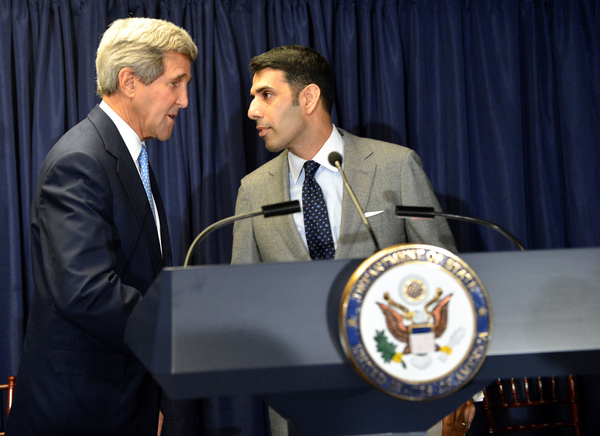
'Forget ISIS... let's talk more about a Palestinian state.' Above, U.S. Secretary of State John Kerry greets U.S. Special Representative to Muslim Communities Shaarik Zafar during an Eid al-Adha reception on Oct. 16, 2014 at the U.S. Department of State in Washington, D.C. (Image source: State Dept.)

"There wasn't a leader I met with in the region who didn't raise with me spontaneously the need to try to get peace between Israel and the Palestinians, because it was a cause of recruitment and of street anger and agitation," Kerry said. "People need to understand the connection of that. And it has something to do with the humiliation and denial and absence of dignity."

The U.S. State Department later denied that Kerry had made the statement attributed to him.

Deputy Spokesperson Marie Harf told reporters that Kerry's comments were distorted for political gains; she pointed a finger at Israeli Economy Minister Naftali Bennett.

"What [Kerry] said was that during his travels to build a coalition against the Islamic State, he was told that should the Israeli-Palestinian conflict be resolved, the Middle East would be a better place," Harf explained.

The Islamic State is one of the by-products of the "Arab Spring," which began as a secular revolt against Arab dictatorships and degenerated into anarchy, lawlessness, terrorism and massacres that have claimed the lives of hundreds of thousands of Arabs and Muslims.

The "Arab Spring" did not erupt as a result of the Israeli-Palestinian conflict. Rather, it was the natural and inevitable outcome of decades of tyranny and corruption in the Arab world.

The Tunisians, Egyptians, Libyans and Yemenis who removed their dictators from power did not do so because of the lack of a "two-state solution."

Nor did the Arabs revolt because of the failure of the peace process between Israel and the Palestinians. This is the last thing these Arabs had in mind when they took to the streets to protest against decades of dictatorship and bad government.

It is this "Arab Spring," and not the Israeli-Palestinian conflict, that brought the Muslim Brotherhood to power in Egypt. And it is the same "Arab Spring" that saw the emergence of Islamic terror groups such as the Al-Nusra Front, the Islamic Front, the Army of Mujahedeen, Jund al-Sham and, most recently, the Islamic State in Syria and Iraq.

The rise of the Islamic State is a direct result of the anarchy and extremism that have been sweeping the Arab and Islamic countries over the past few years.

The thousands of Muslims who are volunteering to join Islamic State are not doing so because they are frustrated with the lack of progress in the Israeli-Palestinian peace talks. They are not knocking on the Islamic State's doors because they are disappointed that the two-state solution has not materialized.

Kerry is anyway naïve to think that the jihadis believe in something called a "two-state" solution. The only solution the Islamic State believes in is the one that would lead to the establishment of a radical Sunni Islamic Caliphate across the Middle East where the surviving non-Muslims who are not massacred would be subject to sharia law.

Not only is the Islamic State opposed to the "two-state solution," it is also opposed to the existence of both Israel and a Palestinian state. Under the new Islamic Caliphate, there is no room for Israel or Palestine or any of the Arab and Islamic countries.

Had Kerry studied the goals and ideology of the Islamic State, he would have discovered that the Israeli-Palestinian conflict is not even at the top of the group's list of priorities.

In fact, the "liberation of Bait al-Maqdis" [Jerusalem] is ranked sixth among Islamic State's objectives.

The group's first goal envisages stirring chaos in the Arab and Islamic countries.

Second, the group will move on to what it calls "management of savagery" in these countries.

Third, Islamic State will embark on the process of establishing an Islamic Caliphate.

Fourth, it will proceed with "liberating neighboring countries and expanding the size of the Islamic Caliphate.

Fifth, the group will start the process of "liberating the Islamic countries," including Bait al-Maqdis.

Obviously, Kerry must have missed the speech delivered by Islamic State leader Abu Bakr al-Baghdadi last July.

Al-Baghdadi did not talk about the "two-state solution." Nor did he call on Muslims to join his group because of the lack of progress in the Israeli-Palestinian peace process.

Instead, al-Baghdadi told his followers that, "Allah likes us to kill his enemies, and make jihad for his sake. O Allah, give Islam victory over the disbelief and the disbelievers, and give victory to the mujahideen, in the East of this earth and its West."

What Kerry perhaps does not know is that the Islamic State is not interested in the Israeli-Palestinian conflict at all. The terrorist group did not even bother to comment on the last military confrontation between Israel and Hamas in the Gaza Strip.

The failure of the Islamic State to express solidarity with the Palestinians or Hamas during the war drew strong condemnations from some of the Arab world's leading columnists.

"What is shocking and strange is that the Islamic State and other terrorist groups that claim to speak on behalf of Islam did not make a single move as Israeli planes were shelling civilians inside the Gaza Strip," remarked Egyptian columnist Jamil al-Afifi. "Nor did any of their wise men come out to condemn the ruthless killings (in the Gaza Strip).

Kerry did not reveal the identity of the "leaders" who told him that the absence of peace between Israel and the Palestinians was a "cause of recruitment and of street anger and agitation" in the Arab and Islamic countries.

What is clear, however, is that Sunni scholars do not seem to share Kerry's assessment.
Last month, over 120 Sunni scholars issued an open letter denouncing the Islamic State and its religious arguments. "You have misinterpreted Islam into a religion of harshness, brutality, torture and murder," the letter said. "This is a great wrong and an offence to Islam, to Muslims and to the entire world."

Needless to say, the scholars did not mention the Israeli-Palestinian conflict as a cause for the rise of Islamic State.

That is because unlike Kerry, the Sunni scholars know that the Islamic State is completely unrelated to the Israeli-Palestinian conflict. And unlike Kerry, the Muslim scholars fully understand that Islamic State has more to do with Islam and terrorism than with any other conflict.


Khaled Abu Toameh

Source: http://www.gatestoneinstitute.org/4801/two-state-solution-isis

Copyright - Original materials copyright (c) by the authors.