Tuesday, October 13, 2015

The "Islamic Inquisition" and the Blasphemy Police - Douglas Murray


by Douglas Murray

  • There is a small but undeniable number who are willing to kill and sometimes die in the cause of imposing their idea of blasphemy on non-Muslims around the world.
  • The editors signalled that they had had enough of the threats and enough of the danger. They censored themselves.
  • Today there might be thousands of people willing to publish cartoons of Mohammed on their Twitter accounts, but most of them hide behind aliases and complain about the cowardice of others.
  • Our societies like to think that terrorism and intimidation do not work. They do -- or can -- but only if we let them.

Ten years ago, one of the editors of a Danish newspaper called Jyllands-Posten had heard that that no cartoonist in Denmark would depict Islam's prophet for a set of children's books on the major world religions. Did such self-censorship really exist in modern Denmark? He sought to find out. So he published a spread of twelve cartoons intended to depict the founder of Islam.

Attacks on the newspaper followed -- the most outspoken attempt at enforcing censorship since the death threats against Salman Rushdie for his novel, The Satanic Verses, in 1988, and the murder of Theo van Gogh for his film, Submission, in 2004. The knife in van Gogh's back also went through a note demanding death threats for Ayaan Hirsi Ali, a Dutch MP at the time, and the Dutch MP, Geert Wilders.

Some of the cartoons printed by Jyllands-Posten led to attacks on the newspaper for having printed them. Some of the cartoons did not even feature Mohammed at all. One, of a Mohammed-like figure with a bomb in his turban, became famous. Local Danish Imams, disappointed at the relative beigeness of the cartoons, added more offensive cartoons of their own to a portfolio, and toured the Middle East with this, trying to whip up anger against Denmark. As many remember, the incitement worked. For a time, aside from all the looting, burnings and murders, the whole world seemed transfixed on these cartoons and what the reactions to them might mean.

Across a number of countries, there were independent outbreaks of mini cartoon-crises. The decision of Ezra Levant to stand alone and publish the cartoons in Canada led to a North American branch of the cartoon crisis. The decision of a number of Norwegian newspapers to print the cartoons, in solidarity with their neighbours, led to a Norwegian cartoon crisis. And, of course, in Paris, the decision of a single magazine -- Charlie Hebdo -- to continue depicting any and all historical figures, led to the slaughter of ten journalists and two police officers in the magazine's Paris offices in January this year.
Stéphane Charbonnier, the fearless editor and publisher of Charlie Hebdo, who was murdered on January 7 along with many of his colleagues, is shown here in front of the magazine's former offices, just after they were firebombed in November 2011.

Now is probably as good a time as any to ask a few questions -- not least, whether we have learned anything at all. Certainly, non-Muslims around the world have learned a great deal more about Islamic sensibilities when it comes to depictions of their Prophet. From within Muslim communities in Europe and elsewhere, there has been a demonstration that there is a small but undeniable number who are willing to kill and sometimes die in the cause of imposing their idea of blasphemy on non-Muslims around the world.

Aside from the attempts on the lives of the staff of Jyllands-Posten, there have been attempts on the life of the Danish cartoonist Kurt Westergaard and the Swedish cartoonist who drew a Mohammed cartoon in solidarity after the first Danish cartoons, Lars Vilks. There have been countless other knocks on the door by the blasphemy police. In London, the publisher of a fawning book about the love life of Mohammed (The Jewel of Medina by Sherry Jones) narrowly survived an attempt to firebomb his offices. If there was a single place on earth that one might have thought could be immune from a visit by the Islamic Blasphemy Police it would probably be somewhere in Texas. But earlier this year, when a display of Mohammed cartoons in took place in Garland, the assassins turned up anyway, and were, fortunately, shot.

So, one lesson is that perhaps nowhere on earth is now safe from the Islam's most stringent enforcers. They can crop up in remote parts of Scandinavia or in the heartland of America. They can show up at a newspaper office or at an individual's home. And it is in this realization that the clearest lesson of the last decade has been learnt.

Last week, on the anniversary of the publication of the first Mohammed cartoons, Jyllands-Posten republished the original spread. The page and texts were laid out as they had been on that famous day ten year earlier. But one thing was missing: the cartoons. Where the original images had been -- even the ones that did not depict Mohammed -- there were only blank spaces. What had been possible in 2005 was no longer possible in 2015. One can hardly blame the publishers. After ten years of paying for security, and staff having to work in perhaps the most threatened newspaper office on earth, the editors of Jyllands-Posten signalled that they had had enough of the threats and enough of the danger. They censored themselves.

It took only ten years for most people across the West to learn about Islamic blasphemy -- and in the end to abide by it. Today there might be thousands of people willing to publish cartoons of Mohammed on their Twitter accounts, but most of them hide behind aliases and complain about the cowardice of others.

A few days before the Mohammed cartoons' anniversary, Mark Steyn, Henryk Broder and the Norwegian editor Vebjoern Selbekk addressed a conference in Denmark to commemorate the anniversary of the cartoons. It was held in the Danish Parliament, the only building there now deemed safe enough to withstand the now-traditional attack from the Islamic Blasphemy Police. Anticipating a terrorist attack, the UK Foreign Office and U.S. State Departments both warned their citizens to stay away from the area of the Parliament building that day. The restaurant in which we were meant to be having dinner cancelled the booking; they realized, when police and security officers scouted out the building in advance, who the guests might be.

Ten years ago, you could publish depictions of Mohammed in a Danish newspaper. Ten years later, it is hard for anyone who has been connected with such an act to find a restaurant in Copenhagen that will serve them dinner.

It is not just artists and writers who have learned the lesson; it is everyone -- from newspaper conglomerates to the people who serve food in restaurants. Our societies like to think that terrorism and intimidation do not work. They do -- or can -- but only if we let them. Over the last ten years, a couple of brief eruptions of sanctimonious point-missing aside, it turned out to be fear -- not Mohammed cartoons -- that went viral.

Freedom, however, was never defended by more than a handful of people. Most prefer their comforts and a quiet life to anything that looks like a fight. But there are still more than a few good people across the world, and more than a handful of them in Scandinavia. If, in previous conflicts, one looked to pilots or statesman to lead the way, in this war against the new "Islamic Inquisition," it is journalists, cartoonists, writers and artists who find themselves on the front lines and who need to lead. Some of them might be surprised to be in this position. They should not be. Freedom of expression and thought have always had vicious enemies. But the truth has always seen them off, and shall do again.

Douglas Murray

Source: http://www.gatestoneinstitute.org/6680/islamic-inquisition-blasphemy

Copyright - Original materials copyright (c) by the authors.

What's the Goal of DOJ's Strong Cities Network? - Johanna Markind


by Johanna Markind

The refusal of the program, and of Lynch and Carlin, to speak plainly about violent Islamism and the need to defeat it, does not bode well for its chances of success at that task.

 
US Attorney General Loretta Lynch
Last week, with the endorsement of Attorney General Loretta Lynch, a group called the Strong Cities Network was launched at the United Nations.

According to its website, Strong Cities "aims to connect cities and other local authorities on an international basis, to enhance local level approaches to prevent violent extremism; including facilitating information sharing, mutual learning and creation of new and innovative local practices."

Reportedly, the "network will conduct workshops and training, will offer online documents of best practices, and will offer grants for innovative initiatives. The US State Department will provide funds through 2016, at which time charities are expected to take over funding."  A summit is scheduled to take place next spring in Paris.

The group includes 23 cities, including four from the US: Minneapolis, New York, Denver, and Atlanta.  Minneapolis is also one of three US cities – the other two being Boston and Los Angeles – the Obama Administration selected to participate in its Countering Violent Extremism pilot program.

The Strong Cities Program has been criticized by the New York Civil Liberties Union and by American Muslim activists fearful it will target Muslims.  Similar criticisms have been leveled against the Department of Justice Countering Violent Extremism program, notably by the Islamist-posing-as-civil-rights group Council on American-Islamic Relations.  New York groups like the NYCLU, Association of Muslim American Lawyers and the Justice League NYC expressed concern New York would eventually become active with the Justice Department's "Countering Violent Extremism," or CVE, programs, which they say "overwhelmingly" target Muslim communities.

Given this sort of challenge, and the Obama Administration's own predilections, it is unsurprising that the program avoids connecting its target to radical Islam.  Its stated goals include addressing "violent extremism in all of its forms" without associating violent extremism "with any particular religion, nationality or ethnic group."  It emphasizes inclusiveness, collaboration, and non-discrimination "in compliance with international human rights standards."

The Attorney General's remarks likewise avoided referring to any specific religion.  The closest she came was to refer vaguely to "groups like ISIL," and ecumenically to "fanatics motivated by hatred against religious or ethnic factions," and explained, "all are antithetical to the shared vision and common cause that joins us."

Similarly, in his remarks at the International Institute for Justice and the Rule of Law's "More Effective Responses to the Foreign Terrorist Fighter Threat" event the day before the Strong Cities launch, Assistant Attorney General John Carlin managed to avoid all references to Islam, and all reference to Muslims save to describe ISIL as "a group that beheads and kills Muslims and non-Muslims with the same impunity," and to focus on the need to broadcast "the damage they [ISIL] are doing to Muslim communities."

The refusal to identify radical Islam as the focus of the Strong Cities Network – indeed, Mayor DeBlasio's insistence that it would not focus on any one type of extremism and references to the shooting of African-American churchgoers in Charleston and the past attacks on Planned Parenthood clinics – has in turn stoked fears that it will target conservative groups and criticism of its close cooperation with the United Nations.  (Regarding the latter, it is difficult to take seriously an organization that puts Saudi Arabia in charge of its Human Rights Commission; the UN's High Commissioner for Human Rights, Saudi Prince Zeid Ra'ad Hussein, was scheduled to be present at the launch.)

Are Lynch's remarks, and the Strong Cities Network's self-description, necessary diplomatic niceties for a program designed to deal with violent Islamism?  Or will the program blunt its utility by taking on too many tasks?  For example, how many resources will it devote to combating right-wing extremism?

The refusal of the program, and of Lynch and Carlin, to speak plainly about violent Islamism and the need to defeat it, does not bode well for its chances of success at that task.  To quote former US Defense Intelligence Agency Director Lt. Gen. Michael Flynn, "You can't defeat an enemy that you don't admit exists."


Johanna Markind is Associate Counselor for the Middle East Forum.

Source: http://www.islamist-watch.org/21128/what-the-goal-of-doj-strong-cities-network

Copyright - Original materials copyright (c) by the authors.

Monday, October 12, 2015

Fatah Officials, Palestinian Social Media, Palestinian Authority Dailies Encourage Continued Violence - MEMRI


by MEMRI
Alongside statements by PA President Mahmoud 'Abbas expressing a desire to avoid escalation and continue the security coordination with Israel, the Palestinian media has been publishing statements by PA officials, especially Fatah officials, as well as op-eds, that advocate continuing the violence.

Fatah seems to be speaking in two voices regarding the violent events of the last few days, which have been described variously as "an intifada," a "popular awakening," the "Al-Aqsa Rage" events, etc. Alongside statements by PA President Mahmoud 'Abbas expressing a desire to avoid escalation and continue the security coordination with Israel, the Palestinian media has been publishing statements by PA officials, especially Fatah officials, as well as op-eds, that advocate continuing the violence. Some described the stabbings as acts of self-defense and others called to maintain a high level of tension and conflict. In some cases, PA spokesmen even chose to deny that violent attacks have taken place, claiming that Israel was falsely accusing Palestinians of terrorism in order to justify their killing. For example, commenting on the attempted car bomb attack at the Al-Za'im checkpoint on October 11, Palestinian Authority (PA) security services spokesman 'Adnan Al-Damiri said that the vehicle had caught fire due to an electric malfunction. The PA daily Al-Ayyam claimed that "Israel concocted a false and deceptive story about an alleged [attempted] bombing, as it has done on numerous occasions in the past."[1] Following the death of Mustafa Al-Khatib, who was killed on October 12 as he attempted to knife a soldier in Jerusalem, the PA daily Al-Hayat Al-Jadida stated that "the occupation forces usually accuse Palestinians of attempted knifings in order to justify shooting at them and killing them."[2] 

Additionally, a delegation of Fatah officials, including figures close to Palestinian President Mahmoud 'Abbas, paid a condolence visit to the family of a terrorist who was killed after he murdered two Israelis in Jerusalem's Old City. An investigative article in the PA daily Al-Hayat Al-Jadida reviewed reactions by Palestinians on social media who expressed joy at the killing of Jews. 

The following are excerpts from statements and articles reflecting this dual stance adopted by Fatah.
 Al-Ayyam Headline: "Al-Za'im Checkpoint: Electric Short Circuit in Vehicle of [Palestinian] Resident Caused Occupation to Injure Her on Pretext of 'Suicide Bombing'"

Fatah Official: "We Are Defending Ourselves... Some Of Us Use Stones And Others Knives"

Fatah Central Committee member Abbas Zaki told the Turkish news agency Anadolu: "Armed struggle against the occupation is a legitimate right that we will not relinquish, but this [activity] requires unity among all the Palestinian factions and establishing a central war room and formulating plans so that the armed struggle exacts a steep price from the enemy while [also] benefiting the Palestinian people. We reserve the right to [engage in] armed struggle, which is an option we will not give up, but we must consider how and when to carry it out, and whether the climate is right to use it to our benefit. At present we support [waging] a popular intifada that will confound the enemy and paralyze his security and economy, and prompt the world to address the question of how to end the world's last remaining occupation.

"Deciding on an armed struggle now will [only] serve the enemy, who has the military power to kill [us] on a daily basis. Today we are defending ourselves, and we will continue to do so. We do not want escalation, but the enemy is attacking and destroying our cities and villages. [The means] of self-defense differ from one Palestinian to the other, some of us use stones and others knives. [But] there is no atmosphere of a new intifada, because there is no Palestinian unity. We are now preparing to organize [the forces] on the ground. At present, the young people are acting without planning, motivated [only] by their conscience and the oppression they live under."[3] 

Muhammad Dahlan, a Palestinian Legislative Council member from Fatah, who is a rival of Palestinian President Mahmoud 'Abbas, wrote on his Facebook page: "Resistance to the occupation is a national and moral obligation and a right sanctified and guaranteed by human and divine laws. The current national activity is a severe blow to everyone who banned resistance to Israeli occupation or termed it a crime. The activity [as a whole] and the individual actions constitute...a firm message to the occupier and the international community that the forms of resistance have changed and that, though the waves [of resistance] may wax and wane, [the resistance itself] will never die or cease as long as an occupation exists... There is an urgent need to take measures and make decisions on two levels. [First,] there is the pressing and immediate level, which is mainly declaring a clear preference for national action and meeting all the needs in order to continue it and defend it... At the same time, [we must] call for serious national meetings with a clear and defined agenda instead of exchanging blows in the media and political arena...[4] 

Fatah Delegation Pays Condolence Visit To Family Of Terrorist Who Knifed Two Israelis

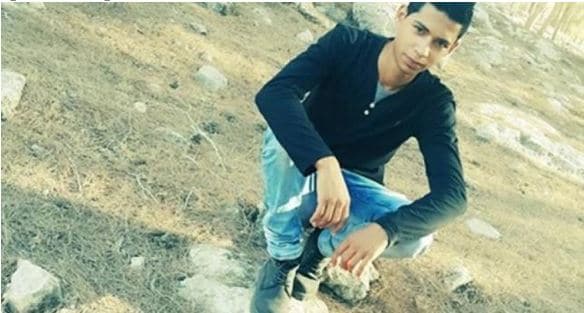
A delegation of Fatah officials paid a condolence visit to the family of Muhannad Al-Halabi, who stabbed two Jews to death on October 4, 2015. The delegation included Fatah Central Committee members 'Azzam Al-Ahmad, a senior PA official close to PA President 'Abbas, as well as Nabil Sha'ath, Mahmoud Al-'Aloul and Jamal Al-Muhsin; Fatah spokesman Ahmad 'Assaf; Fatah's secretary in Ramallah Muwaffaq Sahwil; assistance commissioner of recruitment 'Abd Al-Mun'im Wahdan; Hassan Faraj, secretary-general of Fatah's Shabiba youth movement; Mustafa 'Abd Al-Hadi, member of Fatah's leadership in Ramallah and Al-Bira, and others. During the visit, 'Azzam Al-Ahmad said on behalf of the Fatah: "The Palestinian people will continue to defend itself against aggression and it is very determined to struggle, no matter what the cost, until the occupation ends."[5] 

The Palestinian Bar Association, whose heads are Fatah members and which receives funds from the E.U., announced it would award an honorary law degree to "the martyred hero Muhannad Al-Halabi," who had been studying law.[6] The association also decided to hold its next conference in honor of Al-Halabi.


Muhannad Al-Halabi (image: Amad.ps, October 10, 2015)

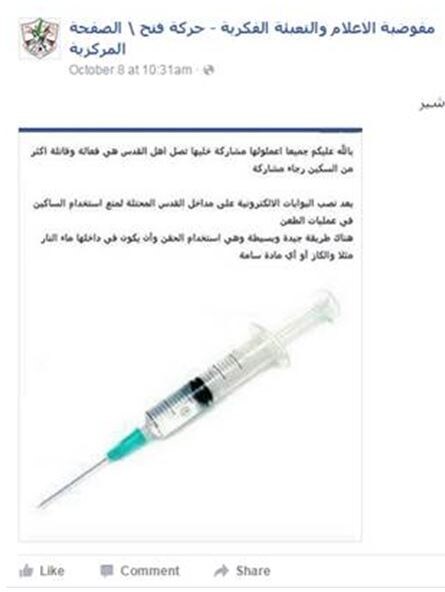
Facebook Page Of Fatah Information Body Calls To Use Poison-Filled Syringes Instead of Knives

In an October 8 post, the Facebook page of the "Fatah Movement Information and Ideological Recruitment Commission" advocated the use of syringes filled with sulphuric acid or some other poisonous substance. It said: "Please circulate this post so it will reach the residents of Jerusalem, since this is a more efficient and lethal [method] than using a knife. Considering that metal detectors have been installed at the entrances to occupied Jerusalem in order to prevent the use of knives in stabbing operations, [note that] there is a newer and simpler method: using syringes filled with sulphuric acid for example, or else gas or any other poisonous substance."[7]  


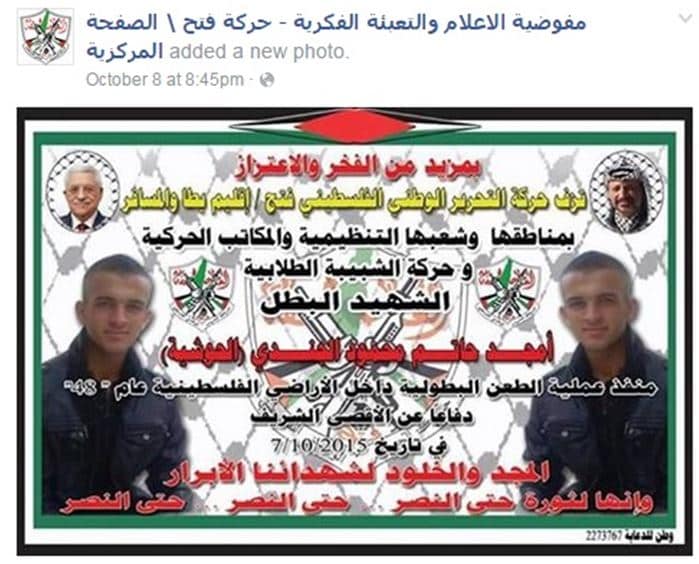
The same day, this Facebook page also posted an obituary notice for Amjad Hatem Mahmoud Al-Jundi, who carried out the October 7, 2015 stabbing attack in the city of Kiryat Gat. The notice, issued by the Fatah movement in Yatta and its environs that includes pictures of 'Abbas and Yasser 'Arafat as well as the official Fatah logo, reads:"The National Palestinian Liberation Movement Fatah in Yatta and its environs, including all its districts and organizational branches, as well as the movement offices and the office of the student youth movement, all proudly congratulate the heroic martyr Amjad Hatem Mahmoud Al-Jundi (Al-Hushiya), who on October 7, 2015 executed a heroic stabbing operation within the Palestinian territories of [19]48 in defense of the Al-Aqsa mosque. Glory and eternal life to our loyal martyrs."[8] 

 
Obituary notice for Amjad Hatem Mahmoud Al-Jundi

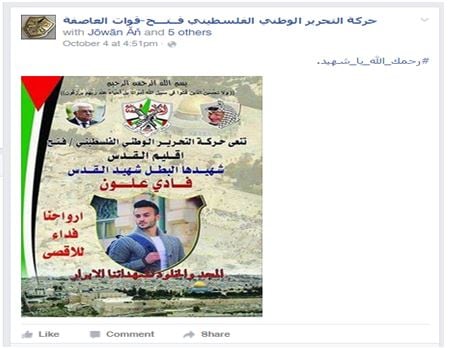
Another Fatah-affiliated Facebook page, called "Fatah – Al-'Asifa Forces," posted an obituary of "the heroic martyr of Jerusalem, Fadi 'Aloun," who committed an attack on security forces on Jerusalem's Haneviim Street. Like the obituary notice for Al-Jundi, this notice too bore the portraits of Yasser 'Arafat and Mahmoud 'Abbas, and the Fatah symbol.[9] 

 
Obituary for Fadi Aloun

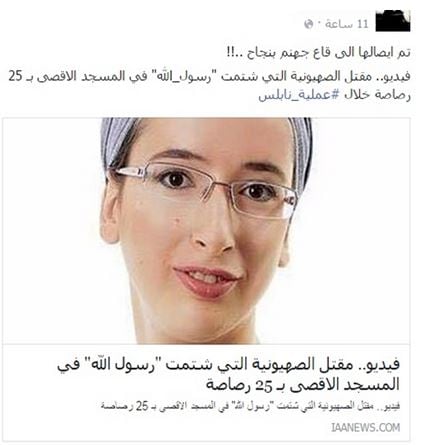
Activists On Social Media Rejoice: "25 Bullets Killed The Zionist Woman Who Cursed The Messenger Of Allah" 

The PA daily Al-Hayat Al-Jadida published an investigative report by Amal Dweikat titled "Facebook Support for Attacking Settlers," which stated that Palestinian activists on Facebook and Twitter had responded with joy to the attack on two settlers near Itamar, which they termed "heroic", and especially to the photos of the man and woman who were killed.[10] The article mentions that one these activists invited readers to watch a video titled "25 Bullets Killed the Zionist Woman Who Cursed the Prophet Muhammad in Al-Aqsa Mosque." The activists also associated the attack with the burning of the Dawabshe family. Some of the activists posted inciting songs encouraging the escalation of violence, such as "No Force in the World Will Take Away My Weapon."[11]

Post on social media: "Video: 25 bullets killed the Zionist woman who had cursed the Prophet Muhammad in Al-Aqsa mosque"

Columnists In PA Dailies Call For Continuing "Awakening", Clashes

Columnists in PA dailies praised the "awakening" events and some called to continue them and to maintain the state of unrest. Yahya Rabbah, the PLO's former ambassador to Yemen and a columnist for Al-Hayat Al-Jadida, wrote: "Thank you, O Palestinian people, yours is the glory and the victory. The comprehensive popular awakening has spread from the northernmost point in the West Bank to its southernmost point, reaching Jerusalem and Al-Aqsa. It has also dawned in Gaza and inside the Green Line, as well as in the Palestinian diaspora, both near and far. With this ongoing awakening, the great Palestinian people has managed to deliver a new blow to the settlements."[12] 

Akram 'Atallah, a columnist for the PA daily Al-Ayyam, wrote: "It is necessary to maintain a certain level of conflict, without reaching a [state of] war with rivers of blood but [also] without reverting to a state of calm...It is necessary to continue the conflict at a certain tension [level], as dictated by political considerations.[13] 

Another Al-Ayyam columnist, Rima Nazzal, wrote: "We must allow events to continue, develop and build up [while] rallying the masses around them and providing the conditions for their continuation. This will be guaranteed if [we] announce the failure of the negotiations and the collapse of the Oslo [Accords] and if a new struggle strategy is formulated, based upon action and providing all sectors the chance to participate and persevere in the popular resistance strategy without giving it names or laying down its frameworks [in advance]."[14]

Endnotes:
[1] Al-Ayyam (PA), October 11, 2015.
[2] Al-Hayat Al-Jadida (PA), October 12, 2015.
[3]  Amad.ps, October 9, 2015.
[4] Facebook.com/mohammad.dahlan2, October 10, 2015.
[5]  Amad.ps, October 10, 2015.
[6] Palestinebar.ps, October 10, 2015.
[7] Facebook.com/fathPsc, October 8, 2015.
[8]  Facebook.com/fathPsc, October 8, 2015.
[9] Facebook.com/fateh.palestine.1965,  October 4, 2015.
[10] Eitam and Naama Henkin were shot from a passing vehicle on October 1, 2015 while driving on a road near Itamar with their four children. 
[11]  Al-Hayat Al-Jadida (PA), October 2, 2015.
[12]  Al-Hayat Al-Jadida.ps, October 10, 2015.
[13]  Al-Ayyam (PA) October 11, 2015.
[14]  Al-Ayyam (PA) October 11, 2015.


MEMRI

Source: http://www.memri.org/report/en/0/0/0/0/0/0/8794.htm

Copyright - Original materials copyright (c) by the authors.

The Palestinian Victimhood Narrative as an Obstacle to Peace - Dr. Eran Lerman


by Dr. Eran Lerman

The false Palestinian narrative of one-sided victimhood is a major hindrance to all peace efforts. Global actors must help the Palestinians move beyond wallowing in self-pity and ritual bashing of Israel, and towards difficult compromises.

The speech delivered by Palestinian Authority leader Mahmoud Abbas at the UN General Assembly last week was proof, once again, that the Palestinian “narrative” of victimhood has become a threat to any practical prospect for peace. Palestinian leaders consistently advance an interpretation of history which is at odds not only with the facts but also with their people’s best interests.

At the core of Abbas’ plaintive narration is the notion of the Palestinians as innocent victims, whose right to statehood and independence has been taken away and brutally ignored for much too long. In this telling of history, the Palestinians deserve to be backed by coercive intervention, as soon as possible, so as to impose on Israel a solution which would implement their “”rights.”

This would include implementation of “all relevant UN resolutions” – meaning UN General Assembly resolution 194 (the so-called “right of return”) as well as the Arab (mis)interpretation of resolution 242 as demanding withdrawal to the June 4, 1967 lines.

Moreover, this is translated into the demand, explicitly made by Abbas, for “international protection” (Himayah Duwwaliyyah); a term of uncertain practical import, yet indicative of the Palestinian reluctance to settle down to the hard work of striking a workable compromise with Israel.

There is no room, therein, for the long litany of Palestinian past mistakes and misjudgments. These are deftly expunged from the record. No mention can be made of the recent rise in Palestinian terror activities; no mention of the Palestinian decision to walk away from the framework advanced by US Secretary of State John Kerry; no word on Hamas’ habitual shelling of Israeli civilian targets.

There is also no mention of the collapse of all past peace efforts; of the fact that only in 1988 did PLO (putatively) recognize Israel’s right to exist. No reference is made to the long years of terror, including the brazen attack on the Olympic Games in 1972; no hint of their rejection of partition in 1947; no mention of Hajj Amin al-Husseini’s relationship with Hitler and Himmler; no mention of the massacres of Jews in Hebron in 1929 and Jaffa in 1921.

In other words, all that the Palestinians have ever suffered – and their suffering was real enough, even if it pales in comparison with what has befallen the Syrian people and others in the region in recent times – is someone else’s fault. It is Israel’s fault, above all, and the world’s.

Over the years, this narrative of victimhood has become so entrenched as to be an integral part of Palestinian identity.  Yasser Arafat even had a way of insinuating that Jesus of Nazareth must have been a Palestinian, given his suffering. Acknowledgement of the tragic aspects of Palestinian history, including the “Nakba” (catastrophe) which befell them in 1948, has become commonplace in Israel and elsewhere.

However, references to the Palestinians’ own role in the chain of events which led to their defeats remain quite rare – even more so at higher political echelons. This, in turn, feeds not only the sense of grievance and the ensuing justifications for violence. It is an active barrier to any practical compromise, and to reconciliation and peace.

Every once in a while, some attempts – few and far between – have been made to wean the Palestinian leadership and people off these habits of thought. Former US Middle East peace  coordinator Dennis Ross recalls (in his 2004 book The Missing Peace: The Inside Story of the Fight for Middle East Peace) how President Bill Clinton unexpectedly wove this theme into his comments before the Palestinian National Council in Gaza in December 1998, “acting as much as a preacher and teacher as world leader.”

He did so by invoking a speech made by the first Governor of Arkansas after the US Civil War, obviously a theme of great emotional import for a President who had served in the same position many years later, and was painfully familiar with the tragic history of the South. The words he quoted were pithy and direct: “We have all done wrong.”

This may indeed have been, as Dennis Ross felt, “the best speech ever given on peace.” But he is wrong to assert that “the Palestinians in the hall were visibly moved” – at least not by the Arkansas story. Those of us who watched that speech live noted the departure from the prepared text – and felt that it actually fell on deaf ears. Its meaning did not seem to register with the Palestinian audience.

To speak of peace had become acceptable, but to cross the threshold into acceptance of mutual victimhood – and mutual moral responsibility – was beyond the Palestinian abilities, then as now. Still, the effort should have been persistently pursued. It was not.

This is not to say that Israel needs to endorse a strategy of counter-accusation, stressing Jewish victimhood. Despite all that has transpired since 2000 (or Oslo, or Madrid) the point is not that what was committed by the other side entitles us to dismiss the prospect of a negotiated agreement. Abbas seemed to take up this line of argumentation in his recent UN speech. But this is not Israel’s best choice. Indeed, in his UN speech Prime Minister Netanyahu chose to emphasize that Israel’s hand remains extended for peace, and that a breakthrough is still possible.

What needs to be done, however, particularly in disputation or in dialogue with those who are sympathetic to the Palestinian cause (whether it be the BDS crowd or more even-handed interlocutors) is to make the point, again and again that endorsement of the Palestinian narrative harms the Palestinians’ own future.

By tagging the Zionist project as “colonialist” in nature (i.e., transient and perishable), those who do so help consign the Palestinian people, whom they purport to help, to an ideological, political and diplomatic cul-de-sac.

More than two years have passed since Kerry used a straightforward formula for success, as he tried to usher in, in July 2013, a new phase of negotiations. Kerry spoke of “reasonable compromises on tough, complicated, emotional and symbolic issues.”

Indeed, any sober assessment of what it would take to strike an Israeli-Palestinian deal inevitably leads to the clear understanding that painful but practical political compromises are required from both sides. Alas, this concept seems alien to many in the region, particularly to Palestinians; and the international community is not doing its part to help the Palestinians mature towards this realization.

The false Palestinian narrative of one-sided victimhood is a major hindrance to all efforts in the direction of peace. Global actors that want to help achieve peace need to assist the Palestinians in moving beyond wallowing in self-pity and rituals of bashing Israel.

A BESA Center Perspectives Paper, published through the generosity of the Greg Rosshandler Family


Col. (res.) Dr. Eran Lerman has joined the Begin-Sadat Center for Strategic Studies as a senior research associate. For the past six years, he served as deputy for foreign policy and international affairs at the National Security Council in the Israeli Prime Minister’s Office. For 20 years prior to that, he held senior posts in IDF Military Intelligence, and also was Israel director of the American Jewish Committee.
Source: http://www.israelnationalnews.com/Articles/Article.aspx/17690#.VhvJGiuzdds

Copyright - Original materials copyright (c) by the authors.
Obama Will Be the Only Person Sticking to Iran Deal - Amir Taheri


by Amir Taheri

The Iranians have signed nothing and have no plans for doing so. The so-called Joint Comprehensive Plan of Action (JCPOA) has not even been discussed at the Islamic Republic's Council of Ministers. Nor has the Tehran government bothered to even provide an official Persian translation of the 159-page text.

Sometime this week, President Obama is scheduled to sign an executive order to meet the Oct. 15 "adoption day" he has set for the nuclear deal he says he has made with Iran. According to the president's timetable the next step would be "the start day of implementation," fixed for Dec. 15.

But as things now stand, Obama may end up being the only person in the world to sign his much-wanted deal, in effect making a treaty with himself.

The Iranians have signed nothing and have no plans for doing so. The so-called Joint Comprehensive Plan of Action (JCPOA) has not even been discussed at the Islamic Republic's Council of Ministers. Nor has the Tehran government bothered to even provide an official Persian translation of the 159-page text.

The Islamic Majlis, the ersatz parliament, is examining an unofficial text and is due to express its views at an unspecified date in a document "running into more than 1,000 pages," according to Mohsen Zakani, who heads the "examining committee."

"The changes we seek would require substantial rewriting of the text," he adds enigmatically.
Nor have Britain, China, Germany, France and Russia, who were involved in the so-called P5+1 talks that produced the JCPOA, deemed it necessary to provide the Obama "deal" with any legal basis of their own. Obama's partners have simply decided that the deal he is promoting is really about lifting sanctions against Iran and nothing else.

So they have started doing just that without bothering about JCPOA's other provisions. Britain has lifted the ban on 22 Iranian banks and companies blacklisted because of alleged involvement in deals linked to the nuclear issue.

German trade with Iran has risen by 33 percent, making it the Islamic Republic's third-largest partner after China.

China has signed preliminary accords to help Iran build five more nuclear reactors. Russia has started delivering S300 anti-aircraft missile systems and is engaged in talks to sell Sukhoi planes to the Islamic Republic.

France has sent its foreign minister and a 100-man delegation to negotiate big business deals, including projects to double Iran's crude oil exports.

Other nations have also interpreted JCPOA as a green light for dropping sanctions. Indian trade with Iran has risen by 17 percent, and New Delhi is negotiating massive investment in a rail-and-sea hub in the Iranian port of Chah-Bahar on the Gulf of Oman. With help from Austrian, Turkish and United Arab Emirates banks, the many banking restrictions imposed on Iran because of its nuclear program have been pushed aside.

"The structures of sanctions built over decades is crumbling," boasts Iranian President Hassan Rouhani.

Meanwhile, the nuclear project is and shall remain "fully intact," says the head of Iran's Atomic Energy Agency, Ali Akbar Salehi.

"We have started working on a process of nuclear fusion that will be cutting-edge technology for the next 50 years," he adds.

Even before Obama's "implementation day," the mullahs are receiving an average of $400 million a month, no big sum, but enough to ease the regime's cash-flow problems and increase pay for its repressive forces by around 21 percent.

Last month, Iran and the P5+1 created a joint commission to establish the modalities of implementation of an accord, a process they wish to complete by December 2017 when the first two-year review of JCPOA is scheduled to take place and when Obama will no longer be in the White House. (If things go awry Obama could always blame his successor or even George W Bush.)

Both Obama and his Secretary of State John Kerry have often claimed that, its obvious shortcomings notwithstanding, their nuke deal with the "moderate faction" in Tehran might encourage positive changes in Iran's behavior.

That hasn't happened.

The mullahs see the "deal" as a means with which Obama would oppose any suggestion of trying to curb Iran.


"Obama won't do anything that might jeopardize the deal," says Ziba Kalam, a Rouhani adviser. "This is his biggest, if not the only, foreign policy success."

If there have been changes in Tehran's behavior they have been for the worst. Iran has teamed up with Russia to keep Bashar al-Assad in power in Syria, mocking Obama's "Assad must go" rhetoric. More importantly, Iran has built its direct military presence in Syria to 7,000 men. (One of Iran's most senior generals was killed in Aleppo on Wednesday.)

Tehran has also pressured Iraqi Premier Haidar al-Abadi's weak government to distance itself from Washington and join a dubious coalition with Iran, Russia and Syria.

Certain that Obama is paralyzed by his fear of undermining the non-existent "deal" the mullahs have intensified their backing for Houthi rebels in Yemen. Last week a delegation was in Tehran with a long shopping list for arms.

In Lebanon, the mullahs have toughened their stance on choosing the country's next president. And in Bahrain, Tehran is working on a plan to "ensure an early victory" of the Shiite revolution in the archipelago.

Confident that Obama is determined to abandon traditional allies of the United States, Tehran has also heightened propaganda war against Saudi Arabia, now openly calling for the overthrow of the monarchy there.

The mullahs are also heightening contacts with Palestinian groups in the hope of unleashing a new "Intifada."

"Palestine is thirsty for a third Intifada," Supreme Guide Khamenei's mouthpiece Kayhan said in an editorial last Thursday. "It is the duty of every Muslim to help start it as soon as possible."

Obama's hopes of engaging Iran on other issues were dashed last week when Khamenei declared "any dialogue with the American Great Satan" to be" forbidden."

"We have no need of America" his adviser Ali-Akbar Velayati added later. "Iran is the region's big power in its own right."

Obama had hoped that by sucking up to the mullahs he would at least persuade them to moderate their "hate-America campaign." Not a bit of that.

"Death to America" slogans, adoring official buildings in Tehran have been painted afresh along with US flags, painted at the entrance of offices so that they could be trampled underfoot. None of the US citizens still held hostages in Iran has been released, and one, Washington Post stringer Jason Rezai, is branded as "head of a spy ring "in Tehran. Paralyzed by his fear of undermining the non-existent deal, Obama doesn't even call for their release.

Government-sponsored anti-American nationwide events are announced for November, anniversary of the seizure of the US Embassy in Tehran. The annual "End of America" week-long conference is planned for February and is to focus on "African-American victims of US police" and the possibility of "self-determination for blacks."

According to official sources "families of Black American victims" and a number of "black American revolutionaries" have been invited.

Inside Iran, Obama's "moderate partners" have doubled the number of executions and political prisoners. Last week they crushed marches by teachers calling for release of their leaders. Hundreds of trade unionists have been arrested and a new "anti-insurrection" brigade paraded in Tehran to terrorize possible protestors.

The Obama deal may end up as the biggest diplomatic scam in recent history.
*This article was first published in the New York Post.

Amir Taheri

Source: http://www.gatestoneinstitute.org/6684/iran-deal-honor

Copyright - Original materials copyright (c) by the authors.
Iran Threatens Saudi Arabia: 'The IRGC... Will Take Vengeance' On The Al-Sa'ud Regime - MEMRI


by MEMRI

In recent days, Iran's Supreme Leader Ali Khamenei and the top echelons of the Islamic Revolutionary Guard Corps (IRGC) dispatched threatening messages to Saudi Arabia's rulers in response to the hundreds of Iranians killed in the stampede in Mina, Saudi Arabia, which claimed the lives of over a thousand Hajj pilgrims. Khamenei, along with IRGC commanders and ideological camp leaders, were furious at the Saudi royal family, holding it responsible for the disaster and promising a "harsh and decisive" response if Saudi Arabia continued what they called its deliberate anti-Iran conduct. The daily Kayhan, which is close to Khamenei, even claimed that Saudi authorities had intentionally caused the stampede after it was planned by the Israeli Mossad.[1]

In fact, in the past 18 months, Iran has repeatedly threatened Saudi Arabia and the Al-Sa'ud royal family, as tensions between the two countries escalated against the backdrop of the nuclear negotiations, the Saudi policy of lowering oil prices, and the wars in Yemen, Syria, and Iraq. Thus, for example, Iran's leadership threatened to "use all means at its disposal against Saudi Arabia," including targeting Saudi oil transports, sparking Shi'ite uprisings in eastern Saudi Arabia, threatening to set oil wells on fire, and more, in order to cause the collapse of the Al-Sa'ud regime.[2] 

Two Models For Iran's Political And Military Conduct

Two distinct models characterize Tehran's geopolitical and military conduct vis-à-vis its regional and global rivals :

1.  The "Paper Tiger" model – mainly vis-à-vis Saudi Arabia. Faced with the empowered military and political Sunni Arab bloc, which is stronger than Iran, the Iranian regime backs down, revealing itself as a paper tiger. This model has come into play on several occasions, when Iran didn't dare to exercise its power revealing its threats as hollow: In 2003, when the U.S. besieged Iran from the south (Iraq) and the east (Afghanistan); in Bahrain in 2011, when a pro-Iranian Shi'ite coup was thwarted by a show of Saudi-Gulf military might, and in Yemen during the past year, where Saudi Arabia is heading a Sunni-anti Iran coalition and is the most active member of this coalition.

It seems that this time as well, Iran's threats follow this "Paper Tiger" model.

2. The "Intimidating Bully" model–mainly vis-à-vis the U.S. The latter has been forgiving and sympathetic to the Iranian regime's demands and to its expansion in the region, in addition to seeing it as a partner in its strategic interests, such as the fight against ISIS – despite Iran's international terrorist activity. The U.S. has even shown willingness to grant Tehran limited nuclear status despite its violations of Security Council resolutions and IAEA regulations. Iran has continued its military and political expansion in the region alongside its ongoing issuing of threats, even against the U.S. military.[3] It has become clear that the U.S.'s sympathetic stance has neither softened nor curbed Iran's offensive activity in the region, but has only encouraged its hostile policy.

This document will review the current wave of threats by Iran's leadership against Saudi Arabia:

Khamenei's Office Posts Military Threat Video

On October 5, 2015, the official website for the office of Supreme Leader Khamenei posted a four-minute video showing Ayatollah Khomeini and then-president Khamenei mourning the death of Iranian pilgrims killed in a 1987 incident in Mecca. The video later shows footage of the bodies of Iranians killed in the Mina stampede some two weeks ago, while Khamenei condemns the lack of cooperation by Saudi authorities in the efforts to return the bodies to Iran. Khamenei is then seen flanked by military commanders and warning the Saudis that ongoing lack of cooperation would trigger a "harsh and decisive" response by Iran. This is followed by an intimidating display of IRGC naval capabilities. See the video at: https://www.youtube.com/watch?v=L0OKgBgivTc&feature=youtu.be.

Khamenei even said on September 30, 2015, at a naval graduation ceremony, that Saudi Arabia was being devious and shirking its duties in the Mina affair, stressing that Iran was free to act and promising "a decisive response." He said:"Certain people in the world of Islam, including from Iran, should go [to Saudi Arabia] and investigate this matter closely and clarify the reasons for the [Mina] disaster. They [the Saudis] have not fulfilled their duty to the injured... Even today there are still problems in transferring the bodies to Iran... but Saudi Arabia is not fulfilling its obligations, and in some cases it is even deviously acting contrary to them...

"Thus far we have looked the other way, [but] Iran has greater freedom of action than many others. We have greater abilities and more tools. They know that if they wish to confront the Islamic Iran, they cannot match it in any arena. We have [thus far] maintained the Islamic dignity and brotherly honor of the Islamic ummah. [But] we can respond, and if we wish to react our responses will be decisive. Harsh and decisive.

"...There are still tens of thousands of our loved ones in Mecca carrying out the Hajj rituals. The slightest disrespect towards them will spark a reaction [from us]. [The Saudis] not fulfilling their role regarding the bodies of our loved ones will spark a reaction [on our part]. They should be careful and carry out their duty... If anyone wishes to harm the rights of the Iranian people and the Islamic Republic of Iran, we will know how to deal with them. We will respond firmly. Thank God, [we] have the ability. The Iranian nation is powerful;this has been proven.We can defend our rights."[4] 

IRGC Commander: We Are Prepared To Take Vengeance On Saudi Arabia

IRGC commander Mohammad Ali Jafari said at a press conference at an Iranian naval base on October 3, 2015 that the IRGC was prepared to take vengeance on Saudi Arabia's royal family at the behest of Supreme Leader Khamenei:

"The IRGC is preparing all possible tools for a swift and decisive Iranian response in order to realize the will of the Leader and cause the Al-Sa'ud [regime] to answer for the disaster in Mina that killed Iranian pilgrims. [The IRGC] is awaiting orders [from the Leader].

"If need be, at any time and in any place in the region, the IRGC is prepared to carry out any decisive and heroic move to defend the honor of Muslims, especially Iranians, vis-a-vis the evil ignorant Al-Sa'ud rulers. [The IRGC] will take vengeance on Al-Sa'ud.

"The Islamic world has grown tired of  Al-Sa'ud's betrayals and ignorance, which include the massacre [they carry out] in Yemen, the displacement of the dear Syrian people, oppressing Bahrainis, the collective slaughter in Iraq, the creation of sectarian schism, and support for terrorism. [Saudi Arabia] will dissolve in the rage of Muslims."[5] 

Iranian Ground Forces Commander: Saudi Arabia Is Betraying The Muslims

On October 5, 2015, Iran's ground forces commander Ahmad Reza Pourdastan, speaking at the funeral of General Saeed Jafari, who died in the Mina stampede, accused Saudi Arabia of "betrayals and crimes against Muslims around the world" and its government of "destroying the innocent Syrian people" and of slaughtering the people of Yemen, Iraq, and Afghanistan. He said:"In response to the recommendations and orders of the Leader [Khamenei], we are  committed and ready to present the unworthy Saudi rulers with a harsh, decisive, and crushing message by the Iranian regime, and also show them the courage and greatness of Iran's soldiers. Not only does Saudi Arabia not serve the holy sites, it also carries out most of the betrayals and crimes against Muslims around the world. The Saudi Arabian government's hands are stained to the elbows with the blood of innocent Yemenis. [In addition,] it is destroying the innocent Syrian people with its total support of Jabhat Al-Nusra, and it also supports ISIS, and its hands are stained with the blood of Iraq's children, women, and men. Saudi Arabia created the Taliban [as well], and is thus killing the Afghani people.

The overall actions of this [Saudi] regime conforms to the desires of the Zionists and America. We can already see signs of deterioration in this unworthy Al-Saud mechanism, and the ground is already set for the collapse of this regime.[6] 

IRGC Navy Commander: Saudis Are Totally Dependent On The Sea... They Are Highly Vulnerable

IRGC Navy Commander Ali Fadavi said on October 4, 2015: "We will look the other way as long as our Islamic duty requires this, but the time will come when it will be our duty to punish and give a slap in the face... At a time when we possess sufficient capability for any response against America's warships, which are considered the greatest threat, there is certainly no weight to Saudi Arabia's threats, which are considered the smallest threat.The Saudis are totally dependent on the sea. All their oil is exported via the Persian Gulf;  more importantly, their oil is in the eastern part [of the country] and inside the Persian Gulf. America's vulnerability is high, but compared to the Americans, Saudi Arabia's vulnerability is immeasurable."[7] 

IRGC Deputy Commander: The Saudi Regime Is On The Verge Of Collapse

At a "National Might" IRGC conference in Urmia in Northern Iran on October 4, 2015, IRGC Deputy Commander Hossein Salami said: "...The regime ruling Saudi Arabia has shown that it intends to graft the thinking of the jahiliyya [the pre-Islamic period] on modern means. Lack of planning, lack of responsibility, lack of management skills, neglect, pride and insensitivity turn the Al-Sa'ud regime into a weapon of mass destruction that causes Muslims to die as they are peacefully praying.

"After the Mina incident, the Saudi government behaved in a manner that was extremely ugly, hate-mongering, illogical, scattershot and irresponsible, and did not provide any answers. To this day they have not provided an accurate death toll. The disorganization prevailing there proves that a clan that treats Muslims savagely and unmercifully can no longer remain alive. All the recent events are signs of the impending collapse of [this] political regime, and the disorganization and disrespect towards the pilgrims indicate that it does not possess the necessary foundations for continued political vitality.

"At the same time, this weak, small, impotent regime intervenes in major affairs and illogically attacks Yemen and its defenseless people... The [Saudi] regime sends terrorist groups to Syria and devotes all its efforts to turn Muslims into displaced persons and humiliate them in the face of Jews and Christians... All these problems are the products of the Al-Sa'ud [dynasty], meant to spark the fire of fitna and schism in the Islamic world.

"Al-Sa'ud supports terrorist elements in order to deny the Iraqi people security and peace... They [the Saudis] do not emit a whiff of God's mercy, nor does it occupy their minds. This is also the reason that, when the Zionists attack the Palestinians, this rotten regime does not utter [a word of] protest.

"The improper Al-Sa'ud policy is the main reason for the Mina disaster. Ambitious and prideful policy in the world of Islam renders the Al-Sa'ud [regime] unable to manage a large-scale Islamic event such as the Hajj. Human imagination cannot grasp the Mina disaster, and I urge you [Saudis] to seriously heed the warnings of Leader Khamenei... As the Leader said, if a response does come, you will regret it."[8]

Endnotes:

[1] Kayhan (Iran), October 4, 2015.
[4] Farsi.khamenei.ir, September 30, 2015.
[5] Sepahnews.ir, October 3, 2015.
[6] Tasnim (Iran), October 5, 2015.
[7] Tasnim (Iran), October 4, 2015.
[8] Defapress.ir, October 4, 2015.

MEMRI

Source: http://www.memri.org/report/en/0/0/0/0/0/0/8792.htm

Copyright - Original materials copyright (c) by the authors.
Jeremiah Wright claims 'Jesus was a Palestinian' - Thomas Lifson


by Thomas Lifson

Jeremiah Wright doesn't know his biblical scripture.

The man who married Barack and Michelle Obama, baptized their daughters, gave him the title of one of his books, and was the only beneficiary of his charity dollars before Obama’s presidential run, has made a remarkably ignorant antisemitic claim. Speaking to an event named with a not-so-veiled threat,  “Justice or else,” held on the 20th anniversary of the Million Man March he sponsored (and that Obama attended), Louis Farrakhan claimed:
“The same issue is being fought today and has been fought since 1948, and historians are carried back to the 19th century… when the original people, the Palestinians — and please remember, Jesus was a Palestinian — the Palestinian people had the Europeans come and take their country.”
Wright also made the bizarre claims that:
“As we sit here, there is an apartheid wall being built twice the size of the Berlin Wall in height, keeping Palestinians off of illegally occupied territories, where the Europeans have claimed that land as their own,”
Some elementary and indisputable facts:

Jews are not native to Europe, they are Middle Eastern in origin. Period. If by “Palestinians” Wright means Arabs, he should know that they only arrived in Israel (called Palestine by the Roman conquerors) in the wave of conquest that followed Mohammed’s rise. They were stuck in Arabia at the time of Jesus’s life.

But face it: as Ed Lasky reminds us, Farrakhan is motivated by hatred of Jews, which he has repeatedly expressed. “Judaism is a gutter religion.” “Hitler was a great man.”

As for that “apartheid wall,” it was built solely to prevent what was an ongoing wave of terror attacks. And it has worked.

Video, if you have the stomach:


What are we to make of Obama's two decades attending Wright's church? Powerline's John Hinderaker sums it up:
The madness goes on and on, and the hate is palpable. Barack Obama couldn’t have missed it, which means that he must have agreed with it, or at least been fine with it.


Thomas Lifson

Source: http://www.americanthinker.com/blog/2015/10/jeremiah_wright_claims_jesus_was_a_palestinian.html

Copyright - Original materials copyright (c) by the authors.
Nazareth mayor accuses Arab MKs of 'ruining coexistence' - Danny Brenner and Daniel Siryoti


by Danny Brenner and Daniel Siryoti

Nazareth Mayor Ali Salem launches tirade against Joint Arab List leader Ayman Odeh on live TV, blasts him for inciting violence, damaging Nazareth's trade and tourism • Salem urges Arabs and Jews to "find a way to live together in peace."


Nazareth Mayor Ali Salem
Photo credit: Screenshot: Channel 2 News


Danny Brenner and Daniel Siryoti

Source: http://www.israelhayom.com/site/newsletter_article.php?id=28847

Copyright - Original materials copyright (c) by the authors.