Sunday, April 1, 2018

Gaza border on edge as IDF says will retaliate if clashes escalate - Nikki Guttman, Daniel Siryoti, Shlomi Diaz, News Agencies and Israel Hayom Staff


by Nikki Guttman, Daniel Siryoti, Shlomi Diaz, News Agencies and Israel Hayom Staff 

Israel will mount a far more forceful response if Palestinians resume violent protests, defense minister says


A Palestinian protester near the Israel-Gaza Strip border, Friday
Photo: AP

Defense Minister Avigdor Lieberman warned Sunday that Israel would mount a far harsher response if the Palestinians in the Gaza Strip resumed violent protests the likes of which were seen on the Israel-Gaza Strip border on Friday.

Several clashes erupted on the southern border and in the West Bank on Saturday, on the heels of the mass march the day before.

The Israeli military said protesters torched tires and hurled rocks and firebombs at Israeli troops, who responded with crowd-control measures.

The Palestinians reported that 70 Palestinians were wounded on Saturday.

Some 30,000 Palestinians took part in the Hamas-organized march along the Gaza border on Friday, during which hundreds of rioters hurled firebombs, set tires on fire and stoned Israeli troops.

Palestinian sources said 17 people were killed and some 1,400 were wounded in riots on the border. The Gaza Health Ministry said that 758 of the casualties were wounded by live fire, with the remainder hurt by rubber bullets and tear-gas inhalation.

IDF Spokesperson's Unit
GOC Southern Command Maj. Gen. Eyal Zamir on the Israel-Gaza border, Friday

Palestinian Authority President Mahmoud Abbas said Israel was responsible for the violence and declared Saturday a national day of mourning and a general strike in the Gaza Strip and the West Bank.

Thousands of people marched through the streets of Gaza Saturday in the funerals for 15 of the men killed the day before, while solidarity protests and riots were held in several Palestinian cities in the West Bank.

Dozens of Palestinians rioted near Damascus Gate in east Jerusalem. The Israel Police dispersed the demonstration using crowd-control measures, and several protesters were arrested.

Hamas leader Ismail Haniyeh issued a statement to the families of those killed Friday, saying, "You sacrificed your loved ones for the liberation [of Palestine] and for Al-Aqsa [mosque] and Jerusalem. Yesterday's march opened the door to a return to all of Palestine. Yesterday's shahids [martyrs] have set our future borders."

Reuters
Palestinians protesters along the Gaza border, Friday

The IDF said Saturday that 10 of the men killed in Friday's border riots were known terrorists.

The military named the terrorists killed as Hamas operatives Musab Saloul, 23; Sari Abu Odeh, 28; Jihad Farina, 35; Ahmed Odeh, 19; Hamdan Abu Amsha, 25; Hamoud Rahmi, 33; Mohammed Abu Amr, 27; and Abdel Fatah Abdel Nabi, 20.

Global jihad operative Ibrahim Abu Sha'ar, 29 and Al-Aqsa Martyrs Brigades operative Jihad Zahir Salman Abu Jamous, 30, were also killed Friday, the IDF said.

Israel is said to be holding two bodies, both of terrorists killed Friday while trying to carry out a shooting attack against an IDF force patrolling the security fence.

On Sunday, the families of two Israeli soldiers,  killed in Gaza in 2014 and whose remains are being held by Hamas, called on the government and the defense establishment to use the terrorists' bodies as leverage to secure the return of their sons' remains.

On Saturday, IDF Spokesperson Brig. Gen. Ronen Manelis said Hamas was using the protests as cover to launch attacks against Israel and ignite the area. He said violence was likely to continue along the border until May 15, when the Palestinians mark Nakba Day, which commemorates the displacement of Palestinian refugees, called the "Nakba" ("catastrophe") in Arabic, during Israel's War of Independence.

"We won't let this [the border] turn into a pingpong zone where they perpetrate terrorist acts and we respond with pinpoint action. If this continues we will have no choice but to respond inside the Gaza Strip," Manelis told reporters.

He warned the IDF will target terrorist groups inside Gaza if violence along the territory's border with Israel drags on.

It appears unlikely protests will continue at such a scale, with larger turnouts only expected after Friday noon prayers, the highlight of the Muslim religious week.

Reuters
A Palestinian demonstrator kicks a burning tire during clashes with Israeli troops in Hebron, Saturday

Manelis denied soldiers used excessive force during Friday's riots on the border, asserting that those killed were known terrorists. He further said that Gaza health officials had exaggerated the number of wounded.

He reiterated Saturday that Israel "will not allow a massive breach of the fence into Israeli territory."

Hamas and other terrorist groups in the coastal enclave "are using protests as a cover for staging attacks," he said, warning that if the violence continues, "we will not be able to continue limiting our activity to the fence area and will act against these terror organizations in other places as well."

Lieberman also pledged that there would be no international inquiry into the clashes, despite demands to that effect by parts of the international community.

"IDF soldiers warded off Hamas military wing operatives with determination and professionalism, just as we expected them to do. They have my full backing. Thanks to them, we celebrated the Passover Seder peacefully," he tweeted.

Prime Minister Benjamin Netanyahu also lauded the IDF's actions, saying, "Thank you to our soldiers, who guard Israel's borders and allow the Israeli public to celebrate the holiday quietly. Israel acts with determination and resolve to defend its sovereignty and the security of its citizens."


Nikki Guttman, Daniel Siryoti, Shlomi Diaz, News Agencies and Israel Hayom Staff

Source: http://www.israelhayom.com/2018/04/01/gaza-border-on-edge-as-idf-says-will-expand-response-if-clashes-continue/

Follow Middle East and Terrorism on Twitter

Copyright - Original materials copyright (c) by the authors.

Leftist Fascist Reign at U of Penn - Jack Kerwick


by Jack Kerwick

Professor told to “cease the heresy.”


It seems that it’s impossible to pass through a single week without hearing about multiple outrages in academia.  And it seems just as obvious that the most obscene of these outrages tend to unfold at the most prestigious institutions of higher learning.

Take, for instance, the University of Pennsylvania.  Penn is an Ivy-league school located in the city of Philadelphia.  It has recently been in the news because of “controversial” comments made by one of Penn’s veteran faculty members, the Robert Mundheim Professor of Law, Amy Wax.

Back in September of last year, Wax appeared on The Glenn Show, the on-line podcast of Brown University professor, Glenn Loury.  During their exchange over some of the deleterious consequences of those race-based preferential treatment policies favoring black student applicants, Wax shared with her host—who is black—some of the observations that she’s made over the duration of her career at Penn.

“Here’s a very inconvenient fact, Glenn: I don’t think I’ve ever seen a black student graduate in the top quarter of the class, and rarely, rarely, in the top half.  I can think of one or two students who scored in the first half of my required first-year Civil Procedure course.”

Wax and Loury were discussing what’s come to be known as the “mismatch” effect of so-called affirmative action:  In their eagerness to satisfy their quotas for black students, colleges and universities wind up mismatching students with institutions. So, Penn, say, recruits black students that, while they would’ve performed excellently at a second-tier school, lack competitiveness at an Ivy-league school.  This move on the part of the first-tier schools in turn has ramifications that affect the whole available pool of black students, mismatching them with institutions throughout the entire system.

Black students, in other words, are not benefitted and, in fact, are actually harmed, by the very policy from which they ostensibly benefit.

Wax continued in her conversation with Loury: “Well, what are we supposed to do about that?  You’re putting in front of this person [a black student admitted via “affirmative action”] a real uphill battle. And if they were better matched, it might be a better environment for them.  That’s the mismatch hypothesis, of course.”

She added: “We’re not saying they shouldn’t go to college—we’re not saying that.  Some of them shouldn’t.”

Wax, in noting that the Penn Law Review has a “diversity mandate,” strongly implied that those black law students who contributed enjoyed this distinction because of their race.

Once these remarks of Wax’s became known, a petition calling for her removal from teaching  her first-year Civil Procedure course was circulated, and Pennsylvania’s branch of Black Lives Matter went so far as to demand her immediate termination from the university.

Asa Khalif, the head of BLM Pennsylvania, threatened to “begin disrupting classes and other campus activities with a wave of protests” unless Wax was fired.  Wax posed a “danger” to “Black and brown students,” he remarked.  Khalif also styles himself a voice for the voiceless, or something like this, when he says that other Penn students have told him that “they are afraid to say anything about Wax due to potential reprisal.”

Thus, BLM must “speak for the students who can’t speak for themselves.”

Unsurprisingly, the Dean of Penn’s Law School, Theodore Ruger, caved to the PC pressure and rebuked Wax.  “Black students have graduated in the top of the class at Penn Law,” Ruger insisted, “and the Law Review does not have a diversity mandate.”  

Wax is no longer permitted to teach any mandatory first-year courses.

Of course, Professor Wax had already come within the crosshairs of leftist militants for an op-ed that she co-authored in August of last year.  Wax lamented the disintegration of America’s “bourgeois culture,” identifying this breakdown as among the principal causes of our nation’s many maladies. 

From the late 1940’ to the mid-60s, bourgeois culture “laid out the script we all were supposed to follow: Get married before you have children and strive to stay married for their sake. Get the education you need for gainful employment, work hard, and avoid idleness. Go the extra mile for your employer or client. Be a patriot, ready to serve the country.  Be neighborly, civic-minded, and charitable. Avoid coarse language in public. Be respectful of authority. Eschew substance abuse and crime.”

Wax even boldly declared: “All cultures are not created equal.”

Her fate was sealed.  Penn’s National Lawyers Guild issued a statement in which it refers to Professor Wax’s remarks as a “textbook example of [the] white supremacy and cultural elitism” that have been “used to denigrate the poor and sustain and justify the gross wealth inequality that defines American capitalism.”  The statement condemns “Professor Wax’s racism and classism, as well as the ‘moral toxicity and…intellectual bankruptcy’ of her opinion.”  Wax, the authors of the statement continue, is “bigoted,” “white supremacist,” and a “segregationist.”

The black Brown University academic, Glenn Loury, to whom Wax made some of the remarks that landed her further in hot water with the left, as well as the Manhattan Institute’s Heather MacDonald are among those who have leapt to Wax’s defense. Both have noted that his protestations to the contrary aside, neither Dean Ruger nor anyone else at Penn have supplied a scintilla of evidence to contradict a single syllable that Wax uttered regarding the general performance of black law students at Penn, and MacDonald specifically cited statistical data that dovetails seamlessly with the anecdotal account that Wax shared with Loury on his podcast.

However, while their efforts are commendable, ultimately they are to no avail, for facts, like reason, are suspect from the vantage of today’s militant left.  Wax above all people must know this.

In a recent essay of hers, she implores her colleagues in the academy to resist the impulse to substitute coercion for persuasion, ad hominem attacks for reasoned, civil discourse. But one can’t escape the impression that she knows her pleading is an exercise in futility, for she bluntly states that after her August op-ed appeared, many of her colleagues at Penn, including administrators, conveyed their message to Wax loudly and clearly:

“Cease the heresy.”

Exactly right: There will be no reasoning with the self-styled guardians of an orthodoxy that broaches no competitors.

And the leftist ideology that prevails in the contemporary academic world is nothing if not an orthodoxy.

Wax assailed the reigning Politically Correct orthodoxy of academia. For that she is to be treated as a heretic.


Jack Kerwick

Source: https://www.frontpagemag.com/fpm/269751/leftist-fascist-reign-u-penn-jack-kerwick

Follow Middle East and Terrorism on Twitter

Copyright - Original materials copyright (c) by the authors.

Trump and the Fading Ghost of an Illusion - Amir Taheri


by Amir Taheri

Tehran seems determined to continue its formal commitment to the "deal" as part of a strategy to drive a wedge between the Europeans and a Trump administration already unpopular in the old continent.

  • The central assumption of Iranian strategists is that the US cannot sustain a long war. It is, therefore, necessary to pin down its forces and raise the kill-die ratio to levels unacceptable by the American public.
  • Iran did not seize the US diplomats as hostages with nuclear weapons; nor did it massacre 241 US Marines in Beirut with an atomic bomb. The mischief that Iran is making in Afghanistan, Iraq, Yemen and Bahrain is not backed by nuclear power either.
Does the appointment of John Bolton as National Security Adviser indicate President Trump's determination to formally renounce the so-called "nuclear deal" concocted by his predecessor Barack Obama?

The common answer of the commentariat is a resounding yes. Long before Trump promised to tear-up the deal, Bolton was on record denouncing it as an ugly example of appeasement.

Thus, next May, when the "deal" comes up for its periodical renewal, President Trump's idea of "tearing up a bad deal" is likely to have broader support in his administration. And that seems to be exactly what Tehran is expecting.

In fact, just days after Bolton's appointment, the spokesman for Iran's Atomic Energy Agency, Behruz Kamalvand, broke a year of silence to boast about ambitious new plans for speeding up and expanding the Islamic Republic's nuclear project.

The buzz in Tehran is that the ruling establishment expects Trump to refuse to sign another waiver linked to the "deal" and, perhaps order a tightening of the existing sanctions. However, Tehran seems determined to continue its formal commitment to the "deal" as part of a strategy to drive a wedge between the Europeans and a Trump administration already unpopular in the old continent.

Tehran's calculation is that the mid-term elections in the US may deprive Trump of crucial Congressional support and pave the way for his defeat in the following presidential election. Thus the wisest course is to keep everyone focused on the nuclear issue that the Europeans, and part of the political establishment in the US, believe they have solved thanks to the "deal," while the International Atomic Energy Agency (IAEA) continues its 20-year long equivocation on the issue.

Only Iran really knows its own intentions on that score.

Iran is right in saying that it is not producing nuclear weapons. What Iran is doing is to set up all the technical, industrial and material means needed to produce such weapons, if and when it decides to do so.

While not producing nuclear weapons now, Iran has a program designed to make such weapons within months. It is like a chef who brings in all that is needed for making a soup but does not actually start the cooking until he knows when the guests will be coming.


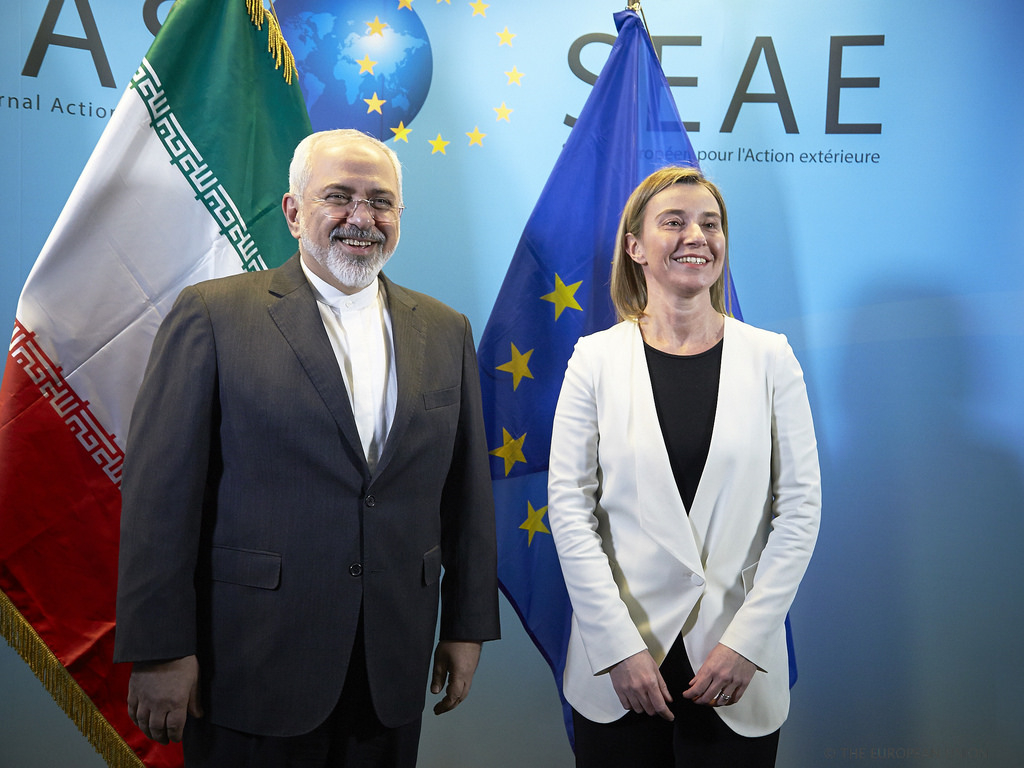
While Iran sets up all the technical, industrial and material means needed to produce nuclear weapons, it seems determined to continue its formal commitment to the "nuclear deal" as part of a strategy to drive a wedge between the Europeans and the Trump administration. Pictured: Iranian Foreign Minister Javad Zarif and European Union foreign affairs chief Federica Mogherini smile during a 2015 photo-op. (Image source: European External Action Servic/Flickr)

In the past three decades Iran has trained and deployed the scientists and technicians needed, built the research centers required, and set up structures for a complete nuclear cycle, from raw materials to the finished product.

Part of the Iranian national defense doctrine is based on the capacity to produce and deploy nuclear weapons within a brief time span.

Before the 1979 Islamic revolution, Iran regarded its northern neighbor, the nuclear "super-power" Soviet Union, as the sole serious threat to its national security. The assumption was that in case of a Soviet invasion, Iran should be in a position to use tactical nuclear weapons while waiting for the great American ally to ride to the rescue.

After the mullahs seized power, Iran's national defense doctrine was based on the assumption that it will, one day, fight a war with the United States plus its Arab allies and/or Israel.

The central assumption of Iranian strategists is that the US cannot sustain a long war. It is, therefore, necessary to pin down its forces and raise the kill-die ratio to levels unacceptable by the American public.

In the meantime, Iran would put its nuclear-weapons program in high gear, and brandish the threat of nuclear war as a means of forcing the US to accept a ceasefire and withdraw from whatever chunk of Iranian territory they may have seized.

Former President Hashemi Rafsanjani publicly evoked the possibility of using nuclear weapons against Washington's regional allies, especially Israel.

"In a nuclear duel in the region, Israel may kill 100 million Muslims," Rafsanjani said in a speech in Tehran in October 2000. "Muslims can sustain such casualties, knowing that, in exchange, there would be no Israel on the map." Iran's top military commanders also speak about a military clash with the United States as the only serious threat to the Khomeinist regime in Tehran.

They believe they have three trump cards to play.

The first is that Iran has a demographic reserve of some 20 million people of "fighting age" and is thus capable of sustaining levels of casualties unthinkable for Americans. The second is that Iran is already the missile superpower of the Middle East and could target all of Washington's allies in the region.

Iran's third trump card is its nuclear program. Without it, the other two cards will not have the desired effect, especially if the US unleashes its new generation of low-grade nuclear weapons designed for battlefield use.

The real issue, as far as US and its allies are concerned, is that the regime in Iran has been, is and most likely will remain, a threat with or without nuclear weapons.

Iran did not seize the US diplomats as hostages with nuclear weapons; nor did it massacre 241 US Marines in Beirut with an atomic bomb. The mischief that Iran is making in Syria, Lebanon, Afghanistan, Iraq, Yemen and Bahrain is not backed by nuclear power either.

So the real question is: How to deal with a maverick power that has built its strategy on fomenting discord and instability not only in the Middle East but anywhere else it gets a chance?

Washington hawks, among them Bolton perhaps, believe that the only realistic policy towards Iran is one of regime change before the Khomeinists build their nuclear arsenal. They believe that could be achieved with a mixture of military and diplomatic pressure, combined with moral and material support for a pro-democracy movement in Iran.

The Europeans, however, fear that any attempt even at soft regime-change may push the Khomeinists on the offensive in Afghanistan, the Persian Gulf, Iraq, the Caucasus, Lebanon, and the Palestinian territories.

Could a realistic policy be developed through a sober assessment of both positions? If yes, that would requires far more sophistication than the "to waiver or not to waiver" debate over what is; in fact; the fading ghost of an accord wrought from dangerous illusions.
This article first appeared in Asharq Al Awsat

Amir Taheri, formerly editor of Iran's premier newspaper, Kayhan, before the Iranian revolution of 1979, is a prominent author based on Europe. He is the Chairman of Gatestone Europe.

Source: https://www.gatestoneinstitute.org/12112/trump-iran-deal-bolton

Follow Middle East and Terrorism on Twitter

Copyright - Original materials copyright (c) by the authors.

A Muslim Committed the Worst Anti-Semitic Hate Crime of 2018 - Daniel Greenfield


by Daniel Greenfield

And no one is talking about it.


The worst anti-Semitic hate crime of 2018 took place outside a restaurant in Cincinnati, Ohio.

Izmir Koch, an Ahiska Turkish migrant who had already been in trouble with the law, allegedly demanded to know if there were any Jews around. A man who been at the restaurant replied that he was Jewish. Izmir punched him in the head, and then kicked him while he lay on the ground.

The victim, who wasn’t actually Jewish, suffered bruised ribs and a fractured eye socket.

Now a federal grand jury has indicted Izmir for committing a hate crime. The violent assault was the single worst anti-Semitic hate crime of 2018. So far. And it’s generated very little interest from the same activists and media outlets who had been accusing the White House of not acting against anti-Semitism.

Izmir had already been facing two counts of felonious assault, one involving a deadly weapon, from 2016. He was found guilty a month after the Cincinnati assault, along with a number of comrades and family members. That assault had taken place outside their trucking company in Dayton, Ohio.

A former employee had come to collect the money that he was owed, and Izmir Koch, Baris Koch, Sevil Shakhmanov and Mustafa Shakhmanov allegedly assaulted him with crowbars, and possibly brass knuckles and a baseball bat. The victim, who apparently had a knife, fought back.

Izmir, Boris and Murad were Turkish Muslims from the former Soviet Union who had migrated to this country. A few years before that fight, the local media was talking up their “positive impact” on the community in Dayton. But it didn’t take long for the legal problems to begin. The benefits of bringing these Turkish Muslims to Dayton were quickly outweighed by the violence they had brought.

The Cincinnati assault is one of the most physically violent recent anti-Semitic attacks. But the perpetrator is a Muslim immigrant and the alphabet soup organizations don’t want to talk about it.

It doesn’t fit their profile or their agenda.

News stories about the Cincinnati attack don’t mention that the perpetrator is a Muslim immigrant. “Give me your violent, your bigoted, your anti-Semitic masses yearning to kill,” doesn’t sound as good.

Lefty Jewish organizations spend all their time forming alliances to support Muslim immigrants against President Trump. Meanwhile the DOJ is fighting the anti-Semitism that they refuse to fight.

While the media and these organizations ignore the most violent anti-Semitic assault of the year, they have been lavishing attention on (((Semitism))), a book by the New York Times' Jonathan Weisman. The thesis of (((Semitism))) is that Muslims are our natural allies and the worst anti-Semitism today is the alt-right trolling on Twitter. Israel is an unfortunate distraction from all the merchant memes and hashtags.

“Stop obsessing about Israel,” the New York Times writer barks at Jews, “Reach out to Muslim groups, immigrant groups.” Weisman is welcome to reach out to Izmir Koch. But he should watch his eyes.

Tweets of Jews in gas chambers may be ugly, but Cincinnati reminds us of that actually dangerous anti-Semitism looks like an anti-Semitic Muslim thug beating you hard enough to fracture your eye socket.

The triple parentheses that some on the alt-right use to mark Jews had their own counterpart in the New York Times which published a list of Democrats opposed to Obama’s Iran deal, and marked which were Jewish in yellow. Weisman was the man behind the left’s version of the triple parenthesis. And his response to being called out was his own version of the alt-right’s “just kidding” wrongfooting gambit.

(((Semitism))) is only the latest example of how discussions about the rise in anti-Semitism elide the perpetrators actually committing serious crimes and instead dwell endlessly on Twitter Nazi trolls.

The ADL’s widely hyped figures noted that more than half of the anti-Semitic assaults in the country were reported in New York. Quite a few of the serious incidents happened in Brooklyn neighborhoods like Crown Heights and Williamsburg where the only white people are lefty hipsters. The rest are largely African-American and Latino. The first listed assault in Brooklyn was carried out by black teens.  

The targets of these assaults are frequently Orthodox Jews who are visibly identifiable as Jewish.

The ADL’s own numbers show that anti-Semitism rates among African-Americans in some years have been nearly twice as high as among the general population. That’s why Tamika Mallory, Barack Obama, Keith Ellison and so many others were comfortable palling around with Louis Farrakhan and the Nation of Islam. It’s why Al Sharpton and Jesse Jackson are black leaders instead of cautionary tales.

That’s a quite different reality from the one that exists in (((Semitism))) and similar narratives. And yet it’s what violent anti-Semitism actually looks like. And it’s what no major organization wants to discuss.


And even when it comes to rhetoric, they would rather talk about Twitter than real life.
 On the University of California-Santa Cruz (UCSC) campus, African/Black Student Alliance protesters harassed Jewish students celebrating Israeli Independence Day with shouts of “Free Palestine” and “F*** Jewish Slugs”. This is the sort of thing that Weisman and (((Semitism))) want us to ignore.

And when is praising Hitler and cheering the Holocaust on Twitter not a problem? When Muslims do it.

Canary Mission is constantly documenting anti-Semitism by members of campus hate groups such as Students for Justice in Palestine, including calls for Jewish genocide, and praise for Hitler. But unlike the same behavior by the alt-right, no major Jewish organization wants to pay attention to the crisis.

MEMRI has documented multiple mosques in the United States preaching the mass murder of Jews.

It’s no surprise that the worst anti-Semitic hate crime of 2018 was committed by a member of a religion whose leaders praise the Holocaust and preach a final apocalyptic conflict between Muslims and Jews.

And it’s also no surprise that lefty Jewish groups enabling Islamic migration don’t want to talk about it.

The Koch clan went from an immigrant success story to a violent nightmare in a matter of years. But the nightmare was always there. We just chose not to see it. And we still aren’t seeing it.

Anti-Semitism is a matter of religion and culture. America is one of the least anti-Semitic countries in the world. When immigrants from anti-Semitic countries come to America, then anti-Semitism increases.

The ADL’s own numbers show that Hispanic immigrants are more likely to be anti-Semitic  than Hispanics born in the United States.  In 2016, only 10% of white people held anti-Semitic views, compared to 19% of Hispanics born in the United States and 31% of Hispanic immigrants.

The numbers are even worse for Muslims.

An extensive British survey found that negative views of Jews among Muslims were 2 to 4 times higher than in the general population. One German survey found that over 50% of Muslim refugees held anti-Semitic attitudes. An Austrian survey showed that 50% of young Muslim had anti-Semitic views.

The ADL claims that in the United States it’s only 34%. Even if that’s true, that’s more than three times as high as white Americans.

Which should we be more concerned about, 10% or 34%?

But not all attitudes are created equal. Most people have some sort of prejudices. But very few will actually violently lash out at someone, especially a total stranger, the way Izmir Koch allegedly did.

Islamic bigotry doesn’t just stay private. It can turn into a lot more than just a joke or a little graffiti.

The Koran doesn’t just preach hatred. It urges the devout to act on that hatred. That is the ground zero of terrorism. It’s why Jews have been repeatedly targeted in acts of Islamic terror in America.

And why these crimes have been repeatedly whitewashed, brushed aside and forgotten.

That’s why we aren’t talking about a man lying bleeding on the street because a Turkish Muslim immigrant thought he was a Jew.


Daniel Greenfield, a Shillman Journalism Fellow at the Freedom Center, is a New York writer focusing on radical Islam.

Source: https://www.frontpagemag.com/fpm/269735/muslim-committed-worst-anti-semitic-hate-crime-daniel-greenfield

Follow Middle East and Terrorism on Twitter

Copyright - Original materials copyright (c) by the authors.

Iraq's Christians: Eighty Percent Have "Disappeared" - Giulio Meotti


by Giulio Meotti

Iraq happens to be "ground zero" for the "elimination" of Christians from the pages of history.

  • Tragically, Christians living in lands formerly under the control of the "Caliphate" have been betrayed by many in the West. Governments ignored their tragic fate. Bishops were often too aloof to denounce their persecution. The media acted as if they considered these Christians to be agents of colonialism who deserved to be purged from the Middle East. And the so-called "human rights" organizations abandoned them.
  • The West was not willing to give sanctuary to these Christians when ISIS murdered 1,131 of them and destroyed or damaged 125 of their churches.
  • We must now help Christians rebuild in the lands where their people were martyred.

Persecution of Christians is worse today "than at any time in history", a recent report by the organization Aid to the Church in Need revealed. Iraq happens to be "ground zero" for the "elimination" of Christians from the pages of history.

Iraqi Christian clergymen recently wore a black sign as a symbol of national mourning for the last victims of the anti-Christian violence: a young worker and a whole family of three. "This means that there is no place for Christians," said Father Biyos Qasha of the Church of Maryos in Baghdad. "We are seen as a lamb to be killed at any time".

A few days earlier, Shiite militiamen discovered a mass grave with the bodies of 40 Christians near Mosul, the former stronghold of the Islamic State and the capital of Iraqi Christianity. The bodies, including those of women and children, seemed to belong to Christians kidnapped and killed by ISIS. Many had crosses with them in the mass grave. Not a single article in the Western mainstream media wrote about this ethnic cleansing.

French Chief Rabbi Haim Korsia made an urgent plea to Europe and the West to defend non-Muslims in the Middle East, whom he likened to Holocaust victims. "As our parents wore the yellow star, Christians are made to wear the scarlet letter of nun" Korsia said. The Hebrew letter "nun" is the same sound as the beginning of Nazareen, an Arabic term signifying people from Nazareth, or Christians, and used by the Islamic State to mark the Christian houses in Mosul.

Now a new report by the Iraqi Human Rights Society also just revealed that Iraqi minorities, such as Christians, Yazidis and Shabaks, are now victims of a "slow genocide", which is shattering those ancient communities to the point of their disappearance. The numbers are significant.

According to the report, 81% of Iraq's Christians have disappeared from Iraq. The remaining number of Sabeans, an ancient community devoted to St. John the Baptist, is even smaller: 94% have disappeared from Iraq. Even 18% of Yazidis have left the country or been killed. Another human rights organization, Hammurabi, said that Baghdad had 600,000 Christians in the recent past; today there are only 150,000.

These numbers may be the reason Charles de Meyer, president of SOS Chrétiens d'Orient, has just spoken of the "extinction of Christians". Father Salar Kajo of the Churches' Nineveh Reconstruction Committee just spoke of the real possibility that "Christianity will disappear from Iraq".

Many ancient Christian churches and sites have been destroyed by Islamic extremists, such as Saint George Church in Mosul; the Virgin Mary Chaldean Church, attacked by car bomb, and the burned Armenian Church in Mosul. Hundreds of Christian homes have been razed in Mosul, where jihadists also toppled bell towers and crosses. The Iraqi clergy recently warned, "The churches are in danger".


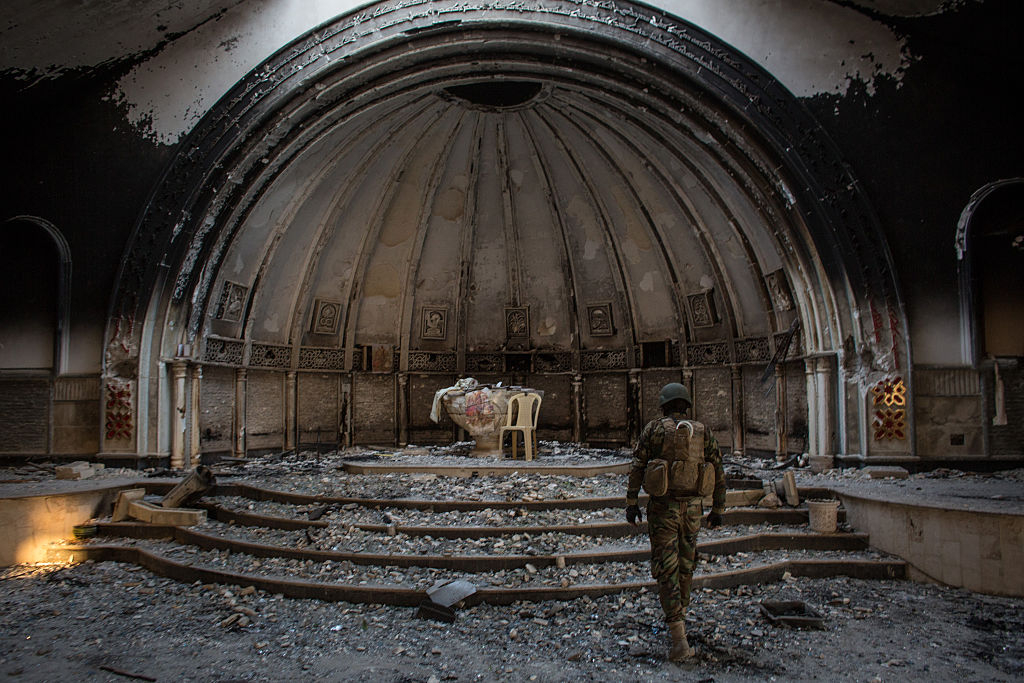
A fighter from the Nineveh Plain Protection Units (NPU) walks through a destroyed church on November 8, 2016 in Qaraqosh, Iraq. The NPU is a militia made up of Assyrian Christians that was formed in late 2014 to defend against ISIS. Qaraqosh is a mostly Assyrian city near of Mosul that was captured by ISIS in August 2014, and liberated in November 2016. (Photo by Chris McGrath/Getty Images)

Tragically, Christians living in lands formerly under the control of the "Caliphate" have been betrayed by many actors in the West. Governments ignored their tragic fate. Bishops were often too aloof to denounce their persecution. The media acted as if they considered these Christians to be agents of colonialism who deserved to be purged from the Middle East. And the so-called "human rights" organizations abandoned them.

European public opinion, supposedly always ready to rally against the discrimination of minorities, did not say a word about what Ayaan Hirsi Ali called "a war against Christians".

Some communities, such as the small Christian enclaves of Mosul, are now lost forever. Syriac Orthodox Patriarch Ignatius Aphrem II said there is a "real danger" Christianity could just become a "museum" in the Middle East. He noted that Iraq has lost 80-90% of its Christian population.

A few Christian villages have begun a slow and painful process of reconstruction with funds donated mainly by international relief organizations such as the US Knights of Columbus and Aid to the Church in Need. US Vice President Mike Pence recently promised to help these Christians. Action now must follow words. Christians who escaped and survived ISIS cannot depend today only on aid from churches and private groups.

Among European governments, only Hungary took a principled position and openly committed itself to save Iraqi Christianity from genocide. Recently, the Hungarian government opened a school for displaced Christians in Erbil; Hungary's Minister of Human Resources, Zoltan Balog, attended the event.

Imagine if all the other European countries, such as France and Germany, had done the same. The suffering of Christians in Iraq would today be much less and their numbers much higher.

The West was not willing to give sanctuary to these Christians when ISIS murdered 1,131 of them and destroyed or damaged 125 of their churches. We must now stand by their side before it is too late. After the mass displacements and the mass graves, we must help Christians rebuild in the lands where their people were martyred. Otherwise, even the smallest hope of hearing the sound of Christian church bells in the ancient lands of the Bible will be forever lost.

Giulio Meotti, Cultural Editor for Il Foglio, is an Italian journalist and author.

Source: https://www.gatestoneinstitute.org/12076/iraq-christians-disappeared

Follow Middle East and Terrorism on Twitter

Copyright - Original materials copyright (c) by the authors.

DEBATE: How Might the Israeli-Iranian Face-Off in Syria Evolve? - Dr. George N. Tzogopoulos


by Dr. George N. Tzogopoulos

Respondents to the question: Dror Michman, Danielle Pletla, Gary Samore, Raphael Ofek, Alex Vatanka, Eitan Shamir, Seth Frantzman


BESA Center Online Debate No. 9, April 1, 2018

Q: The recent infiltration of Israeli airspace by an Iranian drone launched from Syria was considered by Jerusalem a severe violation of its sovereignty. In response, Israel conducted a mission to strike the Iranian drone installation in Syria. During that mission, an Israeli F-16 jet crashed. In the aftermath of this incident, Israel – while not wishing to escalate – made clear that it is prepared to act with determination and exact a heavy price from anyone who attacks it. BESA joins the debate by posing the question: How might the Israeli-Iranian face-off in Syria evolve?

Respondents: Dror Michman, Danielle Pletla, Gary Samore, Raphael Ofek, Alex Vatanka, Eitan Shamir, Seth Frantzman
Dror Michman, Visiting Fellow, Brookings Institution, Washington DC

Iran has been heavily invested in Syria’s future and is determined to not only preserve the Assad regime, but also to capitalize on its gains. Syria represents Iran’s first significant military success abroad in recent years. The Iranians are intent on establishing military infrastructure – to include permanent bases, airfields, and naval bases, manned mainly by proxies (militias) that are already established in Syria and receive IRGC support, such as Hezbollah. Tehran seeks to exert significant influence in the region – not only over Israel, but also over other Iranian rivals – and control a land corridor that weaves from Tehran to Iraq to northern Syria, ending in the Mediterranean port city of Latakia.

The Iranians have also concluded that since the convoys delivering military supplies to Hezbollah are vulnerable to constant Israeli attacks, they should establish military industry facilities in Syria and Lebanon, where they can manufacture their own components to build precision-guided missiles and rockets, greatly amplifying the strategic threat Israel faces.

Hence the Iranian determination to follow through with this strategy despite their clear understanding of Israel’s red lines.

Israel has shown resolve in blocking Iran where possible, rather than allowing the situation to fester until it reaches the scale of other strategic threats facing the country – namely the over 100,000 rockets and missiles currently in Hezbollah’s arsenal. Israel, which in most cases would support a policy of stability, finds itself in a peculiar position: Most of its leverage in Syria comes from its potential for disruption.

Russia is a major player in this conflict. While it has positioned itself as an indispensable mediator between the warring sides, it has not prevented the recent escalation, since a low-level conflict serves its goals. Moscow has no interest in a full-scale confrontation between Syria, Iran, and Israel, as such a conflict would endanger recent achievements in Syria. However, a simmering conflict between the parties keeps them distracted and in line, thereby securing Moscow’s growing strategic role in Syria (which is why Moscow tacitly approves certain provocations).  But whether Russia can really control the conflict moving forward remains to be seen, and surely serious discussions are underway in Moscow regarding the Iranian infiltration.

For now, at least, the US appears ready to leave Russia in the lead in Syria, but its political support of Israel’s actions serves as a significant factor in Russian response.

While none of the parties involved has an interest in a full-scale military conflict, the conflict of interests is too fundamental to have been fully resolved. Iran will continue to challenge Israel’s red lines, perhaps by using different means and arenas; Israel will be forced to react, raising the specter of military conflict between the two.

Danielle Pletka, Senior Vice President, Foreign and Defense Policy Studies,
AEI, Washington DC

Assessing the balance of power in the Middle East, it is hard to escape the conclusion that Iran is winning. On its low-priority nuisance exercises, whether in Yemen or Qatar, it has dragged the GCC into both internal and external conflict at little risk to itself, and with little cost. On its higher priorities, whether support for the Assad regime in Damascus or Hezbollah in Lebanon, or in the subjugation of Iraq, these efforts, while more costly, are also going well. Where does that leave Israel? Facing almost certain conflict, likely with Iran’s proxy Hezbollah, in Lebanon, and perhaps also in Syria.

Israelis make clear publicly and privately that they will not tolerate the build-up and escalation of forces and weapons capability by Hezbollah. In reality, they have tolerated it for over a decade, but the tipping point is coming. The US seems neither to grasp the danger, nor to realize Tehran’s reach and domination in Syria and Lebanon. A war will not be conclusive, but it will be costly in blood and treasure. Worse yet for Israel and for the US and its other allies in the region, it will not solve the threat Iran and its proxies pose, but merely postpone it for another day.

Gary Samore, Executive Director for Research, Belfer Center for Science and International Affairs, Harvard Kennedy School, Cambridge, MA

Israel and Iran are likely to engage in periodic clashes over their opposing interests in Syria, but neither side seems eager to escalate to full-scale conflict at this time. Israel has a free hand to bomb Iranian installations in Syria and sophisticated weapons shipments to its allies such as Hezbollah. At the same time, Israeli bombing raids cannot prevent Iran from achieving its essential objectives in Syria, including strong political influence in Damascus, secure lines of transit into Lebanon, and the enduring presence of Shiite militias in Syria.

One factor that could change this standoff is if Prime Minister Netanyahu succeeds in persuading President Trump to join the battle against Iran from the US-supported Kurdish enclave in northeastern Syria. In that scenario, Iran might retaliate by unleashing attacks on Israel from southern Lebanon and the Golan, precipitating a wider conflict.

Raphael Ofek, Senior Analyst, Begin-Sadat Center for Strategic Studies (BESA), Bar-Ilan University

ISIS lost all its ground in Syria in October 2017. Iran, as a result of its role in the rescue of Bashar Assad’s regime, is now deeply embedded in Syria. Right now, Iran is trying to rewrite the rules of Israel’s military involvement in Syria while Israel is standing as a barrier preventing Iran from establishing a land corridor via Syria to Hezbollah in Lebanon.

The lengthy war of words between Tehran and Jerusalem escalated recently into a border clash. Israel’s immediate response to penetration of its airspace by an Iranian drone on February 10 – striking Iranian and Syrian targets in Syria – was a warning that Israel will not allow Tehran to control any Syrian base from which it can strike Israel. The Iranian drone penetration thus strengthened fears that a new war could break out.

It should be noted that the event occurred despite the widespread demonstrations in Iran in the end of December 2017, which challenged Tehran’s regime. The people of Iran protested mainly to express their dissatisfaction with the sluggish economy, accusing the regime of spending Iran’s resources on undermining the Middle East at the expense of its own citizens’ welfare.

Russia is also highly implicated in the Syrian theater, and so far, it seems to be the biggest winner. It has increased its territorial seizures in Syria and holds now a naval base in Tartus and an air base in Khmeimim. Notably, despite its cooperation with Iran during the Syrian civil war, Russia is maintaining good relations with Israel. For example, Moscow has not publicly denounced Israel for bombing Hezbollah’s weapons convoys travelling to Lebanon via Syria.

The key to curbing a possible Israeli-Iranian military face-off in Syria is Moscow. Moscow will probably restrain Iran so as to avoid becoming involved in a new war in Syria that could damage Russian interests in the Middle East.

Alex Vatanka, Iranian-American Senior Fellow at the Middle East Institute in Washington DC. His book, Personal Rivalries in Tehran and the Making of Iranian Foreign Policy, is due out in early 2019 

Listen closely to the debate in Tehran about Syria and you will detect great unease. There is an underlying fear – inside both the moderate and the hardline camps of the regime – that Iran won the war but is in danger of losing out in the post-war period that will follow. This apprehension has always been there. But it has become markedly more distinct as the principal foreign powers that intervened in Syria – Russia, Turkey and the US – set their sights on the long-term endgame.
With ISIS defeated, the Gulf Arab States distracted by the Yemeni civil war and intra-Arab Gulf rivalries, and a US that is still on the fence about Syria, the Iranians might want to pat themselves on the back (as some do) and declare victory in Syria.

Tehran came in early and heavy in support of the Assad regime. For it to declare itself among the geopolitical winners of this nastiest of wars is not unreasonable. For Tehran, losing Syria to the Gulf Arab-backed opposition was always the biggest nightmare. That scenario has been avoided.

How, then, do we then explain the enduring apprehension in Tehran? Put simply, the soon-to-be-settled Syrian war comes at a time when Iran as a nation is at an ideological crossroads. In the most recent popular protests in Iran that erupted on 28 December 2017, many of the angry slogans were aimed at Tehran’s costly – and ideologically driven – foreign policy (for example, “My life for Iran, not Gaza, not Lebanon”). The Iranian regime’s interventions in the Arab world have never been as popularly contested inside Iran as they are today. Given this pushback from below, can the Iranian leadership up the ante in Syria? This is an unsettled question in Tehran.

In truth, the intervention in Syria was always a war of choice by Iran. The notion that the rise of ISIS posed an existential threat to Iranian domestic security was a narrative of convenience. When the rabidly anti-Shiite and anti-Iran Taliban, which is not dissimilar to ISIS, took control next door in Afghanistan in 1994 and ruled for seven years, Tehran never intervened militarily. Why was fighting ISIS in relatively distant Syria so paramount?

In mid-2011, Tehran did a cost-benefit analysis and determined it had a fighting chance to keep its ally, Assad, in power. In so doing, it could also protect Hezbollah, its Shiite Lebanese darling, from the turmoil set in motion by the so-called Arab Spring. Seven years later, can the Islamic Republic of Iran justify to its people – plagued as they are by deep socioeconomic troubles – its commitment to an open-ended presence in Syria? One thing is for sure: the cost of waging war in Syria will be dwarfed by the cost of the Syrian reconstruction.

No doubt, foreign pet projects have always been the Iranian regime’s soft spot. But the need to maintain political stability on the home front supersedes all else, including the fate of Assad and Syria. Ayatollah Ali Khamenei, Hassan Rouhani, and the rest of the Iranian leadership know full well that at street level across Iran, the Syrian venture – as well as Iran’s other Arab pursuits – are overwhelmingly viewed as nothing but a drain.

The kind of national introspection that Iran is undergoing at the moment also directly touches that most cherished of ideological causes of the Islamic Republic: the enmity towards Israel. At home, Iran’s costly presence in the Levant is sold as necessary to keep alive the so-called Axis of Resistance against the Jewish State.

While the average Iranian tends not to fathom the reasons behind Tehran’s opposition to Israel, Iran’s economic troubles are making more and more Iranians ask if it is worth the price. Geopolitical maneuverings by on-and-off partners and rivals such as Russia and Turkey will largely shape Iran’s Syrian calculations in the short term. What cannot be overlooked, however, is the rising anger within Iranian society that has begun to defy the policy preferences of the Islamic Republic like never before. As Iran’s Syria policy evolves, the role of the Iranian people in shaping Tehran’s calculus should not be underestimated.

Eitan Shamir, former head of the National Security Doctrine Department in the Israel Ministry of Strategic Affairs

Iran is a revisionist country with an ideology to expand the Shiite Muslim revolution and Iranian hegemony as a regional power. An important part of this ideology is the elimination of the Jewish state. The Iranian Supreme Leader has even announced the year when this goal will be fulfilled: 2040.

While Iranian ideological motivation represents the threat, Iranian structural weaknesses, both economic and societal, represent the opportunities. Another opportunity is the current phase in the conflict in Syria. Both the Russians and the Iranians were fighting for the survival of the Assad regime. As they believe they have secured this objective, both are now seeking to consolidate and capitalize their gains.

This is where the conflict of interests between Russia and Iran could arise. The Iranian objective is to create in Syria another launching pad from which to attack Israel. The Russians would like to see stability and minimize the chances of conflict in order to secure their troops and bases.

Israel should try to put a wedge between the Iranian and the Russians and work with the Russians to highlight these differences.

As for a military confrontation, Iran does not have the means to strategically harm Israel from home. The Iranian plan is therefore clear: a pincer threat from Syria and Lebanon, giving Israel two fronts to worry about.

It will take years for Iran to build the necessary military infrastructure in Syria. Until then Iran wants to avoid a full-scale escalation. For its part, Israel should keep “mowing the grass” and stand firmly on its red lines.

If the worst-case scenario comes to pass, Israel has at its disposal the means to defeat its enemies in the north, although not without a price. Meanwhile it should continue to weaken Iran and its proxies using both diplomatic and military means.

In the Middle East there is a geostrategic reshuffling every decade or so, and hopefully the next one will bring an end to the current Iranian regime. Until then Israel will have to prepare for the worst-case scenario.

Seth Frantzman, executive director of the Middle East Center for Reporting and Analysis and op-ed editor of The Jerusalem Post

Israel has said that there are serious red lines in Syria regarding Iranian encroachment towards its northern border. The most likely evolution of the existing low-intensity conflict is that it will continue in its current form. Israel has no interest in a massive conflict with Iran, nor does it have a way to execute such a conflict. Similarly, Iran wants to use its proxies, including Hezbollah and other forces in Syria and Iraq, to threaten Israel.

Israel’s problems in targeting Iranian infrastructure in Syria will increase as the Syrian regime reasserts control near the Golan border and near Jordan. Russian air defenses and the presence of Syrian soldiers will complicate Israel’s usual method of air strikes. The larger concern is that Iraqi Shiite militias will use Syria as a transit to Lebanon or to the Golan border.

However, Iran’s regime carefully calculates its threats to Israel. It wants to drag Israel into a larger conflict that will harm Israel internationally. As long as Israel understands this it can avoid major conflict. With that said, the international community has not heeded Israel’s warnings, and Iran’s presence will grow as it feels empowered by Assad’s victory and Hezbollah’s growing influence in Lebanon.


For Twitter dissemination: #Besaonlinedebates #Israel #Iran #Syria
@BrookingsInst
@AEI
@dpletka
@BelferCenter
@AlexVatanka
@sfrantzman
@Jerusalem_Post
@tzogopoulos


Dr. George N. Tzogopoulos

Source: https://besacenter.org/online-debates/israel-iran-faceoff/

Follow Middle East and Terrorism on Twitter

Copyright - Original materials copyright (c) by the authors.