Monday, June 25, 2018

Nuclear Deterrence: Adopting the Reagan Approach - Mark B. Schneider and Peter Huessy

​
by Mark B. Schneider and Peter Huessy

Today, Russia and China not only have massive nuclear modernization programs, but also precision nuclear missiles, while the U.S. does not. Let it be a cautionary tale for the current administration in Washington.

  • President Reagan's successful policies involved not the elimination of all nuclear weapons, but the simultaneous modernization of all legs of America's nuclear Triad, while significantly reducing the size of the strategic nuclear arsenals of both the U.S. and the Soviet Union.
  • The 2018 Nuclear Posture Review confirms reports going back to 2004 that, "Russia is in violation of its... political commitments that directly affect the security of others, including... the 1991 Presidential Nuclear Initiatives." These eliminated America's battlefield nuclear weapons and many other nuclear capabilities, while Russia violated its reciprocal pledge to do the same.
  • Today, Russia and China not only have massive nuclear modernization programs, but also precision nuclear missiles, while the U.S. does not. Let it be a cautionary tale for the current administration in Washington.
Ronald Reagan, one of the most important presidents in American history, advanced a defense policy based on "peace through strength," and "reducing nuclear dangers." In so doing, he dramatically altered the United States' approach to dealing with the Soviet nuclear threat.

President Reagan's successful policies involved not the elimination of all nuclear weapons, but the simultaneous modernization of all legs of America's nuclear Triad in a manner that enhanced national security and strategic stability, while significantly reducing the size of the strategic nuclear arsenals of both the U.S. and the Soviet Union. He further enhanced America's deterrent by deploying nuclear cruise missiles (SLCMs) on naval ships, and medium-range nuclear missiles and new nuclear artillery in Europe.

Reagan also fundamentally changed the way in which the U.S. negotiates and enforces arms-control agreements. In 1988, his Department of Defense (DoD) submitted a "Report to the Congress on the Analysis of Alternative Nuclear Force Postures for the United States (Unclassified Version)," which contained four possible START treaty force postures, all of which involved having 4,900 ballistic missile warheads and 1,099 accountable bomber weapons. This number of warheads was roughly half of the amount deployed by the U.S. at the time, and those stabilizing reductions were at the heart of the Reagan arms-control revolution. [This report is not available online, but is available from the authors upon request.]

This arms posture vastly differed from that of the SALT agreement process, which had begun in 1972 between the U.S. and U.S.S.R., and was scheduled to allow the number of deployed warheads to reach at least 12,000. Of course, the START postures were totally antithetical to the Soviets' proposed nuclear freeze, which would have left a completely modernized Soviet nuclear force in place while the United States nuclear force was "rusting to obsolescence."

Reagan's 1983 Strategic Defense Initiative also revived the moribund U.S. missile defense program of the Carter-era, and began the development of the technologies that today protect the United States against a North Korean nuclear missile attack and defend its forward-based forces and allies against considerable and growing theater missile threats. The U.S. still has a long way to go before achieving a fully capable defense, but it would have none at all if it had remained stuck in the ABM Treaty of 1972, which prohibited a defense of the country – with the exception of a single program to develop no more than 100 short-range interceptors to defend a military base of Minuteman ICBMs.

The 1988 DoD reported cited above stated the following with regard to the Strategic Defense Initiative:
"...if effective defenses prove feasible, the United States intends to alter the strategic relationship with the Soviet Union with a relationship based on a greater reliance on defenses and on less reliance on offensive retaliation.... Furthermore, initial strategic defenses would offer the United States and its allies some protection should deterrence fail, or in the event of an accidental launch.... Finally, given the Soviet Union's record of treaty violations... Defenses will make U.S. security more robust against possible Soviet Union violations of START."
Remember, the world that President Reagan inherited in 1981 was bipolar and very dangerous. Many of the new threats America faces today were already developing then, but they were not considered by most observers at the time as serious threats. The Soviet Union was an ideologically hostile Communist dictatorship in the process of spending itself into oblivion in war preparations made worse by the debilitating effects of socialism.

During the administration of President George W. Bush, then-Russian Defense Minister Colonel General Sergei Ivanov stated that the Soviet military budget in the 1980s reached 40% of its GNP. To compare, peak U.S. military spending in World War II reached 43% of the GNP in one year; it was 10% in the 1950s and declined to 5% under President Jimmy Carter, who created what was called the "hollow army."

Reagan reversed this decline. During his presidency, defense spending peaked at 7% percent of America's GNP. The U.S. used technology to compensate for a massive disparity in the level of effort underway in the Soviet Union. At a critical point in human history, Reagan presented the Soviets with a military challenge that convinced them they could not win, although they never gave up trying. Reagan did not "end history," but he did create the circumstances that ended Communism in Russia and the Soviet empire as a major force in the world.

Faced with a massive Soviet nuclear buildup, Reagan engaged in the most comprehensive U.S. nuclear modernization program since the 1950s. This included programs such as the MX ICBM (later called Peacekeeper), the AGM-86B nuclear ALCM, the Ohio-class ballistic missile submarines and the Trident II missile.
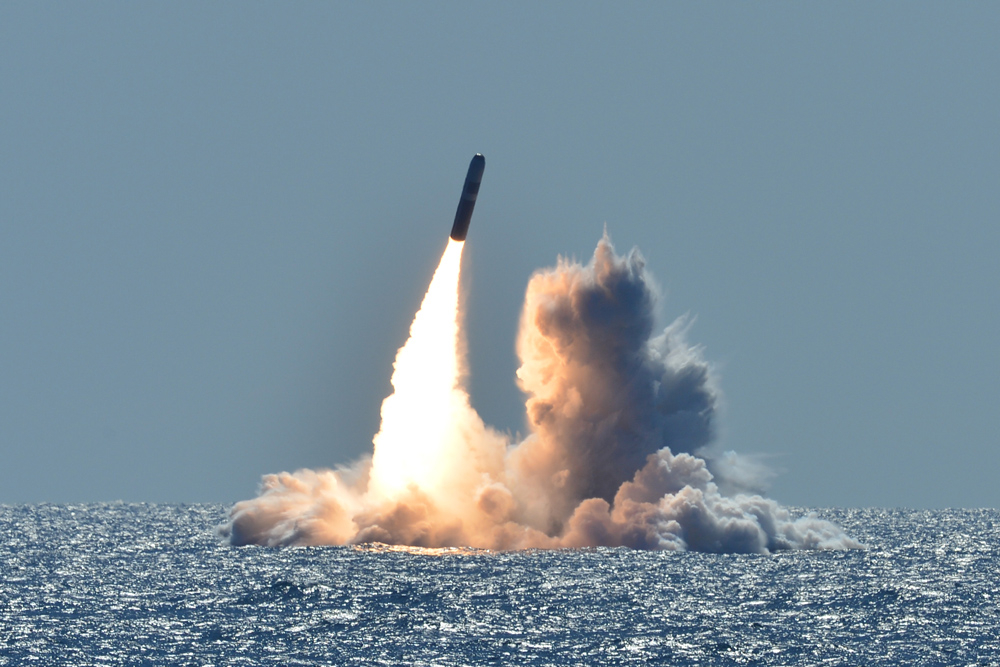

Pictured: The test-launch of an unarmed Trident II D5 missile from the Ohio-class ballistic missile submarine USS Nebraska off the coast of California. (Image source: U.S. Navy/Ronald Gutridge/Released)

The Reagan administration added the B-2 stealth bomber, SRAM II defense suppression weapons for bombers and tactical aircraft, and the single warhead Midgetman ICBM. While limited compared to those of the Soviets, these programs formed the core of a very effective deterrent.

Reagan's planned U.S. strategic nuclear force was eventually reduced by 85% in terms of warhead numbers under the Moscow Treaty and the New START Treaty between the United States and Russia. But while a fully modernized strategic deterrent could have been built even at these lower warhead numbers, many systems -- such as the Peacekeeper, the Advanced Cruise Missile, the nuclear capability of the B-1 bomber, the B-2 bomber (stopped at 20 planes rather than 120) and the SRAM II program -- were terminated by subsequent administrations.

We believe that while Reagan would have adjusted our nuclear deterrence requirements downward at the end of the Cold War, he never would have allowed a more than 20-year gap in U.S. deterrent modernization or never would have allowed Russia to get a 10-fold advantage in non-strategic nuclear weapons.

The current dangerous Russian 10-to-1 advantage in non-strategic nuclear weapons is largely the result of the unilateral Presidential Nuclear Initiatives (PNIs) of 1991-1992. According to General (ret.) Colin Powell, in his autobiography My American Journey, when he proposed the unilateral elimination of U.S. nuclear artillery, all four service chiefs of staff of the armed forces opposed it. Powell also said that the Office of the Secretary of Defense (OSD) policy staff, from "Wolfowitz all the way down," as well as then-Secretary of Defense Dick Cheney, "rejected my proposal." 

According to Powell, President George H.W. Bush "began pushing us for more fresh thinking on arms control." The "fresh thinking" involved important but unilateral nuclear weapons reductions without: (1) legal obligations to secure complimentary Russian cuts; (2) verification measures; or (3) Congressional approval of the cut in American nuclear forces.

Indeed, most of the weapons that were pulled out of Europe and dismantled as a result of the PNIs -- including ship-launched cruise missiles -- had been built and put there by the Reagan administration. The 2018 Nuclear Posture Review confirms reports going back to 2004 that, "Russia is in violation of its...political commitments that directly affect the security of others, including... the 1991 Presidential Nuclear Initiatives." These eliminated America's battlefield nuclear weapons and many other nuclear capabilities, while Russia violated its reciprocal pledge to do the same.

The PNIs have contributed to the current security crisis in Europe, as well. After the Russian invasion of Ukraine and the annexation of Crimea 2014, NATO Deputy Commander Lt. General Sir Adrian Bradshaw stated that the NATO rapid deployment force must be armed not only with conventional weapons, but also with the same weapons that Russia has. Thanks to the PNIs, tactical nuclear weapons exist in the Russian Army but not in that of the U.S. Perhaps, if the Reagan non-strategic nuclear deterrent existed in Europe today, even in much smaller numbers, Russian President Vladimir Putin would not have said in 2014, "If I wanted, Russian troops could not only be in Kiev in two days, but in Riga, Vilnius, Tallinn, Warsaw or Bucharest, too."

Reagan took deterrence of nuclear war very seriously. He saw both nuclear weapons and missile defense as part of America's deterrent strategy and as a hedge against arms control violations. His nuclear modernization programs were not created to finance the military industrial complex, as some have alleged; the modernization effort was undertaken for deterrence purposes. The Soviet nuclear threat was very real. In fact, it was even worse than we thought at the time. Since the end of the Cold War, significant portions of the Warsaw Pact war plan have become available online, and as a result, we know that the Soviets planned on a large-scale first use of nuclear weapons against NATO in support of a ground offensive designed to win and conquer Western Europe. It exercised this capability in its war games. In 2005, Polish Defense Minister Radoslaw Sikorski said, "The objective of the exercise on this map is to take over most of western Europe -- all of Germany, Belgium and Denmark."

In January 1983, in his annual report to the Congress for Fiscal Year 1984, then-Secretary of Defense Caspar Weinberger stated, "If we are to maintain a responsible nuclear deterrent against attacks on our allies, as well as against nuclear attacks on the United States, we will need to continue to exploit our comparative advantage in technology." Since that time, however, the United States has allowed the deployed technology to regress through program terminations, the retirement of some of the most of advanced of the Reagan-era nuclear deterrent systems and the complete lack of modernization. Due to the underfunding of the Defense Department during the presidency of Barack Obama, the Pentagon warned that the U.S. was losing its lead in technology -- and not merely nuclear technology. The Obama administration left office with a military in a condition of degraded combat readiness. In contrast, the Reagan administration left office with a military that in 1991 demolished Iraqi dictator Saddam Hussein's army in four days of ground-fighting and a subsequent decade of relative peace.

Today, Russia and China not only have massive nuclear modernization programs, but also precision nuclear missiles, while the U.S. does not. Russian deployment of low-yield nuclear weapons on its strategic missiles was reported in the Russian state media as early as 2008. In 2016, the Obama administration told Congress that the Chinese had announced the existence of a nuclear version of the DF-26 IRBM, which would give China "...nuclear precision strike capability against theater targets."

Who would have believed in the 1980s that this was going to happen? Who would have believed that the U.S. government, in 2010, would list the deterrence of nuclear attack as the third of five nuclear weapons-related objectives? The answer is: anyone who understood the significance of America's foolishly abandoning Reagan's sensible and realistic policies on nuclear deterrence.

Let it be a cautionary tale for the current administration in Washington.

Dr. Mark B. Schneider is a Senior Analyst with the National Institute for Public Policy.  
Dr. Peter Huessy is President of GeoStrategic Analysis, a defense consulting firm he founded in 1981, as well as Director of Strategic Deterrent Studies at the Mitchell Institute for Aerospace Studies.

Source: https://www.gatestoneinstitute.org/12571/nuclear-deterrence-reagan

Follow Middle East and Terrorism on Twitter

Copyright - Original materials copyright (c) by the authors.

Amid PA rejectionism, Arab nations threaten to 'go ‎over Abbas' head' - Daniel Siryoti, Reuters and Israel Hayom Staff

​
by Daniel Siryoti, Reuters and Israel Hayom Staff 

Egypt, Jordan, Saudi Arabia and ‎the United Arab Emirates say they will back the U.S.'s Middle East peace plan regardless of whether the Palestinian Authority is on board


Palestinian Authority President Mahmoud Abbas
Photo: EPA  
 
Top officials in the moderate Arab nations have ‎reportedly informed U.S. President Donald Trump's ‎Middle East envoys that they would back an American ‎peace plan for the region regardless of whether the ‎Palestinian Authority agrees to discuss it. ‎

Senior officials in Egypt, Jordan, Saudi Arabia and ‎the United Arab Emirates met with White House ‎adviser Jared Kushner and U.S. Special ‎Representative for International Negotiations Jason ‎Greenblatt in recent days and reportedly told ‎them that, having become fed up with Palestinian Authority President ‎Mahmoud Abbas' rejectionism, they will not stand in ‎Trump's way when he presents his Middle East peace ‎plan.‎

The White House said last week that the long-awaited ‎plan, dubbed the "deal of the century," would most ‎likely be presented in August.‎

Abbas declared that he would not engage with the U.S. on peace talks after Trump officially recognized Jerusalem as Israel's capital in December and subsequently relocated the American Embassy in Israel from Tel Aviv to Jerusalem. Abbas maintains that these moves clearly demonstrate Trump's pro-Israel bias and therefore the U.S. cannot act as an impartial peace broker between Israel and the Palestinians.

Senior Cairo and Amman officials told Israel Hayom ‎that they were informed in advance of the remarks that Kushner would make in an interview with the Palestinian ‎newspaper Al-Quds, published Sunday, prior to the Trump adviser's interview with the ‎east Jerusalem-based daily. ‎

In the interview, Kushner excoriated Abbas for ‎snubbing U.S. peace efforts and appealed to the Palestinian people to circumvent Abbas' rejectionist stance, adding that ‎Washington was more than willing to work with the Palestinian leader directly.

Over the past six months, Abbas and other ‎Palestinian Authority officials have refused to meet ‎with American representatives. ‎

A top Egyptian official told Israel Hayom Sunday ‎that the moderate Arab nations' position was ‎‎"unanimous" and that Cairo, Amman, Riyadh and Abu ‎Dhabi would not oppose an attempt by Washington to go ‎over Abbas' head in this case.‎

However, officials in all four nations made it clear ‎to both American envoys that they would not be party to any ‎deal that compromises Palestinian interests. ‎

"Despite the strategic mistakes made by Abu Mazen ‎‎[Abbas] and his people," an Egyptian official said, "Kushner and Greenblatt were ‎told, in no uncertain terms, that the Palestinians ‎deserve an independent Palestinian state with east ‎Jerusalem as its capital."‎

‎"Kushner agreed to the Arab nations' demand and made ‎in clear during his meetings with [Jordan's] King ‎Abdullah and [Egyptian] President [Abdel-Fattah] el-‎Sissi that the interests of the Palestinian people ‎will not be harmed if the regional peace plan is ‎introduced without the Palestinian leadership's ‎cooperation," he said. ‎

However, chief Palestinian Negotiator Saeb Erekat said ‎Sunday that the United States was clearly "determined to ‎dictate a solution" in the region.‎

Other Palestinian officials have accused Kushner of ‎trying to undermine Abbas and what they described as ‎their leader's moderate camp.‎

Ahead of Kushner and Greenblatt's regional visit, ‎Egypt, Jordan, Saudi Arabia and the United Arab ‎‎Emirates had tried to pressure Abbas into meeting with them but ‎to no avail. ‎

Top officials in all four nations made it clear to ‎the Palestinian leader that he had to listen ‎to the ‎American proposal because he was simply in no ‎position to ‎dictate terms to the Americans as to with whom he ‎will or will not negotiate.

A senior Jordanian official told Israel Hayom Sunday ‎that it was made clear to the American envoys that the ‎‎"Arab states will not be the ones to throw a wrench ‎in the wheels of the peace process, and that Abbas' ‎continued refusal to work with the Americans will ‎lead to a regional peace plan being launched without ‎him."‎

This, he warned, "would render the Palestinian ‎leadership irrelevant with respect to the peace ‎process."


Daniel Siryoti, Reuters and Israel Hayom Staff

Source: http://www.israelhayom.com/2018/06/25/amid-pa-rejectionism-arab-nations-threaten-to-go-%e2%80%8eover-abbas-head/

Follow Middle East and Terrorism on Twitter

Copyright - Original materials copyright (c) by the authors.

Turkey's Erdogan wins re-election, gains tighter grip on power - News Agencies and Israel Hayom Staff

​
by News Agencies and Israel Hayom Staff 

Under new system of government, Erdogan will wield sweeping executive powers


Turkish President Recep Tayyip Erdogan
Photo: AP

Turkish President Recep Tayyip Erdogan ‎emerged victorious on Monday from his biggest electoral challenge in a decade and a half, giving him the sweeping executive powers he has long sought and extending his grip on the nation of 81 million until at least 2023.

More than 59 million Turkish citizens, including 3 million expatriates, were eligible to vote. Early on Monday, Supreme Election Council Director Sadi Guven said 97.7% of the votes had been counted and declared Erdogan the winner.


Erdogan, who has never lost an election and has been in power since 2003 (first as prime minister), pledged Monday that there would be no retreat from his drive to transform Turkey, a deeply polarized nation that is both a NATO member and, at least nominally, a candidate to join the European Union.

Erdogan, 64, secured 52.5% of the votes in the presidential elections and his AK party won 42.5% of the votes in the parliamentary polls. It was boosted by its nationalist allies, which outstripped expectations and took 11.1%.

The president had faced a more robust, united opposition than ever before, with combative former teacher Muharrem Ince posing a threat throughout the campaign.

Ince won nearly 30.7% of the vote and the opposition initially claimed that there should be a second round of voting, but it eventually conceded defeat.

Erdogan has repeatedly cast his opponents as enemies of democracy, tapping into the groundswell of nationalist feeling that followed a failed coup in 2016.
Presidency Press Service via AP
Turkish President Recep Tayyip Erdogan waves to supporters in Ankara, early Monday

"The nation has entrusted to me the responsibility of the presidency and the executive duty," Erdogan said in televised remarks from Istanbul.

"It is out of the question for us to turn back from where we've brought our country in terms of democracy and the economy. ... There is no stopping for us until we bring Turkey, which we saved from plotters, coupists and political and economic hitmen, street gangs and terrorist organizations, to among the top 10 economies in the world."

Later, in Ankara, he said, "This election's victor is democracy, this election's victory is national will."

He added that Turkey "will look at its future with so much more trust than it did this morning."

Erdogan also pledged to continue to "liberate Syrian lands" so that refugees can return to Syria safely.

The election was one of the most consequential votes in years, with a revitalized opposition unifying to challenge the incumbent president.

He will now wield sweeping executive powers under a new presidential system that curbs the authority of the parliament and the judiciary and that critics say entrenches one-man rule.

The new system empowers the president to appoint ministers, vice presidents and high-level bureaucrats, issue decrees, prepare the budget, and decide on security policies.

A loyal parliamentary majority could reduce checks and balances on the president's power unless the opposition can wield an effective challenge.

Critics warned that Erdogan's re-election would cement his already firm grip on power and embolden his increasingly autocratic tendencies.

Erdogan enjoys considerable support in the conservative and pious heartland, having empowered previously disenfranchised groups. From a modest background himself, he presided over an infrastructure boom that modernized Turkey and lifted many out of poverty while also raising Islam's profile, for instance by lifting a ban on Islamic headscarves in schools and public offices.

Critics say he has become increasingly autocratic and intolerant of dissent. The election campaign was heavily skewed in his favor, with opposition candidates struggling to get their speeches aired on television. Erdogan directly or indirectly controls most of the media in the country.


News Agencies and Israel Hayom Staff

Source: http://www.israelhayom.com/2018/06/25/turkeys-erdogan-wins-elections-gains-tighter-grip-on-power/

Follow Middle East and Terrorism on Twitter

Copyright - Original materials copyright (c) by the authors.

Systematic destruction - Eldad Beck

​
by Eldad Beck

Given Turkey's political, economic and social decline, one would have expected the opposition parties to have rallied around a charismatic candidate who could have put up a fight against Erdogan.

Dictators who impose their rule on their people through supposedly democratic means mainly derive their strength from their political rivals' inability to unite against the tyrannical regime that is systematically destroying them and their country.

Given Turkey's political, economic and social decline, one would have expected the opposition parties not to have divided their voters among the five different candidates running against Turkish President Recep Tayyip Erdogan but to rally around the candidacy of a charismatic leader that could have put up a fight against the incumbent. But since that did not happen, Erdogan was able to leap easily over the hurdles in his path to becoming Turkey's omnipotent ruler for a term that will take him past 2022, the same year when Turkey will mark the centennial of its establishment as a republic. By then, Erdogan hopes to complete the process of rapid disengagement from the secular principles set out by the founder of modern Turkey, Mustafa Kemal Ataturk. Erdogan is acting to complete this process consistently, vigorously and successfully. Ataturk's Turkey is no more.

Palestinian Authority President Mahmoud Abbas was one of the first to congratulate Erdogan on his election victory, and for good reason: Erdogan is one of Abbas's last remaining hopes in a Middle East that has turned its back on the Palestinians. Beyond the Palestinians' best interest, Erodgan longs for Israel's detriment. The Israeli government decided not to respond with full force to the renewed deterioration in its relations with Ankara following Palestinian attempts to invade Israel from the Gaza Strip. The assessment in Jerusalem was that protest measures by Israel would lead to an escalation in tensions between the two countries that would benefit Erdogan's campaign and ensure his victory at the polls. Now that he has been granted another term in office, the Knesset must act to officially recognize the Armenian genocide. The Israeli government should also recognize the Kurds' right to self-determination and their own country, and all of Israel's official bodies should join forces to convince the West it must not collaborate with Turkey.


Eldad Beck

Source: http://www.israelhayom.com/opinions/systematic-destruction/?redirected=274015

Follow Middle East and Terrorism on Twitter

Copyright - Original materials copyright (c) by the authors.

Sunday, June 24, 2018

'How dreams of peace led to Israel's biggest mistake' - Charles Krauthammer

​
by Charles Krauthammer

A brilliant example of the late commentator's intellectual honesty and his incisive analysis of the Arab-Israel conflict, brought here in memoriam.

(JTA) -- On June 10, 2002, Charles Krauthammer delivered the Distinguished Rennert Lecture upon receiving the Guardian of Zion Award from Bar-Ilan University's Ingeborg Rennert Center for Jerusalem Studies. Below is an excerpt from the lecture titled "He Tarries: Jewish Messianism and the Oslo Peace." 

In the 1990s, America slept and Israel dreamed.

The United States awoke on Sept. 11, 2001. Israel awoke in September 2000.

Like the left and like the reverie that we had in the United States, secular messianism was intoxicated with the idea that history had changed from a history based on military and political conflict to one in which the ground rules were set by markets and technology. This was the infatuation with globalization as the great leveler and the abolisher of things like politics, war and international conflict. This kind of geo-economics was widely accepted in the early post-Cold War era.

It was Sept. 11th that abolished that illusion. It taught us in America there are enemies, they are ideological, they care nothing for economics and they will use whatever military power they have as a means to achieve their ideological ends. This is the old history, perhaps the oldest history of all, the war of one God against another. No new history, no break in history, no redemption from history.

The other source of this secular messianism in the Israeli context was the success of the European Union, which was seen as a model for peace in the Middle East. There was talk of Israel, Palestinian and Jordan becoming a new Benelux, with common markets, open borders, friendship and harmony.

Indeed, if you look at the Oslo Accords, of course there is page upon page of all of these ideas of cooperation on economics, on technology, on environment, all which in retrospect appear absurd. And indeed, this entire idea of the Benelux on the Jordan looks insane in retrospect, but I believe that it was insane from the very beginning, when it was first proposed 10 years ago.

There are such obvious differences between the European situation and the Middle Eastern one. First is that the period of harmony, integration and commodity among the Europeans happened only after the utter and total defeat of one party. It did not come from long negotiations between France and Germany at Camp David, compromising their differences over the 20th century. It came from the utter destruction of Germany and the rebuilding of a new Europe after that surrender and accommodation.

These conditions do not apply in the Middle East. The only way that that kind of peace will come definitely is the peace not of the brave but of the grave, and that means a peace that would be established with the defeat of Israel and its eradication. There is no way that Israel can utterly defeat the Arabs the way the Allies defeated Germany and Japan in the Second World War.

So that the idea of some kind of harmonious Middle Eastern Union drawing on the European mantle is drawn from a totally false historical analogy, one that is based on surrender and accommodation that could not happen in this Middle Eastern context, unless we are looking at the world through the eyes of Hamas and Hezbollah.

Secondly, the Middle East is still a collagen of religious fanaticism, economic backwards and political tyranny. It is nothing more than a mirage to transpose the situation in Europe with the harmony that came after half a millennium of conflict and in conditions of modernity to transpose those conditions to the Middle East, with a conflict as much younger and the political culture infinitely less mature.

In this context, to look at the savage religious and secular conflicts going on throughout the Middle East and to believe that the most virulent of these, the conflict with Israel, can find the kind of harmonious coexistence that exists in Europe, can only be called messianic.

Now this is not to say that the only impulse underlying Oslo was messianic. There was a messianic left and there was a realistic left, if you like. The realists saw Oslo as a pragmatic way out of Israel's dilemma. I believe in retrospect, as I believed at the time, that they were utterly mistaken, but at least they were not dreaming.

I think Rabin had a fairly coherent logic behind Oslo. He saw three basic changes in the world having occurred in the '90s, and he thought they would give Israel an opportunity to quickly settle the Palestinian dispute and to concentrate on the larger disputes coming in the longer run from the periphery, from the missiles and the weapons of mass destruction that would soon be in the hands of Iran, Iraq, Libya and others.

And the three events he saw were: First, the collapse of the Soviet Union, which deprived the rejectionist Arabs of the great superpower sponsor and source of economic, military and diplomatic assistance. Second was the victory of the United States in the Gulf War and the establishment of American hegemony in the region. Third was the terminal condition of the PLO. Arafat had again, as always, chosen the wrong side in war, was cut off by Kuwait and Saudi Arabia, ostracized by the United States, lost all of his financial and diplomatic support. The PLO was on its last legs.

Rabin thought he was cleverly exploiting the weakness of the PLO by reviving it, he imagined, just enough so it could make peace with him. With the Soviets gone, with Iraq defeated, with the U.S. ascended, with the PLO weakened, he thought he could make a deal on this basis. He turned out to be hopelessly mistaken, both on the intentions and on the recuperative powers of the PLO once Israel had helped it out of its abyss.

It was one of the great miscalculations in diplomatic history.

Indeed, I believe Oslo will stand as perhaps the most catastrophic, self-inflicted wound by any state in modern history.

But at least in Rabin's mind, as I understood it, it was a calculation. For Peres and his counterpart on the Israeli left, it was a leap of faith. And I mean the word literally, faith.

Chesterton once said that when a man stops believing in God he doesn't believe in nothing, he believes in anything. In the ideologically fevered 20th century, this belief in anything often turned out to be a belief in history, history with a capital H. For the messianic left, Oslo was more than a deal. It was a realization, a ratification of a new era in history.

Rabin's Oslo was pessimistic, peace with fences, separation, divorce wearing its tenuousness. Peres' Oslo was eschatological: Benelux, geo-economics, the abolition of power politics.

Israel, labored under its illusion, did not awake to its reality for seven long years, until reality declared itself in the summer of 2000 at Camp David, when Barak's astonishingly conciliatory peace offer elicited a Palestinian counteroffer of terrorism and suicide bombing.

This is not to say that peace is impossible; it is only to say that peace will always be contingent. And even that contingent peace will require the demonstration by the Arab side of its willingness, its genuine willingness, to live in acceptance of a Jewish state.


Again, that is not impossible. That is what Sadat offered, and he meant it. It is not clear that post-Sadat Egypt means it, although it has lived within the Sadatian parameters at least for reasons of prudence ever since.

But there has never been a Sadat among the Palestinians. And the idea that one can strike a real peace deal with Arafat, in the absence of a Sadat-like acceptance of the Jewish state, is indeed delusional. Until there is a genuine Arab, a genuine Palestinian acceptance of a Jewish state within whatever borders, there will be no end to history, there will only be more and more history.

Bismarck once said of the Balkans that they produce more history than they can consume, and that will be the fate of the Middle East for the foreseeable future.

Let me conclude by dealing with one objection to my characterization of the secular messianism of the Israeli, and I might say American, left. One might ask, "Was not the original Zionist dream itself messianic?" After all, a hundred years ago Zionism itself appeared to be a crazy dream. The idea of the ingathering of the exiles, the reestablishment of the Hebrew language, of Hebrew culture, the settling of the land, the achievement of political independence, appeared all to be, well, messianic.

I would argue precisely the opposite. Zionism is the antithesis of messianism. Zionism argued against waiting in the Diaspora with prayer and fervency for some deus ex machina to come and to rescue the Jews. Zionism rejected the idea of waiting for an outside agent, for a Shabbetai Zvi and a Bar Kochba. Zionism is supremely an ideology of self-reliance, of self-realization. It refuses to depend on others, it postulates no sudden change in the psychology of enemies, it postulates no change in human nature, it postulates no discontinuity in history.

Zionism accepted the world precisely as it was and decided that precisely because the world was as it was, the Jews had no future in the Diaspora and would have to build their future in Zion. Most of all, they understood that the building of Zion would depend on Jewish action, Jewish initiative, Jewish courage. They had to go out and to build a state themselves, and they did.

Oslo, on the other hand, a supreme expression of post-Zionist messianism, was entirely contrary to that spirit. Why? Because of its passivity, its reliance on an almost quasi-religious change of heart among Israel's enemies. It is an acceptance of Israel by people who daily in their propaganda, in their sermons, in their pedagogies, anatomize the very idea of the Jewish state. It expected a renunciation of terrorism by people who practice, support, and fund and glorify it, and who had been doing that for 20 years, 30 years. It believed in entrusting the security, the safety, perhaps even the very existence of the Jewish state into the hands of sworn enemies.

We have now learned, to our sadness and horror, that one cannot contract out the safety of the Zionist experiment to others, most especially to Arafat and the PLO. That was the premise of Oslo and it has proven to be catastrophic.

I repeat, in the 1990s America slept, and Israel dreamt.

The only good news is that Israel has awoken from that reverie, the most disastrous messianic seduction since Shabbetai Zvi. Shabbetianism survived nonetheless for centuries; Osloism still has its cultic adherence. But the body of the Jewish people has awoken, let us hope not too late, and once and for all determined never again to succumb to the messianic temptation.

© Bar-Ilan University

(Charles Krauthammer wrote a  weekly political column for The Washington Post, was a Fox News commentator and appeared regularly on “Special Report with Bret Baier.” He died Thursday.)


Charles Krauthammer was the leading voice of America's conservative intellectuals.

Source: http://www.israelnationalnews.com/Articles/Article.aspx/22355

Follow Middle East and Terrorism on Twitter

Copyright - Original materials copyright (c) by the authors.

The Peril of Politicized Antisemitism - Caroline Glick

​
by Caroline Glick

Jewish Democrats' libels against Trump mask a dire problem in their ranks.


Originally published by the Jerusalem Post.

Google search of the terms “Trump Nazi,” brings up 70,900,000 results.
There are a number of distressing aspects to this state of affairs.

First and foremost, it is pure libel to call US President Donald Trump a Nazi.
His daughter Ivanka is Jewish. His daughter-in-law is Jewish. Half his grandchildren are Jewish and his non-Jewish ex-daughter-in-law is half Jewish.

How many Nazis have Hanukka celebrations in their homes starring their Jewish grandchildren?

Beyond his Jewish immediate family, Trump has shown extraordinary friendship to the Jewish state. It isn’t simply that Trump kept the promise none if his predecessors kept and moved the US Embassy to Jerusalem, although that would have sufficed to prove his friendship.

Trump shows his friendship and respect for Israel every single day.
 

Last week he agreed to sell Israel mid-air refueling planes. His predecessor, Barack Obama, refused to sell Israel the aircraft in order to protect Iran’s nuclear sites from Israeli air strikes. Trump agreed to sell them to enable such Israeli strikes in the event they become necessary.
This week, Trump approved UN Ambassador Nikki Haley and Secretary of State Mike Pompeo’s determination that the US should withdraw from the institutionally antisemitic UN Human Rights Council. The Obama administration joined the council claiming it would use its membership to influence the council for the better and proceeded to legitimize council’s anti-Jewish witch hunt for eight years.

The people of Israel recognize Trump’s friendship. Nearly 80% of Israelis view him as a friend.

So what explains the 70,900,000 results to the “Trump Nazi” Google search?

One answer came this week with the media outcry over the US government policy of separating illegal immigrant minors from their illegal immigrant parents.

The policy is cruel. Indeed, recognizing its cruelty, Trump signed an executive order banning the practice.


But the policy isn’t new. This was the Obama administration’s policy following a court order prohibiting children from joining their parents in detention.

Rather than soberly acknowledge that law enforcement, including immigration law is often a cruel business and recognize that to remain a state of laws sometimes authorities undertake difficult and harsh actions, the anti-Trump media ignored reality and went straight for the kill. David Remnick, Frank Bruni and countless others didn’t care that the Obama administration separated children from their parents, placed them in cages and wrapped them in aluminum foil.

As far as they are concerned, the continuation of the same cruel policy under Trump is proof that Trump is a Nazi.

Gen. Michael Hayden, the former director of the NSA and the CIA posted a photo of the entrance to Auschwitz on his Twitter feed with a caption “Other governments have separated mothers and children.”

As much as Hayden and his comrades hate Trump, by claiming that enforcing laws of Congress is Nazi behavior, they are demonizing the US and engaging in rank antisemitism. Mexican children separated from their parents because they broke properly constituted laws of a liberal republic are not the moral equivalent of the million Jewish children murdered by the Nazis for the “crime” of breathing while Jewish. Congress is not the Reichstag. And the Rio Grande is not Auschwitz.

Hayden and his comrades are not idiots. So why are they making these unhinged, libelous claims?

The answer is that their actions are part of a wider move by Democrats to politicize antisemitism.

Much has been made of the fact that support for Israel is becoming a partisan issue. Whereas Republicans are almost unanimous in support for the US alliance with Israel, support among Democrats is flagging and becoming a minority view on the rapidly growing far Left.

What has gone largely unmentioned is that antisemitism is also becoming a partisan issue. As their party becomes more hostile to Israel, Democrats are increasingly highlighting the neo-Nazi elements at the fringe of the Republican Party as a means of implicating the entire Republican Party – led by Trump – as antisemitic and dangerous.

At the same time, even as leading members of the Democratic Party like Keith Ellison and luminaries like Linda Sarsour openly espouse anti-Jewish sentiments and propagate antisemitic conspiracy theories, Democrats ignore, whitewash, deny and minimize the significance of the swelling chorus of antisemitism within their ranks.

Compare the responses of Democrats and Republicans to the appearance of antisemites on their ballots.

In the current election cycle, three white supremacists have sought office as Republican candidates. Arthur Jones, a 70-year-old white supremacist Nazi, running for Congress in Illinois’s 3rd Congressional district ran a stealth campaign for the safe Democratic seat. He quietly collected the requisite signatures to file his papers with the state election commission, blindsiding the GOP, which had not planned to field a candidate to run against incumbent Dan Lipinski who has won the last seven elections by a 70-30 margin.

In response to Jones’s maneuver, the state and national GOP condemned and disavowed him in the harshest terms. The state party announced it would field an independent candidate to run in the general election against Jones and Lipinski.

Then there is Patrick Little. Little, another Nazi, ran in California’s open primary for Senate as a Republican. Ten other Republicans also ran. In one poll, which included Little and one other Republican candidate only, he was the top ranked Republican candidate in the open Senate race against Democratic incumbent Diane Feinstein.

Rather than acknowledge the poll’s statistical insignificance, the Forward, Newsweek and Yahoo news ran stories about Little and the poll claiming that it proved that empowered by Trump, Nazis are taking over the Republican Party. The fact that the California GOP forcibly removed Little from their state convention was barely reported in the national media.

Paul Nehlen, a Democratic candidate for Congress in House Speaker Paul Ryan’s district was supported by many conservatives until last December when it came out that he is a white supremacist. As soon as his positions – which he had deliberately hidden – were revealed, every major and minor conservative media outlet and politician condemned him.

But that hasn’t stopped CNN from waging a campaign against Virginia Republican Senate nominee Corey Stewart for having endorsed Nehlen a month before his positions were publicized. Stewart unconditionally condemned Nehlen once his anti-Jewish bigotry was exposed.

In the Democratic tent itself, things are a bit different.

Rising stars in the Democratic Party, including Rep. Ellison and Women’s March leaders Tamika Mallory and Linda Sarsour along with the Congressional Black Caucus embrace Louis Farrakhan, and defend his notorious, virulent hatred of Jews. They demonize Israel and its Jewish supporters.

Far from being attacked or otherwise denounced for their actions, these Democrats are advanced and promoted. Ellison is the vice-chairman of the Democratic National Committee. Mallory and Sarsour, Maxine Waters and other members of the CBC are feted by party leaders including Senators Bernie Sanders and Elizabeth Warren.


Democratic Jews have to date refused to mobilize to oppose them in any significant way. Indeed, in some cases they support antisemites.

Take the Jewish community of Charlottesville, Virginia’s reaction to the Congressional candidacy of Democrat Leslie Cockburn. Cockburn is the co-author, with her husband, Andrew Cockburn, of the 1991 book, Dangerous Liaison: The Inside Story of the US-Israeli Covert Relationship.

The New York Times review of the book said, “Their book, supposedly a history of the secret ties between Israel and the United States, is largely dedicated to Israel-bashing for its own sake. Its first message is that win or lose, smart or dumb, right or wrong, suave or boorish, Israelis are a menace. The second is that the Israeli-American connection is somewhere behind just about everything that ails us.”
Rather than excoriate Cockburn for her history of propagating antisemitic conspiracy theories, the Washington Jewish Week wrote an empathetic article about her quest to have an open exchange with the Jewish community in her district. One member of the Jewish community who was prominently cited as an authority on her outreach to the community, noted approvingly that in a meeting with Jewish constituents Cockburn “pointed out that her views on Israel align with J Street.”

New York Times reporter and author Jonathan Weisman epitomizes the Democrats’ simultaneous promotion of leftist antisemitism and castigation of the Republicans as the new Nazi party. During the 2015 battle over the Obama administration’s nuclear deal with Iran, Weisman, who is Jewish, co-authored an article singling out by name the Jewish members of Congress who opposed the deal. In other words, he engaged in antisemitism to demonize Jewish opponents of the Obama administration’s anti-Israel policy of empowering Iran.

In 2017 Weisman wrote a widely cited book, (((Semitism))): Being Jewish in America in the Age of Trump.

Weisman’s basic argument in his book is that Trump’s populism empowers far-Right antisemites and so threatens the Jewish community in the US.

It isn’t that antisemitism on the far Right is nothing to be concerned about it. To the contrary. There is great reason to be concerned, even alarmed by the Jew-hating rhetoric emanating from the far Right. To their credit, cognizant of the danger, Republican leaders, including Trump have consistently condemned and marginalized these voices and actors in their party.

There is also reason to be concerned with left-wing antisemitism, including when it takes the form of a New York Times journalist singling out for rebuke Jewish members of Congress who oppose an anti-Israel policy. Left-wing antisemitism should be should be fought without prejudice even when it is being propagated by minority groups. Farrakhan should not get a pass, nor should his African-American supporters.

Because the US has a two-party system, marginal forces always seek to use the machinery of the large parties to advance their positions and causes. As a consequence, it is not surprising that antisemites on the Right seek to penetrate the GOP. And it isn’t surprising that their leftist counterparts are seeking to take over the Democratic Party. But again, while the state and national Republican Party condemns and disowns antisemites, the Democrats woo them for their votes and political support and elect them to office. And as they do these things, they libel the Republican Party and Trump accusing them of Nazi sympathies and goals.

It is hard to see a happy end to the story. By attacking Trump, the most pro-Jewish president in living memory, as a Nazi, while ignoring the dangers of the growing power and numbers of antisemites in their own party, Jewish Democrats are doing themselves no favors. So long as Jewish Democrats go along with the rise of antisemitic forces in their party on the one hand, and assault the Republicans as Nazis on the other, the situation will only get more dangerous for them and for the Jewish community in the US as a whole.


Caroline Glick is the Director of the David Horowitz Freedom Center's Israel Security Project and the Senior Contributing Editor of The Jerusalem Post. For more information on Ms. Glick's work, visit carolineglick.com.

Source: https://www.frontpagemag.com/fpm/270526/peril-politicized-antisemitism-caroline-glick

Follow Middle East and Terrorism on Twitter

Copyright - Original materials copyright (c) by the authors.

A quiet affair - Ariel Kahana

​
by Ariel Kahana

Prime Minister Benjamin Netanyahu knows that the Palestinians are a bigger problem for Jordan than for Israel, and is willing to help King Abdullah as much as he can, quietly


Prime Minister Benjamin Netanyahu, right, and King Abdullah 
of Jordan shake hands
Photo: Kobi Gideon / GPO

Israel handles its relations with the Arab world in the shadows, like a forbidden romance.
On Monday, King Abdullah of Jordan hosted Prime Minister Benjamin Netanyahu in Amman. The meeting included many participants. Abdullah and Netanyahu addressed several issues and even signed a general agreement of some kind.

Nevertheless, the Jordan royal house did not publicize the event. Unusually, the official photographer did not post any pictures on Facebook. Even the Jordanian press release characterized the meeting as a negative thing that had to be completed as quickly as possible, stating: "Prime Minister Netanyahu left Jordan after a short visit."

"Short" is apparently a relative term. The meeting included discussions of matters existential to Jordan and very important to Israel. Mossad head Yossi Cohen, Netanyahu's economic adviser Avi Simhon, military attache Brig. Gen. Eliezer Toledano, and other advisers were part of the prime minister's team. Cohen's Jordanian counterpart, Adnan Jundi, was also there, as was Jordanian Foreign Minister Ayman Safadi, and many others of the king's advisers. When a group like this meets, it is obvious that they are talking business, not merely making conversation.

The two leaders discussed Syrian President Bashar Assad's likely return to the Syrian Golan Heights, a development that could send another wave of refugees into Jordan and the Golan – to Israel's dismay – into the hands of Iranian militias. Abdullah and Netanyahu coordinated on the "deal of the century," which advisers to U.S. President Donald Trump are once again here to promote. They agreed that Jordan would retain its position of responsibility for the Temple Mount. If the king is a "mentsch" (a good guy), and people say he is, he would also have thanked Netanyahu for Israel's special help recently on a matter that is still under a censorship blackout.

Jordan is mired in a deep economic crisis. The two leaders agreed that Israel would lift a few restraints that have made it difficult for Jordan to sell produce in Judea and Samaria. This is not the only recent contribution to Jordan's economy, either: Two weeks ago, Saudi Arabia announced it would provide $2 billion in aid to the Jordanians. Rumor has it that Israel had a hand in that deal.

It is clear that after a brief attempt to move closer to the Syrian-Iranian axis, Abdullah has come back to the Sunni side these past few weeks. Israel has a common denominator with Egypt, Saudi Arabia, and the Gulf states, all staunch opponents of Iran. These are the deep currents flowing underneath the first meeting between the two leaders in four years.

But very little can be said about everything that went on behind the scenes. That's how it is when lovers meet in secret.

The Palestinian portfolio 

The immense gap between what the Israelis, the Arabs, and the Americans say to each other behind closed doors and the front they put up is the biggest challenge facing Trump's Middle East advisers Jared Kushner and Jason Greenblatt. This week, they both toured the region in an attempt to push "the deal of the century," "the ultimate deal," "historic peace," or whatever else they are calling their Israeli-Palestinian peace deal. The two envoys have already visited Cairo, Amman and Doha. They are slated to hold meetings in Jerusalem, but they will not be going to Ramallah – Palestinian Authority President Mahmoud Abbas refuses to meet with them.

Kushner and Greenblatt are identifying what anyone with clear vision can see: that the Israeli-Arab bloc is about to come out into the open, and that everyone is fed up with the Palestinians' tricks. Saudi Arabia, the heavyweight in the Sunni bloc, does not care what is said on the paper it will be submitting to the Americans. As a defense official told this reporter this week, the paper could be blank, for all the Saudis care. The main thing is to present a document that Abbas signs. The Saudis simply want to advance the regional struggle against Iran, under the auspices of the Americans. As far as they are concerned, the Palestinians can go to hell.

Jordan's current approach is not much different. If it were up to Abdullah and his advisers, they would strangle Palestinian nationalism with their bare hands. With Palestinians comprising two-thirds of the inhabitants of the kingdom, the Palestinian issue is a bigger threat to the Jordanians than it is to Israel.

And given Jordan's limping economy, the million Syrian refugees already in the country with more arriving and no end in sight, the Muslim Brotherhood breathing down the king's neck, neighboring Iraq bleeding and neighboring Syria falling apart, and especially the mass protests in Jordanian streets, Abdullah needs to be very careful. He must, or at least thinks he must, distance himself from Israel and swear allegiance to a Palestinian state three times a day, even though he wants it even less than Israel does. If he doesn't, his father's house is in trouble. Anyone who talks with the Jordanians hears that this is what is going on. Publicly, Israel is kept at arm's length, but the two countries are drawing closer privately. Exactly the opposite of what they are doing with the Palestinians.

Israel sees the potential collapse of the Hashemite kingdom as a nightmare. So it agrees to keep the bilateral ties quiet and give the king all the help it can, and is willing to accept the official line that "Netanyahu left after a short visit." For Netanyahu, pragmatism trumps honor.

This is not Korea 

Will Kushner and Greenblatt do the incredible and pull the curtain back on the silent alliance? With President Donald Trump over them, we can never say this will not happen.

But it appears that no matter what the "ultimate deal" entails, it will follow in the footsteps of the deals that came before it. Abbas is giving the Americans a cold shoulder, so the only possibility of a breakthrough is for the Sunni bloc to force the deal on him. Sadly, that scenario looks unlikely. If the king of Jordan is unwilling to publish a picture of himself and Netanyahu meeting at the royal palace, what chance is there that he will stand shoulder to shoulder with him at an international conference from which the dying Abbas is absent?

The prevailing assumption in Israel is that while Trump might have performed miracles in Korea, he will not succeed in the Middle East. Sooner or later, the deal will be read and the question will arise of what happens the day after it is signed. At least some cabinet ministers are already busy with that question. Everyone is assuming that Israel has a historic two-year window, from the time the deal dies until the end of Trump's first term.

At this stage, no one has an orderly plan. Behind closed doors, the same ideas are being floated that have been discussed since this government came into power: Israeli sovereignty in Judea and Samaria, widespread settlement construction, and so on.

Of course, at the end of the day everything depends on the laundry list Netanyahu presents to Trump at the beginning of 2019. For years, the prime minister hesitated over any suggestion of annexing territories. Will he change his mind this time?


Ariel Kahana

Source: http://www.israelhayom.com/2018/06/22/a-quiet-affair/

Follow Middle East and Terrorism on Twitter

Copyright - Original materials copyright (c) by the authors.