Sunday, August 19, 2018

Time to Change the Rules in Gaza - Dan Calic

​
by Dan Calic

The repeated "ceasefires" have solved nothing. It's like treading water: at some point, you must sink or swim. Something has to change.

The night of August 14, 2005 remains firmly in the memory of many Israelis. For thousands it was their last night at home in the Gaza Strip. The following day was the deadline for all Jews to evacuate. August 15 saw those who remained being forcibly evicted by Israeli soldiers.
Gut wrenching images of screaming Jews being carried away from their homes were all over the media. Soldiers were being cursed. It was an unimaginable scene of Jew against Jew. Israel was almost brought to its knees, coming close to civil war.  By September 12 none of the 8,000 Jews who lived in Gaza remained.
After 38 years Israel unilaterally turned this small enclave over to the Arabs. Residents were promised financial compensation, homes and employment by the Israeli government. Ten years on the government had failed to honor its promise to many hundreds of the forced evacuees.
Why would Israel take such an unprecedented step, which severely divided the nation?
For one reason: because Israel sincerely desires peace. Prime Minister Ariel Sharon, once a lion who himself championed the development of Israeli communities in Gaza and Judea/Samaria, made an unprecedented and bold move in an effort to bring stability and coexistence with Israel’s Arab neighbors.
However, instead producing a path to peace, the situation only got worse. Subsequent to Israel’s withdrawal Hamas and Fatah engaged in a power struggle. In June 2006 Hamas abducted IDF soldier Gilad Schalit and held him prisoner for five years.
In June 2007 after months of violent clashes Hamas forcibly ousted Fatah, took over the Gaza Strip and has maintained an iron-clad grip ever since.
Repeated Conflict
Eleven years, six military operations and 20,000+ rockets later, peace appears further away than ever.  Approximately 33% of children in Sderot suffer from PTSD (Post Traumatic Stress Disorder). Recent attacks included a barrage of 200 rockets and mortars in one 24 hour period. Thus far, the number of attacks in 2018 is on track to surpass any year in recent history.
In spite of such incessant attacks, the UN, EU and most world leaders remain silent in the face of such abhorrent behavior by Hamas. Yet, when Israel has endured enough terror and takes responsive measures, most of the media quickly vilifies Israel as the “aggressor,” using “disproportionate force.”  A recent example is the BBC. After relentless rocket attacks from Hamas Israel responded. The BBC headline read “Israeli air strikes kill woman and toddler.” Nothing was included about Hamas’s attacks.
BBC changed the headline after Israel’s justifiable complaint.
Hindsight
In hindsight, what has Israel gained since its bold gesture toward peace by withdrawing from Gaza in 2005?
  • Has Hamas given any indication it accepts Israel’s right to exist and a willingness to coexist in peace?
  •  Is there any international pressure to force Hamas to turn away from terror and refrain from their murderous tactics?
  • Has the UN convened an investigation into Hamas’s ongoing reign of terror against Israel’s civilians?
  • Have they condemned the terror tunnels, which are designed specifically to infiltrate into Israel for the single purpose of murdering civilians?
  •  Have they criticized Hamas for constructing the tunnels from material meant for humanitarian purposes?
The horrific anti-Israel bias of the UN was driven home by UN Ambassador Niki Haley, speaking at a Christians United for Israel event on July 23rd, when she revealed the following stunning comment:
“…in the history of the UN General Assembly there has been over 600 resolutions on the Israel-Palestinian issue. Not one of these has ever mentioned Hamas, not a single one.”
Is peace any closer?
Since Hamas took over Gaza there has been an oft repeated cycle of terror attacks to which Israel responds. This continues to a point when Israel decides they’ve had enough and launches a limited military operation designed to bring calm. When Hamas’s leadership (safely protected several stories below ground) as its civilians die, decides it’s time to halt the battle, they announce they are ready for a cease fire. Israel always accepts the cease fire and calm prevails... temporarily. This scenario has repeated itself again and again.
Lives are lost, property in Gaza lie in ruin, yet Hamas raises the flag of victory because they still exist and have withstood the mighty Israeli army. They long to live for another day of martyrdom.
With all due respect to Prime Minister Netanyahu this sick cycle needs to stop. The folly of it is only exceeded by its tragic legacy.
Time to Change the Rules
Time has come for Israel to change the rules. The repeated “cease fires” have solved nothing. It’s like treading water. At some point you must sink or swim. Something has to change.
Hamas’s charter requires the destruction of Israel. They’ve made it abundantly clear they have no intention of stopping their terror tactics. Plus, they have repeatedly stated they will never accept Israel’s right to exist. This eliminates any negotiable solution that allows peaceful coexistence. No civilized nation should have to endure such uncompromising conditions.
Israel would welcome pressure on Hamas from the international community to change their tactics and embrace peace. However, there is none. Add Iran’s persistent supply line of smuggled weapons, I believe it’s up to Israel to take proactive measures.
Israel should stop allowing Hamas to dictate the course of events.
What’s the solution? The reality is there is no simple solution. However, at a minimum Israeli civilians deserve to live in peace, free of the constant reign of terror from Hamas. Given the repeated cycle of terror/cease fire/terror/cease fire, Israel should take a new direction.
Israel should let Hamas and the world know that it will not be the one to break the cease fire. However, they should also unequivocally state that if Hamas breaks it, Israel will not respond in kind as they have been doing for years. This solves nothing. The time has come for Israel to put Hamas on notice they are prepared to mount an operation into Gaza designed to root out the terror once and for all. This will be painful and may very well cost lives on both sides.
Many will cry foul. However, Israel cannot and should not have to endure ongoing terror. With no prospect of Hamas’s willingness to compromise or accept Israel’s right to exist, a long term military operation appears to be the best option. No one wants this. However, what choice does Israel have?
Hamas’s charter calls for the destruction of Israel and annihilation of the Jewish people. Their goal is clear for the entire world to see. Their apocalyptic theological views eliminate any practical negotiated solution which allows Israel to exist. No civilized nation should be forced to make compromises with such an uncompromising enemy.
If Israel informs Hamas how they will respond if they break the cease fire, maybe, just maybe the civilian population of Gaza might rise up. Maybe they will send a message to Hamas they are sick and tired of living with destruction and violence. If there are peaceful Muslims let them speak up and send a message to the terrorists they’ve had enough.
Change the rules, by giving Hamas a clear warning, they need to stop terrorizing Israel or there will be a heavy price to pay. Put the ball squarely in Hamas’s court. Should Gazan’s rise up, the question becomes will Hamas listen? Given the history, what does Israel have to lose?
For this and more of Dan Calic's articles please visit his Facebook Page.

Dan Calic

Source: https://www.americanthinker.com/articles/2018/08/time_to_change_the_rules_in_gaza.html

Follow Middle East and Terrorism on Twitter


The Rise of Chinese Eurasianism - Emil Avdaliani

​
by Emil Avdaliani


Chinese Eurasianism -- could prove more threatening to the US in the long run than the USSR was during the Cold War.


BESA Center Perspectives Paper No. 925, August 19, 2018
EXECUTIVE SUMMARY: Chinese Eurasianism, which – if the Belt and Road Initiative (BRI) is successful – will give Beijing new foreign policy tools to use against Washington, could prove more threatening to the US in the long run than the USSR was during the Cold War.
Many powers throughout history have tried to bring large parts of the Eurasian landmass into their folds. The Achaemenid Empire in antiquity, the Mongols and Tamerlane in the Middle Ages, and many others worked prodigiously to create a unified Eurasian space. After their military successes, though, the invaders could not offer any clear economic or cultural benefit to the various Eurasian peoples. The result was more or less rapid disintegration of their conquests.
The Russians of the 16th century, on the other hand, embarked on a project wherein they gradually built an empire with a clear philosophical vision of its role in world history. A strong Russian military was backed up by relatively attractive economic incentives for the peoples of Central Asia, the Caucasus, and parts of Eastern Europe.
One of the ideologies underpinning the Russian drive to dominate Eurasia was Eurasianism, a concept that emerged as a philosophical movement in the 1920s. There are multiple definitions of Eurasianism, but the most prominent sees Russia as neither a European nor an Asian culture but as a perfect mixture of the two. The Eurasian doctrine implied a specific geographic and philosophical identity for Russia.
During the Soviet period, Russian Eurasianism was overshadowed by Communist universalism, which encouraged direct Russian influence to spread not just to Eurasia but everywhere around the globe. The current Russian government wants to reinvigorate the notion of Eurasianism, but has so far largely failed to do so. The new integration project dubbed the “Eurasian Economic Union” is not a powerful entity and cannot compete with Europe or the Asia-Pacific.
Roughly speaking, the Russian long-term integration project for the Eurasian landmass was relatively successful until 2013, when the Chinese government unveiled its new, Eurasia-wide economic and political idea: the Belt and Road Initiative (BRI).
The Chinese focus on connectivity and integration across Eurasia distinguishes it from Russian Eurasianism insofar as the latter failed to counter Western economic, cultural, and military encroachment into the Russian backyard. The BRI, by contrast, is based on strong economic potential as well as solid institutions. The BRI seeks cross-continental connectivity and integration between China and Europe. Unlike Russian Eurasianism, Chinese Eurasianism would eventually challenge what we may provisionally call Atlanticism: a situation in which the US has built a security umbrella across the entire Eurasian landmass to prevent the emergence of a unified Eurasia.
Chinese Eurasianism will allow Beijing to gain additional foreign policy tools to use against the US, which pressures it in the Asia-Pacific region. China’s pivot to the West goes primarily through Central Asia, a region militarily dominated by Russia. At present, the US has few means of preventing China from increasing its influence in the region and will have to dedicate more economic and military resources to the purpose of countering the Chinese. As of now, Beijing is in a relatively good geopolitical position to bargain with Washington.
Since domination of the oceans is at the heart of US global power, Chinese initiatives to economically restructure the Eurasian landmass are bound to increase Washington’s suspicions of Beijing over the next years and decades.
In the long run, China is more problematic for the US than the USSR was during the Cold War. The Soviets were competing militarily, and did not attempt any large or long-lasting economic projects. It is true that the US had to expend great military and economic resources to stall Soviet influence, but the Soviet threat nevertheless remained solely military. The attractiveness of Communism was nonexistent and the Soviet economy was in a shambles. Taking a long view, it was predictable that the US would win the Cold War.
Today, China, with its powerful economic incentives, represents a much bigger threat to the US-led Eurasian order. China, Iran, and Russia are the pivotal countries in the Eurasian landmass and Washington has largely tense relations with all of them, which limits American power to prevent an alliance of convenience among anti-American countries.
Overall, the Russian vision of the Eurasian landmass is being gradually overshadowed by the Chinese vision. China as a continental power sees the advantages of moving through Central Asia and the Middle East to Europe, and Moscow does not possess the necessary capabilities to oppose Beijing.
BESA Center Perspectives Papers are published through the generosity of the Greg Rosshandler Family

Emil Avdaliani teaches history and international relations at Tbilisi State University and Ilia State University. He has worked for various international consulting companies and currently publishes articles focused on military and political developments across the former Soviet space.

Source: https://besacenter.org/perspectives-papers/china-eurasianism/

Follow Middle East and Terrorism on Twitter


German Court: Bring Back Deported Jihadist - Soeren Kern

​
by Soeren Kern


"What we are currently experiencing is not a struggle for the rule of law, but a power struggle between an obviously ideologically oriented judiciary and unpopular political representatives." — Tomas Spahn, writing for Tichys Einblick.


  • Aidoudi's asylum request was rejected in 2007 after allegations surfaced that he had undergone military training at an al-Qaeda jihadi camp in Afghanistan between 1999 and 2000. During his training, he had allegedly worked as a bodyguard for Osama bin Laden.


  • "What we are currently experiencing is not a struggle for the rule of law, but a power struggle between an obviously ideologically oriented judiciary and unpopular political representatives." — Tomas Spahn, writing for Tichys Einblick.

  • "Confidence in the rule of law is not undermined by a ruling such as that of the Gelsenkirchen Administrative Court, but by the fact that it took almost twelve years for Osama bin Laden's 'alleged' bodyguard finally to be deported." — Henryk Broder, columnist, Die Welt.

  • A court in Germany has ruled that the recent deportation to Tunisia of a failed asylum seeker — an Islamist suspected of being a bodyguard for the former al-Qaeda leader Osama bin Laden — was unlawful and that, at taxpayer expense, he must be immediately returned to Germany.

    The ruling has cast yet another spotlight on the dysfunctional nature of Germany's deportation system, as well as on Germany's politicized judicial system, one in which activist judges are now engaged in a power struggle with elected officials who want to speed up deportations.

    On August 15, the North Rhine-Westphalian Higher Administrative Court (Oberverwaltungsgericht, OVG) in Münster said that immigration authorities in North Rhine-Westphalia (NRW), Germany's most populous state, deliberately deceived the courts in the run-up to the deportation of Sami Aidoudi, who had been illegally living in Germany for more than a decade.

    The court ordered federal authorities to issue a visa for Aidoudi — referred to in Germany as Sami A. for privacy reasons — to facilitate his return to Germany. The court also ordered Bochum, a city in NRW where Aidoudi lived until his deportation, to pay for his flight back to Germany.

    It remains unclear how officials in Bochum can comply with the order, as Tunisian officials have repeatedly said that they have no intention of returning him to Germany.

    Aidoudi was deported on July 13, after years of legal maneuvering which allowed him to stay in Germany — on the grounds that in Tunisia he might face torture. Between 2006 and June 2018, Aidoudi's case was heard 14 times in NRW courts, according to NRW's Ministry of Justice.

    Aidoudi, a Salafist Islamist, first arrived in Germany in 1997, and is believed by German authorities to have spent time in Afghanistan and Pakistan before the al-Qaeda attacks against the United States on September 11, 2001. Since then, he has been under surveillance by German intelligence for propagating Islamist teachings and attempting to radicalize young Muslims. He had "far reaching" relationships with Salafist and jihadist networks, according to an official report leaked to the German newsmagazine, Focus.
    Aidoudi's asylum request was rejected in 2007 after allegations surfaced that he had undergone military training at an al-Qaeda jihadi camp in Afghanistan between 1999 and 2000. During his training, he had allegedly worked as a bodyguard for Osama bin Laden. Aidoudi denied the charges and claimed to have been studying during that time in Karachi, Pakistan.

    Despite rejecting Aidoudi's asylum application, German courts repeatedly blocked his deportation out of fear that he could be tortured or mistreated in his homeland:
    • In April 2017, a court in Münster ruled that Aidoudi faced "the considerable likelihood" of "torture and inhumane or degrading treatment" if he returned to Tunisia.
    • In April 2018, Aidoudi's continued presence in Germany sparked public outrage when the NRW government confirmed that for more than a decade Aidoudi had been receiving €1,168 ($1,400) each month in welfare and child-support payments, even though German intelligence agencies had classified him as a security threat.
    • On May 1, Tunisian Minister for Human Rights Mehdi Ben Gharbia provided a verbal guarantee that Aidoudi would not be tortured upon his return to Tunisia:
      "I can assure you and I can guarantee: There is no torture here! We are a democratic state and our courts act according to the law. Those who return to us are treated democratically. It is absurd that a German court claims that a Tunisian citizen could face torture here."
    • On May 9, Germany's Federal Constitutional Court (Bundesverfassungsgericht) ruled that another Tunisian jihadi — identified only as 37-year-old Heikel S., accused of involvement in the March 2015 jihadi attack on the Bardo museum in Tunis — could be deported to his homeland. Interior Minister Horst Seehofer seizedon this ruling and pledged to make Aidoudi's deportation a top priority.
    • On June 25, Aidoudi was detained in Bochum after Seehofer ordered immigration authorities to expedite deportation proceedings.
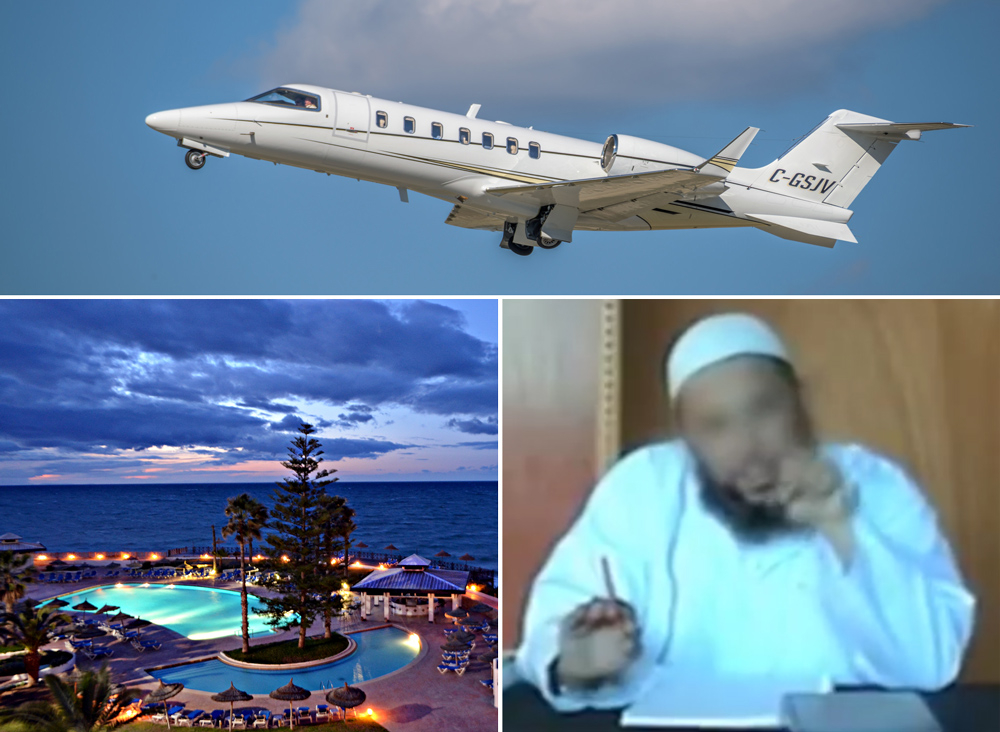
    • On July 13, before dawn, Aidoudi, escorted by four federal police officers and a doctor, was placed on a specially chartered Learjet and flown from Düsseldorf to Tunisia. Aidoudi's deportation cost German taxpayers nearly €80,000 ($95,000), according to Focus magazine.
      Although the Gelsenkirchen Administrative Court had blocked Aidoudi's deportation the night before, the decision was not passed on to immigration authorities until the next morning — after the plane was already airborne.
      When the court learned of Aidoudi's deportation, the judges accused German immigration authorities of "deliberately withholding" information about the timing of Aidoudi's flight in order to ensure that the deportation would be carried out.
      The court said that Aidoudi's deportation had infringed upon "fundamental principles of the rule of law" and ordered the City of Bochum to return him to Germany by July 31, 2018.
    • On August 3, the Gelsenkirchen court fined the City of Bochum €10,000 ($11,500) for failing to retrieve Aidoudi by the July 31 deadline.
    • On August 13, the NRW Criminal Police Office banned Aidoudi's reentry to Germany after he was placed on an EU blacklist known as the Schengen Information System (SIS).
    • On August 15, the Münster court overturned the reentry ban and ordered Bochum officials to immediately retrieve Aidoudi. The ruling can only be appealed at the Federal Constitutional Court (Bundesverfassungsgericht), Germany's highest court.
    Tunisian authorities reacted to the ruling by saying that they had confiscated Aidoudi's passport to prevent him from returning to Germany. Sofiane Sliti, the spokesman for the Tunisian terrorism prosecutor, in an interview with the newspaper Bild, insisted that the matter was an issue of Tunisian sovereignty:
    "This ruling has no consequences for us. I have said it several times: In Tunisia, Tunisian law is valid and nothing else! That there are problems between ministries and courts in Germany is not our problem. The process here in Tunisia is not yet completed, so he [Aidoudi] has no ID card with which he could travel."


    Sami Aidoudi (bottom right) lived in Germany since 1997, until he was deported to his homeland of Tunisia on July 13, 2018. He is alleged to have undergone military training at an al-Qaeda jihadi camp in Afghanistan between 1999 and 2000. He had allegedly worked as a bodyguard for Osama bin-Laden during his training. (Image sources: Aidoudi - SpiegelTV video screenshot; Learjet - Ruido/Flickr; Tunisia - Faris knight/Wikimedia Commons)


    NRW Integration Minister Joachim Stamp (FDP), who has accepted personal responsibility for the decision to deport Aidoudi, said that the ruling left him between a proverbial rock and a hard place:
    "The court leaves us at a loss, because it itself acknowledges current obstacles that prevent a retrieval, but still demands that Sami A. be promptly returned."
    Other members of North Rhine-Westphalia's conservative state government also criticized the verdict. NRW Interior Minister Herbert Reul (CDU), in an interview with Rheinische Post, said that the ruling was out of touch with the public's demand for security:
    "Judicial independence is a highly valuable good, but judges should always bear in mind that their decisions should correspond to the public's sense of justice. I doubt if that is the case with this ruling. If the citizens no longer understand judicial decisions, that is pouring water over the mills of extremists."
    Judge Ricarda Brandts of the Westphalian Higher Administrative Court shot back:
    "The case of Sami A. raises questions about democracy and the rule of law, especially about the separation of powers and effective legal protection. In this case, the limits of the rule of law were tested....
    "The courts have to judge independently of the majority opinion. And everyone should be aware that a constitutional state is working to protect the rights of minorities, even the rights of those who do not respect the rule of law.
    "The case of Sami A. is about determining the fine line between ensuring the security of the population and the rights of those who jeopardize or even violate security. The rule of law must assert itself to the extent that even perpetrators, offenders and terrorists are entitled to effective legal protection and respect for their human dignity."
    Writing for Tichys Einblick, a leading classical-liberal and conservative German blog, Tomas Spahn captured the essence of the issue:
    "The case of the Tunisian Sami A., whose real name Wikipedia does not even dare to write, will enter the lecture halls of future lawyers as one of the absurdities of German legal history. Because no 'case' like this farce reveals the insurmountable discrepancy between jurisprudence (Rechtsprechung) and sense of justice (Rechtsempfinden), between law and politics....
    "I would have liked to have these worries about the separation of powers when a federal minister of justice shifted the finding of a crime such as incitement to hate from the courts to legally unqualified employees of any Internet corporation.
    "However, when [former Justice Minister] Heiko Maas had his censorship law passed, with the name of 'Network Enforcement Act,' that shift of original judicial tasks to private individuals even had the approval of the judiciary. As a result, this increases the suspicion that in the case of Sami A., in the end it is not about the law but about power....
    "What we are currently experiencing is not a struggle for the rule of law, but a power struggle between an obviously ideologically oriented judiciary and unpopular political representatives."
    Commentator Henryk Broder, in a column — "Sami A.: Even the Rule of Law Can Sometimes be Wrong" — for Die Welt, concluded:
    "That Bin Laden bodyguard Sami A. of Tunisia could be brought back to Germany is considered by many to be evidence of the functioning of the rule of law. That is wrong. The real scandal here is another one....
    "The scandal begins when an administrative court declares the deportation of a 'perjurer' is inadmissible because he could face torture in the country to which he was deported.
    "I do not share the view of colleagues that the verdict in the case of Sami A. is 'a sign that our constitutional state is working.'
    "Even in a constitutional state, there can be wrong judgments. A judgment, right or wrong, does not allow conclusions to be drawn as to the rule of law, whether it works or does not work. Not even judges consider themselves infallible.
    "That is why there is a system of instances [trial and appellate courts], that is why judges overturn the judgments of other judges, so the law is adapted to the changed circumstances of life and not vice versa....
    "Confidence in the rule of law is not undermined by a ruling such as that of the Gelsenkirchen Administrative Court, but by the fact that it took almost twelve years for Osama bin Laden's 'alleged' bodyguard finally to be deported."

    Soeren Kern is a Senior Fellow at the New York-based Gatestone Institute.


    Source: https://www.gatestoneinstitute.org/12882/germany-deported-jihadist

    Follow Middle East and Terrorism on Twitter

    Mauritania: US Must Demand Immediate Release of Anti-Slavery Candidate Ahead of Elections - Ruthie Blum

    ​
    by Ruthie Blum


    Mauritania's minorities are so impoverished that being enslaved is often their only perceived alternative to starving

    • The arrest of Abeid -- a prize-winning human rights activist whose latest "crime" was being a candidate in an election -- should sound alarm bells in Washington.
    • The Trump administration needs to demand Abeid's immediate release and make any further financial aid to Mauritania conditional upon proof of concrete moves to eradicate slavery and indentured servitude.

    • To state that Mauritania is engaged in the kind of "reform" that is "needed to improve people's living standards" is both false and unconscionable. Not only are Mauritania's minorities so impoverished that being enslaved is often their only perceived alternative to starving, but its deceitful government is responsible for perpetuating the situation.

    • Although referred to as the "world's last country to abolish slavery," it actually remains "slavery's last stronghold."
    On August 7, the Islamic Republic of Mauritania arrested Biram Dah Abeid, the founding head of the Initiative for the Resurgence of the Abolitionist Movement (IRA), a human rights organization dedicated to eradicating slavery in the west African nation. Abeid described the police waking him in his home in the capital city of Nouakchott, and taking him into custody without charges.
    Abeid and those petitioning for his release have good reason to suspect that his arrest – one of many over the past few years -- is related not only to his persistent anti-slavery activism and critique of Islamic texts, but to the fact that he is running for a seat in parliament in the legislative elections slated for September 1.
    Abeid, a member of the Haratin, Mauritania's largest minority group, established the IRA in 2008, the year in which Mauritania's first democratically elected president, Sidi Mohamed Ould Cheikh Abdallahi, was ousted in a coup led by General Mohamed Ould Abdel Aziz, who has been in power ever since. Abeid has been described as a "thorn in the side" of Aziz, particularly when he challenged Aziz in the 2014 presidential election, and came in a "distant second."


    Biram Dah Abeid (right) meets with Ambassador Keith Harper, U.S. Permanent Representative to the Human Rights Council, on November 23, 2016. (Image source: US Mission Geneva)

    Abeid, as described in a 2014 profile in The New Yorker, has long been a crusader against slavery. The practice was formally abolished in Mauritania in 1981, criminalized only in 2007, but is still practiced with virtual impunity there to this day. Regarding the use in Mauritania of Islamic teachings to justify slavery, Abeid says:
    "My problem is not with religion. It's with the interpretation of religion as the origin, the justification, and the legitimatization of slavery. The use of Islam, not Islam."
    In 2012, Abeid led a demonstration during which he and other protesters burned texts of the Maliki codes of Islamic jurisprudence, which "codify slavery, racism, and the oppression of women." He and others present were arrested on charges of "apostasy."
    As The New Yorker's Alexis Okeowo described the incident:
    By eight o'clock on the evening of the book burning, local news Web sites had begun calling Abeid a heretic. "When I went to bed, I was satisfied," he told me. "But I had a feeling something would happen tomorrow. When I woke up, it was a war—in the media, in the mosques." Newspapers were calling for his death. His phone and Internet had stopped working. Activists flocked to his home, and a steady stream of reporters came for interviews....
    The police came at nine-thirty and put him in a squad car. "It was dark, and we didn't know where we were going," Abeid said. At the police station, Abeid's cell was filthy, full of mosquitoes, and cramped; five other activists were also imprisoned. Policemen brought a television to the cell, and Abeid watched Mauritanians calling for his death on the news. Hundreds of people had gathered in the streets to protest. Abeid recalled watching as President Aziz appeared onscreen and promised to administer the death penalty.
    The police asked Abeid to state on camera why he had burned the books. He refused, suspecting that they would manipulate the video. During his time in prison, the authorities spread a rumor that he was an Israeli agent. "They said I work for the Jews," he recalled. "It's a way to make the Mauritanian people turn against me."
    A 2015 piece in Front Page Magazine, by Stephen Brown, which chastised America's Black Lives Matter movement for ignoring the genuine plight of blacks in Africa, described the race-based nature of Mauritania's rigid caste system:
    Mauritania's slaves are all black Africans and their owners are Arabs or Berbers, called "whites," who constitute about 20 percent of the population. Both slaves and masters are Muslim.
    The "whites," like Mauritania's president, Mohamed Ould Abdel Aziz, make up almost all of Mauritania's political, business and military elite class that controls the country. And therein lays the problem. It is very difficult to get the elite class that makes the laws to take any meaningful action against slavery when many of them are reported to own slaves themselves. But this inaction is also based on a pronounced, anti-black racism that African-American writer Samuel Cotton noticed when he travelled to Mauritania in the 1990s to explore the slavery issue.
    "The problem is that Mauritania's Arabs sincerely believe that blacks are born to be slaves," wrote Samuel Cotton in his book Silent Terror: A Contemporary Journey Into Contemporary African Slavery. "They believe that a black man, woman or child's place in life is to serve an Arab, and does not matter whether that black is a Christian, or a fellow Muslim."
    The state's ongoing racism and widespread practice of slavery sparked the American Federation of Labor and Congress of Industrial Organizations (AFL-CIO) to demand in August 2017 that Mauritania be removed from the eligibility list of countries benefiting from the African Growth and Opportunity Act (AGOA), legislation enacted by Congress in 2000 that "significantly enhances market access to the US for qualifying Sub-Saharan African (SSA) countries."
    To qualify and remain eligible for AGOA benefits, each African country "must be working to improve its rule of law, human rights, and respect for core labor standards." Yet, Mauritania was nevertheless deemed eligible for AGOA benefits as soon as the law was passed. In 2006, its eligibility was removed. Stunningly, in spite of its appalling human rights record, Mauritania's eligibility for AGOA benefits was restored in 2009.
    In September 2017, a month after the AFL-CIO requested to testify before the US Trade Representative to defend its petition, an anti-slavery delegation from the US, which had intended to meet with Mauritanian government officials, was denied entry into the country when it landed at the Nouakchott airport. According to a report in the North Africa Post, this was part of Mauritania's "blackout on the practice of slavery in the country by denying access to international civil rights organizations."
    The International Monetary Fund (IMF) nevertheless continues to provide Mauritania with huge sums of money to support its "economic reform" efforts. At the end of January, IMF Managing Director Christine Lagarde met in Morocco with Mauritanian officials and issued the following statement:
    "I had a constructive meeting with Governor Abdel Aziz Ould Dahi and Minister Ould Djay, during which we discussed Mauritania's recent economic developments and prospects. I welcomed the launch of the Mauritanian authorities' economic reform program supported by the IMF's $163.9 million Extended Credit Facility (ECF).
    "I reiterated that the IMF stands ready to continue to support Mauritania in its reform efforts. I also highlighted that Mauritania should take advantage of the current favorable external environment to accelerate reforms and transition to stronger growth, which is needed to improve people's living standards in a sustainable manner."
    To state that Mauritania is engaged in the kind of "reform" that is "needed to improve people's living standards" is both false and unconscionable. Not only are Mauritania's minorities so impoverished that being enslaved is often their only perceived alternative to starving, but its deceitful government is responsible for perpetuating the situation.
    Thus, according to CJA News Africa, six members of the House of Representatives sent a letter to Lagarde asking that the IMF cease providing loans to Mauritania. The March 5 letter, dubbed the "Mauritania Memo," was reportedly signed by Mark Meadows of North Carolina, Thomas Garret of Virginia, Jeff Duncan of South Carolina, Lee Zeldin of New York, Scott Perry of Pennsylvania and Gus Bilirakis of Florida. No response has been reported.
    This brings us to the issue of Washington's leverage. Mauritania is considered an American ally. According to a recent State Department fact sheet:
    "The United States engages with Mauritania on a wide array of issues, including counterterrorism, food security, trade promotion, and efforts to strengthen human rights and the rule of law. The Departments of State, Defense, USAID and Justice are represented at the U.S. Embassy in Nouakchott... Assistance other than humanitarian assistance to Mauritania was suspended after the 2008 coup. Following certification of the 2009 election by foreign observers, bilateral assistance restrictions were lifted. Mauritania is a member of the Trans-Sahara Counterterrorism Partnership (TSCTP) and receives security assistance to support its counterterrorism efforts... [a] key mission in Mauritania is to advocate for a democratic and peaceful transfer of power in 2019 from one elected president to another for the first time in Mauritania's history. ."
    The arrest of Abeid -- a prize-winning human rights activist whose latest "crime" was being a candidate in an election -- should sound alarm bells in Washington. The Trump administration needs to demand Abeid's immediate release and make any further financial aid to Mauritania conditional upon proof of concrete moves to eradicate slavery and indentured servitude. Although referred to as the "world's last country to abolish slavery," it actually remains "slavery's last stronghold."


    Ruthie Blum is the author of "To Hell in a Handbasket: Carter, Obama and the 'Arab Spring.'"

    Source: https://www.gatestoneinstitute.org/12879/mauritania-slavery

    Follow Middle East and Terrorism on Twitter

    Saturday, August 18, 2018

    Return of the Blacklist: The Left Shuts Down Free Speech - Ed Brodow

    ​
    by Ed Brodow


    The organs of the left have one thing in common: they are against free speech.


    It was only a matter of time.  Mimicking what leftists themselves might call McCarthyism, the left is demanding a blacklist of those who oppose its political ideology.  Dani Rodrik, professor of international political economy at that bastion of leftism, Harvard University, has urged the academic world to stop offering jobs or honors to anyone who has served in the Trump administration.  This ought not to come as a surprise.  It reflects what author Mark Levin calls "the fascist, totalitarian mindset that is modern academia."
    Rodrik insists that universities "should uphold both free inquiry and the values of liberal democracy." Then, in a clear demonstration of leftist hypocrisy, he insults those values by demanding that Trump's supporters be placed on a blacklist.  They should be prohibited, he says, from receiving "even a semblance of honor or recognition" from "the gatekeepers of higher learning."
    Rodrik, who advocates income redistribution and opposes the free market system, accuses Trump of running an "odious presidency."  "We do not, after all, have a normal administration that can be served honorably[.] ... Those who serve with him are necessarily tainted by the experience."  No exceptions.  "Having served in this 'odious' administration," reports HotAir.com, "you should now be barred for life from any form of service in academia."
    Like its fellow travelers the New York Times and the Democratic Party, Harvard has lost its credibility.  These organs of the left have one thing in common: they are against free speech.  In spite of Rodrik's phony defense of "free inquiry," try to get hired at Harvard if you espouse conservative ideas.  A respected poll has pegged liberal faculty at four-year colleges and universities at 87 percent.  Another study identified Democrats to Republicans in journalism departments of 1,500 universities at 20-1, and a whopping 33.5-1 in history departments.  Today's college campuses have become fueling stations for the left.
    How did this happen?  According to Ben Shapiro, author of Bullies, college administrators decided in the 1960s that it was "easier to appease rampaging leftist students than to deal with them.  They came to an agreement with the wildebeests: stop taking over the buildings and locking the doors, and we'll start teaching you about how America sucks." Gradually, that translated into liberalism becoming a prerequisite for getting hired.  Many campuses require new faculty members to sign a diversity statement.  "What diversity oaths seek," says Walter E. Williams, professor of economics at George Mason University, "is to maintain political conformity among the faculty indoctrinating our impressionable, intellectually immature young people.  The last thing that diversity hustlers want," Williams concludes, "is diversity in ideas."
    Intellectual freedom on campus is flirting with extinction.  When I attended college, students demanded more freedom of expression.  Today's students, says Scott Greer in No Campus for White Men, demand less freedom and actually want to limit free expression.  Political correctness on campus is giving rise to a new generation poised to throw free speech out the window.  Activists believe that free speech is their exclusive province.  Contrary opinions are oppressive and labeled hate speech.  "Campus leftists," says Greer, "are able to suppress all dissenting speech for the supposed good of mankind."
    Academia has "invented a labyrinth of anti-free speech tools," says political commentator Kirsten Powers, that are "weapons to silence anyone who expresses a view that deviates from the left's worldview or ideology."  George Orwell warned about this problem in Nineteen Eighty-Four.  The U.S. experienced a taste of it in the 1950s as Joseph McCarthy tried to shut down communists in the upper echelons of American society.  Now the left is getting revenge by attempting to silence the right.
    Because Harvard wields a great deal of influence, Rodrik's proposal will be taken seriously by other campuses around the country – most of which are controlled by the left.  What can be done to prevent an intercollegiate blacklist?  David Horowitz, author of Big Agenda, urges a campaign that will force universities to add "intellectual and political diversity" into their mission statements.  This might compel them to hire conservative professors for a long overdue change.
    The alternative is a disturbing view of the possible social and political discourse in America's future.  If academia imposes a blacklist on conservatives, will the corporate world and government agencies be next?  The kids marching today to shut down Trump-supporters or anyone else they don't like, says Scott Greer, could well be the senators, judges, and newspaper editors of tomorrow.  "Give me four years to teach the children," said Lenin, "and the seed I have sown will never be uprooted."


    Ed Brodow is a political commentator, negotiation expert, and author of seven books including his latest, Tyranny of the Minority: How the Left Is Destroying America.

    Source: https://www.americanthinker.com/articles/2018/08/return_of_the_blacklist_the_left_shuts_down_free_speech.html

    Follow Middle East and Terrorism on Twitter

    Official: Trump and Putin agreed to get Iran out of Syria - Israel Hayom Staff

    ​
    by Israel Hayom Staff

    U.S. administration official tells Bloomberg that Russian leadership believes securing Iran's withdrawal will be difficult • Leaders also said they would ensure Israel's security.

    U.S. President Donald Trump and Russian President Vladimir Putin reportedly agreed in principle that Iranian forces should exit Syria when they met in Helsinki in July, according to a U.S. administration official familiar with the meeting.

    However, the official told Bloomberg that the Russian leadership said securing Iran's withdrawal from Syria would be difficult.

    Trump and Putin also discussed the ongoing campaign against the Islamic State terrorist group, the dispute over Israeli sovereignty in the Golan Heights and the humanitarian situation in Syria, the official told Bloomberg.

    According to the Bloomberg report, Trump briefed his chief of staff, John Kelly, National Security Adviser John Bolton, Secretary of State Mike Pompeo and U.S. Ambassador to Russia Jon Huntsman for 15 minutes immediately after meeting one-on-one with Putin.

    At the July summit, much of the focus was directed at Trump's refusal to back the assessments of the U.S. intelligence community over Putin's denials of Russian meddling in U.S. elections. Trump subsequently said he misspoke and that he did believe the American intelligence community's assessment.

    During their meeting, the two leaders said their countries would work together to ensure Israel's security.

    The Russian leader said that during the "very successful" one-on-one meeting, Trump placed a special emphasis on maintaining Israel's security.

    Netanyahu welcomed the U.S.'s "deep commitment," his office said in a statement after the summit.
    The prime minister "greatly appreciates the security coordination between Israel and Russia and expressed the clear position to President Putin on the need to maintain the separation agreements between Israel and Syria in 1974," the statement said.


    Israel Hayom Staff

    Source: http://www.israelhayom.com/2018/08/17/official-trump-and-putin-agreed-to-get-iran-out-of-syria/

    Follow Middle East and Terrorism on Twitter


    The Future of Eastern Syria and the Israeli Interest - Jonathan Spyer

    ​
    by Jonathan Spyer

    Israel’s interest in this is clear. Maintenance of the east Syria enclave and the base at al-Tanf means keeping a substantial physical obstacle to the Iranian hope for a contiguous ‘corridor.’


    The war between the Assad regime in Syria and the largely Sunni Arab uprising against it, which began in March 2011, is now in its closing stages. The last independent rebel enclaves in parts of Deraa and Quneitra provinces have ceased to be. As of now, the rebellion remains in two parts of the country. In both of these areas, the rebels can maintain themselves only because their presence is supported by an outside power. 

    The two areas are the US base at al-Tanf and the surrounding area, and the Turkish-maintained area of control extending from Jarabulus on the Syrian Turkish border, westwards to include the Afrin area and then south to Idleb Province. 

    The medium-to-long-term existence of these enclaves is far from assured, but in any case, they represent a transition in the civil war in which rebel fighters are no longer pursuing a political project of their own. They have of necessity become contractors working for foreign powers with their own projects in Syria. 

    The situation reflects a sea change in the Syrian dynamic. The Assad regime is no longer under threat. Thanks to Iranian and Russian assistance, its survival is now assured. It remains, however, in possession of only 60% of the territory of Syria. The largest area now outside of regime control is the 30% of the country under the control of the US-supported, Kurdish-led Syrian Democratic Forces (SPD). The Syrian situation is now dependent on the decisions and the rivalries of outside powers, not primarily on the wishes of Syrians on all sides. In the case of the 30% of Syria controlled by the SDF, its future is dependent on the US. 

    If the US chooses to quit eastern Syria, the SDF will have little choice but to negotiate their surrender with the authorities in Damascus. Failure to do so will leave them vulnerable either to the fate of their comrades in Afrin – invasion by Turkey, or to that of the rebels in Ghouta, Deraa and Quneitra – forceful reoccupation at the hands of the regime/Iran/Russia. 

    In late July, I travelled to the SDF enclave in eastern Syria, visiting Raqqa City, Manbij, Qamishli, Ein Issa and Kobani. The intention was to gauge the sentiment among both officials and ordinary people regarding the present state of affairs in Syria, and in particular regarding the prospect of the regime’s return. 

    The first thing that strikes a visitor to this part of Syria is the relatively peaceful and orderly atmosphere. I visited all parts of Syria during the war (except for the ISIS area of control). Rebel areas were always characterized by chaos. Your security was dependent on the authority of the particular rebel group with which you were connected. In the regime-controlled areas, one is immediately aware of being in a totalitarian state, in which the power of the authorities has penetrated every human interaction and normal straightforward dialogue with strangers is impossible. While the SDF-controlled area is no democratic paradise, it is qualitatively different in atmosphere.

    However, one still has to be careful. The regime, in its visible form, is not entirely gone from the SDF-controlled spaces. In the cities of Qamishli and Hasakeh, Assad’s forces are deployed in “security squares,” i.e., areas of regime military control, supplied via the regime-controlled military airport at Qamishli. Traveling west of Qamishli requires a careful traversing of the city to avoid these enclaves. Foreigners straying too close to them have been detained by Assad’s newlyconfident soldiers in recent weeks. 

    The SDF-controlled area looks more secure than it is. In Raqqa and Manbij, the civic councils are functioning, the SDF and Asayish security police checkpoints are as ubiquitous and efficient as ever. But underneath the apparent normality, there is anxiety. The question on everyone’s lips is, “Are the Americans staying?” There is no easy answer. 

    In March 2018, US President Donald Trump vowed to bring home American troops within the year. There are 2,000 declared US Special Forces personnel in the SDF-controlled area. The real number is probably twice that. Trump’s statement added to the sense of insecurity. 

    SDF officials and their civilian counterparts in the Syrian Democratic Council (SDC) remain, at least for public consumption, optimistic about the possibility of a long-term American presence to underwrite their enclave. 

    Aldar Khalil, one of the top officials in the enclave, said, “It is not logical that the US will leave immediately or soon. After ISIS, the US will fight Iran. And they will fight Iran within Syria.”

    From this point of view, the SDF enclave, which emerged as part of the war against ISIS, would be integrated into an emergent US strategy to contain and push back the Iranians. “Many projects are in Syria – that of the Turks, of the Russians, of the Iranians. The Americans see us as the least dangerous, the most moderate,” added Khalil. 

    Mustafa Bali, chief media officer of the SDF, concurred: “US interests require them to be here,” speaking at a dusty SDF base in the town of Ein Issa. “The US is concerned about the Iranian crescent (meaning the desire of the Iranians for a contiguous line of control stretching from the Iraq-Iran border via Iraq, Syria and Lebanon to the Mediterranean Sea).”

    As SDF spokesman Nuri Mahmoud notes, “We have been in a coalition with the US since the Kobani battle. There has been media speculation regarding imminent withdrawal. Putin also once said that his forces were leaving, but the opposite took place. Syria today is a place of international confrontation in which all forces seek to strengthen their allies on the ground. The US will not leave Syria without stability on the ground. We see no evidence of imminent withdrawal.”

    These sentiments are to a degree supported by the latest statements of US officials. Defense Secretary James Mattis, speaking in early June, said, “As the operations ultimately draw to a close, we must avoid leaving a vacuum in Syria that can be exploited by the Assad regime or its supporters.”

    A report in the Times of London on July 27, meanwhile, cited “Gulf sources” as confirming that President Trump in his meeting with Russian President Vladimir Putin in Helsinki that US troops would remain in Syria until Iranian forces withdrew. 

    The Times article also noted that National Security Advisor John Bolton told ABC News that US forces would remain “as long as the Iranian menace continues throughout the Middle East.” This sounds like a commitment that ought to offer reassurance to Washington’s Kurdish allies. 

    Actions, however, are a better guide than sentiments, and it appears that the SDF/SDC leaders remain skeptical regarding US long-term plans. Last week, the first direct negotiations took place between their representatives and those of the Assad regime in Damascus. 

    It is not quite clear where things are heading. But Israel’s interest in this is clear. Maintenance of the east Syria enclave and the base at al-Tanf means keeping a substantial physical obstacle to the Iranian hope for a contiguous ‘corridor.’ It would also prevent an overall Iranian triumph in the war and give the West a place at the table in any substantive political negotiation over Syria’s future. 

    Israel should hence make its voice heard via all available channels in Washington, in both the executive and the legislature, in support of the maintenance of the SDF enclave in eastern Syria. 

    Specifically, efforts should be made to ensure a formal US declaration of a no-fly zone for regime and regime-allied aircraft east of the Euphrates. This move, reminiscent of the no-fly zone declared over Iraqi Kurdistan after the Gulf War of 1991, would with one stroke ensure the continued viability of the SDF-controlled area. There should also be a formal recognition of the SDF zone, or the ‘Democratic Federation of Northern Syria,’ as it is formally known. This entity is not seeking independence from Damascus, so Western concerns regarding the formal breakup of Syria need not be raised by such a move. 

    As the strategic contest between Iran and its allies and the US and its allies in the Middle East moves into high gear, it is essential that the West maintain its alliances and investments and behaves and is seen to behave as a credible and loyal patron and ally. Eastern Syria currently constitutes a testing ground for this. In Qamishli, Kobani and other hard defended zones, its people await the West’s decision.


    Jonathan Spyer is a fellow at the Middle East Forum and a research associate at the Jerusalem Center for Strategic Studies.

    Source: https://www.meforum.org/articles/2018/the-future-of-eastern-syria-and-the-israeli-intere

    Follow Middle East and Terrorism on Twitter


    Despite long-term truce overtures, Hamas urges ‎mass border protest - Ariel Kahana, Mati Tuchfeld, Nikki Guttman and Eli Leon

    ​
    by Ariel Kahana, Mati Tuchfeld, Nikki Guttman and Eli Leon

    "If the calm on the border ‎is violated, Israel will mount a forceful response," official warns


    Hamas leaders on Thursday urged Palestinians in the ‎Gaza Strip to arrive at the border with Israel on ‎Friday and protest en masse, as they have been doing ‎since the onset of the group's border riot campaign ‎four months ago. ‎

    The call came despite the fact Gaza's rulers are ‎engaged in indirect cease-fire negotiations with Israel, ‎meant to prevent the hostilities of recent weeks ‎from escalating further. ‎

    Israeli officials said Hamas' actions on the ground ‎would determine whether negotiations ‎could continue, saying, "If the calm on the border ‎is violated, Israel will mount a forceful, ‎unrestricted response.

    Arab media reported Thursday that the cease-fire ‎‎agreement Egypt is trying to ‎negotiate between ‎‎Israel and Hamas includes a one-‎year truce as well ‎‎as several measures meant to ‎alleviate the dire ‎‎economic situation in Gaza, such as establishing a ‎‎"naval ‎‎corridor" between Cyprus and Gaza through ‎which ‎‎goods could be delivered to the enclave, as well as ‎‎the ‎construction of a port in the ‎Sinai Peninsula, ‎which ‎would operate under Israeli ‎security ‎supervision.‎

    An Egyptian source said that if the truce proves ‎viable, negotiations will be held to extend it to ‎four years. ‎

    He further said a broader agreement would include a ‎prisoner exchange deal, under which Hamas will ‎return the bodies of two IDF soldiers as well as two ‎living Israeli civilians, and Israel will release ‎hundreds of Palestinian security prisoners. ‎

    Hamas denied that a prisoner exchange deal was in ‎the works, saying it opposes linking a truce deal ‎to a potential prisoner exchange. ‎

    Israeli officials denied that the current talks ‎extended beyond a bilateral cease-fire, and said any ‎Arab reports suggesting Israel has agreed to a naval ‎corridor are false.‎

    An official privy to the current talks told Israel ‎‎Hayom, "The truce would have to hold for a ‎considerable period of time for Israel to discuss ‎any humanitarian projects in which it may be involved. ‎This would also depend on prisoner exchange ‎negotiations."‎

    Yisrael Beytenu leader Avigdor Lieberman and Habayit ‎Hayehudi head Naftali Bennett Gil Eliyahu / JINI
    ‎Also on Thursday, Defense Minister Avigdor Lieberman ‎and Habayit Hayehudi leader Naftali Bennett again ‎locked horns over the defense establishment's ‎policies in Gaza. ‎
    Bennett, who over the past week has accused ‎Lieberman of being "too lenient" on terrorism, said ‎that the defense minister's policy of trying to ‎communicate directly with the Palestinians in Gaza ‎in an effort to undermine Hamas' regime was ‎‎"hollow and senseless."‎

    ‎"The idea that Israel can persuade the public in ‎Gaza to topple Hamas' government is detached from ‎reality," Bennett said.‎ "Has Lieberman ask himself how many years it would ‎take to topple Hamas by the power of persuasion? Who ‎does he think will pay the price for the increase in ‎terrorism in the meantime? ‎
    "Lieberman's message has been well received: ‎Terrorism pays. Hamas fires rockets at us and Israel ‎caves. The Israel-Hamas deal Lieberman is pushing is ‎a serious and irresponsible mistake that will allow ‎Hamas to accelerate rocket production," ‎Bennett blasted. ‎

    A statement by Lieberman's Yisrael Beytenu party ‎retorted, "As Bennett has often been absent from ‎cabinet meetings about Gaza, he is unfamiliar with the ‎details involved."‎

    The party went on to characterize the bickering ‎between the two as "an argument between Lieberman's ‎responsible right-wing positions and the messianic ‎and populist Right represented by Bennett, which ‎supports a binational state and the occupation of ‎Gaza."

    Another minister also criticized the deal taking ‎shape saying that "Israel has effectively ‎capitulated to them [Hamas]. Israel is giving them ‎supplies, power, money and assurances for a naval ‎corridor, but we are getting nothing in return. Our ‎captives have not been released and all we are ‎getting is a truce that Hamas can decide to violate ‎at will." ‎

    Senior Jerusalem officials insisted Thursday that no ‎long-term agreement would be reached with Hamas ‎unless the Israeli captives were returned.


    Ariel Kahana, Mati Tuchfeld, Nikki Guttman and Eli Leon

    Source: http://www.israelhayom.com/2018/08/17/despite-moves-toward-long-term-truce-hamas-calls-for-%e2%80%8emass-border-protest/

    Follow Middle East and Terrorism on Twitter