Tuesday, September 11, 2018

The Trump Doctrine and the End of the ‘New World Order’ - Seth Franzman

​
by Seth Frantzman

For years US hegemony didn’t provide security in the region, because the US was balancing too many interests to confront the multiplicity of threats.

"Setting fire to the ground,” a “major catastrophe,” bringing “new instability” are the headlines that have greeted Donald Trump’s unorthodox decisions over the past year. Withdrawing from UNESCO, moving the US Embassy, leaving the Iran deal and cutting funding to UNRWA and funding for Pakistan were seen as extreme decisions in the Middle East and around the world. Insofar as there is a “Trump Doctrine,” it has been to call this bluff.

In the mind-set of Trump and his team, the time has come for the United States to move quickly to reverse decades of foreign policy norms, ending the status quo, and ripping up what the previous administrations did.


This is unprecedented. It could be foolhardy, say the many critics of the administration. But so far none of the threatened “chaos” and “instability” has been unleashed. Previous administrations that played it safe and sought to make minor adjustments or shift the needle a few degrees here and there found instability was unleashed regardless of what they did.


On a vast number of foreign policy files that sat awaiting Trump’s team in January 2017, the administration has sought major changes. Most of these major changes have come since December 2017, when the embassy move was announced. That is at least in part because Rex Tillerson was the secretary of state and H.R. McMaster was the national security adviser. Once they got the boot in the spring of 2018, Mike Pompeo took the helm and John Bolton came on as national security adviser.


Is the US now embarked on a radical break with the past and a rapid change in foreign policy? The American school of foreign policy is not inherently incremental and conservative. What is characterized by Trump supporters as a kind of “deep state” of foreign policy experts and the rotating door of the Washington security establishment was not always stagnant. US policy in the republic’s early years alternated widely between lovers of England and lovers of revolutionary France. America sought to challenge European imperialism in the Western hemisphere and moved relatively rapidly into empire building of its own at the end of the 19th century. It famously retreated into isolationism only to emerge in 1945 in the role of anti-Soviet Cold Warrior.


And even in the Cold War the US reversed itself radically from time to time, with Nixon’s trip to China and Reagan’s decision to ramp up the Cold War in the 1980s. George H.W. Bush promised a “new world order” in 1991. He called it the “big idea” in which “diverse nations are drawn together in common course to achieve the universal aspirations of mankind – peace, security, freedom and the rule of law.” He was as much a revolutionary in foreign policy as Trump, where Trump plays the role of the anti-Bush Senior. Trump has likely never studied Carl von Clausewitz, the historic Prussian general whose thinking The Washington Post’s Joel Achenbach once said “haunted the Pentagon, the White House and Capitol Hill.” Neither does Trump seem to have much time for Henry Kissinger’s “world order,” whose views seem to have underpinned 50 years of US policy in one form or another.

This leaves us, particularly in the Middle East, wondering if the Trump Doctrine is just anti-doctrine, davka for davka’s sake. It appears to be more than that. The team of Bolton, Pompeo and Brian Hook, who handle Iran, and the team of Jared Kushner, Jason Greenblatt and David Friedman, who pioneer Israel-Palestinian policy, have a goal. The goal is to reverse decades of what they see as appeasement.


On Iran the appeasement has taken the form of constantly being enslaved to a paradigm that says the following: Iran is a rational actor (it’s not run by crazy far-right ayatollahs). The Tehran regime dislikes America because of a 1953 coup. We must cultivate moderates and not empower hard-liners. If you don’t give the regime things, then it will empower hard-liners. So give it things and keep it quiet. In this Catch-22 cycle, the more the regime terrorizes the region, the more you have to be nice to it so it won’t be worse.


On the Palestinian file the concept is the following: Palestinians and Israelis need to be brought to the peace table. Until Israel comes to the table, the US must fund the Palestinians’ institutions and make them believe they will get Jerusalem as their capital. America has a responsibility to them because the US supported Israel’s creation and is therefore partly responsible for the chaos that unfolded in the 1948 war when 800,000 Palestinians became refugees. If Palestinians don’t see hope for the future, they will destabilize the region and Israel as well, thus hurting America’s ally. It is in Israel’s best interest to aid the Palestinians and enable their hope.


The Trump Doctrine says this model is nonsense. Step away from the deal, and the other side will come back with a new offer. What Trump’s team either instinctively understands, or plodded into, is that there is a third side to the deal. The third side is Europe. When Trump walked away from the Iran deal, the Iranians wanted to play the bogeyman card and say “Well, now we have a right to nuclear weapons.” But they hesitated because this would force Europe’s hand, and Europe doesn’t want Iran going totally crazy in the region. The bogeyman threat works only when you do it to everyone. But Iran can’t play bogeyman with America and moderate with Europe at the same time. So it’s confused, for the first time in four decades of bogeymanning the region.


Similarly the Palestinian leadership in Ramallah must keep playing the moderate card. The Ramallah leadership is graying and worried about its own future. It can’t unleash the instability that doomsayers predict because instability will result in its overthrow. No Palestinian Spring, Ramallah says. So Ramallah has to get Europe to pick up the tab that Trump walked away from. On cue, Sweden, Germany and other countries are coming to the table.


The Trump administration has forced Europe to do what the EU largely failed to do for 30 years, which is to take a seat at the table. For many years after Bush Sr. brought his new world order, the European powers accepted US leadership and preferred to let the US make mistakes and then critique the US, but not to take the baton and run with it themselves. It is hard to find one major case where the EU led the way on a foreign policy decision since 1990. That is partly Washington’s fault for wanting to muscle in. Europe plays the wise skeptic to Washington’s flailing, from George W. Bush’s “war on terror” to Obama’s promise to “secure the peace” in Berlin in 2008. Europe was rightly skeptical of neoconservatism, WMD and preemption. But it generally went along and got dragged into wars in Iraq and Afghanistan, and then joined the Global Coalition against Daesh.


Since the 1990s the brief period of American global hegemony has withered. Former US ambassador to Moscow Michael McFaul met a mild-mannered man in 1991. “If you had asked me to list 5,000 Russians that might be the next president of Russia, he would not have made this list.” That man was Vladimir Putin. Putin was thinking about a mutlipolar world in the 1990s. I was studying in Russia when he was about to be appointed prime minister by Boris Yeltsin. We thought Russia was Dickensian and cool. But he knew the country could do better and command respect on the global stage. Now he holds court with Turkey and Iran’s president.


For all the anti-Russian rhetoric in the US now, none of those who complain about Putin today did much to stop Russia marching into the Caucuses and into Ukraine, or Syria. Clausewitzians failed. Clausewitz himself probably would have sensed the Russian rising power. The new world order failed. It didn’t restrain Russia or China or Iran or Turkey.

Trump’s policy has made Turkey and Iran think twice. Turkey didn’t expect US sanctions over a jailed pastor. It expected a quiet deal. Iran expected the US to leave Syria and hand over Iraq.


The Trump Doctrine is the end of the new world order. It is its graveyard. It is America’s decision to accept a multipolar world. It has to accept that Turkey, Iran and Russia have run into each other’s arms. It accepts Chinese sovereignty over the islands China built on under Bush and Obama. Trump has birthed a new European policy. The Trump Doctrine tore up decades of foreign policy. What will replace it, relatively quickly, is a new multipolar world.

In the Middle East that may not be a bad thing. For years US hegemony didn’t provide security in the region, because the US was balancing too many interests to confront the multiplicity of threats. A narrower American policy, tailored to deal with certain types of threats, such as Iran and Islamist extremism, can bolster US allies, rather than balancing all the allies against each other.


Seth Frantzman is The Jerusalem Post's op-ed editor, a Writing Fellow at the Middle East Forum, and a founder of the Middle East Center for Reporting and Analysis.

Source: https://www.meforum.org/articles/2018/the-trump-doctrine-and-the-end-of-the-new-world-o

Follow Middle East and Terrorism on Twitter


Obama vs. the Nation - Daniel John Sobieski

​
by Daniel John Sobieski

The latest remarks by this poster child for self-serving hypocrisy and delusion go a long way toward explaining how Obama shrank the Democratic Party by a thousand state, local, and federal legislative seats during his eight years in office.

Transference is a psychiatric term for the ability to take your faults and ascribe them to others.  In the dictionary next to the definition should be a photo of former President Barack Obama, particularly the section in his September 7 University of Illinois speech where he attacked President Trump for fomenting paranoia and division:
In a moment reminiscent of Hillary Clinton's outrageous characterization of Trump voters as "deplorable" and "irredeemable," President Obama said: "I have to say this... Over the past few decades, the politics of division and resentment and paranoia has unfortunately found a home in the Republican Party."
Labeling the 63 million Trump voters as "deplorable" and "irredeemable" didn't work out for Hillary Clinton when she ran a failed presidential campaign against Trump in 2016.  Labeling the same voters as divisive, resentful and paranoid will not work for Democrats in the November midterm elections.
No, it will not, and the remarks by this poster child for self-serving hypocrisy and delusion go a long way toward explaining how Obama shrank the Democratic Party by a thousand state, local, and federal legislative seats during his eight years in office.  Once again, to use President Obama's own phrase, he "acted stupidly."

That was the remark President Obama would fire towards the Cambridge, Massachusetts police who arrested black Harvard professor Harry Louis Gates, Jr. at his home for disorderly conduct:
President Obama knocked back some cold beer in the Rose Garden with Harvard professor Henry Louis Gates Jr. and police Sgt. James Crowley of Cambridge, Mass., the two men at the heart last week of a heated debate over race in America[.] ...
The dispute began July 16 when Crowley, while investigating a report of a potential burglary at Gates' house, arrested the agitated professor on a charge of disorderly conduct.  Gates, who is black, accused the white sergeant of racial profiling.  The disorderly conduct charge was dropped – but the dispute exploded into a national debate, particularly after Obama said the police had "acted stupidly" in arresting Gates.
Remember Obama's beer summit, held to talk about how the Cambridge Police acted against the offended black professor Gates?  And then, afterward, who helped Gates down the steps? The "racist cop," of course.  Obama couldn't be bothered to make sure his friend got down the steps.

From Ferguson to Baltimore and beyond, President Obama's words aiding and abetting the war on cops and inciting racial division have been the equivalent of yelling "fire" in a crowded theater.  He has encouraged a false narrative of racist cops and racist police departments whose officers are guilty until proven innocent, or buried, whichever comes first.  Never mind that in both Baltimore and Ferguson, the cops accused of racism and murder were found guilty of neither.

It was Ferguson, Missouri, where President Obama's Justice Department sent forty FBI agents to prove that Officer Darren Wilson was a racist murder of an innocent black teen. He made the race-baiting Al Sharpton, who helped create the myth of "hands up, don't shoot," a key adviser on race matters and Ferguson.

In December 2014, President Obama stoked the fires of animus against cops when he said on BET that police were judging blacks, not on the content of their character, but on the color of their skin:
President Barack Obama made an appearance on Black Entertainment Television (BET) Monday to reach out to black Americans and discuss calls for criminal justice reform after two grand jury decisions cleared white police officers in the deaths of two black men.  The president has to carefully express his concern for the safety of African-Americans while not undermining the law enforcement community.  President Obama suggested that the issue of police vs. minorities is deeply rooted in American culture and is the result of police having a "subconscious fear of folks who look different."
That is a common theme for the divisive Obama, one he now applies to illegal immigration and border reform, saying those who don't like illegal aliens entering the U.S. to murder our children, like Kate Steinle and Mollie Tibbetts, or oppose sanctuary cities that harbor illegal alien criminals or believe that the rape, torture, and murder gang known as MS-13 aren't here seeking a better life, are racists.

The alleged fear by conservatives of others not like them was a key part of the famous "bitter clingers" remark made during the 2008 campaign:
Barack Obama had not yet locked up the nomination for his party when he revealed his true feelings about gun owners to attendees of a private fund raiser in San Francisco last April:
You go into these small towns in Pennsylvania and, like a lot of small towns in the Midwest, the jobs have been gone now for 25 years and nothing's replaced them.  And they fell through the Clinton administration, and the Bush administration, and each successive administration has said that somehow these communities are gonna regenerate and they have not.  And it's not surprising then they get bitter, they cling to guns or religion or antipathy toward people who aren't like them or anti-immigrant sentiment or anti-trade sentiment as a way to explain their frustrations.
In Obama's world, Islam is a religion of tolerance – not so much of Christians, also maligned as "bitter clingers."  He took a shot at Christians when he said at an Easter prayer breakfast that "I have to say that, sometimes when I listen to other less-than-loving expressions by Christians, I get concerned."  Not so concerned was he by the mass beheading of Coptic Christians on a Libyan beach by the Islamic State.

Obama once lectured Christians to "get off their high horse" as they pronounced their teachings to the faithful:
During remarks at the National Prayer Breakfast, President Barack Obama said that all religions had grappled with radical elements attempting to co-opt its spiritual messages, a rebuke to those who want him to more forcefully condemn what they consider a violent extremism inherent in Islam[.] ...
"Humanity has been grappling with these questions throughout history," Obama continued, "and lest we get up on our high horse and think that this is unique to some other place, remember that during the Crusades and the Inquisition people committed terrible deeds in the name of Christ."
Obama also named slavery and Jim Crow as examples in America, along with religious intolerance "that would have shocked Gandhi" in India.
Religious intolerance?  Physician, heal thyself.  Jesus preached peace long before the prophet Muhammad mounted a horse, grabbed his sword, and began beheading infidels on his way to Mecca.  As for the Crusades, they came after and in response to centuries of Islamic conquest and aggressive war against the infidels of the Christian West.  As Princeton scholar and Islamic expert Bernard Lewis explains, "The Crusade was a delayed response to the jihad, the holy war for Islam, and its purpose was to recover by war what had been lost by war – to free the holy places of Christendom and open them once again, without impediment, to Christian pilgrimage."  According to St. Louis University and Crusade scholar Thomas Madden, "[a]ll the Crusades met the criteria of just wars."

Slavery was an institution supported by Democrats in the South.  Jim Crow laws were written by Democrats.  Evils may have been committed in the name of Christ, but not at the urging of Christ, who preached peace and love and mercy to one's enemies.

It is Barack Hussein Obama who divided America and incited paranoia, attacking, cops, Christians, and clingers, just to name a few.


Daniel John Sobieski is a freelance writer whose pieces have appeared in Investor's Business Daily, Human Events, Reason Magazine and the Chicago Sun-Times among other publications.

Source: https://www.americanthinker.com/articles/2018/09/obama_vs_the_nation.html

Follow Middle East and Terrorism on Twitter


Ancient Hungarian synagogue reopens after 332 years - Dan Lavie and Israel Hayom Staff

​
by Dan Lavie and Israel Hayom Staff 

Local Jewish leader: Seeing hundreds of people celebrating this event 70 years after the Holocaust, I can hear the footsteps of Israel's redemption.


Ahead of the Rosh Hashanah holiday, an ancient Hungarian synagogue confiscated from the Jews following a pogrom in 1686 has been rededicated at a ceremony attended by Hungarian President Janos Ader.

The two-room Sephardic synagogue, known as the medieval Jewish prayer house, was built in 1364. Situated inside the Buda Castle, the synagogue was converted into residential housing and was all but forgotten until the 1960s, when renovators discovered Jewish markings on the ceilings of the rooms. Following the discovery, the rooms were opened to the public as a museum.

Speaking at the ceremony, Unified Hungarian Jewish Congregation executive Rabbi Shlomo Koves said, "Seeing this place 70 years after the Holocaust, seeing hundreds of people celebrating this special event in the Buda Castle with their heads held high, in the presence of the honorable president, I can hear the footsteps of Israel's final redemption."

He said it took years of negotiations with multiple bodies to reach a deal to allow a Jewish congregation to pray at the ancient synagogue.

Budapest-born Asher Faith, who will serve as the synagogue's rabbi, said that "we opened up an old synagogue in extraordinary circumstances, and we're looking forward to good things.

"We'll once again blow the shofar here this Rosh Hashanah, and maybe, in this merit, we will see the Messiah."

The Federation of Hungarian Jewish Communities expressed hope that the opening of the synagogue would bring new energy to Jewish life in the Central European country and help contend with problems facing the local Jewish community, such as emigration, assimilation, intermarriage and a growing sense of detachment from Israel among the younger generation.


Dan Lavie and Israel Hayom Staff

Source: http://www.israelhayom.com/2018/09/09/ancient-hungarian-synagogue-reopens-after-332-years/

Follow Middle East and Terrorism on Twitter


Turkey: Torture, Sexual Abuse Rampant in Prisons - Uzay Bulut

​
by Uzay Bulut

There are currently around 70,000 students in Turkish prisons, and many of them do not even know what they are accused of, since their lawyers are not allowed to see their indictments.

  • Inmates in a jail in Åžanlıurfa in southeast Turkey tell of the plight of 27-year-old UÄŸur YeloÄŸlu, who they say has been isolated and tortured so badly since his imprisonment seven months ago that his level of functioning is like that of a baby.
  • YeloÄŸlu was arrested in Istanbul in January for allegedly "aiding a terrorist organization." His lawyer, Abdülkadir Aslan, said that in spite of the many months his client has been in jail, his indictment has not yet been prepared by prosecutors: "The investigation file is also marked 'confidential,' so we do not know what it contains."
  • "Prisoners are beaten up and sometimes killed, when they refuse to roll-call standing up, give military salute, reject strip searches, or ask to see a doctor." — Report by the opposition Peoples' Democratic Party (HDP).

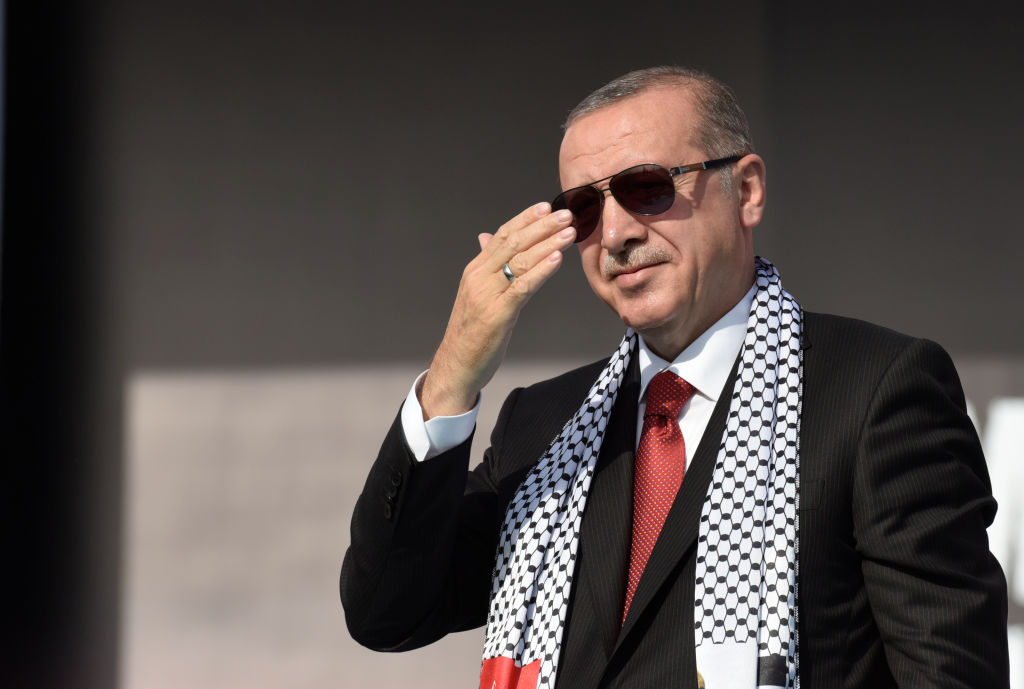
Torture and other forms of unlawful abuse are increasingly widespread in Turkish jails and prisons, under the rule of Turkish President Recep Tayyip ErdoÄŸan. (Photo by Getty Images)

In the early 2000s, after the Justice and Development Party (AKP) first came to power in Turkey, its leader, then Prime Minister (now President) Recep Tayyip ErdoÄŸan, proclaimed a policy of "zero tolerance" for torture.

In June of this year, Turkish Justice Minister Abdulhamit Gül repeated the same mantra. "We -- as the AKP government -- are implementing a policy of zero tolerance for torture," he said.

Statements by many prisoners, their lawyers and human-rights defenders, however, tell a much different story; victim and witness accounts reveal that torture and other forms of unlawful abuse are increasingly widespread in Turkish jails and prisons. Inmates in a jail in Şanlıurfa in southeast Turkey, for example, tell of the plight of 27-year-old Uğur Yeloğlu, who they say has been isolated and tortured so badly since his imprisonment seven months ago that his level of functioning is like that of a baby. He has apparently lost his memory and is unable to walk, or even eat, on his own. In addition, these inmates said, the prison's healthcare staff are lax in their treatment of him.

Yeloğlu was arrested in Istanbul in January for allegedly "aiding a terrorist organization." His lawyer, Abdülkadir Aslan, said that in spite of the many months his client has been in jail, his indictment has not yet been prepared by prosecutors. "We have officially appealed to authorities for my client to be transferred to a full-fledged hospital," Aslan said. "But we have not received a response yet. The investigation file is also marked 'confidential,' so we do not know what it contains."

Opposition MP Tuma Çelik of the Peoples' Democratic Party (HDP) submitted a motion on behalf of Yeloğlu to Justice Minister Gül, which said, in part:
"Is it true that YeloÄŸlu is exposed to torture and mistreatment? Has the ministry started an investigation into these allegations? Will authorities provide a response to his lawyer's request to place him in a hospital due to his deteriorating health? What are the legal grounds for having kept him in solitary confinement?"
Gül has yet to respond.

Yeloğlu is one of many prisoners and other detainees accused of having ties to organizations, such as the Kurdistan Workers' Party (PKK), and what the Turkish government now calls "Fethullahist Terrorist Organization (FETO)," followers of the US-based Muslim cleric, Fethullah Gülen, whom Erdoğan accuses of having orchestrated the failed military coup attempt in July 2016.

According to a 2017 report by Human Rights Watch (HRW):
"People in Turkey accused of links with terrorism or with the 2016 military coup attempt have been tortured in police custody, while others have been abducted, amidst growing evidence of detention abuses.
"Several lawyers told Human Rights Watch that their clients told them of torture or showed them physical evidence. But they said that many victims are afraid to complain, fearing reprisals against their family members. In one case Human Rights Watch documented, the former head of a preschool told a court at length at his trial in February that police had beaten and threatened him with sexual assault and rape to make him 'confess' his involvement with 'FETÖ.' Six other men on trial with him made similar assertions."
Although such prisoners or detainees are accused of terrorism-related offenses, the United Nations Human Rights Committee expressed concern as early as 2012 that several provisions of the Turkish Anti-terrorism Law are incompatible with the International Covenant on Civil and Political Rights, citing:
"(a) the vagueness of the definition of a terrorist act; (b) the far-reaching restrictions imposed on the right to due process; (c) the high number of cases in which human rights defenders, lawyers, journalists and even children are charged under the Anti-Terrorism Law for the free expression of their opinions and ideas, in particular in the context of non-violent discussions of the Kurdish issue."
In November 2017, the Diyarbakır Bar Association released a report on human rights violations at prisons in Elazığ and Şanlıurfa, according to which, among other things, "female prisoners are exposed to violence, including sexual violence, and child prisoners are battered. A transsexual prisoner was sexually assaulted by wardens."

Attorney Öykü Çakmak, a member of the Prison Watch Commission, said that the most fundamental rights violations at prisons included "physical and psychological pressures, sexual violence, mistreatment and torture." In addition, she added:
"The prisoners' right to health is restricted. Cameras are placed in common use areas in rooms. Warm water is not regularly provided. Disciplinary punishments, which are more severe than those specified in the rules and regulations, are arbitrarily imposed on the prisoners. Prisoners are forcibly frisked naked before they are taken to other prisons, hospitals or courts. They are handcuffed during their treatment at hospitals. Bans on their communication with their families and visitors are commonplace, and their access to books, magazines and newspapers is often precluded."
In the Diyarbakır Bar Association's February 2018 report on human rights violations at a prison in Elazığ that "a special team of wardens was formed for torturing prisoners."

Another member of the Prison Watch Commission, Attorney Önder Alçiçek, said:
"The prisoners are battered and tortured when they refuse to stand single file, as if in a military formation. A special team of wardens beats the prisoners, insults and threatens them with death and rips up their possessions. The prisoners said they have no security and are not allowed to go to the prison's hospital to receive medical attention."
Alçiçek added that all the prisoners that members of the Commission saw had signs of beatings on their bodies.

Meanwhile, Barış Yarkadaş, an MP from the opposition Republican People's Party (CHP), presented a parliamentary motion to Justice Minister Gül, stating:
"On February 26, 2018, at TekirdaÄŸ T-type prison, about 50 wardens laid five prisoners on the floor and tied their hands and feet. One was then taken to a 'sponge room' [cells named for the yellow foam that pads their interiors] and was kept waiting there with his hands tied. His hands and feet started getting numb and he felt pain on his head because he was kicked in the head. He was taken out of the room after an hour and a half."
Yarkadas added that many other prisoners suffered similar fates. "Torture has become systematic," he said. "It is not isolated."

The speaker of Turkey's Grand National Assembly (parliament), İsmail Kahraman, rejected Yarkadaş's motion, however, claiming that it "contained personal opinions and the questions in it concerned private lives."

Yarkadas then said:
"This answer means that they [members of the government] are protecting and encouraging torturers instead of confronting them. Kahraman rejects all motions regarding torture and mistreatment. He does not want to document any of the torture experienced under AKP rule. He thinks he can hide facts by covering up torture. But the reality of torture is crystal clear and continues to hurt people."
According to a report on the news website Haberdar, university and high school students have been similarly treated. There are currently around 70,000 students in Turkish prisons, and many of them do not even know what they are accused of, since their lawyers are not allowed to see their indictments.

The mother of one such youth told the newspaper Evrensel that her 18-year-old son, who has been in jail for eight months, was tortured in rooms where there are no security cameras. She said that in August 2017, a group of 30-40 wardens attacked her son and two other boys at Maltepe prison in Istanbul. "My son passed out due to the beatings," she said. "When he woke up, he noticed he was handcuffed behind the back. He showed me the bruises all over his body; he had difficulty raising his right arm; he said he was hit hard on his ear; and he had pain in his ribs."

She also said that she was not allowed to exchange letters with her son and that it is hard to obtain information about his and other prisoners' health. Meanwhile, she added, although her son has appeared in court three times over the past eight months, nobody has been able to provide a convincing explanation as to why he is in jail.

Another mother, two of whose children are in prison, told Evrensel:
"We cannot see prosecutors. They tell us the case files were classified as confidential. The wardens act as if we are criminals. They say, 'If your kids are good, why are they here?' They often impose bans on visiting our children..."
On March 2, the opposition Peoples' Democratic Party (HDP) issued an "urgent call" about Turkish prisons, which it claims "have evolved into torture centers," and reported that charges of "terrorism" by the government are lodged at "almost any dissident voice -- politicians, members of parliament, mayors, activists, human rights advocates, trade unionists, journalists, intellectuals, academics and the like." The HDP report stated, in part:
"In February 2018, alarming news about the torture of prisoners have come from many prisons across the country. In some prisons torture and ill treatment have peaked and become routinized... Prisoners are physically abused on a regular basis. Prisoners are beaten up and sometimes killed, when they refuse to roll-call standing up, give military salute, reject strip searches, or ask to see a doctor.
"The most recent dreadful death was that of UlaÅŸ Yurdakul, a Kurdish man who was sleeping on a mat under the stairs due to lack of space. Prisoners and prison guards beat him up regularly. Eventually, he was beaten to death."
The report also decried the government's recent decision to impose uniforms on prisoners charged with terrorism, claiming that if this is implemented, "it is most likely that Turkey's prisons will become extremely tense spaces of violence, torture and death. Political prisoners have expressed strong commitment to resisting this decision."

The HDP's "urgent call" was addressed to "the international institutions, including the United Nations, the European Parliament, the European Commission and their rapporteurs on torture and human rights; the political parties from the world; and embassies to urgently take action against alarming levels of torture and ill treatment in Turkish prisons."

For the sake of the victims of torture and abuse in Turkish jails and prisons, let us hope that those institutions heed this desperate appeal and hold the ErdoÄŸan government accountable.


Uzay Bulut, a journalist from Turkey, is a Distinguished Senior Fellow at Gatestone Institute. She is currently based in Washington D.C.

Source: https://www.gatestoneinstitute.org/12959/turkey-prisons-torture-sexual-abuse

Follow Middle East and Terrorism on Twitter


EU warns of 'serious consequences' to razing illegal ‎Bedouin village ‎- Eldad Beck, News Agencies and Israel Hayom Staff

​
by Eldad Beck, News Agencies and Israel Hayom Staff

Rights group urges EU to show Israel "what it stands to lose."


The Bedouin village of Khan al-Ahmar
Photo: AP

The European Union warned Israel over the weekend ‎that the planned demolition of an illegal Bedouin ‎village in the ‎West Bank will have "‎‎serious ‎consequences" and will pose a significant threat to ‎the two-state solution.‎

Israel's High Court of Justice on Wednesday cleared ‎the way for the planned demolition of Khan al-Ahmar, ‎an illegal Bedouin ‎encampment located 10 kilometers ‎‎(6 miles) east of ‎Jerusalem between the Israeli ‎communities of Maaleh ‎Adumim and Kfar Adumim, which ‎is home to some 180 Bedouin. ‎

European Union foreign policy chief Federica ‎Mogherini issued a statement saying, "The European ‎Union and its member states have repeatedly stated ‎their long-standing position on Israel's settlement ‎policy, illegal under international law, and actions ‎taken in that context, including the demolitions of ‎Palestinian communities and possible forced ‎transfers of population," Mogherini said.‎

‎"The community of Khan al-Ahmar is located in a ‎sensitive location in Area C, of strategic ‎importance for preserving the continuity of a future ‎Palestinian state. ‎

‎"The consequences of a demolition of this community ‎and the displacement of its residents, including ‎children, against their will, would be very serious ‎and would severely threaten the viability of the ‎two-state solution and undermine prospects for ‎peace.

"The EU expects Israeli authorities to ‎reconsider their decision to demolish Khan al-‎Ahmar," the statement read.‎

On Saturday, Israeli human rights group B'Tselem ‎said it has asked the EU to intervene and prevent ‎the Bedouin village's demolition. ‎

B'Tselem Director Hagai El-Ad wrote to Mogherini, ‎saying, "We have reached the point where it appears ‎that these serious consequences must be spelled out ‎if the EU is to credibly back its own positions."‎

Brussels, he noted, "obviously has ample leverage to ‎have a concrete impact by showing Israel that ‎unacceptable human rights violations will have ‎serious consequences and spelling out exactly what ‎it [Israel] stands to lose." ‎


Eldad Beck, News Agencies and Israel Hayom Staff

Source: http://www.israelhayom.com/2018/09/09/eu-warns-of-serious-consequences-to-razing-illegal-%e2%80%8ebedouin-village-%e2%80%8e/

Follow Middle East and Terrorism on Twitter


Defeating Iran's Mullahs - Amil Imani

​
by Amil Imani

It's Coming.

The Islamic Republic of Iran has entered its fourth decade, and the values and legacy of the revolution it was founded upon continue to have profound and contradictory consequences for Iranian life.  The mullahs have ruled over the defenseless Persian people with iron fists and absolute power.  As a result, millions of Iranians were forced to flee their home to the four corners of the globe. 

Those remaining have been targeted in waves of arrests of largely innocent people.  They have been accompanied by widespread torture, rape, and mass executions.  Tens of thousands more were torn away from their homes and moved to Islamic dungeons.  These prisoners of conscience were forced to confess to crimes they never committed and then either exterminated or sent back to medieval Islamic torture chambers, where they simply faded away.  It is difficult for many people to even talk about these horrible tragedies under the Islamic rules in Iran.  I personally spoke with a few lucky ones who managed to flee the country in the '90s.

In 1979, upon returning from his long exile, Ayatollah Khomeini set the stage for gaining absolute power via primitive Islamic rules and by employing hundreds of thousands of zealous revolutionary guards and militia police against opposition elements within the country.  The machinery of coercion went to work against the Iranian people, who were unaware of the plot of one the greatest terrorist-minded individuals of the twentieth century, the ayatollah Khomeini.  The year 1979 was the beginning of the rejuvenation of the evil empire of Islam.

The propaganda apparatus of the newly emerged empire of evil went to work.  They began with their Cultural Revolution.  Numerous political figures, clerics, and academics were involved in the cultural revolution between 1980 and 1983.  They expelled some 700 university professors from Iran's academic institutions in a short time.  The universities were finally closed in June 1980, and the purification process began.

The execution of thousands of prisoners of conscience in the Summer of 1988 by the direct order of the founder of the Islamic Republic, Ayatollah Khomeini, reached its height.
In his speech, Khomeini said:
Those who are in prisons throughout the country and remain committed to their support for the "Monafeqin" [Mojahedin, the MEK], are waging war on God and are condemned to execution[.] ... Destroy the enemies of Islam immediately.  About the cases, use whichever criterion that speeds up the implementation of the [execution] verdict.
Ayatollah Khomeini's notable legacy will live alongside the most infamous and hated men in history, such as Adolf Hitler, Joseph Stalin, Pol Pot, and Saddam Hussein, who sent millions of their own countrymen to their deaths.  Iran's leaders have turned a wealthy country with a rich history and culture into an economically depleted rogue state whose chief exports are violence, bloodshed, and chaos.

That is how the Iranians learned of Islamic justice.  That is how the Iranian people gained firsthand experience of the laws of Islam in their society.  And that is why, after forty years of incessant indoctrination of Islamic propaganda, Iran has the largest anti-Islam population in the entire world and a huge cohort of pro-Western youths.  The Islamic Republic brainwashing machine has simply backfired.

Ironically, the more vociferous the Iranian people became in defying the terrorist State, the more European countries engaged in appeasing the Islamic tyrants.  They looked the other way then, and they are looking the other way now.


May 1, 2018 protests in Iran (Wikimedia Commons).

The only way to stop Iran 's despotic regime from another holocaust is to help Iranians change the regime themselves.  Notably, the Islamic regime has no fear of any foreign invasion.  The mullahs' only fear comes from within: the Iranian people.

On the 14th anniversary of the death of Ayatollah Khomeini, Supreme Leader Ayatollah Ali Khamenei spoke:
The American threats are not new.  They have threatened us since the beginning of the Islamic revolution.  They know that militarily attacking Iran and the Iranian nation would mean suicide for the aggressor.
Millions of Iranians consider the mullahs and their lackeys and lobbyists as true enemies of Iran.  Iranians have never asked for charity from anybody, but all they are saying is that people and countries that are at clear risk from the mullahs ought to step to the plate and help the Iranians, in numerous effective ways, to get rid of these usurpers, these religious fanatics who are hell-bent on promoting their deadly agenda.  The Iranian people will most assuredly dislodge these wolves and try them for their crimes with all due process, the due process that they have completely denied the people of Iran for forty years.  But tried they will be, and we need help from our friends to destroy the common enemy before it escalates its bloodletting program, both in Iran and against Israel and eventually engulfing the entire region.

We have invaluable allies on the ground in Iran.  There are some 50 million Iranians who are the best hope.  These enlightened Iranians despise the mullahs and have no animosity toward Israel or the United States.  Most of these people are well educated and smart and have broken away from the slavery and fraud of Islamism.  They are in the best position inside to send the mullahs packing for good.  We must also support from the outside Prince Reza Pahlavi, who has the full support of Iranians inside.  Prince Pahlavi has been advocating a referendum for the people to decide for themselves what type of government they desire.  "Iranians are the ones who decide their own destiny and the future form of their government in a free and democratic referendum."

In short, European countries must join the United States in ending the rule of these religious fanatics.  Instead of throwing a lifeline to the sinking ship of the mullahcracy, we must act resolutely in doing everything we can to help the Iranian people to defeat the mullahs.  This is our best bet to end the mullahs' reign of terror.

Amil Imani

Source: https://www.americanthinker.com/articles/2018/09/defeating_irans_mullahs.html

Follow Middle East and Terrorism on Twitter


Saturday, September 8, 2018

Trump to US Jews: No aid for Palestinians until deal with Israel - Israel Hayom Staff

​
by Israel Hayom Staff


U.S. was paying Palestinians "tremendous amounts of money. And I say, 'You'll get money, but we're not paying until you make a deal,'" president tells American Jewish leaders in conference call


U.S. President Donald Trump
Photo: EPA 


U.S. President Donald Trump marked the upcoming Jewish New Year in a conference call with several dozen American Jewish leaders on Thursday and discussed with them his administration's policies on Israel, the Palestinians and Iran.
He said the U.S. would resume funding to the Palestinian Authority and to the United Nations' Palestinian refugee agency UNRWA, but only if the Palestinians reached a deal with Israel.
"What I will tell you is I stopped massive amounts of money that we were paying to the Palestinians and the Palestinian leaders," Trump said.
"The United States was paying them tremendous amounts of money. And I say, 'You'll get money, but we're not paying until you make a deal. If you don't make a deal, we're not paying.'"
Referring to U.S. aid being used as a bargaining chip, Trump said, "I don't think it's disrespectful at all. I think it's disrespectful when people don't come to the table."
Trump also said he had removed Jerusalem as the first obstacle to a peace deal. Last December, Trump recognized the city as Israel's capital and in May he moved the U.S. Embassy there.
"The fact is that I took something off the table," he said.
"If you go back and look at your negotiations with the Palestinians over the years, the first thing was Jerusalem and moving the embassy to Jerusalem, thereby making it the capital. And I will tell you, we've taken that off the table.
"A few days before the declaration on Jerusalem, I stopped taking calls from foreign leaders who wanted to persuade me not to do it [relocate the embassy]. We took Jerusalem off the table, and I believe it will help get a deal done," he said.
He added that Israel would have to do something for the Palestinians but did not specify what that might be, and vowed to continue to defend Israel in international institutions.
Trump also praised the newly imposed economic sanctions on Iran, saying Iran was "no longer the same country" as when he entered office in 2016.
"I would imagine that they'll be calling in the not-too-distant future to try and make a deal. If we can make a real deal, we'll do it. If they don't call, that's okay too. Eventually, they're going to have no choice," he said.
Trump concluded the call by wishing the Jewish leaders and their communities a happy new year and noting his personal link to Judaism.
"My connection to Judaism is also personal. I am the very proud father of a Jewish daughter, Ivanka, and my son-in-law, who I'm very proud of also – I will say that very loudly – Jared, and my several Jewish grandchildren, namely three beautiful Jewish grandchildren that I love," he said.

Israel Hayom Staff

Source: http://www.israelhayom.com/2018/09/07/trump-to-us-jews-no-aid-for-palestinians-until-deal-with-israel/

Follow Middle East and Terrorism on Twitter


Germany: Anti-Immigration Party Surges in Popularity - Soeren Kern

​
by Soeren Kern

"Migration is the mother of all problems." — German Interior Minister Horst Seehofer.

  • The AfD's opponents, who often brand the party as "far right" or "extremist," claim that the party's alleged ties to neo-Nazi groups pose an existential threat to Germany's constitutional order. The AfD's supporters counter that Germany's politically correct establishment, afraid of losing its power and influence, is attempting to outlaw a legitimate party that has pledged to put the interests of German citizens first.
  • "Migration is the mother of all problems." — German Interior Minister Horst Seehofer.
  • "Extremism cannot be combated with exclusion, but with looking at the facts. Those who want to reach concerned citizens must themselves get out of the ideological trenches." — Oswald Metzger in Tichys Einblick, a prominent German blog.

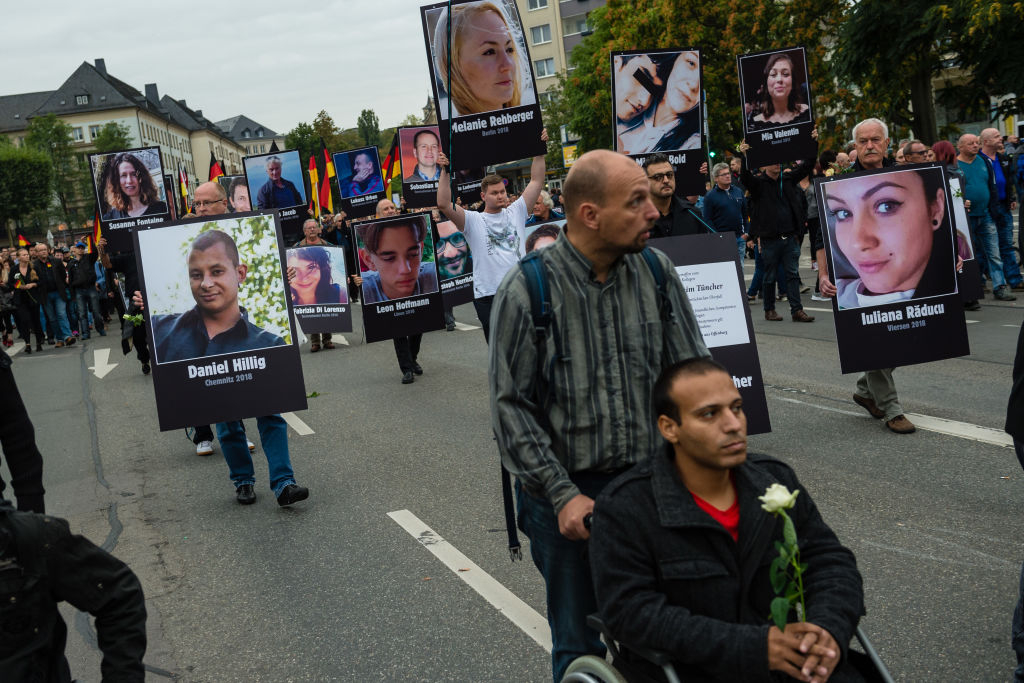
Pictured: A march of silence, organized by the Alternative for Germany (AfD) party, in memory of victims of violent crimes perpetrated by migrants, on September 1, 2018 in Chemnitz, Germany. (Photo by Jens Schlueter/Getty Images)

The murder of a German citizen by two failed asylum seekers in Chemnitz, and the attempted cover-up by German police, has contributed to a surge in support for the anti-immigration party Alternative for Germany (AfD), which, according to a new poll, has overtaken the Social Democratic Party (SDP) to become the second-strongest political force in Germany.

Support for the AfD has increased to 17%, while backing for the SPD has fallen to 16%. Chancellor Angela Merkel's Christian Democratic Union (CDU)/Christian Social Union (CSU) alliance is at 28.5%, according to an Insa Institute poll published by the newspaper Bild on September 3.

The rise of the AfD — which has been fueled by widespread anger over Merkel's decision to allow into the country more than a million mostly Muslim migrants from Africa, Asia and the Middle East, and the subsequent increase in violent crime — reflects an ongoing realignment in German politics, in which voters increasingly are rejecting the multicultural orthodoxy of the mainstream parties.
When federal elections were held on September 24, 2017, the CDU/CSU won 32.9% of the vote, its worst electoral result in nearly 70 years. The SPD won 20.5%, its worst-ever showing. The AfD won 12.6%, to become the country's third-largest party in the German parliament.

The election results showed that more than a million traditional CDU/CSU voters defected to the AfD. In a sign that concerns over mass migration are not limited to conservative voters, the center-left SPD lost 500,000 voters to the AfD while the far-left Left Party lost 400,000 voters. In addition, nearly 1.5 million first-time voters cast their ballots for the AfD. This trend has continued, as consistently corroborated by opinion polls since the 2017 election.

The mainstream parties are fighting back with what some observers say are underhanded measures, aimed at delegitimizing — and possibly criminalizing — the AfD, including by calling for the party to be placed under state surveillance.

The AfD's opponents, who often brand the party as "far right" or "extremist," claim that the party's alleged ties to neo-Nazi groups pose an existential threat to Germany's constitutional order. The AfD's supporters counter that Germany's politically correct establishment, afraid of losing its power and influence, is attempting to outlaw a legitimate party that has pledged to put the interests of German citizens first.

Calls for the AfD to be monitored by German intelligence have intensified in recent days, after members of the AfD participated in mass protests in Chemnitz against spiraling migrant criminality — protests in which approximately 50 hooligans and neo-Nazis were also present.

The protests erupted after a 35-year-old German-Cuban man named Daniel Hillig was stabbed to death on August 26 by two migrants during the city's annual festival.

Police initially refused to reveal the identities of the perpetrators, but on August 27 a police report was leaked on social media — the document has since been scrubbed from German websites but it remains on a Russian site — which showed that the killers were illegal migrants from Iraq and Syria. Both had extensive criminal histories but were allowed by German authorities to roam free on German streets. Police later confirmed that the leaked document was authentic and said that they had opened an investigation into suspected "violation of official secrets."

Thousands of people took to the streets for several days to protest the killing and the inaction by German authorities over the issue of spiraling migrant crime. The protests (and counter-protests) brought together a broad spectrum of German society, including supporters of the AfD, as well as members of the so-called "far-right scene." Near the end of one of the marches, some of the protesters turned violent and began insulting some migrant passersby. That incident then shaped the media narrative from one of Germans protesting migrant crime to one of far-right attacks on innocent migrants.

Few if any of Germany's mainstream politicians condemned the murder of Hillig, but they were quick to denounce attacks on migrants.

On August 27, government spokesman Steffen Seibert, in a national press conference, condemned the "hunting of humans of a different appearance, of different origins" on the streets of Chemnitz.
Chancellor Merkel echoed: "We have video footage about the fact that there were hunts, that there were riots, that there was hatred on the street, and that is unacceptable in our constitutional state."
It later emerged that all of the government's allegations were based on a single 19-second video — titled "Hunting for Humans in Chemnitz" — which was posted on YouTube and later broadcast by the public television channel ARD. The video shows one individual chasing another in what appears to be an isolated incident.

Moreover, a protester who grabbed national headlines by making a Nazi salute at the Chemnitz protest was discovered to be a left-wing extremist who infiltrated the march in order to discredit it. But the media narrative had been set in motion.

The chairman of the German Parliament's Internal Affairs Committee, Burkhard Lischka (SPD), warned of the danger of a civil war:
"There is a small right-wing mob in our country that will take its violent fantasies of civil war to our streets. That in the Bundestag [German parliament] a party applauds these excesses against foreign fellow citizens as legitimate self-justice, shows that the majority of our country must become even louder when it comes to rule of law, democracy and cohesion in our society."
Bundestag Vice President Thomas Oppermann demanded that the AfD be monitored by Germany's domestic intelligence service, the Office for the Protection of the Constitution (Bundesamt für Verfassungsschutz, BfV): "The refugee question divides society and the AfD rides ever more radically on this wave."

German Interior Minister Horst Seehofer (CSU) countered that he sees no basis for monitoring the AfD. On the sidelines of a closed-door meeting of the CSU in Brandenburg, Seehofer defended the Chemnitz protesters: "Just because people protest, that does not make them a Nazi." He added: "Migration is the mother of all problems."

Saxon Prime Minister Michael Kretschmer (CDU) later contradicted the government's claims: "There was no mob, there was no hunting down of people, there was no pogrom in this city."

Saxon Attorney General Spokesman Wolfgang Klein added: "After examining all of the material available to us, there was no hunt in Chemnitz."

When asked to rectify his claims, Seibert doubled down:
"I will not have a semantic debate here over a word. Of course, if the Attorney General's office says so, I take note. However, it remains that a video shows how people of foreign origin were chased and how they were threatened. It remains true that there were statements that were threatening, close to the call for vigilante justice. So, in my opinion, there is nothing to talk about."
Like Seibert, Merkel refused to back down:
"We saw pictures that very clearly revealed hate and the persecution of innocent people. One must distance oneself from that. That is all there is to say."
Writing for Tichys Einblick, a prominent German blog, commentator Oswald Metzger summed it up:
"'There was no mob, there was no hunting down of people, there was no pogrom in this city.' Saxon Prime Minister Michael Kretschmer (CDU) clearly corrected the almost hysterical and false reporting of countless leading media outlets on the events in Chemnitz after the deadly stabbing. Even the chancellor and her government spokesman had, as we all know, conveyed these false reports to the public, and thereby giving them publicity.
"For long enough, many citizens from all walks of life have noticed that the problems of integrating even third- and fourth-generation immigrants have grown bigger, not smaller — especially among Turks. The mass immigration of the past three years, under the banner of 'the right to asylum,' has significantly increased the fear of parallel societies, of crime, and of cultural alienation.
"When I consider the often undifferentiated, blanket accusations against 'brown Chemnitz' [brown is the color of Nazism], then the established parties will not have to wonder why, almost without exception, they continue to lose to the colorful AfD.
"When concerned citizens increasingly are stigmatized as being Nazis — accusations which, incidentally, in their excessive use amount to a shameless trivialization of Nazi crimes — they often respond with the indifferent remark: 'Well, then I'm just a Nazi!'
"Extremism cannot be combated with exclusion, but with looking at the facts. Those who want to reach concerned citizens must themselves get out of the ideological trenches."

Soeren Kern is a Senior Fellow at the New York-based Gatestone Institute. Follow Soeren Kern on Twitter and Facebook


Source: https://www.gatestoneinstitute.org/12973/germany-anti-immigration-party

Follow Middle East and Terrorism on Twitter


Hezbollah force that infiltrates Israel won't get ‎out alive, IDF warns - ‎Lilach Shoval, Associated Press and Israel Hayom Staff

​
by ‎Lilach Shoval, Associated Press and Israel Hayom Staff

Construction of 80-mile wall along Israel's northern border stokes tensions as Lebanon claims the project infringes on its sovereignty


An Israeli soldier near the wall being built on Israel's northern border
Photo: AP 

Israel is building a massive wall along its northern ‎border, saying the barrier is needed to protect nearby communities from Hezbollah attacks, ‎but the project has raised tensions with Lebanon, ‎which fears the wall will encroach on its ‎territory.‎

The Israeli military insists the entire barrier is ‎being constructed in Israeli territory, and UNIFIL – ‎the U.N. peacekeeping force in the area – agrees.

But Iranian-backed Shiite terrorist group Hezbollah has never fully ‎accepted the border, and a senior Israeli military ‎official stressed the need for the wall, saying that ‎while Israeli intelligence closely monitors Hezbollah‎, "we are prepared for the possibility ‎that they will surprise us.‎"

‎"Borders, as the saying goes, will forever be ‎breached. They [Hezbollah] may mark certain ‎achievements but it won't be anything as big as they ‎are planning. Wherever it happens, a Hezbollah force ‎that infiltrates Israel won't get ‎out alive," he ‎said.‎

Hezbollah has been heavily involved ‎in the seven-year-long Syrian civil war, sending thousands of ‎operatives to fight alongside Syrian President ‎Bashar Assad's forces. With the conflict ‎in Syria waning, Israel is wary of renewed ‎hostilities with Hezbollah. ‎

Israel and Hezbollah in Lebanon waged war in ‎‎2006, sparked by a deadly cross-border raid in which ‎Hezbollah killed ‎eight Israeli soldiers and abducted ‎two others, ‎whose remains were returned to Israel in ‎a prisoner ‎exchange two years later.‎

Twelve years on, Hezbollah is believed to have an ‎even larger and more sophisticated arsenal of ‎rockets that pose a threat to all of Israel's ‎territory. ‎

Brig. Gen. Eran Ofir, the commander in charge of ‎Israel's border wall projects, said around 7 miles ‎of the 80-mile barrier has been ‎built. Most of it comprises a ‎30-foot high ‎concrete wall‎ ‎topped by steel mesh and lined with a ‎grid of sophisticated ‎sensors and advanced ‎surveillance systems. Steel fencing ‎replaces the ‎concrete in especially rugged ‎areas.‎ ‎

The $450 million project is slated for completion in ‎‎‎two years. ‎

Lebanese soldiers routinely monitor the ‎construction's progress from a guard post on the ‎opposite side of the Blue Line, which was demarcated ‎by the U.N. after Israeli forces withdrew from south ‎Lebanon in 2000 following an 18-year military ‎campaign. ‎

An IDF official said Israel has noted a troubling ‎rise ‎in "very close cooperation between the Lebanese ‎army and Hezbollah" near the Israeli border in ‎the ‎past year. He said the IDF expects even ‎more ‎Hezbollah fighters to arrive in the area after ‎the ‎Syrian war ends.‎

Israel and Lebanon technically remain at war.‎

The U.N. Security Council warned last month that ‎violations of the cease-fire agreement between ‎Lebanon and Israel could lead to fresh conflict.‎

Lebanon's top security body earlier this year ‎described the planned border wall as an "aggression" ‎against it.‎

‎"This wall, if it is built, will be considered an ‎aggression against Lebanon," it said in a statement. ‎‎"The Higher Defense Council has given instructions ‎to confront this aggression to prevent Israel from ‎building this so-called wall barrier on Lebanese ‎territory."

Maj. Tomer Gilad, Israel's liaison officer with ‎UNIFIL, said monthly meetings are held with the ‎Lebanese military and U.N. officials to coordinate ‎the barrier's construction.‎

‎"Even for the past year before we started this ‎construction, we've coordinated this activity with ‎UNIFIL, and through UNIFIL with the Lebanese Armed ‎Forces. We've alerted them of our intention to construct this defensive mechanism," Gilad ‎told reporters.‎

Thus far, construction has proceeded "very calmly ‎with the participation on all sides to maintain ‎stability," he said. "We expect UNIFIL and the ‎Lebanese army to maintain stability over here ‎throughout this construction because this ‎project is a stabilizing measure."‎

UNIFIL spokesman Andrea Tenenti said that since ‎construction began in February, all the building work has been south of the Blue Line and away from ‎sensitive areas.‎


‎Lilach Shoval, Associated Press and Israel Hayom Staff

Source: http://www.israelhayom.com/2018/09/07/hezbollah-force-that-infiltrates-israel-wont-get-%e2%80%8eout-alive-idf-warns-%e2%80%8e/

Follow Middle East and Terrorism on Twitter