Sunday, January 6, 2019

France in Free Fall - Guy Millière

​
by Guy Millière

The author Éric Zemmour described the "yellow vests" revolt as the result of the "despair of people who feel humiliated, forgotten, dispossessed of their own country by the decisions of a contemptuous caste".
  • French officials evidently understand that the terrorists are engaged in a long war and that it will be difficult to stop them; so they seem to have given in. These officials are no doubt aware that young French Muslims are being radicalized in increasing numbers. The response, however, has been to strengthen Muslim institutions in France.
  • At the time President Macron was speaking, one of his emissaries was in Morocco to sign the UN Global Compact for Safe, Orderly and Regular Migration, which defines immigration as "beneficial" for the host countries. Under it, signatory states pledge to "strengthen migrant-inclusive service delivery systems."
  • A group of retired generals published an open letter, saying that signing the Global Compact was a further step towards "the abandonment of national sovereignty" and noted that "80% of the French population think that immigration must be halted or regulated drastically".
  • The author Éric Zemmour described the "yellow vests" revolt as the result of the "despair of people who feel humiliated, forgotten, dispossessed of their own country by the decisions of a contemptuous caste".

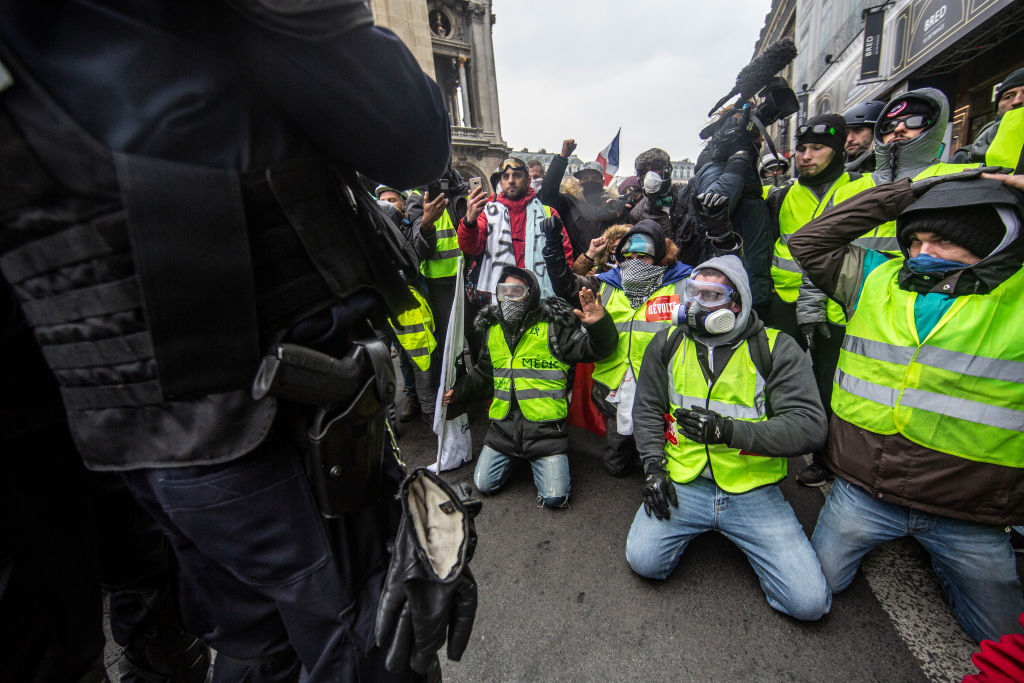
French President Emmanuel Macron seems to hope that weariness will lead the "yellow vests" protestors to give up, but there seems no sign of it yet. On the contrary, the "yellow vests" seem dedicated to bringing him down. Pictured: "Yellow vests" protesters on December 15, 2018 in Paris, France. (Photo by Veronique de Viguerie/Getty Images)

Strasbourg, France. Christmas market. December 11th, 8pm. A man shouting, "Allahu Akbar" ("Allah is the greatest") shoots at passersby, then wounds several with a knife. He murders three people on the spot and wounds a dozen others, some severely. Two will later die of their wounds. The murderer escapes. Two days later, the police shoot him dead.

He was known to the police. When members of the General Directorate of Internal Security and some gendarmes came to his home a few hours earlier, he had escaped. Although they knew he was an armed and dangerous Islamist ready to act, and that Christmas markets had been, and could be, likely targets, no surveillance was in place.

The murderer, Cherif Chekatt, should, in fact, have been kept off the streets. He was 29 years old, his name was on the list of people reported for terrorist radicalization (FSPRT), and he and had already been sentenced for crimes 27 times. He was nevertheless roaming around free, with no police oversight.

His case is similar to that of many jihadi terrorists in France in the last decade. Others include Mohamed Merah, who murdered Jewish children in Toulouse in 2012; Cherif and Said Kouachi, who murdered most of the staff at the satirical magazine Charlie Hebdo in 2015, and Amedy Coulibaly, who murdered people at a kosher supermarket few days later.

Successive governments have done exactly nothing to remedy the situation. Instead, they delivered speeches and stationed soldiers about the streets. "Young French people must get used to living with the threat of attacks", then-Prime Minister Manuel Valls said in 2015. Two years later, just before the first round of the presidential elections, Emmanuel Macron, still a candidate, used almost the same words. Terrorism, he said, is "imponderable" and will constitute a "threat that will be part of the daily life of the French for the years to come".

French laws are extremely lax. Even serial killers and terrorists are not sentenced to long prison terms. Most prisons have become jihadist recruiting stations. Currently, more than 600 no-go zones are under the control of imams and Muslim gangs. Islamists, apparently "ready to act", number in the thousands. The police simply do not have the personnel or material resources to monitor all of them

The only political leaders who have proposed tougher laws against terrorism, or who have said that exceptional measures were needed -- such as a wider use of electronic ankle-bracelets -- to counter increasing threats, come from parties considered "right-wing". The mainstream media immediately branded these leaders as "extremists" and their proposals were dismissed.

Macron and his government continue their unfortunate tradition of submitting to political correctness. It seems they prefer to appease extremists rather than confront them.

These politicians are undoubtedly aware that more riots could take place. In 2016, the head of the French General Directorate for internal Security, Patrick Calvar, spoke of a high risk of "clashes between communities", perhaps even civil war.

These officials evidently understand that the terrorists are engaged in a long war and that it will be difficult to stop them; so they seem to have given in. These officials are no doubt aware that young French Muslims are being radicalized in increasing numbers. The response, however, has been to strengthen Muslim institutions in France.

Although these officials also presumably see that Muslim immigration into France continues, and that hundreds of thousands of illegal Muslim migrants are creating increased security concerns, they do nothing to reverse the trend. The number of deportations is rising, but are still rare: slightly more than 26,000 persons were deported in 2017. Meanwhile, more than 150,000 illegal immigrants live in Seine Saint Denis, near Paris. Macron, since becoming President, has repeatedly said that those who call on him to expel illegal immigrants are "xenophobic".

Macron and the current government, in fact, have been encouraging more migration: all illegal immigrants in France receive financial assistance if they ask for it, as well as free health care; and they run almost no risk of being deported.

Each year, more than 200,000 residence permits are issued (262,000 in 2017), including to illegal immigrants. Many have no marketable skills, some receive for decades the minimum income paid to anyone in difficulty.

Social support for migrants, legal or not, adds to the cost of an increasingly expensive welfare system. France today is the most highly taxed country in the developed world: compulsory levies correspond to more than 45% of GDP. Unemployment is high at 9.1%. Typical salaries are both low and stagnant. A public school teacher starting out earns 1,794 euros per month ($2,052). A police officer after a year of service earns even less: 1,666 euros per month ($1,906).

Macron, when elected president, promised to boost growth and improve purchasing power. To encourage large and multinational companies to invest in France, he lowered their taxes and eliminated a tax on wealth. As he apparently did not wish to increase the French budget deficit (2.6% in 2017), he created new taxes and increased a few of the taxes paid by the entire population, including fuel taxes.

It was in this context that the "yellow vest" ("gilets jaunes") protestors – who have been rioting throughout France for the eight weekends, came into being. They have vowed to keep on demonstrating.

The new taxes, plus the increase in existing taxes, have led many people into real financial straits. Many also saw the reduction of taxes on large companies coupled with the removal of the wealth tax for the rich as outrageously unfair. They see perfectly well that a lack of security is spreading, that immigration is exploding and that the government is not providing sufficient law and order.

Macron's remarks, such as a comparing "those who are successful and those who are nothing" -- or his assertion that "the life of an entrepreneur is much harder than that of an employee" -- gave him the image of an arrogant upstart who despises the poor and knows nothing about the problems they face. Some of his utterances -- such as, "there is not a French culture" or the French are Gauls "resistant to change" -- led many to believe that he did not even have respect for the French or for France.

The proliferation of speed radars on the roads, and the lowering of the speed limit to 80km/h, apart from freeways, as well as a noticeable increase in speeding tickets as a result, also did nothing to help his approval ratings.

Finally, an additional increase in fuel taxes sparked a revolt that has not stopped to this day.
The first protest by the "yellow vests", which took place on November 17, spontaneously gathered hundreds of thousands of people across the country and had the support of more than 80% of the population.

Rather than react quickly and say that he understood the difficulties of millions of French, Macron waited 10 days until a second demonstration, bigger than the first, to respond. He then delivered a speech focusing on the environment and emphasizing that fuel taxes were necessary to fight "climate change".

His words appeared totally out of touch with the economic distress felt by the public.

Four days later, on December 1, a third demonstration drew even more people than the second. Protestors waved French flags and sang the national anthem. People who spoke on television said that Macron had made fun of them and reminded him of his promises. They demanded his resignation, new elections, and a return of sovereignty to the people.

Gangs from the suburbs looted stores and destroyed property. The police were particularly brutal to the protesters, but could not stop the looting or destruction.

Macron said nothing.

On December 8, the day of the fourth demonstration, Paris was effectively set under siege. Armored vehicles were deployed along the main avenues. Thousands of police officers sealed off access to the neighborhood of the presidential residence, the Élysée Palace. A helicopter waited in the courtyard of the Élysée Palace, in case Macron needed to be evacuated. Looting and destruction began again.

When Macron finally decided to say something, on December 10, he announced a slight increase in the minimum wage and the removal of some taxes. He promised to open a "national debate" and announced the need to review the rules for immigration. However, at the time Macron was speaking, one of his emissaries was in Morocco on behalf of France to sign the UN Global Compact for Safe, Orderly and Regular Migration, which defines immigration as "beneficial" for the host countries. Under it, signatory states pledge to "strengthen migrant-inclusive service delivery systems." The next day, the terrorist attack near a Christmas market in Strasbourg took place, in which five people were murdered.

The public's anger did not subside. The "yellow vest" protestors who spoke on television the following days said that Macron had evidently not taken the measure of what they were saying. They stated that talking about reviewing the rules for immigration while signing the Global Compact -- without taking into account the opinion of the population -- showed that Macron was a liar.

A group of retired generals published an open letter, saying that signing the Global Compact was a further step towards "the abandonment of national sovereignty" and noted that "80% of the French population think that immigration must be halted or regulated drastically".

"In deciding alone to sign this pact," the generals wrote, "... You are guilty of a denial of democracy, even treason, with respect the nation".

The Minister of Defense, Florence Parly, said that the generals' letter was "inadmissible and unworthy", but did not dispute the arguments it set forth. Again, Macron said nothing.

On December 22, when the fifth demonstration of the "yellow vests" took place, even though the protestors were fewer, their anger seemed more intense. Calls for Macron's resignation came from everywhere. A puppet representing Macron was symbolically beheaded by an imitation guillotine. A sculpture representing a yellow hand, resembling the logo of SOS Racism, the oldest organization fighting "racism" and "Islamophobia" in France, was burned.

Anti-Semites took the opportunity to offer their usual opinions, but were marginal. Benjamin Griveaux, the government spokesman, however, used their comments to attack the "yellow vest" protestors. He sent a tweet saying that the "yellow vests" were "coward[s], racist[s], anti-Semitic", and of the type that stages coups. Earlier, he had said that whatever happens, Macron would not "change course".

Macron seems to hope that weariness will lead the "yellow vests" to give up, but there seems no sign of it yet. On the contrary, the "yellow vests" seem dedicated to bringing him down. Those on television say they are determined to fight "to the end". The economic damage is considerable; the first estimates numbered hundreds of millions of euros.

"Macron and his team," wrote Ivan Rioufol, an editorial writer at Le Figaro, recently, "would be wrong to believe that if the mobilization weakens during the Christmas truce, it means they are out of the woods".

The author Éric Zemmour described the revolt as the result of the "despair of people who feel humiliated, forgotten, dispossessed of their own country by the decisions of a contemptuous caste". He concluded that he thinks that Macron has lost all legitimacy and that his presidency is over.

Radio commentator Jean-Michel Aphatie, said that the presidency and the government "hang on by a thread", and that the letter published by the generals is a strong sign that the French institutions are deeply shaken. "If the police falter," he stressed, "France could quickly slide towards chaos".

On December 20, two days before the fifth demonstration of the "yellow vests," police officers organized a protest in front of the Élysée Palace. The vice-president of an organization made up of police officers said that many members are exhausted, feel sympathetic to the revolt and are ready to join it.

The next day, the government increased police officers' salaries and paid them millions for overtime -- payments that had been overdue for months.

"The authorities are really afraid that the police could turn on them," commented the journalist Jean-Michel Aphatie. "It is hard to imagine. It is where we are in France, today".

The Macron's popularity is in free fall; it has dropped to 18%. No French president's popularity has dropped so low, so quickly. Flore Santisteban, a professor at the Paris Institute of Political Studies, quoted surveys showing that Macron now crystallizes "an intense hatred, and maybe more than hatred: rage".

Many commentators are wondering how Macron will still be able to govern in the coming weeks, and ask if he could be forced to resign and call for early presidential elections.

Several news analysts have said that this time, Marine Le Pen, the leader of the right-wing, populist National Rally party, could be elected president. The themes of her presidential campaign in 2017 resembled the claims of the "yellow vest" movement.

Macron still says nothing. He is nowhere in sight. His only recent public statements were made in foreign countries: Belgium and Chad. His last public appearance in France was on December 4, in the Massif Central, late in the evening. He went to see the damage done to an official building partly burned by vandals. Although his visit was unannounced, dozens of "yellow vests" arrived, insulted him, and he quickly left.

Polls show that Le Pen's National Rally could win the European Parliament elections in May 2019 with 24%-25% of the vote. Another right-wing, nationalist party, Debout la France! (France, Stand Up!) headed by MP Nicolas Dupont-Aignan, and allied to the National Rally party , could get 8%. The total would amount to 32%-33% percent of the vote. Macron's La République En Marche ! party, created two years ago, is expected to get only 18% of the vote.

Election to the European Parliament has no direct impact on French political life. Such a result, however, would be a scathing disavowal of Macron -- if he manages to stay in power until then.

A few months ago, Macron introduced himself as the champion of an open, "progressive" and multicultural Europe and described the defenders of national sovereignty and all those hostile to immigration and multiculturalism, as "lepers" and supporters of "bellicose nationalism" extolling "the rejection of the other". He pretended easily to triumph over them.

In July 2017, he hinted that he would rule like the Roman god Jupiter. It did not take long for him to fall from his pedestal.

On the evening of December 31, Macron offered the French people his wishes for the year 2019. He did not apologize. He ignored the grievances of the "yellow vest" protesters and their supporters. He merely said that "anger broke out" and that "order will be maintained without indulgence". He described in positive terms all that he had done since becoming President. He added that he would "go forward" in the same direction without changing a thing: "I intend to continue to follow the line that I traced since the first day of my mandate". He described his political opponents as "extremists", "demagogues" and "megaphones of a crowd full of hatred". He again said that the "fight against global warming" is an absolute priority.

Many of the "yellow vest" protestors, interviewed on television, appeared upset; some said they had decided not even to listen to the speech. Macron's political opponents criticized him harshly. Nicolas Dupont-Aignan wrote:
"Tonight the French had the confirmation that Emmanuel Macron learned nothing from the events of 2018. While his politics brought together more than 75% of the French against him, he appeared determined to continue, in defiance of democracy."
Laurence Saillet, of the moderate right party, The Republicans, said:
"I feel that while the 'yellow vests' were protesting, he was on another planet... He has not taken the measure of the country's anger. He makes no mea culpa, he even assessed his actions positively, precisely what is rejected by the French."
Marine Le Pen tweeted, "This president is an impostor. And a pyromaniac."

On January 3, Eric Drouet, one of the main faces of the "yellow vests" movement was arrested by a dozen policeman on his way to the Place de la Concorde in central Paris to light candles to pay tribute to the "yellow vests" wounded or killed since the beginning of the demonstrations. He was peacefully walking on the sidewalk with 15 to 20 of his friends. None of them was shouting or wearing banners, or even a yellow vest. Drouet was indicted for organizing an illegal protest. Macron's political opponents said that Macron was adding more fuel to the fire.

On January 4, after the first cabinet meeting of the year, Macron asked government spokesman Benjamin Griveaux to say that "those who continue to protest... are agitators who promote insurrection", and that the government must "go further, in a stronger way".

On Saturday January 5, thousands of "yellow vests" protested again, calling for Macron's resignation. They broke down the doors of Griveaux's office building as he fled. By evening, the streets of Paris and other cities looked like battlefields once more.

Guy Millière, a professor at the University of Paris, is the author of 27 books on France and Europe.

Source: https://www.gatestoneinstitute.org/13500/france-in-free-fall

Follow Middle East and Terrorism on Twitter


Financial institutions moving to shut foes of jihad terror out of the financial system altogether - Robert Spencer

​
by Robert Spencer

Hat tip: Dr. Jean-Charles Bensoussan


"Abandon free speech or lose your ability to process payments". Has it come to this?

Oppose jihad? Then starve.

This is not hysterical. It’s coming. In some ways, it is already here. It has started with me, but it won’t end with me. Read on. And donate to Jihad Watch, a 501c3 organization, here, and get the book The History of Jihad here, while you still can. It is not at all outside the realm of possibility that you may not be able to do either in the very near future.


“Bokhari: The Terrifying Rise of Financial Blacklisting,” by Allum Bokhari, Breitbart, January 2, 2019:

It is the most totalitarian form of blacklisting: not just to be prevented from speaking on a university campus, or to be kicked off social media, but to be shut out of the entire financial system. That is the terrifying new threat to freedom that western societies must now contend with.
Financial blacklisting doesn’t just rob you of a chance to spread your message: it robs you of your ability to do business, your livelihood, your very means of functioning in a capitalist society. Thanks to the encroachment of progressive ideology into the financial industry — including major credit card companies like Visa, Discover, and Mastercard — it has now become a reality.
I first wrote about the rise of financial blacklisting in July, in a column for Breitbart News in which I highlighted the growing tendency of online financial platforms — as well as Visa and MasterCard — to deny service to customers for political reasons. I was surprised to receive a strongly worded comment from the liberal Electronic Frontier Foundation (EFF), who bluntly warned that banks and credit card companies had become “de facto internet censors.” That even liberal groups had raised the alarm signaled the seriousness of the problem.
Since then, financial blacklisting has only gotten worse. In August, Mastercard and Discover deplatformed conservative and Islam critic Robert Spencer. In the same month, Visa and Mastercard ceased service to David Horowitz. While credit card processing service to Horowitz was eventually restored, Spencer remains financially blacklisted.
Crowdfunding platforms like Patreon, which allow online content creators to collect donations from their supporters, are frequently cast as the primary villains in financial blacklisting. Patreon’s recent ban of YouTuber Carl Benjamin, better known by his moniker Sargon of Akkad, triggered a crisis for the platform. Both donors and creators — including prominent atheist Sam Harris — quit the platform in protest, while Jordan Peterson and Dave Rubin pledged to create an alternative platform that is pro-free speech.
But Patreon and other crowdfunding platforms are not the real villains. They are dependent on the whims of the credit card companies, something that was already apparent in August when Mastercard forced them to withdraw service from Robert Spencer. We now know that the credit card companies were also a factor in Patreon’s decision to boot Benjamin.
YouTuber and Patreon creator Matt Christiansen recently released a transcript of his conversation with Jacqueline Hart of Patreon about Benjamin’s ban. Hart frankly admits that the sensibilities of credit card companies play a key role in Patreon’s decisions.
Here’s an excerpt of that transcript (emphasis ours):
JACQUELINE: The problem is is Patreon takes payments.  And while we are obviously supportive of the first amendment, there are other things that we have to consider. Our mission is to fund the creative class. In order to accomplish that mission we have to build a community of creators that are comfortable sharing a platform, and if we allow certain types of speech that some people would call free speech, then only creators that use Patreon that don’t mind their branding associated with that kind of speech would be those who use Patreon and we fail at our mission.  But secondly as a membership platform, payment processing is one of the core value propositions that we have. Payment processing depends on our ability to use the global payment network, and they have rules for what they will process.
MATT:  Are you telling me that this was Patreon’s decision then, or someone pressured you into this?
JACQUELINE:  No – this was entirely Patreon’s decision.
MATT:  Well then I don’t understand passing the buck off to somebody else.
JACQUELINE:  No, I’m not passing the buck off.  The thing is we have guidelines, but I’m trying to explain, #1 it is our mission to fund the creative class and obviously some people may not want to be associated.  
MATT:  Well if it’s your mission, then payment processors are irrelevant.  It’s your mission. That’s what you’re pursuing.
JACQUELINE:  We’re not visa and mastercard ourselves – we can’t just make the rules.  That’s what I’m saying – there is an extra layer there.
This “extra layer” places platforms like Patreon in an impossible position: abandon free speech or lose your ability to process payments. That’s also why so many free-speech alternatives to Patreon have failed: FreeStartr, Hatreon, MakerSupport, and SubscribeStar all tried to offer a more open platform, and were promptly dumped by the credit card companies. All are unable to do business.
This exposes the emptiness of establishment conservative arguments about the free market. Those who oppose Silicon Valley censorship aren’t allowed to just build their own alternative platforms. They must build their own global payment processing infrastructure to have any hope of restoring free speech online.
That, or they must find a way to stop Visa, Mastercard and Discover from taking advice from the far-left Southern Poverty Law Center (SPLC) and Color of Change. The former was allegedly responsible for the blacklisting of Robert Spencer, while the latter claims to have removed 158 funding sources from “white supremacist sites” — although as the group won’t list what those sites are, we don’t know if they really are “white supremacist.” The far left typically includes regular Trump supporters under the label….

Robert Spencer

Source: https://www.jihadwatch.org/2019/01/financial-institutions-moving-to-shut-foes-of-jihad-terror-out-of-the-financial-system-altogether

Follow Middle East and Terrorism on Twitter


European Court of Human Rights Promotes Human Wrongs - Tommaso Virgili

​
by Tommaso Virgili

Is the new ruling just a capitulation to extortionistic threats of violence?

  • One might also wonder where, in the European Convention on Human Rights, "feelings" are mentioned. Following the court's logic, would it be appropriate to cover the windows of steakhouses not to hurt the feelings of animal activists? Or only if they threatened to riot? Is the new ruling just a capitulation to extortionistic threats of violence?
  • The supposition seems to be, "If you had just kept quiet, these bad things (fill in the blank) would not be happening." It is both a false premise -- the "bad things" might have happened anyway, as they did, for example, when the Bataclan Theater in Paris or the Brussels airport were attacked -- and it is a demand for enforced self-censorship. Moreover, who gets to decide who is accountable? Who watches the watchers?
  • How soon will the public be asked to stop other activities -- drinking alcohol, men and women dancing together, ringing church bells, art that depicts the human image, separation of religion and state, and equal justice under the law for women, to name just a few -- that also might hurt "religious feelings?"
  • Will the ECHR's Grand Chamber -- the only authority that could reverse the decision -- correct this treacherous path?

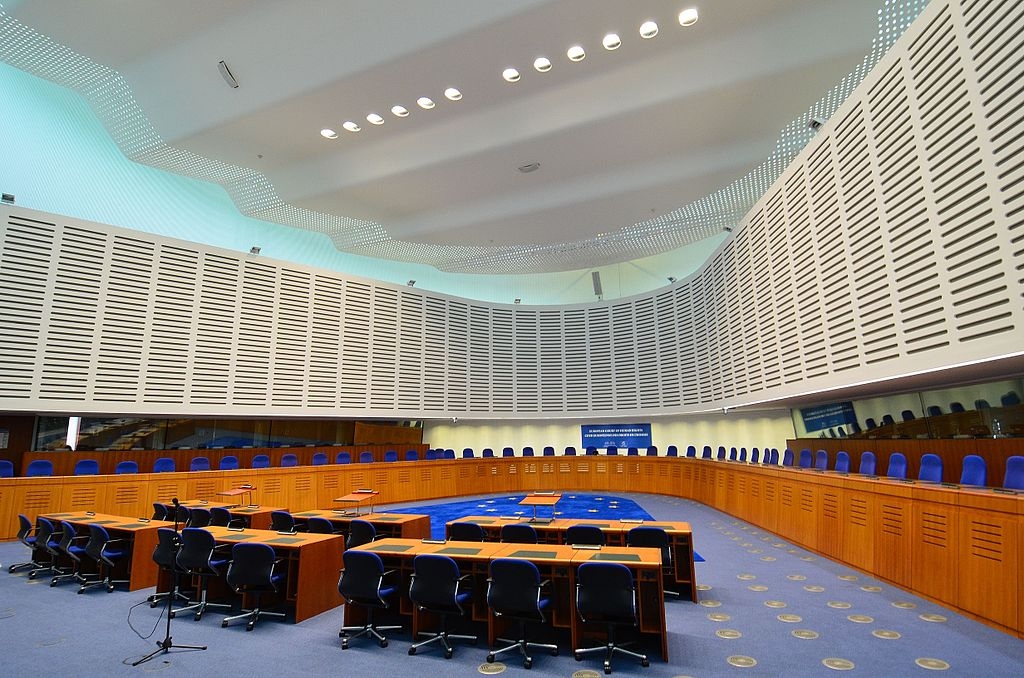
The European Court of Human Rights (ECHR) has ruled that criticism of Islamic prophet Mohammed constitutes incitement to hatred and therefore is not protected free speech. Pictured: A courtroom of the ECHR in Strasbourg, France. (Image source: Adrian Grycuk/Wikimedia Commons)

October 26 marked a historic day for Ireland, where citizens, in a national referendum, overwhelmingly voted to repeal the country's blasphemy law.

Blasphemy remains a serious offence in many parts of the world, in some Muslim countries even requiring the death penalty.

More astonishing is that even some European countries are criminalizing "defamation of religion".

Recently, an actor was detained in Spain for failing to appear in court where he would face the accusation of "having insulted God and the Virgin Mary".

The outcome of the Irish referendum will entail a modification of the Irish Constitution, which states in Article 40.6.1:
"The publication or utterance of blasphemous, seditious, or indecent matter is an offence which shall be punishable in accordance with law."
While no prosecution for blasphemy has been recorded in Ireland since 1855, the Irish police in 2015 opened an inquiry into remarks by the British comedian Stephen Fry, who said live on television: "Why should I respect a capricious, mean-minded, stupid God who creates a world so full of injustice and pain?"

Even the Catholic Church, in conjunction with other Christian groups, declared the constitutional ban on blasphemy "largely obsolete", and called for its removal.

So, removed it was.

Unfortunately, while good news is coming from Dublin, the same cannot be said for Strasbourg, where the European Court of Human Rights (ECHR) -- a supranational judicial body entitled to scrutinize the compliance of national pieces of legislation with the European Convention of Human Rights -- recently upheld the criminal conviction of an Austrian woman, Elisabeth Sabaditsch-Wolff. Her "crime" was supposedly having defamed the Islamic Prophet Muhammad.
"The offending speech was an offhand comment by Sabaditsch-Wolff that Mohammed was a pedophile because he married his wife Aisha when she was just six or seven years old. Sabaditsch-Wolff's actual words were, 'A 56-year-old and a six-year-old? What do we call it, if it is not pedophilia?'"
She was referring to an official Islamic text which states that Muhammad married Aisha when she was six years old and consummated the marriage when she was nine.

The ECHR judgment, which possibly represented the last chance for a conviction that was imposed by Austrian courts to be reversed, was based on Article 188 of the Austrian penal code, containing the "blasphemy law":
"Whoever, in circumstances where his or her behaviour is likely to arouse justified indignation, publicly disparages or insults a person who, or an object which, is an object of veneration of a church or religious community established within the country, or a dogma, a lawful custom or a lawful institution of such a church or religious community, shall be liable to up to six months' imprisonment or a day-fine for a period of up to 360 days."
In particular, the defendant was accused of mentioning -- during a series of small seminars on Islam -- some tendencies of the Prophet Muhammad:
"Because he was a warlord, he had many women, to put it like this, and liked to do it with children...
"The most important of all Hadith collections recognised by all legal schools: The most important is the Sahih Al-Bukhari. If a Hadith was quoted after Bukhari, one can be sure that all Muslims will recognise it. And, unfortunately, in Al-Bukhari the thing with Aisha and child sex is written...
"A 56-year-old and a six-year-old? What do you call that? Give me an example? What do we call it, if it is not paedophilia?..."
The Court found "that the impugned statements can be classified as value judgments without sufficient factual basis". The ECHR did that by recalling and upholding the language used by the domestic tribunals, which distinguished between pedophilia as a general sexual preference and the historic custom of child marriage:
"Even though criticising child marriages was justifiable, she had accused a subject of religious worship of having a primary sexual interest in children's bodies, which she had deduced from his marriage with a child, disregarding the notion that the marriage had continued until the Prophet's death, when Aisha had already turned eighteen and had therefore passed the age of puberty".
On this basis, the ECHR maintained that the applicant's statements went "beyond the permissible limits of an objective debate", constituted "an abusive attack on the Prophet of Islam", and thereby conflicted with "the rights of others to have their religious feelings protected and to have religious peace preserved in Austrian society". Her statements had purportedly "been likely to arouse justified indignation in Muslims", and were "capable of stirring up prejudice and putting at risk religious peace".

No apparent influence on the court's decision to uphold the Austrian courts' conviction had the authoritative opinions of bodies such as the Human Rights Committee, the Venice Commission, the European Parliament or even the Parliamentary Assembly of the Council of Europe -- the international organization to which the ECHR belongs. Although the Court cited them in its ruling, it completely disregarded their views on "blasphemy." The essence of those opinions is that criminal laws should not protect religions as such, but believers from hatred and discrimination. Conversely, article 188 of the Austrian penal code explicitly protects "religious doctrines", "objects of veneration" and "dogmas" -- which are the very basis of blasphemy laws.

The Austrian law has been criticized by the European Centre of Law and Justice (third party intervener before the ECHR), which observed:
"...a criminal conviction which pursued the aim of protecting the belief itself rather than the believers' feelings was one of blasphemy – a criminal charge which, according to international law standards, should be abolished. It argued that [the relevant section of the Austrian] Criminal Code served as a deterrent ("chilling effect") obstructing free debate. Having recourse to a criminal sanction rather than a civil law one to protect freedom of religion was not necessary in a democratic society."
Regarding the debate on the word "paedophilia", it should be borne in mind that, in modern criminal codes, sex with a 9-year-old is a sexual assault irrespective of the context. Moreover, even though sexual relations with children may have been more prevalent in the seventh century, there are certain Muslims nowadays who use Mohammad's preference as an excuse, supposedly sanctioned by religion, to assault children.

The new judgment supports the primacy of religion, and qualifies "religious feelings" as "human rights". What about the feelings of people who find it unbearable to see the truth trampled? Or freedom of expression trampled? Does this ruling foretell even more internal repression?

One might also wonder where, in the European Convention on Human Rights, "feelings" are mentioned. Following the court's logic, would it be appropriate to cover the windows of steakhouses not to hurt the feelings of animal activists? Or only if they threatened to riot? Is the new ruling, then, just a capitulation to extortionistic threats of violence?

To protect religious feelings, the ECHR had to disregard its own formulation -- frequently mentioned but overruled -- that freedom of expression "is applicable not only to 'information' or 'ideas' that are favourably received or regarded as inoffensive or as a matter of indifference, but also to those that offend, shock or disturb."

At bottom, however, speech that does not hurt anyone's feelings does not need protection; it is speech that might run counter to the prevailing spirit of the time, or be considered politically incorrect, that needs a court to protect it from the tyranny of the majority.

While this is not the first time the ECHR has adopted a restrictive view of free speech when religion was involved, its latest judgment is particularly distressing. It endorses the Islamist definition of blasphemy at a time when, even in the West, it is considered a religiously sanctified reason for committing murder and terrorism.

If speaking openly about religion, discredited as "blasphemy," is regarded as "incitement" to creating social unrest, who then is to be held at fault? The victim? Did the editors and cartoonists killed at the offices or the French satirical magazine Charlie Hebdo "cause" their own murder? Even Pope Francis seemed to imply that this retribution was warranted when he commented on the case: "Curse my mother, expect a punch".

The supposition seems to be, "If you had just kept quiet, these bad things (fill in the blank) would not be happening." It is both a false premise -- the "bad things" might have happened anyway, as they did, for example, when the Bataclan Theater in Paris or the Brussels airport were attacked -- and it is a demand for enforced self-censorship. Moreover, who gets to decide who is accountable? Who watches the watchers?

Do women "provoke" "religious feelings" by wearing a miniskirt? Or gays by kissing in the street? Or apostates by stating their disavowal of Islam? Considering that Sharia law comes from sources of "religious veneration" (to use the words of the Austrian law), where does the reasoning of the ECHR stop? Condemning Quranic verses and hadiths that recommend hudud penalties [for violating the rules of Islam] as "barbarous", for instance, would be tantamount to disparaging religious doctrines? How soon will the public be asked to stop other things -- drinking alcohol, men and women dancing together, ringing church bells, art that depicts the human image, the separation of religion and state, and equal justice under the law for women, to name just a few -- that also might hurt "religious feelings?"

The slope of criticism toward Islam is an extremely slippery one, as many freethinkers and reformers who have given their freedom and lives could testify. The latest news these days is that the ordeal of Asia Bibi is not over. Two months ago, the Pakistani Christian mother of five was acquitted after more than 8 years in prison awaiting a death sentence for allegedly offending the Prophet Muhammad. Violent riots, however, were organized by Islamists baying for her death, and the government, bowing to them, has not only agreed to impose a travel ban that prevents her from leaving the country, but has also threatened to allow a "review" of her trial -- presumably until she is convicted, whether guilty or not. In the meantime, the lives of the supreme court justices who acquitted her have been threatened and her lawyer fled the country to avoid meeting the same "street justice" as Salman Taseer and Shahbaz Bhatti - Pakistani politicians who questioned their country's blasphemy laws and who paid with their lives.

At a time when we are celebrating the outcome of the Irish referendum, and when countless alleged "blasphemers" are suffering the consequences of their real or imagined "thought crimes" , the world really did not need a verdict of this kind – especially from a judicial body named the European Court of Human Rights. When an organization such as that starts to protect systems of beliefs and dogmas to the detriment of individual liberties, it has evidently forgotten and betrayed its history and mission. Will the ECHR's Grand Chamber -- the only authority that could reverse the decision -- correct this treacherous path?

Tommaso Virgili, who holds a Ph.D. in Comparative Constitutional Law, is based in Europe.

Source: https://www.gatestoneinstitute.org/13376/european-court-human-wrongs

Follow Middle East and Terrorism on Twitter


Iran's Schizophrenia Heats Up the Debate - Amir Taheri

​
by Amir Taheri

What millions of Iranians demand is a restoration of the authority of their state which, in turn, requires, the closure of the revolutionary chapter.

  • The Khomeinist revolution in Iran has failed to "export" its model to a single country, while making Iran poorer and more vulnerable than it had been under the Shah.
  • The political schizophrenia gives the impression that one is dealing with two Irans: one Iran as a state and another as a revolution. The good news is that, perhaps out of necessity, a new political culture is taking shape inside Iran, one that instinctively links politics to concrete issues of real life rather than abstract notions linked to revolutionary utopias.
  • What millions of Iranians demand is a restoration of the authority of their state which, in turn, requires, the closure of the revolutionary chapter.

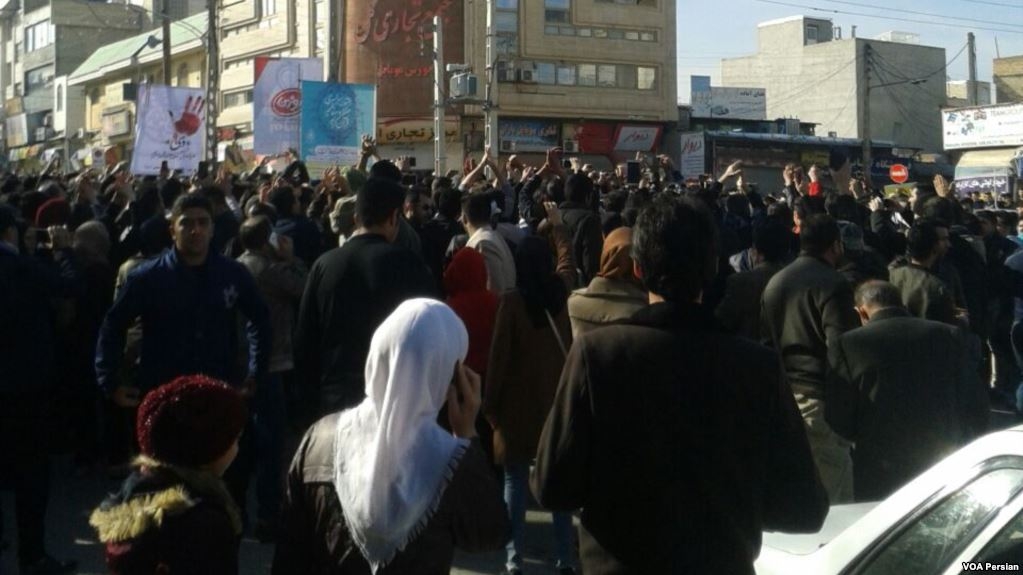
Over the past two years, Iran has witnessed more than 100 strikes by people from virtually all walks of life. It has also been shaken by two nationwide uprisings mobilizing millions of protesters. Pictured: Anti-regime protestors in Kermanshah, Iran, on December 29, 2017. (Image source: VOA News/Wikimedia Commons)

As the leadership in Tehran prepares to mark the 40th anniversary of the Khomeinist revolution, a growing number of Iranians are wondering whether the time has come for their country to close that chapter and resume its historic path as a nation-state.

The need for Iran to move beyond the Khomeinist revolution was the theme of a seminar last month at Westminster University in London where the return of Iran as a nation-state was highlighted as an urgent need for regional peace and stability.

The Khomeinist revolution in Iran has failed to "export" its model to a single country, while making Iran poorer and more vulnerable than it had been under the Shah.

The main reason for this is that the Khomeinist revolution failed to create a new state structure with credible and efficient institutions. Unable to destroy the Iranian state as it had developed over some five centuries, the new Khomeinist rulers tried to duplicate it by creating parallel organs for exercising power.

The aims and interests of those parallel organs, not to mention their modus operandi, differ sharply from those of the Iranian state, leading to almost continuous tension between the two.

The argument finding a growing echo in Iran is that time has come to dismantle the parallel organs and allow the state apparatus to regain its full authority as a vehicle for pursuing national, as opposed to ideological, interests and ambitions.

"As long as Iran has parallel authorities, decision-makers and executants, no one could be held responsible," says journalist Nader Sadiqi. The result is that those who have power have no responsibility while those who are held responsible have no power.

The fact that Iran under the Khomeinist regime is suffering from political schizophrenia is also recognized by the so-called "reformist" faction within the regime.

Saeed Hajjarian, one of the leading theoreticians of the "reformist" action of the regime. is now preaching "civil disobedience" as a means of restoring the dignity and authority of state institutions as opposed to parallel revolutionary organs. The method he is peddling is almost identical with that promoted by Prince Reza Pahlavi, the exiled heir to the Iranian monarchy.

Another leading "reformist" figure, Abbas Abdi, warns his fellow Khomeinists that their regime is in deep crisis and may even have reached "the edge of implosion". Once again, the solution he suggests is to close the chapter of the revolution and allow Iran to reorganize its life as a nation-state.

Classical Iranian historians identify five phases in the emergence of a new state in a country that has seen countless upheavals in its long history.

The first stage is conquest when a new force, often a warrior tribe, manages to seize a chunk or the whole of the nation's territory.

That is followed by a second stage dubbed "domination", when the new conquering force succeeds in establishing itself as primus inter pares. The third stage is known as "control" when the new force is universally recognized as the ultimate arbiter in any power struggle. That leads to the fourth stage which is known as "governance" in which the new force operates as the ultimate arbiter of national life. In the fifth and highest phase, the new force creates a "state" of its own with institutions needed to ensure its perennity and advance its interests and ambitions on a long-term basis.

Based on that model of analysis, the Khomeinist revolution, as a new force, has stopped at the fourth stage, which means it has failed to destroy the old state and create a new one capable of developing a synthesis of national and revolutionary interests and ambitions.

The result is the already mentioned schizophrenia that gives the impression that one is dealing with two Irans: one Iran as a state and another as a revolution.

Iran's political schizophrenia is also affecting the opponents of the Khomeinist regime. Consciously or unknowingly, most of them also behave as revolutionary forces, albeit against the regime, rather than political movements capable of managing a normal nation-state and solving the problems facing a complex society trying to exit from four decades of crisis.

The good news is that, perhaps out of necessity, a new political culture is taking shape inside Iran, one that instinctively links politics to concrete issues of real life rather than abstract notions linked to revolutionary utopias.

Over the past two years, Iran has witnessed more than 100 strikes by people from virtually all walks of life. It has also been shaken by two nationwide uprisings mobilizing millions of protesters.

The important point here is that all those strikes and the two uprisings were prompted by demands that only a normal nation-state and not a revolutionary outfit can understand and satisfy. Therefore, at least implicitly, what millions of Iranians demand is a restoration of the authority of their state which, in turn, requires, the closure of the revolutionary chapter.

"Other countries are also facing the kind of problems we face in Iran," says Ali-Reza Shoja'i Zand, a Tehran analyst. "But that does not delegitimize the established order or lead to its implosion."

What Zand misses is that "other countries" do not suffer from political schizophrenia. They are nation-states, and as such can always mobilize the resources needed for solving the problems of real life, while in Iran the Islamic Republic pursues its phantomatic fantasy of world conquest in the name of a weird ideology.

This article was originally published in a slightly different version by Asharq al-Awsat.

Amir Taheri was the executive editor-in-chief of the daily Kayhan in Iran from 1972 to 1979. He has worked at or written for innumerable publications, published eleven books, and has been a columnist for Asharq Al-Awsat since 1987.

Source: https://www.gatestoneinstitute.org/13499/iran-schizophrenia

Follow Middle East and Terrorism on Twitter


Pelosi Rules the House Again - Joseph Klein

​
by Joseph Klein

Leftist agenda - and hate - to be on full display.


Incoming House Speaker Nancy Pelosi (D., Calif.) gaveled the 116th Congress into session on Thursday, declaring that the voters opted for a "new dawn" in the November midterm elections. She added that the voters are looking to "the beauty of our Constitution," as if her Democrat House majority would be the nation’s savior from a power-hungry President Trump. However, it is Nancy Pelosi who is the power-hungry politician. She arrogantly told the New York Times that the Constitution gives her power equal to that of the president of the United States. Pelosi seems to have forgotten that the Constitution’s system of checks and balances applies to the distribution of institutional powers amongst the three co-equal branches of the federal government. The president is the nation's chief executive officer and commander-in-chief. The speaker of the House is the leader of only the lower chamber of Congress. Pelosi should take the time to read Articles 1 and 2 of the Constitution before making such a ridiculous claim, just as she and her Democrat colleagues should have read the disastrous Obamacare bill thoroughly before passing it the last time she served as speaker.

The craziness of the Democrat House majority rule under Pelosi is just getting started. The incoming freshman class of progressives and their more senior colleagues on the left are anxious to impose their leftwing agenda on the country and to demonize President Trump, if not remove him from office altogether. Indeed, impeachment resolutions have already been filed. Pelosi will be leading her raucous caucus’s attempt to undo the progress made at home and abroad during the previous two years and to obstruct the president’s efforts to secure the nation’s borders with physical barriers of the type that border agents believe are necessary.

One of the Democrats’ senior members on the House Judiciary Committee has just demonstrated the kind of Trump derangement syndrome and contempt for ordinary Americans’ concerns that we can now routinely expect. Georgia Congressman Hank Johnson delivered a New Year's Day speech at a Georgia church in which he compared President Trump to Adolf Hitler, the genocidal megalomaniac who oversaw the extermination of approximately six million Jews during the Holocaust. “Americans, particularly black Americans, can’t afford to make that same mistake about the harm that could be done by a man named Hitler or a man named Trump,” Rep. Johnson said. “Much like how Hitler took over the Nazi party,” Johnson added, “Trump has taken over the Republican Party."

Johnson then went after the millions of people who supported Trump’s candidacy. "Americans elected an authoritarian, an anti-immigrant, racist strongman to the nation's highest office,” Johnson said. “Donald Trump and his Make America Great Again followers...want to return America back to a time where white men and white privilege were unchallenged, and where minorities and women were in their place."

President Trump has spoken out strongly against anti-Semitism and demonstrated his support for the Jewish State of Israel through concrete actions. Rep. Johnson, on the other hand, demonstrated his animus towards those he referred to as “Jewish people,” who he claimed were taking for themselves the land and property of Palestinians. He used the Nazi-like dehumanizing analogy of “termites” in describing how Jewish settlers took residence in the disputed territories of the West Bank. He made those remarks during an event sponsored by the U.S. Campaign to End the Israeli Occupation. Johnson later apologized for what he called a “poor choice of words” and tried to wriggle out of their clear meaning. However, the damage was already done.

It is hard to take seriously a man who once said he feared that stationing 8,000 Marines on Guam would cause the island to "become so overly populated that it will tip over and capsize." However, Congressman Hank Johnson will have significant power as a senior member of the House Judiciary Committee, participating in endless investigations of the Trump administration and the likely impeachment proceedings to follow.

Pelosi and Johnson are representative of the leftwing direction the Democrat party had been following even before the November midterm elections. Such senior members of the Democrat caucus will find further strength in numbers and shared ideology by the addition of newly elected progressives taking office for the first time. In fact, the senior members may seem “moderate” by comparison. Incoming Palestinian-American Congresswoman Rashida Tlaib, D-Mich., for example, said that much of her “strength comes from being Palestinian.” She also tweeted a month after the midterm elections that “The Muslimas are coming.”  How curious considering that she is supposed to be representing Americans of all beliefs in the U.S. Congress.

Tlaib planned to show her full allegiance to the Palestinian cause by wearing a Palestinian gown at her swearing-in ceremony.  She also wanted to follow in former Representative Keith Ellison’s footsteps, proving her Islamist credentials by using Thomas Jefferson’s centuries-old Quran in being sworn in. “The prophet Mohammed was always talking about freedom and justice,” she claimed, apparently skipping over those portions of the Quran and Mohammed’s sayings in the Hadith that demonstrate the precise opposite.

Tlaib wants to see Israel as it presently exists cut off from U.S. foreign aid. She supports the so-called “right of return” that would destroy the Jewish state. Indeed, she wants one state that would be dominated by the Palestinians, relegating Jews in their own historic homeland to a minority status. That idea has not worked out so well for religious minorities in Lebanon. Tlaib also said that she personally supports the Boycott, Divestment, and Sanctions movement, accusing Israel of racism akin to “what African-Americans in the United States endured in the Jim Crow era.”

Tlaib wants President Trump’s removal from office. “I truly believe he’s racist,” she said, mirroring her comments about Israel. Tlaib supports open borders and opposes ICE. She wants not so much to improve Americans’ lives as she wants to “transform people's lives.” Tlaib described the election of progressives such as herself as bringing about a “new era of the social justice movement.”

Socialist-Democrat New York Congresswoman Alexandria Ocasio-Cortez provided more specifics on her own plan to radically transform Americans’ lives to fit her progressive agenda. She has proposed legislation establishing a new “Select Committee for a Green Deal” with the “authority to develop a detailed national, industrial, economic mobilization plan for the transition of the United States economy to become greenhouse gas emissions neutral and to significantly draw down greenhouse gases from the atmosphere and oceans and to promote economic and environmental justice and equality.” Sounds just like the type of top-down central planning so reminiscent of the former Soviet Union and Communist China today.

The rule of Speaker Nancy Pelosi and her majority in the House is not ushering in a “new dawn,” as she claimed. It foreshadows the sunset of America as we know it, unless the leftists are checked and eventually voted out of power before they can do any real damage.


Joseph Klein is a Harvard-trained lawyer and the author of Global Deception: The UN’s Stealth Assault on America’s Freedom and Lethal Engagement: Barack Hussein Obama, the United Nations & Radical Islam.

Source: https://www.frontpagemag.com/fpm/272453/pelosi-rules-house-again-joseph-klein

Follow Middle East and Terrorism on Twitter


Foul-Mouthed Rashida and the Duplicitous Democrats - Jeannie DeAngelis

​
by Jeannie DeAngelis

Rashida Tlaib's incredibly vulgar epithet against the president draws attention to a particular quirk among the left.

As a rule, the standard Democrats have set for Republicans is entirely different from the standard they have set for themselves. ; ;Democrats were always at the ready to defer to and defend Barack Obama from criticism by dangling the dreaded sword of racism over the head of the former president's critics. ; ;In liberal circles, opposition to Barack, in any way, is synonymous with wrapping oneself in a Confederate flag, or, worse yet, donning the garb of the Ku Klux Klan.

In 2009, during a major health care speech to Congress, South Carolina representative and Republican Joe Wilson shouted, "You lie" at President Obama, who, at the time, was dishonest when he vowed that his proposed legislation did not include mandating coverage for illegal aliens.

Following Wilson's outburst, Democrat shill David Shuster of MSNBC rushed to Obama's defense when he remarked that Joe Wilson, being from South Carolina, "strikes a lot of people as awfully close to the idea that maybe there was racist or bigoted element there."

Of late, accusations of racism have become tools with which the left beats the right into guilt-ridden submission. ; ;That's why, in an attempt to further impugn Wilson, the commentator even solicited the opinion of race-baiter Jesse Jackson, whoM Shuster asked the following question: "What role, if any, do you believe that bigotry is playing in some of this venom toward President Obama?"

Jackson, who always welcomes an opportunity to advance his divisive agenda, replied:
Well, substantial. There is a struggle between the hope of going forward and the fear of going backwards…the big C-word, conservative, for some that means fiscal, for some, it means religious ethics, for some it means a code word for race.

Then, in a New York Times September 15, 2009 article entitled "Carter sees Racism in Wilson's Outburst," the Associated Press stated that former president Jimmy Carter felt that "Wilson's outburst was an act 'based on racism' and rooted in fears of a black president."

In other words, pointing out the truth to Barack Obama was, and continues to be, construed as racism.

A similar standard also held for anyone who disagreed with Obama's progressive open borders agenda. ; ;Here's what happened in 2012, on an airport tarmac, when, out of frustration, the former governor of Arizona, Jan Brewer, wagged her finger in the former president's face.

Apparently, at the time, Obama thought he could inflict the same treatment on Jan Brewer that he had inflicted on Bibi Netanyahu for daring to disagree with a pro-Palestinian stance concerning Israel's construction and resettlement plans in East Jerusalem.

Brewer would have none of it.

That's why, as governor of a border state overrun by illegals, Brewer met the Obstinate One as he disembarked from Air Force One, handed him a letter, and proceeded to grapple with the community organizer by following his advice and "getting in his face."

The former governor of Arizona took the president to task and rightly so. But, as a result of her commitment to state's rights, the left accused Brewer of not only being disrespectful but also found a way to add racist to the mix.
RMuse of PoliticsUSA said it this way:
The photograph of Arizona governor Jan Brewer shaking her finger at President Obama is about more than accusing the 'Obama administration of turning a blind eye to illegal immigration because migrants will help Mr. Obama register more Democratic votes.' Brewer's actions were more than disrespect for the leader of the most powerful nation on Earth; they were outward expressions of white supremacy befitting a pre-Civil War plantation owner scolding an errant slave who forgot to empty the master's chamber pot.
Naturally, Al Sharpton agreed.

Fast-forward seven years to 2019, and the what's apparent is that the left's response to presidential disrespect has nothing to do with courtesy and everything to do with who holds the office. ; ;Rather than maintain the standard of deference Democrats demanded during the Obama years, the left has now chosen to either downplay or ignore rudeness on the part of the Trump-detractors currently holding powerful positions in their party.

Then again, these are the same partisan operatives who, while defending Obama by accusing Republicans of racism, chose to ignore Barry's religious and political bigotry toward Americans whom he referred to as "tea-baggers" and "bitter clingers."

Therefore, it's no surprise that with the induction of the 116th Congress's new class of left-wing lunatics, Old Faithfuls like Nancy "Fund Foreign Abortion but Not a Wall" Pelosi and UpChuck Schumer, are among the most disingenuous of the double-standard Democrats for failing to harshly reprimand bad-mannered newcomers for voicing their aversion to Trump in the worst possible way.

The most glaring example of that sort of duplicity concerns the party's non-reaction to the appalling language of newly installed U.S. representative for Michigan's 13th Congressional district, Rashida Harbi Tlaib.

Rashida, who opposes U.S. aid to Israel, is one of the first two Muslim women and the first Palestinian-American woman elected to Congress. ; ;Tlaib is also a proud member of the Democratic Socialists of America. ; ;However, unlike her colleague, Alexandria Ocasio-Cortez, who war-danced her way into office, during a MoveOn rally in Washington, D.C., foul-mouthed Rashida chose instead to lift her leg on the political fire hydrant by vowing to impeach Trump, whom Tlaib referred to as a "m-----------."

In the Quran, doesn't it say women found "guilty of lewdness" should be confined to the house until they die, "or [until] Allah appoint for them a way [through new legislation]?"

Despite Rashida's strict adherence to Islam, the unapologetic Muslim representative's Trump-tirade was met with accolades and kudos from POTUS-haters on Twitter and those who are traditionally among the first to express outrage whenever anyone dares to criticize Obama.

In an interview with Joy Reid, on "The Speaker: An MSNBC Town Hall," even Nancy Pelosi downplayed the severity of the rookie legislator's outburst, saying, "Generationally, that would not be language I would use, but nonetheless, I don't think we should make a big deal of it."

Wait a minute! ; ;If liberals consider Republicans calling Obama a liar, or pointing a finger in his face, racism, then why isn't it also racism for a Democrat pro-Palestinian activist to call an Israel-supporting president, of European descent, a "m-----------"?

Ultimately, what's glaringly obvious is that in response to boorish language and threats directed toward Trump, instead of accusing this president's detractors of racism and disrespect, Democrats are more than willing to amend the standards they established to defend Barack Obama.

Jeannie DeAngelis hosts a blog at www.jeannie-ology.com.

Source: https://www.americanthinker.com/articles/2019/01/foulmouthed_rashida_and_the_duplicitous_democrats.html

Follow Middle East and Terrorism on Twitter