Sunday, May 19, 2019

The Palestinian Arab war tactic known as BDS - Lee Kaplan

​
by Lee Kaplan

Hat tip: Dr. Jean-Charles Bensoussan

Just visit any Presbyterian church vestibule to find anti-Israel literature posted at the front door and BDS promotion. The Poway shooter regularly attended a Presbyterian church.

U.S. President Donald Trump’s actions recognizing the Golan as part of Israel and moving the U.S. embassy to Jerusalem have certainly buoyed Israel’s eternal optimism for the future, but both the Trump and Netanyahu governments are ignoring when it comes to Israel’s long term survival.

Assuming Trump can be reelected in 2020 for another four-year term as the American leader, his remaining presidential administration might delay the current war to dismantle the Jewish state, but only temporarily. And make no mistake, it is a war, only the tactics have changed.

Trump recently cut off all foreign aid from the US to the Palestinian Authority after Mahmoud  Abbas praised all recent terrorist murders including that of a 19 year-old girl who was raped as well as murdered in Jerusalem by a Palestinian cab driver out for a lark. Israel began to apply a way overdue but only partial  solution to stopping Jew-killing by closing the spigot and announcing Israeli would deduct money paid to terrorists from PA the tax revenues it collects and transfers to them each month..

Abbas defiantly said he won’t take any money from Israel at all as a result, and why should he? The gangbangers in the Muslim countries, the dictatorships and even the prostitutes that make up the EU have already agreed to make up the shortfall. Iran would love to join the gang also and nothing guarantees they won’t be able to jump on board later if Trump is no longer in office. During the last U.S. election Hillary Clinton guaranteed that had she won she would have embarked on a U.S. campaign to fight “Islamophobia” in exchange for money contributed by Organization of the Islamic Conference, the cartel of wealthy Arab oil sheiks who never have money to feed Palestinians but can pay them to kill Jews.

The reason Abbas can so easily make up that shortfall is because, should Trump be president until 2024, Abbas will only lose a little frosting off the cake but more than make up for it elsewhere in following years. Latest estimates on his personal palace are now upwards of 30 million dollars from stolen aid money.

The next Democratic administration will plunge the dagger into Israel’s heart. We’ve already seen Rashida Tlaib  and Ilhan Omar make it clear what they will do on congressional finance committees that Israel ultimately depends on.

Hillary Clinton, had she won, said she would fight “Islamophobia.” The U.S. would already be in Arab terrorist hands had Hillary won. Trump needs to put on the brakes and reverse the course of the ship of state, something he is well able to do. He may have two terms, but if he’s gone, the Arab irredentists and jihadis will have a field day from then on.


While the Trump administration was getting kodak moments moving the embassy (the whole world has known Jerusalem is Israel’s undivided capital since 1967 and statements to the contrary were just hot air from the Muslim ummah), and while the administration was acknowledging claim to the Golan and supposedly defunding terrorism, Abbas and Hamas have intensified their BDS campaign to new heights on the grassroots level.

People in the West, even Jews, do not realize BDS is in reality a war tactic by the Palestinians against the Jews. Contrary to Arab excuses, starving someone out of his homes, businesses and right to exist is a violent act. BDS leaders try to claim their threats and intimidation against Jews and anyone else who does business with them is not violent and even in the name of human rights. If I stood on your doorstep and prevented anybody from bringing your family, food, water, the necessities of life while not-so-quietly cheering another factions from my groups as they murder my family just the same, there’s no way you’d perceive my BDS actions as nonviolent. The Nazis did this to the Jews in 1934, so why is it any different today?

But far worse in the midst of this new Gaza war is the fact Hamas and the PA rely on BDS leadership for how they conduct their war on Israel. It doesn’t take a rocket scientist (excuse the pun) to figure out how Hamas’ rocket war is conducted in tandem with BDS goings on outside of the Holy Land. As BDS fortunes flagged  here recently, the rocket attacks increased .

A case in point is the synagogue shooting in Poway near San Diego. The Washington Post ran an article by a naïve “reporter” who commented about how John Earnest, the shooter, was a good Presbyterian Christian who attended church with his family, the idea being he was an anomaly. Had that reporter done her research she would know the Presbyterian  Synod is run by BDS activists and anti-Israel activists. She made no mention of this. This reporter did not understand that Christian members of the BDS movement are providing strategy to the terrorists.

The Presbyterian Synod was targeted years ago by the BDS crowd and promotes New Theology as is taught by the Palestinian Christian wing of the PLO as part of the International Solidarity Movement. The New Theology teaches that the Palestinian Arabs replace the Jews in the Bible. Run by an Arab named Naim Ateek, his Sabeel Ecumenical Movement was set up to deconstruct Christian support for Israel and the Jewish people. These activists lost control of the Presbyterian Synod two years ago and things improved for a while, but they made sure they padded the voting and got complete control again last year.

And they’ve been doing a bang up job as we can see with the Christian shooter in Poway. Two years ago I attended undercover a national conference of the ISM. I rode in a shuttle to the airport with a woman who was a pastor. When I asked how she could support open advocacy to dismantle Israel and support Hamas’ promotion of Jewish genocide, she told me some nonsense about how being a good Christian obligated her to work for everyone, not just the Jews in the conflict. Of course, she would not condemn terror attacks or calls for genocide of the Jews.

Presbyterians are taught groupthink which means all or nothing. You won’t hear them condemning missiles fired on Israelis because there’s is a new mission: to make the Palestinians the new subjects of their theology.  Naim Ateek’s Sabeel has made inroads into many churches in the U.S., but mainly in the Presbyterian Church. Just visit any vestibule to find anti-Israel literature posted at the front door…

And what about those 600 rockets fired at Israeli civilians recently?

BDS, while it tries to claim it is a grassroots movement, is in fact a war program run by Mahmoud Abbas and the Hamas leadership. When Israel’s fortunes climb like during the embassy change and the Golan recognition,  the BDS movement works in coordination with the terrorists to shore up the fiction that the Jews are using excessive force against the poor Arabs in Gaza. That is the idea heard in the pulpits of the Presbyterian Churches today by the likes of the shooter. Apparently it worked well enough to get a 19 year-old “Christian boy” inspired enough to enter a synagogue and shoot up some Jews. According to his manifesto, he shot up the Jews for the glory and grace of God.

The concessions by President Trump to Israel’s sovereignty inspire some to  consider Trump as Israel’s savior. But to the BDS activists who communicate with Hamas and Abbas it’s a signal to step up the rocket and other attacks against the Jews. And this fervor apparently worked within the Presbyterian Church.

There are 190 Students for Justice in Palestine cells on U.S. Campuses promoting BDS and funded by taxpayer money. A pseudo-intellectual Professor Hatem Bazian leads the movement nationwide like a Rico racket. BDS is following the tactics of Rico and everyone looks the other way.

If President Trump forbids BDS from being promoted - which ultimately plays into those rocket attacks - and if the U.S. government sanctions “allies” who contribute to the boycott, the entire war might come to a halt.

President Trump needs to the right thing here. And Israel needs to understand they can’t kick the can down the road forever.


Lee Kaplan heads Stop the ISM. He is an investigative journalist and contributor to Front Page Magazine, senior intelligence analyst and communications director for the Northeast Intelligence Network, and also heads Defending America for Knowledge and Action (DAFKA). He appears frequently in the US media.

Source: http://www.israelnationalnews.com/Articles/Article.aspx/23889

Follow Middle East and Terrorism on Twitter


Iranian aggression is all about the economy - Eli Leon

​
by Eli Leon

Iran, it appears, is trying to create a crisis in reaction to its worsening economy and its unsuccessful effort to overcome U.S. sanctions.


Iranian aggression is all about the economy
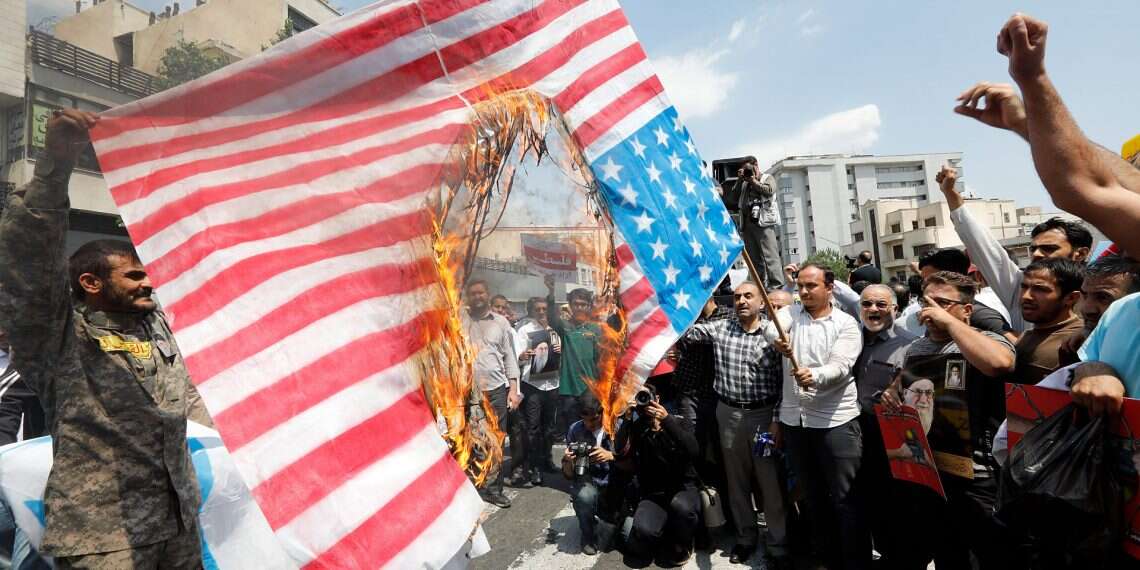
Iranians burn US and Israel flags during an anti-U.S. and Israel demonstration after the weekly Friday prayer ceremony to show their solidarity with Palestinians | Photo: EPA/ABEDIN TAHERKENAREH

The recent escalation with Iran coincided with the anniversary of the U.S. decision to pull out of the 2015 nuclear deal with the Islamic republic.

Iran, it appears, is trying to create a crisis in reaction to its worsening economy and its unsuccessful effort to overcome U.S. sanctions.

U.S. President Donald Trump’s National Security Adviser John Bolton recently revealed that the administration was sending an aircraft carrier to the region, as well as strategic bombers, because of “troubling and escalatory indications” suggesting that Iran was planning to attack U.S. interests or its allies in the region.

Hours after Bolton made that statement, the Iranian media reported that the regime would announce its pullout from the nuclear deal. President Hassan Rouhani did exactly that several days later with a televised speech to the nation.

In his speech, he warned that the Islamic republic would resume high-level enrichment of uranium unless its European trade partners found a way to bypass U.S. sanctions.

This latest behavior underscores the changing Iranian strategy for coping with the debilitating sanctions, which have dealt a crushing blow to Iran’s economy.

According to the International Monetary Fund, Iran’s economy will likely contract by 6% in 2019, compared with 4% in 2018. Inflation is set to climb to 40%.

These figures do not take into account the economic impact of the Trump administration’s decision not to renew the waivers it gave eight nations so that they could continue buying oil from Iran.

Meanwhile, the local currency is nosediving against the dollar, exacerbating the discontent.

Iran plans to use pro-Iranian allies to do its bidding by staging provocations that would complement its combative rhetoric.

This new approach was already on display this week, when oil tankers were sabotaged near the Strait of Hormuz, including two Saudi vessels.

Another example was the drone attack on Saudi oil installations near the capital of Riyadh. The attack was claimed to be carried out by the Houthis, a militia rebel group in Yemen backed by Iran.

According to reports in the U.S. media, the administration believes that Iran was responsible for sabotaging the tankers. After all, the incident took place not long after Bolton’s announcement about troubling” intelligence showing that pro-Iranian groups were planning to attack American troops in the region. One of those indications was the transfer of Iranian missiles through the area.

Bolton’s announcement may have helped deter Iran from targeting the U.S. but it did not stop it from engaging in other forms of aggression.

Iran has blamed Secretary of State Mike Pompeo for the recent escalation and has cast Bolton as a warmonger. Iran’s Foreign Minister Mohammad Javad Zarif repeatedly refers to Bolton, Prime Minister Benjamin Netanyahu, Saudi Crown Prince Mohammed bin Salman and Abu Dhabi Crown Prince Mohammed bin Zayed as the “B Team” because they are supposedly trying to make Trump go to war with Iran.

But despite the rising tensions, U.S. and Iranian officials have made it clear that neither side wants war. Trump even said that he would like Iranian leaders to call him so that they could make a deal.

Iran’s Supreme Leader Ali Khamenei responded by saying that he would not renegotiate the 2015 agreement. But he might ultimately buckle if the sanctions continue. It all boils down to the economy.


Eli Leon

Source: https://www.israelhayom.com/2019/05/17/iranian-aggression-its-all-about-the-economy/

Follow Middle East and Terrorism on Twitter


Painting of Muslim Men Sexually Enslaving White Women Triggers Outrage - Raymond Ibrahim

​
by Raymond Ibrahim

For over a millennium, Islamic rulers coaxed their men to jihad on Europe by citing its fair women.


Originally published under the title "Outrage over Germany's AfD Party Using Painting of Muslim Men Enslaving White Women in Ad Campaign."

To highlight the apparent threat male Muslim migrants pose to women in Germany, a political party has triggered many on both sides of the Atlantic by using an older painting in its campaign.

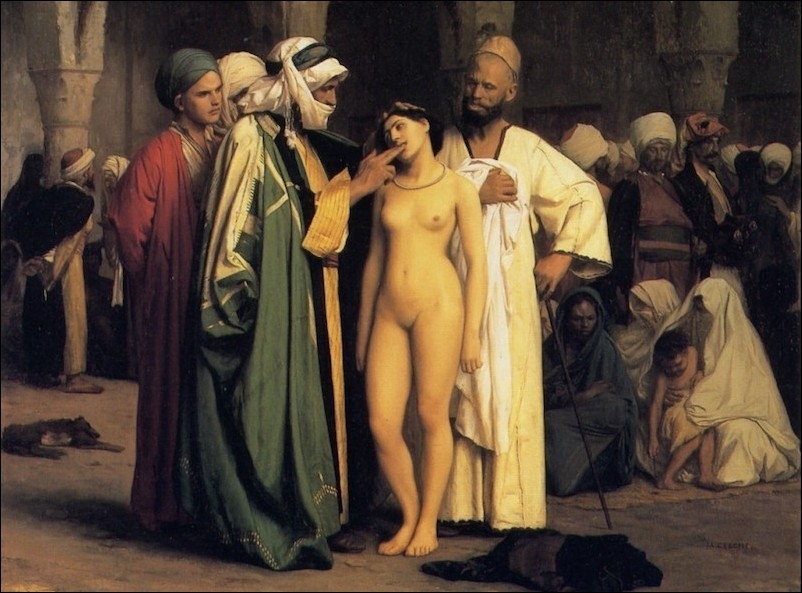
Painted in France in 1866 and titled "Slave Market," the painting "shows a black, apparently Muslim slave trader displaying a naked young woman with much lighter skin to a group of men for examination," probably in North Africa.


Slave Market, by Jean-Léon Gérôme, 1866.

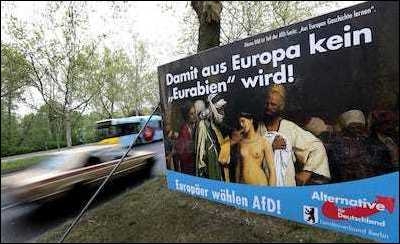
The Alternative for Germany party (AfD), founded in 2013 and first elected to Germany's national parliament in 2017, has been putting up posters of the painting with the slogan, "So that Europe won't become Eurabia."

"We are strongly opposed to the use of this work to advance any political agenda," objects Olivier Meslay, director of the Clark Art Institute in Williamstown, Massachusetts, which houses the original painting. He said his museum had written to AfD, "insisting that they cease and desist in using this painting." Despite the rather legal tone, the painting is in the public domain; even Meslay acknowledges that "there are no copyrights or permissions that allow us to exert control over how it is used other than to appeal to civility on the part of the AfD Berlin."


"So that Europe won't become Eurabia."
For its part, the AfD said the U.S. museum's call is "a futile attempt to gag the AfD," adding that "[t]he German public has the right to find out about the truth about the possible consequences of illegal mass immigration."

Other elements in Germany are even more hostile to the AfD's painting/poster: almost as soon as they are put up, every poster has been torn down, so that "party workers have had to repeatedly put up new copies, only to see them destroyed again the following night."

What to make of all this? Objectively speaking, the "Slave Market" painting in question portrays a reality that has played out countless times over the centuries: African and Middle Eastern Muslims have long targeted European women—so much so as to have enslaved millions of them over the centuries (as copiously documented in my recent book, Sword and Scimitar: Fourteen Centuries of War between Islam and the West, from which the following quotes and statistics are derived).

The Muslim demand for, in the words of one historian, "white-complexioned blondes, with straight hair and blue eyes," traces back to the prophet of Islam, Muhammad, who enticed his followers to wage jihad against neighboring Byzantium by citing its blonde ("yellow") women awaiting them as potential concubines.
For over a millennium, Islamic rulers coaxed their men to jihad on Europe by citing its fair women.
For over a millennium afterwards, Islamic caliphates, emirates, and sultanates—of the Arab, Berber, Turkic, and Tatar variety—also coaxed their men to jihad on Europe by citing (and later sexually enslaving) its fair women. Accordingly, because the "Umayyads particularly valued blond or red-haired Franc or Galician women as sexual slaves," Dario Fernandez-Morera writes, "al-Andalus [Islamic Spain] became a center for the trade and distribution of slaves."

Indeed, the insatiable demand for fair women was such that, according to M.A. Khan, an Indian author and former Muslim, it is "impossible to disconnect Islam from the Viking slave-trade, because the supply was absolutely meant for meeting [the] Islamic world's unceasing demand for the prized white slaves" and "white sex-slaves." Emmet Scott goes further, arguing that "it was the caliphate's demand for European slaves that called forth the Viking phenomenon in the first place."

As for numbers, according to the conservative estimate of American professor Robert Davis, "between 1530 and 1780 [alone] there were almost certainly a million and quite possibly as many as a million and a quarter white, European Christians enslaved by the Muslims of the Barbary Coast," that is, of North Africa, the telling setting of the painting. By 1541, "Algiers teemed with Christian captives [from Europe], and it became a common saying that a Christian slave was scarce a fair barter for an onion."

With countless sexually enslaved European women—some seized from as far as Denmark, Iceland, and even Iceland—selling for the price of vegetables, little wonder that European observers by the late 1700s noted how "the inhabitants of Algiers have a rather white complexion."

Further underscoring the rapacious and relentless drive of the Muslim slave industry, consider this: The United States of America's first war—which it fought before it could even elect its first president—was against these same Islamic slavers. When Thomas Jefferson and John Adams asked Barbary's ambassador why his countrymen were enslaving American sailors, the "ambassador answered us that it was founded on the laws of their Prophet, that it was written in their Koran, that ... it was their right and duty to make war upon them [non-Muslims] wherever they could be found, and to make slaves of all they could take as prisoners."

The situation was arguably worse for Eastern Europeans; the slave markets of the Ottoman sultanate were for centuries so inundated with Slavic flesh that children sold for pennies, "a very beautiful slave woman was exchanged for a pair of boots, and four Serbian slaves were traded for a horse." In Crimea, some three million Slavs were enslaved by the Ottomans' Muslim allies, the Tatars. "The youngest women are kept for wanton pleasures," observed a seventeenth century Lithuanian.


Though Gérôme's painting is in the public domain, Olivier Meslay has demanded that AfD "cease and desist" from using it.
Even the details of the "Slave Market" painting/poster, which depicts a nude and fair-skinned female slave being pawed at by potential buyers, echoes reality. Based on a twelfth-century document dealing with slave auctions in Cordoba, Muslim merchants "would put ointments on slave girls of a darker complexion to whiten their faces... ointments were placed on the face and body of black slaves to make them 'prettier.'" 
Then, the Muslim merchant "dresses them all in transparent clothes" and "tells the slave girls to act in a coquettish manner with the old men and with the timid men among the potential buyers to make them crazy with desire."

In short, outrage at the Alternative for Germany's use of the "Slave Market" painting is just another attempt to suppress the truth concerning Muslim/Western history—especially in its glaring continuity with the present. For the essence of that painting—Muslim men pawing at and sexually preying on fair women—has reached alarming levels all throughout Western Europe, especially Germany.

Note: The historic events, statistics, and quotes narrated above—and more like them—are fully documented in Raymond Ibrahim's Sword and Scimitar: Fourteen Centuries of War between Islam and the West.


Raymond Ibrahim is a Judith Friedman Rosen Fellow at the Middle East Forum.

Source: https://www.meforum.org/58519/painting-muslims-enslaving-white-women

Follow Middle East and Terrorism on Twitter


Time for Iran to Face a Reckoning - Bruce Thornton

​
by Bruce Thornton

The mullahs can only be stopped by means of “the mailed fist.”


While the media obsess over chimeras like the president’s obstruction of justice for nonexistent crimes, and AG Barr’s impeachment for obeying the law, a collision between the U.S. and Iran is brewing in the Middle East. The question now is whether Iran will finally face the reckoning it has invited and deserved for 42 years, or the latest crisis will peter out into U.S. saber-rattling and empty threats.

Donald Trump has made a good start at ending our nearly half-century appeasement of a regime that has declared war on the U.S. and backed it up by murdering Americans and working to create nuclear weapons that would make even more difficult, or even prohibitive, the price of punishing them for their aggression.

Since Jimmy Carter’s timid, feckless response to the 1979 American embassy hostage crisis, we have signaled to the mullahs that we will not exact a cost for their aggression. And this failure has been a bipartisan effort. When in 1983 Iranian proxies murdered 241 of our military personnel in Beirut, the Reagan administration pulled out even as the French and the Israelis strafed and bombed “Little Tehran,” the terrorist camps set up in the Beqaa Valley by Tehran, which nurtured the attackers. Since then Iran has been implicated in the 9/11 terrorist attacks, and periodically taken hostage American citizens and sailors. In Iraq and Afghanistan, Iran’s Quds Force, the regime’s shock troops of global terror, have facilitated and participated in the murder of our soldiers. And it has continued to train and financially support terrorist gangs like Hezbollah and Hamas.

More recently, under the leadership of Al Quds chief Qassem Soleimani, Iran has been working to establish bases in Syria, and has sent thousands of Iranians and mercenary jihadists to help prop up thuggish Bashar al-Assad. At the same time, it has been building up an armed presence on Israel’s northern border in preparation for Iran’s long-time goal to “wipe Israel off the map.” Closer to home, Iran has sent forces to Venezuela to prop up caudillo Nicolás Maduro and maintain a friendly base for developing terrorists to sneak into America and attack the homeland.

After 42 years of U.S. appeasement of Iran’s aggression, Trump is pushing back. He has withdrawn the U.S. from Obama’s disastrous “Iran deal,” which removed economic sanctions and paid a $1.5 billion bribe just to buy at best a 10-15-year delay in the mullahs’ acquisition of nuclear weapons. Trump has restored punitive sanctions and is imposing “maximum pressure,” as National Security Advisor John Bolton put it, on the regime to starve it of the oil revenue it uses for its adventurism in Syria and its clandestine nuclear weapons and missile programs. In addition, Trump has placed the Republican Guard Corp, the mullah’s private security firm at home and fomenters of terror abroad, on the list of terrorist organizations, and put sanctions on the Guard’s extensive economic assets.

And the impact on Iran’s economy is starting to bite. A deteriorating economy and runaway inflation––in the last month prices for food, drink, and tobacco have risen 85%–– have roiled the country. According to Middle East analyst Shoshanah Bryen as quoted by Michael Ledeen, there have been scores of public demonstrations in multiple cities; chants praising Reza Shah, the ruler and Westernizing reformer overthrown by the jihadists in 1979; calls for Supreme Leader Ayatollah Khamenei to “leave the country alone”; and continuing nationwide strikes against the regime by truckers, bazaar merchants, teachers, students, farmers, and railway workers. The government has jailed and killed protestors, but economic conditions continue to worsen, and Iran seems heading closer to civil war.

Feeling the pressure, the mullahs have responded to Trump’s plan to end sanctions waivers for countries still buying Iranian oil by announcing Iran’s withdrawal from the nuclear deal––which we know from Israeli intelligence it has been violating anyway––if the sanctions are not lifted,; and by threatening to close the Straits of Hormuz, through which passes a fifth of the world’s oil. Hamas’ recent 36-hour, 600-missile barrage against Israel on May 4 and 5 was also likely an Iranian-ordered response to Trump’s increasingly tough moves. And an attack last weekend on two Saudi oil tankers and a Norwegian ship near the Gulf likely came from Iran.


According to DEBKA, intelligence reports have also uncovered an Iranian plot to use its proxies to attack the U.S.’s Al Tanf garrison in eastern Syria, strategically located near where the Syrian, Iraq, and Jordanian borders meet. According to CNN’s Barbara Starr, PJ Media reports, US officials have said that “the threats from Iran included ‘specific and credible’ intelligence that Iranian forces and proxies were targeting U.S. forces in Syria, Iraq and at sea. There were multiple threads of intelligence about multiple locations.” In preparation for these attacks, Iranian missiles of varying ranges have been deployed in western Iraq.

In response to these threats, the Trump administration has planned sanctions on Iranian metal exports, its second biggest source of export revenue. More important, he has ordered to the Red Sea the USS Abraham Lincoln strike group, accompanied by the USS Arlington warship; and deployed bombers, stealth aircraft, Patriot anti-missile batteries, and fighter jets throughout the region. We have also made it clear to the Iranians that we will hold them responsible for any attack by their proxies on American forces, and retaliate against Iranian territory and Revolutionary Guard bases.

Such events could be converging towards a violent showdown between the U.S. and Iran. How, then, to respond? On the one hand, Iran could be bluffing, using bluster and histrionic threats to save face. Its domestic economicl weakness and military puniness compared to the U.S. may concentrate the mullahs’ minds and restrain its actions. In Iran’s war with Iraq in the late Eighties, the mullahs attempted to create chaos in the Persian Gulf by attacking international shipping and the USS Stark, killing 37 sailors and injuring 21.  We responded with operation Earnest Will, which destroyed Iranian naval vessels and mine-layers, and Revolutionary Guards bases located on oil platforms. Iran stopped the attacks. The mullahs may not be ready yet to provoke our military might again.

In that case Iran may try to wait out Trump in the hopes that he will be removed from office in 2020, and replaced by a weak-kneed Democrat who like Obama finds “diplomatic engagement” a convenient excuse to avoid action. Given how eagerly our European “allies” want to do business with Iraq and circumvent sanctions, not to mention China’s insatiable appetite for oil, it’s not an unreasonable bet to wait for regime-change in America to restore the appeasement status quo ante. After all, even if Iran has slowed down its nuclear development in recent years, it still maintains the expertise and infrastructure for manufacturing nuclear weapons that can be mounted on missiles capable of reaching most of Europe. As the dysfunctional pygmy-state North Korea has shown, possession of nuclear weapons deters not just weak sisters like the EU, but also a superpower like ours despite the most powerful military in history.

On the other hand, we should not be hasty in assuming that Iran is merely blustering. Its economic weakness and domestic disaffection with its expensive adventurism abroad are seismic forces building towards a political earthquake. And we can’t be sure how the mullahs will respond. They and their praetorian Revolutionary Guards may be just a corrupt gang out for self-enrichment, and will hurry to jet off into exile when the end is near. Or they may be religious fanatics, true believers in an apocalyptic cult that will welcome the domestic and regional violence as an opportunity to destroy Israel and usher in the global triumph of Islam. Can we afford to wait and settle the question with experience, the teacher of fools?

We can’t. We are approaching the time when Iran must face a reckoning and pay for its decades of aggression against us and our interests. More delay brings us closer to Iran’s possession of nuclear weapons, which will radically increase the costs of action and endanger our most important ally, Israel. A Democrat U.S. president and Congress in power will return us to Obama’s appeasing policies that have facilitated Iran’s increasing aggression. Finally, sanctions take time, and economic collapse could spark a civil war that will create chaos with unpredictable consequences.

For now, Iran has given the West 60 days to ease sanctions waivers, and Trump has postponed the sanctions on metal exports for 90 days. But we can’t afford to wait any longer. The president’s actions over the last two years have stopped the appeasement and put the mullahs on notice that we will no longer participate in the kabuki theater of “diplomatic engagement” and unenforced swiss-cheese treaties and “plans of action” that remain all “plan” and no “action.” But all that is just step one. The next step requires mind-concentrating action. If Iran makes good on its threats to close the straits, or if its proxies attack and kill American troops in Syria, then our response must be devastating and linked to escalating levels of destruction until the mullahs get their minds right.

To paraphrase Duff Cooper’s comments about Neville Chamberlain’s infamous deal with Hitler in 1938, the mullahs cannot be stopped “through the language of sweet reasonableness,” but only that “of the mailed fist.” The Europeans and our own globalists will counsel even more of the former, relying on a Micawber foreign policy based on the hope that “something will turn up” to save them from the politically risky costs of action. We should not listen to them. It’s time for Iran to feel the “mailed fist.”


Bruce Thornton is a Shillman Journalism Fellow at the Freedom Center, a Research Fellow at Stanford's Hoover Institution, and a Professor of Classics and Humanities at the California State University. He is the author of nine books and numerous essays on classical culture and its influence on Western Civilization. His most recent book, Democracy's Dangers and Discontents (Hoover Institution Press), is now available for purchase.

Source: https://www.frontpagemag.com/fpm/273761/time-iran-face-reckoning-bruce-thornton

Follow Middle East and Terrorism on Twitter


Tehran Apologists Should Change Their Tune - Amir Taheri

​
by Amir Taheri

-- there are those who see the Khomeinists on the side of angels simply because they are, or pretend to be, anti-American, even if their anti-Americanism is little more than a pose.

  • Iranian Foreign Minister Mohammed Javad Zarif has acknowledged that.... if anyone notices the Islamic Republic it is because its leaders are or pretend to be anti-American. In other words, anti-Americanism upgrades a ramshackle and incompetent regime that is visibly incapable of running a kebab-shop let alone a modern developing society. Zarif says that without anti-Americanism we would, at best, "be something like Pakistan". And, he adds, who cares about Pakistan?
  • "Our solution is clear. In response to the cost of economic sanctions imposed on us we have to impose costs on the other side so that this war is no longer one-sided.... We have a free hand in striking economic blows at the enemy. America's allies in the region, that is to say Saudi Arabia and the Emirates, are heavily dependent on two things: oil and the glass towers they have built around the Persian Gulf and the Red Sea... We must absolutely, hit the vital vein of those two countries, that is to say their oil exports. And we can do this in the Indian Ocean and the Red Sea. Such an operation will, without a doubt, force Saudi and Emirati leaders to seek peace with Iran." — Kayhan, the day before the sabotage of four ships in the UAE port of Fujairah.
  • It is not enough to be anti-American or even anti-Trump to be automatically classed on the side of the angels. It is possible to be anti-American and anti-Trump and yet be a thoroughly obnoxious oppressor of the people and warmonger.

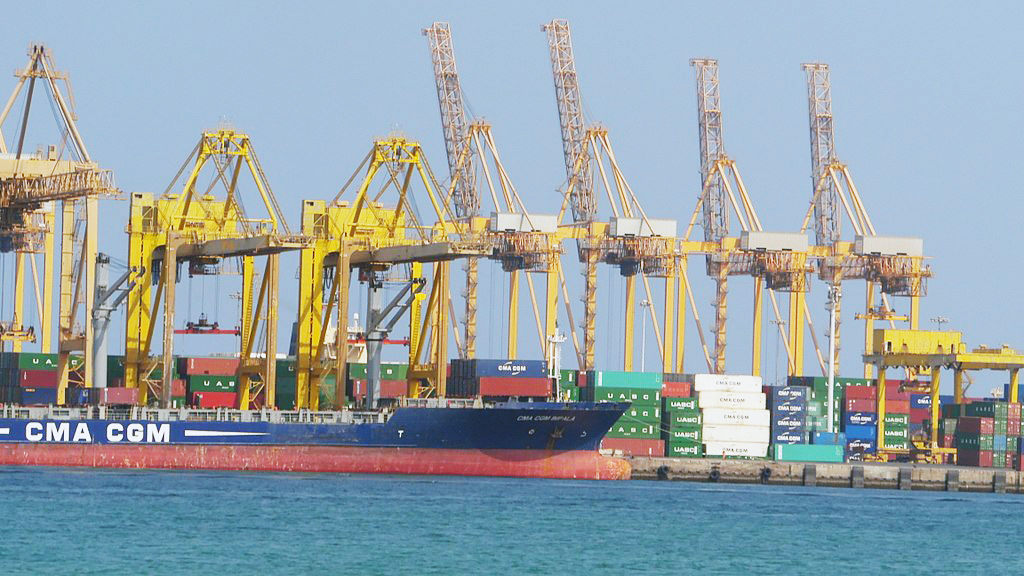
Pictured: The port of Fujairah, United Arab Emirates. (Image source: Rizwan Ullah Wazir/Wikimedia Commons)

One of the problems with a dispassionate discussion of matters related to Iran today is that the issue has become too ideological to allow rational, not to say clinical, examination. Taking part in a televised panel the other evening to discuss the "sabotage" of four ships in the UAE port of Fujairah, I noted that there was as yet no evidence to show who had been behind the operation. At the same time, I noted that a leading daily in Tehran had urged the launching of precisely such operations just a day before the Fujairah attack.

Needless to say, I was attacked on all sides. Some claimed that by suggesting there was no evidence regarding the authorship of the attack, I was trying to whitewash the mullahs. Others claimed that by reminding people that such an operation had been urged in the daily Kayhan, representing the views of "Supreme Guide" Ali Khamenei, meant that I wished to incriminate Tehran to please "American warmongers."

In a series of subsequent media programs, a range of personalities, including two former British ambassadors to Tehran, appeared as apologists for the mullahs while two former British defense and foreign secretaries spoke as if they had solid evidence that Tehran was involved.

On the one had we have those who, not always without reason, are suspicious of anything remotely connected with Islam, even if that connection is spurious. On the other, there are those who see the Khomeinists on the side of angels simply because they are, or pretend to be, anti-American, even if their anti-Americanism is little more than a pose.

In his twisted carpet-merchant's style, Iranian Foreign Minister Mohammed Javad Zarif has acknowledged that. He says that if anyone notices the Islamic Republic it is because its leaders are or pretend to be anti-American. In other words, anti-Americanism upgrades a ramshackle and incompetent regime that is visibly incapable of running a kebab-shop let alone a modern developing society. Zarif says that without anti-Americanism we would, at best, "be something like Pakistan". And, he adds, who cares about Pakistan?

I am inclined to think that the British Labour Party leader Jeremy Corbyn agreed to work for the Revolutionary Guard television not only for money but mainly because Iran is anti-American, exactly the same reason that turned him into a mouthpiece for the Venezuelan regime.

At the other end of the spectrum, we have France's Marine Le Pen who, her dislike of all things Islamic notwithstanding, acts as an apologist for the mullahs because they are anti-American and, as a bonus, also hate the Jews.

In the United States, the whole thing is more complicated. The Islamic Republic has become the cause célèbre of the Democrat Party and the bête-noire of the Republicans.

At a private dinner in London the other night, we listened to one of the US Democrat Party's grand seigneurs repeating almost word-by-word the nonsense that the mullahs mouth every day in justifying their weird behavior. What mattered to the grand seigneur was that the mullahs were challenging Donald J Trump, the common foe.

Not surprisingly, all Iran-controlled and financed lobbies in the US have been reorganized as campaigning tools to help drive Trump out of the White House.

Where preferring the mullahs to the Americans seems difficult, the trick is to cast the former as peace-lovers and the latter as warmongers. Thus Trump, his National Security Adviser John Bolton, Secretary of State Mike Pompeo and Brian Hook, the man supervising the Iran dossier, are depicted as the four horsemen of the Apocalypse while Khamenei and his cohorts are portrayed as messengers of peace and harmony.

Federica Mogherini, the lady who acts as the European Union's foreign policy spokesperson, whatever that means, never tires of pretending that the mullahs' aggressive behavior is due to American "bullying."

Well, let's go back to Fujairah. I still don't know for sure who did the sabotage. But here is what Kayhan advised before the event:
"Our solution is clear. In response to the cost of economic sanctions imposed on us we have to impose costs on the other side so that this war is no longer one-sided.... We have a free hand in striking economic blows at the enemy. America's allies in the region, that is to say Saudi Arabia and the Emirates, are heavily dependent on two things: oil and the glass towers they have built around the Persian Gulf and the Red Sea... We must absolutely, hit the vital vein of those two countries, that is to say their oil exports. And we can do this in the Indian Ocean and the Red Sea. Such an operation will, without a doubt, force Saudi and Emirati leaders to seek peace with Iran."
And here is how the Revolutionary Guards news agency Tasnim's news director Amin Arabshahi jubilated about the Fujairah attack immediately after the incident:
"The port of Fujairah, the only vital route for exporting Saudi and Emirati oil, has been set on fire. Only a few steps away from the Strait of Hurmuz, the sons of Resistance have opened fire. Those who trade in fear should know that the war has been going on for years and we are heading for its final phase."
Corbyn, Mogherini, John Kerry and other apologists for the mullahs should consider this. It is not enough to be anti-American or even anti-Trump to be automatically classed on the side of the angels. It is possible to be anti-American and anti-Trump and yet be a thoroughly obnoxious oppressor of the people and warmonger.

Apologists for the Tehran's antediluvian regime do not necessarily do it a service. By justifying its destructive behavior, they encourage the continuation of policies that have led the Islamic Republic into a deadly impasse which, if not breached, could lead to something worse. True friends of the Islamic Republic, if not of Iran as a nation, should tell the mullahs to dismount their high horses and understand that they cannot gallop around imitating Saddam Hussein without suffering consequences.
This article was originally published by Asharq al-Awsat

Amir Taheri was the executive editor-in-chief of the daily Kayhan in Iran from 1972 to 1979. He has worked at or written for innumerable publications, published eleven books, and has been a columnist for Asharq Al-Awsat since 1987.

Source: https://www.gatestoneinstitute.org/14245/iran-apologists-fujairah

Follow Middle East and Terrorism on Twitter


Burkina Faso: The New Land of Islamic Jihad and Christian Slaughter - Raymond Ibrahim

​
by Raymond Ibrahim

Of 2,869 schools in Burkina Faso, 1,111 have been closed in the last three years as a direct result of Islamic extremist violence." — James Murphy, The New American, May 16, 2019.

  • "The assailants asked the Christians to convert to Islam, but the pastor and the others refused. They ordered them to gather under a tree and took their Bibles and mobile phones. Then they called them, one after the other, behind the church building where they shot them dead." — Local Christian, reported by World Watch Monitor, May 2, 2019.
  • "Much of the Islamic anger in Burkina Faso has to do with the teaching of so-called Western thoughts and ideals. Besides churches, schools are also a favorite target of the militants, who are pushing to make the country an Islamic state and impose Sharia Law... Of 2,869 schools in Burkina Faso, 1,111 have been closed in the last three years as a direct result of Islamic extremist violence." — James Murphy, The New American, May 16, 2019.
  • As with other African Islamic terror groups, the motivating ideology fueling the terrorists of Burkina Faso is distinctly Islamic and jihadi in nature. For example, after eight Muslims were arrested for their role in terrorist attacks that killed 14, their prosecutor said, "they all carried on their foreheads or had white bands on which were written in Arabic the following expression — translated as — 'there is no god but Allah and Muhammad is His Messenger.'" — Africa News, July 3, 2018.

When five assailants opened fire on the French embassy in Ouagadougou, Burkina Faso in March 2018, they were heard to cry the jihad's ancient war cry, "Allahu Akbar" ("Allah is the greatest."). Pictured: A street in Ouagadougou. (Image source: iStock)

Last Sunday, May 12, in the small West African nation of Burkina Faso, as many as 30 armed Islamic terrorists stormed a Catholic church, slaughtered at least six Christian worshippers — including the officiating priest — then burned the church to the ground.

Ousmane Zongo, the mayor of Dablo, where the attack occurred, recalled the incident:
"Towards 9:00am, during mass, armed individuals burst into the Catholic Church... They started firing as the congregation tried to flee.... They burned down the church, then shops and a small restaurant before going to the health centre where they searched the premises and set fire to the head nurse's vehicle.... The city is filled with panic. People are holed up at home. Shops and stores are closed. It's practically a ghost town."
Discussing the situation in the country — which is 60% Muslim, 23% Christian, and 17% animist or other — the BBC reports that "Jihadist violence has flared in Burkina Faso since 2016.... Fighters affiliated to al-Qaeda and the Islamic State group as well as the local Ansarul Islam [Champions of Islam] have been active in the region."

Sadly, while a total of 12 Islamic terror attacks were registered in 2016, nearly 160 were reported in just the first five months of 2019.

Last Sunday's assault is, in fact, the third church attack in only five weeks. On Sunday, April 28, in Silgadji, Islamic terrorists stormed a Protestant church near the end of the service and killed six Christian worshippers, including the pastor, 80-year-old Pierre Oult, and his two sons. According to a local Christian:
"The assailants asked the Christians to convert to Islam, but the pastor and the others refused. They ordered them to gather under a tree and took their Bibles and mobile phones. Then they called them, one after the other, behind the church building where they shot them dead."
On April 5, Islamic gunmen entered another Catholic church and murdered four Christians. The same report adds that "the fate of a Catholic priest kidnapped a month ago remains unclear."

Considering the usual fate in store for Christians kidnapped in Burkina Faso, optimism is not warranted. For example, in February, Muslim terrorists abducted and murdered Antonio Cesar Fernandez, a 72-year-old Christian who had served as a missionary in Africa since 1982. Others — including Kirk Woodman, a Canadian — were also kidnapped and later found slaughtered.

The Islamic terrorists operating in Burkina Faso seem to be similar to other African jihadi groups, such as Nigeria's Boko Haram and Somalia's Al Shabaab. Like them, when not terrorizing churches and slaughtering Christians, they target anything else that might be associated with the West. According to one report:
"Much of the Islamic anger in Burkina Faso has to do with the teaching of so-called Western thoughts and ideals. Besides churches, schools are also a favorite target of the militants, who are pushing to make the country an Islamic state and impose Sharia Law... Of 2,869 schools in Burkina Faso, 1,111 have been closed in the last three years as a direct result of Islamic extremist violence."
"A lot of schools have been torched," elaborated one head teacher whose own school was set ablaze in the town of Foubé.

The jihadis have also targeted a hotel (20 killed) and a restaurant (18 killed) popular with Western people.

As with other African Islamic terror groups, the motivating ideology fueling the terrorists of Burkina Faso is distinctly Islamic and jihadi in nature. For example, after eight Muslims were arrested for their role in terrorist attacks that killed 14, their prosecutor said, "they all carried on their foreheads or had white bands on which were written in Arabic the following expression — translated as — 'there is no god but Allah and Muhammad is His Messenger.'"

Similarly, when they opened fire on the French embassy in Ouagadougou, the five assailants were heard to cry the jihad's ancient war cry, "Allahu Akbar" ("Allah is the greatest.").

Needless to say, such clear indicators of motive have not caused the establishment to revise its narrative. When interviewed on last Sunday's church carnage, Sten Hagberg, a Swedish professor of anthropology at Uppsala University, offered the usual fare: The attack, he said, "has, to my mind, much more to do with politics and economics than religion."

The situation in Burkina Faso is a reminder that, if groups like the Islamic State are on the wane in Iraq and Syria, the jihad continues to spread like wildfire in more obscure and forgotten nations around the world, and to consume countless nameless and faceless innocents.


Raymond Ibrahim, author of the new book, Sword and Scimitar, Fourteen Centuries of War between Islam and the West, is a Distinguished Senior Fellow at the Gatestone Institute and a Judith Rosen Friedman Fellow at the Middle East Forum.

Source: https://www.gatestoneinstitute.org/14243/burkina-faso-jihad-terrorism

Follow Middle East and Terrorism on Twitter


The Jews Who Became like Arabs: The Early Days of Israeli Intelligence - Janet Levy

​
by Janet Levy

A new book unveils the daring exploits of the Arab Section, the embryonic Israeli intelligence service.


When Israel was still a dream, an idea far from plausible reality, Jews from the Arab world risked their lives for the nascent state and went undercover in enemy territory: Syria, Egypt, Lebanon, and Jordan. This special Palmach unit, dubbed the “Arab Section” or the “Ones Who Become Like Arabs,” received cursory training in spycraft, intelligence gathering, and sabotage. Resources -- cars, cameras and radios -- were in short supply, as was money to cover ordinary expenses and even salaries. Yet, the Arab Section infiltrated Arab communities, gathering useful intelligence and radio reports, carrying out acts of sabotage and even attempting an assassination. 

The exploits of this elite unit of the Haganah, the Jewish underground army in Palestine, are told through the lives of four of its Arab-Jewish recruits in Spies of No Country: Secret Lives at the Birth of Israel (Algonquin Books of Chapel Hill, 2019). Author Matti Friedman uses material from interviews, Israeli military archives, unclassified Haganah documents, published histories and unpublished testimonies from participants to tell the story of four of the men who helped establish what would become Israel’s intelligence services.

These young men, Jews born in Middle Eastern communities, could easily navigate between two worlds, but were, for the most part, amateur spies who survived mainly by their wits. They paid close attention to Arab morale, their opponents’ military strength and schemes, any potential subterfuge plans, and most importantly, what was happening around them.
In 1947, the British announced their departure from Palestine. For more than 25 years, the British had struggled to cope with rising tensions and the increasingly difficult task of governing two hostile populations at odds with each other. The United Nations decided that the British Mandate for Palestine would be divided into two separate states: one Jewish and one Arab. Although the U.N. had no way to enforce this plan and it was unclear how it would be resolved, Jews rejoiced at the long-promised creation of a Jewish state in their ancestral land. Arab Muslims reacted with fury. In Arab-Muslim countries, Arab rioters burned Jewish homes, stores, and synagogues in Jewish communities that had existed for centuries. The U.N. and other international agencies failed to intervene, and many Jews fled, abandoning their property and belongings. 


This violent civil war evolved into full-scale war. When Israel’s War for Independence began in late 1947, it wasn’t clear that a state of Israel would ever exist. At that time, British authorities believed the Arabs would prevail. To further complicate matters, British soldiers and police were still on the ground, and the British navy continued its efforts to keep Jewish Holocaust survivors from reaching Palestine. 


During this turmoil, the four men portrayed in Spies of No Country became recruits in the Palmach Arab Section. They were Gamliel Cohen from Damascus, Isaac Shoshan from Aleppo, Syria, Havakuk Cohen of Yemen, and Yakuba Cohen, born in Jerusalem. Friedman describes how they often operated alone in isolated, hostile environments without the backing of an established intelligence agency or even an existent country, as the Israeli state was not yet a reality. An incorrect word or clothing, a gesture, an accent could engender suspicion, blow their covers and result in torture and death.


The author also discloses an uncomfortable reality at the time for these Mizrahim, or Middle East Jews, as they were called. They didn’t feel fully accepted by most of the inhabitants of what was to become the Jewish state. European Jewish refugees, or Ashkenazis, with their Left-leaning, secular ideas about Zionism, viewed the “otherness” of Arab Jews with discomfort and referred to the them as “blacks.” With this intrinsic bias, it was difficult for the Palmach to place these spies in training on kibbutzim for instruction purposes.


Thus, the goal for the Arab Section was to create agents who could pass as Arabs. They had to learn about Arab culture and Islam and practice Muslim prayer rituals. “They had to become the people they fled,” Friedman writes. While undercover, the agents struggled to keep a distance from Jewish residents of the Arab communities. Sometimes, they succumbed to their emotions and visited family members, which proved to be a dangerous, life-threatening proposition for several agents.


Despite the bias and dangers, the Mizrahim played a crucial role during the first stage of the war that was fought inside Palestine by Jewish and Arab irregulars. This fighting preceded the 1948 fall of Haifa and the later invasion by regular Arab armies into the area partitioned for the Jews. In one early reconnaissance operation described by the author, an Arab Section agent noticed a suspicious vehicle in Haifa. It turned out to be a truck bomb destined for the Jewish part of town. It could have caused much destruction and many deaths, but the alert agent and a cohort had the truck blown up and a catastrophe was avoided. 


As part of another mission in Beirut, a letter written by a German serving the Arab cause was intercepted. It contained information about a yacht that had formerly belonged to Hitler and on which 20 escaped German POWs in Beirut were working to install new armaments for the Egyptian navy. The ship posed significant danger for Israeli coastal areas. Three Arab Section spies rigged the ship with explosives, eliminating the threat.


On another operation, a Muslim cleric was targeted for assassination. After several failed attempts on his life, a two-car team was employed: one to make a positive identification, the second to follow with a hit. Although the operation went awry and the sheikh was only wounded, he sufficiently feared for his life after the incident and fled from Israel to Beirut.
Agents of the Arab section also proposed to blow up a refinery in Tripoli in northern Lebanon. The operation was seriously considered but shelved because of concerns about the safety of local Jews and the political repercussions that could arise from European companies with financial interests in the refinery.


By then, the course of the war had shifted with Jews becoming more successful in the fight against the disorganized Arabs. It began to appear that the Jews would prevail and establish their state. At this point, the new government jettisoned the partisan militias and disbanded the Palmach. Toward the end of 1948, the Arab Section became a unit of the Israel Defense Forces.


The state of Israel was already beginning to evolve from a secular solution to Europe’s long-standing, pathological anti-Semitism to more of an amalgamation of European Jews and Jews from the region. As fleeing Arab Jews began populating the state, its character was altered by their culture, deeply tied to Jewish tradition and community. Their profound appreciation for the importance of religion and strength empowered a changing view of Israel from a refugee camp for the Jews of Europe to a country that had resisted, fought, and suffered in the Arab world.


The daring exploits of the Arab Section, or the “doctrine of Arab cover,” were later codified and organized into formal Israeli intelligence courses. The “One Who Becomes Like an Arab” was dismantled in favor of a more professional intelligence service and was replaced with brief operations to arrest or kill suspects rather than a unit of rugged individuals that lived like Arabs. Friedman quotes one Palmach agent who said, “Israel’s intelligence doctrine was built on their backs.” The author concludes that with present-day Arab-Jews far removed from their roots and a well-established Israeli identity, the modus operandi of the Arab Section would be very difficult to duplicate in today’s world.

Janet Levy

Source: https://www.americanthinker.com/articles/2019/05/the_jews_who_became_like_arabs__the_early_days_of_israeli_intelligence.html

Follow Middle East and Terrorism on Twitter


And a Little Child Shall Lead Them - Mark Tapson

​
by Mark Tapson

Why the Left puts children at the forefront of its agendas.


In this recent video clip from a news channel’s interview with 16-year-old climate activist Greta Thunberg, it is clear that the young girl has no special insight to offer, only canned platitudes (“If everyone does something, huge changes can happen”). And yet the older male interviewer fawns over his teenage subject as if she is a credible, informed expert and a wise Cassandra whose dire warning we ignore at our peril. He does so not in spite of her youth, but precisely because of it. Why? Because the leftist media, and the left generally, love propping up gullible, politically indoctrinated children as authoritative mouthpieces to promote their agendas.

Swedish schoolgirl Thunberg attracted worldwide media attention at age 15 for her activism against weather, and is now the deadly serious face of the left’s climate change hysteria. Recently nominated for a Nobel Peace Prize, Thunberg is following in the carbon footprints of environmental activist Xiuhtezcatl Roske-Martinez who, at the age of 15, entreated the United Nations General Assembly in 2015 to take action against purportedly human-caused climate change.

After the Parkland school shooting in Florida on Valentine’s Day, 2018, student activists David Hogg and Emma Gonzalez (pictured above), 17 and 18 respectively at the time, were ubiquitous in the media coverage about the atrocity – not because their thoughts on the incident were any more insightful than those of any of their fellow students, but because of their forceful calls for stricter gun control and their eagerness to demonize the hated National Rifle Association. Parkland students who didn’t take a strong anti-gun stance quickly found themselves ignored by the news media. Hogg, whose bumper-sticker mentality proved to be no barrier to getting into Harvard, shot to prominence overnight as the face of the gun confiscation movement in America.

Jazz Jennings, born male in 2000, was only six years old when he began making television appearances – including an interview with Barbara Walters – to discuss his gender dysphoria. He went on to become the media darling of transgender activism, with his own reality TV show about transgender teen drama and his gender reassignment surgery. Similarly disturbing, child drag performer Desmond is Amazing has been the young, garishly made-up face of LGBTQ activism for years, celebrated as a trailblazer on national talk shows and in gay pride parades. He is only eleven.

These are just a few recent examples of the leftist habit of ushering children to the forefront of their various agendas. Those on the right rarely if ever do this. This is not to say that young conservative activists don’t exist; 16-year-old CJ Pearson, for example, was politically active in grade school and was still only twelve years old when he began attracting national media attention as young, black, and conservative. But Pearson is not a leading rightwing personality, much less the face of any particular right-leaning policy, and every other young conservative activist I can think of is at least college-aged.

The exploitation of child activists is a purely leftist strategy. Why? The simple answer is that the left is for children of all ages and the right is for adults of all ages. From Greta Thunberg, 16, to George Soros, 88, leftism attracts people who cling to their youthful, utopian delusions of societal perfection; conservatism attracts people, both young and old, who are grounded in the reality of human nature and of life experience. Leftism stems from passionate – if not obsessive – idealism (regardless of the fact that their ideals wreak widespread destruction) and a lust for the power necessary to enforce those ideals. Conservatism stems from an acknowledgement of our fallen and imperfect nature, and a wariness of power, both of which come with maturity.

One might think that putting children on the political front lines is an easily-countered strategy, but in fact it is shrewd and effective for the obvious reason that a very young spokesperson – the younger the better, within reason – is emotionally manipulative, and the left is nothing if not emotionally manipulative. Using a child to push an agenda cuts cleanly through the right’s logic and facts like Alexander the Great’s sword through the Gordian knot. Actually, a better analogy might be that it allows the left to completely circumvent logic and facts, which are the left’s Kryptonite. Rational argument from an adult can be disarmed by the presumed beautiful innocence of children, especially articulate children with a sense of self-importance inflated by their adult handlers. Any grownup who dares challenge their emotion-based sloganeering can be easily dismissed as a heartless bully. When little totalitarians like David Hogg or Greta Thunberg condemn you for bequeathing to them a bleak future, only a jaded, selfish meanie would scorn their earnest desire for a better world. After all, the future belongs to them; we adults had our shot and we screwed things up, they tell us, so it’s time for smug young know-it-alls to clean up our mess.

How can the right counter this frustrating, exploitative strategy? The best defense is a scorched-earth offense. Don’t play their game, ever. Ignore the left’s appeals to emotion and irrationality. Barrage them relentlessly with facts and reason and evidence and, most of all, with ridicule, because nothing can survive ridicule – least of all humorless leftists, who are unaccustomed to being on the receiving end of it. Be the adults in the room – adults who aren’t afraid to discipline their children when required.

The Romantic poet William Wordsworth once waxed sentimental about the clear-eyed wisdom of a child: “Thou, whose exterior semblance doth belie Thy soul's immensity; Thou best philosopher,” he gushed. But contrary to what Wordsworth and today’s Democrats would like to believe, wisdom comes not from fresh-faced innocence but from deep humility, lifelong learning, and broad experience. A civilization shaped by a sentimentalist, childlike worldview is doomed to self-destruct.


Mark Tapson is the Shillman Journalism Fellow on Popular Culture at the David Horowitz Freedom Center.

Source: https://www.frontpagemag.com/fpm/273767/and-little-child-shall-lead-them-mark-tapson

Follow Middle East and Terrorism on Twitter