Sunday, March 8, 2020

Gantz on Liberman's conditions: 'Agreed' - Arutz Sheva Staff

​
by Arutz Sheva Staff

Blue and White chair responds to Liberman's conditions for joining a coalition. 'We must move forward.'


Benny Gantz
Benny Gantz                                                                                                                                     Kobi Richter/TPS

Will Liberman recommend Gantz? Blue and White Chairman Benny Gantz wrote on Twitter on Sunday that he accepted the conditions set by Avigdor Liberman for his Yisrael Beytenu party to join a future coalition.

In response to Liberman’s post, Gantz tweeted, "Agreed. We must move forward."

Later this week, President Reuven Rivlin is expected to begin consultations with the various factions regarding whom they recommend to attempt the formation of a coalition, and Blue and White is currently making efforts to ensure that Liberman recommends Gantz for the task.

Earlier Sunday morning, Liberman wrote a message on his Facebook account titled: "Yisrael Beytenu’s threshold conditions for joining the next coalition."

In his post, Liberman laid out five issues the implementation of which he said was the condition for his party to join the next coalition.

Liberman's first condition is "A minimum income of 70% of the minimum wage in the economy for all pensioners living from income support and old age pension."

His second condition is "Transfer of all authority in the matter of public transportation and the opening of businesses on Shabbat to local government."

The additional conditions are "The Draft Law in the version approved in first reading in the 20th Knesset," the "Civil Marriage Law," and "conversion by municipal rabbis, such that every municipal rabbi can establish a court and carry out conversions.”


Arutz Sheva Staff

Source: http://www.israelnationalnews.com/News/News.aspx/276981

Follow Middle East and Terrorism on Twitter


Iran: The Train Hits Something Hard - Amir Taheri

​
by Amir Taheri

No longer enjoying access to massive amounts of easy money from oil exports, the Khomeinist leadership is growing daily more desperate to loosen the lasso thrown by the Trump administration.

  • After weeks of debate, the outgoing Majlis had rejected the budget with a clear majority. The "Supreme Guide", however, needed the budget to release funds for the various military and security organizations on which the regime is built not to mention stipends for Bashar al-Assad, Hassan Nasrallah, the Houthis, Hamas, Islamic Jihad, Iraqi militias and kindred groups across the globe.
  • In other words, Trump's policy has forced the Islamic Republic to assume its true identity as a typical "Third World" regime based on the military-security apparatus with a pseudo-theocratic façade.
  • The daily Kayhan, believed to reflect Khamenei's views, claimed last Tuesday that, in a letter transmitted through the Swiss ambassador, Tehran had "indicated agreement" to return to a de facto recognition of "The Zionist regime", disarming of the Lebanese branch of Hezbollah and end of support for Hamas
  • No longer enjoying access to massive amounts of easy money from oil exports, the Khomeinist leadership is growing daily more desperate to loosen the lasso thrown by the Trump administration. Always anxious not to lose face, it has modified aspects of its behavior, confirming the view that the Khomeinist train, which according to Mahmoud Ahmadinejad had no reverse gear, would stop only if it hits something hard.

Having already exposed President Hassan Rouhani (pictured) and his Cabinet as nothing but puppets, last Tuesday, Iran's "Supreme Guide" Ali Khamenei decided to reassert his position as puppet-master by annulling the decision of the Majlis on the new national budget. (Photo by Drew Angerer/Getty Images)

One of the arguments advanced by Democrat critics of US President Donald Trump's "maximum pressure" policy towards Iran is that, far from persuading Tehran to change its behavior, it has helped marginalize the so-called "moderate faction" and propelled the "radicals" into an even more aggressive posture.

At first glance, the criticism may appear justified. In last month's parliamentary election, the "moderate" faction, always the Cinderella of the system, was reduced to the status of a mouse in the Khomeinist kitchen.

Having already exposed President Hassan Rouhani and his Cabinet as nothing but puppets, last Tuesday, "Supreme Guide" Ali Khamenei decided to reassert his position as puppet-master by annulling the decision of the Majlis on the new national budget. After weeks of debate, the outgoing Majlis had rejected the budget with a clear majority. The "Supreme Guide", however, needed the budget to release funds for the various military and security organizations on which the regime is built not to mention stipends for Bashar al-Assad, Hassan Nasrallah, the Houthis, Hamas, Islamic Jihad, Iraqi militias and kindred groups across the globe.

In a brief "state edict", a kind of fatwa, he declared the national budget approved, thus making it clear that the President, the Council of Ministers and the Islamic Majlis all depended on his whim.

In other words, Trump's policy has forced the Islamic Republic to assume its true identity as a typical "Third World" regime based on the military-security apparatus with a pseudo-theocratic façade.

That, I think, is an important and positive development. The only question is whether the end of the moderate-hardline game will lead to change of behavior in Tehran.

The answer could be a tentative yes. In fact, the end of the moderate-hardline pas-de-deux may itself be regarded as part of the behavior change in question. There are signs that, always anxious not to lose face, the regime has started to modify its behavior in a number of areas.

For the first time in decades, Tehran has downgraded annual "End of America" and "End of Israel" international conferences that attracted professional anti-Americans and Holocaust- deniers from all over the world. The usual Hate-America crowd, from Louis Farrakhan to "Che" Guevara's daughter and son-in-law and passing by British Corbynites waited in vain for invitations to travel to the Islamic Republic for a rite of verbal abuse against the "Great Satan". This year, there was no Holocaust-denying cartoon exhibitions while Oliver Stone and kindred characters waited in vain for invitation to the Fajr ("Dawn") film festival in Tehran, where America-bashing has been a favorite sport.

More importantly, badly hit by cash-flow problems, the regime has been forced to cut down payments to regional clients in Iraq, Lebanon, Syria, Yemen, Afghanistan and Gaza. This has led to a reduction in Lebanese Hezbollah's military presence in Syria while the Houthis in Yemen have also gone into slow motion mode. Almost all offices in 30 Iranian towns and cities recruiting "volunteers" to fight in Syria, ostensibly to protect Shiite shrines, have been closed or downgraded into a symbolic presence.

The Islamic Republic has also stopped raising new fighting units of Afghan and Pakistan mercenaries. Boastful claims that Tehran would help Venezuela's Nicolás Maduro reassert authority with vast amounts of cash have not materialized. At the same time Tehran has taken no new hostages and even released three, including an American.

In his meeting in Zurich with Brian Hook, Trump's point-man on Iran, Iranian Foreign Minister Muhammad Javad Zarif relayed the message that Tehran was prepared for further releases.

Concerned that they might have to put up with Trump for a second term, Khamenei's associates have back-pedaled on boasts that Tehran could wait for a Democrat, preferably Joe Biden, in the White House in 2021.

A more dramatic sign of behavior change by Tehran came in the wake of General Qassem Soleimani's killing in an American drone attack. Khamenei described Soleimani as "the apple of my eye" and many expected the general to succeed Rouhani as President of the Islamic Republic next year. Not a single one of the remaining 12 top Islamic generals come close to filling Soleimani's boots. And, yet, Tehran has been forced to ignore calls for escalating the situation through serious revenge attacks.

More importantly, perhaps, the idea of appeasing Trump is publicly evoked in Tehran, albeit in the usual negative rhetorical style.

The daily Kayhan, believed to reflect Khamenei's views, claimed last Tuesday that, in a letter transmitted through the Swiss ambassador, Tehran had "indicated agreement" to return to a de facto recognition of "The Zionist regime", disarming of the Lebanese branch of Hezbollah and end of support for Hamas. Kayhan does not say who signed the letter, when, and to whom the Swiss ambassador, representing American interests in Iran, transmitted it.

Iran was one of the first two Muslim-majority nations to recognize Israel on its foundation as a state. Turkey went for full, de jure, recognition, while Iran chose the lower grade de facto option.

Turkey's move took the form of a declaration by the Foreign Ministry in Ankara while Iran passed an act of parliament, giving its decision greater legal solemnity. Since that act has never been repealed by any legal instance in the Islamic Republic, Tehran could return to recognition of Israel with a simple declaration.

No longer enjoying access to massive amounts of easy money from oil exports, the Khomeinist leadership is growing daily more desperate to loosen the lasso thrown by the Trump administration. Always anxious not to lose face, it has modified aspects of its behavior, confirming the view that the Khomeinist train, which according to Mahmoud Ahmadinejad had no reverse gear, would stop only if it hits something hard.

As whining and sniveling replaces braggadocio in Tehran it seems that the wayward train has already hit something hard. To be sure, two successive popular uprisings have also helped shake the regime that seems unable to reconnect with the broader Iranian society.
This article was originally published by Asharq al-Awsat

Amir Taheri was the executive editor-in-chief of the daily Kayhan in Iran from 1972 to 1979. He has worked at or written for innumerable publications, published eleven books, and has been a columnist for Asharq Al-Awsat since 1987. He is the Chairman of Gatestone Europe.

Source: https://www.gatestoneinstitute.org/15689/iran-train-hits

Follow Middle East and Terrorism on Twitter


Protesters Push Arab Militaries Off Their Pedestal - Dr. James M. Dorsey

​
by Dr. James M. Dorsey

A decade of anti-government protests in the Arab world have thrown popular trust in the military into the garbage bin and undermined the military’s position as one of the most trusted institutions.


BESA Center Perspectives Paper No. 1,472, March 8, 2020
EXECUTIVE SUMMARY: A decade of anti-government protests in the Arab world have thrown popular trust in the military into the garbage bin and undermined the military’s position as one of the most trusted institutions.
Long gone are the days when protesters on Cairo’s Tahrir Square chanted “the military and the people are one.”
In 2011 the protesters managed to break the barriers of fear created by autocratic rulers—fear that had long kept the disgruntled from taking their grievances to the street.
In 2019 and 2020 those barriers have been further reduced, with protesters refusing to back down despite the use of brutal force by law enforcement and security forces in Lebanon and Iraq and occasional violence elsewhere in the Arab world.
These tactics have caused popular perceptions of the military to change. Increasingly, the military is seen at best as positioning itself to salvage what it can of an ancien regime and at worst as the enforcer of a hated regime.
“Iraqis broke the shackles of fear and reached the point of no return. The movement will not stop, and the Iraqi people will never be silenced,” said Ali Hashim, a protester in Baghdad, speaking a week after a night of mass killings in December 2019.
In increasingly violent clashes in Beirut, protesters unsuccessfully sought to persuade the security forces they were attacking that their demands for a complete break with Lebanon’s political elite was also in the interest of men in uniform.
“Among the most important lessons cited by Sudanese and Algerian protesters so far are… (that) transition plans designed by the military—particularly proposals for quick elections—can be a trap,” said Middle East scholar Michele Dunne.

Algeria’s newly elected president Abdelmadjid Tebboun is struggling to garner legitimacy with mass protests continuing nine months after the toppling of Abdelaziz Bouteflika. Citizens voted with their feet in the recent presidential poll, with 60% abstaining.

Algeria was railroaded into the election by its powerful military in a bid to outflank protesters by holding the poll before they had an opportunity to prepare for it.

A crucial nail was driven into the coffin of the notion of a unity of purpose between protesters and armed forces with the 2013 military coup in Egypt, which produced one of the Arab world’s most repressive regimes under general-turned-president Abdul Fattah Sisi.

Protesters realize almost a decade after the 2011 protests, in which demonstrators declared victory once leaders like Egypt’s Hosni Mubarak and Tunisia’s Zine El Abidine Ben Ali had resigned, that their only chance of success is to retain their street power until the elites, including the military, agree—as appears to be the case in Sudan—to a truly transformational process.

In Sudan, unlike in Egypt in 2011, this meant protesters and/or civil society groups ensuring that they had a seat at the table before they surrendered the street.

In Lebanon, protests escalated as a result of the elite’s attempt to address the crisis with the appointment as PM of Hassan Diab, widely seen as beholden to Hezbollah, the Iranian-backed militia and political group.

Mounting violence on the streets of Lebanon and Iraq in which hundreds of protesters have been killed or wounded will do little to rebuild confidence in the military and allied security forces.
If Lebanon and Iraq are anything to go by, clashes are likely to escalate and leave deep scars.

“Our backs are against the wall. We have nothing more to lose. We are fighting a regime with a history of 40 years of corruption and their armed defenders,” said a masked protester on the streets of Beirut.

According to journalist and scholar Rami Khouri’s analysis of revolution and resistance, militaries become outposts of political systems that have produced brutal autocracies and/or economic and environmental mismanagement. “Arab and Iranian ruling elites and their own citizens now openly fight and resist each other, seeking to define their countries’ identities and policies. This is probably the most consequential ideological battle in the Middle East since its state system was established a century ago,” Khouri said.

It’s an epic battle that has turned the once revered military into yet another institution that finds itself on the wrong side of history.

While Arab protesters have made that clear on the streets of Khartoum, Algiers, Beirut and Baghdad, Iranian students demanded the departure and demise of the Revolutionary Guards in anti-government demonstrations both prior to and after the recent killing of Iranian general Qassem Soleimani.
“The only way out of our current predicament is the simultaneous rejection of both domestic despotism and imperial arrogance. We need a politics that doesn’t merely claim security, freedom, and equality for a select group or class, but that understands these rights as inalienable and for all people,” Iranian students said in a statement demanding an end to all foreign interference in the affairs of the region, be it by the US, Iran, or the conservative Gulf states.


Dr. James M. Dorsey, a non-resident Senior Associate at the BESA Center, is a senior fellow at the S. Rajaratnam School of International Studies at Singapore’s Nanyang Technological University and co-director of the University of Würzburg’s Institute for Fan Culture.

Source: https://besacenter.org/perspectives-papers/arab-militaries-protesters/

Follow Middle East and Terrorism on Twitter


Saying No to the Invasion of Europe - Janet Levy

​
by Janet Levy

The European community appears to have paused in its ongoing acceptance of migrants.


The inundation of Europe with Muslim migrants intent on permanent settlement is unprecedented in world history. Europe, which has accepted vast numbers of the migrants, has become an epicenter of Islamic terrorism replete with alarming levels of migrant crime, including Muslim sex slave gangs and sharia-controlled "no-go" zones. Faced with this reality, four Central European countries — Hungary, Poland, Czechia, and Slovakia — have adamantly refused to accept Muslim refugees, earning criticism from the European community and prosecution by the European Court of Justice.

But now, with Turkey threatening to open its border and inundate Greece with thousands more Muslim refugees, the European community appears to have paused in its ongoing acceptance of migrants and pledged to protect Greece's border. It illustrates the threat that has existed from the beginning from the mass movement of Muslims from the Middle East and North Africa.

Some view the migration as a "humanitarian crisis" and call critics "xenophobes" or "racists" who lack compassion. Others question the motivation for the sudden refugee onslaught and ask why Europe must shoulder responsibility and absorb the mass exodus when proximate, affluent Muslim countries have not offered assistance. They see, instead, a planned invasion or hijra, a 1,400-year-old Islamic doctrine modeled after Mohammed's migration from Mecca to Medina. It is designed to subvert and subdue non-Muslim societies and pave the way for total Islamization, in this case, of all Europe. 

It began in 1990, when the U.N. high commissioner for refugees (UNHCR) established a liaison with the European Union (E.U.) and its executive branch, the European Commission (E.C.), to monitor the asylum and migration process. This led to resolutions and recommendations on refugee policies by the European Council, heads of state of E.U. member-nations that determine overall E.U. political priorities. 

In 2015, E.C. president Jean-Claude Juncker unveiled a proposal to redistribute Muslim refugees flooding Europe to all E.U. member-states. The European Council followed with a plan that gave refugees the right to settle in E.U. member-states based on each country's economic and demographic circumstances. All were required to participate, with substantial fines to be imposed against countries that rejected refugees. 

The E.C. edict was particularly problematic for the Visegrád (V4) countries — Hungary, Poland, Czechia and Slovakia, four Central European countries with a combined population of 64 million, constituting the fifth largest economy in Europe. Unlike the rest of Europe, they had only recently recovered their sovereignty after suffering under the Iron Curtain and resisted delegating power to a central authority. They balked at the E.U. refugee resettlement policy, unwilling to jeopardize national security and their cultural and religious traditions. The V4 countries clearly identified the stark reality facing the continent. They recognized that the asylum-seekers were infiltrated by ISIS and other terrorist groups, included refugees resistant to assimilation, and represented a drain on national resources. The countries preferred to provide aid to migrants in or near their countries of origin.

Polish leader Dominik Tarczynski affirmatively stated that Poland would not accept a single Muslim illegal migrant. He proudly points to his country's record of safety — not one Islamic terrorist attack. Tarczynski has compared Muslim immigrants to Polish immigrants, pointing out that "zero Poles" have blown themselves up in any country in the world for their religion or out of hatred. Deflecting charges of "racism" and "nationalism," he defends his policy that has protected his countrymen. For this, he has been vilified by E.U. leadership.

Tarczynski acknowledges that Poland has taken in two million Christian Ukrainians, but he defends himself against charges of "Islamophobia" by plainly stating that Poland chooses to be a Christian country free of the problems facing the rest of Europe struggling with Muslim migration. His country is not responsible for conflicts in Syria or Iraq, he has said, and has pointed out that wealthy Arab countries like Saudi Arabia and Qatar, well equipped to accept Muslim refugees, do nothing to help their co-religionists. 

Government officials from Hungary, Czechia, and Slovakia have all adopted similar restrictions. 

Current V4 leader and Hungarian prime minister Viktor Orbán has maintained that the "refugee crisis" is a well funded, well organized invasion and that NGOs are serving as human-smuggling groups. According to Orbán, Hungarian intelligence discovered that 95% of the migrants were military-age men in military-style group movements. Few are innocent women and children who suddenly appear when the media are present. Orbán has financed a "Hungary Helps Project," which provides aid directly to churches and charities to assist migrants to remain in their own countries. The funds are earmarked for persecuted Christians, a population typically ignored by other governments and the media.

For the past five years, the V4 have remained at the forefront of an effort to stem massive Muslim migration into Europe. They have collectively refused to accept any compulsory long-term refugee resettlement quotas set by the E.U. and notably remain virtually unaffected in a continent rife with Islamic terrorist attacks and sharia-compliant no-go zones.

In 2017, the European Commission took Hungary, Poland, and the Czech Republic to the European Court of Justice (ECJ) and charged them with breaking E.U. law by refusing to accept asylum-seekers under the E.U.'s mandatory migration quotas. The three countries were criticized for reaping the benefits of the union while failing to meet their humanitarian and political responsibilities. The ECJ denied that legitimate security concerns existed and cited legal obligations to follow E.U. policies.

Leaders in Hungary, Poland, and Czechia responded that their security and cultural cohesion were threatened by the E.U.'s refugee plan and denied that legal grounds existed to impose such quotas. The ECJ will rule on the matter later this year.

So it stood until just recently, when Turkey opened its border to Greece and threatened Europe with the arrival of several million refugees. Recep Tayyip Erdoğan, Turkey's president, threatened the invasion following the E.U.'s lack of support for Turkey's military incursion into northern Syria. Thousands of so-called asylum-seekers from Afghanistan, Syria, Iran, Pakistan, Bangladesh, Morocco, and several East African countries have traveled to the Turkish border in recent days. President Erdoğan has gone so far as to make a formal announcement about the open border and supply buses and maps to facilitate the latest crossings, despite a 2016 agreement with the E.U. to prevent refugees from illegally entering Europe. Greek authorities claim that Turkish soldiers have used wire-cutters to open the borders and that Turkish police have provided the "refugees" with tear gas canisters to be used against Greek police blocking their passage. Reports from Greece also allege that freed prisoners have been escorted to the E.U. border in Turkish police cars and that Turkey has deployed 1,000 policemen to halt any pushback of migrants. 

All this has sorely tested the E.U.'s tolerance for the migrant problem, and government officials are condemning the onslaught. They have agreed to help Greece and mobilize a Frontex force to protect the border. Suddenly, the Greek border is a European border, and the E.U. is expressing solidarity with the rest of the continent and a willingness to mobilize the necessary operational support to fortify the defensive actions of the Greek authorities.

It remains to be seen if this new development represents a volte face of the E.U.'s 2015 policy on refugee resettlement or is a temporary moratorium to slow the tide of migrants into Europe. It certainly lends credence to the Visegrád Group's characterization of Muslim migration as an invasion and a serious threat to Europe's way of life.


Janet Levy

Source: https://www.americanthinker.com/articles/2020/03/saying_no_to_the_invasion_of_europe.html

Follow Middle East and Terrorism on Twitter


Trump was correct about Biden – there’s something not right there - Andrea Widburg

​
by Andrea Widburg

While Biden’s defenders talk about conspiracies, stuttering, and fatigue, his latest gaffe about re-electing Trump reveals diminished mental function.

One of Trump’s gifts is saying what other people are already thinking but don’t want to admit out loud. That was the case during Thursday’s Fox News town hall, which was the most-watched election town hall in cable news history, with 4.2 million viewers. It was before those viewers that Trump -- after alluding to Joe Biden’s gaffes about “Super Thursday” and 150 million dead in the last 13 years from gun violence -- said what everyone is thinking: “There’s something going on there.”

The establishment instantly swung into defense mode. Former Clintonite and current CNN political analyst Joe Lockhart thinks that there’s a conspiracy behind the claim that Biden is suffering from cognitive decline:

The Atlantic was on the issue early, assuring everyone that Biden is a stumble-tongue because he’s had a childhood stutter and still fights it when fatigue hits:
A stutter does not get worse as a person ages, but trying to keep it at bay can take immense physical and mental energy. Biden talks all day to audiences both small and large. In addition to periodically stuttering or blocking on certain sounds, he appears to intentionally not stutter by switching to an alternative word—a technique called “circumlocution”—­which can yield mangled syntax. I’ve been following practically everything he’s said for months now, and sometimes what is quickly characterized as a memory lapse is indeed a stutter. As Eric Jackson, the speech pathologist, pointed out to me, during a town hall in August Biden briefly blocked on Obama, before quickly subbing in my boss. The headlines after the event? “Biden Forgets Obama’s Name.” Other times when Biden fudges a detail or loses his train of thought, it seems unrelated to stuttering, like he’s just making a mistake. The kind of mistake other candidates make too, though less frequently than he does.
The Washington Monthly wrote an entire article that included quoting from The Atlantic and then added some other quotations to bolster the same theory: Biden isn’t in the grip of dementia or some other cognitive decline; he’s just tired and overwhelmed.

The problem is that there comes a certain point when it’s clear that the person doing the talking isn’t just having tangled words, he’s having tangled thoughts. Just this afternoon, Biden once again said something that goes far beyond the “word soup” that all of us occasionally struggle with, when the wrong word pops out. This one was positively Freudian for, out of a meaningless tangle of words, he eventually managed to say, “We cannot win this re-election. We can only re-elect Donald Trump.” [Editor: Although I agree wholeheartedly that Mr. Biden seems to have significant cognitive problems, the following  is an example taken out of context. The next phrase that he utters (not heard in this clip) makes clear his real intent.]


For those who remember Biden’s performance during the 2012 Vice Presidential debate with Paul Ryan, Biden was sharp then. He was also mean, overbearing, and dishonest, but that’s not the point of this post. Instead, it’s to note that just eight years ago, Biden was a different man, well-fleshed and well-spoken. Now, he’s got a face like a death’s head and he’s manifestly confused:


Incidentally, if that video showing Biden’s mental decline doesn’t convince you that Biden is not fit to lead the most important country in the world, this one, which covers Joe’s years of inappropriate behavior with little girls, just might:


As you can see, Joe isn’t just-hands on with women, something he and his defenders ascribed to his being a touchy-feely guy from a past generation. What is indefensible is his hands-on behavior with little girls, something that is not now, nor has it ever been, acceptable.

Andrea Widburg

Source: https://www.americanthinker.com/blog/2020/03/trump_was_correct_about_biden__theres_something_not_right_there.html

Follow Middle East and Terrorism on Twitter


China's New Silk Road Strategy and the Middle East - Dr. Mordechai Chaziza

​
by Dr. Mordechai Chaziza

China’s policy toward the Middle East is necessarily defined within a complex regional context that involves a multitude of local rivalries enmeshed with serious great power competition.


BESA Center Perspectives Paper No. 1,473, March 8, 2020

EXECUTIVE SUMMARY: In recent years, the People’s Republic of China has significantly increased its economic and diplomatic engagement with the Middle East. Most of Beijing’s investment in the region focuses on energy, infrastructure construction, nuclear power, new energy sources, agriculture, and finance. These investments serve not only China’s interests but also those of Middle Eastern countries hoping to boost their economies as a means of strengthening social stability.

Outside the Asia-Pacific, the Middle East is likely the most critical region in the world for China, connecting it to the Mediterranean and Europe. It is a critical source of much-needed energy resources and an area of expanding economic ties. In turn, Middle Eastern countries see Beijing as the most important world capital after Washington because of China’s considerable economic power.

China’s policy toward the Middle East is necessarily defined within a complex regional context that involves a multitude of local rivalries enmeshed with serious great power competition. The Chinese policy is to maintain a balance among several priorities that are at times in conflict. These priorities are to:
  • maintain mutual respect between China and each regional state, which means honoring one another’s territorial integrity and sovereignty and agreeing not to interfere in each other’s internal affairs;
  • maintain a peaceful and stable environment for the advancement of China’s modernization drive, promotion of development, and improvement of its people’s livelihood;
  • maintain a peaceful environment in the Middle East, in line with the above, to protect Beijing’s regional interests;
  • maintain good relations with all countries in the region; and finally,
  • avoid a major confrontation with the US while limiting its regional hegemony and promoting regional as well as global multi-polarity.
In keeping with this policy, China seeks to forge a mutual interdependency with the countries of the region in sectors such as energy, construction and infrastructure projects—in other words, to leverage its economic strength to make the new Silk Road a success.

The Belt and Road Initiative (BRI), a sprawling framework of trade and commercial ties between China and various world regions, is the flagship foreign policy of the Xi administration and its most significant diplomatic and economic activity of the 21st century. It seeks to open up new markets and secure global supply chains to help generate sustained Chinese economic growth and thereby contribute to social stability at home.

The initiative has both land-based and maritime components. The different sub-branches of the Silk Road Economic Belt (a series of land-based infrastructure projects including roads, railways, and pipelines) and the 21st-century Maritime Silk Road (made up of ports and coastal development) would create a multinational network connecting China to Europe and Africa via the Middle East. This will facilitate trade, improve access to foreign energy resources, and give China access to new markets. The two schemes are inseparable, and they are meant to be implemented in parallel.

The Middle East is situated at the physical heart of the BRI. Not only do the three continents of Asia, Africa, and Europe meet there, but the Mediterranean, the Red Sea, the Arabian Sea, the Caspian Sea, and the Black Sea also converge there. It is adjacent to the four strategic maritime channels of the Bosporus, the Dardanelles, Bab el-Mandeb, and the Hormuz Strait. The region contains diverse and complex humanitarian, religious, and ethnic factors, and its significant energy resources mean it will play a decisive role in the building of the BRI. This region will also play a major role in security coordination, economic cooperation, and cultural exchanges under the BRI framework.

The BRI is at the core of China’s diplomatic encounter with Middle East countries, a point repeatedly emphasized by Beijing officials. The Silk Road strategy thus provides new momentum for the economic transformation of the Middle East. Despite challenges, risks can be turned into opportunities as long as China faces up to them squarely and responds positively.

In the past two decades, major changes in the global economy and geopolitical trends have paralleled China’s ascent. These developments are creating new opportunities for Middle East countries as they look to diversify or rebuild their economies, increase trade, and seek investment opportunities in emerging markets. There is a growing tendency among the countries of the region to see China’s favorable business conditions, expertise, and experience as a path to economic development, a view that has led them to look favorably on the BRI and wish to incorporate it into their national development plans.

Chinese trade with the Middle East has sharply increased in recent years, making it the region’s largest trade partner. The two sides have deepened cooperation in the fields of energy, trade, project contracting, and investment. According to China Customs Statistics (export-import), China-Middle Eastern countries’ trade volume increased to $294.4 billion by 2019, up from $227 billion in 2018.

The Middle East also accounts for more than 40% of China’s oil imports and is a key supplier of the country’s liquefied natural gas. Forty-five countries supplied crude oil to China, but close to half (44.1%) of Chinese imported crude originates from just nine Middle Eastern nations, and six Persian Gulf states are among the top 15 crude oil suppliers to Beijing. This energy relationship is set to continue as Middle Eastern exporters look to East Asia in general and China in particular as a reliable long-term energy export market. The International Energy Agency (IEA) expects Beijing to double its oil imports from the region by 2035.

According to the China Global Investment Tracker, Beijing’s investments in the Middle Eastern states from 2013 to 2019 reached $93.3 billion. Most are in the energy sector ($52.8 billion), real estate ($18.4 billion), transport ($18.6 billion), and utilities ($5.9 billion). This is important for the Middle Eastern countries as they are all under pressure to create more diverse economies, and so are embarking upon massive infrastructure and construction projects. Chinese firms are uniquely well-positioned to take advantage of this, and an aggressive approach to infrastructure development is driving much of the BRI.

Moreover, Chinese companies are operating directly in the Middle East, often focusing on projects that lend themselves to the BRI’s goal of connectivity. Ports and industrial parks have been central to such cooperation, as they create an economic chain that links China to the Gulf, the Arabian Sea, the Red Sea, and the Mediterranean. Examples include the UAE’s Khalifa Port, Oman’s Duqm Port, Saudi Arabia’s Jizan Port, Egypt’s Port Said, and Israel’s Ashdod and Haifa ports. Chinese companies are also likely to play a significant role in reconstruction projects in Iraq, Syria, Lebanon, and Yemen. The Gulf monarchies have been major sources of infrastructure construction contracts for Chinese companies, such as those for Qatar’s Lusail Stadium, Saudi Arabia’s Yanbu Refinery, and the high-speed rail line that connects Jeddah with Mecca and Medina.

In the wake of the Arab uprisings and civil wars, the Middle Eastern countries are under pressure to rebuild their economies and boost growth to assuage domestic conflict and avoid being left behind in the wave of globalization. To this end, they have been actively rolling out plans for rehabilitation and long-term development. Comprehensive and upgraded Chinese engagement will provide a new impetus for regional economic growth.

China and the Middle Eastern countries have a common interest in integrating and synergizing the Belt and Road Initiative with major initiatives for national rejuvenation. These include Saudi Arabia’s Vision 2030, UAE’s Vision 2021, Jordan’s Vision 2025, Turkey’s Middle Corridor, Egypt’s Vision 2030 and Suez Canal Corridor Development Project, Oman’s Vision 2020, and Kuwait’s Vision 2035.


Dr. Mordechai Chaziza holds a Ph.D. from Bar-Ilan University and specializes in Chinese foreign and strategic relations. motih1308@gmail.com

Source: https://besacenter.org/perspectives-papers/china-silk-road-middle-east/

Follow Middle East and Terrorism on Twitter


Who's Attacking Palestinian Christians? - Bassam Tawil

​
by Bassam Tawil

It is worth noting that that the Christian population in the Bethlehem area has dropped from 86% in 1950 to less than 12% today.

  • The plight of Christians living under the Palestinian Authority in the West Bank and Hamas in the Gaza Strip is one that is often ignored by the international community and foreign journalists based in the Middle East.
  • It is worth noting that that the Christian population in the Bethlehem area has dropped from 86% in 1950 to less than 12% today. Across the West Bank, Christians now account for less than 2% of the population....
  • In the Hamas-ruled Gaza Strip, the situation of Christians is even worse.
  • Instead of raising their voices against the persecution of Christians by the Palestinian Authority and Hamas, these Christian leaders are busy trying to blame Israel. They want the world to believe that Christians are fleeing Bethlehem and the Gaza Strip because of Israeli security measures against terrorists, and not because of the brutalities perpetrated by the Palestinian authorities and Muslims in the West Bank and Gaza Strip. If their claim were true, why aren't Muslims also fleeing as a result of the purported Israeli measures?

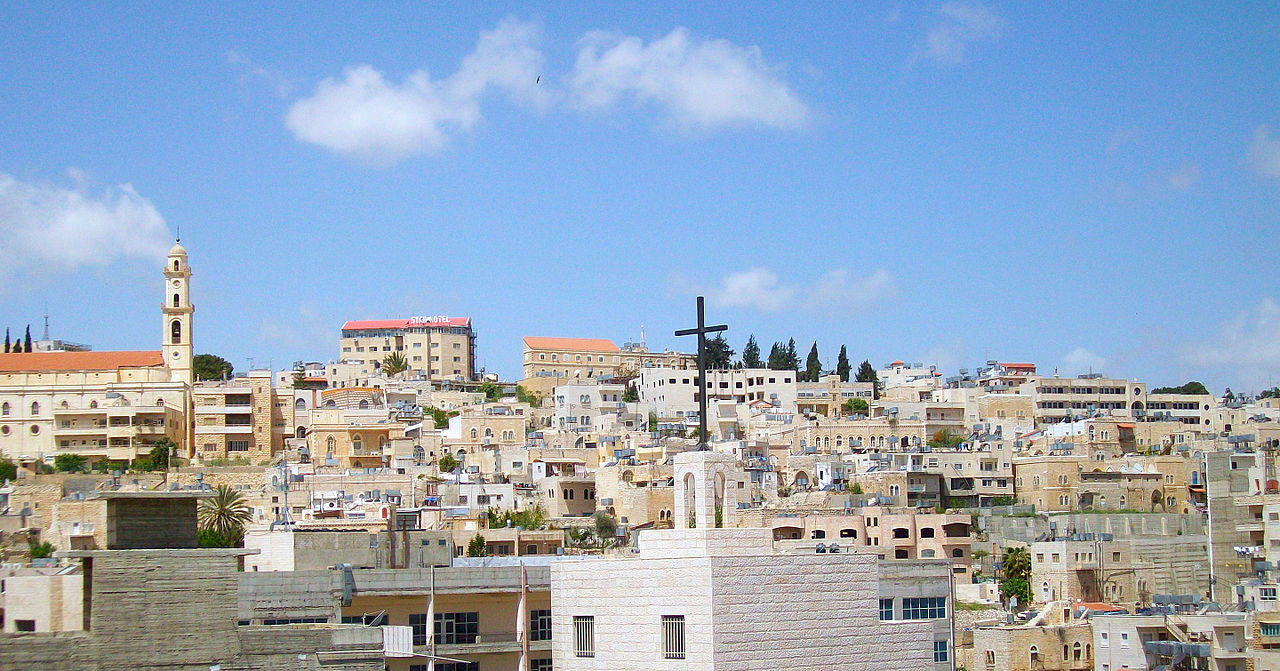
While Christian leaders are busy condemning Israel and spreading blood libels against it, Christians in Bethlehem (pictured) are again being targeted by hoodlums and punks. (Image source: Daniel Case/Wikimedia Commons)

While Christian leaders are busy condemning Israel and spreading blood libels against it, Christians in Bethlehem are again being targeted by hoodlums and punks.

The latest victim of this anti-Christian violence is Dr. Salameh Qumsiyeh, a gynecologist from Bethlehem who was brutally attacked by unidentified thugs as he was driving his car in the center of the city on February 18.

Four masked assailants intercepted Qumsiyeh's car, eyewitnesses said, and beat him with clubs and sharp tools before fleeing the scene. Qumsiyeh was rushed to hospital, where medics said that the wounds he had suffered were serious.

The doctor's family, one of the biggest Christian clans in the Bethlehem area, issued a statement harshly criticizing the assault, dubbing it a "sinful and despicable attack by a group of cowards and violators of laws and national and social norms." The clan went on to express shock over the attack and was careful to claim that it had been carried out by "mercenaries." It urged the Palestinian Authority (PA) security forces to do their utmost to "arrest the cowards and bring them to justice."

Palestinian factions in the Bethlehem area also denounced the "brutal and cowardly" attack on Qumsiyeh. "We strongly condemn this cowardly and suspicious act, which is alien to our traditions," the factions said in a statement.

The Holy Family Hospital in Bethlehem further condemned the assault on Qumsiyeh and urged the Palestinian security forces to apprehend the perpetrators and bring them to justice.

The attack on Qumsiyeh came only weeks after a Christian woman from the town of Bet Jala, near Bethlehem, died when Palestinian police officers raided her home to arrest her son, Yusef, for unpaid debts. The woman was identified as 63-year-old Terez Ta'amneh.

Ta'amneh's daughter, Marian al-Hajal, accused the Palestinian security forces of "killing my mother" and said that as a Christian, she has no confidence in the Palestinian law and police. "The seven police officers who raided our home," she said, "were led by Jamal Hmeid, a nephew of Kamel Hmeid, the Palestinian governor of Bethlehem."

On the eve of last Christmas, 76-year-old Fairouz Ijha, a Christian woman from Bethlehem, complained that she has been in court for the past two years, fighting to attain family-owned land illegally seized by Muslims. "Each time I ask the judge for permission to speak, he tells me, 'it's not your turn yet,'" Fairouz said. "If I were a Muslim, I would have been treated differently."

A Christian schoolteacher who identified herself as "Diana" emphasized that discrimination against Christians was not new and has in fact increased. "The [Palestinian] police have separate rules for Muslims and Christians," she maintained. "If, for example, there's a car accident involving a Christian and a Muslim, the police always side with the Muslim."

The plight of Christians living under the Palestinian Authority in the West Bank and Hamas in the Gaza Strip is one that is often ignored by the international community and foreign journalists based in the Middle East.

It is worth noting that that the Christian population in the Bethlehem area has dropped from 86% in 1950 to less than 12% today. Across the West Bank, Christians now account for less than 2% of the population, though in the 1970s they were 5%.

In the Hamas-ruled Gaza Strip, the situation of Christians is even worse. The number of Christians living there has dropped from 4,200 in 2007, to only a few hundred today.

"The Hamas people took over my house and turned it into a war room," said Kamal Teresi, a Christian who recently fled the Gaza Strip.
"I was put in a number of prisons, and the Hamas prison is nothing but beating and psychological torture. We Christians are not bystanders in Palestine; we have been in Palestine for 2000 years; we are not guests. They [Hamas] are harassing and hurting the Christian public and Christian institutions, churches and associations. I can't go back to Gaza; returning would be a death sentence."
While ordinary Christians are saying they no longer feel safe living under the Palestinian Authority and Hamas, their leaders continue to lie to the world about the predicament of their community. Instead of raising their voices against the persecution of Christians by the Palestinian Authority and Hamas, these Christian leaders are busy trying to blame Israel.

These Christian leaders, possibly to avoid being targeted themselves, seem to want the world to believe that Christians are fleeing Bethlehem and the Gaza Strip because of Israeli security measures against terrorists, and not because of the brutalities perpetrated by the Palestinian authorities and Muslims in the West Bank and Gaza Strip.

If that were true, why aren't Muslims also fleeing as a result of the purported Israeli measures? Israel's security measures, by the way, are usually not directed against Christians but against Palestinian Muslims for their involvement in terrorism. If anyone has good reason to flee from Israeli security, it is the Muslim terrorists and their families, and not peaceful and vulnerable Christians, most of whom are not involved in anti-Israel activities or terrorism.

What are Palestinian Christian leaders doing to defend their community? Unfortunately, nothing. Some even join the Muslims who spread blood libels against Israel.

One such cleric is the head of the Sebastia Diocese of the Greek Orthodox Church in Jerusalem, Archbishop Atallah Hanna, who recently claimed that Israel had "poisoned" him in an apparent failed assassination attempt. Hanna, who is known for his vicious anti-Israel incitement, alleged that he had inhaled a dangerous amount of poison when a gas canister was fired through the window of his room at the church.

It later turned out that Hanna's accusations were completely unfounded and simply the continuation of a despicable defamation campaign against Israel.

An investigation by the Israeli authorities revealed that the church had invited an Israeli company to spray the church with pesticide. "We expect a clergyman to adhere to the truth," the Israeli Foreign Ministry responded to Hanna's blood libel, "and that clergymen around the world denounce these outrageous false proclamations and refrain from distributing this libel."

Hanna, like other Palestinian Christian leaders, is not just a liar; he is a traitor to his own community. Hanna has not spoken a word against the attack on Qumsiyeh and other Christians in Bethlehem. He does not care about the suffering of his people under the oppressive Islamist rule of Hamas in the Gaza Strip.

By ignoring the real reason why Christians are fleeing from the West Bank and Gaza Strip, leaders such as Hanna are emboldening the anti-Christian Muslims and allowing them to continue their attacks on Christians living there.

As for the international community and Christian institutions around the world, it is their most far-reaching duty to look into these blood libels by Palestinian Christian leaders to check if there is factual accuracy. If they fail to do so, the day will come when not a single Christian will be left in Bethlehem, the Gaza Strip, and most likely the Middle East, with the exception of Israel, where numbers are on the rise.

Bassam Tawil is based in the Middle East.

Source: https://www.gatestoneinstitute.org/15690/attacking-palestinian-christians

Follow Middle East and Terrorism on Twitter


Trump chooses Mark Meadows for chief of staff, strikes blow against Deep State - Debbie Georgatos

​
by Debbie Georgatos

Choosing Meadows is another sign that this most unusual commander-in-chief is getting his "sea legs."


President Trump's surprise announcement that outgoing congressman Mark Meadows will become his new White House chief of staff is a shot across the bow against the Deep State Obama holdovers who've worked to undermine the Trump administration since the day he was sworn in.

From leaks to the media to eavesdropping to whistleblowing based on secondhand reports on presidential conversations to relentless jabs in the media at the president's competency, "unnamed White House sources" have undermined this president since January of 2017, and that inside-the–White House swamp will be working in high gear during 2020 to help assure Trump's defeat. Choosing a new chief who has already proven he is on track with the Trump agenda, and who is more familiar than many with the leftist players on the ground in Washington, and the depth of and reasons for their disdain of the Trump agenda, is a brilliant, strategic, and (most importantly) offensive move.

Congressman Louie Gohmert (R-Texas, C.D. 1) pointed out before this appointment was announced that choosing Congressman Meadows as his chief of staff would be one of the president's best avenues to root out disloyalty and undermining from within his own administration. Meadows knows D.C. and many of its consequential players.

Representative of the 11th District of North Carolina since 2013, Meadows knows the Congress, the Trump-supporters, and the swamp. He supports the president, fought for Trump's presidency against the assault of the American left in response to the Mueller investigation and the House impeachment proceedings, and will be a loyal voice and trustworthy whisperer into President Trump's ear.

Meadows is a brilliant choice for chief of staff because of that loyalty to the Trump agenda and an instinct to protect the president from the onslaught of the left and the Swamp. And he's a founding member of the House Freedom Caucus, so he can directly provide articulate and succinct explanations of the roots of and reasons for conservative goals, unfiltered competing voices of holdovers less loyal to the values of the conservative base that elected Donald Trump.

The word "naïve" is rarely used in the same sentence as President Trump, but one of the blessings and the curses of Donald Trump's rise to the presidency is that he did not have a deep bench of political allies or a wide range of connections within the D.C. bubble from which to draw together a loyal administration team. Many of his hires flowed through the PPO, the Presidential Personnel Office, and were only as attuned to his agenda as were the gatekeepers manning that office. While President Trump ran on draining the swamp, entrenched Obama-era leftism resided in nooks and crannies of his White House, and the new president couldn't or wouldn't immediately drain the White House administration swamp, perhaps due to a naïveté about the breadth of the swamp compounded by the sheer overwhelming need to rapidly fill a wide range of positions.

Especially in the era of Trump in which America is changing course in profound ways, choosing Congressman Mark Meadows as chief of staff is a signal of commitment to the new direction America chose in the 2016 elections. From border abandonment to border security, from weakening the U.S. military to building it back up to needed strength, from the slow tumble over the cliff to socialism to the resurgence of freedom and free markets, from the capitulation to and participation in the globalist agenda to the rejection of globalism and the re-emergence of America as rooted in sovereignty based on our founding ideals, President Trump laid out a new direction for our country, and the voters said yes. The president needs leaders and players in place who are on board with the mission and committed to supporting it.

Choosing Meadows — who will expose and challenge the swamp-dwellers and offer wise counsel to the president — is another sign that this most unusual commander-in-chief is getting his "sea legs," growing into parts of the job he wasn't totally ready for, and putting in place leaders who embrace his agenda and mission.


Debbie Georgatos is the host of America, Can We Talk, an author, a public speaker, and a non-practicing attorney.

Source: https://www.americanthinker.com/blog/2020/03/trump_chooses_mark_meadows_for_chief_of_staff_strikes_blow_against_deep_state.html

Follow Middle East and Terrorism on Twitter