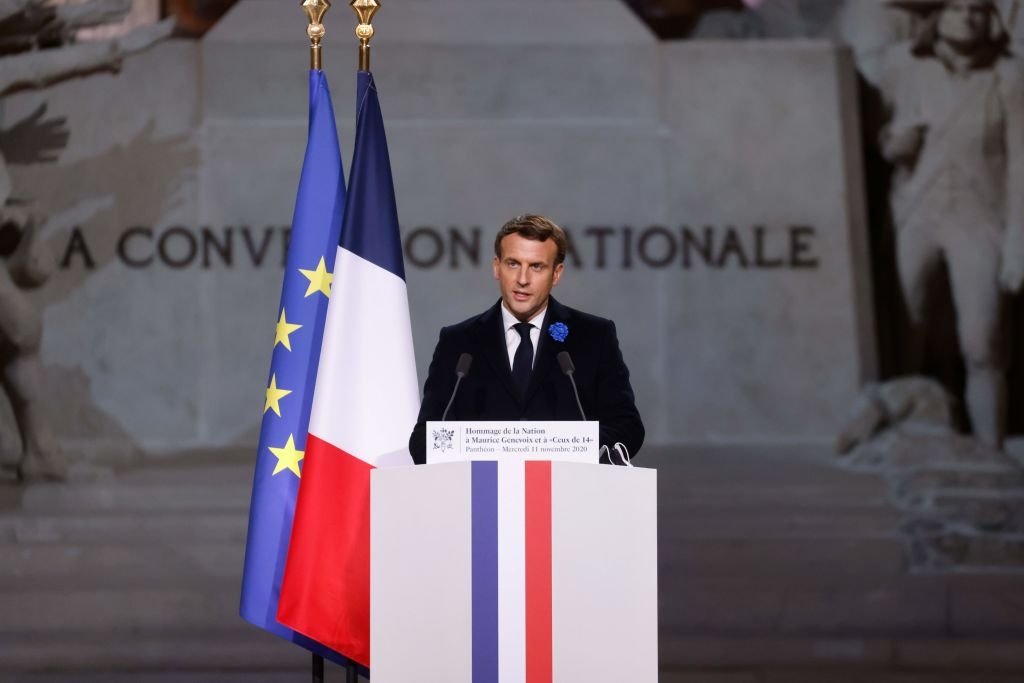
 France's
President Emmanuel Macron recently said in an interview: "Alignment
with American multiculturalism is a form of defeatist thought... Our
model is universalist and not multiculturalist... You should not care if
someone is black, yellow or white; first, they are citizens...." (Photo
by Ludovic Marin/AFP via Getty Images) |
The Financial Times has never understood France grappling with
extremist Muslim terrorism and the country's battle for freedom of
expression. After the Charlie Hebdo massacre in 2015, Tony Barber wrote in the Financial Times that the massacred journalists and cartoonists had been "stupid". The article was then edited.
It recently happened again. The British newspaper removed an article
on French President Emmanuel Macron's anti-Islamist policies. The
article, "Macron's war on Islamic separatism only divides France
further", by Mehreen Khan, appeared in the online version of the
newspaper and was then also removed.
The piece argued that after two beheadings in Yvelines and Nice, Macron
would need six million Muslims in the country to eradicate violent
extremism, but that instead, he chose to feed "moral panic".
Clearly, the article postulated, if there are Islamist attacks in
France, it must be because its president has been looking for them.
Macron himself thought of attempting to educate the Financial Times.
"Who could imagine that the statements made publicly by the head of a
G7 member state could be distorted by this news organisation?" Macron wrote.
"The piece misquoted me, substituting 'Islamic
separatism' — a term that I have never used — for 'Islamist separatism',
which is a reality in my country. It accused me of stigmatising French
Muslims for electoral purposes and of fostering a climate of fear and
suspicion towards them".
Macron went on to accuse the Anglophone media of not understanding what is going on in the French suburbs.
"Since 2015 it has become clear, and I said this even
before I became president, that there are breeding grounds for
terrorists in France. In certain districts and on the internet, groups
linked to radical Islam are teaching hatred of the republic to our
children, calling on them to disregard its laws. That is what I called
'separatism' in one of my speeches. If you do not believe me, read the
social media postings of hatred shared in the name of a distorted Islam
that resulted in Paty's death. Visit the districts where small girls
aged three or four are wearing a full veil, separated from boys, and,
from a very young age, separated from the rest of society, raised in
hatred of France's values".
It is the first time that a French president has attacked the
Anglophone media in this way -- and Macron had every reason to do so. In
fact, what he wrote was the article that the columnists of the Financial Times
should have the courage to write and their editors to publish; this
brand of religious extremism has also claimed many victims on the
streets of London.
In another interview published online by Le Grand Continent, Macron attacked
"the manipulation of history" of those who want to lock him up "in the
camp of those who would not respect the differences". "I am for the
respect of cultures, civilizations, but I am not going to change my law
because it is shocking elsewhere", he said.
This is also a major difference between France and the American
mainstream outlets, of which some apparently would even like to change
the date of foundation of the United States. The New York Times's "1619 Project" could serve as Exhibit A for this new "manipulation of history".
Macron plans to fight "Islamist separatism".
We do not know if the French president's project will be successful; it
is legitimate to have doubts about its real effectiveness in stopping
the disintegration of French society operated by the extremist
communitarianism that feeds terrorism. We are not, all the same, allowed
to accuse France of racism and "Islamophobia", as the Anglophone media
is obsessively doing. It seems that the entire American media has
decided to blame the victim of terrorism.
According to Le Monde, Macron, in a recent cabinet meeting, said:
"Alignment with American multiculturalism is a form of defeatist
thought... Our model is universalist and not multiculturalist... You
should not care if someone is black, yellow or white; first, they are
citizens...." Multiculturalism in France seems to keep ending in "no-go zones".
Macron, after that, arranged an interview with The New York Times to criticise the Anglophone media:
"So when I see, in that context, several newspapers which
I believe are from countries that share our values – journalists who
write in a country that is the heir to the Enlightenment and the French
Revolution – when I see them legitimising this violence, and saying that
the heart of the problem is that France is racist and Islamophobic,
then I say the founding principles have been lost".
On Friday, October 16, an extremist Muslim beheaded a teacher, Samuel Paty, in Conflans-Sainte-Honorine. The New York Times headlined
its article on the attack: "French Police shoot and Kill Man after a
fatal Knife Attack on the Street". It seems that the Anglophone media
live in a world deaf to reality and based on imaginary victimization;
they see racism where there is none, and they do not even know what to
name it when it appears in the French streets to behead a teacher.
Associated Press immediately succumbed to an avalanche of criticism.
The news agency again cancelled a tweet, one accusing France of "inciting" hatred against Muslims after the wave of Islamic terror attacks the country just suffered.
"This is not only disgraceful but dangerous," the journalist Agnès Poirier replied. "The Associated Press is inciting hatred against France and its people." She too charged the American media with "malicious distortion of facts, ignorance and bad faith".
In 2015, Associated Press had been quick to censor the Islamic cartoons of Charlie Hebdo. The reason? "Deliberately provocative". They evidently have no idea what free speech is and appear uninterested in defending it.
Politico joined in, removing an op-ed,
"The dangerous French religion of secularism", by the French
sociologist Farhad Khosrokhavar. Politico then set about publishing a letter by Gabriel Attal,
a French government spokesperson, who accused Khosrokhavar of "an
unthinkable reversal of roles between the attackers and the attacked".
When the Charlie Hebdo massacre occurred in 2015, the
Anglophone media effectively competed to black out and censor the
cartoons about Mohammed. The big American networks (CBS, NBC, MSNBC, ABC
and CNN) refused to show the cartoons. Facebook blocked the French site of Le Point to prevent access to the offending drawings. Sky News interrupted
a live broadcast to avoid airing them. That was when the cowardice of
the American media really began to show: during the 2006 Danish cartoon
crisis. The only newspapers to rebel against self-censorship were The Weekly Standard, Free Inquiry and The Western Standard, media outlets with an extremely limited circulation.
With a small paper, Seattle Weekly, a reporter, Molly Norris, in solidarity with the endangered creators
of the television cartoon "South Park," drew a caricature of the
prophet of Islam. She then had to disappear after death threats. The
last newspaper article that talked about her stated:
"You may have noticed that the Molly Norris strip is not
included in this week's issue. That's because there is no more Molly...
on the advice of FBI security specialists, she will be moving and
changing her name...".
You would have to search a lot to find a single voice defending Norris in all the mainstream American media.
The New York Times -- ostensibly out of "respect" towards the Muslim faith -- censored the Mohammed caricatures of Charlie Hebdo, but defended the work of Chris Ofili's "The Holy Virgin Mary,"
in which the mother of Jesus is covered with feces and images of
genitalia. The American media, it seems, show "respect" only toward
Islam. Are the American media, one wonders, expecting any reciprocity?
A French scholar of Islamic extremism, Gilles Kepel, recently noted that the atmosphere now in France reminds him of the time of the Iranian fatwa in 1989 to murder the author Salman Rushdie for his fictional novel The Satanic Verses.
Already then, the Anglophone media and publishing houses were blaming
the victim, not the ayatollahs. Among Rushdie's colleagues, Roald Dahl, a
bestselling author of children's books, said he was a "dangerous opportunist", while the king of the literary spy stories, John Le Carré, called Rushdie "arrogant", "self-righteous" and a "colonialist".
The Jewel of Medina,
a novel by the American writer Sherry Jones about the life of the third
wife of Muhammad, was purchased and then scrapped by the US publisher
Random House. Yale University Press published a book, The Cartoons That Shook the World,
by Jytte Klausen – but without the cartoons. "The capitulation of Yale
University Press to threats that hadn't even been made yet was the
latest and perhaps the worst episode in the steady surrender to
religious extremism -- particularly Muslim religious extremism -- that
is spreading across our culture", the late Christopher Hitchens wrote.
How, as well, can one forget the shameful list of "anti-Islamic extremists", published by the Southern Poverty Law Center?
Among them were Ayaan Hirsi Ali, a former member of the Dutch
parliament and the most famous dissident from Islamic world, and Maajid
Nawaz, a British Muslim who has fought radicalism -- and, successfully, the Southern Poverty Law Center.
Canadian PM Justin Trudeau recently criticized Charlie Hebdo and declared that free speech "has limits". Trudeau, to put it bluntly, is not Charlie. He is a communitarian affirming the rights of groups, not a liberal affirming the rights of the individual.
The American media know perfectly well what is going on in France.
They see a teacher beheaded for showing Islamic drawings and discussing
freedom of expression; journalists under guard for criticizing extremist
Islam; massacres in churches; secession in neighborhoods with a high
numbers of immigrants, and the challenge that political Islam has
launched to European culture and democracy. It is apparently, however,
out of the fear of being called a "racist" -- not even of being
murdered, like Samuel Paty -- that they choose self-censorship. Not to
appear as cowards, they call it "respect".
Unfortunately, Anglophone culture has been devoured, piece by piece,
by the "diversity industry". If the villain is, by definition, white,
Western culture, then Muslims supposedly must be victims of colonialism
-- old and new. It is no coincidence that, in the name of "diversity",
the American media in the last year have bullied journalists such as James Bennett and Bari Weiss, who resigned from the New York Times.
In the jihadist war against the West, the Anglophone press, now
famous for "cancel culture", has deserted the ranks. It is a shame. This
war on the West was already in progress nearly twenty years ago, when
two planes appeared over the skies of Manhattan.