Monday, November 23, 2020

Iran: We Will Not Re-Negotiate the Nuclear Deal Again - Lt. Col. (ret.) Michael Segall and Jerusalem Center - Iran Desk


​ by Lt. Col. (ret.) Michael Segall and Jerusalem Center - Iran Desk

In Iran’s domestic arena, six months before the Iranian presidential elections, the U.S. presidential election re-ignited the controversy between proponents and opponents of dialogue with the United States.

Iran: We Will Not Re-Negotiate the Nuclear Deal Again
The front page of the Iranian newspaper Sobhe No (Morning News)

Institute for Contemporary Affairs

Founded jointly with the Wechsler Family Foundation

Vol. 20, No. 25

  • In Iran’s domestic arena, six months before the Iranian presidential elections, the U.S. presidential election re-ignited the controversy between proponents and opponents of dialogue with the United States. President Rouhani, Foreign Minister Zarif, and other proponents of dialogue with the United States are facing fierce fire from the conservative camp that is backed by Iran’s Supreme Leader Khamenei, who dismisses the U.S. election results and has continued to preach his Economic Resistance Doctrine.
  • Iran’s foreign ministry spokesman, Saeed Khatibzadeh, declared that Iran would not be willing to make changes to the nuclear deal. “The agreement belongs to the past and is not open for discussion again … The United States violated UN Resolution 2231, withdrew from the nuclear agreement, caused enormous damage to the Iranian people, and must compensate for it.”
  • The reformist camp called on President Rouhani to use his influence over Khamenei to the fullest extent to urge him to agree to a move toward talks with the United States. They have called to restart negotiations if the Biden administration returns to the nuclear deal or conducts behind-the-scenes talks on the required conditions that the United States would demand from Iran to enable it to return to the agreement framework.
  • The conservative camp in Iran emphasizes that there is no real difference between Biden and Trump and that Democrats are just a “prettier face” with the same policy and the same intentions that were implemented so far by the Republicans against Iran.
  • The conservatives state that only if the United States fulfills a long list of conditions that Iran will impose on it would they agree to return to the negotiating table with Washington regarding the nuclear deal. However, they would by no means enter into a dialogue on other issues, including ballistic missiles, human rights, or regional issues.
The front page of the Iranian newspaper
The front page of the Iranian newspaper Sobhe No (Morning News), November 11, 2020, addressing President Trump: “Go to hell, Gambler!” (When Trump once stated he would like to meet with Iran’s president, the late Gen. Qassem Soleimani responded, “Mr. Trump, gambler, you have business with me, but I will tell you: go to hell!”)

The U.S. elections continue to draw the attention of the Iranian leadership and media, which reports on its front pages the election process, its disputed results, and implications. Most of the publications mocked the confusion, division, and the United States’ lack of direction. The Vatan Emrooz newspaper illustrated this in a bloody cartoon published on its front page on November 11, 2020, depicting Trump’s expected departure, which will deepen the left-right chasm within the United States.

Vatan Emrooz cartoon
Vatan Emrooz cartoon.

Iran’s top religious and political figures have highlighted the damage caused to Iran by the U.S. maximum pressure policy. This has resulted in the Iranian regime’s unwillingness to discuss the nuclear deal with the incoming U.S. administration. Iranian officials have maintained in this regard that the United States will be “examined by deeds and not by words” within regional contexts.  The Iranian leadership called on the countries of the region to secure themselves in regional cooperation frameworks and not to be dependent on the United States and Israel.

In the domestic arena and against the background of the upcoming Iranian presidential elections in June 2021, the conservative and the reformist camps are set to compete with one another over the benefits of negotiations with the United States. President Rouhani, who has served two successive terms will not stand again. Both camps perceive the United States as the “same lady, just in a different coat.”

It is likely that reformist candidates will be screened beforehand since the Guardian Council is dominated by conservatives who will try to block reformist candidates, as they did ahead of the recent (February 2020) Majlis (parliamentary) elections. If a hardline president is elected, both domestic and foreign policy (dealing with the nuclear dossier, Middle East peace efforts, power projections) will become more uncompromising and defiant. In the meanwhile, in the run-up to the election, conservatives in Iran will try to frustrate any dialogue with the incoming U.S. administration.

Iran’s Supreme Leader Ali Khamenei emphasized before the U.S. elections and on Election Day that regardless of who is elected, “America is in decline.” It appears that the Iranian Leader is leaning towards Iran’s conservative camp. In any case, relations with the United States critically impact both Iran’s economy and the welfare of its people. Therefore, relations with the United States is expected to be one of the major themes in the Iranian presidential election campaign and a key issue for the next Iranian president – reformist or conservative.

Khamenei: The United States Is Descending, No Matter Who Leads It

Iran’s Supreme Leader Ali Khamenei has reiterated his past views that the U.S. elections have no implications for Iran, and he minimized the significance of the U.S. elections, saying, “It does not matter who will be the next president in the United States.” Khamenei added, “The decline of the United States is certain … The situation in the United States and its internal debate regarding the recent elections demonstrate the ugly reality of liberal democracy inside the country. No matter which one will be elected, there is one obvious point, which is the political, civil, and moral decline of the American regime.”1

Rouhani: The Elected President Must Compensate for the Damage of His Predecessor

Iranian President Hassan Rouhani took advantage of the Shanghai Cooperation Organization Summit and said in his November 10, 2020, speech that the U.S. elections proved that not only the international community rejects the Trump administration’s mistaken policies. According to Rouhani, the American public is fed up with Trump, and the election results prove the failure of “a country that spreads threats, imposes sanctions, uses sticks, threatens and bullies other nations, and adopts wrong and misleading policies. “

Rouhani attacked the U.S. policy of unilateralism and said it had threatened international economic cooperation in recent years. According to the Iranian President, recently elected representatives in the United States must implement the mandate as determined by American voters, which means changing U.S. foreign policy and relations with other countries. Alluding to the nuclear agreement with Iran, from which U.S. President Trump withdrew in May 2018, Rouhani added, “that renewed adherence to international laws, regulations and obligations, respect for the rights of other countries, and compensation for damages caused, are necessary conditions for restoring world’s trust in the United States.”2

Iran’s Foreign Minister Zarif: The Nuclear Agreement Is Not Up to Discussion

 The Iranian Foreign Minister Javad Zarif said on November 10, 2020, while visiting Pakistan, that the future of the nuclear deal (JCPOA) depends on the steps the United States will undertake. Tehran is waiting to see what policy the U.S. administration would implement and what action it would take regarding the nuclear deal. Regarding Biden’s elections, Zarif said, “Individual people are indeed important, but it is also essential to see how the administration runs.”

The Iranian Foreign Ministry issued a statement mocking the U.S. administration’s policy against Iran.  The ministry spokesman, Saeed Khatibzadeh, said that “the Trump’s administration has been on the wrong track for several years, and the policy of maximum pressure has led to maximum defeat.” In the spirit of the Iranian Foreign Minister, Khatibzadeh added that Iran will closely monitor the steps and policies of the incoming administration and that the United States has an opportunity to return from the wrong path.

Khatibzadeh referred to the recent peace agreements signed between Israel and the United Arab Emirates and Bahrain and declared that the U.S. elections “sent a new message to the Middle East … Iran reached out to its neighbors. However, the UAE, Bahrain, and Saudi Arabia bought their security from psychopaths in the United States and Israel. They must immediately retract to seeking peace and security, acting within a regional context. If these countries want to keep putting all their eggs in the American basket, then it is no longer safe for them.”

The spokesman denied that Iran had already contacted Biden’s transition team and clarified that “in principle, Iran will not contact any party that is not related to the nuclear deal, especially given the fact that the new administration has not yet taken office.” He reiterated that Iran would not be willing to make changes to the nuclear deal. “The agreement belongs to the past and is not open for discussion again … The United States violated UN Resolution 2231, withdrew from the nuclear agreement, caused enormous damage to the Iranian people, and must compensate for it.”3

The Controversy between Opponents and Supporters of Negotiations with the U.S. Has Re-Ignited

In Iran’s domestic arena, six months before the Iranian presidential elections, the U.S. presidential election re-ignited the controversy between proponents and opponents of dialogue with the United States. President Rouhani, Foreign Minister Zarif, and other proponents of dialogue with the United States are facing fierce fire from the conservative camp that is backed by Iran’s Supreme Leader Khamenei, who dismisses the U.S. election results and has continued to preach the Economic Resistance Doctrine.

“Iran Is Hopeful Again”

Following the announcement that Biden was elected president, the newspapers and media affiliated with the reformist camp expressed hope that the United States would return to the nuclear deal.  They proffered that Biden’s election would allow the renewal of dialogue between Iran and the rest of the international powers, in general, and specifically with those countries that would ease sanctions and even remove economic pressure on Iran, whose people have felt its destructive impact.

Headlines and op-eds of many newspapers in the reformist camp in Iran emphasize that the Iranian people are once again hoping that the future administration in Washington will herald a new era for the Iranian people.

These articles call on the Rouhani government, which is expected to end its term in May 2021, and all government agencies not to miss the opportunity to resume negotiations with the new U.S. administration. The newspaper Seday-e Eslahat (Voice of Reform) even published the headline on November 7, 2020: “Iran is hopeful again.”4

Seday-e Eslahat front page
Seday-e Eslahat: “Iran is hopeful again.”

Officials in the reformist camp have called on President Rouhani to use his influence over Khamenei to the fullest extent to urge him to agree to a move toward talks with the United States. They have called to restart negotiations if the Biden administration returns to the nuclear deal or conducts behind-the-scenes talks on the required conditions that the United States would demand from Iran to enable it to return to the agreement framework.

Biden pointed out in an article published by CNN in September 2020 that “there is a better way” and that the United States will return to the agreement if Iran meets all its commitments. Biden added that this would serve as a starting point for further negotiations. In the wake of the elections, however, Iran has already reiterated that it is unwilling to change the agreement.

Biden said the United States would also raise the issue of human rights, including the execution of wrestler Navid Afakari,5 and the arrest of attorney Nasrin Satuda. Biden also noted the importance of the reduction of tensions in the region, especially in Yemen.6

The strengthening of the value of the Iranian currency rial against foreign currencies, after the historic steep drop in the value in the last six months and the sharp drop in the prices of vehicles, gold, and even property in Iranian markets, were interpreted as positive consequences of Biden’s victory, and more precisely, the removal of Donald Trump from the arena.

The newspaper Etmad published on November 8, 2020, an article saying –

The conservatives continue to strongly oppose dialogue concerning the nuclear agreement.  They ignore the fact that the state needs a clear and even urgent plan to get out of the crisis. After all, under the terms of the FATF (The Financial Action Task Force) and because of U.S. sanctions, there is no access to the program or an alternative way other than the nuclear agreement. Conservatives announced that even funds frozen in Iraq, South Korea, and China ­– which are not dependent on the United States – are not being released.

The newspaper concluded –

having a national dialogue based on national interests in order to reach an orderly and uniform policy in the face of the conditions that the future will set for us, is a necessary thing … From a uniform internal position, it is possible to introduce three-dimensional plans for a short, middle, and long- term, based on the nuclear agreement, in order to remove the sanctions and reach proper governance in domestic politics. The party presenting such plans could prospectively be elected as the future president in the upcoming elections in Iran in June 2021.7

Conservatives: Biden – A Steel Hand in Silk Gloves

Conservatives, for their part, have attacked the reformist camp, branding some of “the traitors who want to ‘waste’ the people’s time and to entrust all aspects of life and livelihood, and economy of the state and of the citizens to the United States.” Conservative-affiliated newspapers emphasized that the reformists “beautify” Biden and Democrats, while Democrats’ hand “was and is still made of steel but hidden under silk gloves.”

Trump sheds his skin
“Trump sheds his skin,” and there is no difference between Trump and Biden (Quds, November 8, 2020)

Conservatives further condemned Biden’s ardent support for the assassination of Qassem Suleimani. In addition, they noted that Biden was President Barak Obama’s right-hand man who planned and enacted the severe and cruel sanctions on Iran that lasted even during the Corona era. The conservative camp emphasized that there is no real difference between Biden and Trump and that Democrats are just a “prettier face” with the same policy and the same intentions that were implemented so far by the Republicans against Iran. A front page of the newspaper Quds featured on November 8, 2020, a caricature depicting the shedding of Trump’s skin and the emergence of Biden out of it, pointing out no difference between them.9

In the same breath, conservatives and prominent loyalists of the Iranian Leader point out that recent U.S. elections have most clearly demonstrated that the United States only appears to be a superpower, while its society is divided and suffering from many deep problems. Therefore, Iran should not place any hope in a morally, socially, and politically declining country.

The front page of the Vatan-e Emrooz
The front page of the Vatan-e Emrooz newspaper, affiliated with the conservative camp,  published on November 7, 2020, a caricature “The Cemetery of Democracy,” where Biden is depicted holding an arm bone, hinting at reports of voting fraud, including dead people voting in the U.S. elections.8

The Keyhan newspaper affiliated with the Supreme Leader reminded President Rouhani on November 9, 2020, that “American hostility to Iran did not begin with Trump and will not end with Biden.” The newspaper wrote that Rouhani and his government became beggars asking once again for dialogue with Americans instead of investing their full energy in strengthening the foundations of the state and Iran’s internal power.

According to the newspaper, the Rouhani government has severely damaged the livelihood of the people and is once again passing the ball to other fields to cover up its helplessness.  The ultra-conservative newspaper Keyhan mentioned that President Rouhani “passed the buck” and told the Iranian people a few weeks ago not to curse his government because of the difficult economic situation but “to address the curses to the White House that has implemented the most vicious sanctions against Iran.”

The front-page of the conservative newspaper, Sobhe No (Morning News), ran a headline on November 9, 2020: “Iranian Biden supporters are busy at work,” trying to make Biden pretty and present him as a good-natured man, with whom Iran can start negotiations.10

Sobhe No front page
Sobhe No: Iranian Biden supporters prettifying the president-elect.

“The Unforgivable Ignorance of Rouhani and Zarif”

Conservatives emphasize that “the unforgivable ignorance and innocence of President Rouhani, Minister Zarif, and the government” linked the fate of the Iranian people and the country’s economy to the nuclear deal. Therefore, conservatives insist, they should never be permitted to return to this naiveté. Instead of “salivating” over Biden’s victory, they should redouble their efforts and strengthen the foundations of the “Economic Resistance” in the remaining nine months of the current government as Khamenei has declared for the second year in a row.

The conservative camp has reiterated that over the past seven years, the Rouhani government has neglected numerous directives of the Iranian Supreme Leader Rouhani called for proper and meticulous management of economic affairs, as well as a real and severe fight against corruption, and implementation of banking system reforms, and more.

Furthermore, with the year of the presidential election around the corner, in May 2021, conservatives have expressed deep concern that reformists will use the dialogue card with the United States as a new tool to advance their candidates in the Iranian presidential election as they will try to leverage improvement of the Iranian people’s economic situation as a result of the dialogue. Among other things, the conservatives raise concerns that the rival camp will advance Foreign Minister Zarif’s candidacy for the presidency because only a president like him can negotiate successfully with Biden.

Conservatives: Return to Nuclear Talks Is Possible But It Depends on Meeting Iran’s Demands

At the same time, the conservatives leave little room to renew talks with the United States. They state that only if the United States fulfills a long list of conditions that Iran will impose on it would they agree to return to the negotiating table with Washington regarding the nuclear deal. However, they would by no means enter into a dialogue on other issues, including ballistic missiles, human rights, or regional issues. Conservatives emphasize that Iran’s ballistic missile capability is “the heart and soul” of Iran’s national integrity and security, which makes it a prohibited topic for discussion.

Accounting for Soleimani’s Assassination Was Only Partially Avenged

Prominent conservative sources emphasize that there is no difference between Biden and Trump. At the same time, there is no doubt that Trump’s departure is good news for Iran because he was behind the assassination of Qassem Suleimani. The Javan newspaper, affiliated with the Revolutionary Guards Corps and Zeinab Soleimani, the daughter of Qassem Suleimani, pointed out that Trump’s removal eases somewhat the heavy burden on the hearts of the Iranian people. However, the account with those who ordered the assassination of the “great commander” is still open.

It should be noted that some of the conservatives warn reformists to refrain from entering into a dialogue with Joe Biden. They use Trump’s own arguments about “crooked” elections. Among other things, the newspaper Sobhe No (Morning News) wrote that Biden is the “postal president” who was elected by a majority of the “dubious” votes that arrived in the mail.

Trump as a fat turtle who turned the polls upside down
Tasnim: Trump as a fat turtle who turned the polls upside down and said angrily: “The system is corrupt and I was deceived, otherwise I won!”

On the other hand, the Tasnim news agency, affiliated with the Revolutionary Guards Corps, published a caricature showing Trump as a fat turtle flipped on a ballot box.  “The system is corrupt and was deceived; otherwise I won!”11

Support for Trump. Rouhani and Zarif Are Slaves of the Democratic Party

At the same time, figures who are considered senior officials in former President Ahmadinejad’s government and who are still close to him express surprising support for Donald Trump and sharply criticize President Rouhani for neglecting all the opportunities President Trump had offered Iran in order to engage in a dialogue.

 Abdol Reza Dori, a senior official in the Ahmadinejad office, reiterated that the Supreme Leader gave general permission to hold talks with the United States. However, both Rouhani and Zarif did not lead negotiations with Trump because they “became enslaved to Democrats in the United States” and “promised” officials like John Kerry not to hold talks with the Trump administration Dori talked about it in lengthy interviews with TV stations, such as the BBC in Persian. The Iranian regime considers this station to be allied with Iran’s enemies.

* * *

Notes


Lt. Col. (ret.) Michael Segall and Jerusalem Center - Iran Desk  

Source: https://jcpa.org/article/iran-we-will-not-re-negotiate-the-nuclear-deal-again/ 

Follow Middle East and Terrorism on Twitter

Sunday, November 22, 2020

No, it's not time to move on ... - Monica Showalter


​ by Monica Showalter

The oligarchy is still attacking us, and will stop us if we don't stop them. it's time to accelerate the fight.

We're Americans. And nothing is more natural for Americans to cut our losses and move on.

You can see it in the building pressure for President Trump to concede the election to former Vice President Joe Biden.

The Washington Examiner ran this editorial-page headline: It's time for Trump to concede and move on.

Jonah Goldberg, who is still worth reading, stated this, according to Breitbart's Joel Pollak:

Never Trump stalwart Jonah Goldberg published an essay Friday in which he argued that President Donald Trump “is trying to steal an election he clearly and unequivocally lost.”

The Trump team which sends me text-messages pleading for legal funds, says it's coming up short in the fundraising it needs.

People are drifting off. They're trying to make peace. And with Sidney Powell and her team of lawyers having to prove a massive fraud conspiracy in an incredibly short window of time, there's fear she can't come through. Fox News's Tucker Carlson seemed fearful of that scenario in the past week...

As for a 'President Biden' there's also comfort in knowing he might be blocked from doing much harm if Republicans can hold the Senate. There is hope that as a 78-year-old, he will serve just one term. And in the House, a red wave is building...

That said, it's time to accelerate the fight.

Unfortunately, this election is not like normal elections. Should this election, with all its signs of massive fraud succeed for the election thieves, the U.S. faces a bleak future no different from that of California. It's no coincidence that Biden's running mate, Kamala Harris is a denizen of Berkeley, California, with Berkeley values so far-left they top the stances of Bernie Sanders. Her father was a Stanford professor of Marxism and her mother an authentic Indian Brahmin, from that caste with high-class disdain for the 'untouchables.'

It's an oligarchy we are fighting, as Angelo Codevilla writes in this must-read piece in American Greatness here:

But the “resistance” took on a life of its own, fed from on high by such as the CIA’s John Brennan and FBI’s James Comey, and the host of their politicized subordinates, as well as from below by violent “intersectional” groups like Antifa and Black Lives Matter. 

This resistance was powerfully sustained in the middle by countless corporate executives, government employees, editors, and reporters. The convergence of so many like-minded people quickly and decisively transmuted a political tactic into the replacement of a republic with an oligarchy. It replaced government by consent with rule by force. 

He can add billionaires such as Tom Steyer, Michael Bloomberg, George Soros and whoever the Goliaths are at the Ford Foundation, the Democracy Alliance, and moneybags NGOs to the top of that cited food chain. Democrats cower at their very names and such groups would like nothing better than to force the peasants from their cars into public transport, their homes into tight cramped apartments, with an end to all that expensive sports equipment and free airline travel that used to be the province of what long ago was solely the rich. None of that. The oligarchy has its interests and rest assured, you're in opposition to them whether you like it or not.

We often speak of California as the dreaded example of the one-party state where government can no longer be changed, no matter how you vote, but California wasn't always like this. Until 20 years ago, the state would swing left and right. Today, it's a monopoly party and elections are useless. 

The model came about as observers from Mexico about a decade ago noticed the similarities ... of California as it's run now, to the place called the "perfect dictatorship," as writer Mario Vargas Llosa called it, Mexico's old Partido Institucional Revolucion, or PRI, which ruled and ruined Mexico for 70 long years, leaving the country underdeveloped and by the end of its run, exporting people.

Stolen elections were a way of life back then. A Mexican friend told me recently that Mexicans rolled their eyes on U.S. election night and said to themselves: 'we've seen this rodeo before' when the counting stopped in the dead of night, and when they resumed, their tallies mysteriously reversed course. The exact same thing happened in Mexico several years back. (Africa, too, has seen all the signs of vote-rigging, as described in this pre-Trump 2016 BBC piece here.) It's absolutely no surprise that Mexican President Andres Manuel Lopez-Obrador refused to recognize the results of the election here -- all the things that happened here are the same things that happened to him when he had an election stolen from him in 2006. He knew.

Several Latin American heads of state, in fact, have noticed, including Brazil's Jair Bolsonaro. Elections have also been nakedly stolen in Nicaragua and Honduras in recent years, the thieves almost always the party on the left. Venezuela of course is the granddaddy of stolen elections, pioneering the way with electronic voting machines, courtesy of its massive seed capital to Smartmatic, which moved into the U.S. market by acquiring Sequoia, which was later bought up by Dominion. The owners come and go but the tech remains the same.

Why must we continue to fight? Because it might be 70 long years before anything changes politically in the U.S. if we don't. The machines appear to be rigged and they're all in the uncooperative hands of the Democrat big city political machines and governors. Bernie Sanders was a pilot project, Democrats stole his nomination once in 2016, and again in 2020. Anyone think they'd do less with Trump? Blue state governments are the ones who refused to cooperate with President Trump in cleaning up the voter rolls, or ascertaining that everyone who votes is an American citizen. Rest assured there was a plan in action and allowing them to remain in power means there will never be reform.

And the future for us? Well, stolen-election Venezuela is the example - twenty-two years of humongous, gargantuan popular protests -- and despite this obvious ferver, rigged elections at the ballot box. After twenty-two years of protests, Venezuela's opposition has literally nothing. And socialism is king.

And yes, Trump won Venezuelan-Nicaraguan-Colombian-Cuban exile citizen voters decisively in Florida, as well as the Tex-Mex border counties loaded with Mexican-American voters who know what's what -- and what may be coming down the pike.

We can't let this happen to us in the states. We have the examples in hand as to what can and will happen, and would be fools to ignore them. Either we fight now, and keep fighting with President Trump for any scrap of justice that can be found, or we will find ourselves submerged without remedy in a sea of oligarchic socialism.


Monica Showalter  

Source: https://www.americanthinker.com/blog/2020/11/no_its_not_time_to_move_on.html 

 Follow Middle East and Terrorism on Twitter

'Trump administration will continue to be a force for good' - Alex Traiman , JNS and ILH Staff


​ by Alex Traiman , JNS and ILH Staff

"You can see nations coming to understand that the Palestinians have rejected reasonable offers to negotiate time and time again. The leadership has simply failed its own people," US Secretary of State Mike Pompeo tells JNS exclusively.


Pompeo: US expects to trigger snapback sanctions on Iran soon
US Secretary of State Mike Pompeo | Photo: Getty Images/ Thomas Kronsteiner

Under the stewardship of US Secretary of State Mike Pompeo, the administration in Washington has taken new approaches to American foreign policy, particularly in the Middle East.

The results have been profound, culminating in three separate normalization agreements between the State of Israel and Sunni Muslim-majority nations: the United Arab Emirates, Bahrain and Sudan.

In laying the groundwork for these agreements over the past several years, the Trump administration has instituted new policies to combat global anti-Semitism and strengthen Israeli sovereignty over territories that the international community has long-considered disputed – acknowledging centuries of Jewish history in these areas, as well as current facts on the ground.

In addition, the administration has placed an economic stranglehold on the Iranian regime in the form of crippling sanctions over its malign activities in the region and its illicit pursuit of nuclear weapons.

Now, during a whirlwind seven-country tour that includes a packed three-day visit to Israel, Pompeo continues to build upon his administration's Middle East policies, even as former Vice President Joe Biden has been projected as the winner of the recent US presidential elections.

In Israel, the secretary of state participated in a historic trilateral meeting with Israeli Prime Minister Benjamin Netanyahu and Bahraini Foreign Minister Abdullatif bin Rashid Al-Zayani. During the meeting, Al-Zayani announced the commencement of commercial and cargo flights between Manama and Tel Aviv, and the establishment of an e-visa program to facilitate this travel.

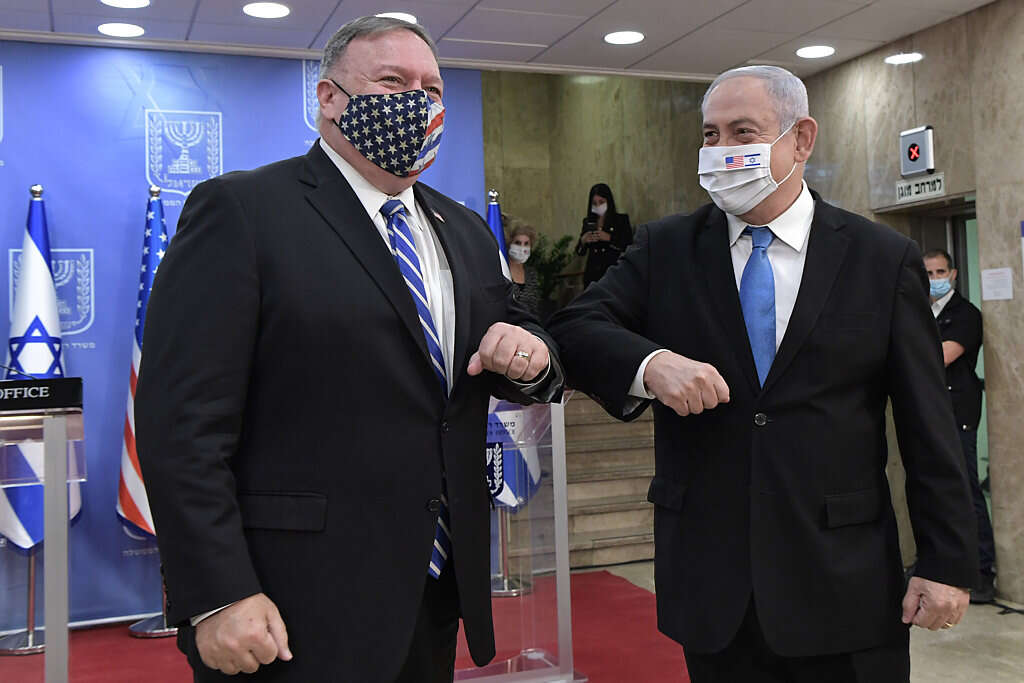
US Secretary of State Mike Pompeo and Prime Minister Benjamin Netanyahu in Jerusalem, Nov. 19, 2020 (Kobi Gideon/GPO)

In addition, Pompeo made a historic visit to the Golan Heights, which the Trump administration formally recognized in 2019 as part of Israel's sovereign territory – and became the first US secretary of state to visit an Israeli settlement in Judea and Samaria.

Furthermore, during Pompeo's stay in Israel, the State Department announced that America would impose additional sanctions on Iran and take specific measures to combat the global anti-Israel BDS movement, which he called a "cancer" and "anti-Semitic." These measures include a new US legal requirement that goods produced in Israeli-controlled "Area C" of the West Bank be designated as "Made in Israel."

Each of these policies has been met with praise within Israel, though they risk being overturned by a future administration.

In an exclusive interview with JNS, Pompeo discussed the rationale and motivations behind these policies, and where he believes that they will lead in the future.

Q: You have often spoken publicly of your strong faith in God. How fulfilling is it for you, not just on a diplomatic level, but personally and spiritually, to have been able to make such meaningful policy initiatives to strengthen the State of Israel, particularly in those territories in which the stories of the Torah, the Bible, came to life?

"Personally, it's been an enormous privilege to get the opportunity to deliver on President Trump's policies with respect to each of those things. But in the end, it is not about Mike Pompeo. In the end, it is about how America will exert its moral force to be a force for good around the world. And I am very confident that the Trump administration has been, and will continue to be, a force for good not only in this region but in every place where American influence can be."

Q: In announcing new sanctions on Iran, you wrote, "The Iranian regime is increasing its stockpile of enriched uranium. This is indeed troubling, but even more disturbing is the notion that the United States should fall victim to this extortion and abandon our sanctions." How long should these sanctions stay in place?

"They stay in place until Iran demonstrates a commitment to changing its behaviors around the world.

"We laid down a policy back in May of 2018 that said, "These are the things that normal nations do," such as ceasing assassination campaigns around the world or arming militias and sovereign nations. So, you run Shia militias in Iraq; you run forces into Syria that conduct terror campaigns on civilians; you build up a ballistic-missile program with the intention of one day creating a nuclear capability.

"These are unacceptable, and we ought to do everything we can to deny the regime the resources and capacity to continue to build out those programs. And so that's what the campaign has been designed to do. It's been very effective, for sure. And I am confident in the president's objective – that we are prepared to have a conversation about how we resolve this amicably and peacefully.

"As a result, we've also delivered the amazing Abraham Accords, which are deeply connected to the fact that the world has now isolated Iran in ways that when we came into office wasn't the case. We put [the Iranian leadership] in a smaller space, which gives all the capacity for the Iranian people ultimately to get a regime to behave in the way that's in the best interest of [those] people. That's our mission. We're closer to it today than we were three years ago. For sure."

Q: You recently tweeted, "The historic Abraham Accords have put the region on a transformative path towards stability, security and opportunity." Do you expect that the momentum of the Accords will continue, regardless of whether the White House actively serves as a peace broker in the future?

"Of course, the Abraham Accords exist because they are in the best interest of sovereign nations. The leaders of Bahrain and Sudan and the Emirates chose to enter into these agreements with Israel because it was in the best interest of their people. And every leader has a responsibility to do that.

"So I'm very confident in the direction of travel that this administration helped foster, which is: The isolation of Iran; the central recognition that Jerusalem is the rightful capital of the Jewish homeland; that the Golan Heights belongs to Israel; that the conflict between Israel and Palestinians is important and needs to be resolved, but the resolution of that [conflict] can't be a precondition for increased stability and prosperity in the Middle East.

"That was 40 years of policy that said that if we don't solve [Palestinian-Israeli conflict], we can't do anything anywhere else. Well, we've proven that wrong. I think these leaders have seen that. And I'm very confident that other nations will come to conclude that the best policy with respect to the Middle East is a unified, peaceful, prosperous Middle East, which includes Israel as a partner in those very endeavors."

Q: Yesterday you said that the "Department of State stands strongly to the recognition that settlements can be done in a way that is lawful and appropriate and proper." Your reversal of the 1978 Hansell Memo, which considered "civilian settlements" in Judea and Samaria as "inconsistent with international law," has come to be known in Israel as the "Pompeo Doctrine." Is this, in your view, the Pompeo Doctrine?

"Well, no, it is a statement of fact. It is the case of these places I visited yesterday in Judea and Samaria. I saw Arabs living peaceably alongside Jews. I saw people of all different stripes. The idea that every settlement is unlawful as a matter of law doesn't comport with reality. Israeli courts have recognized that some settlements aren't, and this is how this should be resolved. It's actually pretty straightforward, in my judgment."

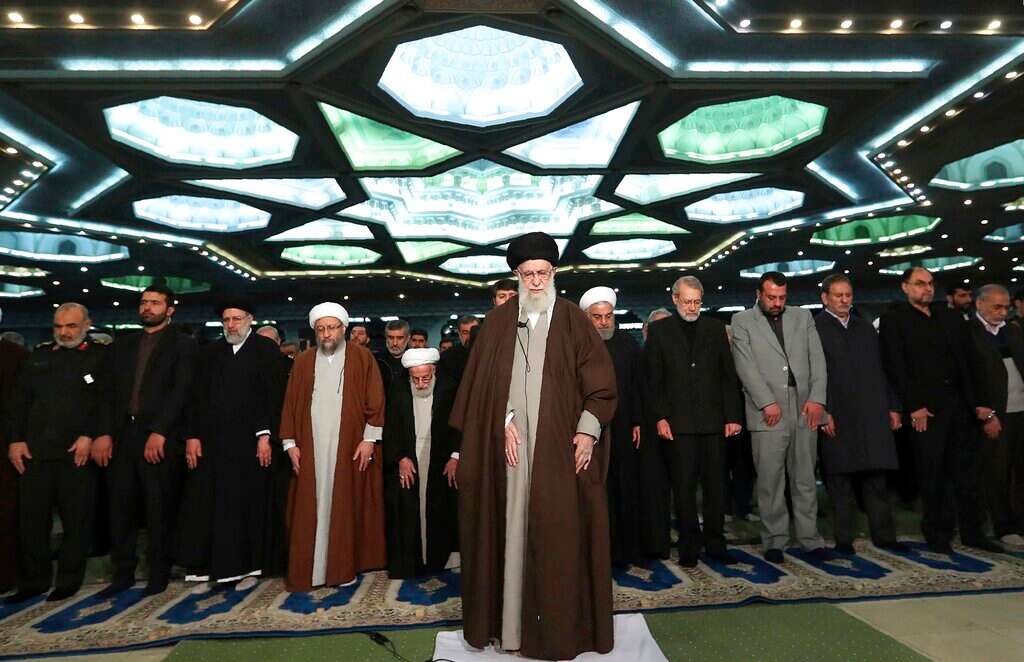
Supreme Leader Ayatollah Ali Khamenei, center, leads the Friday prayers at Imam Khomeini Grand Mosque in Tehran (AP via the Office of the Iranian Supreme Leader)

Q: In the Trump administration's "Peace to Prosperity" vision, all Jewish communities in Judea and Samaria would remain part of Israel in any settlement between Israelis and Palestinians. Will this recognition lead to a breakthrough in a stalled peace process?

"We've made pretty clear the administration's position with respect to the vision for peace that we've laid out. The central requirement is a set of leaders of the Palestinian people who are prepared to engage in an important conversation with Israel to come to a reasonable and amicable solution.

"We laid out our vision for peace. It had a two-state solution. It granted enormous capacity for the lives of the Palestinians to be better. We hope that the Palestinians will join in this conversation. We are prepared to do that at any time. We want them to sit down with Israelis and begin to resolve this. It's something that the world is demanding.

"You can see nations all across the world coming to understand that the Palestinians have rejected reasonable offers to negotiate time and time again. And the leadership has simply failed its own people."

Q: Is there a unifying theme between your policies regarding the Abraham Accords, isolating Iran and laying out a new vision for peace between Israelis and Palestinians?

"The common theme is that in the United States, we recognize the reality of what's best for humanity, for the people. And so, whether it's the Iranian people or the Palestinian people, we want them to live in harmony and peace and be prosperous, not engage in historical feuds that don't comport with the reality that is 2020."

Q: You pledged to treat anti-Zionism as anti-Semitism and called BDS a "cancer, and the United States will now require producers in "Area C" to mark their goods as "Made in Israel." The New York Times called your diplomatic announcements "parting gifts to the Israeli right." Are these "parting gifts"? Why are these announcements coming now? And who are the beneficiaries?

"Oh, these are the right things for the world. Again, our policy in the Middle East has been that we took our founders' principles, a conservative worldview and realism that comports with our central understanding and President Trump's understanding about how American foreign policy should be effectively used."

"This decision about how we ought to label products is simply an outcome of this understanding of the region. I'm sure the beneficiaries of this will be legion. I'm sure people will be more prosperous, more free and more capable of living autonomous lives as a result of the decision that we made yesterday. And we're excited about that.

"You know, as for timing, I'm the secretary of state. Every day, I'm the secretary of state. I get up just like I did the first day I was secretary of state and run at problem sets, and try to make President Trump's foreign policy real and effective. That's my mission. So long as I'm secretary of state, I'll continue to do it."

Q: Should we be expecting further announcements in the days and weeks ahead?

"Oh yeah, we're still working. Yeah. You seem to have a shocked look on your face, as if the secretary of state would stop working at some point in time. No, America's still engaged and working throughout the world, and we will be."

Reprinted from JNS.org.


Alex Traiman , JNS and ILH Staff  

Source: https://www.israelhayom.com/2020/11/22/trump-administration-will-continue-to-be-a-force-for-good/ 

Follow Middle East and Terrorism on Twitter
What Is Going to Change in the Middle East under Biden? - Brig.-Gen. (res.) Yossi Kuperwasser


​ by Brig.-Gen. (res.) Yossi Kuperwasser

President-elect Joe Biden and his entourage have announced that they are interested in lifting sanctions on Iran and returning to the nuclear agreement.


What Is Going to Change in the Middle East under Biden?
Prime Minister Netanyahu welcomes then-Vice President Biden to Israel in 2010. (Avi Ohayon, Government Press Office)

Institute for Contemporary Affairs

Founded jointly with the Wechsler Family Foundation

Vol. 20, No. 24

  • President-elect Joe Biden and his entourage have announced that they are interested in lifting sanctions on Iran and returning to the nuclear agreement. They also expressed the view that the new administration intends to renew U.S. ties and assistance to the Palestinian Authority.
  • At the same time, Biden and his advisers have asserted that their strategic objectives are no different from those of previous administrations, i.e., preventing Iran from arming itself with nuclear weapons; restraining Tehran’s dangerous activities in the region and the domestic arena; fortifying Israel’s security, in part by continuing security assistance and preserving Israel’s qualitative military edge (QME); opposing Israel’s delegitimization; and promoting an agreement to the Israeli-Palestinian conflict.
  • Significant parts of the changing reality in the Middle East appear irreversible, notably, the normalization of relations between Israel and the pragmatic Sunni states. For instance, in the agreement with the UAE, the Emirates recognized the existence of a Jewish People for the first time – a clear contradiction of the central principle underlying the Palestinian narrative that rules out the existence of such a people.
  • It is unlikely that the new U.S. administration will ignore the Taylor Force Act, which prohibits financial aid to the PA if it insists on continuing to pay salaries to terrorists who murdered Israelis (and Americans). The Palestinians are considering changes in the system of payments, but it is doubtful that they really mean to stop this practice or change it in any significant way.
  • In the Iranian context, it will be difficult for the Biden administration to turn the wheel back quickly. Some sanctions were deliberately imposed through mechanisms that cannot be readily repealed (such as those set under anti-terrorism legislation). Moreover, the Iranians are unwilling to agree to changes or additions to the original nuclear agreement, such as limitations on intercontinental ballistic missiles.
  • Ultimately, Biden will have to take into account that relations with Israel are crucial to protecting American interests in the region and that the pragmatic Arabs are close allies of the United States.

Breaking the Palestinian Veto over the Arab World’s Relations with Israel

President Trump’s policies in the Middle East contributed significantly to changes in the rules of the game in the region, both in the Palestinian and regional contexts.

The primary change was the breaking of the paradigm claiming that the Israeli-Palestinian conflict was at the heart of the Middle East impasse. By the rules of the paradigm, normal relations between Israel and pragmatic Arab countries, including diplomatic relations, could not be established without a diplomatic agreement or at least substantive progress toward an Israeli-Palestinian settlement in accordance with the principles of the Arab Peace Initiative. That initiative called for the recognition of territories Israel captured in the 1967 war, including eastern Jerusalem, as Palestinian territory and a solution to the Palestinian refugee problem, based on UN General Assembly Resolution 194. All the while, the Palestinians would refrain from recognizing Israel as the nation-state of the Jewish people. 

The peace and normalization agreements between Israel and the United Arab Emirates, Bahrain, and Sudan illustrated the exact opposite, that these rules were not obligatory. The agreements denied the Palestinians the veto they supposedly held under this rule for promoting relations between Israel and the Arab world.

The second change in the rules overturned the claim that Israel’s sovereignty over territory it had seized in the Six-Day War should not be recognized. In a precedent, the United States under Trump acted according to the opinion that the UN Security Council Resolution 242 called on Israel to withdraw from “territories” it seized, rather than “all territories.” The U.S. acknowledged Israel’s sovereignty in the Golan Heights, and Israel’s claim to sovereignty in eastern Jerusalem and 30 percent of Judea and Samaria, including the Jordan Valley.

Other rules of play that changed during Trump’s term were the rejection of allegations that Israeli settlements in Judea and Samaria were illegitimate or illegal, that an agreement would require the evacuation of some of the settlements, and that the security arrangements that would be established in the future between Israel and a future Palestinian entity would be based on Palestinian responsibility for security. The United States recognized the legality of Israeli settlement in Judea and Samaria and Israel’s security needs, which require Israeli control of the Jordan Valley and overriding Israeli responsibility for security in the entire territory.

The previous paradigm demanded that Israel choose between two problematic alternatives. The first was to continue the status quo. In order to convince Israel to disavow it, the status quo is portrayed by many as inevitably forcing Israel to choose between being a Jewish state or a democratic one. The second alternative is a return to the 1967 lines with minor changes and exchanges of territory, in such a way as to enable the establishment of a Palestinian state in Gaza and the West Bank that remains committed to the vision of defeating Zionism and to the struggle to realize this vision.

Instead, the alternatives put forth were implementing the Trump peace plan in its entirety or Israel expanding normalization agreements with the Arab states while continuing the status quo in the territories and suspending the application of its sovereignty over parts of Judea and Samaria. Implementing the Trump plan would have allowed the expansion of Israeli sovereignty over territories vital to Israel’s security (the Jordan Valley and much of the settlements) and the non-removal of other communities, while establishing a Palestinian state in Palestinian-populated territories after the Palestinians disavowed their vision of destroying “Zionism.” Furthermore, the Palestinians would renounce terrorism (among other things, by stopping incitement and paying salaries to terrorists) and fight terrorism (including by dismantling the terrorist organizations, including Hamas). In either of these scenarios, Israel’s Jewish and democratic nature is preserved.

A Change in Palestinian Policy?

Some of these demands have already been translated by the United States and Israel into legislation, notably the Taylor Force Act, which secured wall-to-wall support in Congress and declared that the United States would not provide aid to the Palestinian Authority as long as it pays salaries to terrorists and their families. Israel passed a similar law, which also received broad support in the Knesset, and has determined that Israel will reduce the amount the PA pays in salaries to terrorists and their families from the taxes it collects for the Palestinian Authority. This deviates from the previous American practice of avoiding punitive measures against the PA, even if it blatantly violated the Oslo Accords and supported terrorism. That American practice had been followed to ensure the PA’s stability, and out of fear of a strong PA reaction. This Palestinian “deterrent” was also ignored when the United States recognized Jerusalem as Israel’s capital and relocated the American embassy to Jerusalem, actions that did not provoke a widespread negative response.

As a result of the changes in the rules of the game in the Palestinian context, the Palestinian leadership’s ability to advance its strategic objectives, primarily the struggle to defeat Zionism, has been significantly weakened. Within Palestinian society, one can see the beginnings of a re-evaluation of the logic of the Palestinian narrative that prioritizes confrontation with Zionism and places the quality of Palestinian life as a secondary priority. On the other hand, there were, of course, those who pledged to adhere to the narrative at all costs and even considered promoting unification moves between Fatah and Hamas. Biden’s election as the next president was greeted with a sigh of relief among Palestinians, who believe that the pressure on them will diminish, and perhaps even that personnel sympathetic to the Palestinians will be integrated into the president-elect’s team. But at the same time, the Palestinians understand that they have to come to terms with the new reality and the new rules. This is why they have announced that they will resume security and civilian coordination with Israel, without Israel announcing that it is giving up its intention to extend its sovereignty over parts of Judea and Samaria.

Vice President Biden meets the Palestinian Authority’s Mahmoud Abbas in 2016.
Vice President Biden meets the Palestinian Authority’s Mahmoud Abbas in 2016. (Palestinian press)

Changes on the Iranian Front

In the regional context, the axiom that stated that Iran and its proxies enjoyed immunity from actions against them by the United States and Israel has ended. U.S.-imposed economic sanctions on Iran, Syria, Lebanon, and Hizbullah; the elimination of Iranian Quds Force commander Maj.-Gen. Qasem Suleimani; U.S. strikes in Syria and Iraq; and the succession of Israeli strikes against Iranian targets in Syria (and possibly several actions attributed to Israel in Iran itself) reflect the change in this rule. However, the rule still stands that direct military activity against Hizbullah in Lebanon, beyond intelligence gathering, should be avoided.

The most significant practical manifestation of the change in the rules was the U.S. decision to leave the nuclear deal with Iran, the Joint Comprehensive Plan of Action (JCPOA), and to impose ever-tightening sanctions on the Islamist regime in Tehran. As a result of this change, Iran faced severe economic hardship, affecting its control of countries where it gained significant influence during the Obama era (Iraq, Syria, and Lebanon), and, in response, it chose to violate the nuclear agreement. Iran was forced to leave, at least temporarily, the safe path to a large arsenal of nuclear weapons promised by the JCPOA. Instead, it returned to the problematic trajectory of striving to “break out” and follow the path of enriching uranium to a military-grade level, which would allow for the production of a small number of nuclear weapons. Today, the time to “break out” to produce enough military-grade enriched uranium for a nuclear weapon stands at 3-5 months, compared to one year, according to the Obama administration’s interpretation of the deal.

Israel and the Arab World

The breakthrough in relations between Israel and the pragmatic Arab countries and the pressures on Iran also changed the rules of the game between the pragmatic camp and its radical rivals from the Iranian axis and the Muslim Brotherhood axis. This led to the strengthening of the pragmatic camp, thanks to the growing commitment of the United States and Israel to its members’ security and prosperity (including arms deals with the United Arab Emirates, notably the F-35 deal).

During the election campaign, Democratic presidential candidate Joe Biden and his entourage announced that they had not come to terms with many of the changes enacted by the Trump administration, and they intended to reinstate the previous rules of the game. Messages in this vein were also heard after it became clear that Biden had, in fact, become president-elect. Biden and his top foreign policy advisers emphasized the U.S. interest in lifting sanctions on Iran and returning to the nuclear agreement, hoping that minor changes to the deal would be acceptable to the Iranians. They also expressed the view that the Palestinian issue is a key topic in the Middle East and that the new administration intends to renew U.S. ties and assistance to the Palestinian Authority.

Will Biden Follow in the Previous Administration’s Footsteps?

At the same time, Biden and his advisers have asserted that their strategic objectives are no different from those of previous administrations, i.e., preventing Iran from arming itself with nuclear weapons; restraining Tehran’s dangerous activities in the region and the domestic arena; fortifying Israel’s security, in part by continuing security assistance and preserving Israel’s qualitative military edge (QME); opposing Israel’s delegitimization; and promoting an agreement to the Israeli-Palestinian conflict based on the formula of two states – even if they are skeptical of the prospect of making significant progress towards this goal.

The ability of the new administration to advance its worldview in the Palestinian context, given the changing reality in the Middle East, will be influenced by a variety of constraints. Significant parts of the new rules of the game appear irreversible, notably, the normalization of relations between Israel and the pragmatic Sunni states, which have even adopted dimensions of moderation. For instance, in the agreement with the UAE, the Emirates recognized the existence of a Jewish People for the first time – a clear contradiction of the central principle underlying the Palestinian narrative that rules out the existence of such a people. Therefore, the ability of the PA to mobilize the Arabs to pressure Israel has been significantly reduced.

It is also unlikely (though not entirely impossible) that the new administration will ignore the Taylor Force Act and renew financial aid to the PA, even while it insists on continuing to pay salaries to terrorists who murdered Israelis (and Americans) and even announced that it would employ the terrorists who had completed their prison terms within the PA security forces. The Palestinians are considering changes in the system of payments to arrested terrorists, encouraged by sympathetic Democratic Party activists, but it is doubtful that they really mean to stop this practice or change it in any significant way that might satisfy Israel, the United States, and other donors.

It appears that Biden will refrain from returning the U.S. embassy to Tel Aviv or canceling the recognition of Jerusalem as Israel’s capital and the Golan Heights as part of Israel. If the Senate remains Republican-controlled, he will find it even harder to aid the Palestinians, despite expected pressure from the progressive camp in his party.

On the other hand, Biden may freeze or cancel President Trump’s peace initiative, and return to referring to the settlements in the territories as illegitimate or even lacking legal validity (in the language of UNSC Res. 2334, which the Obama administration allowed to pass in its final days), despite the opinion of the State Department under President Trump and Secretary of State Pompeo, which contradicted this claim.

Biden may re-adopt the Obama-Kerry peace plan of 2013-14, which included a security concept dangerous to Israel (the “Allen Plan,” which among its many flaws included a Palestinian Special Forces unit equipped with helicopters). In any event, it is likely that despite Biden’s sympathetic attitude to Israel, he will show a more critical attitude toward it, especially compared to Trump.

Even in the Iranian context, the new rules of the game and current circumstances will make it difficult for Biden and his administration to turn the wheel back quickly. Some sanctions were deliberately imposed through mechanisms that cannot be readily repealed (such as those set under anti-terrorism legislation). Moreover, the Iranians are unwilling to agree to changes or additions to the original nuclear agreement, such as limitations on intercontinental ballistic missiles. The Iranians are now busy preparing for Iran’s upcoming presidential elections and the consequential internal tensions. Meanwhile, more information about Iran’s nuclear program has emerged and is being discovered, both on the basis of the nuclear archives uncovered by Israel and on the basis of revelations by opposition sources, which could require the International Atomic Energy Agency (IAEA) to take action against Iran, complicating the situation further.

In the broad regional context, Biden is expected to adopt a more critical policy toward Saudi Arabia and other elements of the pragmatic Arab camp and move closer to Muslim Brotherhood-affiliated states and “reformists” in Iran. Groups in the United States, led by the pro-Iran National Iranian American Council (NIAC)’s Trita Parsi, and the Council on American-Islamic Relations (CAIR), with its ties to the Muslim Brotherhood, had close relations with the Obama administration and supported Biden’s candidacy. They will be seeking “payback” for their support. Progressives in the Democratic Party will also pursue government posts in return for their support.

Maintaining the U.S.-Israel Relationship

Ultimately, however, Biden will have to take into account that relations with Israel are crucial to protecting American interests in the region and that the pragmatic Arabs are close allies of the United States, while the regimes in countries led by radical elements, such as Turkey and Iran, are involved in activities that undermine stability and blatantly violate the human rights of their citizens, much more than the pragmatic Arab camp.

It is precisely the new rules of the game that create a leverageable potential to make significant changes in Palestinian and Iranian policy during the next U.S. president’s term. The distress in which the Iranians, their proxies, and the Palestinians find themselves, and their high expectations that Biden will extract them from these pressures, create a convenient basis for the new president to demand flexibility from the Palestinians and the Iranians to further his foreign policy goals. On the other hand, attempts to reinstate the old rules of the game unconditionally, and to reject everything achieved by the Trump administration, as expressed in some of the initial statements by Biden’s people, may dissolve the potential to bring about desired changes. Such a position could result in encouraging the Iranians to become more stubborn in their demands to reject any changes in the JCPOA.

Israel must do all it can to strengthen ties with the United States under the new administration, preserve as much as possible the changes in the rules of the game created in recent years, sharpen the positive potential that is inherent in these changes, and emphasize the importance of support for the pragmatic Arab camp, even though it has its problems. The more Israel cooperates with members of this camp and expands the circle of countries that openly promote normalization of relations with it, the stronger Israel and the pragmatists will become as they seek to bring the new U.S. administration to support the positive changes in the Middle East and to realize their potential. At the same time, Israel will strive to maintain its fundamental positions and freedom of action toward Iran and the Palestinians.


Brig.-Gen. (res.) Yossi Kuperwasser is Director of the Project on Regional Middle East Developments at the Jerusalem Center. He was formerly Director General of the Israel Ministry of Strategic Affairs and head of the Research Division of IDF Military Intelligence.

Source: https://jcpa.org/article/what-is-going-to-change-in-the-middle-east-under-biden/ 

 Follow Middle East and Terrorism on Twitter
The PA's policy of deception - Maurice Hirsch


​ by Maurice Hirsch

While the PA may hope to deceive the uninformed, the truth is incontrovertible: For the PA, rewarding terrorists is not about social welfare, but about incentivizing and rewarding terror and murder.

Richard Engel of the Council on Foreign Relations, a prestigious and influential US think tank, held an exclusive webinar on Nov. 17 hosting Palestinian Authority Prime Minister Mohammad Shtayyeh.

While anyone still believing in the value of truth would have had a field day with the entire presentation, the six minutes in which Shtayyeh tried to explain and justify the PA's "pay-for-slay" policy were, by far, the most offensive.

Every year, the PA spends hundreds of millions of dollars on salaries for imprisoned terrorists and released terrorists and allowances to wounded terrorists and the families of dead terrorists. The PA pays these terrorists because, as Deputy PA Prime Minister Nabil Abu Rudeina recently said, "It is impossible to send a soldier to war and then not take care of his family. We are talking about someone who acts on our behalf and receives orders from us."

Among the thousands of recipients of the PA payments are mass murderers like Abdallah Barghouti, who is responsible for multiple terror attacks in which 67 people were murdered, and the family of Abd Al-Basset Odeh, the suicide bomber who carried out the Passover attack at the Park Hotel in Netanya on March 27, 2002, murdering 30 Israelis.

The beneficiaries of the payments include terrorists from all the Palestinian terror groups, including Hamas, Palestinian Islamic Jihad and the Popular front for the Liberation of Palestine – all internationally designated terror organizations – as well as members of Fatah. Many of the terrorists are responsible not only for the murder of Israelis – Jews and Arabs alike – but also for the murder of foreigners, including, but not limited to, US, UK, French, Dutch, Australian and Russian citizens.

When it comes to "pay for slay," the only requirement to receive payment is that you were engaged in terrorism against Israel. When it comes to rewarding terror, the PA is truly an equal opportunity employer.

What made Shtayyeh's presentation so offensive was his resort to outright lies.

Shtayyeh opened his defense of the PA's squandering of billions of dollars of US and international aid by claiming that Yigal Amir, who assassinated Israeli Prime Minister Yitzchak Rabin on Nov. 4, 1995, "is getting a social security pension from the State of Israel."

In fact, there are multiple provisions in Israeli law that deny any state benefits whatsoever to any person being held in prison.

Shtayyeh went on to explain that the PA policy does not incentivize terror but rather compensates for the "collective punishment" he claimed Israel imposes on the terrorists and their families. According to Shtayyeh, Israel destroys the house of every terrorist arrested.

This too is a lie. The Israeli practice of employing home demolitions as a deterrent measure is reserved for cases of murder. Accordingly, of the thousands of terrorists arrested every year, the houses of only a handful are actually demolished.

Doubling down, Shtayyeh tried to explain that the PA policy is – pass the tissues – focused on the terrorists' "orphans" and "kids."

What Shtayyeh failed to mention is that according to Palestinian Media Watch (PMW) reports, later confirmed by the Israeli Prison Service, 70% of the imprisoned terrorists are single. Many of them are minors, such as Morad Adais, the 16-year-old murderer of nurse Dafna Meir; Khalil Jabarin, also 16, who murdered Ari Fuld; or Iham Tzabach, who at the tender age of 14 convinced three of his friends to participate in the terror attack that led to the murderer of Tuvia Yanai Weissman. If "pay for slay" is all about the "orphans" why are single terrorists receiving a payment?

Shtayyeh argued that the payments were actually in Israel's security interests, claiming the IDF Military Governorate had called him to ensure the PA renewed the canteen payments to the imprisoned terrorists. Shtayyeh obviously "forgot" that it was actually Israel, following a PMW report, that stopped the canteen payments, and that only after the terrorists threatened a hunger strike did the Israeli government temporarily capitulate.

Finally, Shtayyeh tried to justify "pay for slay" by asking about the recidivism rate of terrorists who had benefited from the payments.

Before joining PMW, I spent almost 20 years in the IDF Military Advocate General's Corps. In my last position, I served as director of the IDF Military Prosecution for Judea and Samaria. In total, I spent 14 years of my service dealing with Palestinian terrorism. The answer to your question, Shtayyeh, is about 60%.

While Shtayyeh may hope to deceive an uninformed audience, the reality is clear. For the PA, rewarding terrorists is not about social welfare. It is about incentivizing and rewarding terror and murder. "Pay for slay" is an abomination that should enjoy universal condemnation.

Reprinted from JNS.org.


Maurice Hirsch  

Source: https://www.israelhayom.com/opinions/the-pas-policy-of-deception/ 

Follow Middle East and Terrorism on Twitter