The "Middle East and Terrorism" Blog was created in order to supply information about the implication of Arab countries and Iran in terrorism all over the world. Most of the articles in the blog are the result of objective scientific research or articles written by senior journalists.
From the Ethics of the Fathers: "He [Rabbi Tarfon] used to say, it is not incumbent upon you to complete the task, but you are not exempt from undertaking it."
The message is clear: "challenge us again at your own peril."
Donald
Trump has the distinction of being the first challenger to our
political ruling class in my lifetime. This ruling class is not
strictly party-related. It comprises a broad array of Democrats (almost
all of them), Republicans (a significant number of them), the media
(the propaganda ministry), and bureaucrats (those faceless government
employees who formed the "resistance" against the will of the people).
The
Donald challenged their power, and now they're exacting their
revenge. Whether fairly or fraudulently, he's been defeated for
re-election, but that's not enough. Now his legacy must be destroyed
and his supporters crushed. The ruling class is determined to ensure
that no form of Trumpism or any challenge to their authority ever rises
again.
Ancient
mythology holds that conquering armies would salt the earth of beaten
civilizations. This salting was a curse to forestall any future
re-habitation. It was meant to ensure that a beaten civilization would
never again challenge the victor. The beaten were to stay beaten.
We've
reached the "salt the earth" stage of the ruling class's victory over
the Trump movement. Democrats are demanding that President Trump be
removed from office, via impeachment or the 25th Amendment — just two
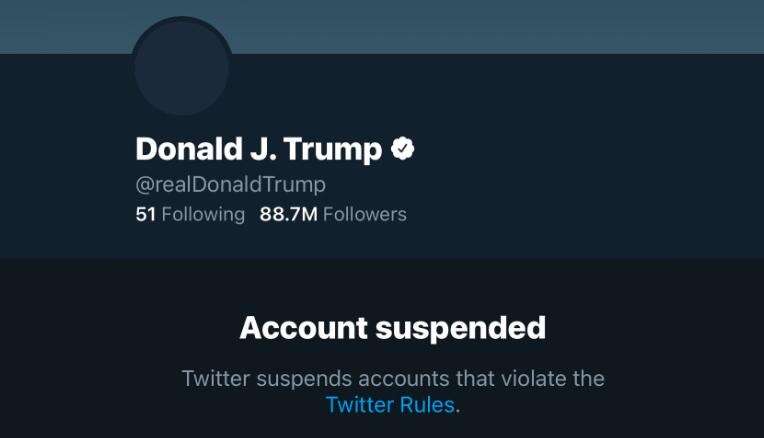
weeks before the end of his term. Twitter has banned him for
life. Representative Joaquin Castro (D-Texas) has even submitted
legislation to prohibit federal buildings from ever being named after
Donald Trump. It's not enough that he was defeated for re-election; he
must also be humiliated. There's even a report that a U.S. attorney is
conducting a criminal investigation into whether Donald Trump incited a
riot with his speech on January 6. Is it so unbelievable that Donald
Trump could be indicted after leaving office? Isn't it alarming that an
indictment, for making a speech, is even conceivable? But after seeing
him impeached for a phone call, it doesn't seem so incredible, does it?
As
for his followers, they're going to get theirs, too. We're seeing that
in the coverage of the January 6 U.S. Capitol protest. It's being
billed as an unprecedented violent assault on our democracy. We don't
know yet who caused the violence, and there is some doubt that it was
instigated by the Trump-supporters. But there was nothing unprecedented
about it. Violent protests torched Washington, D.C. on the day of
Donald Trump's inauguration — with never a single word of condemnation
from any Democrat. This is the ruling class working in conjunction with
their propaganda ministry to create the narrative that Trump-supporters
are all unhinged lunatics. And since they're all unhinged lunatics,
the flight attendants' union is now demanded that everyone in attendance
at the January 6 protest be placed on the "no fly list." Why is it not
disturbing to everyone that this would even be considered a reasonable
response to a political protest?
The ruling class's message is clear: "challenge us again at your own peril."
In
just a few short years, U.S. politics has taken a disturbing
turn. Politics is no longer the competition of ideas. For the ruling
class, conservatives are no longer political opponents; we are enemies
of the state. Calls for unity and civility are transparently
hypocritical. Our rulers don't want unity; they want submission.
Fortunately
for us, and unfortunately for our rulers, we still value liberty above
all else. Will things stay peaceful? I hope so. But only time will
tell. The only certainty is that we the people will prevail. Buckle
up.
John
Green is a retired engineer with over 40 years of experience in the
defense and oil exploration industries. His career has spanned the
areas of product development, quality, organizational development, and
corporate strategic planning. He can be reached at greenjeg@gmail.com.
Republican senators presently find themselves between the American media's insatiable appetite for Trump's head and the 74 million Americans who voted for him.
Trump's Twitter account this weekend (Screenshot)
The Democrats' hypocrisy knows no
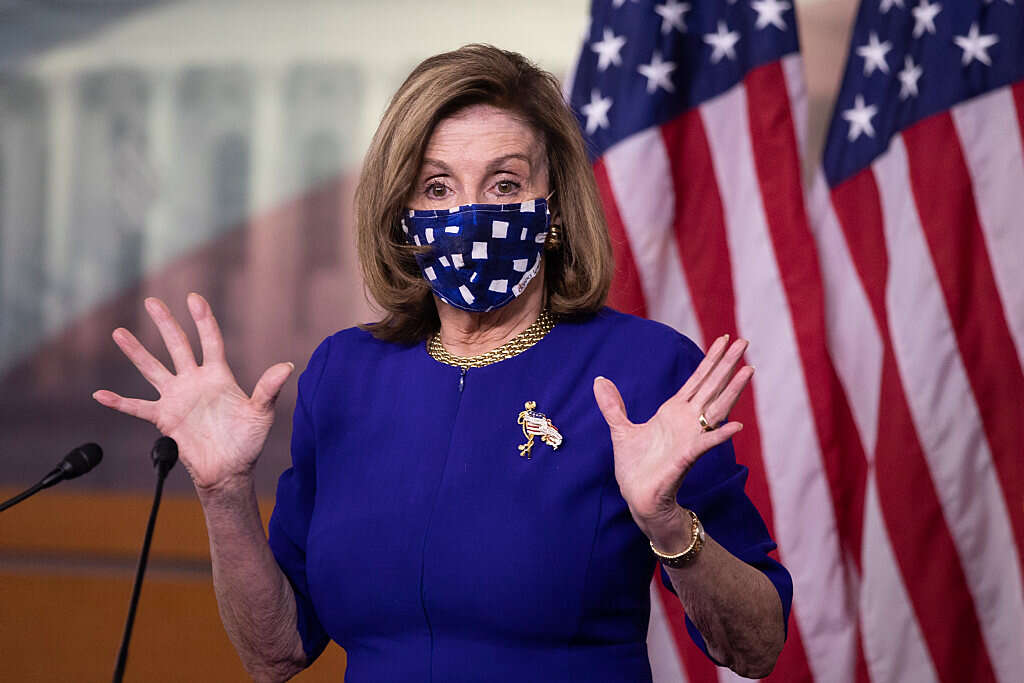
bounds. Nancy Pelosi, the Speaker of the House of Representatives,
currently has just one thing on her mind: Impeaching President Donald
Trump. Because Vice President Mike Pence won't support using the 25th
Amendment, which would strip Trump of his presidential powers, she
intends to launch a quick impeachment vote with the backing of her
friends in Congress if he doesn't resign willingly.
As Republican leaders don't plan on
backing the initiative (at least that's what they decided behind closed
doors), it is destined to fail – similar to the attempt to disqualify
some of the Electoral College votes last week. Hence, Pelosi is doing
precisely what she accuses Trump of doing – dividing America when the
one thing it needs is to unite. Even more so when just 11 days remain
until the end of his term.
In an interview with 60 Minutes, Pelosi didn't mince words, calling the president "deranged," "unhinged" and "dangerous."
We must not forget that Pelosi
herself harmed the congressional institution, even if not physically,
when she tore up Trump's State of the Union address on live TV in front
of tens of millions of Americans.
The big question is where was Pelosi
during the riots and looting across the US this past summer. The
Democrats' hypocrisy in this context knows no bounds. Trump's speech to
his supporters before the storming of the Congress was a bad mistake,
but the Democrats are now making it worse.
"The more they block him, the
greater our support will be." Twitter decided on Friday to shut down
Trump's account indefinitely, after initially suspending it temporarily
for 12 hours the same day dozens of his supporters raided Congress to
disrupt the Electoral count.
The decision reverberated across the
US and the entire globe, as the president's Twitter account is perhaps
his main tool for communicating with the American public. He has 88
million followers. Twitter's stock plummeted and Trump's many supporters
– 74 million of whom voted for him, it's important to note – furiously
accused the social media giant of censoring one side of the political
divide. Just a reminder: While the president's Twitter account is
disabled, Iran's supreme leader, Ayatollah Ali Khamenei, continues using
the platform to deny the Holocaust and disseminate his doctrine of
hate.
These days, conservatives in the US
believe the best way to fight the social media networks is to establish
competing networks of their own and weaken the monopolies of Twitter,
Facebook and Instagram – which all blocked the US president's official
accounts.
The blocking of Trump's account on
Friday came after two additional tweets of his: In one he called his
supporters "patriots" and in the second he said he wouldn't attend
president-elect Joe Biden's inauguration.
US Speaker of the House Nancy Pelosi (EPA)
The California-based company
presented the suspension as an attempt to prevent the president from
inciting violence and avoid a repeat of Wednesday's events on Capitol
Hill. All of the president's thousands of tweets from the past four
years simply vanished from the internet. Trump himself tried tweeting
from other accounts, including the official account of the US president,
from which he warned against trying to silence 75 million people. "We
will not be silenced," he wrote in capital letters, indicating he was
examining the option of establishing a "platform of our own."
As stated, people on the right are livid at Twitter
over its astoundingly Orwellian measure. We should note that even on
the election trail Trump assailed Silicon Valley "big-tech" for choosing
sides. Trump himself discovered the immense power of communicating via
Twitter in 2011. There's no doubt that blocking his primary and most
direct avenue of communication with his base is a severe blow to the
president, but according to several of his supporters who I met in
Washington on Friday, the move will only amplify support for him.
"Trumpism isn't going anywhere. The more they attack him, the more we
will support him," tells me Paul, who came to the rally from Idaho with
two friends.
The outrage against Twitter is
considerable among conservatives, but it is not unequivocal. Not
everyone in the conservative camp likes the president's tweets, nor the
fact that Twitter became his main tool. There's no question that many
Republicans also didn't like his tweet against Mike Pence last week
after the vice president fulfilled his Congressional duties during the
Electoral vote. Silencing him, however, is a step too far. In America,
we have to bear in mind, freedom of expression is a sacred right. Hence
the discussion surrounding alternative social media platforms, such as
Parler.
The media wants Trump's head on a
platter. The Republicans won't risk impeaching a president 11 days
before the transfer of power in Washington. Israel Hayom
has learned that Republican senators will try navigating between the
desire of the American press, together with Democrats who want Trump's
head and respecting the 74 million American voters who view Trump as the
leader of the Republican party. It's a difficult task indeed.
Senator Lindsey Graham personally
felt the ire of Republicans for coming out against the president shortly
after the despicable Capitol breach. He was heckled by protesters at
Ronald Reagan Washington National Airport. The Republican senators
understand that joining the Democrats' initiative will reduce their
chances of getting elected in two years' time, or whenever they are up
for reelection.
Pelosi decided to submit a formal
impeachment inquiry if Trump refuses to resign, but without Republican
cooperation in the Senate, it is dead in the water. President-elect
Biden said he wouldn't interfere. Jim Justice, the governor of West
Virginia, doesn't understand why America needs this divisive measure
right before the transfer of power, particularly after Trump on Friday
declared power would be transferred in a quiet and lawful manner.
The big question is how the Republican senators will react to the Democrats' impeachment push.
A real battle on this issue is
currently being waged behind the scenes, and to the best of my
understanding, the Republican senators will allow Senate Democrats,
headed by Chuck Schumer, to proceed with the inquiry without helping
him. The Republican senators presently find themselves between the
American media's insatiable appetite for Trump's head and the 74 million
Americans who voted for him and remember all the good things he has
done.
No sane American likes the images
from Capitol Hill on January 6, but from that to impeaching a sitting
president, the distance is great. Such an extreme and dramatic step,
just days before the conclusion of his term, stands in stark contrast to
the notion of American unity evoked by Biden.
The belief is that Pelosi is enacting
the measure due to a personal grudge against Trump, and mainly to
prevent him from running again in 2024. According to many others,
meanwhile, an impeachment inquiry will only bolster the support for
Trump from his base. Either way, virtually identical headlines are being
splashed across the front pages of US newspapers, from the New York Times to the Wall Street Journal, saying that Trump is facing increased calls for impeachment. The New York Post, meanwhile, ran the one-word headline, "Revolting," to describe the scenes from Capitol Hill.
The media found a great opportunity
to settle a score and is now crucifying Trump. The criminals who stormed
the US Congress provided proof of all its claims and Trump's
considerable achievements won't stand to his credit. The newspaper
headlines say it all: treason, revolt, uprising, domestic terrorism,
revolution. The rift between at least half of Americans and the
anti-Trump media is unbridgable. It's a fact that the most recent
Rasmussen poll showed increased support for Trump. In the days since the
Capitol incident, the outgoing president's approval ratings have
approached nearly the 50% mark.
It is always astounding to realize that Democratic Party members slam Israel, the United Arab Emirates, Bahrain, and Saudi Arabia over human rights issues, but are more than willing to ignore the brutality Iran shows its own people.
After Georgia's runoff election and the victory of the leftist
Reverend Raphael Warnock over Sen. Kelly Loeffler, Democrats and
leftists immediately called for radical legislative action to ram
through the entire agenda of Democrat Joe Biden, ending the filibuster,
packing the courts, and adding new states such as Washington DC and
Puerto Rico to assure that Democrats end up with between two and four
new US Senators. One might wonder with such radical action, how this
will impact foreign policy, especially towards the Middle East.
Warnock with his antisemitic and outrageous statements comparing
Israel to apartheid South Africa and endorsing Reverend Jeremiah
Wright's infamous "God damn America" sermon is representing the
attitudes of many members of the radical left in the Democratic Party,
who are against traditional America. For them, this America has
historically been built on racism and has to be changed and accordingly
any allies of this traditional America are also part of this racism and
white supremacy or white privilege.
This might explain why most of these Democratic Party members attack
countries like Israel, the United Arab Emirates, Bahrain, and Saudi
Arabia for human rights issues but call for forgiveness and
rapprochement towards the Iranian regime, ignoring the brutality against
its own people and the tragedies perpetrated by Tehran over the past 40
years. We can liken the alliance between the radical left-wing of the
Democratic Party and Islamists to that of the Iranian regime and the
Muslim Brotherhood, based on a consensus against traditional or more
accurately Evangelical America with all its principles and values.
Therefore, if those allies were by majority leftist revolutionary
resonating against traditional America, the radical left-wing of the
Democratic Party would probably not utter a single word against them.
All of these attitudes and visions are reflected in the American
mainstream media, which is dominated by the liberal left. The double
standard is extremely obvious in this media, for instance, its coverage
of protests in Iran in 2009, 2017, 2018, and 2019 was nothing like the
coverage of the so-called Arab Spring. The difference was apparent in
terms of content, airtime, and the number of articles and news items.
Another example of media hypocrisy was recent events on Jan. 6 when the
media condemned the acts of civil unrest on Capitol Hill and called
protesters, who were resisting what they believe were stolen elections,
'mobs'.
While in the summer of 2020 during the BLM protests, CNN
anchor Chris Cuomo made excuses for rioters. He said on-air, "Please,
show me where it says protesters are supposed to be polite and
peaceful." Liberal Vox's German Lopez proclaimed during last summer that
while "riots are destructive, dangerous, and scary," they serve a
purpose because they "can lead to serious social reforms." So, we see
that for Democrat politicians and their supportive media who the rioters
are will determine how they are reported and commented on.
We will definitely see more of these double standards and hypocrisy
with the radical left increasingly dominating the political and media
arena in the United States, so can the Abraham Accords weather the
Democratic Party's left-wing wave?
On September 15, 2020, the Abraham Accords – named after the common
patriarch of the three monotheistic Abrahamic religions –were announced,
to establish peace, diplomatic and trade relations, and a normalization
of bilateral ties between the State of Israel, the UAE and the Kingdom
of Bahrain. Even though these agreements were politically and
economically strategic, it was notable that they were branded in
religious-cultural terms as the "Abraham Accords". So, can there be an
Evangelical Christian, Orthodox Jewish and moderate Muslim alliance to
counter this left-wing-Islamist alliance?
The UAE initiated this idea with an announcement in 2019 that it
intended to build an interfaith Abrahamic Family House including a
monumental church, a mosque and a synagogue. The UAE has chosen to focus
on the cultural commonality between Judaism, Christianity, and Islam,
symbolized by Abraham who is revered by all three faiths. This move can
be built on to counter the Islamist idea that other religions are toxic
to Islam. Framing Orthodox Jews, Evangelical Christians, and moderate
Muslims as part of an Abrahamic family can form a political alliance
that is a more robust alternative to the long-standing narrative of
Judeo-Christian and Islamic civilizations being in conflict.
The attempt to build an Abrahamic narrative may challenge not only
Islamist extremists, but also the radical left who want to undermine the
legitimacy of countries not aligned with their left-leaning political
and intellectual visions.
Before making any move that he may later regret, Mr Biden needs to think long and hard about the likely implications of trying to improve relations with Tehran.
There is eager anticipation
among many of Washington's foes that Mr Biden's inauguration will result
in the new president adopting a less confrontational tone with the
outside world than his predecessor.
China's communist rulers, for example, are hopeful that Mr Biden
will engage in the kind of meaningless trade deals so beloved of his
Democratic predecessor, Barack Obama. These are the trade deals where
Washington agrees to improve trade ties with Beijing on the
understanding that China addresses the unfair trading relationship
between the two countries, knowing full well that China's communist
rulers have absolutely no intention of fulfilling their end of the
bargain.
Before making any move that he may later regret, Mr Biden needs
to think long and hard about the likely implications of trying to
improve relations with Tehran.
As Iran has demonstrated consistently since signing the 2015
nuclear deal with the Obama administration, Tehran's primary objective
is to become the dominant power in the Middle East -- not to live in
peaceful coexistence with other nations in the region.
The
revelation that Hezbollah has doubled the arsenal of advanced guided
missiles it keeps trained on Israel is a timely reminder that Iran,
together with the its terrorist proxies throughout the Middle East,
promises to present the incoming Biden administration with its most
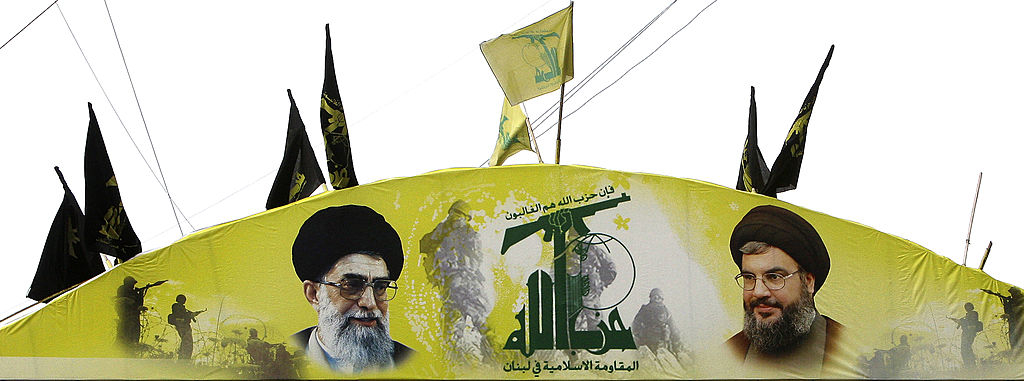
critical foreign policy challenge in 2021. Pictured: An arch glorifying
Hezbollah chief Hassan Nasrallah (right) and Iran's Supreme Leader
Ayatollah Ali Khamenei decorates a street in Beirut. (Photo by Anwar
Amro/AFP via Getty Images)
The revelation that Hezbollah has doubled
the arsenal of advanced guided missiles it keeps trained on Israel
during the course of the past year is a timely reminder that Iran,
together with the numerous terrorist proxies it supports throughout the
Middle East, promises to present the incoming Biden administration with
its most critical foreign policy challenge in 2021.
In many respects, so far as the ayatollahs are concerned, 2020 has
been a year to forget. The year, for them, got off to a bad start when
the Trump administration succeeded in carrying out the assassination
of Qassem Soleimani, the iconic head of Iran's Islamic Revolutionary
Guard Corps' Quds Force -- the man who, as a trusted confidante of
Supreme Leader Ayatollah Ali Khamenei, was primarily responsible for
disseminating Tehran's malign influence throughout the region.
In addition, the Iranian regime has seen its economy eviscerated by
the Trump administration's punitive sanctions regime, which President
Donald Trump implemented after withdrawing from the hazardous nuclear
deal with Iran that would ultimately have allowed it to have nuclear
weapons. As a consequence the rial, the Iranian currency, has lost more than half its value, while inflation and unemployment are both running at well above the 20 percent mark.
The mullahs have also had to contend with intense domestic criticism
over their handling of the coronavirus pandemic, with the regime facing
accusations that it has been too slow to respond to the challenge posed
by Covid-19, and has deliberately sought to cover up the true number of fatalities.
With Iran's presidential elections due to take place in June, the
regime's rulers are clearly desperate for some good news they can relay
to their sceptical electorate.
So the announcement by Hassan Nasrallah, the head of Iran's proxy
Hezbollah militia in Lebanon, that the terror group has, despite all the
setbacks Tehran has suffered during the past year, achieved a
significant increase in the number of missiles it has aimed at Israel,
will be music to the ears of Iran's ayatollahs as they seek to present
their track record in a positive light ahead of the elections.
Mr Nasrallah, who made the announcement during a four-hour interview
on a pro-Hezbollah Lebanese television station earlier this week,
claimed that the group's Iranian-made precision missiles were now
capable of hitting targets anywhere in Israel, as well as the West Bank
and Gaza.
The Hezbollah announcement -- if true -- constitutes a serious
escalation in Iran's ability to attack Israel, especially as Iran's
Revolutionary Guards are understood to have deployed similar weapons at
newly-constructed bases in Syria that are located close to the Israeli
border.
Even if it transpires that Mr Nasrallah, by making the claim, is
seeking to boost Hezbollah's standing in Lebanon after the criticism it
has received for the Port of Beirut explosion in August, Israel is
unlikely to tolerate the existence of such powerful weapons so close to
its border.
Tensions are already running high between Tehran and Jerusalem
following reports earlier this week that Israel is deploying one of its
submarines to the Persian Gulf, a move that prompted an angry response
from Abolfazl Amouei, spokesman for the Iranian Parliament's National
Security and Foreign Policy Committee, who described the Israeli move as "an act of aggression", and warned that Iran reserves the right to respond.
While many military observers regard the Israeli move, which is being
taken in conjunction with an increase in US naval activity in the Gulf,
as a purely precautionary measure as the Trump administration draws to a
close, hostilities between Israel and Iran can never be ruled out, a
prospect that President-elect Joe Biden would be well-advised to take on
board as he considers his foreign policy options.
There is eager anticipation among many of Washington's foes that Mr
Biden's inauguration will result in the new president adopting a less
confrontational tone with the outside world than his predecessor.
China's communist rulers, for example, are hopeful that Mr Biden will engage in the kind of meaningless trade deals so beloved of his Democratic predecessor, Barack Obama.
These are the trade deals where Washington agrees to improve trade
ties with Beijing on the understanding that China addresses the unfair
trading relationship between the two countries, knowing full well that
China's communist rulers have absolutely no intention of fulfilling
their end of the bargain.
There are similar feelings of optimism, too, in Tehran where the
ayatollahs will be desperately hoping that Mr Biden will fulfil his
promise to revive the nuclear deal and lift the sanctions, thereby
alleviating Iran's economic hardship and enabling its nuclear
capability.
Before making any move that he may later regret, Mr Biden needs to
think long and hard about the likely implications of trying to improve
relations with Tehran.
As Iran has demonstrated consistently since signing the 2015 nuclear
deal with the Obama administration, Tehran's primary objective is to
become the dominant power in the Middle East -- not to live in peaceful
coexistence with other nations in the region.
Con Coughlinis the Telegraph's Defence and Foreign Affairs Editor and a Distinguished Senior Fellow at Gatestone Institute.
"If the Americans do not lift financial, banking and oil sanctions by Feb. 21, we will definitely expel the IAEA inspectors from the country and will definitely end the voluntary implementation of the Additional Protocol," Iranian MP says.
Iran will expel United Nations nuclear watchdog inspectors unless US
sanctions are lifted by a Feb. 21 deadline set by the hardline-dominated
parliament, a lawmaker said on Saturday.
Parliament passed a law in November that obliges the government to
halt inspections of its nuclear sites by the International Atomic Energy
Agency and step up uranium enrichment beyond the limit set under
Tehran's 2015 nuclear deal if sanctions are not eased.
Iran's powerful Guardian Council approved the law on Dec. 2 and the government has said it will implement it.
"According to the law, if the Americans do not lift financial,
banking and oil sanctions by Feb. 21, we will definitely expel the IAEA
inspectors from the country and will definitely end the voluntary
implementation of the Additional Protocol," said parliamentarian Ahmad
Amirabadi Farahani.
The comments, referring to texts governing the IAEA's mission and activities, were carried by several Iranian media outlets.
In a statement, US Secretary of State Mike Pompeo said Iran had an obligation to allow the inspectors access.
"Once again the Iranian regime is using its nuclear program to extort
the international community and threaten regional security," Pompeo
said.
Iran said on Monday it had resumed 20% uranium enrichment at an
underground nuclear facility, breaching the nuclear pact with major
powers and possibly complicating efforts by US President-elect Joe Biden
to rejoin the deal.
Iran began violating the accord in 2019 in response to President
Donald Trump's withdrawal of the United States from it in 2018 and the
reimposition of US sanctions that had been lifted under the deal. Tehran
often says it can quickly reverse its breaches if Washington's
sanctions are removed.
The comparison between rioters in the US to the Right here, which is utterly detached from reality, not only turns the victim into the attacker but also tries establishing a new narrative about the Right.
It didn't take long for the cynics on
the political left and the media to exploit the riots in Washington to
tell us a little something about the Israeli right. MK Yair Golan
hastily declared: "The distance between Trump, the invasion of Congress
by an incited mob, and Netanyahu's conduct is shrinking." Moshe Ya'alon
added: "Could this happen here? Let me remind you it already has:
Netanyahu didn't accept the election results." And, as usual, MK Eli
Avidar regaled: "This time, Netanyahu can't say 'I didn't hear
anything,' as he has in the past."
And in the press? "It could happen
here, too," warned Ron Ben Yishai of Yediot Ahronoth, followed a day
later by his colleague, Sima Kadmon, who in an article headlined "Coming
soon" explained: "Don't say it's any different here." Unsurprisingly,
condemnations of the events in Washington also poured in from the right;
after all, if you don't say you are appalled by the thugs on Capitol
Hill, you are at the very least complicit in their actions.
All of the Black Lives Matter riots
and the coup attempts spearheaded by Antifa, the months of violence,
looting and daily incitement – none of it left an impression on the
Israeli left. Quite the opposite, the daily coverage, accompanied by
blatant support, was presented as newsworthy documentation. Even the
local impersonation pervading the "Balfour protests" – calls for
anarchy, debasement of state symbols, well-funded demonstrations –
received no condemnation. Nor did the worst forms of incitement, the
calls for violence, or even the explicit threats on the lives of the
prime minister and his family. Not a word; in fact, every mob-lit
bonfire in town was portrayed as a beacon of democracy.
And the calls to "storm the Bastille"
and to "finish with Netanyahu as with Ceaușescu" and other tyrants
throughout history whose demise was neither democratic nor natural –
imparted any discernible mark of anti-democratic shame among this
cohort.
On the other hand, those who cast
their votes democratically, who respected the rules, who absorbed the
undemocratic attempts to disqualify their voice – they, of all people,
are the threats to democracy. This comparison, utterly detached from
reality, between rioters in the US to the right here, not only turns the
victim into the attacker but also tries establishing a new narrative
about the right.
It is a game of discourse; of
boundaries and freedom of expression. It's as if someone came along and
uprooted the word "democracy" from our lexicon and our ability to use
it. In the past, it was "liberalism." Along with the fact that if you're
not a progressive liberal verging on nihilism, you are a dangerous,
messianic conservative. Later on, it was the word "peace," whereby if
you don't support a Palestinian state and struggle to accept the bloody
cost, you are, at minimum, a militant war hawk. And now they've taken
"democracy" as well. As if the word is the birthright of a certain
group.
These ploys of de-legitimization,
while painful, have also appeared quite similar throughout the years. It
doesn't matter how "stately" Begin was on the Altalena, for them he was
always a "fascist." And it doesn't matter how many times Shamir opted
for "unity," he was always a "terrorist" to them. And the number of
peace treaties signed by Netanyahu is also irrelevant; in their view, he
will always be the person who "killed" peace.
Therefore, instead of subjugating
ourselves to the discourse of the all-knowing crowd, we must remember
that liberalism, unity, stateliness, and peace are our domain. As is
democracy.
US CAATSA sanctions on Turkey’s defense industry are now official.
Recep Tayyip Erdogan and Vladimir Putin, photo by the Russian Presidential Press and Information Office via Wikimedia Commons
BESA Center Perspectives Paper No. 1,876, January 10, 2021
EXECUTIVE SUMMARY: US CAATSA sanctions on
Turkey’s defense industry are now official. The costs to Turkey of its
S-400 deal with Russia have been enormous, both strategically and
economically. Those costs will continue to rise exponentially and will
push Turkey further into the Russian orbit.
Only three days after Turkey’s Islamist strongman
Recep Tayyip Erdoğan sighed with relief at having side-stepped heavy
European sanctions, he got slapped with heavy American ones. In this
three-party game, Turkey is the loser, Russia is the winner, and the
West is breaking even.
At a summit on December 10-11, the leaders of the EU agreed to
impose light sanctions on an unspecified number of Turkish officials
and entities involved in gas drilling in disputed Mediterranean waters.
They deferred more punishing sanctions, such as trade tariffs or an arms
embargo, until after they consult with the incoming Biden
administration.
But on December 14, the US announced that
it would be imposing sanctions on Turkey via the Countering America’s
Adversaries Through Sanctions Act (CAATSA) for its purchase of the
Russian-made S-400 long-range air and anti-missile defense system.
Secretary of State Mike Pompeo said the US would ban all export licenses
and authorizations for Turkey’s defense procurement agency (SSB in its
Turkish acronym) while issuing asset and visa restrictions against SSB’s
president, Ismail Demir, and other Turkish defense industry officials.
“Despite our warnings, Turkey moved ahead with its purchase and testing
of the S-400 system from Russia. Today’s sanctions on Turkey’s SSB
demonstrate the US will fully implement #CAATSA. We will not tolerate
significant transactions with Russia’s defense sector,” Pompeo tweeted.
This is not the only price Ankara will have to pay
for Erdoğan’s Russian romance. Turkey has paid $2.5 billion for a
defense system it will probably never use. Over the summer, Turkey
test-activated the S-400 system and then re-packed it again. Quite an
expensive device to put back in the box.
In addition, the S-400 acquisition has cost Turkey
its partnership in the US-led multinational Joint Strike Fighter
program, which is building the next-generation F-35 fighter, the
Lightning II. Turkey’s dismissal from the program will cost its own
defense industry around $10 billion over the next 10 years. The
dismissal also deprives the Turkish Air Force of a strategic firepower
asset. To add insult to injury, the F-35s denied Turkey will now go to
the air force of its rival, Greece. “The United States welcomes ‘at the
highest levels’ Greece’s interest in purchasing F-35 fighter jets,” said US Ambassador to Athens Geoffrey Pyatt. Greece wants to buy 18 to 24 used or new F-35s.
And that’s not all. The CAATSA against Turkey
includes “all export licenses,” which means Turkey will not be able to
export any weapons systems to third-party countries if those systems
include US-made parts. The Turkish helicopter gunship is a good example.
In 2018, Turkish aerospace powerhouse TAI signed a
$1.5 billion contract to sell a batch of 30 T129 attack helicopters to
Pakistan. But there was a snag,
which has now been formalized. The T129 is a twin-engine multi-role
attack helicopter produced under license from the Italian-British
company AgustaWestland. It is powered by two LHTEC T800-4A turboshaft
engines. The T800-4A is an export version of the CTS800 engine. LHTEC,
the maker of the engine, is a joint venture between the American company
Honeywell and Britain’s Rolls-Royce. The US sanctions have thus
officially killed the $1.5 billion deal between Turkey and Pakistan.
“The people of Turkey are still our friends. But
their leadership has chosen to abandon thousands of F-35 jobs, which
will dry up once manufacturing stops in 2022, and to invite sanctions on
an already struggling economy. It didn’t have to be this way. Yet
Turkish leadership is pressing forward and earlier this year reportedly
test-fired the Russian missile-defense system,” US senators Lindsey
Graham and James Lankford wrote in the Wall Street Journal.
“The US has an obligation to protect American interests from threats
from Iran, Russia and North Korea. Turkey needs to understand the
consequences of its decisions.”
Another strategic Turkish defense program is for
the production of the country’s first indigenous main battle tank, the
Altay. The next-generation tank would have been powered by a German
engine and transmission had Turkey not been embargoed by Germany.
Endless rounds of talks with alternate Western manufacturers have
failed. Turkey’s defense procurement officials most recently turned to South Korea for a solution that can salvage the Altay program, which is already burdened by major delays.
Earlier this year, the Canadian government suspended export of
key drone parts to Turkey. High-tech sensors and targeting technology
produced by L3Harris WESCAM, an Ontario-based company, were used in
Turkey’s finest armed drones, the Bayraktar TB2. The Turkish army has
been successfully using the TB2 in its fight against Kurdish militants
inside Turkey as well as in northern Iraq and northern Syria, and the
drone has been used in support of one fighting side in Libya’s civil
war. Most recently, there were reports that the TB2s were used by the
Azeri army in the armed conflict between Azerbaijan and Armenia over
Nagorno-Karabakh.
But Erdoğan refuses to acknowledge his mistakes or
his failures. In 2019, when the threat of US sanctions was crystal
clear, Erdoğan said that
in addition to the S-400 acquisition, Turkey and Russia would jointly
produce the S-500, an advanced version of the air defense system. “There
will be joint production of the S-500 after the S-400,” he told an
audience in May 2019.
As recently as August 2020, Russia and Turkey signed a
contract on the delivery of the second batch of S-400s. “The contract
has been signed,” TASS news agency reported, quoting Alexander Mikheyev,
the head of Russia’s state arms exporter, Rosoboronexport.
As Putin must have calculated from the beginning,
Western embargoes and sanctions on Turkey will likely push the NATO ally
further into Moscow’s orbit, especially in defense procurement. This
will pave the way for exploratory efforts to see what systems Russia can
supply to Turkey and what (limited) degree of technology transfer it
may allow. And why not? Turkey may become the first NATO ally to have
Russian fighter jets in its fleet.
We let some Californian kids and their start-ups create a brilliant mechanism to block those are ideologically opposed to them
Twitter is just like Pravda. It is a monopoly. There is no other place to go.
In the USSR, they had to
invent ‘samizdat’ (self-publishing) to get around it. This is the
comment on Twitter’s closing of Donald Trump’s account by a leftist
economist, Branko Milanovic.
That the largest social networks in the world have banned the
president of the United States speaks much about the problem of freedom
of thought we have created.
Because we created it. We have given all this power to some
Californian kids and their start-ups and we have allowed them to become a
monopoly, the "Gafa", and now they are chasing those who are
ideologically opposed to them, becoming publishers.
They created a brilliant and infernal mechanism: censorship in the
name of freedom, exclusion in the name of inclusion, discrimination in
the name of the fight against discrimination, hatred in the name of the
fight against hatred, intolerance in the name of tolerance.
Soon there will be no more mis-steps on race, gender, Islam, climate
and much more. They will also check for commas. And they will also
banner people on the left who are not entirely aligned, as is already
happening.
“Cancel culture” is a leftist creation attacking many on the Left as well, like J.K. Rowling.
Twitter and Facebook have become political tools: Trump is censored,
Ayatollah Khamenei is not; pro Israelis are attacked, pro Palestinians
are welcomed.
Here, in fact, there is no left or right, there is the mental health
of Western societies in the grip of conformity, the lack of pluralism,
political homologation, the crisis of alternatives, a gigantic Netflix
of information and entertainment.
And
their answer is even unquestionable: “It's the market, beauty”. In fact
George Orwell when he wrote "1984" did not imagine that the
dictatorship of thought, Newspeak, the Ministry of Information and the
antiphrasis would come not from the state, but from private individuals.
And that is why it is all the more difficult to fight them.
They are doing and will do a great deal of cleaning up of accounts,
books, articles, journalists, ideas and words "for our good". Social
media, conceived as places of emancipation, have become machines for
producing extreme thinking, marginalizing nuances. Minorities organize
themselves in herds to silence the opposition. The hyper-democracy
produced by digital technology will lead to dictatorship. It is no
longer conceivable to utter a speech contrary to their leftist “doxa”.
Any debate is immediately disqualified. To doubt is to be a racist.
Progressive discourses have gradually become an arsenal that claims to
prohibit any alternative discourse. Reality is called to bow to the
hegemony of the moral of the moment.
Faced with this shipwreck of postmodernity, a phrase by the Russian philosopher and writer Nicolaj Berdjaev comes to my mind:
“Utopias seem to be much more achievable than previously believed.
And currently we are faced with a much more distressing question: how to
avoid their realization and return to a less utopian and 'perfect' but
freer society?”.
Giulio Meotti is, an Italian journalist with Il Foglio,
writes a twice-weekly column for Arutz Sheva. He is the author, in
English, of the book "A New Shoah", that researched the personal stories
of Israel's terror victims, published by Encounter and of "J'Accuse:
the Vatican Against Israel" published by Mantua Books, in addition to
books in Italian. His writing has appeared in publications, such as the
Wall Street Journal, Gatestone, Frontpage and Commentary
Mankind today, is in a phase of "waiting" for the Twelfth Imam as part of a divine scheme that lesser mortals could never understand.
Because Fardid knew no
German, his knowledge of Heidegger was based on scanty reading and
misreading of French or Persian translations.
Fardid's understanding of Heidegger could be summed up in two
erroneous beliefs: society's need for order and the need for an
unimpeachable leader to impose that order. He also claimed a visceral
hatred of Marxism in all its many different forms
No one was allowed to join the debate and suggest, ever so
modestly, that maybe it was time for Iranians to use their own heads and
begin thinking themselves.
At
a time that the ruling elite in Tehran were busy marking the
anniversary of the killing of Gen. Qassem Soleimani, the Khomeinist
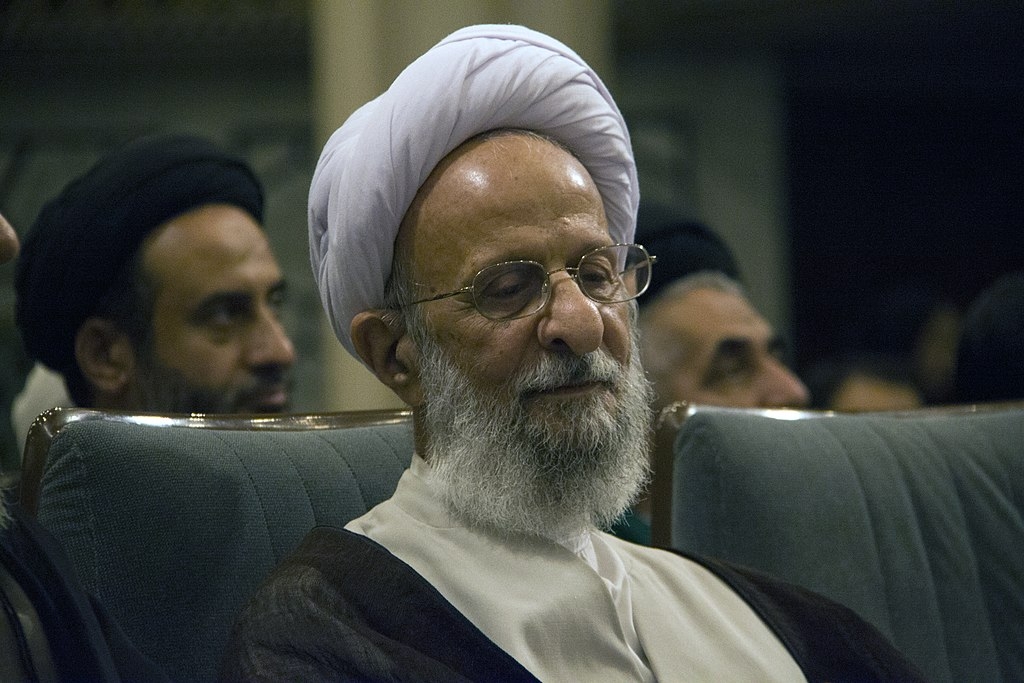
movement lost another of its iconic figures: Ayatollah Muhammad-Taqi
Mesbah-Yazdi (pictured). (Image source: Mostafameraji/Wikimedia Commons)
At a time that the ruling elite in Tehran were busy marking the
anniversary of the killing of Gen. Qassem Soleimani, the Khomeinist
movement lost another of its iconic figures: Ayatollah Muhammad-Taqi
Mesbah-Yazdi.
The 86-year-old cleric who changed his surname from Givehchi
(sandal-maker) to Mesbah (Arabic for lamp) was alone among Khomeinist
mullahs to have secured the title of "Super Scientist" (Allameh
in Arabic) from the establishment. He was marketed as "the greatest
living Islamic philosopher" and, as head of the Imam Khomeini Center of
Studies, the custodian of Khomeini's theologico-political heritage.
However, Mesbah-Yazdi's chief distinction may well have been his role
in providing a pseudo-religious basis for the cult of personality built
around the "Supreme Guide" Ali Khamenei. This is perhaps why Khamenei
took the unusual step of personally leading the "prayers on the mortal
remains" of the cleric.
To enable Khamenei to perform the ritual, his security forces had to deal with complex logistics.
Since the "Supreme Guide" is in lockdown because of coronavirus
pandemic, the corpse of the mullah had to be ferried in a military
helicopter to Khamenei's palace, to be ferried back for burial in south
Tehran.
The select group of individuals allowed to attend the ceremony had to
pass infection tests and observe other protocols on wearing masks and
social distancing. According to some accounts, when eulogizing "our
elder brother" and "one of the greatest teachers in Islamic history",
Khamenei was close to tears.
With a green light from the Leader's palace, other state-controlled
clerics also issued statements praising Mesbah-Yazdi's mostly imaginary
achievements in philosophy and theology. In another sign that the
traditional Shiite clergy are distancing themselves from the regime,
however, none of the non-state grand ayatollahs of Qom, Mashhad or Najaf
chose even to note Mesbah-Yazdi's demise, let alone mourn him.
Outside the official clerical circles, Mesbah-Yazdi was, perhaps, the
most hated figure in the Khomeinist sect, at times to a degree he
didn't deserve.
His popular nickname was "crocodile" (timsah in Arabic) because the shape of his face reminded cartoonists of the amphibian beast with a bad reputation.
I first met Mesbah-Yazdi in the 1970s when he was a follower of the
philosopher Ahmad Fardid who, in turn, cast himself as a disciple of the
German philosopher Martin Heidegger. Because Fardid knew no German, his
knowledge of Heidegger was based on scanty reading and misreading of
French or Persian translations.
Fardid's understanding of Heidegger could be summed up in two
erroneous beliefs: society's need for order and the need for an
unimpeachable leader to impose that order. He also claimed a visceral
hatred of Marxism in all its many different forms, a hatred that he
transmitted to Mesbah-Yazdi and other disciples such as Muhammad-Reza
Davari Ardakani who was to become the republic's official philosopher.
By the mid-1970s the group seemed prepared to accept the Shah as the
unimpeachable leader who could ensure the desired social order. The
Shah's regime saw the group as useful in combating Communism, which the
security services wrongly identified as the main threat.
That was poor timing, however, as Iran soon entered a revolutionary
moment and the Shah, rather than trying to protect the existing order,
decided to throw in the towel and go into exile to avoid bloodshed.
As Khomeini emerged as the symbol of the revolution, the group began
to see him as the ideal leader, a kind of Fuhrer with a turban.
To be sure some members of the group, including, Mesbah-Yazdi had
Ardakani had professed sympathy for Khomeini in his first anti-Shah
uprising in 1962 and had little difficulty to drop the Shah and follow
the mullah.
Such a switch, however, was harder for Fardid who was an Aryan
supremacist, seeing Islam as an Arab-Semitic phenomenon, and a man whose
knowledge of French wines was unrivalled in the Persian Empire.
Nevertheless, like his master Heidegger, who had discovered Hitler as
the ideal leader, Fardid, too, started making pro-Khomeini noises, thus
not only keeping his chair but, perhaps, even saving his life.
In the early years of the new regime, Mesbah-Yazdi became a TV star
by taking part in a number of debates with leaders of various Communist
groups, including the pro-Soviet Tudeh (Masses) Party.
By all accounts, "the crocodile" won most rounds. He had an advantage
in the fact that the Communists had to acknowledge the "Islamic" nature
of the revolution and new regime, plus Khomeini's infallibility (ismah in Arabic).
Mesbah-Yazdi's reputation as a great thinker soared when several
prominent Communists, including Ishan Tabari, chief theoretician of the
Tudeh Party, and Nureddin Kianuri, the party's leader, publicly
renounced Marxism and converted to the Khomeinist version of Shiism.
Other Marxist-Leninist protagonists such as Farrokh Negahdar, a
guerrilla leader, transferred to Europe to defend the revolution from
abroad.
Encouraged by those TV victories, Mesbah-Yazdi tried to find Islamic
sources for his Heideggerite misunderstanding. He found them in the imami
theory, according to which all power has a divine source and can only
be exercised by infallible Imams or their worthy heirs who act as
"nails" (mesmar in Arabic) that keep the world fixed and safe from falling into nothingness.
In that doctrine, ordinary folk are not qualified to take decisions
beyond quotidian matters which they understand. Mesbah-Yazdi liked to
quote the verse from the great Persian Sufi Molavi (Roumi in Arabic):
Oh God! Don't leave our affairs to us;
Woe betides us if you do.
Soon, Mesbah-Yazdi identified Khamenei as the "Ideal Leader" who must
be obeyed on all matters without question. According to the official
RJANEWS, Mesbah-Yazdi on his deathbed said he had only one regret:
Having had the honor of kissing Leader's hand, he had not yet kissed his
feet, which he longed to do.
Mesbah-Yazdi said: "Islam, today, can be summed up in one phrase: Absolute obedience to the Leader."
It was good of the Leader to allow elections for various positions
but no one should forget that this is a favor, not a right. That
Khamenei was the "Ideal Leader" until the return of the Hidden Imam was
clear from the fact that he had not made a single mistake in four
decades at the helm. Mankind today, is in a phase of "waiting" for the
Twelfth Imam as part of a divine scheme that lesser mortals could never
understand.
The choice offered to Iranians was between Marx and Heidegger, or between Communism and Nazism.
No one was allowed to join the debate and suggest, ever so modestly,
that maybe it was time for Iranians to use their own heads and begin
thinking themselves.
This article was originally published by Asharq al-Awsat
Amir Taheriwas the executive editor-in-chief of the daily Kayhan in
Iran from 1972 to 1979. He has worked at or written for innumerable
publications, published eleven books, and has been a columnist for Asharq Al-Awsat since 1987.
Plan to normalize status of 46 Jewish towns in Judea and Samaria shot down by Defense Minister Benny Gantz, as protests continue.
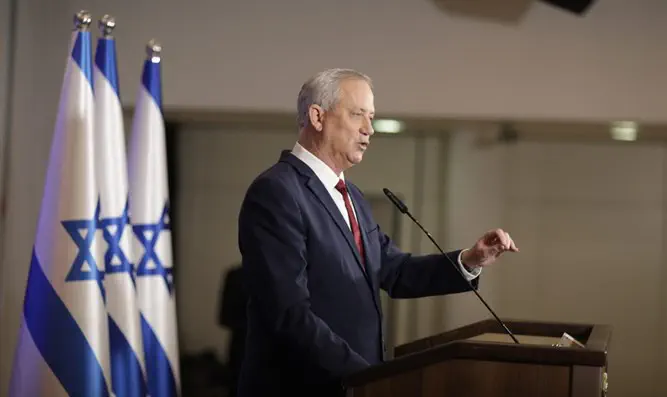
Benny Gantz Elad Malka
Defense Minister Benny Gantz (Blue and White) has ruled against a
plan to normalize the status of dozens of Israeli towns in Judea and
Samaria, Kan reported Sunday night.
According to the report, Gantz met with legal advisers and Minister
Michael Biton (Blue and White) Sunday morning in the Defense Ministry to
finalize his decision on the plan to normalize the status of 46
fledgling communities in Judea and Samaria, regulating their legal
status and enabling them to receive full integration into Israel’s
infrastructure networks, including for electricity.
But at the meeting, Gantz ruled against moving forward with the plan,
deciding not to normalize the status of towns which had not first
undergone a process to enforce building regulations in the towns in
question.
Gantz recently met with settlement leaders in a gathering hosted by
Minister Omer Yankelevich (Blue and White). During the meeting, Gantz
spoke with the leaders about the possibility of convening the Defense
Ministry’s Higher Planning Committee to approve building plans for Judea
and Samaria.
Galei Tzahal reported that Gantz promised “to help as much as possible”.
The Defense Minister’s office said in response that “Gantz has met
and will continue to meet with all the populations which require the
ministry’s help – from residents of Ashkelon and the Gaza frontier to
people on the front-line in the north, and also residents of Judea and
Samaria – both Jewish and Palestinian. The fact that the meeting and a
general statement about assistance have been turned into headlines is
puzzling.”
Earlier on Sunday,
the widow of Rabbi Raziel Shevach, joined the hunger strike of the
'Young Settlements' in Judea and Samaria Sunday in order to pressure the
government to regulate the communities and begin providing basic
services to them
Shevach, who lives in the community of Havat Gilad, told Arutz Sheva:
"I decided to join the hunger strike in the hope that it would not take
very long, with the understanding that things should move forward."