Sunday, December 12, 2021

"Is the Biden Administration at War with Israel?" - Guy Millière


by Guy Millière

[T]he purpose of opening the consulate is to recognize Palestinian claims to Jerusalem." — Eugene Kontorovitch, professor, George Mason University, Antonin Scalia School of Law, Israel Hayom, December 5, 2021.

  • "The US does not want to open a consulate merely to have a place for diplomatic connections with the PA [Palestinian Authority]. If that is all they wanted, they could easily do this by opening a mission in Abu Dis or Ramallah -- where most other countries conduct their relations with the PA... the purpose of opening the consulate is to recognize Palestinian claims to Jerusalem." — Eugene Kontorovitch, professor, George Mason University, Antonin Scalia School of Law, Israel Hayom, December 5, 2021.

  • The 1963 Vienna Convention on Consular Relations states that "a consular post may be established in the territory of the receiving State only with that State's consent". In other words, reopening the consulate may be done only with the consent of the Israeli government.

  • All this cannot be dissociated from the general hostile attitude of the Biden administration towards Israel from the moment it came to power.

  • Earlier in March, an internal memo from the US State Department was leaked to The National, a daily newspaper in Abu Dhabi, United Arab Emirates. The National reported that "The Biden administration memo recommends voicing US principles on achieving Israeli-Palestinian peace under a two-state solution framework 'based on the 1967 lines'".

  • The author of the memo is Hady Amr, Deputy Assistant Secretary for Israeli-Palestinian Affairs and Press and Public Diplomacy in the Biden administration, and also in charge of US negotiations with Israel and Palestinian organizations. It is hard to imagine that Amr was chosen as an "honest broker". Amr has a long history of anti-Israeli activities.

  • Amr also is the lead author of a report published by the Brookings Institution in December 2018 in which some proposals are made that could be regarded as disturbing. The report says that the United States must "reconnect" with Hamas, a fundamentalist terrorist group; seek "to create a Palestinian unity government integrating Hamas", and "compel Israel to make major concessions", even if it may "endanger Israel". The report never defines Hamas as a terrorist group, and never says that Hamas's goal is to destroy Israel. The report adds, "should Israel prove uncooperative with American efforts, the United States could signal it will move ahead anyway."

  • The behavior of the Biden administration towards Israel is all the more worrying in that at the same time, it places itself in a weak position regarding negotiations with Iran and seems ready to make a deal with the mullahs' regime at any price, in a resolution that has already been called "less for less", or, worse, "less for more".

  • An Israeli diplomatic service briefing recently announced the Biden administration is ready to accept a deal with Iran that includes only two elements: the removal of all international sanctions still imposed on Iran, and Iran's pledge to stop enriching uranium, which would mean that Iran's nuclear program would remain intact and that Iran's regional destabilization actions, including its threats against Israel, could continue.

  • Two days before the current negotiations began, chief Iranian Army spokesman Brigadier General Abolfazl Shekarchi said to the Iran Students News Agency (ISNA) that Israel's annihilation is his country's "greatest ideal before us and the greatest goal we pursue."

  • Iran claims, truthfully or not, that it already has enough enriched uranium to produce a nuclear warhead on short notice. On November 8, Iranian Foreign Ministry Spokesman Saeed Khatibzadeh, announced that Iran will only agree to sign a deal with the US if all sanctions are unconditionally lifted. "Either we agree on everything, or we agree on nothing," he said.

  • The US Biden Administration seems.... at a time finally of peace, deliberately acting to destabilize not only Israel's new coalition government but, more importantly, the entire region. The United States seems once again to be igniting, on the heels of its failure in Afghanistan, yet a second, unnecessary disruption, with all the carnage, global damage and pandemonium that will result. Those two historic upheavals will be the legacies of the Biden Administration. If Biden is looking for yet another disaster to notch on his belt, this is it.

"The US does not want to open a consulate merely to have a place for diplomatic connections with the PA [Palestinian Authority]... the purpose of opening the consulate is to recognize Palestinian claims to Jerusalem." — Professor Eugene Kontorovitch, Antonin Scalia School of Law, George Mason University. According to Dore Gold, formerly both Israel's Ambassador to the UN and Foreign Ministry Director-General, "The opening of the consulate on Agron Road in the west of the city will not only undermine Israeli sovereignty in the capital, it will also result in a serious withdrawal from the status Israel achieved in West Jerusalem prior to 1967." Pictured: The former US Consulate on Agron Road in Jerusalem, Israel, photographed in 2009. (Image source: Magister/Wikimedia Commons)

On May 2018, when the United States Embassy in Jerusalem was inaugurated on the 70th anniversary of the State of Israel's founding, the US consulate in Jerusalem became useless and quickly shut its gates. Now, in 2021, the current US Biden administration wants to reopen the consulate, "for the Palestinians", Arabs ruled by the Palestinian Authority.

Seeing this proposal as a threat to Israel's sovereignty over Jerusalem, Israeli Prime Minister Naftali Bennett declined the request.

"A U.S. consulate in Jerusalem to a foreign body", wrote the noted attorney and former US Ambassador to Israel David Friedman, and "clearly runs afoul of American law" because of the Jerusalem Embassy Act of 1995, passed overwhelmingly by both the U.S. House and Senate.

"With the opening of the U.S. Embassy in Jerusalem in 2018, there was no basis for a consulate to exist. The Jerusalem embassy provides consular services on a non-discriminatory basis to all Israelis and Palestinians — equal treatment for Jews, Christians and Muslims. The consulate thus became obsolete and a waste of taxpayer dollars. I know of no other country where the United States maintains an embassy and a consulate in the same city."

"The US Embassy in Jerusalem," asserts Eugene Kontorovitch, a professor at George Mason University's Antonin Scalia School of Law, "already provides consular services to the Palestinians."

"It is unheard of to have an independent consulate in the same city where a country has an embassy. The point of creating a separate consulate is to undermine former US President Donald Trump's recognition of Jerusalem... The US does not want to open a consulate merely to have a place for diplomatic connections with the PA [Palestinian Authority]. If that is all they wanted, they could easily do this by opening a mission in Abu Dis or Ramallah -- where most other countries conduct their relations with the PA... the purpose of opening the consulate is to recognize Palestinian claims to Jerusalem."

The consulate is not in the eastern part of the city, emphasized Dore Gold, formerly both Israel's Ambassador to the UN and Foreign Ministry Director-General. Reopening it would not only be signal "the desire to divide Jerusalem", he said, but constitute "an attempt to call into question Israel's sovereignty over the entire city".

"The opening of the consulate on Agron Road in the west of the city will not only undermine Israeli sovereignty in the capital, it will also result in a serious withdrawal from the status Israel achieved in West Jerusalem prior to 1967."

The 1963 Vienna Convention on Consular Relations states that "a consular post may be established in the territory of the receiving State only with that State's consent". In other words, reopening the consulate may be done only with the consent of the Israeli government.

Nevertheless, it seems that the Biden administration is considering taking lawless unilateral action once again, this time by placing a new sign on the consulate, and getting ready to trigger a diplomatic crisis between Israel and the United States. Aware that such a diktat could lead to a fall of the coalition government currently in power in Israel, the Biden administration is now trying to seduce the Israeli government by making offers to it.

To suggest in exchange the creation of economic ties between Saudi Arabia and Israel, however, is ridiculous: economic ties already exist between Israel and Saudi Arabia. Talking about the introduction of limited visa exemptions to Israeli tourists is no better: to imagine that an Israeli government could consider calling into question of the sovereignty of Israel over its own capital in exchange for visa exemptions is, in fact, an insult.

It appears, however, that the Biden administration, whatever the consequences, does not intend to give up on its destabilizing project.

All this cannot be dissociated from the general hostile attitude of the Biden administration towards Israel from the moment it came to power.

As early as January 26, less than a week after Joe Biden was sworn in, acting U.S. Ambassador to the United Nations Richard Mills announced that the Biden administration supported "the Palestinian people's legitimate aspirations for a state of their own and to live with dignity and security".

On April 7, US Secretary of State Antony Blinken published a statement declaring that the United States will "restart U.S. economic, development, and humanitarian assistance for the Palestinian people". He added:

"This includes $75 million in economic and development assistance in the West Bank and Gaza, $10 million for peacebuilding programs through the US Agency for International Development (USAID), and $150 million in humanitarian assistance for the UN Relief and Works Agency (UNRWA)".

The problem is that this US assistance will not go to the "Palestinian people", but to the Palestinian Authority -- which will doubtless use a significant portion of it to finance more terrorism. The PA still continues to finance terrorism, through a program often nicknamed "pay for slay". On May 10, the Jewish Institute for National Security of America published a text explaining that "By Renewing Palestinian Aid, America Is Funding Terrorism".

Part of the US aid money will go to Gaza, hence to Hamas, still officially designated as a terrorist organization by the State Department. Blinken, bizarrely, seems to see no contradiction between helping an entity governed by a terrorist organization and contributing to its purported "peacebuilding programs". UNWRA, despite effectively being an employment agency for Hamas terrorists, will thereby again receive US assistance. Many of its premises serve as arms depots for Hamas, but apparently that inconvenient fact has been set aside.

When, in May, the leaders of Hamas, apparently certain that there would be no American reaction, raised tensions in Jerusalem, incited riots on the Temple Mount, and launched a massive missile attack on Israel, the Biden administration for two days did not say a word. On May 13, answering a journalist, Biden simply said, "Israel has a right to defend itself". The next day, he added, "Palestinians -- including in Gaza -- and Israelis equally deserve to live in dignity, safety and security". He did not condemn Hamas, which, by firing on densely populated civilian areas, was committing a war crime; instead, he disingenuously put Hamas and Israel on an equal footing, with no distinction between the aggressor and the victim of that aggression.

On May 17, Biden asked Israel's Prime Minister not to "destabilize the region", as if it were Israel that had been guilty of initiating the violence and had no right to defend itself. Hamas and Biden both asked for a cease-fire; however, on May 20, as soon as one was in place, Biden, while quickly reaffirming that Israel did have a right to defend itself, immediately promised to "provide rapid humanitarian assistance and to marshal international support for the people of Gaza and the Gaza reconstruction efforts" -- without ever mentioning the damage suffered by Israel.

Since then, the guideline followed by the Biden administration towards Israel appears not to have changed.

On October 22, when the Israeli government accurately designated six Palestinian NGOs affiliated with the Popular Front for the Liberation of Palestine (PFLP) as "accessories to a terrorist organization", US State Department Spokesman Ned Price immediately charged that the State Department had not been informed:

"We are currently engaging our Israeli partners for more information regarding the basis for these designations. It is, to the best of our knowledge, accurate that we did not receive a specific heads-up about any forthcoming designations".

The State Department, it turns out, had been informed. Not only had it received the necessary information, but the Israeli government had expressed its readiness to provide any missing information.

The State Department appeared to be trying to ignore that the six NGOs designated by the Israeli government as affiliated with the terrorist group, PFLP -- Addameer, Al Haq, Bisan Center, the Samidoun Palestine Prisoner Solidarity Network, Defense for Children International Palestine, and the Union of Agricultural Work Committees -- had been engaging in suspicious activities, described in detail by NGO Monitor. Addameer, for instance, has been supporting Palestinians imprisoned in Israel for terrorism. Al Haq is defined by NGO monitor "a leader in anti-Israel lawfare" and "BDS campaigns". The Bisan Center aims to "enhance Palestinian's resilience" -- a word used by Palestinian organizations as a synonym for "resistance", a euphemism for killing Israelis -- for the Samidoun Palestine Prisoner Solidarity Network, which works to free Palestinian prisoners from Israeli prisons. Defense for Children International Palestine and the Union of Agricultural Work Committees raise funds internationally and use them to finance PFLP activities. If information was missing, the State Department could easily have requested it; instead, it chose to create a public incident.

On October 27, Israel approved the construction of 1,300 new housing units in settlements in Judea and Samaria, also known as the West Bank (of the Jordan River). Price delivered an extremely harsh condemnation of Israel:

"We strongly oppose the expansion of settlements, which is completely inconsistent with efforts to lower tensions and to ensure calm, and it damages the prospects for a two-state solution".

The proposed housing units, however, are to be built inside of settlements that already exist.

What does seem "completely inconsistent with efforts to lower tensions and to ensure calm" are the negative comments against Israel made by the Biden administration. Indeed, they have been leading to increasingly more violent remarks from the Palestinian leadership, who doubtless see themselves as newly empowered by the US.

Prospects for a two-state solution always have been -- and still are -- totally absent from the speeches of Palestinian leaders. Israel has offered the Palestinians many chances for two-state solutions and for peace; they have always been always rebuffed outright, without even a counter-offer. Now, prospects for a two-state solution are also totally absent from Israel's new leaders.

On September 24, in his prerecorded address to the UN General Assembly, Palestinian Authority President Mahmoud Abbas, now in the 16th year of his four-year term, falsely accused Israel of "apartheid" and "ethnic cleansing". He added:

"Circumstances on the ground will inevitably impose equal and full political rights for all on the land of historical Palestine, within one state".

The Biden administration keeps repeating that it wants a "two-state solution", but there are signs that it may want more.

On November 9, the Biden administration did not reject a UN resolution called "Assistance to Palestine Refugees". Instead, it voted to abstain. The text, among other things, says that "Palestine refugees are entitled to their property and income derived from it." Almost all of the people designated by the UN as "Palestine refugees" have never owned property in Israel and are not real refugees: they were born outside Israel and have never set foot in Israel. On January 14, former US Secretary of State Mike Pompeo wrote a tweet saying: "it's estimated <200,000 Arabs displaced in 1948 are still alive and most others are not refugees by any rational criteria".

The Biden administration, by abstaining, is therefore confirming a lie. "The resolution comes up every three years," wrote the journalist Yaakov Lappin. "The U.S. abstaining was a marked departure in policy -- all previous American administrations except the Obama administration have voted against this resolution."

Earlier in March, an internal memo from the US State Department was leaked to The National, a daily newspaper in Abu Dhabi, United Arab Emirates.

"The Biden administration memo recommends voicing US principles on achieving Israeli-Palestinian peace under a two-state solution framework 'based on the 1967 lines with mutually agreed land swaps and agreements on security and refugees'".

The author of the memo is Hady Amr, Deputy Assistant Secretary for Israeli-Palestinian Affairs and Press and Public Diplomacy in the Biden administration, and also in charge of US negotiations with Israel and Palestinian organizations. It is hard to imagine that Amr was chosen as an "honest broker".

Amr has a long history of anti-Israeli activities. On January 31, 2002, he published in Lebanon's Daily Star newspaper an article in which he said that he was "inspired by the intifada." Four months later, on May 8, 2002, he published in the same newspaper an article describing Israel as "occupied Palestine", accusing the Israeli government of "ethnic cleansing" and defining Israel's supporters in the US of being "pro-ethnic-cleansing activists".

Amr also is the lead author of a report published by the Brookings Institution in December 2018 in which some proposals are made that could be regarded as disturbing. The report says that the United States must "reconnect" with Hamas, a fundamentalist terrorist group; seek "to create a Palestinian unity government integrating Hamas", and "compel Israel to make major concessions", even if it may "endanger Israel". The report never defines Hamas as a terrorist group, and never says that Hamas's goal is to destroy Israel. The report adds "should Israel prove uncooperative with American efforts, the United States could signal it will move ahead anyway." The report proposes allowing the Palestinians to develop a "greater portion of West Bank Area C under full Israeli control" -- meaning a decrease in the territories of Judea and Samaria under Israeli control without the agreed-upon negotiations to determine any outcome. The report also supports the idea that a territorial decrease and a net weakening of Israel are necessary to achieve peace.

Everything the Biden administration does in Israel today seems to be drawn from that report, including the idea of reopening the U.S Consulate in Jerusalem "for the Palestinians".

The behavior of the Biden administration towards Israel is all the more worrying in that it places itself in a weak position with Iran regarding negotiations and seems ready to make a deal with the mullahs' regime at any price in a resolution that has already been called "less for less", or, worse, "less for more".

The Biden administration, by backing two openly genocidal enemies of Israel, Hamas and Iran, appears committed to destroying the only reliable democracy in the Middle East.

On February 19, State Department Spokesperson Ned Price announced that the United States was ready to "discuss a diplomatic way forward on Iran's nuclear program". He did not mention the multiple violations by Iran's mullahs of the 2015 nuclear deal. Not one member of the Biden administration criticized Iran's support for Hamas when Hamas attacked Israel in May.

In June, Iran, well before resuming negotiations on November 29, chose to replace President Hassan Rouhani with Ebrahim Raisi, "the butcher of Tehran", reportedly a criminal and fanatic. Iranian diplomats are not meeting directly with American negotiators, and only want to speak to European diplomats who act as intermediaries. The Biden administration agreed to that humiliating position.

Iran's then Foreign Minister Mohammad Javad Zarif posted a tweet on April 2, 2021, stating the goal of the mullah's regime: "removal of all sanctions". "No Iran-US meeting. Unnecessary", he added dryly: the Biden administration's team are not even in the room.

Two days before the current negotiations began, chief Iranian Army spokesman Brigadier General Abolfazl Shekarchi said to the Iran Students News Agency (ISNA) that Israel's annihilation is his country's "greatest ideal before us and the greatest goal we pursue."

An Israeli diplomatic service briefing recently announced that the Biden administration is ready to accept a deal with Iran that includes only two elements: the removal of all international sanctions still imposed on Iran, and Iran's pledge to stop enriching uranium, which would mean that Iran's nuclear program would remain intact and that Iran's regional destabilization actions, including its threats against Israel, could continue.

Iran claims, truthfully or not, that it already has enough enriched uranium to produce a nuclear warhead on short notice. On November 8, Iranian Foreign Ministry Spokesman Saeed Khatibzadeh declared that Iran will only agree to sign a deal with the US if all sanctions are unconditionally lifted. "We either agree with everything or disagree with nothing," he said.

On September 27, 2021, Israeli Prime Minister Naftali Bennett warned that "Israel is ready to act alone if necessary". The Biden Administration seems, therefore, at a time finally of peace, deliberately acting to destabilize not only Israel's new coalition government but, more importantly, the entire region. The U.S. seems once again to be igniting, on the heels of its failure in Afghanistan, a second, unnecessary disruption, with all the carnage, global damage and pandemonium that will result. Sadly, it looks as if the legacy of the Biden Administration will be those two historic upheavals. If Biden is looking for yet another disaster to notch on his belt, this is it.

"Is the Biden administration at war with Israel?" asks Martin Sherman, founder and CEO of the Israel Institute for Strategic Studies.

"Undermining the stability and safety of the only reliable democracy in the Middle East," wrote a physician, Dr. Shmuel Katz, "will... empower the enemies of good".

Israel, according to the journalist Caroline Glick, is strong enough to defeat its enemies. But, she warns, "Israel's security establishment needs to wake up from its American delusion. America does not have Israel's back. Only Israel has Israel's back".

On September 30, Hamas, assuming that it now has the full support of the United States, organized a conference in Gaza City to "prepare the future administration of a Palestinian state", scheduled to take power after the destruction of Israel. The conference defined what would be the fate of the Jews who would survive the war . The Jewish soldiers still alive, those at the conference decided, would all be killed. Non-combatant Jews would be allowed to leave "Palestine", but educated and economically useful Jews would have to remain, enslaved, and become third-class "tolerated" residents, knows as dhimmis, so that their skills could be used for building the new Palestinian state. Hamas's leader in Gaza, Yahya Sinwar, repeated that "the full liberation of Palestine from the sea to the river" is "at the heart of Hamas's strategic vision."

Did the Biden Administration even notice?


Dr. Guy Millière, a professor at the University of Paris, is the author of 27 books on France and Europe.

Source: https://www.gatestoneinstitute.org/18010/biden-administration-israel

Follow Middle East and Terrorism on Twitter

Understanding Arab strategy towards Israel - Dr. Mordechai Nisan


by Dr. Mordechai Nisan

Three cases of the strategy of stages in the context of the prolonged Arab-Israeli conflict, highlighting the primary Arab personalities who exhibited sophistication and creativity, with no small dose of duplicity.

Clausewitz wrote in On War, that "war is a mere continuation of policy by other means," a virtual political instrument. In the same way is politics itself a method of warfare. Not war as an isolated event, rather war as a long strategic vector for victory. Even then, the strategy adopted does not necessarily entail violent warfare because the instrumentalities of politics can be sufficient to overwhelm the enemy.

Habib Bourguiba

Habib Bourguiba, president of Tunisia from 1957-87, fired the first political shot for a staged approach to vanquish the Jewish state of Israel. Here was an Arab personality proposing, in 1965, a peace plan based initially on the United Nations and international legitimacy. Resolution 181 from 1947 would leave Israel with less territory than her post-'48 borders; and Resolution 194 from 1948 would inundate Israel with hundreds of thousands of Palestinian Arab refugees. If Israel would reject these steps for conflict-resolution, then the Arab stance would earn global vindication. Israel's political and legal legitimacy would erode.

While the inception of the PLO in 1964 awakened a call for revolutionary guerrilla warfare, Bourguiba offered a pacific solution with a vision of Arabs and Israelis living in harmony. His was a reasonable plan, eschewing demagoguery, and abandoning war. The Arab world, led by President Nasser of Egypt, resounded with horror at the mention of peace with Israel, denouncing Bourguiba for recommending that "we [Arabs] should respect stages." Drawing upon his own personal and national experience in the long and successful Tunisian struggle for independence, and the expulsion of French colonialism, Bourguiba concluded that the dissolution of Israel required time and patience.

After the Six Day War in June 1967 with the Arab loss, Cecil Hourani, a former adviser to President Bourguiba, developed the theme of containing, Arabizing, and Orientalizing Israel as the optimal strategy. A combination of foreign and domestic pressures would convince the Jews to prefer a return to their status under Arab rule rather than pursue the impossible dream of a secure and recognized Jewish state in Palestine. In 1974, Boutros Ghali, Egyptian academic who was subsequently appointed Minister of State for Foreign Affairs under Sadat, considered Israel's defense of its sovereignty to be "a very stiff attitude."

***

We shall examine three cases of the strategy of stages in the context of the prolonged Arab-Israeli conflict, highlighting the primary Arab personalities who exhibited sophistication and creativity, with no small dose of duplicity. The common thread is the realization that rational analysis must replace emotional exhilaration, or deep despair, in choosing politics over war at least in the initial stage of the undertaking.

Anwar Sadat

Anwar Sadat, president of Egypt from 1970-81, chose diplomacy in 1977 after attacking Israel in the 1973 Yom Kippur War.

In the 1970s, various intellectual, cultural, and political figures in Egypt introduced the new thinking into the Israeli-Arab issue. Mohammad Sa'id Ahmed began his book When the Guns Fall Silent with a challenging statement: "The time has come to think about what we dared not to think." He argued in favor of adopting peace with Israel as a method based on the model of superpower détente for which the culmination is not the resolution of conflict as such. The final goal, Sa'id Ahmed wrote, is "the extinction of the Zionist enterprise with the absorption of Zionism in the Arab expanse." Incrementalism and struggle, international pressure and Israel's withering from within, serve as the signposts for achieving a peace that would not signal the end of the conflict—but the end of Israel.

Other noteworthy Egyptian personalities who dangled the idea of peace with normalization of relations with Israel included Naguib Mahfouz and Ali Salam, but they really seemed to intend full acceptance of Israel. Rage, boycott, and assault, burst forth against this betrayal of an Arab consensus that negated the right of a Jewish state in the midst of the Arab world. Sadat, however, had other thoughts in mind, while his beguiling persona radiated with the aroma of political theatre.

Sadat traveled to Israel in November 1977 and launched his so-called "peace initiative" to chart a novel course in Middle East political history. His strategy, when unraveled, encompassed a stratagem that could trap Israel into submission.

Sadat had intimated in private conversations with fellow-Arabs, that he would sign a peace treaty—as he did in 1979—if that was the only way to recover the Sinai peninsula. Moreover, the Camp David Peace Treaty included a plan for Palestinian Arab autonomy in Judea, Samaria, and Gaza [soi-disant West Bank and Gaza Strip], which would serve as the political route toward the establishment of a Palestinian state. The essential purpose of such a state is the platform provided for irredentist disruption, invasion, and destabilization in Israel. Sadat referred in his Knesset speech in Jerusalem to the need for Israel withdrawing back to the June 4, 1967 lines, and to the need for a resolution of the Palestinian Question. Presumably, the latter matter required an additional Israeli capitulation to advance toward peace.

Sadat skillfully placed Israel on a political vector of territorial withdrawal. The Israel-Egyptian peace remained cold, no people-to-people peace evolved, anti-Semitism was the popular narrative in Egyptian society and culture. In the deal, Egypt got Sinai and, as Sadat bitingly remarked of the Israeli Prime Minister: "Menachem [Begin] got a piece of paper." Yet the deep significance of Sadat's initiative was the underlying precedent of future withdrawals on other fronts. The clever Egyptian president had said in a 1975 interview: "The task of our generation is to return to the [pre-] 1967 borders; afterward the next generation will carry the responsibility."

Yasir Arafat

Yasir Arafat assumed the leadership of the multi-faction Palestine Liberation Organization (PLO) established in 1964. Its covenant stated that Palestine is an Arab land, Zionism is a foreign invader, and the Jews do not qualify as a people. The only way to liberate Palestine was "armed struggle" (Art. 9) against the racist, fascist, and Nazi-like state of Israel.

In 1974, a decade later, the PLO formulated its "phased plan" to persevere along the path of liberation, but as a staged process. It would begin with the establishment of a "combatant national authority" over any territory liberated from Israel, and then advance toward the founding of a democratic Palestinian state over all of Palestine—in place of Israel. The 1988 Palestinian Declaration of Independence, while mentioning the 1947 Partition Plan with the ominous implication of Israel relinquishing areas from its 1948 victory, seemed a sign of moderation and acceptance of Israel. However, this very generous interpretation—in the year when a militant and violent Palestinian Arab uprising struck Israel—lacked validation.

Thereafter, the Oslo agreement in 1993 launched the PLO-phased plan onto the international and political stage. Israel recognized the PLO and Palestinian Arab rights, and agreed to interim arrangements for Palestinian self-government in the 'West Bank' and the Gaza Strip. Israel's military control on the ground morphed into incremental territorial pullbacks in 1994, 1995, 1997, and 1998.

Despite this, Arafat's overall response was incompatible with reconciliation: he called for jihad, recalled the 628 Hudaybiyyah episode in early Muslim history when Islam's prophet Mohammad violated his agreement with the Meccans—foreshadowing Arafat violating his agreement with the Israelis. His authorized murderous terrorist operations against the Israeli civilian public. Prime Minister Rabin was lost in moral confusion when he epitomized Israel's political drift from common sense by labelling Israeli victims of terrorism "sacrifices for peace."

Arafat dared to take the big idea of Palestine and lodge it, as Fouad Ajami wrote, in the filth and misery of the Gaza Strip. He set up an administration, formed a police force, and dreamt that the flag of Palestine will fly on the walls of the Old City of Jerusalem. Palestinian personalities like Mahmud Darwish and Edward Said were aghast at what was in their eyes Arafat's betrayal of the big idea; after all, Israel was not collapsing nor withering, and Arafat was grinning and cajoling with the enemy. They considered him a traitor for what was in their eyes the surrender of Palestine. However, Arafat knew better, playing to the Israeli and international audiences, displaying a gusto for histrionics (kafiyyeh, scruffy beard and all): he demanded, took, and asked for more. He designed a new political game and set in motion the PLO's phased plan.

The social and economic interaction between Israelis and Palestinians after 1967 offered a political mechanism to undo the integrity of the Jewish state. With the emergence of the Palestinian Authority in 1994, cooperation acquired an official and institutional foundation. This provided Palestinian Arab spokespersons with the idea that, in the end, one state would emerge for the two peoples. The disappearance of Israel and the rise of a secular democratic state including pre-'67 Israel and the post-'67 territories would be cast as a triumph for equality, reconciliation, and justice.

Ziad Abu Ziad, Faisal Al-Husseini, and Abu Iyad, were among Palestinian figures who advocated the one-state solution. A shared sovereignty arrangement according to George Abed, or a cantonal framework in one state according to Emile Nahle, were some of the formulations that Palestinians elucidated. Underlying the spirit of such proposals was the partial and interim quality of the Oslo accords. Nabil Shaath, senior PLO negotiator, openly declared that any agreement achieved was only temporary and non-obligatory while pursuing the goal to emasculate Israel's diminishing geo-strategic condition.

Meanwhile, considering the bottleneck on the 'West Bank' political playing field, whose basic feature was Israeli settlement and military rule, the PLO/PA was relentless in demanding a two-state solution. This tactical move, with its air of Palestinian moderation and concession, mobilized international opposition to ongoing Israeli "occupation." In itself, a Palestinian state in the 'West Bank' contiguous to Israel would provide the PLO with its Ho Chi Minh trail on the road to conquering Tel Aviv.

Oslo, in sum, was a strategy for ongoing war, in part violent and in part diplomatic, rather than for achieving an authentic peace. A November 2021 confirmation of the PLO-Fatah position, in anticipation of the 104th anniversary of the Balfour Declaration, appeared in a Palestinian Authority newspaper that explicitly called for the need "to put an end to the colonialist Zionist project [Israel]." Even though the Palestinian Arabs deceived the Israelis, at other times they did not flinch from telling the truth.

Mansour Abbas

Mansour Abbas (not to be confused with Mahmoud Abbas/Abu Mazen president of the Palestinian Authority), deputy head of the southern branch of the Islamic Movement in Israel, led his Ra'am (United Arab List) party in the March 2021 Israeli parliamentary elections to garner a commendable four seats. He then became a partner and participant in the Bennett-led coalition government and is playing an unexpected and critical role in Israeli politics.

Abbas presented a pleasant demeanor, while yet committed to what he called a "civilian jihad" for the benefit of the Arab community in the country. The Israeli government had declared illegal and banned the northern branch of the Islamic Movement in 2015, for having provided funds to Hamas (the Islamic Resistance Movement) which in its Charter (Art. 2) identifies as a wing of the Muslim Brothers.

The contemporary Islamic Movement in Israel is one of the many ideological offshoots in the world of the Muslim Brothers founded in Egypt in 1928. Its doctrinaire patron demands militancy and warfare to establish Islam as the "whole of life," in the words of Bernard Lewis. Secrecy and insurrection were part of the Brothers' modus operandi. However, the Israeli branch within the pre-'67 borders, cognizant of the anomaly of non-Muslim dominancy over Muslims in the Jewish state, chose to focus on seemingly benign and unobjectionable issues: the re-Islamization of Arab identity through prayer, education, and social activities, modulated by law-abiding behavior to bolster the self-defined Palestinian citizenry.

Mansour Abbas related that he was raised on the legacy of Sheikh Abdallah Nimr Darwish who founded the Islamic Movement in Israel. A collection of Darwish's writings and sermons, translated into Hebrew from the Arabic, appeared in 2021 under the title Islam is the Solution. Those four words constitute the quintessential theme that the founder of the Muslim Brothers, Hasan al-Banna, formulated. It is the slogan of the Islamic Movement, and recurs frequently when Darwish explained that Islam as a religion of peace and justice is the only true guide and remedy for all the ills of civilization. The Koranic revelation and the ensuing Sharia law, it follows, will provide a framework for co-existence and harmony between Muslims and non-Muslims (especially Jews and Christians), without oppression, occupation, and terror. Darwish presents Islam as a humanitarian religion and a bastion for tolerance and equality, ignoring that the Koran (Ch. 9: verse 33) obligates Muslims to make the true faith "triumphant over all religions." Indeed, the sheikh confidently stated that the missionary/propaganda Islamic dawa assures that "the future belongs to this religion."

Mansour Abbas took the sloganeering Darwish rhetoric to the forefront of a public campaign in the spring of 2021. This, with Ra'am joining the government coalition headed by Naphtali Bennett, leader of the rightist Yamina Party, signaled a revolutionary development for the Arab presence in Israeli politics. Abbas relegated to the margins of discussion the conventional and controversial Arab themes of Palestinian statehood, liberating Jerusalem, ending Israeli occupation, and calling for refugee return. He brought the discussion down to the non-political practicalities of local Arab government, personal security and gun controls, essential services, and infrastructure. Darwish had instructed his followers to respect the state and avoid any violence.

These teachings from both the mentor and now voiced by the student were designed to foster an environment of moderation and accommodation, promote Jewish-Arab understanding, and advance integration of the Arab minority within the Jewish-majority society in Israel. This was in stark contrast to the shrill political language, spewing vitriolic attacks against Israel and its army, typical of the alternative Joint Arab List (JAL) with its snarling and confrontational Members of Knesset.

At root, Mansour Abbas chose to adopt a political strategy that allowed, to use a phrase from Fouad Ajami, "the conquered Palestinian citizens of Israel from 1948 to jump on the wagon of the successful Zionist enterprise." This did not indicate acceptance of Zionism, as a broad Arab consensus never came to terms with the Jewish national revival and its culmination in statehood. The Arab narrative sees Zionism and its '48 victory as the cause of the Arab catastrophe (Nakba). Contrary to MK Ahmad Tibi of the JAL, whose arrogance allowed him to tell President Rivlin to his face in September 2019: "We [Arabs] are the owners of this land," Abbas meticulously avoided imperious and insulting language. For now, he ostensibly put the Palestinian Question on freeze, leaving it for a later stage. In public, he chose pragmatism over ideology.

Yet reticence has its limits. In his opening Knesset address on June 13, 2021, with the launching of the new government, Mansour Abbas referred to the "historic injustice that has been our [Palestinian Arab] fate over the years because of the [Israeli] policy of discrimination." For him, was not the very founding of Israel in Palestine in 1948 the core injustice? On June 27, Abbas gave an interview with Al-Quds Al-Arabi newspaper in which he directed his present thoughts to "realizing our [Arab] civil, national, and religious rights" in the Israel of 1949. Echoing his mentor's outlook, Abbas expected civil equality for the Arab citizens, without submission or inferiority, in peace and mutual security, with cooperation and tolerance between the two [Jewish and Arab] peoples. The language and tone were wrapped in a veil of secrecy around the long-term goal of the Islamic Movement. Boualem Sansal, a noteworthy Algerian novelist, had cautioned the public about Islam in France—perhaps also fitting for Islam in Israel—that initially "the threat is invisible."

More than seventy years following Jewish statehood, the exceptional advances that Israel registered offered the Arab citizens opportunities to participate in the benefits of a modern society. In return for Ra'am's pivotal role in providing Bennett with a majority in the Knesset, the 2021-22 budget committed a whopping 35 billion shekels for development in the Arab sector. Israel has never demanded that Arabs sacrifice their multiple Muslim and Palestinian identities as a sign of allegiance to the state, or as a condition for state funding. In short, integration 'yes', assimilation 'no'.

The Muslim Movement in Israel declares its commitment to Israel as a formal and legalistic affirmation, but a recent news report in October 2021 related that two senior members of Ra'am ran a fund revealingly called "48 Aid" that transferred money to a Hamas outfit. The movement's commitment to Islam is indeed absolute. Democracy is not the solution—because Islam is the solution. The green flags of Islam, symbolic of the Muslim Brethren and the Islamic Movement, adorned the stage at a speech by MK Mansour Abbas to his followers on April 3, after the dramatic achievement by Ra'am in the March Israeli elections.

Abdallah Darwish quoted the Koran (ch. 16) that, with the help of Allah, Muslims must be patient. Abbas does not boycott Israel nor publicly malign her. He just does not think she has a right to exist as a Jewish state as defined in the 2018 Basic Law: Israel the Nation-State of the Jewish People. Mansour Abbas has intimated that some matters, like a Palestinian state, should be left for later. Nonetheless, while his party and electoral agenda tackles problems in local Arab life in Israel, dealing with roads and transportation, electricity and housing, Abbas talked about political matters with King Abdullah II when he responded to an invitation to visit Amman in early November.

Deception & Delusion

The cumulative policies of Sadat, Arafat, and Abbas, over the last decades constitute a pattern, multiple links in a strategy of stages to diminish, demoralize, and finally demolish the Jewish state.

The comprehensive Arab campaign revolves around three circles. Egypt represents the external circle, to which we attribute the Sinai withdrawal, also pullbacks from south Lebanon in the year 2000, and the transfer on the eastern frontier of lands to Jordan in 2018. The Palestinians represent the internal circle with withdrawals from parts of Gaza and the Jericho salient in 1994; then from cities, villages and rural areas in Judea and Samaria in 1995, Hebron in 1997, parts of Samaria in 1998; then the total pullback from the Gaza Strip in 2005, including areas in northern Samaria. Arabs in Israel proper represent the domestic circle, launching a political flight from the Zionist bedrock of Israel's existence. Now the ideological and national foundations of Israel are tottering with concessions to the Islamic Movement and accepting its participation at the heart of political affairs.

The domestic element draws the circle to the source of things in the Arab Grand Strategy. It constitutes the final phase, reaching the climax and pointing to the finale. The Arabs look to the future, though Israel is strapped to the present. Mansour Abbas would concur with Sheikh Abdallah Azzam, a Palestinian who journeyed from Jordan to Afghanistan to preach jihad against the Soviet invasion, who wrote that "Palestine is the foremost Islamic problem." However, that problem can be resolved by politics and not necessarily—or only—through warfare.

Through Nietzsche, we can better understand how a democracy—like Israel's—experiences a loss of will. An excess of tolerance and pluralism, with no hard sacred values, dilutes the judgment and seeps the energy from people in leadership. No matter how bizarre the demand, leaders in a democracy are sensitized to say "yes" to all and every disaffected and disgruntled groups. The combination of victimology and indoctrination fill the echo chambers, and the media engage in a brainwashing assault on behalf of the alleged underdog—the Arabs. Of a like mind with John Stuart Mill and Lord Acton, the activists and propagandists list the benefits of freedom and vitality that flourish in a country of many nationalities, lodged in a common union.

The Israeli experience, still unfolding, carries an alternative and ominous meaning. The fact that Arab citizens weigh in heavily in demographic proportions of crime and violence against both fellow-Arabs and Jews is a menacing sign. Poll findings revealing Arab rejection of a Jewish-majority state gain scant public attention. Alongside that, Arab employment in high-profile jobs, from professors to pharmacists, free from any discriminatory hiring practice, is a noticeable social reality. Active support from the Israeli Left combined with the tacit support of the Israeli Right accelerate the emerging peril to the integrity of the Jewish nation-state. Jews will increasingly not feel safe and at home in their own country.

Shmuel Trigano has written persuasively on the destructive potential of the ideology of multi-culturalism, post-modernism without truths, minority rights for all, and identity politics, as an immediate, present, and future danger to the state of Israel. The mayor of the Arab town of Taibe, who is close to Mansour Abbas, gave voice to what is obvious to him and his Palestinian fellow-compatriots: "Taibe is part of Palestine," adding, "You [Israel] cannot erase our identity."

Memory is at the root of identity. It can also serve as an impetus for action. It becomes unacceptable to forgive what is a scalding old grievance that future generations must address. Recall the struggle for justice in the story of the King of Amon in the Book of Judges, who after three hundred years went to war against Israel for having conquered his lands long earlier. The Arab strategy of stages against Israel is resolute and tireless. Is it too harsh to characterize the present stage in the Arab strategy as going for Israel's political jugular?

The success of a sly deception depends not only on the skill of the deceiver but also on the indiscretion of the deluded. Sadat fooled Begin who thought there would be a warm peace with Egypt. Arafat fooled Rabin who thought there would be peace with the Palestinians. Abbas is now fooling Bennett who thinks it will be beneficial for Israel to conciliate and integrate the Arabs in Israel.

The wheel turns and stops always with Israel's misunderstanding.


Dr. Mordechai Nisan lectured in Middle East Studies at the Hebrew University of Jerusalem. He has written extensively on political topics. Reposted from New English Review.

Source: https://www.israelnationalnews.com/news/318436

Follow Middle East and Terrorism on Twitter

Being Pro-Palestinian Actually Means Being Anti-Israel - Richard L. Cravatts


by Richard L. Cravatts

It is the pro-Palestinians who are singularly responsible for the majority of hostility on campuses today, not some other, vaguely defined and most invisible group of white supremacists, fascists, or right-wing lunatics that haunt the liberal mind

Writing in 2009 about the Israeli/Palestinian conflict, the insightful Palestinian/Israeli journalist Khaled Abu Toameh observed that, “What is happening on the U.S. campuses is not about supporting the Palestinians as much as it is about promoting hatred for the Jewish state. It is not really about ending the ‘occupation,’” he wrote, “as much as it is about ending the existence of Israel.”

And that is what those who observe the campus activism against Israel have never fully understood: that being pro-Palestinian, by definition, means being anti-Israel.

It does not involve urging the Palestinian leadership to come to terms with Israel about long unsettled negotiation points about borders, Jerusalem, the return of refugees, and other key issues. Is has never involved advising Palestinians to abandon terror, or so-called “resistance,” as a tactic for advancing political ambitions.

Those helping to promote Palestinian self-determination have not been firm in suggesting that Palestinian leaders and other officials end incitement, stop the indoctrination of children in textbooks and lesson plans that demonize Israel and Jews and teach children to look at the Jewish state as an abomination, an illegal regime, a perverse example of the malignancy of Jews who steal land, commit genocide, and oppress an innocent indigenous people.

The Palestinians have never been told by their supporters that it morally repugnant and diplomatically lethal to engage in a “pay to slay” program through which terrorists and their families were financially rewarded with $183 million in 2017, for example, garnered from foreign aid heaped on the Palestinians, purportedly for humanitarian aid.

In debating the Israeli/ Palestinian conflict, social justice activists, of course, demonstrate their hypocrisy by endlessly dwelling on the many evils of Israel without bothering to examine or measure the Palestinians’ own central role in contributing to the many pathologies endemic to their civil society and institutions. Like many Western elites do when choosing sides, social justice warriors infantilize the Palestinian victim and assume he has no agency to ameliorate his own conditions.

Many academics in the humanities and social sciences, including activists as disparate as Black Lives Matter, Students for Justice in Palestine, and the National Association of Women’s Studies, increasingly find a linkage as they seek to affirm the rights of the victimized and name the villains responsible for this oppression—foremost among them, Israel.

The more that seemingly unrelated instances of oppression can be conflated, it is thought, the greater the ability to confront these oppressors and dilute the negative effect they have on their specific victims and on society at large. This trend has been called “intersectionality,” and for social justice warriors, to know one victim group is to know any victim group—with Israel being a tempting and habitual target of their opprobrium.

That has meant, as one vexatious example, that the notoriously anti-Israel Jewish Voice for Peace, working in concert with Students for Justice in Palestine and other campus radicals, have promoted the mendacious “Deadly Exchange” lie which accuses Israel of being complicit in promoting racist violence in the United States by training police officers on how to arrest and neutralize black suspects, using the techniques and procedures gleaned from their long oppression of Palestinians. So, the brutality, racism, and cruelty of Israel is so malignant and powerful that it negatively affects blacks in America and the intersectional circle of oppression is closed in this perverse narrative.

Victim groups on campus, including the pro-Palestinians, claim that they join forces to fight for justice, equity, and liberation, that, as SJP disingenuously claimed, “The fight against anti-Semitism must be linked to the wider fight against oppression — including the fight against Palestinian oppression.” But it is the pro-Palestinians who are singularly responsible for the majority of hostility on campuses today, not some other, vaguely defined and most invisible group of white supremacists, fascists, or right-wing lunatics that haunt the liberal mind.

In fact, as studies by the AMCHA Initiative, as one example, have shown, it is the presence of groups like SJP on campuses that is directly responsible for fomenting anti-Semitic expression and behavior on university campuses, not white supremacists. AMCHA reports revealed that “Schools with instances of student-produced anti-Zionist expression, including BDS promotion, are 7 times more likely to have incidents that targeted Jewish students for harm than schools with no evidence of students’ anti-Zionist expression and the more such anti-Zionist expression, the higher the likelihood of incidents involving anti-Jewish hostility,” meaning that BDS activism spreads outward on a campus, tainting the overall environment for Jewish students who may or may not even be directly involved in the Israeli/Palestinian debate.

Equally serious was the report’s findings that SJP’s presence resulted in “incidents of Israel-related anti-Semitic harassment increase[ing] 70%.” And, based on SJP’s obsession with calls to boycott only Israel and suppress any and all dialogue in support of Israel, Zionism, or Jews—SJP’s actions on campuses have the end effect that “attempts to exclude Jewish and pro-Israel students from campus activities more than doubled, with expression calling for the total boycott or exclusion of pro-Israel students from campus life nearly tripling.”

Since its founding in 1993, SJP has a long history of bringing vitriolic anti-Israel speakers to their respective campuses (now numbering some 200 with chapters), and for such collateral activities as sponsoring the pernicious Israeli Apartheid Weeks, building mock “apartheid walls,” and sending mock eviction notices to Jewish students in their dorms to demonize Israel and create empathy for the Palestinian Arab cause.

SJP has a record on campuses nationwide of a pattern of radicalism, misbehavior, toxic speech, and regular instances of overtly antisemitic behavior. AMCHA reports also “indicate a significant increase in actions which directly harm or threaten Jewish students, including physical and verbal assaults, destruction of property, harassment discrimination and suppression of speech, at schools with an SJP or similar anti-Zionist chapter.”

At University of Toronto, Scarborough, anti-Israel students recently voted to forbid Kosher food on campus unless the suppliers disavowed support for Israel. CUNY law students just introduced a resolution condemning Birthright trips to Israel, as well as Stand With Us, Hillel, and other Jewish, pro-Israel groups on their campus as dangerous and destructive and wants them purged from campus, along with any Zionist ideology or support for the Jewish state.

At McGill, based on their spurious charges that Israel is a colonial, apartheid, racist regime engaged in ethnic cleansing, land theft, and an ongoing genocide of an indigenous people, anti-Israel groups and individuals outrageously petitioned the administration that, in light of these accusations, any pro-Israel ideology or expression on campus should henceforth be considered to be hate speech, or as they defined it, “violent, hateful, and harmful speech.”  

And while Zionism, Jewish self-determination, is under attack on campuses across the country and in Canada, pro-Palestinian activists, nevertheless, claim that their hostility towards Zionism has nothing to do with anti-Semitism and their loathing of the world’s only Jewish state has nothing to do with Jew-hatred.

That these campus activists are willing, and ready, to sacrifice the Jewish state, and Jewish lives, in the name of social justice and a specious campaign of self-determination by Palestinian Arabs, shows how morally corrupt and deadly the conversation about human rights has become.

And that their dangerous and toxic activism is often genocidal in promoting the destruction of the Middle East’s only democracy, this odious campaign for social justice social should frighten us all.

Photo credit: Alisdare Hickson CC BY-SA 2.0 license


Richard L. Cravatts, Ph.D., a Freedom Center Journalism Fellow in Academic Free Speech and President Emeritus of Scholars for Peace in the Middle East, is the author of Dispatches From the Campus War Against Israel and Jews.

Source: https://www.americanthinker.com/articles/2021/12/being_propalestinian_actually_means_being_antiisrael.html

Follow Middle East and Terrorism on Twitter

China nakedly threatens U.S. troops - Monica Showalter


by Monica Showalter

Where does that emboldening come from, Joe?

To get a sense of Joe Biden's "experienced leadership" in foreign affairs, consider how China is suddenly talking

According to American Military News (hat tip: Trending Politics):

Chinese state media threatened on Thursday that China will attack U.S. troops who attempt to defend Taiwan if China starts war with the island nation. The U.S. has said that China is readying for an attack on Taiwan.

China’s Global Times wrote, “It is credible that the PLA will heavily attack US troops who come to Taiwan’s rescue. Such credibility is increasingly overwhelming the deterrence that US troops may have.”

China conducts near-daily warplane flights around Taiwan, who governs itself as an independent nation, but which China claims as its own territory. China also conducted live bombing drills on islands in the South China Sea last week as another measure to intimidate and pressure Taiwan. The U.S. has continued its freedom of navigation flights and warship transits in the region to ensure free passage for all nations in the disputed territory.

“If Washington supports the Taiwan authority’s path of seeking secession and encourages the Taiwan authority to rely on it, then reunification by force will definitely happen. The more the U.S. and the island of Taiwan collude, the sooner reunification by force will come,” the Global Times added.

It sounds like they are spoiling for a fight. The American Military Times notes that bluster like this is not uncommon from China but they've never directly threatened to attack U.S. troops as they are now. Anyone got confidence that Chairman of the Joint Chiefs of Staff, Gen. Mark Milley, the man who botched Afghanistan, and who telephoned up his Chinese counterparts to warn them about that awful warmonger Trump and how he'd stop him, would know what he is doing on this front? Based on this report, he was sidling up to jackals ready to attack. He couldn't scare a fly now.

 The belligerance comes at a bad time, when Vladimir Putin has been rattling his sabres against Ukraine, probably does intend to invade in 2022, and has otherwise been aligning with China in military exercises. Some experts have been warning for years that the U.S. should be doing all in its power to separate China from Russia and play them off against one another instead of letting them pair up with each pursuing their imperial ambitions from west to east. What's Joe been doing?

Old foreign policy pro Joe Biden doesn't seem to have been doing this and the results now speak for themselves. What a nasty start to what looks like a newly emboldened China's long war against the West.


Monica Showalter

Source: https://www.americanthinker.com/blog/2021/12/china_nakedly_threatens_us_troops.html

Follow Middle East and Terrorism on Twitter

Titleist bans “Let’s Go Brandon” personalization of its golf balls - Eric Utter


by Eric Utter

“F Trump” and “Kill Trump” are OK, but “Let’s Go Brandon” isn't?

Don’t try to personalize your Titleist golf ball with the popular phrase “Let’s Go Brandon.” The golf equipment company bans customers from doing so on its website, alleging that the saying is “inconsistent” with its “values or brand identity.” When one tries to customize a golf ball with that message, one receives a notification stating: “Sorry, one or more of the words you have chosen cannot be used. Please see our Terms and Conditions to learn more about what we will imprint.”

Titleist’s Terms and Conditions reads: "Acushnet Company [the parent company of Titleist] reserves the right to reject orders for imprints on our products that may, in our sole discretion, be inconsistent with our company values or brand identity, including, but not limited to logos, designs and/or personalizations that are negative in nature, advocate violence or illegal activity, or are slurs, hateful, threatening, libelous, defamatory, vulgar, obscene or pornographic."

As Fox News noted, "It is unclear which of those categories the phrase 'Let’s Go Brandon' violated." The outlet added, "Certain political and vulgar messages that Fox News Digital tested on the website did not receive the same error message, including 'F Trump,' 'ACAB,' 'Antifa,' 'Kill Cops,' 'Impeach Trump,' and 'Kill Trump.'"

“Let’s Go” is an upbeat exhortation. “Brandon” is a common name. Whether apart or together, they/it are certainly not “threatening,” “libelous,” “vulgar,” “obscene,” or “pornographic.”

“Let’s Go Brandon” is not a slur, which means an insinuation or allegation. Nor is it defamatory, the definition of which is “damaging the good reputation of someone.” Neither does it advocate violence or illegal activity.

Is it hateful? Not on its face. Its symbolic or figurative meaning could conceivably be construed as such, but even that is relatively mild compared to so much else in our coarse modern society. And it is as nothing compared to what was directed at Trump (by individuals, groups and corporations) every day of his presidency, no obfuscation, restraint, or decorousness needed.

So “F Trump” and “Kill Trump” are not “inconsistent” with Acushnet’s “company values or brand identity” but “Let’s Go Brandon” is? “F Trump” and “Kill Trump” are not “negative in nature” but “Let’s Go Brandon” is? That is the result when a company’s only value and brand identity is appeasing the woke mob to maximize profit, every other consideration be damned.

I wonder if one could personalize a Titleist product on its website with “Titleist Sucks!?”

Sadly, like many other corporations these days, the Acushnet Company appears to have no rationality, no integrity, no soul, and, ironically, no balls.


Eric Utter

Source: https://www.americanthinker.com/blog/2021/12/titleist_bans_lets_go_brandon_personalization_of_its_golf_balls.html

Follow Middle East and Terrorism on Twitter

'For every missile Iran launches through proxies, Israel will target Tehran' - Boaz Bismuth


by Boaz Bismuth

"Iran is governed by a radical Islamic regime that wants to obtain nuclear weapons in order to use them, that is their goal. There's no point in talking to people who want to push you into the sea," former Jerusalem mayor Likud MK Nir Barkat tells the Israeli-American Council conference in Florida.


'For every missile Iran launches through proxies, Israel will target Tehran'
Likud MK Nir Barkat | File photo: Yehoshua Yosef

"If Iran gives an order to launch missiles [into Israel] from Lebanon, we must attack Tehran," former Jerusalem mayor and current Likud MK Nir Barkat told Israel Hayom's Editor-in-Chief Boaz Bismuth, at the Israeli-American Council conference in Florida on Saturday. 

Barkat, who is currently in the United States on a public diplomacy tour, stressed that "when we talk about the Iranian threat, we are all one people – the opposition and the coalition in Israel as well as the US. Iran is governed by a radical Islamic regime that wants to obtain nuclear weapons in order to use them, that is their goal. There's no point in talking to people who want to push you into the sea."

Barkat added, "We also need to be aware of the existing threat. There are about 250,000 missiles around our borders. We need to tell the Iranian regime that for every missile fired at Israel from one of its proxies, our target will be Tehran. We need to be prepared for the first war with Iran, and the only way to prevent a war is to prepare for it seriously. The Iranians need to understand that we will attack forcefully. I want them to be afraid before they press the button to attack Israel."

In the last few months, Barkat led the efforts to prevent the reopening of the United States' Palestinian consulate in Jerusalem. He garnered the support of 200 members of Congress who sent a letter to President Joe Biden opposing the move. In addition, 36 senators submitted a bill to block the reopening.

"Opening the consulate would divide Jerusalem, and that is why we will never let that happen," Barkat said.

With regard to internal Israeli politics, the lawmaker said, "When we [Likud] return to power, we will promote Israel much faster, because the [current] government has no vision. There are elements from the Left, the Right, Arabs, they have completely different angles. We need a government with a clear vision to promote the Golan, the Negev, the Galilee and Judea and Samaria."

When asked about the polls that predict his victory in the Likud leadership race after Opposition Leader Benjamin Netanyahu, Barkat said, "I am part of the Likud, and we are a democratic party in a democratic state. For me, the day Netanyahu decides to leave, primaries will open and I will run and win."

Barkat was also asked whether Netanyahu constitutes an asset or a burden for the Likud now, to which he replied, "I said before that we are a democratic party and we are a democratic state, so the people who need to determine assets or burdens are the Likudniks and the people of Israel – they will decide. They are the ones who decide at every election, as they did last time, and whatever they decide, we will accept."


Boaz Bismuth

Source: https://www.israelhayom.com/2021/12/12/for-every-missile-iran-launches-through-proxies-israel-will-target-tehran/

Follow Middle East and Terrorism on Twitter

2nd-Temple-period synagogue found where Gospel’s Mary Magdalene was born - Rossella Tercatin


by Rossella Tercatin

The building is the second synagogue from the time uncovered in Migdal, a prominent Jewish settlement that was also the main base of Flavius Josephus, historian and anti-Roman rebel commander.


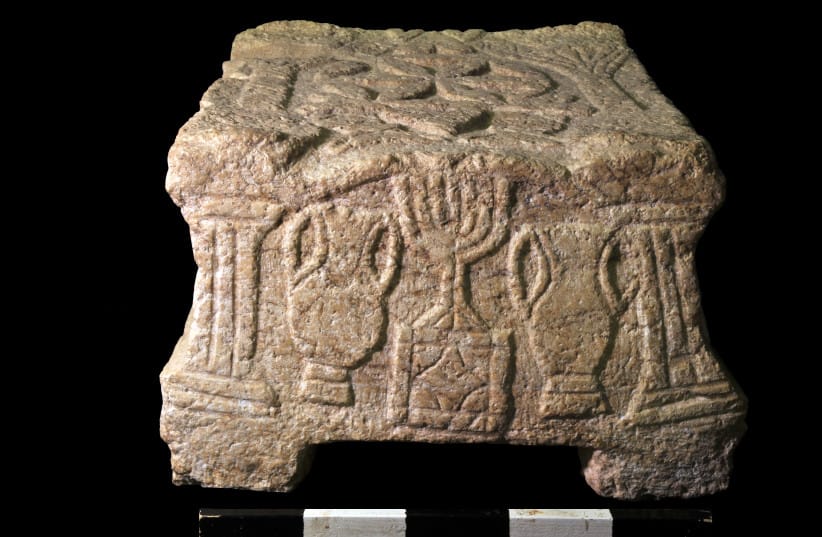
Magdala stone exhibited for the first time in Israel at Yigal Allon Center  (photo credit: EINAT AMBAR ARMON/ISRAEL ANTIQUITIES AUTHORITY)
Magdala stone exhibited for the first time in Israel at Yigal Allon Center
(photo credit: EINAT AMBAR ARMON/ISRAEL ANTIQUITIES AUTHORITY)

A 2,000-year-old synagogue was discovered in the ancient Jewish settlement of Migdal in Galilee, the second synagogue from the Second Temple Period uncovered in the town, also known as Magdala. The location is prominently featured both in the Jewish-Roman historian Flavius Josephus’ writings, and as the birthplace of Mary Magdalene in the Gospels.
 
“The discovery of a second synagogue in this Galilean settlement casts light on the social and religious lives of the Jews in the area in this period, and reflects a need for a dedicated building for Torah reading and study and for social gatherings,” said Dina Avshalom-Gorni, one of the directors of the excavations. “We can imagine Mary Magdalene and her family coming to the synagogue here, along with other residents of Migdal, to participate in religious and communal events.”
 
According to the Gospels, Mary Magdalene – also known as Mary from Magdala – was one of the women who traveled with Jesus and witnessed his crucifixion and resurrection.
 
In the first century CE, Migdal was also the main base of Yosef ben Matityahu (Flavius Josephus), who served as commander of the rebellion against the Romans in Galilee before he surrendered to them and eventually obtained Roman citizenship.
 
Ancient synagogue uncovered in Migdal, Galilee. (credit: COURTESY OF UNIVERSITY OF HAIFA) Ancient synagogue uncovered in Migdal, Galilee. (credit: COURTESY OF UNIVERSITY OF HAIFA)
 
The first synagogue was uncovered in the Migdal in 2009, when an excavation by the Israel Antiquities Authority unearthed Jewish ritual baths (mikvaot), streets, a marketplace and industrial facilities. A unique artifact stood in the middle of the synagogue’s main hall: a large stone portraying the Second Temple of Jerusalem, with a carved seven-branched menorah on one of its sides. It represented a crucial discovery because the depiction was engraved in the stone when the temple was still standing.
 
“The fact that we have found two synagogues shows that the Jews of the Second Temple period were looking for a place for religious, and perhaps also social, gatherings,” said Zinman Institute head Prof. Adi Erlich. “The stone bearing a relief of the Menorah from the other synagogue at Migdal, suggests that the local Jews saw Jerusalem as their religious center, and their local activities took place under this centrality.”
 
The newly discovered synagogue was shaped as a square and built in basalt and limestone. It featured a main hall and two other rooms. The main hall was coated in white plaster and featured a stone bench along the walls, also coated in plaster. One of the smaller rooms presented a stone shelf. According to the experts it might have been used to store Torah scrolls.
 
“The synagogue we are excavating now is close to the residential street, whereas the one excavated in 2009 was surrounded by an industrial area,” Erlich also said. “Thus the local synagogues were constructed within the social fabric of the settlement.”
 
The excavation was initiated as a salvage excavation prior to construction works at the Migdal intersection. According to Israeli law, all development projects need to be accompanied by such an excavation.
 

Rossella Tercatin

Source: https://www.jpost.com/archaeology/2nd-temple-period-synagogue-found-where-gospels-mary-magdalene-was-born-688519

Follow Middle East and Terrorism on Twitter

Iran: Exporting Oil or Revolution? - Amir Taheri


by Amir Taheri

His [Khamenei's] recipe is simple: Live from one day to another but, even if you can't export oil, make sure that you can continue exporting revolution.

  • This may be an exaggeration, but the Kayhan editorial says that without the "Resistance Front" there would be no Iran and, of course, no Iraq, no Syria, no Lebanon, and no Yemen. Control of the four Arab countries is vital for protecting the Islamic Revolution.

  • In that context, Tehran has been pumping cash and weapons into regimes in Venezuela, Nicaragua and, until recently, Zimbabwe. It has also been in alliance with anti-war groups in Europe and North America while funding numerous non-Muslim politicians and celebrities across the Middle East.

  • Non-Shiite Palestinian outfits such as Hamas and Islamic Jihad have also been on the payroll of the "Resistance Front" for decades.

  • [W]e now know that the "Supreme Guide" is ready to take bread away from Iranians so that he can continue fattening Bashar al-Assad, Hassan Nasrallah and scores of other "for sale" personalities across the world.

  • To be able to do that, Khamenei is counting on US President Joe Biden to ease some of the sanctions imposed by President Donald Trump.

  • Zarif estimated that Tehran needed a minimum of $60 billion a year to pay its military and security personnel, keep the "Resistance Front" afloat and continue "exporting" revolution.

  • Khamenei demands that the P5+1 deposit $3 billion a month in a German bank and another $1 billion monthly in a French bank from Iran's frozen assets, while allowing the Islamic Republic to increase oil exports to 2.5 million barrels a day.

  • His [Khamenei's] recipe is simple: Live from one day to another but, even if you can't export oil, make sure that you can continue exporting revolution. The Khomeinist system can survive without exporting oil, but can't do so if it stops exporting revolution.

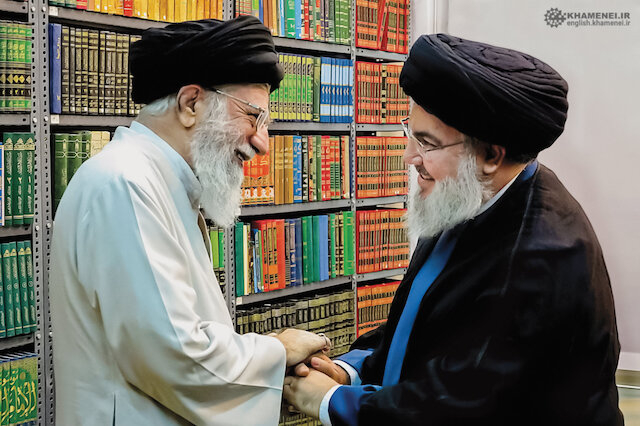
We now know that the Iran's "Supreme Guide" Ali Khamenei is ready to take bread away from Iranians so that he can continue fattening Syrian President Bashar al-Assad, Lebanese Hezbollah chief Hassan Nasrallah and scores of other "for sale" personalities across the world. Pictured: Khamenei meets with Nasrallah, head of Lebanon's Hezbollah terrorist organization. (Image source: khamenei.ir)

"The greatest achievement of Imam Khomeini's Islamic Revolution!"

This is how the daily Kayhan in Tehran, believed to reflect the views of "Supreme Guide" Ali Khamenei, describes what it labels a "Resistance Front" led by Iran.

The paper's editorial does not say why it needs to raise the controversial issue at this time. One possible reason may be a behind-the-scenes debate about the need for reviewing a policy that has cost Iran billions of dollars over the past decades.

With Tehran facing a serious liquidity problem, the administration of then President Hassan Rouhani proposed to cut the "resistance" budget by around 10 percent in the next Iranian year starting March 2022. Such a cut would have affected the various members of the "front", that is to say, the Assad regime in Damascus, the Houthi faction in Yemen, the Lebanese branch of Hezbollah, Hashd al-Shaabi and other Shiite militias in Iraq, plus the Afghan Hazara Fatimiyoun fighters, at a time that, according to Kayhan, they are all under pressure.

The editorial indicates that the debate has ended with the victory of those opposed to reducing the cash flow to Tehran's regional "allies".

"Creating and maintaining the Resistance Front is the best investment that the Islamic Republic has made," the paper asserts.

The new administration of President Ebrahim Raisi has rearranged the budget to prevent any cuts in "resistance funding" which is handled by the Quds Force, led by Major-General Ismail Qaani.

There is little doubt that the ultimate decision-maker, as in most other cases, was the "Supreme Guide", who believes that the survival of his regime depends on the survival of the network that the late General Qassem Soleimani created.

The editorial quotes Khamenei as saying: "The Quds Force isn't just a military, security, intelligence, diplomatic, economic, or public service force, but all of them at once."

In other words, the Quds Force is an intra-national government for "Resistance Front" countries that is to say Iraq, Lebanon, Syria, Yemen and, to be sure, Iran itself.

The paper revives the old idea of creating what it calls an "institution" to supervise the governance of the countries concerned under Iranian leadership. It mentions the European Union and the North Atlantic Treaty Organization (NATO) as possible models.

It was in that spirit that the late Gen. Soleimani deployed units of his Iraqi militia to the Iranian province of Khuzestan during a massive flooding crisis that could have led to anti-regime revolts. The Quds Force has also been training an unknown number of Lebanese Hezbollah fighters in speaking Persian for possible deployment, when and if needed, to protect the regime against revolts inside Iran.

Researcher Reza Mohammedi suggests that Khamenei regards Hezbollah as his Praetorian Guard, ready to kill and die for him even if he is abandoned by the Islamic Revolutionary Guard Corps and Baseej militia.

This may be an exaggeration, but the Kayhan editorial says that without the "Resistance Front" there would be no Iran and, of course, no Iraq, no Syria, no Lebanon, and no Yemen. Control of the four Arab countries is vital for protecting the Islamic Revolution.

It also boasts that "no one has quit the Resistance Front or joined the other side."

It does not say what "the other side" is. The American "Great Satan" and the Israeli "Little Satan" are obvious targets. But the editorial quotes the late Khomeini as airing much bigger ambitions: "We must create a global party of the mustadhafin [dispossessed] and offer a third way to all mankind between East and West."

It is on that basis that the Islamic Republic has forged alliances with numerous non-Muslim groups in all continents, mostly on the left.

In that context, Tehran has been pumping cash and weapons into regimes in Venezuela, Nicaragua and, until recently, Zimbabwe. It has also been in alliance with anti-war groups in Europe and North America while funding numerous non-Muslim politicians and celebrities across the Middle East.

Non-Shiite Palestinian outfits such as Hamas and Islamic Jihad have also been on the payroll of the "Resistance Front" for decades.

With the Islamic Republic facing its worst financial crisis, one might have thought that the budget cut suggested by Rouhani for "exporting revolution" would have sailed through without opposition.

However, we now know that the" Supreme Guide" is ready to take bread away from Iranians so that he can continue fattening Bashar al-Assad, Hassan Nasrallah and scores of other "for sale" personalities across the world.

To be able to do that, Khamenei is counting on US President Joe Biden to ease some of the sanctions imposed by President Donald Trump.

A 35-page proposal presented by Iranian negotiators earlier this month at Vienna talks with the P5+1 group spells out Tehran's need for cash in some detail.

This is based on a formula initially suggested by then Iranian Foreign Minister Muhammad Javad Zarif in talks with his French counterpart Jean-Yves Le Drian almost three years ago. Zarif estimated that Tehran needed a minimum of $60 billion a year to pay its military and security personnel, keep the "Resistance Front" afloat and continue "exporting revolution".

At the time, Khamenei dismissed the formula as a trick by Zarif's "New York Boys" to weaken the "Resistance Front". He has now adopted it as core policy in the Vienna talks while the Raisi team multiplies signs that more concessions may be offered later.

Khamenei demands that the P5+1 deposit $3 billion a month in a German bank and another $1 billion monthly in a French bank from Iran's frozen assets, while allowing the Islamic Republic to increase oil exports to 2.5 million barrels a day. Depending on the price of crude oil, all that could provide Khamenei with around $80 billion a year of extra revenue, higher than that envisaged by the Zarif-Le Drian formula.

The big concession that Khamenei's formula offers is to make the arrangement subject to mutually agreed time limits. That could give the P5+1 the power to turn off the cash faucet at the end of an agreed time frame.

Khamenei has often talked of "heroic flexibility", his catchphrase for beating the retreat if and when necessary. Thus, his regime has survived on the edge of the precipice for decades. His recipe is simple: Live from one day to another but, even if you can't export oil, make sure that you can continue exporting revolution. The Khomeinist system can survive without exporting oil, but can't do so if it stops exporting revolution.

Thus the P5+1, knowingly or out of ignorance, are barking up the wrong tree when they seek a deal on how much oil Tehran can export and how much uranium it can enrich.

This article was originally published by Asharq al-Awsat


Amir Taheri was the executive editor-in-chief of the daily Kayhan in Iran from 1972 to 1979. He has worked at or written for innumerable publications, published eleven books, and has been a columnist for Asharq Al-Awsat since 1987.

Source: https://www.gatestoneinstitute.org/18025/iran-exporting-revolution

Follow Middle East and Terrorism on Twitter

Threat against US Chabad: I want to blind, blow heads off rabbis - Israel National News


by Israel National News

Texas man arrested after threatening New York Chabad headquarters, girlfriend attacks law enforcement.


Christopher Brown and Rebekah Jones
Christopher Brown and Rebekah Jones                                                                Texas Police

Christopher Stephen Brown, 37, a resident of the northwestern Texas city of Amarillo, was arrested on suspicion of threatening to murder three senior Chabad hasidim in New York and also threatening their families, the North Texas federal prosecutor's office said.

Brown's partner, 28-year-old Rebekah Jones, was also arrested after attacking federal agents who came to arrest Christopher.

The chief federal prosecutor said that "the defendant has explicitly threatened to harm rabbis as well as ordinary citizens and law enforcement personnel. These threats are a violation of the law for all intents and purposes and together with local law enforcement agencies we will continue to take action against those behind them."

The indictment states that ten days ago, Brown approached the Chabad hasidic headquarters in Crown Heights through the organization's website, writing that he wanted to "murder all the Jews." He added a link to a YouTube video in which he documented himself threatening to execute hasidic leaders.

Brown stated that he wanted to "blind all the rabbis and blow their heads off."

The hasidic movement turned to the New York Police Department, which involved the FBI, and federal agents raided Brown's home and found the computer and camera from which the threats were sent.

He is being charged with threatening to murder and the prosecution is seeking a prison sentence of five years.


Israel National News

Source: https://www.israelnationalnews.com/news/318496

Follow Middle East and Terrorism on Twitter

Saturday, December 11, 2021

Defense Min. Benny Gantz presents Iran attack timeline to US officials - Yaakov Katz


by Yaakov Katz

A senior diplomatic source said on Friday that the Americans did not voice opposition to the Israeli preparations when presented with the date by Gantz.


Defense Minister Benny Gantz and US Defense Secretary Lloyd Austin meet outside the Pentagon, December 9, 2021. (photo credit: DEFENSE MINISTRY)

MIAMI - Defense Minister Benny Gantz updated the Americans on Thursday that he has set a deadline for when the IDF will need to complete preparations for an attack against Iran. 
A senior diplomatic source said on Friday that the Americans did not voice opposition to the Israeli preparations when presented with the date by Gantz. 
 
“There was no veto,” the source said. 
 
The IDF has intensified planning for an attack against Iran. Last week, American sources revealed that Austin and Gantz were expected to discuss joint military preparations and a report on Kan said that the IDF was planning a massive aerial drill mocking a strike against Iran this coming summer. 
 
Gantz met on Thursday with Defense Secretary Lloyd Austin and Secretary of State Antony Blinken. The conversations focused mostly on Iran and its continued pursuit of a nuclear capability but some of the US officials also brought up Israeli settlement activity and their concern that building in the West Bank will block a future two-state solution. 

US Defense Secretary Lloyd Austin welcomes Israel's Defense Minister Benny Gantz during an enhanced honor cordon arrival ceremony at the Pentagon, in Arlington, Virginia, US, December 9, 2021. (credit: REUTERS/KEN CEDENO) US Defense Secretary Lloyd Austin welcomes Israel's Defense Minister Benny Gantz during an enhanced honor cordon arrival ceremony at the Pentagon, in Arlington, Virginia, US, December 9, 2021. (credit: REUTERS/KEN CEDENO)

On Friday Gantz addressed the Israel American Council summit in Miami and said that Iran is a great threat to Israel but first and foremost to the world. 
 
“This is why the international community, with US leadership, must stand together and act forcefully against Iran’s hegemonic aspirations and nuclear program and restore stability for the sake of global peace,” he said. 
 
Gantz later said that the consultations in Washington were “excellent” and included discussions about ways to ensure Israel’s qualitative military edge in the Middle East. 

Gantz said that he spoke with the Americans about ways to keep the pressure on Iran with the aim of keeping them away from a nuclear capability and to take advantage of Iranian vulnerabilities - particularly economic - that could be used to persuade them to suspend nuclear activity. 
 
The defense minister said that his impression from the meetings in Washington was that the fate of the negotiations in Vienna would be determined in the coming weeks. 
 
“I think that in the coming weeks we will know where we stand,” he said.


Yaakov Katz

Source: https://www.jpost.com/international/defense-min-benny-gantz-presents-iran-attack-timeline-to-us-officials-688489

Follow Middle East and Terrorism on Twitter