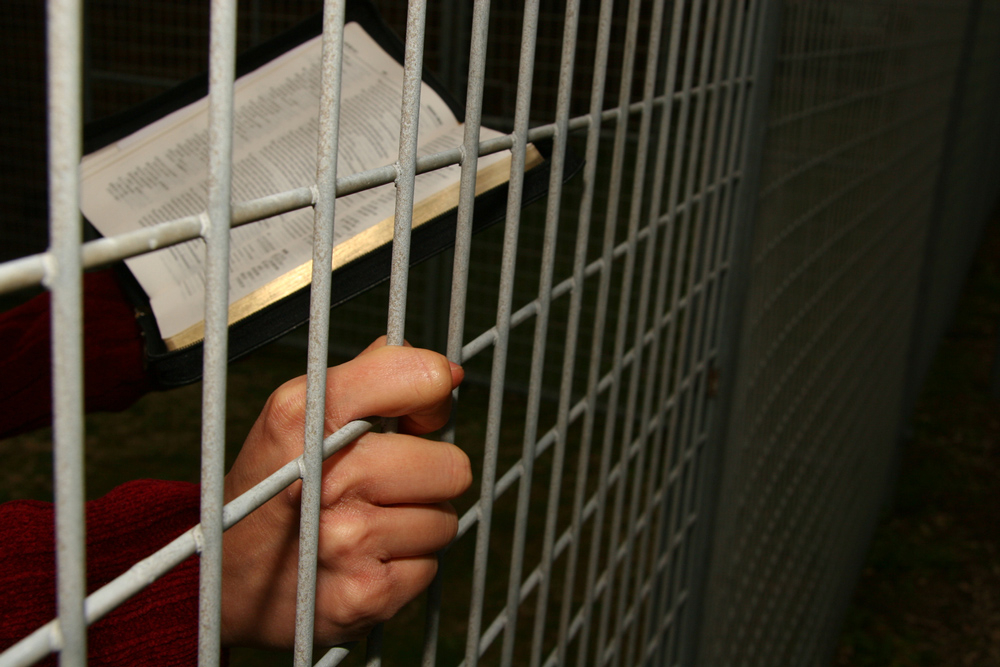
 On
July 4, 2022, a Christian mechanic who had been imprisoned for the last
five years, awaiting trial under a false accusation of "blasphemy" for
allegedly insulting the Muslim prophet Muhammad, was sentenced to death
by hanging in a Pakistani court. (Image source: iStock) |
On July 4, 2022, a Christian mechanic who had been imprisoned for the
last five years, awaiting trial under a false accusation of "blasphemy"
for allegedly insulting the Muslim prophet Muhammad, was sentenced to death by hanging in a Pakistani court.
Five years earlier, on June 5, 2017, Ashfaq Masih, 34, had gotten
into a quarrel with Muhammad Naveen, a rival who had established a
mechanics' workshop near Masih's. According to Masih's not guilty plea,
Muhammad "was jealous because my business was running better," and,
after their altercation, "threatened me with dire consequences." On the
following day, June 6, according to Masih:
"Muhammad Irfan came to my shop for wheel balancing for
his motorbike. I balanced the wheel and demanded my amount of labour as
settled between us. Muhammad Irfan refused to give me money and said, 'I
am a follower of Peer Fakhir [a Muslim ascetic] and don't ask for money
from me.' I told him that I am a believer in Jesus Christ and I don't
believe in Peer Fakhir and please give me my labour."
At that point, Muhammad Irfan went—or perhaps returned—to the rival
shop of Muhammad Naveed, and, moments later, a Muslim mob had formed
around the Christian's shop. As Masih explains:
"They both made conspiracy against me and lodged a false
FIR [First Incident Report] against me. I told the real story to a
police officer but he did not record my version but conducted
investigation ex-parte. I neither uttered any derogatory word against
Prophet Muhammad nor can think about it."
Along with rival shop owner Muhammad Naveed, Muhammad Irfan, the
complainant, also got two other Muslims — Muhammad Nawaz and Muhammad
Tahir — to lie and tell
police that they "heard Masih say derogatory words against the Muslim
prophet," even though none of them was present during the altercation
between Irfan and Masih.
Masih was charged under Section 295-C of Pakistan's penal code, which states:
"Whoever by words, either spoken or written, or by
visible representation, or by any imputation, innuendo, or insinuation,
directly or indirectly, defiles the sacred name of the Holy Prophet
Muhammad (peace be upon him) shall be punished with death, or
imprisonment for life, and shall also be liable to fine."
The problem with this law is not so much that the sentence is extreme
and irrevocable, but rather that Muslims regularly exploit it to settle
personal grudges against non-Muslim minorities in Pakistan. The fact
is, Pakistan's non-Muslim minorities, mostly Christians and Hindus, know
better than to say anything that can be misconstrued as offensive about
the Muslim prophet — they are well acquainted with the dire
repercussions. They are taught from their youth to exhibit nothing but deference
for Islam's prophet. That does not, however, stop Muslims from falsely
accusing these "infidels" with whom they might have a gripe of
supposedly insulting Muhammad.
Amnesty International noted this dynamic in a report compiled nearly three decades ago in 1994:
"[I]n all the cases known to Amnesty International, the
charges of blasphemy [in Pakistan] appear to have been arbitrarily
brought, founded solely on the individuals' minority religious beliefs. .
. . The available evidence in all these cases suggests that charges
were brought as a measure to intimidate and punish members of minority
religious communities . . . hostility towards religious minority groups
appeared in many cases to be compounded by personal enmity, professional
or economic rivalry or a desire to gain political advantage. As a
consequence, Amnesty International has concluded that most of the
individuals now facing charges of blasphemy, or convicted on such
charges, are prisoners of conscience, detained solely for their real or
imputed religious beliefs in violation of their right to freedom of
thought, conscience and religion [emphasis added]."
The implication that, when it comes to blasphemy cases, Pakistani
courtrooms host kangaroo show-trials would seem to be an adequate
description of Ashfaq Masih's recent trial. Despite Christians in
Pakistan knowing that they have to be to be ultra-careful about saying anything that could be misconstrued as offending Muhammad, the prosecution declared:
"On 15 June 2017 at 12 noon, accused Ashfaq Masih, while
sitting in shop, was uttering blasphemous words about Prophet Muhammad
& said words [that] could not be restated."
The Muslim judge presiding over the case, Khalid Wazir, went so far as to state
that "it could not be believed that a Muslim will spin a story in this
regard," while simultaneously describing the evidence presented by
Masih's defense team as "not believable. " So, on July 4, 2022, Khalid pronounced
that the 34-year-old Christian, who has a wife and young daughter, is
to "be hanged by neck till his death subject to confirmation by
Honorable High Court."
Considering that Masih had already suffered over the past five years
in prison, his family was aghast when the judge pronounced the death
sentence. He had not been allowed to see or be with his mother ,who died
in 2019, because he was behind bars. Since then,
"the case has witnessed multiple adjournments, rescheduling, judge not
showing up, witness failing to turn up and even the complainant's lawyer
not registering their presence."
According to Masih's older brother, Mehmood:
"The sudden judgment stunned me and I didn't know what to
do. I hardly gathered myself and came out of the courtroom and started
crying as it was the end of the world for me. I rushed home and informed
my family. My wife and children also started crying. As the news spread
my relatives started visiting to console us, but it was not easy for me
as Masih is my only brother and I love him very much."
Discussing this ruling, Nasir Saeed, the director of the Centre for
Legal Aid Assistance and Settlement, a charity that supports persecuted
Christians in Pakistan, said the judgement was "very sad yet expected." He added:
"I don't remember any case where the lower court decided
to grant bail or freed anyone accused of the blasphemy law. The judges
are aware that such cases are made to punish and settle personal grudges
with the opponents, especially against the Christians. Because of
pressure from the Islamic groups, lower courts' judges are always
hesitant to free the victims but make popular decisions to save their
skin and shift their burden to the high court. Masih's case was very
clear—the shop owner wanted him out and Naveed was a business rival who
implicated him in a false blasphemy case. He is innocent and has already
spent five years in prison for a crime he never committed."
Masih's case is now at least the third death sentencing of its kind since the start of this year.
In February 2022, Zafar Bhatti, 58 — another Christian man who had
been serving a life sentence under a false accusation of blaspheming
Muhammad in a text — was given a death sentence.
In January 2022, Aneeqa Atteeq, a Muslim woman, was sentenced to death
after a Pakistani court pronounced her guilty of insulting Muhammad in
text messages she had sent to a man via WhatsApp. She had offered a more
plausible if not prosaic explanation: the man who reported her was
getting "revenge" on her because she had refused his advances.
Horrific as it is to be accused of blasphemy in a Pakistani
courtroom, it is even far worse to fall into the hands of a Pakistani
mob. A decade-old report
found that in Pakistan, between just 1990 and 2012 alone, "fifty-two
people have been extra-judicially murdered on charges of blasphemy."
Most recently, in March 2022, a Muslim woman and her two nieces slaughtered Safoora Bibi by slitting her throat, after a relative of the three murderers merely dreamt that Bibi had blasphemed against Muhammad.
In February 2022, a Muslim mob stoned a mentally handicapped man to death, after a rumor surfaced that he had burned a copy of the Koran.
In December 2021, a mob descended on a factory, murdered and then burned the body of a Sri Lankan man, over rumors
that he had blasphemed Muhammad. At least, it appears that the mob had
killed him before torching his body, unlike a young Christian couple
whom another Pakistani mob slowly burned alive in 2015 on a rumor that they had offended Islam.
This unspeakable style of murder against supposed "blasphemers" has
also been on display recently in Nigeria. Two months ago, a number of
university students stoned to death
and set on fire Deborah Emmanuel, a Christian student who had earlier
refused the sexual advances of a Muslim man. He retaliated by loudly
claiming that she had blasphemed Muhammad, the prophet of Islam. Before
long, a mob had formed and murdered her.
As oppressive as "blasphemy laws" are in Pakistan, they are not
limited to, or a byproduct of, one country. They are, sadly, the
byproducts of Islam. They not only occur throughout the Islamic world
(for example, in Indonesia, Iran, Malaysia, Oman and Bangladesh), they have started spilling into the West -- in France and Spain.
"When you touch the prophet," a Muslim cleric, Yello Babo, who
defended the stoning to death and burning of Deborah Emmanuel by a mob
in Nigeria, notified us all, "we become mad people.... Anyone who touches the prophet, no punishment—Just kill!"








 But
on July 1, the time when many people are away on vacation, and Jewish
clergy are busy preparing for the upcoming High Holidays in September,
the Jewish Home made a quiet but hugely significant change to their
entire persona. They removed the word “Jewish” from their identity.
But
on July 1, the time when many people are away on vacation, and Jewish
clergy are busy preparing for the upcoming High Holidays in September,
the Jewish Home made a quiet but hugely significant change to their
entire persona. They removed the word “Jewish” from their identity.