Sunday, May 5, 2024

Netanyahu to Hamas: We will not stop the fight - Troy Osher Fitzhand


by Troy Osher Fitzhand

Israel cannot accept a situation in which the terror group regains control of the Gaza Strip, said the prime minister.
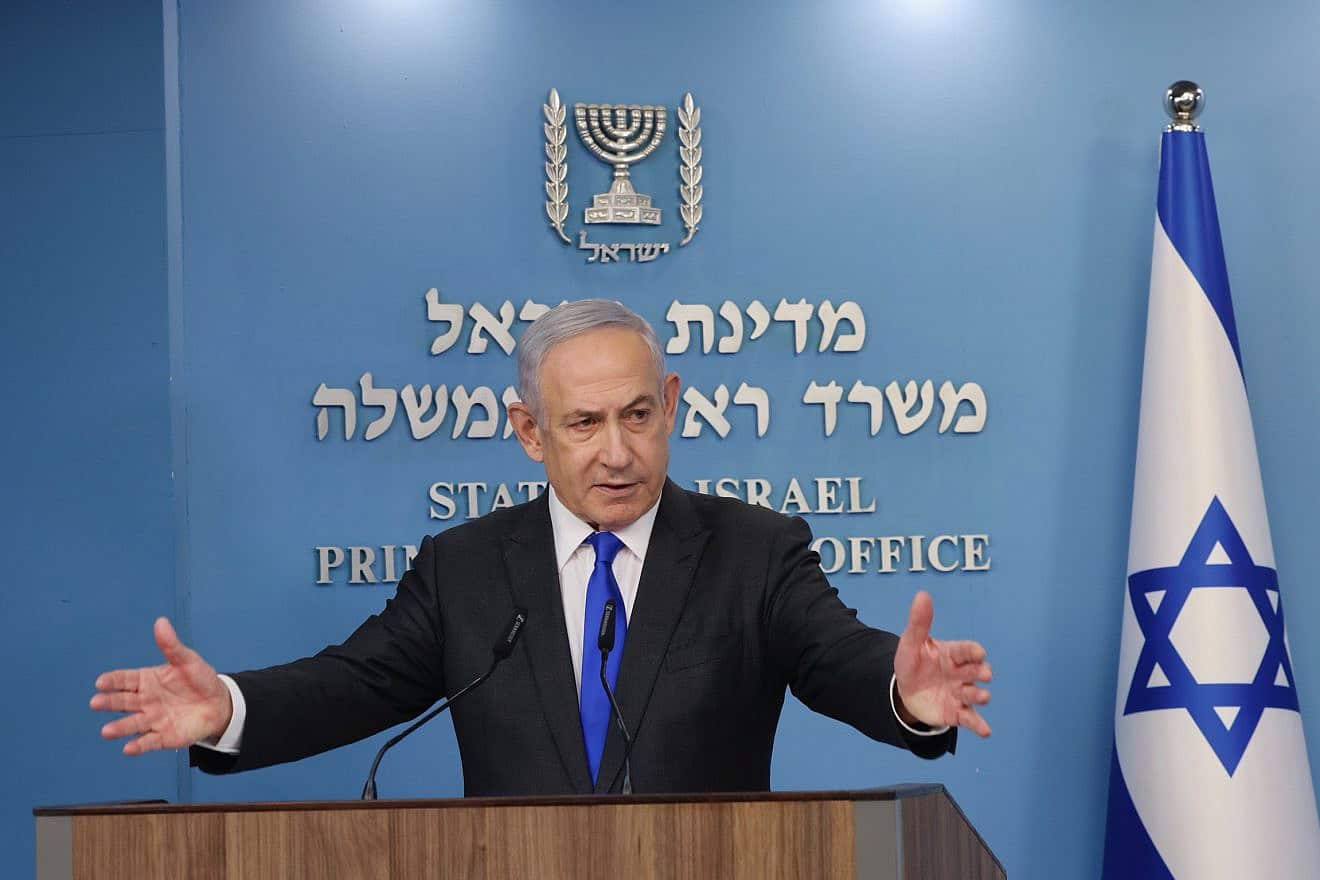
 

Prime Minister Benjamin Netanyahu speaks during a press conference in Jerusalem, March 31, 2024. Photo by Marc Israel Sellem/POOL.

Israeli Prime Minister Benjamin Netanyahu issued a stern message to Hamas on Sunday amid ongoing negotiations for the release of the hostages still held by the terror group in Gaza.

“While Israel showed this willingness [to compromise], Hamas remained entrenched in its extreme positions, chief among them the demand to withdraw all our forces from the Strip, end the war, and leave Hamas intact,” Netanyahu said following the weekly Cabinet meeting in Jerusalem.

“The State of Israel cannot accept this. We are not ready to accept a situation in which the Hamas battalions come out of their bunkers, take control of Gaza again, rebuild their military infrastructure and return to threatening the citizens of Israel in the surrounding communities, in the cities of the south, in all parts of the country,” he continued.

Should that occur, “the next Oct. 7 is only a matter of time.”

Hamas terrorists killed some 1,200 people and abducted 252 during the Oct. 7 massacre; they are still holding 132.

Israel is prepared for a truce to free the remaining hostages, said Netanyahu.

“That’s what we did when we freed 124 abductees [during a truce in November], and we returned to fight—and that’s what we’re ready to do today as well,” he said.

Hamas politburo head Ismail Haniyeh released a statement after Netanyahu’s, saying his terrorist group is willing to reach a deal while blaming the Israeli prime minister for “the continuation of the aggression and the expansion of the circle of conflict, and sabotaging the efforts made through the mediators and various parties.”

The prime minister’s message comes hours after Israeli officials on Saturday night vehemently denied reports that the government had agreed to end the war against Hamas as part of an emerging hostage deal.

According to the reports, the Biden administration had conveyed guarantees to Hamas that the agreement currently being discussed would culminate with a full Israel Defense Forces withdrawal from the Gaza Strip.

The proposal reportedly includes a first phase lasting 40 days during which up to 33 Israeli hostages in the humanitarian category—female, elderly and sick—would be freed in exchange for an IDF pullout from several areas of Gaza.

The second phase would reportedly last 42 days and include the release of all other living Israeli hostages and arrangements for a prolonged truce. The final phase would also last six weeks and include the exchange of bodies.

Hundreds of Palestinian terrorists would be released from Israeli jails over the course of the agreement.

In his video statement, Netanyahu pointed to the losses faced by the IDF and police—608 since Oct. 7 and 263 since the IDF entered Gaza on Oct. 27—saying, “Is this why heroes and heroines fell? Did we pay unbearably heavy prices for this? The answer is no! Surrendering to the demands of Hamas would be a terrible defeat for the State of Israel.”

Addressing the U.S. push for a peace deal with Saudi Arabia, the Israeli premier said that failure to press forward against Hamas would not lead to peace.

“This weakness will only bring the next war closer, and it will push the next peace agreement further away. Because alliances are not made with the weak and defeated, alliances are made with the strong and victorious,” he said.

“Therefore, Israel will not agree to Hamas’s demands, which mean surrender, and will continue the fighting until all its goals are achieved,” he said.

An Israel-Saudi deal is part of a larger agreement that would include a defense pact between Washington and Riyadh. U.S. National Security Advisor Jake Sullivan said on Saturday that without Israeli normalization—which Riyadh has conditioned on ending the war and an Israeli commitment to a path toward a Palestinian state—there will be no defense pact.

During the Cabinet meeting, Defense Minister Yoav Gallant said the IDF operation in Rafah, Gaza’s southernmost city, where the remaining Hamas battalions are located, will occur “very soon.”

Hamas officials told the London-based, Qatar-owned Al-Araby Al-Jadeed newspaper on Sunday that “there will be no agreement without a complete cessation of the war and the withdrawal of the occupation from the entire Gaza Strip.”

Also on Sunday, the Cabinet approved two measures, the closure of Al Jazeera’s Israel branch and the construction of a new hospital in the Negev.

“The government headed by me unanimously decided: The incitement channel Al Jazeera will be closed in Israel,” tweeted Netanyahu after the meeting, while thanking Communications Minister Shlomo Karhi.

Karhi said, “Our orders will go into effect immediately. Too much time has passed and too many unnecessary legal hurdles for us to finally be able to stop Al Jazeera’s oiled incitement machine that harms the security of the country.”

The legislation states that the communications minister may act against a foreign channel that harms the state’s security, with the consent of the prime minister and the approval of the Cabinet or the government. The prime minister and Cabinet can approve the measure after security officials prove that the channel poses an actual security risk.

The measures enable authorities to order television providers to stop broadcasting the outlet, close its offices in Israel, seize its equipment, shut down its website and revoke press credentials for staff.

The new hospital is to be built in Beersheva and operated by Sheba Medical Center, and is to feature 600 beds. Officials hope it will open in 2028. The project has an estimated cost of 1.5 billion-2.5 billion shekels ($403.5 million to $672.6 million).

After the initial approval last month, Finance Minister Bezalel Smotrich, who allocated the funding, said, “This is an important and significant decision for Beersheva and the entire southern and Negev region, which will substantially improve medicine in the community and advance the provision of excellent health services to the residents of the south.”

He added, “This step is part of a number designed to increase investment in infrastructure in the periphery, and there is no doubt that it will lead to an increase in the population in these areas.”


Troy Osher Fitzhand

Source: https://www.jns.org/netanyahu-to-hamas-we-will-not-stop-the-fight/

Follow Middle East and Terrorism on Twitter

Iran's Dangerous New Terror Proxy: Sudan Iran's Encirclement of Israel, Control of Red Sea, Almost Complete - Pete Hoekstra


by Pete Hoekstra

The U.S. and Europe must step up now to counter Iran's efforts in the Middle East and Sudan.


  • "What makes the future in this case darker is Sudan's history of hosting extremists and jihadists from the far right and far left. During the previous regime, Sudan hosted Osama bin Laden, leader of Al-Qaeda, Hamas, Hezbollah, and Carlos the Jackal. This warm embrace of violent extremists earned Sudan a spot on the list of state sponsors of terrorism."— Areej Elhag, Washington Institute for Near East Policy, January 31, 2024.

  • The bottom line for America and Europe is that the strategy of engaging and appeasing Iran has failed miserably.

  • The U.S. and Europe must step up now to counter Iran's efforts in the Middle East and Sudan.

  • We cannot allow new "proxies of terror" for Iran.

Bloomberg reported on January 24 that Iran has been supplying the Sudanese Armed Forces, led by General Abdel Fattah al-Burhan, with military drones. Iran has also been teaching the Sudanese how to make them locally. Both the Iranian and Sudanese regimes, by a security cooperation agreement signed last month, have becomes an additional threat to Israel, to the region, and to the national security of the United States and its allies. Pictured: Al-Burhan in Gedaref State, Sudan, on April 10, 2024. (Photo by AFP via Getty Images)

While the Biden administration is preoccupied trying to win re-election this November, as well as putting out a series of fires it helped start in Ukraine, the Middle East and the Indo-Pacific, a new area of urgent concern, largely flying under the public's radar, has been brewing: Iran's increasing penetration of Sudan.

Pocketing Sudan would provide Iran with more oil, gold and rare minerals, as well as another port on Red Sea from which to continue blocking maritime commercial passage. Sudan would also provide Iran with proximity to Israel, and serve as an additional launching pad from which to swarm Israel with more lethal drone attacks – at least until its nuclear weapons program is complete.

Iran could also add Sudan to the list of the four other countries it already effectively controls in the region: Iraq, Syria, Lebanon and Yemen.

Sudan, with Iran's backing, would then be well on its way to being another Hamas, al-Qaeda or Taliban, and spreading its inclinations to the rest of the African continent.

Areej Elhag recently wrote for the Washington Institute for Near East Policy:

"What makes the future in this case darker is Sudan's history of hosting extremists and jihadists from the far right and far left. During the previous regime, Sudan hosted Osama bin Laden, leader of Al-Qaeda, Hamas, Hezbollah, and Carlos the Jackal. This warm embrace of violent extremists earned Sudan a spot on the list of state sponsors of terrorism."

Bloomberg reported on January 24 that Iran has been supplying the Sudanese Armed Forces (SAF), led by General Abdel Fattah al-Burhan, with military drones – everyone's new "cheap, instant air force," more accessible than a real one. Iran has also been teaching the Sudanese how to make them locally.

The SAF, reportedly linked to the Muslim Brotherhood and other Islamists, is currently embroiled in a civil war.

The Sudanese regime, headed by al-Burhan, is a dictatorial one. It has reportedly committed atrocious crimes against the Sudanese population, including bombing entire neighborhoods and killing civilians.

Worse still, this regime signed a strategic agreement with Iran, an enemy of democracy that has been killing and wounding American troops to try to force the US out of the region.

It is crucial that the US not comply, as it did in Afghanistan. Whatever modest US force is presently in the Middle East, it sends a strong a message that the entire area does not belong to the most aggressive predator.

Both the Iranian and Sudanese regimes, by a security cooperation agreement signed last month, have becomes an additional threat to Israel, to the region, and to the national security of the United States and its allies.

The SAF, with Iran's help, is attempting to defeat the paramilitary Rapid Support Forces (RSF), headed by Mohamed Hamdan Dagalo, and apparently not much better. Dagalo, also known as "Hemedti," appears aligned with Ethiopia, Chad, and the Libyan National Army of Field Marshal Khalifa Haftar (an ally of Egypt).

The Iranians evidently see the sale of weapons and new economic agreements as the initial steps to leverage chaos in the world to enhance its geostrategic aims. That is what it appears to be doing in deepening its ties to Sudan. Reports indicate the extent to which these Iranian activities already are taking place. Iran has also reportedly offered Sudan a "helicopter-carrying warship" in exchange for allowing Iran to construct a naval base in the country. The request was reportedly turned down out of fear of the response by Israel and the United States.

After the Biden administration relaxed sanctions on Iran, Iran was able to reenergize its treasury. From being cash-strapped, Iran has bolstered its cash reserves by billions through increased oil sales. It has used these extra funds to help finance the Houthi's threat to shipping in the Red Sea and Gulf of Aden, fund the brutal attack by Hamas against Israel on October 7, fund its own massive drone and missile attacks against Israel on April 14, and fund the ongoing build-up of arms caches by Hezbollah.

Iran now seeks to use its money to buy influence with the Sudanese government as it wages a violent and deadly civil war. Sudan and Iran have a complicated history, but the civil war there has created an opening for Iran to build stronger and closer ties with Sudanese leaders. These efforts could well result in Sudan itself, or groups in the country, becoming the latest proxy for Iran in its efforts to spread conflict and distract the West.

Given Sudan's strategic location, Iranian efforts to weave the nation into its sphere of influence must be blunted.

In a world seemingly on hair trigger, it is essential that the U.S. and our allies in Europe not let the chaos exploding in Eastern Europe and the Middle East spread. The Russia-Ukraine war has strained Western military supply capabilities, revealing shortcomings in both the stockpiles and defense industrial base of the West. It also has caused growing divisions in Washington, D.C. as was witnessed by the months-long delay in Congress to approve the latest arms package for Ukraine. This same arms package included funding for a key U.S. ally, Israel, in its ongoing war against Hamas in Gaza and the threat posed by Hezbollah in Lebanon. The other issue gaining significant attention in the region is the ongoing threat to international shipping posed by the Houthis in Yemen.

There is one constant in all of these areas of unrest—Iran. Iran's support for its armed proxy groups, and its provision of weapons to Russia, have provided the necessary kindling to fuel conflict across a large chunk of Eurasia.

Curtailing Iran's malign influence is critical to putting an end to the current conflicts in the Middle East, but it is also imperative that the West wise up and halt the spread of Iranian influence into other areas of the world.

The Iranians evidently see the sale of weapons and new economic agreements as the initial steps to leverage chaos in the world to enhance its geostrategic aims of "exporting the revolution," becoming the hegemon in the region, and displacing the other oil-rich countries and holy sites in the Gulf.

These are dangerous and escalatory steps being taken by Iran to increase its influence and ability to project chaos and terror in the region. The U.S. government has publicly called for a halt to weapons sales to Sudan, and added that Sudan faces "a crisis of epic proportions." U.S. Ambassador to the U.N., Linda Thomas-Greenfield, noted that the city of El Fasher is "on the precipice of a large-scale massacre." These official U.S. statements highlight the desperate situation in Sudan today, a situation that is being worsened by and for the benefit of Iran.

The bottom line for America and Europe is that the strategy of engaging and appeasing Iran has failed miserably. Not only is Iran a key supplier to Russia's war effort in Ukraine, it also has successfully destabilized the Middle East.

The war that is currently being fought by Iranian proxies has resulted in massive public demonstrations. These seem notably well-organized well-funded in the U.S. and Europe by outside agitators who are dedicated to overthrowing America, the rule of law and the West – in preference for terrorism and tyranny.

It is therefore doubly important to prevent Iran from extending its chaos and malign influence without delay. Tensions in the Middle East, and the growing pressure to appease terrorists, have also strained the relationship between the U.S. and Israel –- the two main countries that stand in the way of predatory regimes, such as Iran, Russia and Communist China from achieving their goals.

Washington cannot allow this chaos to be the opening for Iran to expand its footprint in the Middle East and Africa. The lessons of the past five decades are clear. When Iran sees an opening — an opportunity in chaos — it will seize the initiative and leverage its resources to create more areas of chaos in additional parts of the world to further expand its influence.

The U.S. and Europe must step up now to counter Iran's efforts in the Middle East and Sudan.

We cannot allow new "proxies of terror" for Iran.


Pete Hoekstra is a Distinguished Senior Fellow at Gatestone Institute. He was US Ambassador to the Netherlands during the Trump administration. He also served 18 years in the U.S. House of Representatives representing the Second District of Michigan and served as Chairman and Ranking Member of the House Intelligence Committee.

Source: https://www.gatestoneinstitute.org/20619/iran-proxy-sudan

Follow Middle East and Terrorism on Twitter

Pro-Rafah invasion protests escalate amid reports Hamas will accept hostage deal - Eve Young


by Eve Young

Sunday's march followed a similar protest led by the Valor Forum Saturday night, following Saturday's reports that Hamas will likely accept a hostage deal in the coming days.


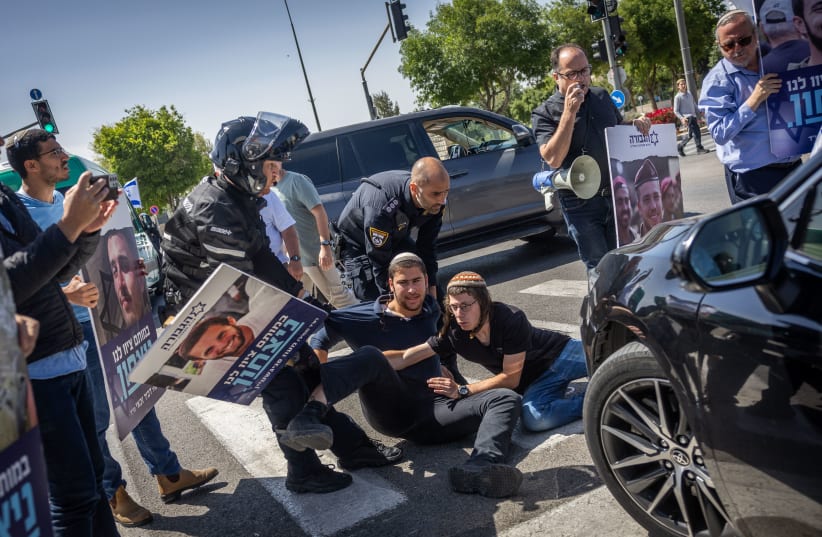
Bereaved families of Israeli soldiers killed in the Gaza Strip call for the continuation of the war outside the Prime Minister's office in Jerusalem, May 5, 2024.  (photo credit: YONATAN SINDEL/FLASH90)
Bereaved families of Israeli soldiers killed in the Gaza Strip call for the continuation of the war outside the Prime Minister's office in Jerusalem, May 5, 2024.
(photo credit: YONATAN SINDEL/FLASH90)

Protests and actions calling for the IDF to invade Rafah have been ramping up as media is reporting that Hamas is close to accepting a hostage deal spread over the weekend.

Families of soldiers who have fallen in the Israel-Hamas war who were joined by additional protesters marched from their tent near the Knesset to the Prime Minister’s Office, where they blocked an entrance Sunday morning and demanded an invasion of Rafah, according to the Valor Forum, which organized the march.

They were joined outside the PMO by numerous ministers reiterating their demands, including National Missions Minister Orit Strock, Culture and Sport Minister Miki Zohar, Communications Minister Shlomo Karhi, National Security Minister Itamar Ben-Gvir, and Finance Minister Bezalel Smotrich.

Smotrich addressed the prime minister and other ministers in Israel’s war cabinet at the protest, calling on them to immediately renew Israel’s military action in Gaza with full force, saying that the public will not allow them to throw victory down the drain.

Saturday night, the Hope Forum, representing some family members of hostages who support increased military pressure against Hamas, called on Prime Minister Benjamin Netanyahu to resign if he cannot “take the pressure and order the IDF to win.”

 Israeli minister of Public Security Itamar Ben Gvir attends a protest of bereaved families of Israeli soldiers killed in the Gaza Strip calling for the continuation of the war outside the Prime Minister's office in Jerusalem, May 5, 2024. (credit: YONATAN SINDEL/FLASH90)Enlrage image
Israeli minister of Public Security Itamar Ben Gvir attends a protest of bereaved families of Israeli soldiers killed in the Gaza Strip calling for the continuation of the war outside the Prime Minister's office in Jerusalem, May 5, 2024. (credit: YONATAN SINDEL/FLASH90)

The forum criticized ongoing talks with Hamas, saying that “Disgracefully, in addition to fading on the battlefield in the past few months, there is negotiation with sub-humans who slaughtered us.”

Anticipated positive response from Hamas is meaningless

The forum went on to say that the anticipated positive response from Hamas is meaningless and is causing the prime minister to delay conquering Rafah and rescuing the loved ones of the forum’s members.

The forum added that they hold Netanyahu responsible for actions to save their families and that waiting for an answer from Hamas is a “humiliation of the Jewish people.”

This is the first time the Hope Forum has called for the resignation of the prime minister if he does not act, and in this call, they join another contingent of hostage families who have already been calling for Netanyahu’s resignation for a few weeks, saying that he is blocking a deal that would bring the hostages home.

Sunday’s march followed a similar protest led by the Valor Forum Saturday night, following Saturday’s reports that Hamas will likely accept a hostage deal in the coming days.

“Talk of surrendering to Hamas has brought families of the fallen from the entire Israeli spectrum out to the streets to demand that the war go on,” said the Valor Forum.

The forum wanted to make clear to members of Israel’s government that they “don’t have a mandate to give in to Hamas. Our children did not fall for nothing.”


Eve Young

Source: https://www.jpost.com/israel-hamas-war/article-799926

Follow Middle East and Terrorism on Twitter

Israel orders local Al Jazeera offices to close immediately - Madeleine Hubbard


by Madeleine Hubbard

"It’s time to remove the Hamas mouthpiece from our country," Netanyahu said after the vote.


Israel's government unanimously voted Sunday to close the local offices of Al Jazeera, a Qatar-owned broadcaster, effective immediately, as Qatar is mediating ceasefire negotiations between Israel and Hamas. 

Israeli Prime Minister Benjamin Netanyahu announced the decision on X, formerly Twitter, calling the Arabic and English-language network, "the incitement channel." 

Walid Al Omari, Al Jazeera's Palestinian office director, said the decision does not impact the West Bank, but he described it as coming from right-wing government leaders in search of "easy victories," according to the network.

"Al Jazeera reporters harmed Israel’s security and incited against soldiers," Netanyahu said after the vote, according to The Associated Press. "It’s time to remove the Hamas mouthpiece from our country."

Multiple senior Hamas officials live in Qatar, and the country is reportedly facing pressure from the U.S. to expel the officials if the terrorist organization rejects another ceasefire proposal.

While Israel has previously taken actions against individual journalists, this is believed to be the first time the country has ever completely shuttered a foreign news organization.

Follow Madeleine Hubbard on X or Instagram.


Madeleine Hubbard

Source: https://justthenews.com/government/diplomacy/israel-orders-local-al-jazeera-offices-close-immediately

Follow Middle East and Terrorism on Twitter

Bomb threats target multiple NY synagogues - JNS


by JNS

According to a state representative, more than 20 Jewish houses of worship were threatened over Shabbat.


New York City Police Department vehicle. Credit: Photogeider/Pixabay.

At least 20 synagogues were targeted by bomb threats over Shabbat, according to a New York State representative.

At least four of the targeted Jewish houses of worship are in Alex Bores’s district, the assemblymember wrote.

“I’ve spoken with rabbis and the police; they have investigated the specific threats and found them to be not credible,” Bores wrote. “Antisemitism is unacceptable, and the perpetrators should be prosecuted.”

On Saturday evening, New York Gov. Kathy Hochul wrote that the state is “actively monitoring a number of bomb threats at synagogues in New York.”

“Threats have been determined not to be credible, but we will not tolerate individuals sowing fear and antisemitism,” she wrote. “Those responsible must be held accountable for their despicable actions.”

Several other city and state lawmakers commented on the threats.

Rebecca Seawright, another New York state representative, called them “disgraceful.”

“There is zero tolerance for antisemitism and those responsible must be held accountable,” she wrote. “We must keep our community safe for all New Yorkers.”

Mark Treyger, the CEO of the Jewish Community Relations Council of New York, noted that the threats came on the eve of Holocaust Remembrance Day.

“Not normal. Not peaceful. Not lawful,” he wrote.

Keith Powers, a member of the New York City Council, wrote that the threats thankfully “don’t seem credible at this point in time.”

“But it’s a clear attack on the Jewish community here in New York City,” he added. “Unacceptable and reprehensible.”

“This is a clear effort to sow fear in the Jewish community,” wrote Mark Levine, the Manhattan borough president, adding that this “cannot be accepted.”


JNS

Source: https://www.jns.org/bomb-threats-target-multiple-ny-synagogues/

Follow Middle East and Terrorism on Twitter

Bidenomics tips more stressed U.S. banks into danger zone as economy slows - Charlotte Hazard


by Charlotte Hazard

According to recent reports, hundreds of banks face the potential of failing just like Republic First Bancorp.


With inflation, high-interest rates and slowing economic growth already stressing Americans heading into the 2024 election, another reason to worry about the Biden economy has cropped up: distressed banks in danger of failing.

Last month U.S. regulators seized a bank known as Republic First Bancorp and agreed to sell it to Fulton Bank.

The bank reportedly had a total of $6 billion in total assets and $4 billion in total deposits, according to Yahoo Finance. The Federal Deposit Insurance Corp estimated the cost of the failure to its fund would be about $667 million. 

Republic Bank has 32 branches in New Jersey, Pennsylvania and New York that are reopening as branches of Fulton Bank by this Monday.

"With this transaction, we are excited to double our presence across the region," said Fulton Chairman and CEO Curt Myers in a statement.

According to recent reports, hundreds of banks face the potential of failing just like Republic First Bancorp.

Consulting firm Klaros Group analyzed roughly 4,000 U.S. banks and found that the banks face a threat of losses due to "secular changes in social patterns accelerated by the COVID pandemic (such as work-from-home, which has materially impacted demand for office space) and to the impacts of higher interest rates and related inflation."

“You could see some banks either fail or at least, you know, dip below their minimum capital requirements,” Christopher Wolfe, managing director and head of North American banks at Fitch Ratings told CNBC in an interview.

Federal Reserve Chairman Jerome Powell likewise has warned of more regional bank failures, specifically citing the softening commercial real estate industry.

“This is a problem we’ll be working on for years more, I’m sure. There will be bank failures,” he told the Senate Banking Committee last month.

“It’s not a first-order issue for any of the very large banks. It’s more smaller and medium-sized banks that have these issues. We’re working with them. We’re getting through it. I think it’s manageable, is the word I would use,” he added.

Last week, the Federal Reserve announced it will not cut interest rates until there is “greater confidence” that price increases are slowing down to the 2% target, according to The Associated Press. 

"Jerome Powell, head of the Federal Reserve, has actually been very vocal about this telling us that expect more bank failures, and when you combine that with all the debt that this country is in...that's something to be concerned about," Genesis Gold Group CEO Jonathan Rose said on the "Just the News, No Noise" TV show. 

Last year, Silicon Valley Bank collapsed after it couldn't meet a massive run by depositors who took out tens of billions of dollars in just a matter of hours.

Part of the reason for the significant drop in deposits was the uncertainty over how many and which banks the FDIC provided with unlimited insurance for their depositors.

According to Rose, even more bank failures are expected this year. 

"We've already been told that there's going to be more bank failures this year," he said. "Our trade deficit is out of control."


Charlotte Hazard

Source: https://justthenews.com/politics-policy/finance/wkd-bidenomics-tips-more-stressed-us-banks-warning-zone-economy-slows

Follow Middle East and Terrorism on Twitter

The Scorpion Pass Massacre: A Brief History - Hugh Fitzgerald


by Hugh Fitzgerald

Arab terror has been part of reality for Israeli Jews since long before any "occupation"


The Palestinians like to justify their terrorism against Israelis as being prompted by the Jewish state’s control of the “occupied West Bank.” But before Israel came into possession of the West Bank (the name that Jordanians gave to those parts of Judea and Samaria they had seized in the 1948 war) in 1967, when tiny Israel was even tinier than it is today, with a nine-mile-wide waist from Qalqilya to the sea, there were hundreds of terror attacks on the Jewish state, from Jordan in the east, from Egypt in the south, and from Syria in the north between 1949 and 1967. Most ended with Israelis being wounded; 55 of those attacks resulted in dead Israelis. The “occupied West Bank” did not exist, but there was plenty of terrorism. A recent posting by a Canadian doctor about a particularly atrocious attack, the Scorpion Pass Massacre in 1954, which was launched from Jordan’s “West Bank,” merits reprinting. The world needs to be reminded of what life was like for Israelis before they acquired, after the Six-Day War, a minimum of strategic depth that they have no intention of relinquishing. The original article can be found here: “Remembering The Scorpion Pass Massacre of 1954,” by Jacob Sivak, Algemeiner, March 7, 2023:

…The attack was carried out in the middle of the day on an Egged bus (Israel’s largest bus company) containing 14 passengers plus a driver. The attackers shot at the bus as it was traveling very slowly around one of the hairpin bends, killing the driver. They then boarded the bus and shot most of the passengers. Eleven riders (ten passengers and the driver) were killed and three passengers were injured. One of the injured a nine year-old boy, Chaim Fuerstenberg, survived in a semi-conscious and paralysed state for 32 years, dying in 1986.

Ephraim Fuerstenberg had been on vacation in Eilat with his wife Hannah and two children, Chaim, nine and Miri, five. Ephraim was killed first, then Hannah, who was raped and then killed. The two children were protected by the body of an Israeli soldier who threw himself on them as the attack began. When Chaim asked his sister if the attackers had gone, he was overheard and one of the assailants came back and shot him.

The tracks left by the assailants indicated that they came from Jordan, but the perpetrators were never identified. A safer more central route to Eilat was built as a result of the attack and today the pass is used for recreational purposes such as bicycle races

While the 1949 armistice agreements between Israel and her Arab neighbors ended the active shooting war between them, it didn’t stop cross-border attacks on Israelis from Gaza and the West Bank. Until 1967 and the Six Day War, Gaza was administered by Egypt and the West Bank, including the old city of Jerusalem, was governed by Jordan. For 19 years there was no occupation (and there was no Palestine). The Scorpion Pass Massacre was one of many attacks on Israelis that took place before the occupation. The Israel Ministry of Foreign Affairs lists 55 deadly attacks between 1953 and 1966, refuting the charge that terror attacks by Palestinians are a result of the occupation.

Hundreds of other Arab attacks resulted in wounded, but not dead, Israelis. Were Israel to allow itself to be squeezed back within the 1949 armistice lines, in exchange for a peace treaty with a newly-created Palestinian state in the West Bank and Gaza, it would again be in a state of maximum vulnerability, without the slightest strategic depth. The Palestinians have already broken the solemn undertakings they agreed to in the Oslo Accords. Their model of treaty-making is the agreement – a “truce treaty” — that Muhammad made with the Meccans at Hudaibiyya in 628 A.D., which was to have lasted for 10 years. But within 18 months, sensing that his forces had grown strong enough, Muhammad broke the treaty and attacked the Meccans. Given that Al-Hudaibiyya is the model for all subsequent treaty-making by Muslims, why should Israel give up its current defensible borders for the sake of a peace treaty that the Palestinians will be certain to break whenever they feel sufficiently strong?


Hugh Fitzgerald

Source: https://www.jihadwatch.org/2024/05/the-scorpion-pass-massacre-a-brief-history

Follow Middle East and Terrorism on Twitter

Biden administration continues its attack on energy - Eric Utter


by Eric Utter

Biden issued a slew of regulations that will drive prices at the pump and electricity bills higher.


No, I’m not speaking of the president “calling a lid” at 3:00 p.m. or appearing nearly comatose during certain speeches.

As part of its sweeping climate change agenda, the Bite me Biden administration recently finalized regulations that will make things much harder on existing -- and future -- fossil fuel-fired power plants.

Environmental Protection Agency (EPA) and White House officials, via a joint announcement, noted that the rules and regulations would apply to all coal-fired power generation and future natural gas power plants, which will be required to control/capture 90% of their carbon emissions. This will force numerous older plants to simply shut down, or, to use the softer sounding euphemism, be “sunsetted.”

It's certainly reassuring that the administration has its priorities in order! Forget the open Southern border across which millions of unvetted foreigners are streaming, mostly military-aged men! Forget 100,000 fentanyl deaths a year and the rampant sex trafficking! Dismiss raging inflation and violent crime! Who cares about unsustainable debt, wars breaking out across the planet, and the ongoing violent anti-Semitism spreading across our college campuses?! Ditto for the continued collapse of the family and the impending collapse of Western nations’ populations! The Biden administration is properly laser-focused on limiting Americans’ choices in appliances, vehicles -- and elections -- and in trying to significantly drive up the cost of their food and energy.

Our power plants may soon blow no smoke, but the same cannot be said of the Biden administration.

Image: Pixabay / Pixabay License

 
Eric Utter

Source: https://www.americanthinker.com/blog/2024/05/biden_administration_continues_its_attack_on_energy.html

Follow Middle East and Terrorism on Twitter

Camp Intifada: Students for Theocratic Authoritarianism - Clarice Feldman


by Clarice Feldman

The Administration’s failure to act on the side of Western civilization is seriously damaging President Biden’s reelection prospects and the prospects for the Democratic party itself.


I’m old. So old that I still believe that classic Western liberalism is the best system for assuring prosperity and peace, and authoritarianism, particularly of a theocratic nature, is a disastrous governance style. Watching the encampments and riots on college campuses, I see that too many young people have missed this lesson and instead support violent, barbaric, theocratic authoritarianism. I think these participants are not representative of a majority of students or voters and that the weak responses of some universities bode ill for their futures. Moreover, I think the Administration’s failure to act on the side of Western civilization is seriously damaging President Biden’s reelection prospects, indeed, the prospects for the Democratic party itself. In the absence of a federal response, private litigation is likely to prove particularly damaging to those who have funded and encouraged or tolerated these campus outrages.

Several lawsuits are in the works. At least three have already been filed. The most significant was a suit filed in Virginia this week alleging that the National Students for Justice in Palestine coordinated with Hamas, an organization federally listed as a terrorist organization, to orchestrate these campus attacks. The suit claims that NSJP “has effectively become the campus arm of Hamas” and is “directly aiding and abetting the terror group on American colleges” and “facilitating the conditions necessary for Hamas to continue carrying out acts of terror and the holding of hostages, including American nationals.” If successful, the lawsuit would permanently shut down NSJP and American Muslims for Palestine, a reincarnation of a previous outfit that provided material support for Hamas.

The complaint suggests that the defendants in the case just filed are carrying on in the same ways of the Holy Land Foundation before HLF, along with five of its leaders, were found guilty in a federal court at Dallas of providing material support to Hamas. They were convicted and sent to prison for, in two cases, 65 years. At the time, the assistant attorney general for national security said that the sentences “should serve as a strong warning to anyone who knowingly provides financial support to terrorists under the guise of humanitarian relief.”

The Sun asks Mr. Ostrovsky: What happens if SJP is determined to be a terrorist arm of Hamas? “The ramifications would be extraordinarily wide-ranging,” he says. “First and foremost, it would shut them down once and for all. They would not be allowed to operate in the United States, including campuses. They could not fundraise. It would be illegal to be affiliated with them. There are many other consequences, but there [sic] are a few of the main ones.”

Two significant lawsuits related to these campus outrages are directed at Northwestern University.  In the first, brought by three students, the university is charged with breach of contract.

“...alleging that the university violated its duty to abide by its own policies by allowing a climate of antisemitism on its campus.

Attorneys from the Chicago-based Much Shelist, P.C., who brought the suit in Cook County’s circuit court on Wednesday, wrote in the filing that the plaintiffs “expected Northwestern to fulfill a modest core promise it made to them and all other similarly situated, tuition-paying students: the conduct of your student peers and faculty will be governed by rules, and — once you enroll — you will be free to safely move about and avail yourself of our beautiful campus in accordance with those rules.”

“Rather than conduct the business of the campus in accordance with the clear rules of conduct that everyone signed up for,” the attorneys wrote, “Northwestern ignored those rules, opting instead to facilitate, encourage, and coddle a dystopia cesspool of hate in the school’s lush green center, Deering Meadow.”

In the second suit against the school, the Wisconsin Institute for Law and Liberty (WILL) charges that it violated Title VI, contending that the university’s concession to the protestors to award nearly $1.9 million in full-ride scholarships, faculty positions, and student-organization space to Palestinian students and staff violates Title VI’s prohibition against discrimination. 

Vic Bernson, Vice President and General Counsel for YAF, stated, “What Northwestern is doing here is completely pathetic. It’s a perfect encapsulation of the infantile DEI mindset in action: those committing illegal acts and spewing antisemitic bile are justified, so let’s not challenge them but instead give them everything they want and they’ll go away. But it never works that way, does it? Appease awful people making awful demands, and they’ll always respond by demanding even more. This is pure cowardice and lunacy, and YAF will fight back with every fiber of our being.”

Additional Background: On April 29, 2024, University officials entered into an agreement with anti-Israel demonstrators occupying a space on campus called Deering Meadow. The officials involved in the agreement are University President Michael Schill, Provost Kathleen Hagerty, and Vice President Susan Davis. Under the agreement, the University promised to provide the “full cost of attendance for five Palestinian undergraduates to attend Northwestern for the duration of their undergraduate careers.” 

The agreement also provides “funding two faculty per year for two years,” with the provision that these faculty will be “Palestinian faculty.” Finally, the University promises to “provide immediate temporary space for MENA/Muslim students.” MENA is an acronym for “Middle Eastern and North African” individuals. 

Our Legal Grounds: As a recipient of federal funds, the University is subject to Title VI of the Civil Rights Act of 1964, which prohibits discrimination “on the grounds of race, color, or national origin.” By providing nearly $1.9 million in scholarships, two faculty positions, and “immediate temporary space” based on an individual’s status as Palestinian or MENA, the University is intentionally discriminating against non-Palestinian or non-MENA individuals on the grounds of race, color, or national origin.

As the United States Supreme Court recently held in a case applying Title VI, race and national origin may never operate as a “negative” or a “stereotype.” Students for Fair Admissions, Inc. v. President & Fellows of Harvard Coll., 600 U.S. 181, 218 (2023). Discrimination in favor of Palestinians or MENA individuals is, in turn, discrimination against individuals not within those categories and is therefore illegal under federal law. [/quote]

I think it safe to assume that more lawsuits will be filed against more colleges and universities in the coming weeks. 

Wretchard T. Cat is correct: not every university response has been identical. 

One of the encouraging things about the university response to pro-Hamas protesters has been its variety depending on the state, socio-economic composition of the student body, degree of eliteness etc. of the campus. This indicates a learning response, and adaptive strategy. This is why American society is much more resilient than it might seem. Subsidiary decision making is much more effective than a centralized state response. This is not immediately obvious but quite significant. The responses of the individual colleges, including the ivies, have been far less canned than the protesters, who dress alike, sound alike and think alike. Faced with the frat boy attack, Harvard's 3 foot fence, the water sprinkler defense they could find no answer.

Nevertheless, too many of the affected colleges and universities have failed in their mission to protect a safe learning environment for their students. The reasons are many, including reliance on foreign donations, particularly from Hamas-supporting Qatar, faculty rolls stuffed with anti-American and anti-Israeli ideologues, the DEI staff and humanities departments’ opposition to Jews and Israel, the large number of full-freight paying foreign students who do not share Western values, and the always present faculty and administrative psychological inability to handle conflict.

Still, it seems clear to me that the continued Camp Intifada ruckus and outrageous behavior are seriously damaging not only the Administration’s planned student debt relief but also the president’s reelection and the fate of his party. Rasmussen Reports notes that Trump has widened his lead over Biden by ten points (46% to 36%), and the plan to have Trump jailed on one of the numerous baloney cases recedes even further. (Among other things, Judge Aileen Cannon this week unredacted material in the Mar-a-Largo documents case showing prosecution coordination with the White House, DoJ, and NARA, and the Jack Smith team was forced to a tardy admission it had tampered with the evidence.)

My favorite senator, John Kennedy, nailed it when criticizing the President’s response to anti-Israel demonstrations on American college campuses.

JOHN KENNEDY: It should not go unnoticed that President Biden has the ability to stop all of this on a dime. All he's got to do is call the college presidents and say, look, if you don't get control of your campuses, I'm going to withhold your federal money. The president hasn't done that. The moral of the story is you're never... too old to suck. The reason he hasn't done that is because of politics. CNN just came out with a poll. It said that 52% of likely voters in America will not vote for President Biden under any circumstance, any circumstances... They would vote for the guy who salts the fries at McDonald's before they would vote for President Biden, and the White House knows this, so they're scared to alienate the not insubstantial, Hamas wing of the Democratic Party. 

[…]

What you allow is what will continue. If you allow… these jackwagons on the college campuses to continue to do what they're doing, they're going to continue to do what they're doing.

The College Democrats of America have stated their support for the anti-Israeli protestors.

As if to underscore the Administration’s cluelessness and incompetence, the Department of Education called a high-level conference on antisemitism on Friday, only notifying participants at the last moment that far-left groups that supported the campus protests had been invited to participate. The Anti-Defamation League, the Jewish Federation of North America, Hillel International, the Orthodox Union, the Louis D. Brandeis Center for Human Rights Under Law, and the Conference of Presidents of Major American Jewish Organizations withdrew, as they should have. Education Secretary Miguel Cardona, White House domestic adviser Neera Tanden, and other senior officials who were representing Biden in this “outreach” are responsible for this perfectly predictable public-relations pratfall. 

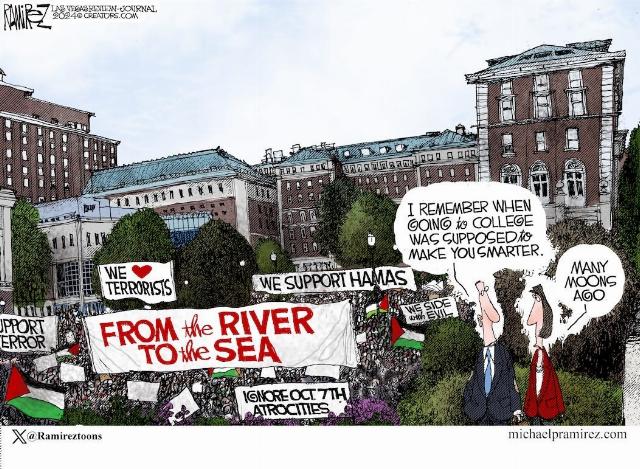
Image: MichaelRamirez.com


Clarice Feldman

Source:https://www.americanthinker.com/articles/2024/05/camps_intifada_students_for_theocratic_authoritarianism.html

Follow Middle East and Terrorism on Twitter

From Idealism to Irresponsibility: Comparing College Protests Then and Now - Roger Kimball

by Roger Kimball

One of the most conspicuous, and conspicuously jejune, features of America's cultural revolution has been the union of hedonism with a species of radical (or radical-chic) politics.


Like every major college protest since the 1960s, the pro-Palestinian—which is to say, the anti-Israel—protests sweeping college campuses today have early and often been compared with the protests of that annus horribilis, 1968.  There are plenty of similarities but also plenty of differences. History repeats itself as student and faculty protestors align themselves with the totalitarians.  Then it was the Viet Cong, Mao, and the Khmer Rouge. Today it is the Sunni Muslim terrorist group Hamas, the main puppet master of the “pro-Palestinian” agitators.

One apparently striking difference is the strong current of anti-Semitism. It is ubiquitous now; it was not a factor in the protests of the 1960s and 1970s.

But that difference distracts us from a deeper similarity between the two.  Fueling the anti-Semitism is a profound anti-American and anti-Western animus. Although shot through with radical Islamic verbiage, the overarching ideology is essentially Marxist in aim and origin.  The assaults on campus are not so much political as a snarling repudiation of the political in favor of something more atavistic. As Jean-François Revel noted in The Totalitarian Temptation (1977), such an upsurge is “not simply a new political orientation. It works through the depths of society. It writes the play in which political leaders will act much later.”

Providing a full anatomy of this phenomenon would take a book, or several books.  But as we ponder the emergence of “Gaza Solidarity Encampments” on the quads of our most exclusive universities, it may be useful to note a few things that today’s protestors have in common with their predecessors.

One of the most conspicuous, and conspicuously jejune, features of America’s cultural revolution has been the union of hedonism with a species of radical (or radical-chic) politics. This union fostered a situation in which, as the famous slogan put it, “the personal is the political.” The politics in question was seldom more than a congery of radical clichés, serious only in that it helped to disrupt society and blight a good many lives. In that sense, to be sure, it proved to be very serious indeed.

Our new revolutionaries, like the college revolutionaries of yore, exhibit that most common of bourgeois passions, anti-bourgeois animus—expressed, as always, safely within the swaddling clothes of bourgeois security.  Typical was the spectacle of that Columbia Ph.D. candidate who, having helped smash into and occupy a major college classroom building, stood before microphones, keffiyeh in place, to demand that the university feed the occupiers.  As Allan Bloom remarked in The Closing of the American Mind (1987), the cultural revolution proved to be so successful on college campuses partly because of “the bourgeois’ need to feel that he is not bourgeois, to have dangerous experiments with the unlimited. . . .Anti-bourgeois ire is the opiate of the Last Man.”  It almost goes without saying that, like all narcotics, the opiate of anti-bourgeois ire was both addictive and debilitating.

Like Falstaff’s dishonesty, the adolescent quality of these developments was “gross as a mountain, open, palpable.” Looking at the pampered multitudes agitating on campus, one is reminded that now, as in the 1960s, the actions of the protestors were at bottom an attack on maturity; more, they was a glorification of immaturity. As the Yippie leader Jerry Rubin put it, “We’re permanent adolescents.”

In “Dreams of Plenitude, Nightmares of Scarcity” (1969), the sociologist Edward Shils summarized the chief components of the revolution he saw unfolding around him in the universities and elsewhere in American life. “The moral revolution,” Shils wrote,

consists in a demand for a total transformation—a transformation from a totality of undifferentiated evil to a totality of undifferentiated perfection. Evil consists in the deadening of sentiment through institutions and more particularly through the exercise of and subordination to authority. Perfection consists in the freedom of feeling and the fulfillment of desires. . . . It is the transformation of sentiment and desire into reality in a community in which all realize their wills simultaneously. Anything less is repressive.

Two decades later, in  “Totalitarians and Antinomians,” Shils elaborated on the theme of absolute fulfillment in his description of the “antinomian temptation.” At the center of that temptation was the fantasy of absolute freedom, unfettered by law, custom, or the promptings of morality.

The highest ideal of antinomianism is a life of complete self-determination, free of the burden of tradition and conventions, free of the constraints imposed by institutional rules and laws and of the stipulations of authority operating within the setting of institutions.

“Free,” in other words, from the very things that underwrite freedom, that give it content, that prevent it from collapsing into that merely rhetorical freedom that always turns out to be another name for servitude.

The glorification of such spurious freedom is closely connected with another misuse of language-one of the most destructive: the description of irresponsible political naiveté as a form of “idealism.” Nor is it only naïveté that gets the extenuating absolution of “idealism.” So do all manner of crimes, blunders, and instances of brutality; all can be morally sanitized by the simple expedient of being rebaptized as examples of (perhaps misguided) “idealism.” The one essential qualification is that the perpetrator be identified with the political Left. In her book On Revolution (1963), Hannah Arendt—who was certainly no enemy of the Left herself—cannily observed that,

one has often been struck by the peculiar selflessness of the revolutionists, which should not be confused with “idealism” or heroism. Virtue has indeed been equated with selflessness ever since Robespierre preached a virtue that was borrowed from Rousseau, and it is the equation which has put, as it were, its indelible stamp upon the revolutionary man and his innermost conviction that the value of a policy may be gauged by the extent to which it will contradict all particular interests, and that the value of a man may be judged by the extent to which he acts against his own interest and against his own will.

In fact, the “peculiar selflessness” that Arendt describes often turns out to be little more than an abdication of individual responsibility abetted by utter self-absorption. It is a phenomenon that, among other things, helps to explain the queasy-making spectacle of left-wing Western intellectuals falling over themselves in a vain effort to excuse, mitigate, or sometimes simply deny the crimes of the Soviet Union and other murderous left-wing regimes throughout the Cold War and beyond. Perhaps we can admit that Stalin (or Mao or Pol Pot or Fidel or whoever) was repressive (or maybe that is just an ugly rumor propagated by the United States); perhaps he “went too far”; maybe some measures were “extreme”; this or that policy was “misjudged”; . .  but omelettes require breaking a few eggs, . . . and besides what glorious ideas are equality, community, the brotherhood of man . . . going beyond capitalistic greed, mere selfish individualism, repressive patriarchal society based on inequitable division of labor, etc., etc. The odor of piety that attends these rituals of exculpation is almost as disagreeable as the aura of grotesque unreality that emanates from them.

One has seen the same thing in another key in the left-liberal response to America’s cultural revolutions. Whatever criticisms might be made of the counterculture, they are quickly neutralized by invoking the totem of “idealism.” For example, one has regularly been told that youth in the 1960s and 1970s, whatever their extravagances and silliness, had a “passionate belief (the beliefs of radicals are never less than “passionate”) in a “better world,” in a “more humane society,” in “equality.” The guiding assumption is that “passion” redeems moral vacuity, rendering it noble or at least exempting it from censure. This assumption, which, even today, is part of the Romantic background of the counterculture, is profoundly mistaken and destructive.

As T. S. Eliot observed in 1934, the belief that there is “something admirable in violent emotion for its own sake, whatever the emotion or whatever the object, is a cardinal point of faith in a romantic age.” It is also, he noted, “a symptom of decadence.” For it is “by no means self-evident,” Eliot wrote,

that human beings are most real when they are most violently excited; violent physical passions do not in themselves differentiate men from each other, but rather tend to reduce them to the same state; and the passion has significance only in relation to the character and behavior of the man at other moments of his life and in other contexts.

Furthermore, Eliot observes, “strong passion is only interesting or significant in strong men, those who abandon themselves without resistance to excitements which tend to deprive them of reason, become merely instruments of feeling and lose their humanity; and unless there is moral resistance and conflict, there is no meaning.”

“Passion,” like “idealism,” is a nostrum that the left prescribes to itself in order to relieve itself from the burdens of moral accountability.

G. K. Chesterton once observed that in the modern world, “the virtues have gone mad because they have been isolated from each other and are wandering alone. Thus, some scientists care for truth, and their truth is pitiless. Thus, some humanitarians only care for pity; and their pity … is often untruthful.” Something similar can be said about the virtues of freedom and idealism. Freedom is an important virtue. But it is not the only virtue. And apart from other virtues—apart from prudence, say, and duty and responsibility, all of which define and limit freedom—freedom becomes a parody of itself. It becomes, in a word, unfree. And so it is with idealism. Idealism remains a virtue only to the extent that the causes to which it devotes itself are worthy of the devotion they attract. The more abstract the cause, the more vacuous the idealism.

In a subtle essay called “Countercultures,” first published in 1994, political commentator Irving Kristol noted that the counterculture of the 1960s was in part a reaction against a society that had become increasingly secular, routinized, and crassly materialistic. In this respect, too, the counterculture can be understood as part of our Romantic inheritance, a plea for freedom and transcendence in a society increasingly dominated by the secular forces of Enlightenment rationality. Indeed, revolts of this tenor have been a staple of Romanticism since the nineteenth century.

Dostoevsky’s “underground man,” who seeks refuge from the imperatives of reason in willful arbitrariness, is only one example (a rather grim one) among countless others. The danger, Kristol notes, is that the counterculture, in its attack on secular materialism, “will bring down—will discredit—human things that are of permanent importance. A spiritual rebellion against the constrictions of secular humanism could end up . . . in a celebration of irrationalism and a derogation of reason itself.” At a time when the radical tenets of the counterculture have become so thoroughly established and institutionalized in cultural life —when they have, in fact, come more and more to define the tastes, habits, and attitudes of the dominant culture—unmasking illegitimate claims to “liberation” and bogus feats of idealism emerges as a prime critical task.

 
Roger Kimball

Source: https://amgreatness.com/2024/05/05/from-idealism-to-irresponsibility-comparing-college-protests-then-and-now/

Follow Middle East and Terrorism on Twitter