The "Middle East and Terrorism" Blog was created in order to supply information about the implication of Arab countries and Iran in terrorism all over the world. Most of the articles in the blog are the result of objective scientific research or articles written by senior journalists.
From the Ethics of the Fathers: "He [Rabbi Tarfon] used to say, it is not incumbent upon you to complete the task, but you are not exempt from undertaking it."
The 'Post's' Yonah Jeremy Bob explains the IDF's mistaken killing of Red Cross workers.
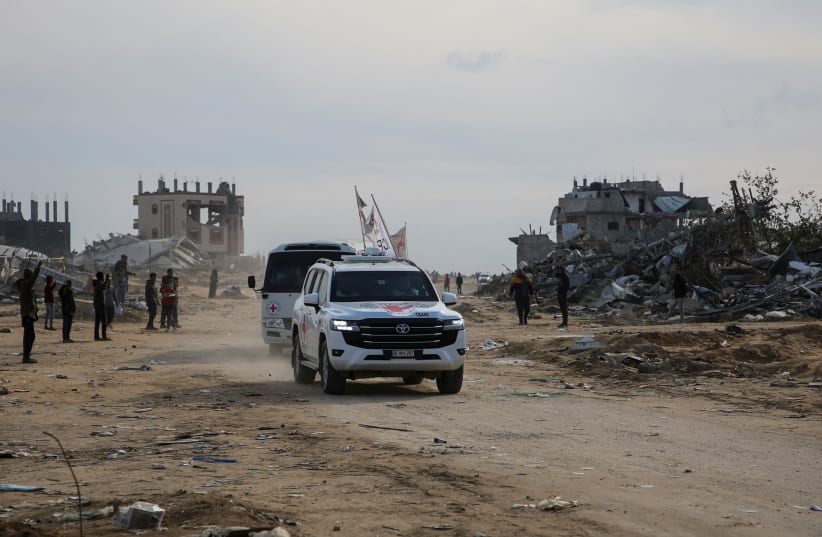
Red Cross vehicles pictured in the Gaza Strip in a previous hostage exchange.(photo credit: REUTERS/Hatem Khaled)
The IDF mistakenly killed 14 Gaza medics and wounded one last month in what has turned out to be one of the worst IDF attacks on international aid workers in the war.
The Jerusalem Post's
military correspondent Yonah Jeremy Bob breaks down the international
law implications of this incident for Israel and explains the importance
of a full investigation.
JPost Videos
He also breaks down what the war in Gaza looks like now and how this differs from previous stages of the Israel-Hamas War.
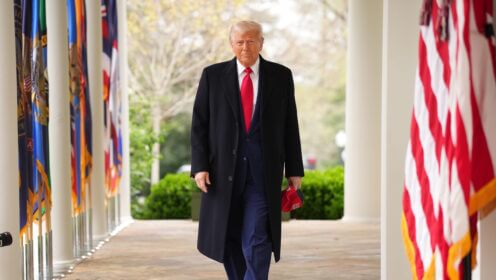
Although Iran has rejected US President Donald Trump's demand for direct talks, it wants to continue indirect negotiation.
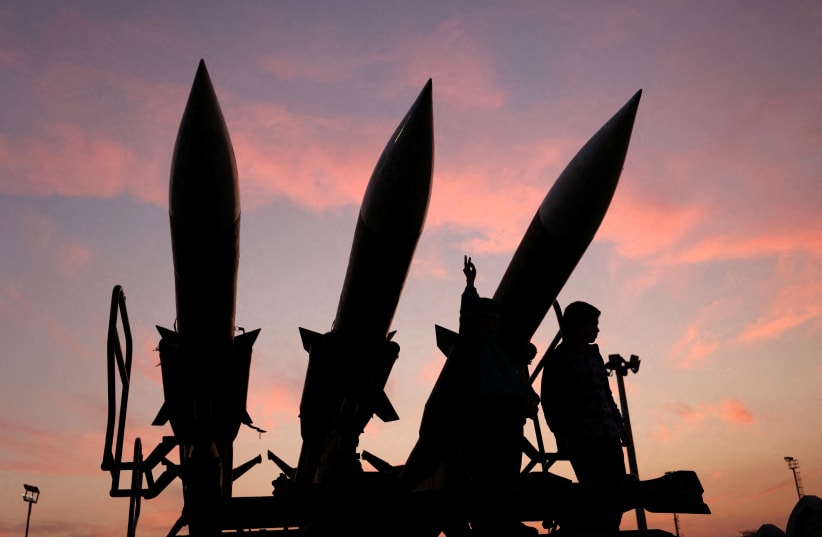
Iranian missiles are displayed at the Islamic
Revolutionary Guard Corps (IRGC) Aerospace Force Museum in Tehran, Iran,
November 15, 2024. (photo credit: MAJID ASGARIPOUR/WANA (WEST ASIA NEWS AGENCY) VIA REUTERS)
Iran is pushing back against US demands that it directly negotiate
over its nuclear program or be bombed, warning neighbors that host US
bases that they could be in the firing line if involved, a senior
Iranian official said.
Although Iran has rejected
US President Donald Trump's demand for direct talks, it wants to
continue indirect negotiations through Oman, a longtime channel for
messages between the rival states, said the official, who spoke to
Reuters on the condition of anonymity.
"Indirect talks offer a chance to evaluate Washington's seriousness about a political solution with Iran," said the official.
Although that path could be "rocky," such talks could begin soon if US messaging supported it, the official said.
Iran
has issued notices to Iraq, Kuwait, the United Arab Emirates, Qatar,
Turkey and Bahrain that any support for a US attack on Iran, including
the use of their air space or territory by US military during an attack,
would be considered an act of hostility, the official said.
Iran's Supreme Leader Ayatollah Ali Khamenei looks on during a meeting
with Iranian students in Tehran, Iran, March 12, 2025. (credit: Office
of the Iranian Supreme Leader/WANA (West Asia News Agency)/Handout via
REUTERS)
Khamenei warns Gulf States
Such an act "will have severe consequences for them," the official said, adding that Supreme Leader Ayatollah Ali Khamenei had placed Iran's armed forces on high alert.
Warnings
by Trump of military action against Iran have jangled already tense
nerves across the region after open warfare in Gaza and Lebanon,
military strikes on Yemen, a change of leadership in Syria and
Israeli-Iranian exchanges of fire.
Worries
of a wider regional conflagration have unsettled states around the
Gulf, a body of water bordered on one side by Iran and on the other by
US-allied Arab monarchies that carries a significant proportion of
global oil supplies.
Spokespeople
for the governments of Iraq, Kuwait, the UAE, Qatar and Bahrain did not
immediately respond to requests for comment. Turkey's Foreign Ministry
said it was not aware of a warning but that such messages could be
conveyed by other channels.
On
Wednesday, Iranian state media reported that Kuwait had reassured Iran
that it would not accept any aggressive action being directed at other
countries from its soil.
Iran's ally Russia said on Thursday that US threats of military strikes against the Islamic Republic were unacceptable and on Friday called for restraint.
Iran
is trying to gain more support from Russia, but is skeptical about
Moscow's commitment to its ally, said a second Iranian official. This
"depends on the dynamics" of the relationship between Trump and Russian
President Vladimir Putin, the official said.
Trump
has said he would prefer a deal over Iran's nuclear program to a
military confrontation and he said on March 7 he had written to Khamenei
to suggest talks.
The
first Iranian official said a first round of indirect talks could
involve Omani mediators shuttling between the Iranian and US
delegations. Khamenei has authorized Foreign Minister Abbas Araqchi or
his deputy, Majid Takht-e Ravanchi, to attend any talks in Muscat.
Oman's government spokesperson did not immediately respond to a request for comment.
However,
the official believed there was a window of around two months to agree a
deal, citing worries that Iran's long-time foe Israel might launch its
own attack if talks took longer, and that it could trigger a so-called
"snap back" of all international sanctions on Iran to prevent the
country from acquiring a nuclear weapon.
Iran
has long denied wanting to develop a nuclear weapon. However, it is
"dramatically" accelerating enrichment of uranium to up to 60% purity,
close to the roughly 90% weapons-grade level, the U.N. nuclear watchdog
has warned.
Western
states say there is no need to enrich uranium to such a high level
under any civilian program and that no other country has done so without
producing nuclear bombs.
While
Iran has said it will consider talks with the US if the aim was to
address concerns over its program, it has rejected holding any direct
negotiations when the US is making threats and has said its missile
program would be off limits.
A
senior Iranian military commander, the Islamic Revolutionary Guards
Corps' Amirali Hajizadeh, had implied on Monday that US bases in the
region could be targeted in any conflict.
In
2020, Iran targeted US bases in Iraq after the assassination of Qassem
Soleimani, the head of the IRGC's Quds Force, in a US missile strike in
Baghdad.
Saudi media reports that the US transferred two Patriot batteries and a THAAD missile interceptor battery to Israel during its military operation against the Houthi rebels in Yemen.
THAAD iStock
The Saudi channel Al-Arabiya Al-Hadith reported
overnight from sources that the United States transferred two Patriot
batteries and a THAAD missile interceptor battery to Israel.
The
transfer was made against the backdrop of the US military operation
underway in Yemen against the Houthis and against the backdrop of US
President Donald Trump's repeated threats against the Iranian nuclear
program.
The THAAD air defense system, manufactured by Lockheed
Martin, is an advanced solution for dealing with ballistic missiles and
can intercept targets within and outside the atmosphere.
It is
estimated that the transfer of the additional battery to Israel was
carried out in coordination and with American approval, among other
things, to demonstrate a significant American military presence in the
region and to send a message of deterrence to hostile elements. The
battery is expected to be manned by about 100 American soldiers.
The first THAAD battery was transferred to Israel in October and has
since managed to intercept several missiles launched from Yemen.
Yesterday
it was reported that an American C5 Super Galaxy cargo plane, the
largest of the Americans, landed at the Nevatim Air Force base and left
after eight hours.
The U.S.-led Golden Dome aims to counter hypersonic missile threats with cutting-edge tech and allied support, redefining North American defense for a new era.
The rapid evolution of missile technology rarely captures public
attention, but within the defense community, the era of surprise over
next-generation weapons is long past. Still, the advent of hypersonic
missiles represents a significant shift—one that demands renewed
scrutiny and strategic recalibration.
These missiles travel faster than five times the speed of sound,
can maneuver mid-flight, and are incredibly unpredictable. Even setting
aside their near immunity to current missile defense systems,
hypersonic weapons present a fundamental challenge to established
strategic assumptions. Traditional missile defense is calibrated to
counter ballistic threats—projectiles that follow predictable, high-arc
trajectories, like those intercepted by Israel’s Iron Dome.
Hypersonics, by contrast, maneuver unpredictably at low altitudes and
extreme speeds, rendering them both elusive and destabilizing. They may
resemble a technological marvel, but in the context of great power
competition, they are anything but a toy.
The operational implications are significant. Hypersonic weapons are
not only harder to track and intercept—they expand the threat envelope
to include both forward-deployed forces and civilian populations. In
response, systems like the proposed Golden Dome aim to integrate
advanced sensors and AI-driven interception capabilities to meet this
emerging challenge. The goal is clear: shift interception points from
urban centers like New York City to far earlier in the threat
trajectory—ideally, over the Atlantic.
With nearly four million square miles
of territory to protect, the United States is leading efforts to
develop the Golden Dome system—a next-generation missile defense
architecture designed for the threats of the 21st century. While
headlines often focus on friction between the U.S. and its allies, the
foundation of allied cooperation remains strong, especially when it
comes to shared security. I saw this firsthand at an event this week at
the House of Sweden, where representatives from Iceland, Denmark,
Norway, Greenland, and Sweden all affirmed their commitment to
collective defense. Their interest in contributing to the Golden
Dome—rather than passively relying on U.S. capabilities—signals a
meaningful shift. For many, this includes increasing defense spending
and investing in key areas like sensor development. Canada, too, has
expressed intent to support the project directly. This collaborative
approach reflects a broader transformation in allied defense posture—one
not seriously tested since World War II—and a clear recognition that
defending the homeland is a shared imperative.
This collaboration reflects the modernization efforts of NORAD (North
American Aerospace Defense Command) which is the organization
responsible for monitoring and defending skies over North America. By
integrating this advanced system into NORAD’s broader defense
infrastructure, the U.S. and Canada position themselves to more
effectively counter the threats of the future, regardless of the ocean
between us and Russia.
The protection of our borders is the bedrock of U.S. national
security policy, and a very loud focus for both the Trump
administration, and the American voter. With countries like China and
Russia aggressively pursuing advanced missile technologies, further
evidence of a shift in global power dynamics, the U.S. cannot afford to
slow down on innovation and development.
The Golden Dome system epitomizes this approach and a newly realigned
defense strategy. By integrating this technology into our defense
architecture, America sends a powerful message: your technology will not
outpace ours and we are prepared to defend ourselves at all costs.
Yet, this concept of deterrence hinges on our credibility per the
adversary’s belief that the U.S. will act. There is no doubt that the
U.S.’s innovation outpaces all other nations; however, those nations
take note when we slow down. That is not a risk we can take here; nor a
risk that I am concerned over with our current administration. The
Golden Dome enhances our credibility.
While recruitment and retention for our military are incredibly
important, a concept often overlooked by those critical of our defense
spending is that America’s military strength does not simply lie in the
number of troops or weapons at its disposal; it is mutually rooted in
our ability to innovate and adapt to new threats. The Golden Dome system
exemplifies this adaptability, ensuring that the U.S. is not simply
reactive to new technologies but is proactive in developing them and the
solutions to counter them. The beauty of the American defense community
is that the partnership of the government and the private sector makes a
cutting-edge system like this well within reach.
As the world’s foremost military power, the U.S. continues to lead in
developing and deploying defense systems that protect not only our own
borders but also those of our allies. Through the Golden Dome system,
America is demonstrating our capacity to innovate, deter, and defend
against threats who desire to knock on our door.
This article was originally published by RealClearDefense and made available via RealClearWire.
Taylor Hathorn is a visiting fellow at
Independent Women. She has over 10 years of experience in cybersecurity,
policy, public relations, and non-profit management.
Trump is a political paradigm-shifter, taking bold action where others only talk—disrupting norms, slashing DEI, imposing tariffs, and redrawing the rules of governance.
One of the biggest differences between Donald Trump and other politicians is that Trump does what others only talk about.
It’s become a popular sport to dig up video clips
from lefty politicians like Nancy Pelosi, Bernie Sanders, and Barack
Obama, who once upon a time said things about subjects like trade,
tariffs, government spending, and immigration that sound a lot like
Donald Trump or Elon Musk today. Here, for example, is Obama on the subject of rooting out “wasteful spending” in “a systematic way.” Here he is on immigration.
People who say, “Oh, they’re just hypocrites,” are, I believe,
misunderstanding the situation. It’s possible—even likely—that hypocrisy
comes into the equation. More important is their assessment of
political reality.
In the introduction to his translation of Machiavelli’s Discourses on Livy,
Harvey Mansfield observes that Machiavelli believed that to understand
political situations correctly, “one must not listen to the intent of
the words people use but rather look at the necessities they face.” Most
politicians accept the political chessboard they inherit. They are
prepared to make moves—even dramatic ones—on the given field of play.
They are unwilling or unable to change or challenge that field.
As a theory about the way science actually works, I think that the process Thomas Kuhn describes in his wildly successful bookThe Structure of Scientific Revolutions
is completely wrong. Kuhn drowns the logic of science in its history
and sociology. He neutralizes the idea of truth and the cognitive
machinery we employ to arrive at the truth in order to champion a
relativized view of science in which there are no discoveries, only
“discoveries,” no refutations, only “refutations,” no proofs, only
“proofs,” no real progress, only the substitution of one model for
another. The triumph of relativism in Kuhn’s philosophy of science
explains why his book instantly became such a hit with literary critics,
sociologists, anthropologists, and other humanists beset by science
envy. The philosopher David Stove performed the definitive anatomy of
Kuhn’s brand of cognitive sabotage in his book Scientific Irrationalism.
While Kuhn’s model of science is logically flawed, one of its images
is highly suggestive of how politics unfolds. Kuhn says that the
practice of science is an agglomeration of certain techniques,
questions, and assumptions about the world. Taken together, this deposit
describes the actual practice of what he calls “normal science.” There
are always tensions and anomalies in the edifice of normal science,
however, questions we can’t answer, eccentricities we can’t explain.
When these tensions become aggravated enough, a “paradigm shift” (how
the humanists loved that term!) occurs, and normal science gives way to a
period of change, tumult, and revolution.
As I say, as an account of science, the Kuhnian model is woefully
deficient. Among other things, it leaves the question of truth and its
first cousin, probability, wholly out of account—or, rather, it
willfully rejects the question of truth as a naïve atavism.
But inadequate though it is as a theory about the practice of
science, it has great relevance to the practice of politics. The
taken-for-granted field of politics is akin to what Kuhn describes as
“normal science.” At any given moment, most politicians play ball on
the field and with the equipment they have inherited. They look to
exploit, not usually, to expand the Overton window of political possibility.
Donald Trump is different. He does what others say is impossible.
Some commentator (I forget who) recently employed a quip attributed to
Winston Churchill about Trump. Churchill is supposed to have said that
U.S. Secretary of State John Foster Dulles was “the only bull I know who
carries his china shop with him.” Apparently, Churchill did not say that.
But it is a memorable image, and one can understand why someone would
apply it to Donald Trump. He has been in office fewer than 100 days, yet
look at the disruptions he has instigated. On his first day, he abolished all “diversity, equity, and inclusion”
programs throughout the federal government. He also forbade simply
renaming those programs in order to carry on their racist, inequitable
work by subterfuge. He insisted that universities jettison their
coddling of racist and anti-Semitic policies as a condition for
receiving federal money. As of this writing, hundreds of millions of
dollars have been withheld from Princeton, Brown, Harvard, Columbia, the
University of Pennsylvania, and other elite institutions for failing to
abide by this directive. He tapped Elon Musk to help him identify and eliminate waste and fraud in the government. The revelations are stunning. It’s almost as if the U.S. government had evolved into a machine to serve politicians at the taxpayer’s expense.
This last week, Trump got around to one of the main things he
campaigned on, his “favorite word,” tariffs. The stock market cratered,
the establishment recoiled like a scrotum in icy water, and the acrid
scent of panic was everywhere. I wrote about the tariffs the morning of what Trump called “Liberation Day” before the market opened. I expected market tumult but was taken aback by the ferocity of the market reaction.
Still, I continue to believe that we should give Trump’s strong
medicine a chance to work. I think that the commentator Tanvi Ratner is
correct: the tariffs “aren’t a trade tweak,” she wrote,
“they’re the first move in a full-spectrum reset.” As the stock market
declines, investors flee to treasury bonds, forcing the yield on those
bonds lower. This year, almost $10 trillion will need to be refinanced.
Every basis point that the yield declines translates into a
billion-dollar annual savings in loan repayment. Thus, a 0.5% drop, she
points out, would save $500 billion over a decade. As of this writing,
the yield has declined about 0.7 points. That’s a lot of money saved.
As a friend of mine observed, Trump’s tariffs are less a matter of
economic policy than they are a matter of statecraft. Just a few days
ago, Scott Bessent,
Trump’s Secretary of the Treasury, discussed Trump’s strategy in an
interview with Tucker Carlson. Their ultimate aim, he said, is to
strengthen the middle class by helping to get spending under control and
by equalizing the international economic playing field. Will it work?
Time—and it won’t be a lot of time—will tell. I think that the investor
Bill Ackman was spot on in his recent post on X. “Trump’s strategy is
not without risk,” he noted,
“but I wouldn’t bet against him. The more that markets support the
President and his strategy, the higher the probability that he succeeds,
so a stable hand on the trading wheel is a patriotic one.”
An important characteristic of a great leader [Ackman
continued] is a willingness to change course when the facts change or
when the initial strategy is not working. We have seen Trump do this
before. . . . Trump cares enormously about our economy and the stock
market as a measure of his performance. If the current strategy works,
he will continue to execute on it. If it needs to be tweaked or changed,
I expect he will make the necessary changes. Based on the early read,
his strategy appears to be working.
To me, Ackman seems right about all this. And I think he is also
right in his concluding exhortation. “Let’s help him succeed. It’s the
least we can do.”
Gas...and gaslighting: With record-high oil and gas production, Democrats are now claiming that Biden never made a war on American energy. The American Energy Alliance claims there was, and they say they have the receipts.
The American Energy Alliance
(AEA) has been keeping a tally of actions that Congress and current
administrations have taken that impact the production of oil and gas in
the U.S. The most recent list
counts 50 actions that the Trump administration and Congressional
Republicans have taken to unleash American energy since Jan. 20.
“In just over 60 days, President Trump and Congress have
already taken over 50 actions to reverse the damage. It is a great
relief to see positive movement in the right direction, but there is
much more to do. We look forward to rolling up our sleeves and helping
to get the job done,” Tom Pyle, president of the AEA, said in a statement.
Record high production despite hundreds of impediments
Under the Biden administration, oil companies produced record-high amounts of oil and gas,
a fact many Democrats have used to either deny there was ever a war on
fossil fuels or to credit Biden with being pro-energy. During the Biden
administration, however, the AEA documented hundreds of actions the
administration and Democrats took to impede the flow of oil and gas to
consumers.
In May 2022, the AEA published on their website an essay titled “100 Ways Biden and the Democrats Have Made it Harder to Produce Oil & Gas." At
the time, Biden’s signature climate law, the Inflation Reduction Act,
had passed the House without a single vote from Republicans, and it was
making its way through the Senate.
The list starts out with Biden, on his first day in office
on Jan. 20, 2021, signing executive orders canceling the Keystone XL
pipeline and placing a moratorium on oil and gas leasing in the Arctic
National Wildlife refuge. By May of 2022, Biden was canceling a lease sale of 1 million acres in the Cook Inlet of Alaska and a lease sale in the Gulf of America.
The AEA released regular updates throughout the Biden administration, and by the time Biden left office, the list had grown to 250 actions
the Biden administration and Democrats had taken that made it harder
for companies to produce oil and gas, including many of the provisions
of the Inflation Reduction Act that Biden signed into law in August
2022. The latest AEA report listing actions taken by the GOP and Trump
administration shows a complete reversal on energy policy in the U.S.
Alex Stevens, manager of policy and communications for the Institute for Energy Research, the research wing of the AEA, told Just the News
that many of these actions are vulnerable to future administrations.
Many of the items on the new report are executive orders, which was also
the case with AEA’s list of actions Biden and the Democrats took.
“The congressional actions are sort of the first steps on some of the CRAs [Congressional Review Act]
that need to be done. I think overall, a good first couple months here.
It’s going to be very important that Congress follows through on a lot
of these things, because obviously, with his executive orders, they can
be overturned,” Stevens said.
Boasts of production, accusations of "conspiracy theory"
While the AEA list shows Biden and the Democrats took every
opportunity to add more regulations impacting the oil and gas industry,
many Democrats now deny there was any war on fossil fuels. In multiple
congressional hearings, Democrats argued the record-high production
rates under the Biden administration dispute Republican claims of a
concerted effort to harm the oil and gas industry.
“My colleagues have invited you here today to testify about
President Biden's so-called war on energy, which we know doesn't exist.
For better or worse, the United States is producing record high levels
of oil and natural gas today, it's never been so high so our colleagues
can breathe easy,” Rep. Jeremy Raskin, D-Md., said at a House Oversight Committee hearing in May 2024.
After claiming that there was no effort to reduce oil and
gas production, Raskin went on to explain that fossil fuels are causing
an unparalleled crisis and oil companies have been deceiving everyone.
“Climate change is the defining crisis of our time. And we know that
burning fossil fuels is by far the leading factor in contributing to
climate change, a fact that fossil fuel companies knew about decades
ago, but suppressed,” Raskin said.
Inconvenient fact
Raskin wasn’t the only Democrat making these seemingly
contradictory statements in hearings. “This may be an inconvenient fact
for some, but under President Biden and Vice President Harris, we are
now producing more oil than ever before, more than Russia, more than
Saudi Arabia, and more than any other country on Earth,” Rep. Brendan
Boyle, D-Pa., said at a House Budget Committee Hearing in September.
Later in the hearing, Boyle seemed to take the other side,
claiming that fossil fuels were costing Americans billions and to back
up his claim, he cited the “Billion Dollar Disaster”
tally of the National Oceanic and Atmospheric Administration. The tally
claims to show that costs of climate-related natural disasters are
growing higher every year as a result of more extreme weather, but the
methodology NOAA uses to produce the report has received extensive
criticisms. In the face of mounting criticism, the agency agreed in
August, one month before Boyle’s statements at the House Budget Hearing,
to review and improve its methodology to be in line with scientific standards.
“The United States is already producing more oil and gas
than ever, more than any country in history,” Ansari said. She then
explained that the U.S. should prioritize a transition away from fossil
fuels because “the gravest existential threat to our national security
is climate change.”
Stevens, from the Institute for Energy Research said that a
lot of the impact of the actions Democrats and the Biden administration
took impacted long-term investment on upstream investments,
which is the exploration and production aspect of the industry furthest
up the supply chain from the end consumers. This blunted any immediate
impacts on production, as there were wells drilled under the first Trump
administration that were still producing.
Fatih Birol, executive director of the International Energy
Agency said at the CERAWeek energy conference in Houston last month
that more investment in existing oil and gas fields is needed in order
to satisfy future energy demand. It was a contrast from the agency’s
outlook just a few years ago, according to Reuters. The IEA had claimed in 2021 that no investments in new oil and gas development were needed as the world would be transitioning to a net zero economy by 2050.
Regulatory hostility
Despite the Democrats who now dispute there was ever an
effort to reduce the production of oil and gas, the AEA has documented
hundreds of actions that the previous administration took in line
Biden’s climate agenda, which made it harder for oil companies to
produce fossil fuels. Its latest lists show the Trump administration has
taken a very different direction.
At the House Budget Committee hearing in September, Alex Epstein, president of the Center for Industrial Progress
and author of “Fossil Future,” offered an explanation for how there
could be so much regulatory hostility toward the oil and gas industry
under the Biden administration, while the industry managed to produce
record amounts.
“This is very important when you hear the Biden
administration has record production. That's in spite of them, not
because of them,” Epstein said.
Dr. Ofer Grosbard, a clinical psychologist, discussed Israel's use of psychological warfare and the next steps in the war.
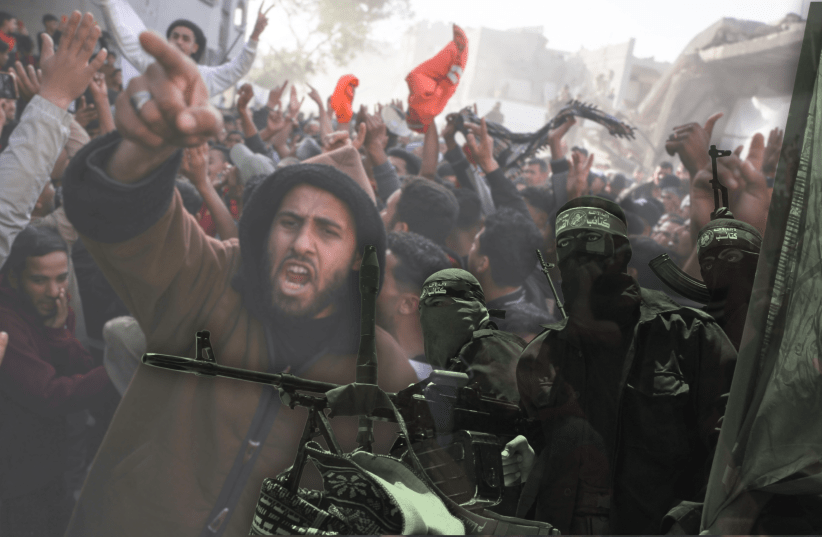
Hamas terrorists against backdrop of Gazan demonstrators in the Gaza Strip (illustration).(photo credit: Canva, Getty Images/AFP, SAID KHATIB)
Israel may need to consider an alternative strategy involving the use
of psychological warfare to "end terrorism in Gaza and the West Bank,"
Dr. Ofer Grosbard, a former advisor to the Military Intelligence
Directorate, told Maariv on Sunday.
“You
don’t need to mobilize divisions, and you don’t need to lose human
lives – you need to understand the enemy,” Grosbard, a clinical
psychologist, told Maariv.
"To
this end, psychological warfare must be used,” he explained. “However,
in our security system, psychological warfare does not exist because a
necessary condition for its existence is understanding the enemy's ways
of thinking.
JPost Videos
“The
terrorist organizations have actually used psychological warfare
against us throughout the years, which reached its peak in the issue of
the hostages. They have what is called an 'external focus of control,'
and therefore, they focus on us, learn, and get to know us. Whereas we,
who have an 'internal focus of control,' focus on ourselves and do not
know them."
While
Hamas accuses those who protest of being agents of either Israel or the
Palestinian Authority, it is clear that any Israeli public embrace of
the protests will only backfire. Here, Gazans chant slogans during an
anti-Hamas protest, calling for an end to the war. (credit: YOUSSEF
ALZANOUN/MIDDLE EAST IMAGES/AFP VIA GETTY IMAGES)
Grosbard
explained: “The psychology of the residents of Gaza and the West Bank
is that of a very traditional population... Therefore, some of its
prominent characteristics are rumors, gossip, conspiracies, and, above
all, fear. This is a culture in which independent thinking is less
developed, group pressure is great, and people are driven mainly by
fear. One can, of course, get the impression that the residents of Gaza
will align themselves with Hamas as a result of fear.
“These
non-democratic societies have an external focus of control – that is,
the emphasis is not on what I think and want, but on what the
environment requires and forces me to do,” he highlighted.
“For
example, a member of Western culture will automatically stop at a red
light. If he does not do so, he may feel guilty. In contrast, in these (Palestinian)
societies with an external focus of control, the individual may not
stop at a red light if there is no policeman by his side. Order,
therefore, is caused by fear – and not by internalizing values as in
the West. Similarly, the individual will not steal in these societies
because he may be caught – and not because it is ingrained in him that
this is not the way to do things.”
The solution to terrorism in Gaza and the West Bank
Based
on the psychological evaluation, Grosbard recommended two courses of
action: first, preventing incitement and second, creating group pressure
against terrorism.
“The
defense establishment got confused,” he argued. “This is not a
democratic society where individuals should think independently, and
therefore it is permissible and even desirable to encourage free
thinking. We project our modern thinking onto the enemy and allow
incitement in schools, textbooks, mosques, and social media – with the
unconscious assumption that individuals in these societies have the
ability to resist incitement and form their own opinions independently.
But in these societies, awareness of the instigator’s nature is
considered no less responsible than the instigator. In contrast to a
modern society where every mother will say to her son: ‘So what if he
said… that doesn’t mean you have to listen to him.’"
“Incitement
is the driving force behind terrorism,” Grosbard stressed. “If we dry
up incitement – there will be no terrorism. Today, using AI, it is not
difficult to detect incitement content in various places and forms. To
deny individuals and leaders the ability to incite as a result of
punishment and fear – is tantamount to denying their power.”
On the second point – creating group pressure against terrorism,
Grosbard explained, “In Proverbs it is written, ‘Blessed is the man who
fears always’ – such is the nature of a member of the traditional,
collective society, from which we all grew up. If he is not afraid, he
is liable to do very serious things.
“Creating
a psychological situation in Gaza and the West Bank in which people
will be afraid to engage in terrorism because someone will immediately
report them and turn them in – this is the desired situation. The nature
of their society, which is ruled by fear, must be understood, and these
insights must be used. The goal is to create a situation in which Hamas
members will fear the population that wants to be free from them – and
not the other way around.”
Grosbard suggested that he had the answer on how to spread this fear.
“We
are establishing a reward system where anyone who reports a Hamas
member or any hostile activity is rewarded,” he explained. “Reports can
be made discreetly via mobile phones. Anyone found guilty will be
severely punished, as will anyone who knew and did not report. The
carrots and sticks are simple: medical treatment and work in Israel – or
their prevention.
“Benefits
for family members who report to the authorities – and punishments for
family members of terrorists. Benefits and punishments for family
members are very effective in these collective societies. A Hamas member
who turns himself in, arms himself, and signs a pledge to stop engaging
in terrorism, will not be eliminated.
“And
every time a Hamas member is caught engaging in terrorism, his
humiliated picture will be published, and his family will be severely
punished. Humiliation is also a winning weapon in these societies, where
the loss of honor is equated with death.
“The
Palestinian population must move from a situation where they are afraid
of Hamas to a situation where every Hamas member is afraid that they
will be handed over,” he said, speaking on the future of Palestinian
territories. “This can be done – and for this, you don’t need divisions
of soldiers, just appropriate psychological warfare – which does not
exist at all in the security system today.”
“Israel
has declared that a Hamas member who releases a hostage will receive
huge benefits. However, without creating group pressure and denunciation
that forces the Hamas member to behave in this manner, there is no
chance of this. We apply military pressure, but he is willing to fight
us and die with the hostages in order to maintain his honor in the eyes
of his group members. Therefore, harming their honor and humiliating
them at the hands of their group members is the only way to change their
behavior, not military pressure.
“Indeed,
the release of the hostages must also go through psychological warfare
and understanding the ways of thinking of our enemy.”
Zimnako Salah was reportedly working on building a real IED as he placed fake bombs in churches.
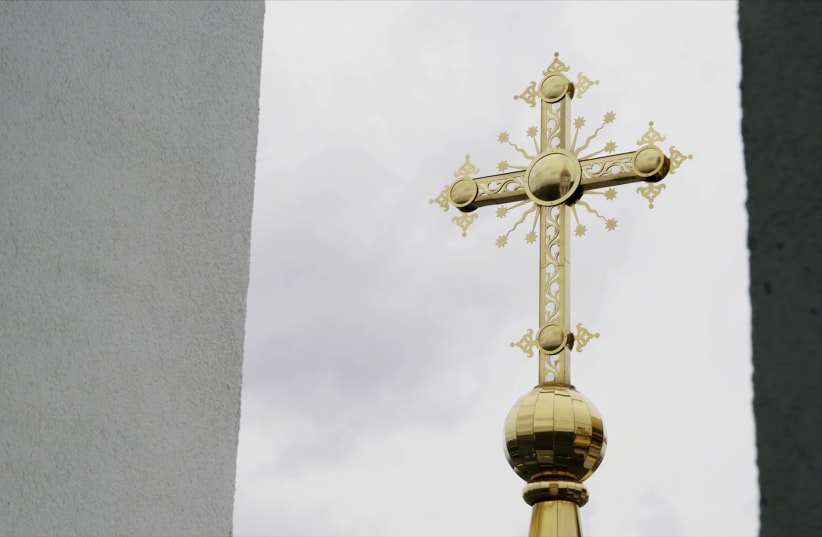
View of a golden cross of a Christian church (illustration)(photo credit: INGIMAGE)
Zimnako Salah planted fake bombs across four churches in Arizona,
California, and Colorado and worked separately to construct a real one,
according to a US jury that found the 45-year-old guilty on Thursday.
Salah
planted the fake bombs from September to November of 2023, after
watching extremist content online, according to the US Justice
Department. This content, including ISIS videos, featured “infidels dying.”
At
two of the churches, Saleh was confronted by security before he was
able to plant the fake bombs. However, in two instances, he was able to
strap the items to bathrooms and call in a fake bomb threat to incite
panic.
JPost Videos
The jury found that Salah’s motivation had been “to obstruct the free exercise of religion
of the congregants who worshipped there,” according to the department,
which saw the charges escalated to include a hate crime charge.
“This
Department of Justice has no tolerance for anyone who targets religious
Americans for their faith,” said Attorney General Pamela Bondi. “The
perpetrator of this abhorrent hate crime against Christians will face
severe punishment.”
A view of the sun behind a cross on top of a church in Lisbon,
Portugal, earlier this year. The writer argues that fundamentalist
Christian missionaries are as dangerous to Jewish continuity in the Land
of Israel as Islamic fundamentalist terrorists. (credit: PEDRO
NUNES/REUTERS)
The real threat
While
causing bomb scares, Salah had been constructing an IED capable of
fitting in a backpack, the department said. An FBI Bomb Technician
seized items from a storage locker belonging to Salah that an FBI Bomb
Expert testified at trial served as component parts of an improvised
explosive device.
“The
Sacramento Division of the FBI is proud of our collaboration with local
partners in bringing Mr. Salah to justice. His deliberate targeting of
multiple places of worship and calculated efforts to spread panic were
intended to terrorize people of faith and disrupt the peace of our
communities,” said Special Agent in Charge Sid Patel of the FBI
Sacramento Field Office. “The FBI remains committed to protecting the
American people and will continue to work within the confines of the law
to hold individuals accountable for acts of terrorism whether those
acts are true threats or intended as hoaxes.”
“Planting
a hoax bomb at the Roseville church was not an isolated incident or a
prank for this defendant,” said Acting US Attorney Michele Beckwith for
the Eastern District of California. “His actions were designed to
threaten and intimidate the congregation because he disagreed with their
religious beliefs. Thanks to the coordinated efforts of federal and
local law enforcement, the attorneys from my office, and our DOJ
partners in Washington, DC, our communities are safer with yesterday’s
verdict. People of all religions should be able to worship freely and
exercise their First Amendment rights in this country without fear of
violence.”
Salah,
who will appear before the courts on July 18 for sentencing, faces a
maximum penalty of six years in prison and a fine of $250,000.
The animosity between the regional powers has spilled over into Syria, with Israeli forces striking Syria.
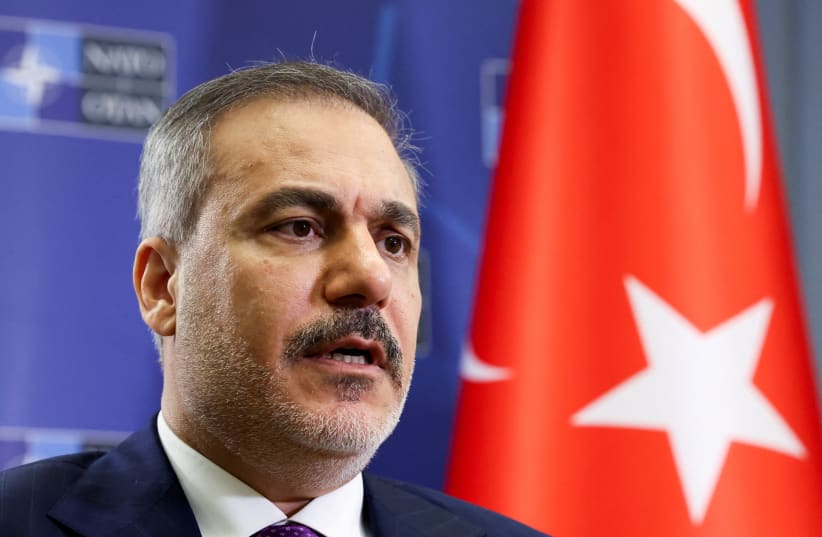
Turkish Foreign Minister Hakan Fidan attends an interview with Reuters, in Brussels, Belgium April 4, 2025.(photo credit: REUTERS/YVES HERMAN)
Turkey wants no confrontation with Israel in Syria after repeated
Israeli attacks on military sites there undermined the new government's
ability to deter threats, Turkish Foreign Minister Hakan Fidan told
Reuters on Friday.
In
an interview on the sidelines of a meeting of NATO foreign ministers in
Brussels, Fidan said Israel's actions in Syria - where the
administration of President Ahmed al-Sharaa is a close Turkish ally -
were paving the way for future regional instability.
If the new administration in Damascus
wants to have "certain understandings" with Israel, which, like Turkey,
is a neighbor of Syria, then that is their own business, he added.
NATO
member Turkey has fiercely criticized Israel over its attacks on Gaza
since the October 7 Hamas attacks in 2023, saying they amount to a
genocide against the Palestinians, and has applied to join a case at the
World Court against Israel while also halting all trade.
IDF
soldiers gather near the ceasefire line between Syria and Israel, in
the Golan Heights, December 9, 2024 (credit: REUTERS/AMMAR AWAD)
The animosity between the regional powers has spilled over into Syria, with Israeli forces striking Syria since a new administration took control in Damascus.
Turkey's response
Turkey
has called the Israeli strikes an encroachment on Syrian territories,
while Israel has said it would not allow any hostile forces in Syria.
Asked
about US President Donald Trump's threats of military strikes against
Iran, Fidan said diplomacy was needed to resolve the dispute and that
Ankara did not want to see any attack taking place against its neighbor Iran.
Terrorist financing and money laundering are top concerns for the United States, which wants to prevent Hezbollah from using the Lebanese financial system and cash flows.
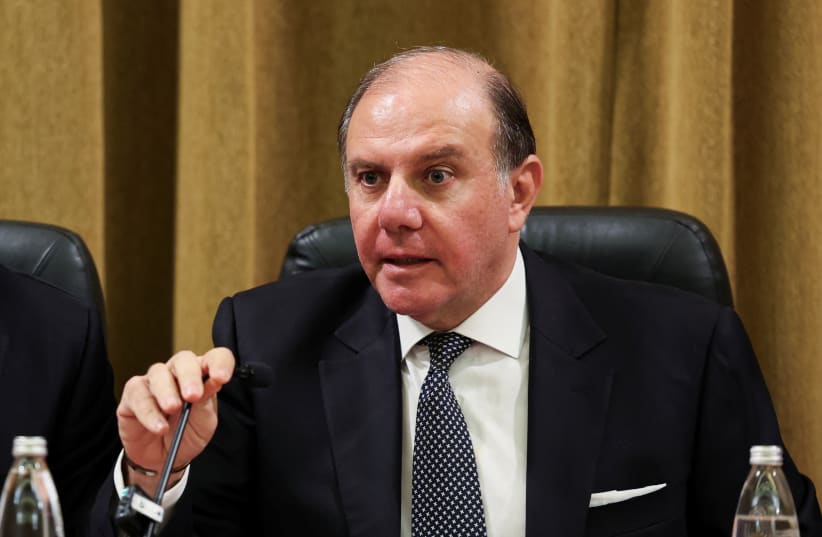
Lebanon's newly appointed central bank governor Karim
Souaid takes office in a handover ceremony in Beirut, Lebanon April 4,
2025.(photo credit: REUTERS/MOHAMED AZAKIR)
Lebanon's new
central bank governor said on Friday commercial banks must recapitalize,
merge or be closed as he outlined plans for reviving the paralysed
financial system, saying that small depositors would be prioritised in
recovering their funds.
Karim
Souaid also said the central bank would counter terrorism financing and
eliminate the parallel economy as it seeks to get Lebanon removed from a
global financial watchdog's "grey list" of states requiring special
scrutiny.
Souaid
takes over Banque du Liban with Lebanon still suffering the
repercussions of a financial crisis that began in 2019, when decades of
profligate spending and corruption led the state to default on its huge
debt, the currency to collapse, and the banking system to seize up.
His
appointment is part of a major shake-up of Lebanese officialdom that
followed last year's war between Israel and the Iran-backed Hezbollah, an armed group that long had major sway over state affairs but was badly weakened by the conflict.
Souaid
said the central bank would work to reschedule the public debt and pay
back depositors, while calling upon private banks to gradually raise
their capital by injecting fresh funds.
A person holds a flag as people gather to attend the public funeral
ceremony of Hezbollah leaders Hassan Nasrallah and Hashem Safieddine,
who were killed during Israeli airstrikes last year, on the outskirts of
Beirut, Lebanon February 23, 2025. (credit: REUTERS/Ali Allouch)
Those
banks unable or unwilling to do so, should look to merge with other
institutions. Otherwise, they would be liquidated in an orderly manner,
with their licences revoked and depositors' rights protected, he said.
"The
priority must be to pay the funds of the small depositors," he said.
Commercial banks, BdL and the Lebanese state must bear their
responsibilities in paying depositors, he added.
Losses in Lebanon's financial system as a result of the 2019 collapse are estimated at some $72 billion.
Successive
governments made little to no progress in enacting reforms to revive
the economy since the collapse, with vested interests widely blamed for
blocking change. The World Bank in 2022 said the collapse had been
orchestrated by the ruling elite that had long exploited state
resources.
The
new government, led by Prime Minister Nawaf Salam, has requested a
programme with the International Monetary Fund, which says Lebanon needs
a comprehensive strategy for rebooting its economy.
Souaid pledged to safeguard the central bank's independence from political pressure and prevent conflicts of interest.
"I
will ensure that this national institution remains independent in its
decision-making, shielded from interference, and grounded in the core
principles of transparency and integrity," he said.
Money laundering
Souaid,
who was appointed last week, outlined his priorities during his
official handover with the outgoing acting central bank governor, Wissam
Mansouri.
"The
most important of these are combating money laundering and terrorist
financing, and identifying and disclosing politically and financially
influential individuals, their relatives, and those associated with
them," he said.
The
Financial Action Task Force placed Lebanon on its list of countries
requiring special scrutiny last year in a move many have worried could
discourage the foreign investment it needs to recover from the financial
crisis.
Terrorist
financing and money laundering are top concerns for the United States,
which wants to prevent Hezbollah from using the Lebanese financial
system and cash flows through the country to re-establish itself.
Souaid
said any activity counter to the monetary and credit law, either by
accepting deposits in cash or in any other manner, or by issuing loans,
is by definition illegal, illegitimate, and would be shut down.
Hezbollah has long operated its own financial institution - Al-Qard Al-Hassan
- which provides loans to people according to Islamic principles. It
operates under a licence granted by the Lebanese government, although the US Department of the Treasury has imposed sanctions on it since 2007.
Asked whether Souaid was referencing Al-Qard Al-Hassan in his comments, a central bank spokesperson declined to comment.
Souaid
takes office nearly two years after long-serving governor Riad
Salameh's tenure ended with his legacy stained by the financial collapse
and graft charges at home and abroad, which he has denied.