Thursday, April 10, 2025

Nearly $60b. seized from Egyptian Jews in decades-long 'modern Passover' - report - Ohad Merlin


by Ohad Merlin

"Unlike its ancient counterpart, the modern-day uprooting of Egyptian Jewry is not a tale of triumph but of tragedy," the report claimed.


Tourists ride on camels next to Pyramid of Khufu on Great Pyramids of Giza, on the outskirts of Cairo (photo credit: REUTERS/MOHAMED ABD EL GHANY)
Tourists ride on camels next to Pyramid of Khufu on Great Pyramids of Giza, on the outskirts of Cairo
(photo credit: REUTERS/MOHAMED ABD EL GHANY)

While Jews worldwide will celebrate Passover this week, recounting the ancient Israelites’ exodus from Egypt, a newly released report sheds light on a modern exodus that remains largely forgotten: the 20th-century ethnic cleansing of Egypt’s Jewish community.

The report, released by Justice for Jews from Arab Countries, is the culmination of six years of research, documenting both the rich cultural legacy of Egyptian Jews and the systematic persecution that led to their expulsion. According to JJAC’s findings, the total value of assets seized from Egyptian Jews amounts to $59 billion in today’s currency.

“Unlike its ancient counterpart, the modern-day uprooting of Egyptian Jewry is not a tale of triumph but of tragedy, bringing to a grinding halt millennia of vibrant history and heritage,” JJAC said.

The report centers around the vibrant – though sometimes turbulent – Jewish community and culture that thrived in Egypt from ancient times until the early 1970s. It examines the properties, enterprises, assets, and other possessions confiscated from Egyptian Jews as they faced persecution, imprisonment, and forced exile.

It also highlights the significant impact Egyptian Jews had on their country’s advancement throughout various aspects of society.

“They were key in building the modern economic framework in every sector: agriculture, industry, commerce, and finance,” according to Stanley Urman, executive director of JJAC. “In particular, they played a vital role in developing the financial and economic systems that strengthened Egypt’s infrastructure and boosted its production capacity.”

 A depiction of the Roman triumph celebrating the conquest of Jerusalem on the Arch of Titus in Rome, featuring the menorah and other items taken from the Second Temple.  (credit: ANU MUSEUM/WIKIPEDIA)Enlrage image
A depiction of the Roman triumph celebrating the conquest of Jerusalem on the Arch of Titus in Rome, featuring the menorah and other items taken from the Second Temple. (credit: ANU MUSEUM/WIKIPEDIA)

A history of two millennia

Jewish history in Egypt is characterized by cycles of tremendous achievement followed by periods of persecution. Biblical accounts view the first ties between the Israelites and Egyptians in the context of the exodus during pharaonic times.

Despite the fact that these events have not been corroborated scientifically, ancient Egyptian texts do mention the “Habiru,” which some have understood as referring to the Hebrews, and the famous Merneptah Stele from the 13th century BCE appears to mention the name “Israel.”

Documented history of a Jewish community in Egypt goes back to the end of the First Temple/beginning of the Second Temple period, followed by a vast presence in what was known as the “Land of Onias,” where a fully functioning Jewish temple stood during the Hasmonean era. Likewise, the Jewish community in Alexandria took part in the 2nd century “Diaspora Revolt” against the Romans.

For nearly two millennia afterward, the community persevered under different rules and cultures, including the Hellenic and Fatimid ones. Despite recurring challenges, luminaries such as Saadia Gaon and Maimonides excelled there, and the discovery of the Cairo Geniza revealed a vast source of documentation of Jewish everyday life for almost 13 centuries.

In more recent years, prominent Egyptian Jews included Moreno Cicurel, founder of major Cairo department stores; the influential Mosseri banking family; and Joseph Smouha, who developed Smouha city. Their contributions extended beyond commerce to culture, with figures like composer Daoud Khidr Levi (Dawood Hosni) and theater pioneer Yaqub Sanu shaping Egypt’s artistic landscape.

By the early 20th century, Egypt’s Jewish population approached 60,000, bolstered by refugees fleeing persecution elsewhere. The community was well-integrated into economic, government, and diplomatic circles.

The 1930s marked a turning point, with the rise of fascist movements on the one hand and the Muslim Brotherhood injecting religious militancy into Egyptian nationalism on the other. Anti-Jewish sentiment intensified as the “Palestine problem” became entangled with nationalist fervor and xenophobia.

“From this point on, things began spiraling downward for Egyptian Jews,” the report states. “Violence, arrests, bombings, blood libels, and the virus of Jew-hatred had spread like a biblical plague throughout Egypt.”

The establishment of Israel in 1948 provided Egyptian authorities with a pretext to intensify persecution. Between 1948 and 1966, approximately 63,000 Jews fled Egypt. The 1956 Suez Crisis accelerated this exodus, with 25,000 of the remaining 45,000 Jews leaving by mid-1957.

The Six Day War in 1967 resulted in the imprisonment and expulsion of the last major group of Jews, reducing the community to a few hundred. By the early 1970s, Jewish life in Egypt had virtually disappeared. Today, only two Jews remain in the country, according to the report.

Documenting for the next generations

Urman emphasized that the report is part of a larger project that aims at documenting the expulsion of nearly one million Jews from 10 Arab countries and Iran in the years leading up to and following the establishment of the State of Israel. The Egypt report follows similar investigations into the Jewish communities of Syria and Iraq, which have already seen light.

Sylvain Abitbol, co-president of JJAC, added, “Egypt has held a unique and significant place in the history of the Jewish people,” highlighting a presence that spanned thousands of years before its abrupt termination in the early 1970s and stressing that Egypt denies these facts.

The report directly challenges statements by Egyptian officials, including President Abdel Fattah al-Sisi, who said in a 2023 meeting with then-US secretary of state Anthony Blinken that “Jews always lived peacefully in Egypt” and were never targeted “in their old or modern history.”

Levana Zamir, president of the International Association of Jews from Egypt and vice president of JJAC, offered her firsthand testimony contradicting Sisi’s narrative.

“The Egyptians told us, ‘You are Zionists; you are enemies of this country, so we will confiscate all your assets.’ And they did,” she said.

“Though many try to deny it, Jews are an indigenous people of the Middle East, having lived in Egypt and elsewhere in the region continuously for millennia... 1,500 years before the advent of Islam,” explained Elie Abadie, co-president of JJAC. “The truth about the uprooting of Jews from Arab totalitarian regimes, dictatorships, and monarchies has been denied for over 75 years. This important project endeavors to set the record straight.”

The report on Egyptian Jewry is part of JJAC’s broader effort to document the systematic expulsion of Jewish communities across the Middle East and North Africa – a historical injustice that, unlike the ancient exodus commemorated during Passover, remains largely unacknowledged in international discourse.

“Over the past 70 years, the long and proud history of Jews in Egypt slowly and inexorably moved toward extinction with the passing of each elderly Jew,” Urman observed. “The mission of JJAC is to preserve this history in the name of truth and justice.”


Ohad Merlin

Source: https://www.jpost.com/middle-east/article-849657

Follow Middle East and Terrorism on Twitter

Hundreds of Air Force reservists face expulsion after opposing Gaza war - Yonah Jeremy Bob


by Yonah Jeremy Bob

"The war serves political and personal interests; only an agreement will ensure the safe return of the kidnapped," the letter stated.


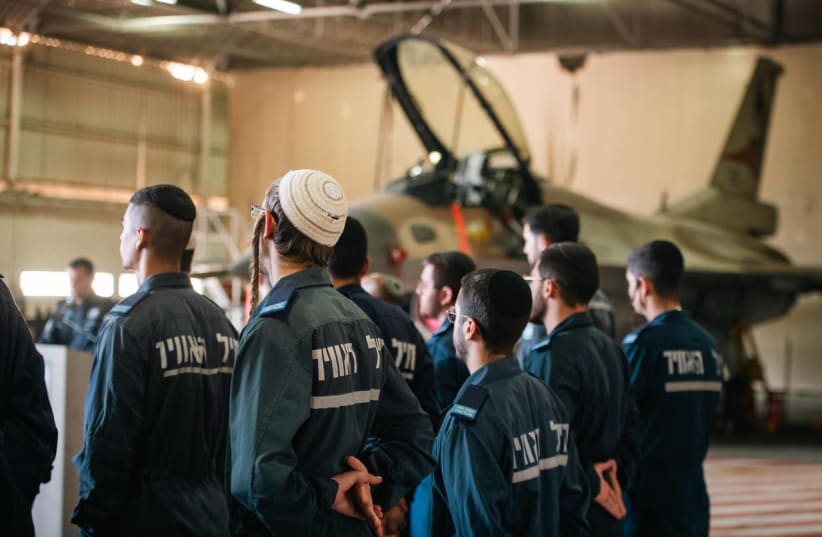
Haredi soldiers completing an F-16 aircraft technicians course, and will ensure the operational readiness of IAF fighter jets.  (photo credit: IDF SPOKESPERSON'S UNIT)
Haredi soldiers completing an F-16 aircraft technicians course, and will ensure the operational readiness of IAF fighter jets.
(photo credit: IDF SPOKESPERSON'S UNIT)

The IDF announced on Thursday that it will expel hundreds of Air Force reservists who signed an open letter calling for an end to the war.

Breaking with former IDF chief Herzi Halevi and former defense minister Yoav Gallant, who showed sympathy to IDF reservists for such signs of protest as long as they showed up when called to serve, current IDF Chief of Staff Lt.-Gen Eyal Zamir will toe the line of Prime Minister Benjamin Netanyahu regarding the judicial overhaul.

Zamir's view is that no matter how controversial Netanyahu's policies may be, these are policies decided by the lawfully elected government of Israel and the IDF, and its reservists, are forbidden from taking any public position on these issues.

In contrast, Halevi and Gallant were highly critical of using public protests against reservist service to pressure the government to back off of its judicial overhaul but were so concerned that Netanyahu's policy could wreck the army's readiness that they took a much more lenient approach to public protests.

During the Halevi-Gallant era, there were a small number of reservists who were expelled, but only if they permanently refused a callup after multiple changes to be called up, not for public threats.

 A letter signed by reservists and retired Israel Air Force personnel protesting the Israel-Hamas war.  (credit: SECTION 27A COPYRIGHT ACT)Enlrage image
A letter signed by reservists and retired Israel Air Force personnel protesting the Israel-Hamas war. (credit: SECTION 27A COPYRIGHT ACT)

Those defense officials credited their middle-of-the-road policy with keeping the army from falling apart in 2023 and slammed Netanyahu for pushing through a judicial overhaul, which they said undermined military readiness, including leading into the October 7 invasion by Hamas.

The IDF said on Thursday that a majority of the reservists due to be expelled are not serving actively, and that the Air Force will function fine, given that it has tens of thousands of members.

However, the IDF did not provide actual numbers of how many reservists who will be expelled are active.

Further, the IDF declined to answer questions about comparing its policy to the policy under Halevi-Gallant, to Netanyahu's battle with Shin Bet Chief Ronen Bar, which many in the defense establishment view as the political echelon improperly intervening in the defense establishment's independence, nor did it address the concerns of pilots that the judicial overhaul is leaving them more vulnerable to war crimes charges before the International Criminal Court.

Reserve and retired Israel Air Force pilots published on Thursday a signed statement in paid newspaper ads demanding the immediate return of the Gaza hostages, even if it required suspending the fighting.

"The war serves political and personal interests; only an agreement will ensure the safe return of the kidnapped," they stated.

Defense Minister Israel Katz responded to the situation, saying, "I completely reject the letter of air force reservists and the attempt to harm the legitimacy of this just war which the IDF is leading in Gaza in order to free the hostages and to defeat the murderous terror organization Hamas."

"I trust the discretion of the IDF chief and the air force chief and am sure they will deal with this improper phenomenon in the right way."

Despite Katz sending his statement out after the IDF had already held a briefing about how aggressive it will be against the reservists, it is widely known that Katz was pressing strongly for the IDF to take a harsh response.

Former Chief of Staff Dan Halutz signed the letter

Among the signatories of the letter are former Chief of Staff Dan Halutz and former Major General Nimrod Shafir.

The letter caused a storm within the Air Force, with Air Force Commander Major General Tomer Bar threatening that anyone who signs the letter will not be able to continue serving in the reserves.

This is despite the fact that the letter did not include a threat of refusal or cessation of reserve service.

Bar was most troubled by the political statement in particular and met with Corps commanders in recent days to discuss the issue, with IDF Zamir in attendance.

Jerusalem Post Staff contributed to this report.


Yonah Jeremy Bob

Source: https://www.jpost.com/breaking-news/article-849620

Follow Middle East and Terrorism on Twitter

President Trump's Secret Weapon - Lawrence Kadish


by Lawrence Kadish

The best news is that nuclear fusion energy, as opposed to the nuclear fission energy currently prevalent, does not need enriched uranium. What does nuclear fusion energy need? Seawater. How is that for a continent surrounded by two oceans?

Lawrence Kadish serves on the Board of Governors of Gatestone Institute.

Source: https://www.gatestoneinstitute.org/21539/president-trump-secret-weapon

Follow Middle East and Terrorism on Twitter

Wednesday, April 9, 2025

Trump's tariffs go into effect, impacting multiple countries - Charlotte Hazard


by Charlotte Hazard

Trump says that these tariffs will benefit the U.S. economy and bring about fairer trade while economists are predicting a recession as a result.


President Donald Trump's tariffs went into effect Wednesday morning, impacting trading partners around the world. 

The U.S. began charging reciprocal tariffs on about 60 countries, beginning Wednesday at 12:01 a.m. ET. 

Trump says that these tariffs will benefit the U.S. economy and bring about fairer trade while economists are predicting a recession as a result. 

Billionaire fund manager Bill Ackman and Trump ally on Monday warned that disproportionate tariffs on friends and enemies of the U.S. will launch a global and economic war.

Since Trump announced the slew of tariffs last week, leaders of nations such as Israel and Japan have reached out to negotiate a deal.

Meanwhile, other countries such as China have responded with retaliatory tariffs. China said Wednesday it is raising its retaliatory tariffs on the U.S. to 84%.

 
Charlotte Hazard

Source: https://justthenews.com/government/white-house/trumps-tariffs-go-effect-impacting-multiple-countries

Follow Middle East and Terrorism on Twitter

Netanyahu: Iran deal must entail blowing up, dismantling nuclear sites - JNS Staff


by JNS Staff

"The second possibility—that will not be—is that they drag out the talks, and then there is the military option," said the Israeli prime minister.


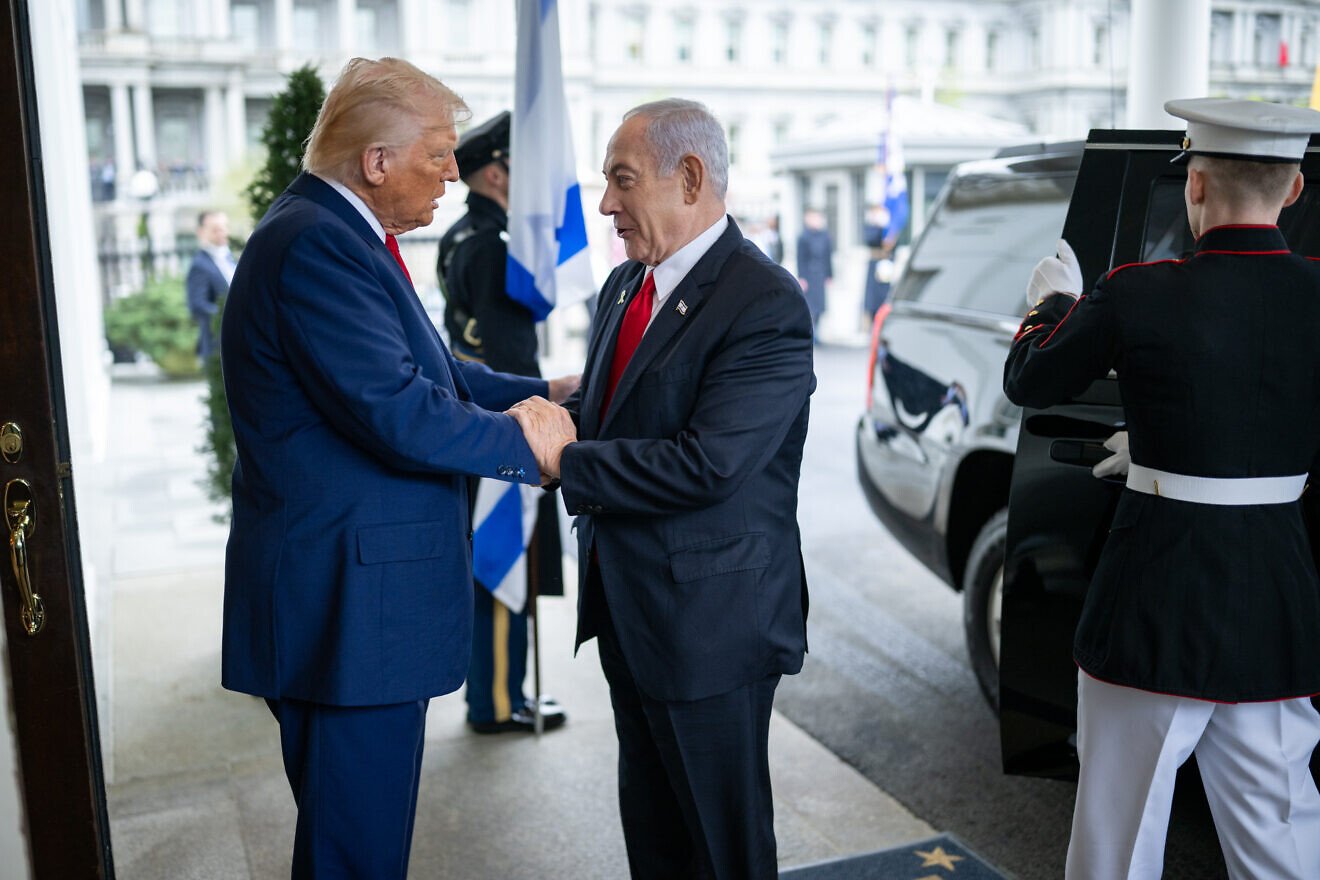
U.S. President Donald Trump greets Israeli Prime Minister Benjamin Netanyahu at the White House, April 7, 2025. Credit: Daniel Torok/White House.

Israeli Prime Minister Benjamin Netanyahu warned on Tuesday about the potential perils of a nuclear deal with Iran, ahead of taking off for Israel following his meeting the previous day with U.S. President Donald Trump at the White House.

“We agree that Iran will not have nuclear weapons. This can be done by agreement, but only if this agreement is Libyan-style: They go in, blow up the installations, dismantle all of the equipment under American supervision and carried out by America—this would be good,” he said.

“The second possibility—that will not be—is that they drag out the talks, and then there is the military option. Everyone understands this. We spoke about this at length,” he added.

Iranian Foreign Minister Abbas Araghchi confirmed on Tuesday that his government had decided to start negotiations with Washington.

“Iran and the United States will meet in Oman on Saturday for indirect high-level talks,” he wrote on X, hours after U.S. President Donald Trump announced the discussions set to take place in Muscat, which he called direct.

Speaking in the Oval Office after meeting Netanyahu on Monday, Trump announced: “We’re having direct talks with Iran, and they’ve started. … Iran cannot have a nuclear weapon,” he stressed. “If it can be done diplomatically in a full way, the way it was done in Libya, I think that would be a good thing.”

Netanyahu on Tuesday said he and Trump also discussed the ongoing war against Hamas in Gaza.

“We are determined to eliminate Hamas, and at the same time, we are determined to return all of our hostages. The president looked at me and told the journalists who were present: ‘This man is working constantly to free the hostages.’ I hope that this shatters the lie that is being circulated to the effect that I am not working for them, that I don’t care. I do care, and I am doing it, and we will be successful,” said the Israeli premier.

Netanyahu noted that he raised Trump’s vision to relocate civilians in the Gaza Strip, insisting that Jerusalem was currently in contact with several countries talking about the possibility of absorbing Palestinians.

“This is important because in the end, this is what needs to happen,” he said.

“The third issue: Turkey. Turkey wants to establish military bases in Syria, and this endangers Israel. We oppose this and are working against it. I told President Trump, who is my friend and also a friend of [Turkish President Recep Tayyip] Erdoğan: ‘If we are in need of your help, we will discuss it with you,'” stated the prime minister.

“The fourth and last issue: the tariffs. President Trump has asked countries to reduce their trade deficits with the U.S. to zero. I told him: ‘This is not so difficult for us. We will do it.’ This is the little that we can do for the U.S. and its president, who does so much for us,” said Netanyahu.

The prime minister concluded by stressing that it was a “very warm visit,” his second in two months since Trump assumed office, adding that “there were additional things that you will hear about later.”


JNS Staff

Source: https://www.jns.org/netanyahu-iran-deal-must-entail-blowing-up-dismantling-nuclear-sites/

Follow Middle East and Terrorism on Twitter

Pardoned Devon Archer says Hunter Biden leveraged Biden brand, gave 'halo' of protection to clients - Steven Richards


by Steven Richards

Hunter Biden's former business partner more clearly described the former first son’s role in leveraging his family name for business deals around the world. He also said he had “no doubt” the younger Biden was talking business with his father.

In his first interview since being pardoned by President Donald Trump last month, former Hunter Biden business partner Devon Archer tells Just the News that there was “no doubt” the younger Biden was talking business with his father and confirmed that his former partner was selling the “Biden” brand in deals abroad.

Archer previously testified in the impeachment inquiry into former President Joe Biden, telling lawmakers he witnessed Hunter Biden introduce his father, whether in person or over the phone, to several foreign business partners, including a Russian oligarch, a Chinese fund manager, and Ukrainian energy company executives.

The former business partner also told Congress he considered Hunter Biden to be a “lobbyist” who leveraged a “very powerful name” to score millions in deals with these companies, including the Ukrainian energy company Burisma, which was was seeking protection from corruption probes and other legal woes at the time he and Archer joined the board.

“I mean, there's absolutely no doubt in my mind” that Hunter Biden discussed his clients with his father and other government officials, Archer told the Just the News, No Noise TV show on Monday.

The pair’s work for the Ukrainian gas company Burisma illustrated the value of Hunter Biden’s access to the highest levels of American government. “I mean, that was the…that was the role. The role was to, you know, pave a path for success of Burisma by having kind of a halo from the U.S.” he said.

“And how businesses respond to the halo of the U.S.—you know, the world's strongest navy, the world's strongest army, obviously, the most powerful country in the world—signals are enough,” Archer explained. "And what Hunter was responsible for was garnering those signals. And it was effective.”

Archer’s testimony during the impeachment inquiry was instrumental in the joint conclusion of three House committees that President Biden had engaged in “a conspiracy to monetize his office of public trust to enrich his family” while he served as Barack Obama’s vice president.

Vice President Biden meets with oligarchs

Archer told congressional investigators that Hunter Biden would frequently introduce prospective clients and partners to his father, in person or over the phone, which would advertise the Biden brand and the access the politically-connected family could provide.

Archer told the committees that he witnessed Hunter Biden introduce his father to several of his business partners in person or over the phone, including Jonathan Li of Bohai Capital, Vadim Pozharskyi of Burisma, Russian oligarch Yelena Baturina, and Kazakhstani oligarch Kenes Rakishev.

Devon Archer’s partnership with Hunter Biden came to an abrupt end in 2016 when he was charged, and later convicted, in a $60 million bonds fraud scheme while they were working at Burnham Asset Management.

Though the younger Biden has long tried to distance himself from that firm, despite corporate records identifying Biden as the “Vice Chairman,” a signed employment agreement, and after Archer used one of their shared bank accounts in the bond transaction, Just the News previously reported. One impeachment witness, who was also convicted in the scheme, testified that Hunter Biden planned for his father to join the firm after his vice presidency.

According to the Justice Department, the pair, along with several other co-defendants, defrauded an Oglala Sioux Native American tribal entity by inducing it to issue bonds, but then failed to invest them as they promised in a scheme that took place from 2014 to 2016. After multiple appeals, Archer was granted the opportunity for resentencing when federal judge ruled last year that Archer’s lawyer provided ineffective counsel when he failed to object to an erroneous sentencing guidelines range. 

Archer pointed out disparity in treatment he received during the fraud trial compared to the apparent lack of official scrutiny on his former partner. Biden pleaded guilty to significant federal tax charges and was convicted on gun-related charges in a Delaware court, but faced no inquiries over his role with Burnham. Former President Biden, when he pardoned his son last year, claimed that Hunter had been “selectively, and unfairly, prosecuted.”

“You know, in my mind, were they extra hard on him? I think there was a bigger spotlight. But if you look at what I went through, and what I went through with him, where I was, you know, the chairman of an investment bank. He was the vice chairman of investment bank. I spent 10 years fighting a legal case in which I was first exonerated by the trial judge, then unexonerated in maybe double jeopardy,” Archer said.

“So I am not crying any crocodile tears for the way he was…you know, treated in any respect after fighting for myself and my family, without having anyone in high political office, much less the president,” he added.


Steven Richards

Source: https://justthenews.com/accountability/political-ethics/pardoned-devon-archer-says-hunter-biden-leveraged-biden-brand-gave

Follow Middle East and Terrorism on Twitter

Facing calls to disarm, Hezbollah ready to discuss weapons if Israel withdraws, senior official say - Reuters


by Reuters

"Hezbollah is ready to discuss the matter of its arms if Israel withdraws from the five points, and halts its aggression against Lebanese," the senior official told Reuters.


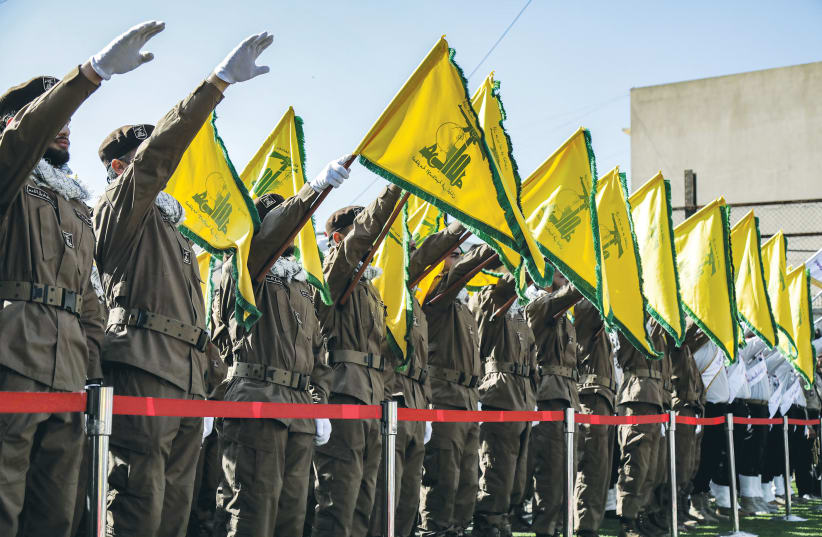
HEZBOLLAH OPERATIVES salute during the funeral of comrades killed in an Israeli strike, in Shehabiya, south Lebanon, April 17. (photo credit: AFP VIA GETTY IMAGES)
HEZBOLLAH OPERATIVES salute during the funeral of comrades killed in an Israeli strike, in Shehabiya, south Lebanon, April 17.
(photo credit: AFP VIA GETTY IMAGES)

As calls for Lebanon's Hezbollah to disarm gain momentum, a senior Hezbollah official told Reuters the group is ready to hold talks with the Lebanese president about its weapons if Israel withdraws from south Lebanon and stops its strikes.

US-backed President Joseph Aoun, who vowed when he took office in January to establish a state monopoly on the control of arms, intends to open talks with Hezbollah over its arsenal soon, three Lebanese political sources said.

Discussion of disarmament has intensified since the power balance was upended by last year's war with Israel and the ousting of Hezbollah's Syrian ally, ex-President Bashar al-Assad.

Hezbollah emerged severely weakened from the 2024 conflict with Israel when its top leaders and thousands of its fighters were killed, and much of its rocket arsenal was destroyed.

The senior Hezbollah official said the group was ready to discuss its arms in the context of a national defence strategy, but this hinged on Israel pulling out its troops from five hilltops in south Lebanon.

 Lebanese Parliament Speaker Nabih Berri and Lebanon's army chief Joseph Aoun stand after Aoun is elected as the country's President at the parliament building in Beirut, Lebanon, January 9, 2025.  (credit: REUTERS/MOHAMED AZAKIR)Enlrage image
Lebanese Parliament Speaker Nabih Berri and Lebanon's army chief Joseph Aoun stand after Aoun is elected as the country's President at the parliament building in Beirut, Lebanon, January 9, 2025. (credit: REUTERS/MOHAMED AZAKIR)

"Hezbollah is ready to discuss the matter of its arms if Israel withdraws from the five points, and halts its aggression against Lebanese," the senior official told Reuters.

Hezbollah's position on potential discussions about its arms has not been previously reported. The sources spoke on the condition of anonymity due to political sensitivities.

Hezbollah's media office did not immediately respond to a request for comment. The presidency declined to comment.

Israel, which sent ground troops into south Lebanon during the war, has largely withdrawn but decided in February not to leave the five hilltop positions. It said it intended eventually to hand them over to Lebanese troops once it was sure the security situation allowed.

Renewed focus on Hezbollah's arms

Despite a ceasefire since November, Israeli airstrikes have kept pressure on the group while Washington has demanded Hezbollah to disarm and is preparing for nuclear talks with Hezbollah's Iranian backers.

Hezbollah has been the most powerful of the paramilitary groups Iran has backed across the region, but its supply lines to Iran via Syria have been cut by Assad's ouster.

Reuters reported on Monday that several Iranian-backed militia groups in Iraq are prepared to disarm for the first time to avert the threat of an escalating conflict with the Trump administration in the US.

Hezbollah has long rejected calls from its critics in Lebanon to disarm, describing its weapons as vital to defending the country from Israel. Deep differences over its arsenal spilled into a short civil war in 2008.

The group's critics say the group has unilaterally dragged Lebanon into conflicts, and the presence of its large arsenal outside of government control has undermined the state.

A US-brokered ceasefire with Israel requires the Lebanese army to dismantle all unauthorised military facilities and confiscate all arms, starting in areas south of the Litani River, which flows into the Mediterranean some 20 km (12 miles) north of the Israeli border.

Two sources familiar with Hezbollah's thinking said it is weighing handing to the army its most potent weapons north of the Litani, including drones and anti-tank missiles.

Call for a disarmament timetable

Aoun has said Hezbollah's weaponry must be addressed through dialogue because any attempts to disarm the group by force would prompt conflict, the sources said.

Patriarch Bechara Boutros Al-Rai, the head of Lebanon's Maronite church, said last week it was time for all weapons to be in state hands, but this would need time and diplomacy because "Lebanon cannot bear a new war".

Communication channels with relevant stakeholders are being opened to "begin studying the transfer of weapons" to state control, after the army and security services had extended state authority across Lebanon, a Lebanese official said, saying this was a move to implement Aoun's policy.

The issue was also being discussed with Parliament Speaker Nabih Berri, an important Hezbollah ally, who plays a key role in narrowing differences, she said.

US envoy Morgan Ortagus, who visited Beirut at the weekend, repeated Washington's position that Hezbollah and other armed groups should be disarmed as soon as possible and the Lebanese army was expected to do the job.

"It's clear that Hezbollah has to be disarmed and it's clear that Israel is not going to accept terrorists shooting at them, into their country, and that's a position we understand," Ortagus said in an April 6 interview with Lebanon's LBCI television.

Several Lebanese government ministers want a disarmament timetable, said Kamal Shehadi, a minister affiliated with the anti-Hezbollah Lebanese Forces party. Shehadi told Reuters disarmament should take no more than six months, citing post-civil war militia disarmament as a precedent.

A timetable- which presumably would impose deadlines on the process- is, he said, the "only way to protect our fellow citizens from the recurring attacks that are costing lives, costing the economy and causing destruction".

The most recent conflict began when Hezbollah opened fire in support of Hamas at the start of the Gaza war in October 2023.

Hezbollah leader Naim Qassem, in a March 29 speech, said his group no longer has an armed presence south of the Litani and had stuck to the ceasefire deal while Israel breached it "every day". Israel has accused Hezbollah of maintaining military infrastructure in the south.

Hezbollah has put the onus on the Lebanese state to get Israel to withdraw and stop its attacks. Qassem said there was still time for diplomatic solutions. But he warned that the "resistance is present and ready" and indicated it could resort "to other options" if Israel doesn't adhere to the deal.


Reuters

Source: https://www.jpost.com/middle-east/article-849408

Follow Middle East and Terrorism on Twitter

High stakes game: Is Iran sending missiles to militias in Iraq? - analysis - Seth J. Frantzman


by Seth J. Frantzman

Iran is messaging that it is prepared to keep its arms while also pretending it might comply with demands to rein in its power in Iraq.


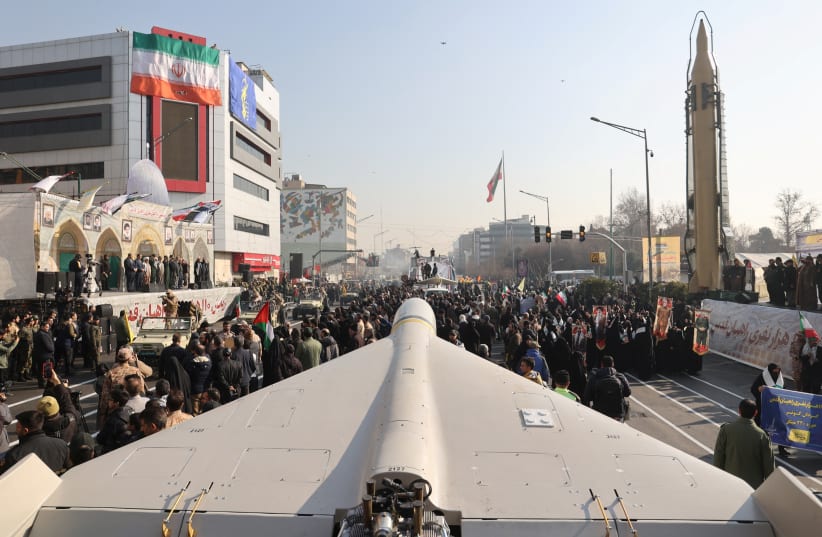
An Iranian drone and missile are displayed during an anti-Israeli march in Tehran, Iran, January 10, 2025 (photo credit: MAJID ASGARIPOUR/WANA (WEST ASIA NEWS AGENCY) VIA REUTERS)
An Iranian drone and missile are displayed during an anti-Israeli march in Tehran, Iran, January 10, 2025
(photo credit: MAJID ASGARIPOUR/WANA (WEST ASIA NEWS AGENCY) VIA REUTERS)

Iran may be providing various types of surface-to-surface missiles to militias in Iraq, according to a new report by the UK's The Times on Wednesday.

The report depicts this as part of Iran’s high stake chess game in the region, as the US and Iran head to indirect talks in Oman. In addition, the US is carrying out airstrikes on the Iran-backed Houthis in Yemen.

Therefore, Iran may want to improve the position of militias in Iraq. These militias are part of an umbrella group called the Popular Mobilization Forces. The reports of the missile transfer stand in contrast to a Reuters report on April 7 that suggested the Iranian-backed militias might be willing to disarm due to threats and pressure from the US. 

It would be difficult to believe both reports are accurate. The Reuters report was based on anonymous sources within four of the militias. The report claimed to have spoken with ten commanders. At the same time the report also relied on information from sources close to the Iraqi Prime Minister. Clearly the militias may want to message in private that they could consider disarming.

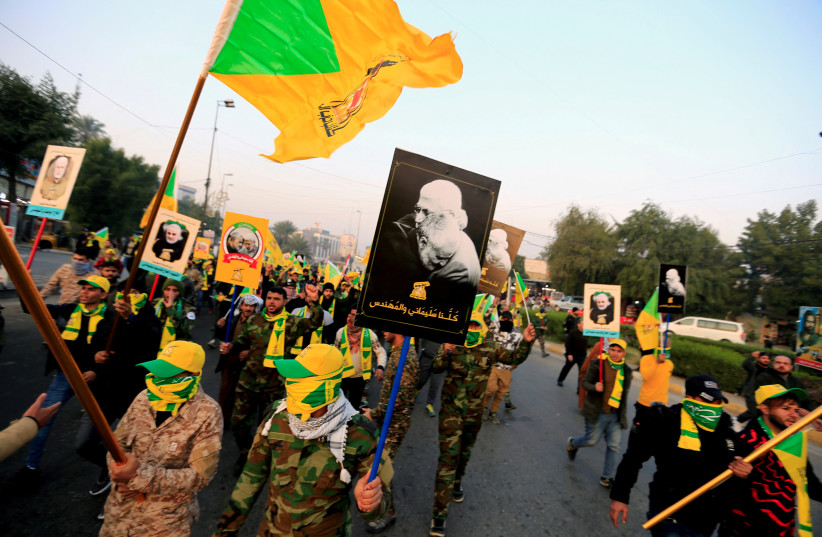
 Kataib Hezbollah Iraqi militia gather ahead of the funeral of the Iraqi militia commander Abu Mahdi al-Muhandis, who was killed in an air strike at Baghdad airport, in Baghdad, Iraq, January 4, 2020.  (credit: REUTERS/THAIER AL-SUDANI/FILE PHOTO)Enlrage image
Kataib Hezbollah Iraqi militia gather ahead of the funeral of the Iraqi militia commander Abu Mahdi al-Muhandis, who was killed in an air strike at Baghdad airport, in Baghdad, Iraq, January 4, 2020. (credit: REUTERS/THAIER AL-SUDANI/FILE PHOTO)

What is 'disarming'?

What is “disarming”? It may mean simply saying their arms are now under Iraqi government control. The PMF is an official paramilitary force in Iraq and therefore the militias could simply play a game of bait and switch and say their arms are now part of the “state.”

According to The Times report, however, Tehran has been bulking up its presence in the region by supplying a new batch of weapons to powerful Shia militias in Iraq, dashing hopes that Iran would withdraw support as it prepares to enter negotiations with the United States over its missile and nuclear programme.”

The report says that “the weapons were transferred last week, according to regional intelligence involved in monitoring the nearly 1,000-mile border between the countries. It was the first time long-range surface-to-surface missiles had been in the possession of an Iran-allied militia in Iraq. Sources said the delivery was arranged by the Iranian Revolutionary Guards Air Force.” 

Types of missiles

This is not the first time that Iran has sought to move ballistic missiles to Iraq. It did the same thing in the summer of 2018. Reuters reported in late August 2018 that “Iran has given ballistic missiles to Shi’ite proxies in Iraq and is developing the capacity to build more there to deter attacks on its interests in the Middle East and to give it the means to hit regional foes, Iranian, Iraqi and Western sources said.” At the time the report claimed the missiles might include the Zelzal, Fateh 110 and Zolfaghar  (Zolfiqar). It said these had ranges from 200-700km.

Today the report at The Times says that “sources said that two other types of missiles, the Quds 351 cruise and Jamal 69 ballistic missiles, were also smuggled into Iraq last week. They had a much shorter range than the new surface-to-surface missiles, which could be positioned to target as far as Europe.” The Quds 351 is also known as Project 351 or the Paveh cruise missile. It is also known as the Quds-4 in the hands of the Houthis. It may have a range of 2,000km. It was unveiled in 2019.

The International Institute for Strategic Studies notes that the land attack cruise missile “known as Project 351…This [land attack cruise missile] LACM has been provided to the Houthi movement (Ansarullah) in Yemen, where it is called the Quds. Iran has never publicly paraded or claimed ownership of Project 351 and has denied involvement in the supply of the weapon to the group, a claim lacking in credibility given the evidence to the contrary.” The report adds that “the initial version of Project 351, which likely equates to the Quds-1, had a range in the order of 700–800 km. Ansarullah [the Houthis] first claimed to have used an improved version of the missile, the Quds-2, against a Saudi oil refinery in November 2020.”

The Jamal 69 missile, which may also be known as the Zolfaghar  (Zolfiqar) in Iran, has been alleged to be in Iraq before. In 2022 reports also said it was in the hands of militias in Iraq. Newsweek reported in 2022 that the Jamal-69 was seen at a Quds Day event in Iraq in 2022. It was photographed with the Harakat Hezbollah al-Nujaba militia. This is one of the powerful pro-Iranian militias that are part of the PMF. “Iran and its allies across the Middle East are showing off weapons capable of striking their mutual foe, including a new missile revealed by Iraq's Hezbollah Al-Nujaba Movement,” Newsweek noted. “The missile, known as Jamal-69, is said by the group to have a range of 700 kilometers, or roughly 435 miles, greater than the average distance of less than 300 miles between Iraq and Israel, as claimed by the group in a video accompanying the unveiling.”

Tal Inbar, an expert on rockets and space, noted in a post in 2022 that the Jamal 69 “Iranian Zolfaghar ballistic missile in the hands of Iran's proxies in Iraq.”

The movement of these missiles to the militias in Iraq would therefore represent the movement of weapons Iran already transferred abroad over the last several years. The cruise missile, project 351, has already been sent to the Houthis. The Jamal 69 was already alleged to be in the hands of the militias in Iraq. Therefore what Iran may be doing is increasing the supplies of these systems to the militias. If so, then it is unlikely these groups will disarm.

A high stakes game

What is clear in the two reports, at Reuters and The Times is that Iran and its militias in Iraq are playing a high stakes game. They are messaging and they are prepared to keep their arms while also pretending they might comply with demands to rein in their power in Iraq. This comes amid other reports that Hezbollah in Lebanon could disarm if Israel agrees to withdraw from certain areas in Lebanon. It also comes as a report emerged that the Houthis have offered the US a deal. The talks in Oman could help decide all this. In the past Iran has linked the behavior of its proxies to its nuclear program and US policy. For instance, during maximum pressure in 2019 Iran operationalized the militias to attack US forces in Iraq.


Seth J. Frantzman

Source: https://www.jpost.com/middle-east/iran-news/article-849454

Follow Middle East and Terrorism on Twitter

Ten Environmentalist Myths - Edward Ring


by Edward Ring

Modern environmentalism often strays from its original purpose, advancing policies that unintentionally damage ecosystems, strain economies, and benefit powerful corporate interests.


The first Earth Day was organized in 1970 in response to growing public concern for the environment. Many of these concerns were entirely justified. In 1969, for example, an oil slick along an industrialized stretch of the Cuyahoga River in Ohio caught fire, generating national awareness of the need to reduce water pollution. Similarly, in coastal cities in California, most notably in Los Angeles, the exhaust from unleaded gasoline created air pollution so dense you couldn’t see the hills a few miles away.

We’ve come a long way in 51 years. This month, as Americans celebrate Earth Day on April 22, we are challenged to differentiate between legitimate environmental priorities and those priorities chosen for us by special interests with ulterior motives for whom environmentalism is a sentiment to be manipulated.

Here are ten issues where environmentalism has been misused, with consequences that have either been of no benefit whatsoever to the environment or have even caused harm.

(1) We are in a climate crisis

We may as well begin with the most controversial environmentalist claim, that our planet is at imminent risk of catastrophic climate change. The problem with this claim is two-fold. First, there remains vigorous—if suppressed—debate over whether the data actually supports this claim. There is ample evidence that average global temperatures are not rapidly increasing, if they are even increasing at all. There is also strong evidence that extreme weather events are not increasing but rather that our ability to detect them has improved and that population increases have led more people to live in places that are particularly vulnerable to extreme weather. Second, even if there is some truth to the claims of climate catastrophists, it is not possible to precipitously transform our entire energy infrastructure. The technology isn’t ready, the funding isn’t available, and most nations will not participate. Adaptation is our only rational course of action.

(2) There are too many people

Based on extrapolations back in 1970, this may have appeared to be the case because populations worldwide at that time were rapidly growing. But today, in almost every nation, the inverse is now true: birthrates are well below replacement levels. Even in those nations that continue to experience rapid population growth, the rate of growth is following the same pattern of decline. The United Nations now estimates the total global population to top out at around 10 billion people, after which it is projected to decline. This means the rapid population growth we’ve seen over the past two centuries, where the global population octupled from 1 billion in 1804 to over 8 billion by 2024, is over. There is not one trend anywhere on earth that contradicts this pattern. Humanity faces a future of too few people, not too many.

(3) We are running out of “fossil” fuel

While this is technically correct, the situation is nowhere close to what was famously predicted in 1956 by American geologist M. Hubbert, who claimed oil production in the U.S. would peak by 1970 and then slide into permanent decline. In the U.S. and around the world, new technologies and new discoveries have put total reserves of oil, along with natural gas and coal, at record highs despite increasing demand. According to the authoritative Statistical Review on Global Energy, based on current consumption, proven reserves could supply oil for 61 years, natural gas for 50, and coal for 208. This grossly understates the big picture, however, because proven and recoverable reserves are being expanded all the time. “Unproven” reserves, waiting to be discovered, will easily double the amount of time left. This doesn’t mean we shouldn’t continue to research new sources of energy. But we have a century or more to sort this out.

(4) Biofuel is renewable and sustainable

Nothing could be further from the truth. Biofuel will never supply more than a small fraction of our energy requirements, and attempts to scale it beyond a niche product have produced catastrophic results. Just to use California as an example, the current yield of ethanol from a corn crop stands at not quite 500 gallons per acre. Californians consumed 13.6 billion gallons of gasoline in 2023. Since ethanol has 33 percent less energy per gallon than conventional gasoline, that means replacing gasoline with carbon-neutral ethanol would require 20.3 billion gallons of ethanol production, which in turn would require 63,400 square miles of irrigated farmland and over 120 million acre-feet of water per crop. To put this in perspective, California’s entire expanse of irrigated farmland only totals around 14,000 square miles, and California’s entire agricultural sector only consumes around 30 million acre-feet of water per year. Worldwide, biofuel crops already consume an estimated 500,000 square miles while only offsetting 2 percent of the global consumption of transportation fuel.

(5) Offshore wind energy is renewable and sustainable

Absolutely not. Wind turbine blades, on land or offshore, routinely kill raptors, condors, and other magnificent endangered birds, along with bats and insects. Offshore, there are additional harmful impacts. Electromagnetic fields from undersea cables produce birth deformities in marine life and produce magnetic fields that disrupt the orientation abilities of some fish. Their low-frequency operational noise disrupts sounds made by fish for mating, spawning, and navigating. The turbines “increase sea surface temperatures and alter upper-ocean hydrodynamics in ways scientists do not yet understand” and “whip up sea sediment and generate highly turbid wakes that are 30-150 meters wide and several kilometers in length, having a major impact on primary production by phytoplankton, which are the base of marine food chains.” California’s official plan is to install 25,000 gigawatts of offshore wind capacity in floating wind farms 20 miles offshore. At 10 megawatts each, California’s treasured marine ecosystem will be disrupted by the presence of somewhere between 2,500 floating wind turbines, each one nearly 1,000 feet high. They will need 7,500 tethering cables descending 4,000 feet to the seafloor, along with 2,500 high-voltage cables. Expect ratepayers and taxpayers to subsidize a project that could cost $300 billion or more to build systems that may only have a lifespan of 10-20 years.

(6) Renewables are renewable

No. They’re not. Renewables most in favor with environmentalists are solar and wind farms with battery farms to store the intermittently generated electricity. Just the consumption of natural resources to build these renewables is hardly sustainable. For example, using data from the International Energy Agency, geopolitical writer Peter Ziehan calculated the mineral requirements for power generation, comparing renewables to natural gas in terms of kilograms of minerals per megawatt of capacity. Offshore wind: 16,000 kg/MW, onshore wind: 10,000 kg/MW, solar photovoltaic: 7,000 kg/MW, and natural gas: 2,000 kg/MW. Compounding this disparity is the fact that natural gas power plants can operate for 60 years or more, whereas solar installations are operable for 30 years at most, and wind turbines substantially less than that, depending on where they’re situated. As for EVs, Ziehan calculated kilograms of minerals per vehicle, with EVs requiring over 200 kg/vehicle, compared to conventional cars at only 35 kg/vehicle. It’s easy enough to see what this means. Replacing conventional energy with “renewables” has ignited an expansion of worldwide mining in nations with minimal environmental protections.

(7) Renewables can replace fossil fuels

Not anytime soon. Worldwide, in 2022, 82 percent of global energy was still derived from fossil fuels. For everyone on earth to consume half as much energy per capita as Americans, global energy production will have to double. Based on those two cold facts, fossil fuels are going to be around for a very long time. Even these statistics understate the challenge. In 2023, most of the non-fossil fuel energy produced was from either nuclear (4.0 percent) or hydroelectric (6.8 percent) sources, leaving only 7.5 percent from allegedly renewable sources. And of the remaining 7.5 percent “renewables,” two-thirds of it was biofuel production, which should not be considered renewable or, at the very least, must be considered already at maximum capacity. That leaves only about 2.5 percent of worldwide energy production coming from renewables, if you want to call them that, primarily wind, solar, and geothermal sources.

(8) New housing must be confined to the footprint of existing cities

This is not true for California, nor for the United States, and not even worldwide. Nonetheless, urban containment has been enforced in California ever since we stopped investing in expanding our energy, water, and transportation infrastructure, resulting in 94 percent of the population living on only 5 percent of the land. But urban containment isn’t necessary to ensure enough farm production. Even India, the most densely populated large nation on earth, where there are 2,700 people per square mile of farmland, is a net food exporter. In California, the alleged need for urban containment is truly ridiculous. Building new homes for ten million new California residents on quarter-acre lots, with four-person households, and allocating an equivalent amount for schools, parks, roads, and retail and commercial areas would only consume 1,953 square miles. This would only increase California’s urban footprint from 7,800 to 9,700 square miles, i.e., from 5.0 percent to 6.2 percent of all land in the state. The global trend is people voluntarily migrating to cities at the same time as the global population is expected to begin to decline within a few decades. There will be plenty of room for farms and wilderness even if cities are permitted to expand. Keeping cities bottled up is misanthropic and misguided, creating artificially high home prices and unwanted overcrowding.

(9) Mass transit is necessary to achieve sustainability

It’s hard to imagine a claim more at odds with reality. Mass transit works in extremely dense urban areas where most jobs are located in a central core. With rare exceptions, such as Manhattan, most metropolitan areas no longer have this hub-and-spoke model, which renders economically viable mass transit extremely difficult. Then there are the challenges introduced during the COVID pandemic, which drove millions of riders out of mass transit to either commute in private cars or work from home. Ridership never recovered. An additional barrier to the readoption of mass transit is the fact that most cities are unwilling to police and remove disruptive individuals from the buses and trains, rendering their systems too dangerous for potential passengers to consider. Finally, along with now-mature work-from-home technology that is only going to improve, we have innovations just around the corner that will enable smart cars to convoy at higher speeds, increasing the capacity of existing roads, as well as a revolution in passenger drones that will take additional pressure off roads. Why would someone ride mass transit when they can relax while their own smart vehicle drives them point-to-point with no interruptions? And why should taxpayers subsidize mass transit?

(10) Wilderness areas are sacred

This mantra has caused more harm than good to the wilderness. Litigation pursuant to the Endangered Species Act has severely restricted, if not put a complete stop to, logging on public land, although the current White House administration is trying to change that. Since then, over the past 40 years, because fires were suppressed and logging didn’t remove new growth, our forests have become overgrown, resulting in catastrophic fires. Similarly, ESA litigation and environmentalist-inspired regulations put a stop to dredging in California’s Sacramento-San Joaquin Delta, which was the only way to maintain deep, cool channels favored by salmon ever since the construction of levees in the 1800s caused silt deposits to accumulate in what remained of their migration routes. It is important to protect truly endangered species, but environmentalists often create bigger problems. Poverty in Africa could be alleviated if environmental restrictions on energy development were lifted. But as it is, in desperate poverty, Africans are cutting down their forests for firewood, hunting wild game for food, and poaching dwindling herds of elephants, rhinos, lions, and other precious and endangered species for sale to international smugglers. How we manage our wilderness must be revisited with a reality-based emphasis on results, not ideology. Moreover, an encouraging fact is that while total forest cover in the world was in decline for many centuries, over the past 40 years, it has been increasing. This is the result of several factors: reforestation efforts, migration to urban areas, which depopulates forest regions; huge improvements in agricultural productivity, which takes farmland out of production, allowing for forests to reclaim the land; and maybe even slightly elevated atmospheric CO₂, which is plant food.

The ideals of environmentalism ought to inspire everyone, but the policies promulgated in the name of environmentalism are all too often actually hurting the environment. Examples are the mad rush to develop renewables and the power of the “climate crisis” narrative to deter rational cost/benefit analysis of environmentalist policies. The impact of misguided environmentalism is not merely the fate of wildlife and wilderness or the health of global ecosystems. It is also economic and, in practice, has led to profound transfers of wealth as entrenched special interests thrive on escalating regulations that only the biggest corporations and wealthiest individuals can navigate. Worldwide, entire industrial sectors are consolidated, costing nations the resilience and affordability that a diverse and competitive economy can deliver. Environmentalism, as it is practiced in the 21st century, is an arm of globalism, with shades of paternalism and colonialism that often overshadow its virtues.

The ten myths identified above are some of the fundamental premises of environmentalism, and they are flawed. They are exploited by special interests for profit and control. Our challenge is to restore environmentalism to its honorable roots. We have to recognize and reject these flawed premises wherever they are applied. We have to recognize and restructure our regulatory environment to take away the incentives for opportunism and manipulation. We have to nurture prosperity through diverse, competitive national economies, recognizing that through prosperity, we find the resources to invest in genuinely clean and sustainable technology, as well as the funds to engage in practical environmental protection.

For Earth Day to remain relevant, we have to rescue environmentalism from what it has become: a manipulative tool that corporations use to corner markets and charge more. This will not be easy. But we may begin by challenging the myths.


Edward Ring is a senior fellow of the Center for American Greatness. He is also the director of water and energy policy for the California Policy Center, which he co-founded in 2013 and served as its first president. Ring is the author of Fixing California: Abundance, Pragmatism, Optimism (2021) and The Abundance Choice: Our Fight for More Water in California (2022).

Source: https://amgreatness.com/2025/04/09/ten-environmentalist-myths/

Follow Middle East and Terrorism on Twitter

Integration, reconstruction: What are the priorities of Syria's new government? - analysis - Seth J. Frantzman


by Seth J. Frantzman

Syria's transitional government, led by Ahmed al-Sharaa, held its first meeting on April 7, focusing on reconstruction and unity.


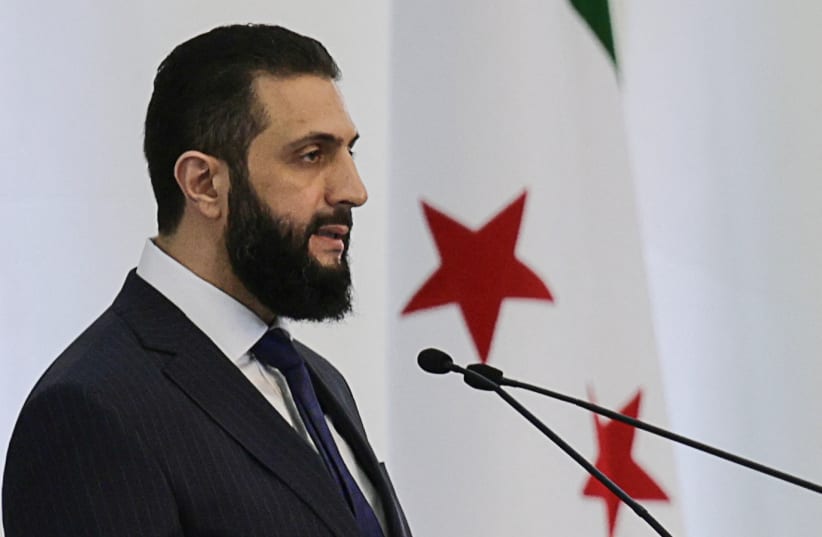
President Ahmed al-Shara'a speaks during the formation of the new Syrian government. March 29, 2025.  (photo credit: REUTERS/KHALIL ASHAWI)
President Ahmed al-Shara'a speaks during the formation of the new Syrian government. March 29, 2025.
(photo credit: REUTERS/KHALIL ASHAWI)

The new Syrian government of Ahmed al-Sharaa held its first meeting in late March after two dozen ministers were chosen. The new government is a transition government that has been in the works since the Assad regime fell on December 8.

Ahmad Shara’a became the new transitioned president in late January, and he spent February and March establishing a new series of ministries. Around a third of the ministers are linked to Hayat Tahrir al-Sham, the group Shara’a once commanded. The others come from various backgrounds and include one Christian woman, a Druze, a Kurd, and an Alawite.

Syrian state media SANA said that “the first meeting of the government of the Syrian Arab Republic was held Monday, April 7, 2025, chaired by President Ahmad al-Sharaa, who gave a directive speech that defines priorities of the government work and the challenges that face various ministries.”

The report said that “the President stressed the importance of integration in the work of the ministries in order to develop emergency plans that take into account the priority of the Syrian citizen in terms of revitalizing the economy in a way that would positively impact their daily needs and repair the massive damage caused by the former ousted regime to the country’s infrastructure.”

Reconstruction is a major priority. People in Syria are returning to damaged homes in areas that were destroyed during a decade and a half of civil war. Also, Syrians from abroad are returning.

Syrian interim President Ahmed al-Sharaa disembarks from an airplane before a meeting in Amman, on February 26, 2025. (credit: Alaa Al Sukhni/Reuters)Enlrage image
Syrian interim President Ahmed al-Sharaa disembarks from an airplane before a meeting in Amman, on February 26, 2025. (credit: Alaa Al Sukhni/Reuters)

The right direction for Syria

The government currently does not control the whole country. Turkey controls part of northern Syria, and the Syrian Democratic Forces control eastern Syria. The SDF is backed by the US, and SDF Mazloum Abdi signed a deal with Shara’a in early March to integrate the IDF into the new government within a year.

SANA noted that “President Al-Sharaa also stressed the importance of the reconstruction file and the necessity of developing strategic plans to organize cities and towns, emphasizing the cultural and civilizational integration with urbanization. The President stressed the principle of civil peace as a primary factor for the government action during the coming period and some related issues such as media discourse, which must be national and inclusive, enhance the national unity, and rise above all partitions, as Syria belongs to all its citizens.”

This is an important step in the right direction for Syria. The government is also seeking to rebuild a professional military and ensure that all arms in the country are in the hands of the state. This means getting rid of former militias and cracking down on gangs and other armed groups.

The new government wants to “respond to promising opportunities in various sectors by building partnerships between the public and private sectors, and implement plans to enhance domestic tourism, in light of the return of many citizens living abroad,” SANA noted. The government has to tackle many issues at the same time. This includes public works and housing, as well as dealing with internally displaced people. During the war, more than ten million people were displaced, and more than 5 million ended up as refugees abroad. 


Seth J. Frantzman

Source: https://www.jpost.com/middle-east/article-849469

Follow Middle East and Terrorism on Twitter