Sunday, January 25, 2026

Board of Peace explained: How it works and who is running it - Shimon Sherman


​ by Shimon Sherman

Above the General Board is the Executive Committee, the primary strategic and decision-making organ, chaired by Trump, who retains veto power.
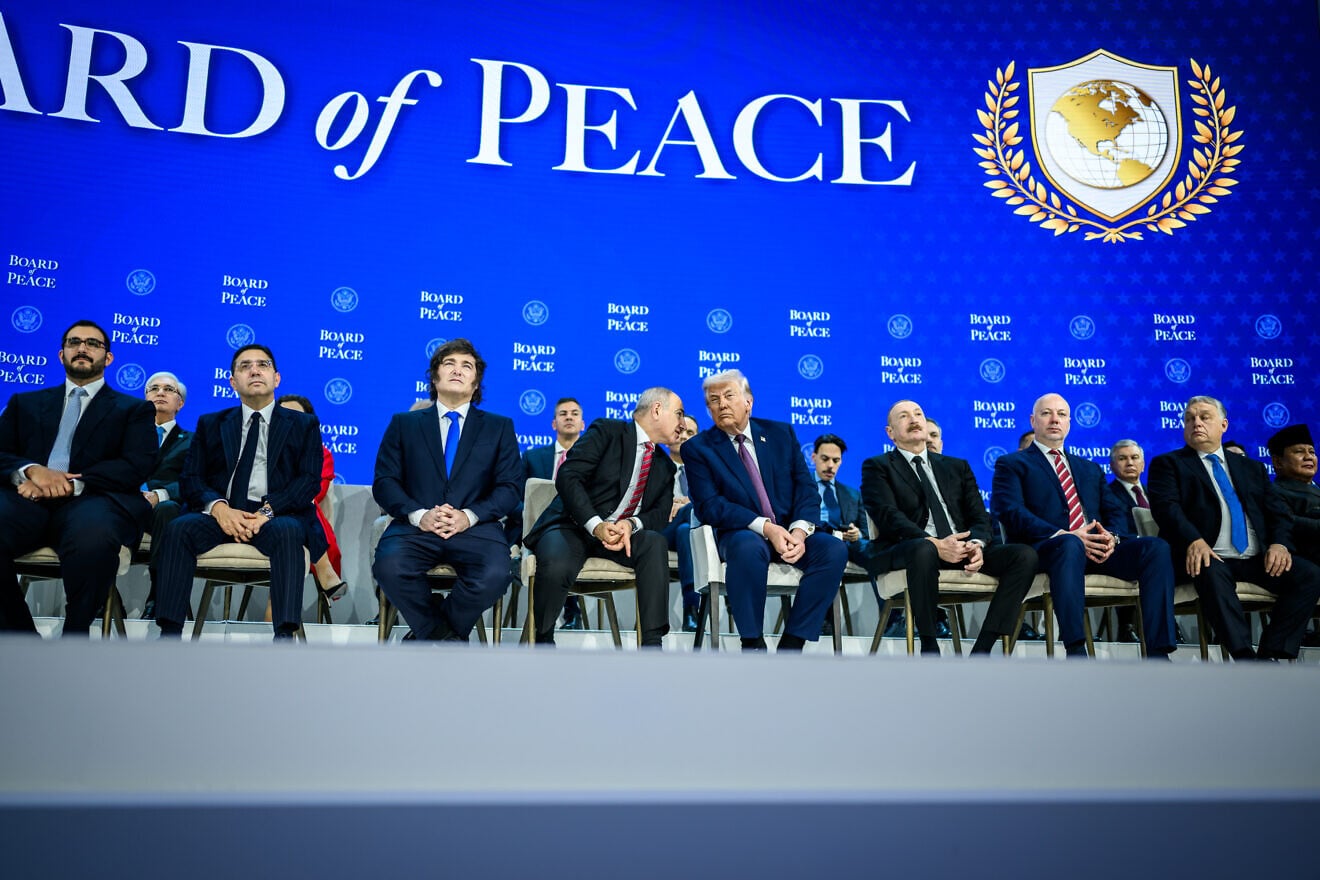
 

U.S. President Donald Trump participates in the Board of Peace charter announcement and signing ceremony during the World Economic Forum at the Davos Congress Center in Davos, Switzerland, Jan. 22, 2026. Credit: Daniel Torok/White House.
U.S. President Donald Trump participates in the Board of Peace charter announcement and signing ceremony during the World Economic Forum at the Davos Congress Center in Davos, Switzerland, Jan. 22, 2026. Credit: Daniel Torok/White House. 

President Donald J. Trump signed the charter for the Board of Peace on Thursday at the World Economic Forum in Davos, marking the formal commencement of Phase 2 of the administration’s Gaza peace initiative.

According to the Trump administration, the signing ceremony, attended by regional leaders and global financial executives, transitions the focus of the U.S. strategy from the current ceasefire toward “demilitarization, reconstruction and civil administration” of the Gaza Strip.

Phase 2 establishes a new governing framework for the enclave, intended to replace Hamas and previous international aid structures with a centralized board of stakeholders. Under the terms of the charter, the Board of Peace is now the self-appointed primary authority responsible for directing reconstruction funds and overseeing the transition to a civilian government.

“The whole architecture of the current Trump plan is a very impressive effort which is unprecedented in many ways,” Col. (res.) Eran Lerman, vice president of the Jerusalem Institute for Strategy and Security (JISS), told JNS. “There have been ideas in this direction of an international oversight for many years, and this implementation is by far the most concrete and advanced of any of those programs.”

Lerman added, however, that the plan is in very early stages and “for now it only exists on paper.”

International oversight

The newly established Board of Peace is organized into a tiered hierarchy of multiple levels of oversight committees. At its base sits the General Board of Peace, a plenary body composed of heads of state.

While invitations have been extended to more than 60 nations, including everyone from the pope to Belarusian dictator Aleksander Lukashenko, only 35 countries have so far accepted membership. Notably, most European countries, including the United Kingdom, France and Germany, have declined a position on the board, leading to significant dominance of the Middle Eastern Arab states on the Board of Peace.

This assembly serves as the foundational body for the initiative’s international legitimacy, though the charter explicitly grants the chairman-for-life, U.S. President Donald Trump, sole authority to invite new members and appoint his own successor. Under the terms of the charter, while nations may accept a three-year rotating term at no cost, a $1 billion cash contribution to the Board’s fund secures a permanent seat.

Above the General Board is the Executive Committee, the primary strategic and decision-making organ. Chaired by President Trump, who retains absolute veto power, this committee is tasked with “operationalizing” the Board’s vision. Key members include U.S. Secretary of State Marco Rubio, who serves as the diplomatic lead, and senior adviser Jared Kushner, the principal architect of the administration’s “New Gaza” vision.

They are joined by U.S. Special Envoy Steve Witkoff, former British Prime Minister Tony Blair and private equity executive Marc Rowan of Apollo Global Management. Rounding out the committee are World Bank President Ajay Banga and U.S. Deputy National Security Advisor Robert Gabriel, providing a mix of institutional financial weight and operational strategy.

The final tier is the Gaza Executive Board, which functions as the direct link between the high-level strategists and the administration on the ground. The Executive Board includes many of the lower-level members of the Executive Committee in addition to regional players such as Egyptian intelligence chief Hassan Rashad; UAE Minister of State for International Cooperation Reem Al Hashimy; Ali al-Thawadi, a senior aide to the Qatari prime minister; and Turkish Foreign Minister Hakan Fidan.

Rounding out the Executive Board are Dutch diplomat Sigrid Kaag and Israeli-Cypriot real estate developer Yakir Gabay, who is expected to oversee the physical implementation of reconstruction projects.

On the ground administration

Directly bridging the gap between the Executive Board and the local administration is Nickolay Mladenov, the newly appointed high representative for Gaza and director of the Executive Board. A Bulgarian diplomat and former U.N. special coordinator for the Middle East peace process, Mladenov is tasked with the daily synchronization of governance, reconstruction and security efforts between the civil authorities in Gaza and the Executive Board.

“Most Israelis respect and trust Nikolay Mladenov. We came to know him when he was U.N. envoy,” Lerman observed. “He has a deep understanding of the Israeli position and has a deep criticism of the Palestinian Authority and its corruption. We have no difficulty accepting this appointment.”

Meanwhile, the civil administration of the Gaza Strip has been assigned to the National Committee for the Administration of Gaza (NCAG), a 15-member body of Palestinian technocrats. Under the terms of its mandate, the NCAG is responsible for restoring public services, managing infrastructure projects, and overseeing civil institutions.

The committee is chaired by Ali Shaath, a Gaza-born civil engineer who previously served as the Palestinian Authority deputy minister of planning and international cooperation, as well as the undersecretary for the ministry of transport and communications. Shaath belongs to a prominent Gazan clan with deep historical ties to Fatah.

Several key members of the NCAG have extensive histories within the Palestinian Authority’s administrative and security sectors. The interior and internal security portfolio is held by Sami Nasman, a veteran officer of the P.A.’s General Intelligence Service and a lifelong Fatah member.

Nasman, who was sentenced to 15 years in absentia by a Hamas-run court in 2016 for allegedly destabilizing the Strip, is tasked with managing Gaza’s local policing. Other members with P.A. backgrounds include Adnan Abu Warda (Justice), a former judge in the P.A.’s Supreme Constitutional Court, and Osama Al Saadawi (Housing), a former P.A. minister of state for entrepreneurship and empowerment.

The National Committee’s economy and trade portfolio is held by Ayed Abu Ramadan, the current head of the Gaza Chamber of Commerce. Abu Ramadan has also served as the director of the Palestine Islamic Bank, a financial institution that has historically had proximity to Hamas-controlled financial structures. Israeli security monitors have expressed concern that the Palestine Islamic Bank has facilitated transactions for Hamas-affiliated businesses.

While the NCAG is presented as a technocratic body, Hamas leadership in Cairo has publicly instructed its own administrative agencies to prepare to cede civil power to the committee, while simultaneously maintaining that its “military” wing will not be subject to the committee’s jurisdiction.

While the NCAG has responsibility over civil administration, the security and demilitarization component of the Trump plan is led by the International Stabilization Force (ISF), commanded by U.S. Maj. Gen. Jasper Jeffers. Jeffers, who recently served as a monitor for the Israel-Hezbollah ceasefire in Lebanon, is authorized to oversee security operations and the dismantling of military infrastructure.

However, the ISF currently operates without a standing army. President Trump has confirmed that no U.S. combat troops will be deployed to Gaza, and several potential contributors, including Azerbaijan, have declined to participate. While countries such as Italy and Indonesia remain in discussions regarding troop contributions, no commitments have been finalized.

“The ISF has no committed forces and exists only on paper,” Lerman explained. He went on to note that while Jeffers “has a very impressive record,” he is “operating by himself.”

Lerman added that “even if some troops were committed, I find it very difficult to believe that the ISF will at any point be in the position to march in and actively disarm Hamas. At this stage, the ISF is not a paper tiger but just a paper document.”

The ‘New Gaza’ plan

Beyond the various administrative structures, the Trump administration is seeking to couple this effort with a broad reconstruction plan. The economic and structural blueprint for the enclave’s future was presented by senior adviser Jared Kushner, who outlined a multi-phased redevelopment project estimated to require at least $25 billion in initial funding.

The “New Gaza” master plan, designed in part by Gabay, envisions the transformation of the Strip into a free-market economic hub by 2035. The plan’s stated goals include lifting Gaza’s Gross Domestic Product to $10 billion and raising the average annual household income to more than $13,000.

Central to the proposal is the creation of a Coastal Tourism Zone along Gaza’s Mediterranean shoreline. Renderings displayed at Davos featured approximately 180 mixed-use high-rise towers, including luxury hotels, villas and commercial spaces.

The inland areas are designated for residential neighborhoods, industrial complexes and data centers, spanning more than 25 square kilometers (around 6,200 acres). Supporting infrastructure projects include a new seaport, an airport, a freight rail line connected to a regional logistics corridor, and a “trilateral crossing” at Rafah to facilitate the movement of goods between Gaza, Egypt and Israel.

The reconstruction is set to begin with a 100-day “reconstruction sprint” focused on southern Gaza. The plan prioritizes the development of “New Rafah,” which is slated to include more than 100,000 workforce housing units, medical facilities and schools, with a target completion date for initial phases within three years.

To fund these projects, the U.S. administration has announced an international investment conference to be held in Washington in the coming weeks, where the Board of Peace hopes to secure significant commitments from the private sector and regional stakeholders.

Jerusalem’s concern

Jerusalem has maintained a complex response to the launch of the Board of Peace, rooted primarily in a lack of strategic coordination between Washington and the Prime Minister’s Office. On Jan. 17, the Prime Minister’s Office issued a formal statement asserting that the announcement regarding the Gaza Executive Board “was not coordinated with Israel and runs contrary to its policy.”

This friction was exacerbated by the unilateral nature of the Davos signing, which proceeded despite Jerusalem’s requests for further clarification on the board’s mandate and specifically its oversight of Israeli security interests.

A central point of Israeli contention is the inclusion of al-Thawadi and Fidan on the Executive Board due to Turkey’s and Qatar’s long-term support for Hamas. Government officials have argued that including nations that have historically hosted Hamas leadership effectively bolsters the terror group’s political standing. Prime Minister Netanyahu echoed these concerns in the Knesset, vowing once more on Jan. 20 that “there will be no Turkish or Qatari soldiers in the Gaza Strip.”

A primary concern within the Israeli security establishment is the requirement to begin reconstruction while Hamas remains partially armed.

In a recent analysis for the JISS, Col. (res.) Professor Gabi Siboni and Brig. Gen. (res.) Erez Winner wrote that the plan’s success depends on “steadfast adherence to Hamas’s disarmament, strict enforcement at every stage, and preventing any attempt by Hamas or regional actors to undermine its implementation.”

They argued that a transition to civilian-led reconstruction while terror tunnel networks are still being mapped creates a risk where the “start of the reconstruction process” begins before Hamas’s “military” capabilities are fully dismantled.

“Trying to move this plan forward without disarming Hamas is like producing Hamlet without the prince. Without that key element there is no plan and there is no normal future for Gaza,” Lerman said.

The return of the last remaining hostage, Border Police Master Sgt. Maj. Ran Gvili, also continues to serve as a nonnegotiable prerequisite for Israel’s full participation in the plan. Under what has been termed the “Ran Gvili Clause,” the Israeli government has signaled it will not allow the National Committee for the Administration of Gaza (NCAG) to fully function or reopen the Rafah crossing until Gvili’s remains are returned.

The Hostages and Missing Families Forum released a statement on Jan. 14, urging the prime minister to honor his private commitment that “Israel would not proceed to phase two of the deal until Gvili is brought home,” arguing that moving forward without his return would surrender Israel’s most significant source of leverage.

Analysts have further questioned the plan’s long-term viability, given the radicalized state of the Gazan population.

Michael Milshtein, head of the Palestinian Studies Forum at the Moshe Dayan Center for Middle Eastern and African Studies, has pointed out that current data shows support for “armed struggle” remains as high as 70%.

He suggested that social engineering projects through raw economic incentivization, such as the U.S. administration’s focus on $40 billion in investment, may fail to achieve de-radicalization.

Milshtein criticized the “misplaced belief that reality and public perception can be engineered mechanically, that economic incentives alone can reshape existence, and that these are reliable foundations for policy, a belief that was one of the core failures exposed on October 7.”

This assessment suggests that without a fundamental shift in Gazan civil discourse, the “New Gaza” vision may face a persistent internal threat that no amount of capital can neutralize. 


Shimon Sherman is a columnist covering global security, Middle Eastern affairs and geopolitical developments. With a focus on investigative journalism and expert interviews, his work offers critical insights into the most pressing issues shaping international relations and security.

Source: https://www.jns.org/board-of-peace-explained-how-it-works-and-who-is-running-it/

Follow Middle East and Terrorism on Twitter

Anti-ICE agitators adopt Palestinian tactics, including martyrdom - David Marcus


​ by David Marcus

Alex Pretti brought gun and extra ammunition before allegedly intervening in immigration arrest  


The highly organized groups of agitators in Minneapolis, coordinated online to harass federal immigration agents (or anyone in an SUV it seems), have begun to employ tactics that any Israeli would recognize from decades of terrorism in their country.

The basic idea employed by both the Minnesota leftists and Hamas, is to be as menacing as possible to authorities, including through acts of violence, and then, when the authorities strike back, to claim victimhood and martyrdom.

The tragic and needless death of Alex Pretti on Friday morning, was a terrible example of this phenomenon, one that, sadly and unconscionably, is being not just tolerated by Minnesota officials, but shamelessly encouraged.

Alex J. Pretti in cycling gear

This undated photo provided by Michael Pretti shows Alex J. Pretti, the man who was shot by a federal officer in Minneapolis on Saturday, Jan. 24, 2026.  (Michael Pretti via AP)

The video of the shooting is vague, and it will take time and testimony to piece together the chain of events that led to Pretti’s death. But there are a few facts that seem clear, and they all point to an organized effort to antagonize and provoke law enforcement.

TODD BLANCHE WARNS AMERICANS 'SHOULD BE WORRIED' ABOUT MINNESOTA PROTESTS AFTER CHURCH DISRUPTION

Pretti left home Friday with a gun and extra ammunition and a plan to impede federal agents, which is exactly what he seemed to be doing when he allegedly intervened in the arrest of a suspect.

It is reasonable to assume that Pretti brought the gun and extra clips in anticipation of a potential confrontation with law enforcement. Can we know that for sure? No. Is it more likely than not? Absolutely.

Split of a federal agent and a weapon

(Fox News; DHS)

The key point here is that no matter how much one may cherish the Second Amendment, nobody has a right to carry a gun while committing a felony, because to do so obviously puts everyone involved in harm’s way.

TRUMP URGES DHS, ICE TO PUBLICIZE ARRESTS, SAYS CRACKDOWN IS 'SAVING MANY INNOCENT LIVES'

Pretti’s defenders are disingenuously arguing that he was merely enjoying his rights as a gun owner while protesting, which would be perfectly fine, except there was no protest. Instead, he was involved in direct, illegal action to interfere with the feds.

This is why reports, from all sides, say that the crowd of hundreds did not gather until after the shooting, which is exactly what happened in the case of Renee Good, who was also breaking the law with a deadly weapon, in that case, her SUV.

Federal agents and protesters clash

A Border Patrol member pepper sprays observers after getting into a car accident on Blaisdell Avenue on Jan. 21, 2026 in Minneapolis, Minn. (Stephen Maturen/Getty Images)

The tactic here is clear as day: organize hordes of people to harass federal agents all day, then cross the line into breaking the law in order to create a flash point, even if that means people have to die.

NOEM SAYS MINNEAPOLIS SUSPECT COMMITTED ‘DOMESTIC TERRORISM,’ ACCUSES WALZ, FREY OF INCITING VIOLENCE

This is straight out of the Palestinian playbook: cause just enough harm to provoke a reaction, then claim the reaction is disproportionate and evil, as in, "We just sent a suicide bomber, you used missiles, no fair!"

Let’s be clear, if you choose to fight with federal agents while they attempt to arrest a criminal and you bring a gun to that fight, you stand a very, very good chance of getting shot. 

But this was more than just a bad decision by Pretti. These types of actions have been cynically sanctioned by local elected officials such as Minneapolis Mayor Jacob Frey, Gov. Tim Walz, and state Attorney General Keith Ellison.

MINNESOTA AGITATORS STALK, PELT BORDER PATROL AGENTS WITH FOOD AND SPIT AT GAS STATIONS, DHS SAYS

To date, none of them have firmly told citizens to stop organizing to impede federal agents. It's hard not to come to the conclusion that the deaths are good politics for them in their one battle after another against President Donald Trump.

Frey, and Walz and Democrats in general will hide behind the well-worn phrase, "peaceful protest," but will never say exactly what peaceful protest includes.

Mayor Jacob Frey and Governor Tim Walz split image.

Mayor Jacob Frey and Governor Tim Walz split image. (Getty Images)

Does peaceful protest include storming churches? Does it include using your car to hinder investigations? Does it include carrying a gun while committing a felony? They won’t address any of this, and the only reason why, not that makes any sense, is that they like the results.

MOB VIOLENCE IN MINNESOTA ISN’T FREE SPEECH — IT’S GROUNDS FOR THE INSURRECTION ACT

After the death of Good, conservatives pleaded with Democrats to tell their followers to stand down from illegally impeding agents. We warned, very specifically, that it would cause more death. But Frey and Walz just didn’t care.

CLICK HERE FOR MORE FOX NEWS OPINION

Sadly, we were right. 

One lesson that Israel has learned in fighting an enemy that wants to or is willing to die, is that the reaction to Israelis defending themselves is widespread moral outrage and condemnation. The other lesson is that they have to do it anyway.

This is the conundrum that the Trump administration finds itself in today. They could throw in the towel and leave the Twin Cities to their own devices, but doing so would be the end of federal law.

No, the administration must hold firm, in the face of public outrage, in the face of midterm worries, and in the face of the shameless harassment of their agents.

It is up to Minnesotans if they wish to create more martyrs to their cause, and sadly, given the support for lawlessness seen from Frey and Walz, we can expect more, sooner rather than later.


David Marcus is a columnist living in West Virginia and the author of "Charade: The COVID Lies That Crushed A Nation."

Source: https://www.foxnews.com/opinion/david-marcus-anti-ice-agitators-adopt-palestinian-tactics-including-martyrdom

Follow Middle East and Terrorism on Twitter

Why Saudi Arabia is Embracing Anti-Semitism Again - Tikvah


​ by Tikvah

Now that Saudi Arabia does not perceive Iran as a threat, they are not so interested is "making nice" with Israel? Seems that way...


In June 2025, American B-2 bombers destroyed Iran's nuclear facilities in Operation Midnight Hammer. Five days before the strike, Middle East expert Hussein Aboubakr Mansour made a counterintuitive prediction: devastating Iran wouldn't lead Arabs to embrace Israel. And that’s exactly what’s happened. 

Seven months later, Mansour sat down with Jonathan Silver to explain how he sees his prediction taking shape. Saudi Arabia hasn't just declined normalization—it's begun weaponizing anti-Zionism against the UAE, the first Abraham Accords signatory. 

Mansour explains how a "dual vacuum"—the collapse of Iran's axis of resistance and America's retreat from regional leadership—has unleashed fierce competition among Middle Eastern states. Each now competes using distinct advantages: Saudi symbolic authority, UAE logistical power, Qatari narrative control, Turkish military force, and Israeli escalation dominance. This makes anti-Zionism strategically valuable and will intensify anti-Semitism in Western institutions as wealthy powers vie for influence. Mansour offers a sobering assessment of the Abraham Accords and how this may affect world Jewry. 

 Chapters:  

00:00 - Introduction  

04:19 - The Abraham Accords and Israel's Outsider Status  

12:22 - The Shift to Post-Liberalism in U.S. Foreign Policy  

15:50 - The Dual Vacuum: Iran's Collapse and America's Retreat 

 19:01 - Syria, Yemen, and the Saudi-Emirati Rivalry 

 21:41 - Comparative Advantages: How Middle Eastern States Compete  

27:17 - Saudi Arabia's Symbolic Power and Palestinian Instrumentalization  

29:38 - The Qatari Narrative Empire and Western Institutions  

38:41 - Iran's Future: Two Scenarios for the Region  

41:38 - Israel's Path Forward: Breaking Regional Assumptions  

48:30 - The Growing Utility of Anti-Zionism in the U.S.  


Tikvah

Source: https://www.youtube.com/watch?v=q4wAW3mM6oo

Follow Middle East and Terrorism on Twitter

Follow the flow: Inside Iranian narco-trafficking in Iraqi Kurdistan - explainer - Obsidian Research Bureau


​ by Obsidian Research Bureau

In recent years, the Sulaymaniyah governorate in eastern Iraqi Kurdistan has become a hub for Iranian narco trafficking.


Kurdish internal security forces stand guard after seizing a quantity of captagon pills in Qamishli, Syria, March 25, 2025.
(photo credit: orhan qereman/reuters)

The Kurdistan Region of Iraq has always been a major node for regional and international trade, heading both east and west. But, in recent years, the Sulaymaniyah governorate in eastern Iraqi Kurdistan has become a hub for Iranian narco trafficking. The trafficking of heroin from Afghanistan heading to Europe through Turkey is not a new problem, but in recent years, the trafficking of synthetic drugs, such as Crystal Methamphetamine and Captagon, has dramatically increased.

The flow of narcotics between Iran and the Sulaymaniyah governorate of the Kurdistan Region of Iraq (KRI) has evolved from a secondary transit concern into a critical regional security crisis. Sulaymaniyah serves as a primary gateway for the "Balkan Route" and the flourishing synthetic drug trade, driven by economic desperation, geopolitical maneuvering, and the porous nature of the Zagros Mountains.

Iranian narcos

Synthetic drug production and trafficking in Iran involves a complex overlap of small-scale local "cooks," cross-border smuggling networks, and alleged high-level involvement from state-embedded actors. While the Iranian government officially maintains a strict anti-drug stance, frequently carrying out mass seizures and executions, international observers and intelligence reports highlight a different reality behind the scenes.

The most significant entity linked to large-scale synthetic drug activity is the Islamic Revolutionary Guard Corps (IRGC). While the IRGC officially combats trafficking, they have been repeatedly accused by the US Treasury, the UN, and independent investigators of facilitating the transit of narcotics by "taxing" shipments in exchange for safe passage. The IRGC controls Iran’s borders and ports.

In 2012, the US Treasury designated IRGC-Qods Force’s General Gholamreza Baghbani as a narcotics trafficker, alleging he allowed Afghan traffickers to move drugs through Iran in exchange for moving weapons to the Taliban.

Kurdish internal security forces display seized captagon pills in Qamishli, Syria, March 25, 2025.
Kurdish internal security forces display seized captagon pills in Qamishli, Syria, March 25, 2025. (credit: REUTERS/Orhan Qereman)

Profits from the drug trade are reportedly used to fund regional proxies like Hezbollah (which has its own extensive history with Captagon and synthetic drugs) and militias in Iraq and Syria.

Historically, Iran was a major producer of "Shisheh" (crystalline methamphetamine). However, following a domestic crackdown and tighter regulations on precursor chemicals (like pseudoephedrine), production has largely shifted. Much of the methamphetamine now found in Iran, and trafficked out of Iran, is produced in Afghanistan using the Ephedra plant.

While the raw "liquid meth" or plant-based ephedrine often comes from Afghanistan, it is frequently refined into high-purity crystal form in laboratories within Iran’s border provinces, such as Sistan-Baluchistan and Khorasan. In urban areas like Tehran, synthetic drugs are also produced by decentralized, small-scale criminal networks. These criminal groups often focus on the domestic market, where methamphetamine has become the second most popular drug after opium.  Many of these local operations survive by bribing low- and mid-level law enforcement, allowing them to operate in plain sight within impoverished neighborhoods.

Recent reports from 2024 and 2025 (such as those from the Institute for Science and International Security) have raised concerns that IRGC-affiliated universities and research centers are exploring the large-scale synthesis of pharmaceutical-based agents (PBAs) like fentanyl and medetomidine. The concern is that these are being developed not just for the illicit market, but as potential "incapacitating" chemical weapons for military use.

Sulaymaniyah governorate

The 500-kilometer border between Iran and the Kurdistan Region, specifically the stretches near Sulaymaniyah, is defined by rugged, mountainous terrain that is notoriously difficult to police. For centries this border has been the lifeblood of local economies through the kolbar system: Kurdish porters who carry goods on their backs across mountain passes.

While the majority of kolbar activity involves legitimate consumer goods (electronics, cigarettes, food) to circumvent sanctions and high taxes, the infrastructure they provide has been co-opted by the Iranian narco traffickers. Small-scale smuggling routes are now integrated into larger, hierarchical networks that transport high-value narcotics.

To understand the narcotics landscape between Iran and Sulaymaniyah, we must look at the specific geography of the "Green Corridor" and the chemical shift toward synthetic drug production.

The border between the Iranian province of Kurdistan (Sanandaj) and the Iraqi governorate of Sulaymaniyah is a sieve of informal crossings. Trafficking logic follows the path of least resistance, favoring mountain passes over official border gates.

  • The Penjwen-Bashmakh Hub: The Bashmakh border crossing is the official gateway, but the surrounding district of Penjwen is the actual staging ground. Smugglers use the dense forests and steep valleys to move goods. By 2025, Penjwen recorded a 300% increase in narco trafficking cases.
  • The Southern Flank (Halabja/Hawraman): To the south of Sulaymaniyah, the Hawraman mountain range provides high-altitude cover. This route is favored for smaller, high-value shipments of Crystal Meth (Shabo) because the terrain is inaccessible to heavy vehicles, requiring only human couriers (kolbars) or drones.
  • The Northern Divert (Raperin): In the north of the governorate, near the Qandil Mountains, routes often intersect with areas controlled by various non-state armed groups. These "political" routes are often used for bulkier shipments of Captagon moving from Iraq and Syria back into Iran for regional distribution.

Iran remains the primary transit point for Afghan opiates. Heroin and opium enter Iran via its eastern border and are moved across the country to Sulaymaniyah. From here, they are trafficked toward Turkey and onward to European markets. Sulaymaniyah’s proximity to major Iranian cities such as Sanandaj and Kermanshah makes it a traditional hub for these shipments.

But the most alarming trend in recent years is the explosion of crystal methamphetamine. Crystal meth has flooded Sulaymaniyah as it is trafficked into Europe and the Gulf states. UNODC reports from late 2024 and 2025 indicate that Iraq is transitioning from a transit zone to a consumer market. There is increasing evidence of "conversion labs" near the border, where chemical precursors, often smuggled in from Europe, are used to refine meth on-site to reduce the risk of long-distance transport.

The most significant development in 2024–2025 is the transition from importing finished drugs to domestic refining within the border areas. Traffickers have realized that moving liquid precursors is less risky than moving finished crystal meth. Traffickers are increasingly setting up "kitchen labs" in the rural outskirts of Sulaymaniyah and the surrounding villages.

Unlike Western meth, which relies on diverted pharmaceuticals, the meth coming through Iran often uses the Ephedra plant, which grows wild in the region. This makes the supply chain nearly impossible to cut off at the chemical source. Precursors like P2P often enter the KRI via legitimate industrial channels (cleaning supplies, plastic manufacturing) before being diverted to illegal labs near the Iranian border.

While Syria remains the primary producer of Captagon, Iranian-linked networks have begun utilizing the Sulaymaniyah route to move these amphetamine-type stimulants (ATS) toward the Gulf States.

The traffickers’ tactics combine traditional and modern methods bypass traditional border security.

  • Aerial Smuggling: In 2025, Iranian and Iraqi officials reported an increase in the use of drones and paragliders to transport high-value packages of meth and heroin over the mountains, avoiding land-based checkpoints.
  • Militia Involvement: Reports suggest that various armed groups and "shadow" networks, some with alleged ties to regional political factions and the IRGC, facilitate the movement of drugs. These groups provide "protection" for shipments in exchange for a share of the profits, which helps fund their operations amid tightening international sanctions.
  • Corruption: The high profit margins of narcotics allow traffickers to bribe underpaid border officials on both sides, ensuring that "green lanes" are kept open during specific windows of time.

The local social impact 

The influx of drugs has had a devastating impact on the social fabric of Sulaymaniyah and its border towns like Penjwen. Once considered a "clean" transit point, Sulaymaniyah now faces a public health crisis. Local authorities in 2024 reported a fourfold increase in drug-related arrests compared to previous years. In border districts, the drug trade provides a lucrative, albeit dangerous, alternative to the stagnant formal economy. This creates a "narco-economy" where local youth are recruited as couriers, further destabilizing the region.

The response to this crisis has been divided for various reasons. On the one hand, there is high-level diplomatic cooperation; on the other, deep-seated institutional friction.

In late 2025, the Iraqi Interior Ministry and Iranian anti-narcotics directorates began conducting more frequent joint raids. One notable operation in December 2025 resulted in the seizure of 64 kg of high-purity narcotics in the Iranian city of Abadan, which is near the border with Iraq's southernmost Basra province.

Both Iran and the KRI maintain strict "war on drugs" policies, with Iran frequently employing the death penalty for traffickers. However, these punitive measures have failed to address the root causes: poverty and the high demand for narcotics in Europe and the Gulf states.

Effective policing is often hampered by the complex relationship between the Kurdistan Regional Government (KRG) in Erbil, the local PUK-led administration in Sulaymaniyah, and the central government in Baghdad. Disagreements over border control jurisdiction frequently create security vacuums that traffickers exploit.

As of 2026, the Kurdish security forces of the Asayish and the Peshmerga are struggling with three main tactical and technological gaps:

  • Commercial Drone Detection: Small commercial drones are now used for "scouting" ahead of kolbars. If a drone sees a security force patrol, the couriers stash the drugs in pre-arranged mountain caches (marked by GPS) and retreat.
  • Large Drone Detecting and Interception: Larger drones are being used to transport shipments over unpassable border terrain and also internally to circumvent security checkpoints.
  • Penetration of Encrypted Finances: Payments for large shipments are rarely made in cash. The use of Hawala (traditional trust-based banking) has been augmented by Tether (USDT) and other stablecoins, making it difficult for regional authorities to freeze the assets of "Narco-Lords" operating from within Iranian or Iraqi cities.

The Iran-Sulaymaniyah narcotics corridor is a microcosm of the broader challenges facing the Middle East: the intersection of economic sanctions, the "meth-ification" of global drug markets, and the use of illicit trade to fund non-state actors. While security operations have become more frequent, the mountainous terrain and the immense profitability of the trade suggest that Sulaymaniyah will remain a central node in the regional drug ecosystem for the foreseeable future. 


Obsidian Research Bureau

Source: https://www.jpost.com/middle-east/article-884440

Follow Middle East and Terrorism on Twitter

'America. We Are Going to Destroy It': The Persecution of Christians, November 2025 - Raymond Ibrahim


​ by Raymond Ibrahim

'The international community must intervene to change the current situation of instability and fear, because the attacks are incessant.' ...many young people lose their jobs because they are Christian, women are forced to wear the niqab, and threatening posters against those who do not convert to Islam adorn the streets near churches." — christanophobie.fr, November 21, 2025, Syria


  • "I am hereby instructing our Department of War to prepare for possible action. If we attack, it will be fast, vicious, and sweet, just like the terrorist thugs attack our CHERISHED Christians! WARNING: THE NIGERIAN GOVERNMENT BETTER MOVE FAST!" — US President Donald J. Trump, Truth Social, November 1, 2025

  • Muslims slaughtered five Christians because they were selling pork too close to a mosque in Yumbe.... "Yumbe was dedicated to Allah from the beginning. We cannot allow pork shops to operate here. Every Muslim youth must rise and defend the honor of our faith. Let no Christian business that promotes sin remain standing in our land." — morningstarnews.org, November 12, 2025, Uganda

  • "Once minority girls are declared Muslim, they are often warned that leaving Islam would make them apostates – a label that can lead to targeted violence. These threats trap girls in marriages they did not freely choose and leave them vulnerable to lifelong abuse in what can also be described as sexual slavery masked as marriage." — Katherine Sapna, who works with Christian survivors of forced conversion and forced marriage, morningstarnews.org, November 26, 2025, Pakistan

  • Father Rico, a priest with the Order of St. Elias in Argentina, and a Christian layman named Diego, have been traveling through Pakistan "with the sole purpose of freeing Christian slaves." In 2025 they managed to free 110 Christians, and 200 in 2024, thanks to the donations they collected to help free the slaves. — persecution.org, November 21, 2025, Pakistan

  • "The Christian is considered 'chura,' which ... is equivalent to saying 'excrement.' .... After a life of eating garbage, being treated like garbage, and suffering constant violence, some of them don't know what it's like to be human. That's why we have to get them to where they can live in peace, practice Christianity, and raise their children." — Father Rico, persecution.org, November 21, 2025, Pakistan

  • "Since the change of power, with a jihadist government at the head of the country, the situation is untenable, not only for Christians, but also for moderate Muslims and for any minority that feels genuinely threatened. [According to Brother Fahdi Azar, a Franciscan friar currently stationed in Aleppo:] 'The international community must intervene to change the current situation of instability and fear, because the attacks are incessant.' ...many young people lose their jobs because they are Christian, women are forced to wear the niqab, and threatening posters against those who do not convert to Islam adorn the streets near churches." — christanophobie.fr, November 21, 2025, Syria

  • "Historians say there are around 100,000 Christians in Turkey today, compared to nearly four million at the start of the 20th century, with the numbers falling significantly due to forced exile or massacres....For decades after Turkey became a republic, Christians and Jews were regularly described by certain government officials and media outlets as 'the enemies inside' and were targeted by discrimination and violence—even into the early 2000s." — Report from aina.org, November 24, 2025, Turkey

  • Salah "had consumed extremist propaganda online," including searching "for videos of 'infidels dying,'" and watching "videos depicting ISIS terrorists murdering people." In a cellphone video taken days before the crimes of conviction, Salah declared, "America. We are going to destroy it." — US Department of Justice, November 7, 2025, United States of America

  • According to a Nov. 3 report, a Christian man has been in prison for nearly a year-and-a-half on a false blasphemy charge, and his impoverished family has been unable to afford legal representation.... " His Muslim colleagues were also opposed to him when he turned down their attempts to convert him to Islam." — Report from britishasianchristians.org, November 3, 2025, Pakistan

According to a November 24 report, "Despite some progress in restoring their rights, Christians in Turkey are still struggling against inequality..." Citing the famous boast by President Recep Tayyip Erdogan (pictured) that "In Turkey, 99 percent of the population is Muslim," Yuhanna Aktas, president of the Assyrian Union, which represents Christians in southeastern Turkey, said: "Every time he says that I feel excluded because he always fails to mention the non-Muslim minorities. We are not seen as full citizens." (Photo by Serdar Ozsoy/Getty Images)

The following are among the abuses and murders inflicted on Christians by Muslims throughout the month of November 2025.

The Muslim Slaughter of Christians

Nigeria: U.S. President Donald Trump announced that Nigeria will be designated a Country of Particular Concern (CPC) under the International Religious Freedom Act. He cited the relentless persecution and mass killing of Christians by Muslim extremists, adding that "radical Islamists are responsible for this mass slaughter," as thousands of Christians continue to be murdered, kidnapped, and displaced while Nigerian authorities largely fail to hold perpetrators accountable. Proponents say that "a Country of Particular Concern designation could significantly improve the lives of many Christians in Nigeria by raising awareness of the ongoing persecution and exerting pressure on the Nigerian government to take action." Trump had designated Nigeria as a CPC in 2020. President Joe Biden removed the designation for unknown reasons in 2021.

Hours after Trump's announcement, Islamic Fulani, continuing as usual, carried out coordinated nighttime attacks, slaughtering at least another 17 Christians on the Plateau-Kaduna border. Many of those killed were women and children who had gathered for a night vigil ahead of Sunday service. Trump responded by threatening to halt all aid to and possibly launch direct military action against Nigeria:

"If the Nigerian Government continues to allow the killing of Christians, the U.S.A. will immediately stop all aid and assistance to Nigeria, and may very well go into that now disgraced country, "guns-a-blazing," to completely wipe out the Islamic Terrorists who are committing these horrible atrocities. I am hereby instructing our Department of War to prepare for possible action. If we attack, it will be fast, vicious, and sweet, just like the terrorist thugs attack our CHERISHED Christians! WARNING: THE NIGERIAN GOVERNMENT BETTER MOVE FAST!"

Between Nov. 1 and 2, Fulani terrorists slaughtered seven more Christians, some in their beds.

On Nov. 6, the Muslim herdsmen launched more attacks in the middle of the night, killing another 15 Christians as they slept in their beds. "Our peaceful home, where we enjoyed all the comforts, has been turned into a den of armed bandits," said one local.

On Nov. 12, Muslim terrorists abducted seven Christians, including women and children.

On Nov 18, Muslim terrorists attacked a Christ Apostolic Church in Kwara state, killing three worshippers and abducting several others, including the pastor.

On Friday, Nov. 21, Islamic gunmen stormed a Catholic school in Niger State and kidnapped at least 227 Christian children and their teachers. The report adds,

"Other attacks this week include the kidnapping on Monday of 25 schoolgirls from a boarding school in Kebbi state and an attack on a church in Kwara state, in which a church official told Reuters that 38 worshippers were taken by gunmen."

On Nov. 26, it was reported that "Amid a rash of mass kidnappings in Nigeria, an Anglican priest in Nigeria abducted along with his wife and daughter has died in captivity." The Rev. Edwin Achi was kidnapped on Oct. 28 along with his wife, Sarah, and daughter. Although how he was killed is unclear, the assailants had demanded a ransom of 600 million naira ($415,216)—an exorbitant sum for most people, let alone impoverished Nigerians.

Finally, Rev. Ezekiel Dachomo, a pastor in Plateau State, faces death threats for speaking out against Islamic attacks on Christians and calling for protection against what he (and many others) call a genocide. In mid-October, Ezekiel recorded a video standing over a mass grave of Christians slaughtered by Muslim herdsmen. He criticized the Nigerian government for denying the violence and appealed to the U.S. and the U.N. for help:

"My life is in grave danger. Even as I speak, I am on the lookout for attacks. I no longer sleep with my eyes closed. I have been attacked before but escaped... The Nigerian government keeps denying that there's no genocide [sic] against Christians in Nigeria, but look at the corpses that were killed today. I'm calling on President Trump of America to please save our lives in Nigeria. Just as he intervened in the conflict between Israel and Hamas, I'm calling on his attention to Nigeria. Christians are being massacred. They claim Muslims, too, are being killed, but the question is, they're being killed by whom? By Muslims, of course!"

According to a separate report, other Christian leaders in northeast Nigeria have documented,

"systematic persecution in Gwoza, Borno state, where hundreds of churches have been destroyed, Christian land and political representation denied, and 107,000 Christians displaced to camps or refugee settlements. They assert these are not isolated incidents but part of a deliberate pattern of erasing Christians and their heritage."

Uganda: On Nov. 4, Muslims slaughtered five Christians because they were selling pork too close to a mosque in Yumbe. The Muslims had initially mobilized to protest peacefully, but before long, a cleric incited them and they turned violent and began attacking Christian properties and homes, including several churches, all of which were vandalized and/or burned. Sheikh Kasim Abdalla, of Munir Mosque, was heard crying,

"Yumbe was dedicated to Allah from the beginning. We cannot allow pork shops to operate here. Every Muslim youth must rise and defend the honor of our faith. Let no Christian business that promotes sin remain standing in our land."

At least five Christians were killed in the aftermath, some by stoning; many others were severely injured by Somali sword stabs. "We are in great fear because Muslims are many in the region," a Christian identified only as Bernard said.

General Muslim Abuse of Christians

Pakistan: On Nov. 17, a 21-year-old Christian woman, Monica Jennifer, disappeared from her home, only to appear later in court claiming she had willingly converted to Islam and married her Muslim neighbor. In an interview, her brother, Raza, said Jennifer

"was a spirit-filled Christian girl, devoted to her faith. There is no way she would willingly choose to leave her home, her religion and her family without pressure.... [Muslim neighbor Waleed Ahmad] abducted her and manipulated and blackmailed her until she felt she had no choice but to leave."

When Jennifer failed to return from work, her family immediately reported her disappearance:

"But instead of registering our complaint, [police] told us to come the next morning, Our First Information Report [FIR] was registered on Nov. 23 only after some rights activists intervened, giving the accused sufficient time to marry Monica after forcibly changing her faith."

Raza adds that Jennifer's court statement was made under duress, that she remains under threat, and that Ahmad's relatives have threatened the family to drop the case or face a blasphemy complaint, a charge widely feared for its deadly consequences. Raza also said the marriage was fraudulent, claiming the Islamic certificate lacked required identity details and contains forged signatures. Discussing this case, Katherine Sapna, who works with Christian survivors of forced conversion and forced marriage, said:

"Once minority girls are declared Muslim, they are often warned that leaving Islam would make them apostates – a label that can lead to targeted violence. These threats trap girls in marriages they did not freely choose and leave them vulnerable to lifelong abuse in what can also be described as sexual slavery masked as marriage."

Separately, according to a Nov. 21 report, Father Rico, a priest with the Order of St. Elias in Argentina, and a Christian layman named Diego, have been traveling through Pakistan "with the sole purpose of freeing Christian slaves." In 2025 they managed to free 110 Christians, and 200 in 2024, thanks to the donations they collected to help free the slaves. According to Fr Rico,

"Christians suffer from slavery and constant oppression, and their situation is terrible. The Christian is considered 'chura,' which ... is equivalent to saying 'excrement.' ... After a life of eating garbage, being treated like garbage, and suffering constant violence, some of them don't know what it's like to be human. That's why we have to get them to where they can live in peace, practice Christianity, and raise their children."

Syria: The diocese of Valencia published a statement around the testimony of Brother Fadi Azar, a Franciscan friar currently stationed in Aleppo. It underscores the sufferings of religious minorities under the new jihadist regime:

"The priest says the situation in Syria is getting worse every day: 'People don't want food, clothes, or material aid; they simply want to leave the country and escape the fear that grips them, because they fear for their lives and the lives of their children.' Since the change of power, with a jihadist government at the head of the country, the situation is untenable, not only for Christians, but also for moderate Muslims and for any minority that feels genuinely threatened. 'The international community must intervene to change the current situation of instability and fear, because the attacks are incessant.' These attacks also result in discrimination: many young people lose their jobs because they are Christian, women are forced to wear the niqab, and threatening posters against those who do not convert to Islam adorn the streets near churches."

Turkey: According to a Nov. 24 report, "Despite some progress in restoring their rights, Christians in Turkey are still struggling against inequality..." Citing President Recep Tayyip Erdogan's famous boast that "In Turkey, 99 percent of the population is Muslim," Yuhanna Aktas, president of the Assyrian Union, which represents Christians in southeastern Turkey, said,

"Every time he says that I feel excluded because he always fails to mention the non-Muslim minorities. We are not seen as full citizens."

The report adds that

"Historians say there are around 100,000 Christians in Turkey today, compared to nearly four million at the start of the 20th century, with the numbers falling significantly due to forced exile or massacres as the Ottoman Empire crumbled and modern Turkey emerged.... Christian minorities have also struggled to achieve representation, with many civil service positions closed to them despite no legal ban on non-Muslim minorities holding office.... For decades after Turkey became a republic, Christians and Jews were regularly described by certain government officials and media outlets as 'the enemies inside' and were targeted by discrimination and violence—even into the early 2000s."

Muslim Attacks on Christian Churches

Bangladesh: On Nov. 7, a Catholic cathedral and adjoining school in Dhaka, were bombed—just hours before a worship event that drew bishops from across the country. According to the report,

"A suspect on a motorbike threw two homemade bombs at the church — one exploded near the gate, and another landed near the property, failing to detonate. No one was injured in the attack."

Christian minorities of the Muslim majority nation expressed fears from this and similar incidents: "Anxiety grips many of us while going to church," one churchgoer said. Before this bombing, the Holy Rosary Church in Tejgaon, located in the capital, was attacked with a similar homemade bomb on Oct. 8. "We Christians are very few in number; we are peace-loving people," said another local. "But these incidents are frightening us."

United States: On Nov. 7, the U.S. Dept. of Justice announced that Zimnako Salah, a 46-year-old Muslim man, had been sentenced to six years in prison. Earlier, he had visited several churches in Arizona, California, and Colorado "wearing black backpacks":

"At two of those churches, Salah planted those backpacks, placing congregants in fear that they contained bombs. At the other two churches, Salah was confronted by security before he got the chance to plant those backpacks... The jury's verdict included a special finding that Salah targeted the church because of the religion of the people who worshipped there, making the offense a hate crime."

Salah had also tried to construct a real bomb that would fit in a backpack. When the FBI searched a storage unit of his, the bureau took material that "served as component parts of an improvised explosive device." The Justice Department adds that Salah "had consumed extremist propaganda online," including searching "for videos of 'infidels dying,'" and watching "videos depicting ISIS terrorists murdering people." In a cellphone video taken days before the crimes of conviction, Salah declared, "America. We are going to destroy it." According to the U.S. Attorney,

"Salah's seeming ultimate goal to bomb a Christian church would have resulted in many deaths and injuries if his plan had not been thwarted."

France: On Nov. 5, Muslim teenagers terrorized the cathedral on Pey-Berland Square in the centre of Bordeaux. According to the report,

"a group of teenagers filmed themselves in the nave of Saint-André Cathedral, located on Place Pey-Berland in Bordeaux. In the videos, the five teenagers, aged 16 and 17, repeatedly shout 'Allah Akbar'. The scene frightened the worshippers who had come to pray, prompting them to alert the local police. Upon arrival, officers apprehended three of the five teenagers; the other two had already fled. Placed in police custody, the three teenagers are accused of condoning terrorism. However, the police are trying to reassure the public. 'This is completely stupid behavior. The terrorist angle has been ruled out,' asserts the Gironde DIPN (Departmental Directorate of the National Police)."

Italy: A popular Catholic church, and a chapel, both in Rome, were desecrated with human feces and urine—a well-documented Islamist tactic against churches. First, on Nov. 25, human excrement was found smeared throughout the St. Nicholas Church in Bari, including its altar. A few days later, more human waste and urine were also found in various areas of a Catholic chapel, including its altar. The report adds that

"Numerous acts of desecration inside churches have taken place throughout Europe and indeed across the globe within the last year alone. In October, a man urinated on the high altar of St. Peter's Basilica during Mass. In February, another man jumped onto St. Peter's high altar and kicked off the historic candelabra along with the altar cloths."

Sudan: On Nov. 26, Christians discovered Islamic graffiti on their church wall. CCTV camera captured a man coming out of a vehicle with paint and writing in Arabic on the wall of the Sudan Presbyterian Evangelical Church-Port Sudan, "There is no God but Allah, and Muhammad is the Prophet of Allah." According to Philip Abdelmasih of the church in question, "This is a deliberate act of the Islamists and might be the beginning of Boko Haram-like acts in Sudan." Another pastor, whose identity is held for security, said

"The Coptic Orthodox church was also targeted as well, we have informed the authorities about the incident, and we expect them to arrest the culprit who was captured by the CCTV camera."

Indonesia: On Nov. 30, around 1 a.m., a large group of Muslims surrounded and hurled stones at a church. Some of the Muslims also attacked and wounded several Christians with swords, while others shattered windows and set off firecrackers. Accustomed to such behavior, a Christian militia formed, at which point police acted quickly to prevent the conflict from escalating.

Muslim Attacks on Christian Apostates and Blasphemers

Uganda: Sudanese Christian refugee Safaa Abdalla Yousif and her family, who fled Sudan in 2016 due to religious persecution, are now living in fear in Uganda as other Muslims try to kill them. On Nov. 19, she received an Arabic language text from an unknown number:

"You are infidel because you left Islam, your blood will be shed."

In the weeks and months before this death threat, Safaa had been sharing her faith with Muslims, provoking some to anger. One Muslim, during an interfaith debate, declared that he wished he had burned her vehicle on a prior occasion in Sudan "so that we get rid of you and can get some rest." Muslims from Somalia have also threatened her. A Somali convert she worked with was kidnapped and tortured by Muslim relatives:

"He was sent back to warn us to close the church and stop discipleship classes. He said, 'If you don't stop the ministry and close the church, they will kill you because you are now known to them very well.'"

Most recently, unknown persons attempted to open the window of the room where her 13-year-old daughter was sleeping:

"Since that day, I have not been sleeping well during nights. The girl is scared, and this made me upset. The move was a sign that we are being seriously monitored by the radical Muslims who wish to kidnap or kill us."

So the family—the husband and father of which was also stabbed in 2019 by Somali Muslims—is on the run again.

Separately, according to a Nov. 30 report, 27-year-old Sudanese refugee Essam Juma Abdelkreem was expelled from his uncle's home after converting from Islam to Christianity. Fleeing war-torn Khartoum, Abdelkreem had secretly embraced Christianity in early 2025, completed discipleship training, and was baptized, until his uncle's wife searched through his bag and discovered a Bible:

"She immediately reported to my uncle. Upon hearing the report, my uncle was emotionally upset and ordered me to leave his shop and his house immediately."

Pakistan: According to a Nov. 3 report, a Christian man has been in prison for nearly a year-and-a-half on a false blasphemy charge, and his impoverished family has been unable to afford legal representation. On Jun. 26, 2024, 22-year-old Christian waiter, Basharat Masih, was arrested under Pakistan's blasphemy laws. He was traveling to begin his new job, when authorities raided his bus, confiscated his phone, and accused him of sharing blasphemous content online—charges he denies. Discussing his case, the British Asian Christian Association said,

"Basharat's story is yet another example of how Pakistan's blasphemy laws destroy innocent lives. We cannot allow fear or poverty to silence justice."

In a separate incident, according to a Nov. 6 report, police arrested Rasheed Masih, 48, a mentally handicapped Christian man, for allegedly trying to incite religious tensions by recording a video against Islamic and governmental corruption. He was charged under blasphemy, sedition, and anti-terrorism laws. According to his son, Nabeel, Rasheed had been suffering from severe depression for the past two to three years after failing to obtain justice:

"He worked as a sanitary worker in a rural health center along with my mother Najma Rasheed, but he was targeted with false accusations when he raised his voice against corruption and theft of government resources by the Muslim staff members.... His Muslim colleagues were also opposed to him when he turned down their attempts to convert him to Islam."

Nabeel said authorities ignored his father's complaints, repeatedly transferred him, and finally terminated him in January 2018. Rasheed's challenge in the Lahore High Court failed, and prolonged unemployment plunged the family into financial crisis. "Our parents could no longer afford education for their three children," Nabeel said, adding that his father's hardship led to severe depression and multiple hospitalizations:

"My father is a good man, but he has suffered a lot due to his Christian faith. People who have nurtured grudges against him over the years for exposing their wrongdoings have conspired to implicate him in the false case, taking advantage of his mental health condition.... This is the price we are continuing to pay as a family for my father's stance against the corrupt system... He is a victim of the system and deserves sympathy."

Iran: Convert to Christianity, Aida Najaflou, imprisoned since February 2025 for her faith-based activities—including praying, performing baptisms, taking communion, and celebrating Christmas—suffered a spinal injury on Oct. 31 when she fell from her top bunk. Aida, who previously had spinal disc surgery and suffers from rheumatoid arthritis, was diagnosed with a fractured T12 vertebra. Despite medical recommendations for urgent treatment, authorities returned her to prison, prolonging her pain and worsening her condition. When even fellow prisoners protested, officials finally took her to a second hospital, where surgery was advised. Aida also faces charges of "propaganda activity against the Islamic Republic" for online criticism of Iranian and Hezbollah leaders. Her requests for a lower bunk were previously denied and continuous denial of proper medical care has severely endangered her health. Her current condition remains unknown.

Raymond Ibrahim, author of Defenders of the West, Sword and Scimitar, Crucified Again, and The Al Qaeda Reader, is the Distinguished Senior Shillman Fellow at the Gatestone Institute and the Judith Rosen Friedman Fellow at the Middle East Forum.

About this Series

While not all, or even most, Muslims are involved, persecution of Christians by extremists is growing. The report posits that such persecution is not random but rather systematic, and takes place irrespective of language, ethnicity, or location. It includes incidents that take place during, or are reported on, any given month. 


Raymond Ibrahim

Source: https://www.gatestoneinstitute.org/22229/persecution-of-christians-november

Follow Middle East and Terrorism on Twitter

West Virginia lawmakers try third time to amend state constitution to mandate citizen-only voting - Chris Dickerson


​ by Chris Dickerson

Both chambers of the state legislature introduced measures Wednesday to amend the state constitution.


(The Center Square) -

For the third consecutive session, resolutions that would amend the state Constitution to ensure only United States citizens vote in West Virginia elections have been introduced in the state Legislature.

House Joint Resolution 18 and Senate Joint Resolution 9 both were introduced Wednesday

“Only American citizens should vote in West Virginia’s elections,” Charlie Kolean, state director of Americans for Citizens Voting, told The West Virginia Record. “We’ve raised this issue over the past two legislative sessions because it matters to voters, and we believe this moment presents a real opportunity for Republican leadership to lead on an issue with overwhelming public support.

“Nearly 80 percent of Americans agree that voting should be limited to U.S. citizens. This is common sense, it’s popular, and it’s exactly the kind of issue where Republicans can step forward, set the standard, and strengthen trust in our elections and our Republic.”

During the 2024 session, a similar resolution passed the House on a 96-0 vote and the Senate on a 32-0 vote. But the House measure died on the final night of the session because of a technical glitch in the Legislature’s bill tracking system that temporarily showed the measure as being completed.

By the time the problem was realized, it was too late for it and a host of other measures to be taken across the finish line because of a Democratic filibuster.

In last year’s session, the Senate resolution passed by a 34-0 vote before being sent to the House of Delegates’ Judiciary Committee, where it sat until the end of the session.

Proponents of the bill blamed House leadership for the 2025 failure, but GOP House Speaker Roger Hanshaw told The Record shortly after last year’s session he expected the idea to get “an increased effort” this session because of the impact it will have on this year's mid-term elections.

As with previous resolutions, this year’s would would modify Section 1, Article IV of the state Constitution to prohibit persons not United States citizens from voting in any election held within the state. The resolution needs to be adopted by both houses by a two-thirds vote to be put before voters in this fall’s general election.

The lead sponsor of the House bill is Delegate Scot Heckert with fellow Republican conference members Delegates Rick Hillenbrand and Dave Foggin as cosponsors. 

The lead sponsor of the measure in the upper chamber is GOP Sen. Patricia Rucker who is a naturalized citizen. She was born in Venezuela, emigrated to the United States when she was 6 years old and became a U.S. citizen in 2004.

“This is a simple constitutional amendment that I believe most citizens will support and makes it consistent throughout the state that only U.S. citizens can vote in any West Virginia election,” Rucker told The Record last year.

Other sponsors of the Senate version are GOP Sens. Chris Rose, Darren Thorne and Amy Grady.

In recent years, ACV has worked to have similar measures adopted in states. Texas voters approved a similar measure in November. And in 2024, eight states – Idaho, Iowa, Kentucky, Missouri, North Carolina, Oklahoma, South Carolina and Wisconsin – passed laws to keep non-citizens from voting.

Including Texas, 21 states now have laws ensuring only American citizens can vote in those states, and several other states are actively considering such legislation.

Legislatures in Arkansas, Kansas and South Dakota already have placed amendments on the 2026 ballot. And in addition to West Virginia, efforts to place citizen only voting measures on the 2026 ballot are taking place in Alaska, Georgia, Indiana, Michigan, Mississippi, Montana, Nebraska, New Hampshire and Tennessee. 


Chris Dickerson

Source: https://justthenews.com/nation/states/center-square/citizen-only-voting-measures-again-introduced-wva

Follow Middle East and Terrorism on Twitter

Michigan Republicans oppose Supreme Court proposal limiting immigration arrests - Elyse Apel


​ by Elyse Apel

“This misguided proposal seems to contradict the very purpose of the court buildings themselves, which is to provide a place where laws are enforced and justice served,” the letter said.


(The Center Square) -

Michigan House Republicans sent a letter criticizing a proposal from Supreme Court Chief Justice Megan Cavanagh that would limit certain immigration arrests inside state court buildings.

State Rep. Bradley Slagh, R-Zeeland and chair of the House Corrections and Judiciary budget subcommittee, is leading the charge.

He argued in the letter, which was also signed by 11 other House Republicans, that this rule would undermine public safety and the rule of law in Michigan.

“This misguided proposal seems to contradict the very purpose of the court buildings themselves, which is to provide a place where laws are enforced and justice served,” the letter said.

Cavanagh first proposed the rule back in November. It would prohibit civil arrests from taking place in a courthouse “while attending a court proceeding or having legal business in the courthouse.”

While not directly singling out immigration enforcement, this rule would implicitly stop federal law enforcement from arresting illegal immigrants with civil immigration warrants who are in court for minor offences.

So far, at least five other states have passed similar rules., including California, Illinois, New York Oregon and Connecticut.

In most of those states, the rule was passed by the legislature. Slagh argued in the letter that Cavanagh and the Michigan Supreme Court is violating the separation of powers with the proposal.

“Judges are not lawmakers,” he said. “For your court to propose that federal immigration laws, which have been properly passed by Congress, and signed into law by past presidents (both Republican and Democrat), not be applied in Michigan courthouses threatens to undermine the uniformity of our system of immigration.”

Many state Democrats have come out in support of the rule, which was in a public comment period for the last two months. It received more than 2,500 public comments, compared to others which received just five.

Michigan Attorney General Dana Nessel was one of those. Nessel argued it should have minimal impacts on ICE enforcement.

“All told, the impact of the proposed amendment on ICE’s operations will be minimal,” Nessel said, “And any impact is far outweighed by the need to protect and preserve the people’s fundamental right to participation and accountability in the fair administration of justice.”

The court had a public administrative hearing for the rule on Jan. 14. In the initial rule, Justice Brian K. Zahra said he would have declined to move forward with the proposal. Zahra is the only Republican on the seven-member court.

It is unclear if it will move forward with the rule, though it is likely. If the court does though, Slagh threatened there could be an impact on funding.

“Should the Michigan Supreme Court choose to move forward with implementing the rule, making our courthouses ‘sanctuary buildings,’ it is difficult to see how this would not have an impact on the future funding of some court operations, as the courthouse would now be an impediment to the efficient administration of justice,” Slagh said. 


Elyse Apel

Source: https://justthenews.com/nation/states/center-square/republicans-oppose-supreme-court-proposal-limiting-immigration-arrests

Follow Middle East and Terrorism on Twitter