Thursday, October 1, 2026

'The cockpit was empty': Israeli recounts fight to survive flydubai attempted hijacking - exclusive - Zvika Klein


by Zvika Klein

At a beachfront hotel in Tel Aviv, Tal reconstructs the moment he had to get two additional pilots to the controls, the efforts to secure the aircraft and the moment he thought about his children.


Tal, an Israeli businessman who was aboard the flydubai flight, is seen during the onboard crisis and later speaking to The Jerusalem Post in Tel Aviv on October 1, 2026
(photo credit: ROI ABRAMOWITZ for THE JERUSALEM POST)


The cockpit was empty as the flydubai aircraft descended, Tal said, and the two additional pilots who could take its controls were still in the passenger cabin. While other Israelis fought the attacker at the front of the aircraft, he had to get those pilots forward.

A day later, Tal, an Israeli businessman who lives abroad, sat across from me at the beachfront Carlton hotel in Tel Aviv.

He spoke readily about the passengers who had fought and the dentist who had treated the wounded pilot. He made comparatively little of his own part in getting someone back to the controls.

The view, however, deserved some attention.

With the Tel Aviv skyline visible from where we sat on Thursday, Tal spoke about how extraordinary it felt to see the city from there. The previous day, he and the other passengers had been desperate to land and finally arrive in Israel. Now he could take in the buildings from a hotel by the beach.

Tal, an Israeli businessman at the door to the cockpit amid the attempted hijacking of flydubai flight to Tel Aviv, Israel. / Courtesy

His account of an empty cockpit was among the most consequential details to emerge from our second conversation.

During the confrontation aboard the Dubai-to-Tel Aviv flight on Wednesday, he said, there had been an interval when nobody was inside it. He understood that the two pilots traveling among the passengers had to take over.

“I had to shake them to get them to move to the front and take control of the plane, because it was diving,” he had told The Jerusalem Post in our initial exchange.

The aircraft eventually made an emergency landing in Tabuk, Saudi Arabia. Flydubai confirmed that all passengers were safe and accounted for. Tal’s description of the empty cockpit remains an eyewitness account; the precise sequence inside it and the duration of that interval have not been independently established by the Post

In our correspondence from Saudi Arabia on Wednesday, he had already offered a description of his own contribution.

Others had physically subdued the attacker. He had dealt with the additional pilots and helped find restraints.

He called it “combat support” and added a smiley face.

Tal, an Israeli businessman who was aboard the flydubai flight, is seen during the onboard crisis and later speaking to The Jerusalem Post in Tel Aviv on October 1, 2026.
Tal, an Israeli businessman who was aboard the flydubai flight, is seen during the onboard crisis and later speaking to The Jerusalem Post in Tel Aviv on October 1, 2026. (credit: ROI ABRAMOWITZ for THE JERUSALEM POST)

The two men near row six

Tal had been sitting in row six, immediately behind business class. Two additional flydubai pilots were close by. He said he recognized them when he boarded, although their clothing differed from that of the crew operating the aircraft. A frequent traveler, he had identified them before he had any reason to think he would need their help.

According to the account he sent the Post on Wednesday, one pilot had begun stabbing the other with a small knife and was trying to force the wounded man out of the cockpit. The wounded pilot resisted. Israeli passengers seated toward the front rushed into the confrontation as the aircraft descended.

Tal described several things happening at once. Passengers were trying to overcome the attacker. The injured pilot needed help. The additional pilots had remained in the cabin and, in his description, appeared frozen.

He shouted for them to move forward and take control. He then had to shake them, he said. One ultimately took control of the aircraft; the other took longer to recover from the shock.

The struggle near the cockpit and the effort to get pilots to the controls overlapped. Tal was close enough to see the confrontation while also knowing where the additional pilots were sitting. His account places him between those two groups, trying to get the men with the necessary skills to the place where they were needed.

He was precise in the original correspondence about allocating the credit. Three people had actually subdued the attacker, he wrote. He stood beside them and dealt with other tasks.

Among those tasks was finding something with which to bind the man they were fighting.

“Charging cables,” Tal replied when asked what they had used.

He followed it with a Hebrew expression: “In the desert, every thorn is a flower.”

An Israeli dentist, meanwhile, was treating the wounded pilot. Tal described the injuries as grave and credited the dentist with saving the man’s life. As he reconstructed the emergency, the dentist’s intervention figured alongside the passengers’ struggle and the effort to get the additional pilots forward. Different people had taken responsibility for different parts of a crisis unfolding within a few meters.

What the cabin video showed

At the Carlton, we watched footage from inside the aircraft. It gave our conversation a second reference point alongside his recollections: people visible on a screen, some of whom Tal could identify and whose movements he could explain.

There were flight attendants in checked shirts. A man with blood on his clothing passed through the frame. Tal himself was visible near the front.

“This is me looking at... trying to understand what’s going on,” he said.

I asked about the bloodied man. Tal identified him as one of the Israelis involved in the fight.

The footage showed only part of the cabin. Conversations overlapped and people moved through the shot. Tal’s explanation supplied information the images alone could not: what the passengers were discussing and what he was trying to arrange.

“All the Israelis are aligned that we should have only Israelis in key points,” he said.

“And that’s what we are also discussing. And that’s a point when I’m trying to make sure that you have an Israeli in the cockpit.”

The words described a further stage of the emergency. The passengers who had intervened were trying to determine how the aircraft would remain secure. Tal’s attention had moved from bringing pilots forward to making sure an Israeli passenger was also present in the cockpit.

The additional pilots had the task of flying the aircraft. The Israeli presence Tal described concerned security: passengers who had just intervened in a violent confrontation wanted someone they trusted to remain at critical positions.

In Wednesday’s messages, he had described taking that effort further. The Israelis told the cabin crew that they were now running the flight, he wrote, and positioned Israelis to watch crew members. His account conveyed the distrust and uncertainty among the passengers; it did not establish that other crew members had participated in the attack.

The new interview helped explain the scene visible in the footage. Tal was trying to work out who was where while discussing which positions the Israelis should occupy. The people moving through the cabin were still responding to an emergency, even as the physical struggle gave way to the work of securing the aircraft.

The phrase he used, “key points,” was characteristic of the conversation. He could describe an extraordinary situation in the language of an assignment that needed to be carried out.

The things he could remember

Tal’s account was detailed about some moments and much less certain about others. He could describe where he had been sitting, the men he had urged forward and the search for charging cables. He could not reliably say how much time had passed.

Asked about the duration of the descent and struggle in a separate television exchange, he said: “Frankly speaking, I can only quote on this one what other people say. I don’t have any sense of the time.”

He described himself as being “in acting mode,” occupied with doing things.

That was consistent with what he had written from Saudi Arabia before we met. Throughout the incident, he said, he had felt detached and continued carrying out tasks. He had yet to absorb what had happened and thought it would catch up with him after he landed in Israel.

His first instinct on making contact with the Post had been to correct what he believed were errors in the reporting. He asked to see the facts we had so he could identify what needed changing. We continued by WhatsApp because he felt uncomfortable talking with soldiers around him.

The exchange developed over several hours. His description became more specific as the questions moved from the general sequence to individual actions: how the cockpit had become accessible, who had fought, how the attacker had been restrained and what Tal himself had done.

He also distinguished between his understanding of the attack and a specific claim about what had been shouted during it.

Asked whether he had heard “Allahu akbar,” Tal said he had been standing close to the cockpit and had heard no such shout. Neither had the people beside him, he wrote.

“None of us heard it.”

He described the attacker as a terrorist throughout our correspondence. His certainty about that did not lead him to endorse a detail he could not confirm. His account rested on the repeated stabbing, the effort to force the other pilot out and what he had witnessed as the aircraft descended.

A daughter screaming for her father

There was one moment Tal said had interrupted his concentration on the tasks in front of him.

The flight carried children returning from vacations with their families. During the confrontation, he recalled, they had screamed that they did not want to die. One girl’s father was among the passengers fighting the attacker. She was screaming that she did not want him to die.

“That was the only moment when I stopped and thought about my own children,” Tal wrote.

He had been traveling alone. His children were abroad, and when we corresponded on Wednesday, he said they did not know what had happened. They did not speak Hebrew and did not have mobile phones.

In Saudi Arabia, he described doctors attending to children and passengers in distress. Food had been provided. He found the Saudis kind and understanding.

A senior Saudi figure, he said, approached the Israeli dentist and thanked him for saving the pilot. The man then took the dentist’s hand and walked with him. Tal explained the gesture as an expression of warmth.

These details had arrived in separate messages during an afternoon in which he was still waiting to reach Israel. We discussed the wounded pilot, the frightened children and the prospect of another flight. At 3:17 p.m., Tal wrote that they were boarding the plane back.

By Thursday, he was in Tel Aviv, looking out at the city he had wanted so badly to reach. Sitting opposite him, the understated description he had sent from Saudi Arabia seemed entirely consistent with the man: the people who fought deserved the credit, and he had carried out the work alongside them.

Even when our messages turned to his own family, he was reluctant to claim too much. I had congratulated him on his children’s lack of mobile phones. He attributed that largely to his wife.

“But I’ll take a little of the glory,” he wrote.


Zvika Klein

Source: https://www.jpost.com/israel-news/article-910376

Follow Middle East and Terrorism on Twitter

Trump admin sanctions Iranian automotive, rail and metals sectors - Mike Wagenheim


by Mike Wagenheim

The new designations strike “directly at the critical arteries Iran relies on to sustain its economy and evade sanctions,” the U.S. Treasury Department stated.


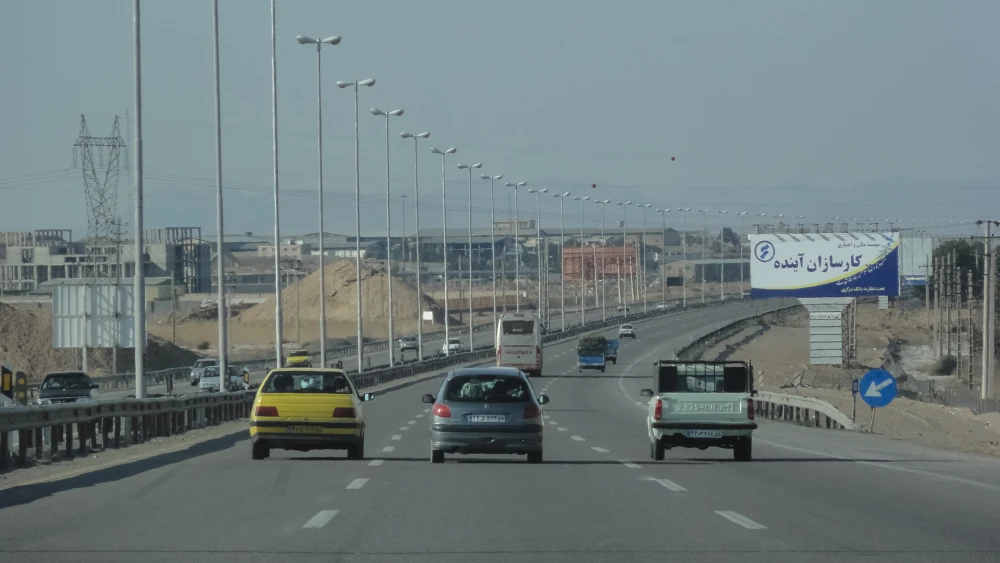
The Tehran–Qom highway, officially part of Freeway 7 (the Persian Gulf Highway), in Tehran, February 2011. Credit: Mostafa Meraji via Wikimedia Commons.


The U.S. Department of the Treasury sanctioned “some of the last significant elements of Iran’s failing industrial infrastructure” on Thursday, including the regime’s railroad and automotive conglomerates.

With a U.S. blockade of the Strait of Hormuz still in place and secondary sanctions all but shutting down Iranian air travel abroad, the “rail and automotive sectors represent some of the regime’s largest remaining sources of revenue and logistical capacity,” the department said.

The new designations strike “directly at the critical arteries Iran relies on to sustain its economy and evade sanctions,” the department stated.

Two companies representing some 90% of the domestic auto market were sanctioned, along with various subsidiaries and the country’s largest motorcycle manufacturer.

The department also sanctioned key auto parts exporters from Indonesia, the United Arab Emirates, Turkey and Hong Kong that “continue to export key automotive parts to sustain Iran’s auto industry and evade U.S. sanctions.” So were key passenger and freight rail servicers, both state and privately owned.

The federal government also sanctioned domestic and foreign metals manufacturers and components of a steel and oil export network spanning China, Germany and the Dominican Republic.

The designations fall under “Operation Economic Outcast,” which the Treasury Department launched in late August, to isolate the Islamic Republic and choke its revenue streams.

“The Iranian regime’s ability to fund its war machine and inflict terror on the world has been severely diminished thanks to ‘Operation Economic Outcast,’” stated Scott Bessent, U.S. treasury secretary.

“Today’s action directly targets Iran’s enablers and lays the groundwork for the United States and our partners to drain the regime’s revenue once and for all,” he stated.


Mike Wagenheim

Source: https://www.jns.org/news/u-s-news/trump-admin-sanctions-iranian-automotive-rail-and-metals-sectors

Follow Middle East and Terrorism on Twitter

Stricter eligibility requirements for SNAP applicants now in effect, along with bump in payments - Kevin Killough


by Kevin Killough

Under new work requirements imposed by the "The Big Beautiful Bill Act," able-bodied adults aged 18 to 64 who don't have dependents will be required to work. Previously, the age limit was 54.


Families applying for food assistance through the federal Supplemental Nutrition Assistance Program (SNAP) will, beginning Thursday, face changes to payments, eligibility requirements and how the benefits are administered.

Most families will initially see a slight bump in their monthly payments to support grocery purchases from a cost-of-living adjustment, but in the coming months, households will face stricter eligibility requirements, meaning fewer people will receive the benefits, ABC News reported. 

Under new work requirements imposed by the "The Big Beautiful Bill Act," able-bodied adults ages 18 to 64 who don't have dependents will be required to work. Previously, the age limit was 54. Families with children age 14 or older are no longer exempt from the work requirements. 

The "The Big Beautiful Bill Act" also requires states to pay for a larger share of SNAP administrative costs, and states with SNAP recipient error rates above 6% will be required to fund a portion of the benefits themselves.  


Kevin Killough

Source: https://justthenews.com/government/federal-agencies/stricter-eligibility-requirements-snap-applicants-go-effect-along-bump

Follow Middle East and Terrorism on Twitter

DOJ sues University of Delaware to end in-state tuition for illegal aliens - Ben Whedon


by Ben Whedon

Under the Trump administration, federal agencies have worked to curtail benefits available to illegal aliens to encourage self-deportation.


The Department of Justice on Thursday filed a complaint against the University of Delaware over its policy of providing in-state tuition to illegal aliens.

“This Department of Justice’s efforts will not cease until we have challenged every state law or university policy that gives preferential treatment to illegal aliens over our Nation’s own citizens,” Associate Attorney General Stanley Woodward Jr. said in a statement. “Congress long ago made clear that states cannot give reduced tuition to illegal aliens not available to all Americans. When a state Attorney General allows her own state to violate federal law, this department must step in to enforce it.”

The suit marks the 26th such action from the Trump DOJ against institutions offering in-state tuition to illegal aliens. The DOJ has previously brought cases in states across the country, securing court orders to end the practice in several.

Under the Trump administration, federal agencies have worked to curtail benefits available to illegal aliens to encourage self-deportation.


Ben Whedon
is the Chief Political Correspondent at Just the News. Follow him on X.

Source: https://justthenews.com/government/courts-law/doj-sues-university-delaware-end-state-tuition-illegal-aliens

Follow Middle East and Terrorism on Twitter

Newsom draws criticism of ‘asymmetry’ for signing expansive Muslim holiday bill before more limited legislation about Jewish, other days - Jessica Russak Hoffman


by Jessica Russak Hoffman

“The fact that Newsom chose to sign the Eid law before the law that protected other religious observance speaks volumes about the direction he is moving as he eyes a 2028 run for the presidency,” the chair of Jewish engagement for the California Republican Party told JNS.


Newsom
California Gov. Gavin Newsom, a Democrat, is pictured during a recorded interview with AFP in the Manhattan borough of New York City on Sept. 23, 2026. Credit: Charly Triballeau/AFP via Getty Images.


California Gov. Gavin Newsom, a Democrat, drew criticism on Wednesday night when he signed a more focused bill recognizing Jewish and other holidays after appearing to have prioritized signing a more expansive bill about Muslim holidays days before.

A spokeswoman for Democratic state representative Jesse Gabriel, chair of the Jewish Legislative Caucus and the bill’s sponsor, confirmed to JNS late on Wednesday that Newsom signed AB 395 into law, designating Rosh Hashanah, Yom Kippur and Passover and days sacred to other faiths as state holidays to protect students and California employees from scheduling and other conflicts.

Elizabeth Barcohana, chair of Jewish engagement for the California Republican Party, told JNS that it is a “concerning sign” of the influence of the Council on American-Islamic Relations in U.S. politics that it sponsored the bill about Muslim holidays.

CAIR blamed Israel for being attacked shortly after Oct. 7. The Biden administration initially included it in an advisory role on the national strategy on Jew-hatred before dropping it.

“The fact that Newsom chose to sign the Eid law before the law that protected other religious observance speaks volumes about the direction he is moving as he eyes a 2028 run for the presidency,” Barcohana told JNS.

David Bocarsly, CEO of Jewish California, told JNS that AB 395 is the first time a Jewish holiday has been named in California state law.

“I’m really thrilled that California has recognized the Jewish community in this way,” he said. “There have been so many instances where Jewish community members, and I’m sure this is the case for others as well, were trying to attend a public meeting to make public comment because it impacts their lives and the meeting is scheduled on holiday, and they just are unable to.”

Bocarsly cited a “particularly egregious situation in Santa Ana,” in which “school board members were found in discovery to have texted each other, scheming to have a school board meeting on Passover so that Jews wouldn’t show up to give public comment on the ethnic studies curriculum.”

“There are some real impacts here on the betterment of Jewish engagement in civic life, which ultimately have long-standing impacts on what policy is made,” he told JNS. “I’m particularly excited about it.”

Newsom, who signed AB 2017 recognizing Muslim holidays Eid al-Fitr and Eid al-Adha as statewide holidays earlier in the week, had until Sept. 30 to sign or veto AB 395. A spokeswoman for the governor previously told JNS that he had “until midnight to take action.”

AB 2017 allows schools to offer classroom instruction exploring the history of Eid al-Fitr and Eid al-Adha and allows the State Board of Education to adopt a model curriculum guide for Eid-related lessons, but AB 395 has no such provision for the Jewish and other holidays.

According to Bocarsly, the communities involved in the bills asked for different things.

“It looks different than what other communities are asking for, and that’s because we’re asking for something else that addresses the needs of our community,” he told JNS. “But both AB 2017 and AB 395 do one thing that is similar, which is acknowledge these holidays.”

“We’re proud that Jewish holidays are now part of state law,” he said.

Lisa Cusack, Republican chairwoman of California’s 44th Assembly district, told JNS that she is “OK with saying that you can take off the holiday of your faith without being punished” but is concerned that the Eid legislation, sponsored by the CAIR, allows educators to create classroom lessons about those holidays.

“Where I have a problem is bringing teaching about Islam into the school,” Cusack said.

“My father comes from Turkey. He was a Christian born in a Muslim country and faced persecution there,” she told JNS. “The left has been so determined to create a separation of church and state, between Christianity and the state. Instead, it’s taken the church out of the state and now appears to be replacing it with Islam.”

Barcohana told JNS that the “asymmetry between the bills” struck her.

“Eid receives all the same protections as Jewish holidays, plus more,” she said. “Schools can close for Eid, and they can develop curriculum to teach the ‘meaning and significance’ of Eid.”

“People may think this is alarmist, but this is an example of American laws adopting a Sharia law framework,” Barcohana told JNS. “Special protections no other religious observance receives, the option to shut down public institutions to observe the holiday that, until now, only Christian holidays received and curriculum in public schools that is religious in nature, notably about a religion that emphasizes conversion.”


Jessica Russak Hoffman is a reporter for JNS in Seattle.

Source: https://www.jns.org/news/u-s-news/newsom-draws-criticism-of-asymmetry-for-signing-expansive-muslim-holiday-bill-before-more-limited-legislation-about-jewish-other-days

Follow Middle East and Terrorism on Twitter

Media coverage of Trump's CNN ouster, Jack Smith spying on news outlets exposes double standard - Amanda Head


by Amanda Head

The records came from National Archives productions tied to 87 White House phones, capturing journalist-source exchanges as Smith’s team pursued Trump over the 2020 election and classified documents.


Legacy media outlets that spent last week decrying President Donald Trump’s decision to bar CNN, MS NOW and Politico from White House access and pool duties largely shrugged Tuesday when Senate Judiciary Chairman Chuck Grassley, R-Iowa, revealed that former special counsel Jack Smith’s Arctic Frost investigation swept up communications between government sources and nearly 50 journalists from more than a dozen news organizations.

"The partisan media is suffering from a severe case of Stockholm Syndrome. Jack Smith's weaponized investigation harmed thousands of Americans, including dozens of journalists, yet many in the partisan media still want to treat him like a folk hero," Sen. Charles Grassley, R-Iowa, told Just The News. 

Grassley, who chairs the Senate Committee on the Judiciary where the Smith hearing took place continued: "Arctic Frost and Jack Smith were a generational scandal, and it's a disservice to the American people not to report on the rampant misconduct honestly." 

Grassley’s whistleblower-backed disclosure listed outlets including CNN, Fox News, CBS News (including 60 Minutes), NBC, The Associated Press, The Washington Post, The Wall Street Journal, Reuters and NPR. 

The records came from National Archives productions tied to 87 White House phones, capturing journalist-source exchanges as Smith’s team pursued Trump over Trump's actions following the 2020 election and his handling of classified documents.

Instead of examining that government collection of reporter communications, major headlines followed a familiar script. The Hill led with “Jack Smith stresses strength of Trump cases.” The New York Times declared “As Jack Smith Testifies, a Senator’s Accusation of Perjury Falls Apart,” focusing on Sen. Eric Schmitt’s mix-up of an Atlanta Hawks game with an Iowa Hawkeyes contest in Maryland. The Associated Press reported that Smith “forcefully defends investigations.”

“What is a bigger threat to freedom of the press: revoking special access to the White House or weaponizing the government to spy on journalists," David Bozell, CEO of the Media Research Center, raised to Just The News.

"The media went up in arms about the former, but the broadcast networks dedicated exactly ZERO minutes to the latter."

Legacy media's inconsistencies

The contrast is not new. The same institutions that treated a pool rotation dispute as an existential First Amendment crisis have historically downplayed or delayed stories that cut against preferred narratives — from the Hunter Biden laptop dismissed as Russian disinformation before the 2020 election to early COVID-19 lab-leak questions labeled as conspiracy theories. 

Smith’s team issued 197 subpoenas touching at least 430 Republican individuals and entities, obtained lawmaker call logs and donor financial data, yet the dominant coverage framed the hearing as Smith standing by “proof beyond a reasonable doubt” while a senator’s basketball error unraveled.

Smith doesn't just have the legal system to answer to when it comes to those Republican records. Senator Marsha Blackburn is suing Smith personally and the Justice Department, alleging he unlawfully and secretly subpoenaed her Verizon phone toll records during the Arctic Frost probe of January 6 and the 2020 election challenges without notifying her or the court that she was a sitting senator. 

Blackburn alleges this violated the Speech or Debate Clause and other rights, argues his appointment was unconstitutional, and seeks a court declaration that the actions were unlawful, return or destruction of the records, and $1 in nominal damages. 

Mark Chenoweth, President of the New Civil Liberties Alliance (NCLA), is representing Blackburn in the lawsuit and spoke exclusively to Just The News. 

"If a member of of the current Department of Justice were to keep a federal district judge in the dark in this sort of deliberate way, in order to get a non-disclosure order in connection with a grand jury subpoena, I think that the media would think that was a really big deal. But that's exactly what Jack Smith and his team did, and I think that it's intolerable behavior," Chenoweth said. 

However, Chenoweth is hopeful that the media double standard might not endure, at least in this instance: "I actually think that some of the media will come around. Maybe they all won't, but as these facts come to light, this is not some grand conspiracy that we're alleging here. This is a very particular set of unlawful behavior that violated a particular individual's rights, and I think that we're going to be able to prove that." 


Amanda Head

Source: https://justthenews.com/government/white-house/first-amendment-emergency-only-when-trump-bans-legacy-media-not-when

Follow Middle East and Terrorism on Twitter

IDF: 170 Hamas, PIJ terrorists killed in Gaza were misrepresented as 'innocent journalists' - Goldie Katz


by Goldie Katz

The journalists' identities and terrorist affiliations were verified using documents released by the terrorist organizations themselves and materials recovered by IDF troops during Gaza operations.


IDF reveals that 170 alleged "journalists" killed in Gaza were Hamas, PIJ terrorists.
(photo credit: IDF SPOKESPERSON'S UNIT)


The IDF revealed on Thursday that 170 individuals who were misleadingly presented as civilian “journalists” killed in strikes on Gaza were actually affiliated with Hamas, Palestinian Islamic Jihad (PIJ), and other terrorist organizations.

The journalists' identities and terrorist affiliations were verified using documentation released by the terrorist organizations themselves and materials recovered by Israeli troops during Gaza operations, the military stated.

The IDF launched a website dedicated to compiling information regarding terrorists found to be misrepresenting themselves as civilian journalists and combating accusations that the IDF deliberately targets civilians working in the media.

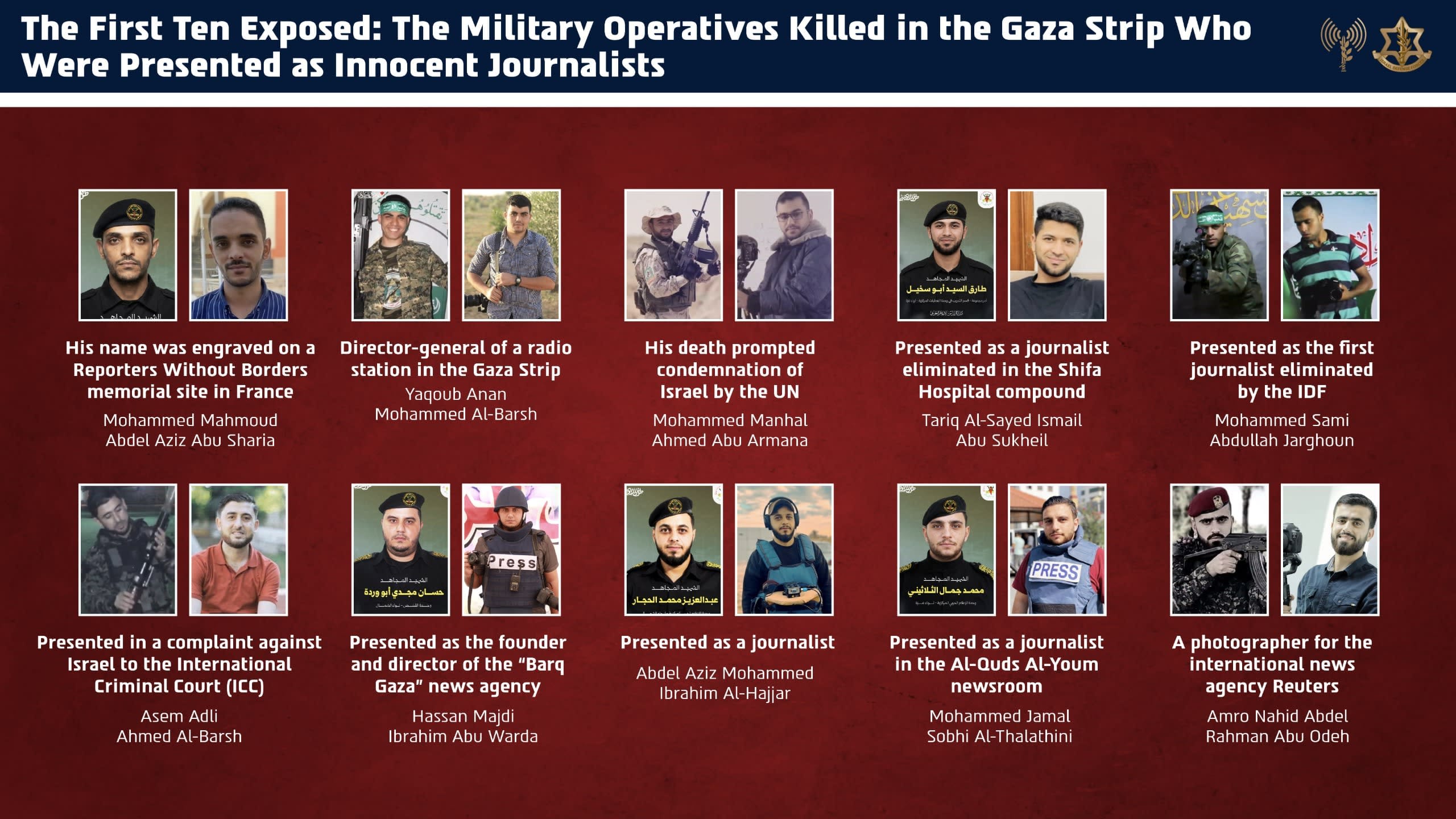
Earlier on Thursday, the IDF released a statement highlighting ten journalists who doubled as Hamas and PIJ terrorists.

The terrorists, some of whom worked for news outlets such as Reuters, Turkish state-run Anadolu Agency, and Palestine Now News Agency, operated as snipers, commanders, trainers, and propaganda agents, among other roles.

Ten Hamas and Palestinian Islamic Jihad terrorists misleadingly presented as civilian “journalists” killed in IDF strikes in Gaza.
Ten Hamas and Palestinian Islamic Jihad terrorists misleadingly presented as civilian “journalists” killed in IDF strikes in Gaza. (credit: IDF SPOKESPERSON'S UNIT)

According to the IDF, some of the alleged journalists infiltrated Israel and participated in Hamas’s October 7 massacre.

Deaths of Hamas, PIJ journalists cited in complaints against Israel

The deaths of the alleged civilian journalists were cited in complaints and condemnations launched against Israel.

Hamas terrorist Asem Adli Ahmed al-Barsh, an alleged journalist for Palestinian Al-Rai Radio, was named by Reporters Without Borders (RSF) in a December 2023 complaint to the International Criminal Court.

RSF accused Israel of deliberately targeting civilian journalists and did not mention Barsh’s status as a Hamas terrorist in the complaint.

RSF also engraved the name of Mohammed Mahmoud Abdel Aziz Abu Sharia, a PIJ sniper who allegedly worked for Palestinian Shams News Agency, in a memorial dedicated to journalists who were killed between June 2024 and June 2025.

In 2024, then UNESCO Director-General Audrey Azoulay condemned the killing of another Hamas terrorist, Mohammed Manhal Ahmed Abu Armana, whom the IDF identified as Hamas’s Rafah Brigade Propaganda Department Commander.

A number of the terrorists named by the IDF were included in the Committee to Protect Journalists' (CPJ's) database of journalists and media workers killed in Gaza since 2023.


Goldie Katz

Source: https://www.jpost.com/israel-news/defense-news/article-910354

Follow Middle East and Terrorism on Twitter

Wednesday, September 30, 2026

Flydubai pilot attempts terror hijacking of flight to Tel Aviv, foiled by Israeli passengers - Amichai Stein, James Genn, Yonah Jeremy Bob, Zvika Klein


by Amichai Stein, James Genn, Yonah Jeremy Bob, Zvika Klein

Israeli official says “major disaster avoided” after pilot stabbed his co-pilot, attempted to hijack aircraft with over 100 Israeli passengers • Plane makes emergency landing in Saudi Arabia


Damage done to rudder of flydubai flight after suspected attempted hijacking, September 30, 2026.
(photo credit: COURTESY)


One hundred and seventy-four Israeli passengers were returned to Ben-Gurion Airport Tuesday evening after a stunning series of events in which multiple passengers helped restrain an Omani hijacker-pilot who attempted to crash the airplane earlier in the day.

The passengers were initially on a flydubai commercial passenger aircraft flying from Dubai to Tel Aviv, but then the pilot-hijacker, who was the deputy pilot for the flight, stabbed the lead pilot and tried to crash the aircraft before as many as four passengers wounded him and tied him up.

An additional flight crew on board were then able to handle landing the plane in Saudi Arabia, though the original pilot, a native of India, was in critical condition, having been stabbed repeatedly by the Omani pilot.

One of the Israeli passengers was a medical professional who helped stem the bleeding of the Indian pilot, who was reportedly in stable condition in Saudi Arabia.

Some of the passengers who managed to restore control of the plane credited the Indian pilot for opening the cockpit for them even after he had been stabbed, so that they could provide assistance.

Prince Sultan bin Abdulaziz Airport, also known as Tabuk Airport, September 11, 2017
Prince Sultan bin Abdulaziz Airport, also known as Tabuk Airport, September 11, 2017 (credit: Wikimedia Commons)

Passengers returned safely to Israel with help of Mossad despite Saudi plane refusal

After around six hours in Tabuk, Saudi Arabia, a second flydubai aircraft, with a new staff, specially approved by the Mossad, came through Saudi Arabia and flew the Israeli passengers back to Israel.

Part of the delay came due to a refusal by the Saudis to allow an Israeli air force or commercial El Al aircraft, that would have arrived earlier, to bring them back to the Jewish state, with Riyadh fearing Prime Minister Benjamin Netanyahu would use the event as an election and normalization prop.

There was even a proposal for an aircraft to arrive without markings, but ultimately the Saudis said no.

A source close to the Saudi royal family told The Jerusalem Post that “Israel needs to understand that normalization cannot be forced.”

Another delay came when many Israeli passengers initially refused to get on the new flydubai aircraft, insisting they would only leave Saudi Arabia on an Israeli aircraft.

Eventually, they gave in on the issue when told this was their only choice for being rescued.

So far, multiple sources have told the Post that the Mossad, Shin Bet, IDF, and Transportation Ministry believe the hijacker was a lone wolf, not under orders from Iran or another terror group.

There is a partial disconnect in the investigation since the Saudis are leading the interrogation of the hijacker, with Israel receiving information from Riyadh secondhand or from passengers who spoke with the hijacker after he was subdued.

A number of failures are being probed by the joint Israeli security team, including why the Omani pilot was not properly checked for weapons possession, since he had a weapon with him in the cockpit with which to stab his co-pilot.

The Saudis are also probing how the United Arab Emirates allowed an Omani citizen to pilot an aircraft flying to Israel, given explicit agreements between the countries that this would not occur.

There were mixed reports about who was advocating a temporary ban on flights between the UAE and Israel until these issues were resolved, but some credited Shin Bet Director David Zini with leading the charge on that issue.

Transportation Minister Miri Regev eventually endorsed this position, though some earlier reports indicated she initially resisted Zini on the issue.

A Flydubai Boeing 737-8 MAX A6-FKF aircraft, which was bound for Israel from the United Arab Emirates diverted to Saudi Arabia, is seen flying over Salzburg, Austria, March 8, 2026
A Flydubai Boeing 737-8 MAX A6-FKF aircraft, which was bound for Israel from the United Arab Emirates diverted to Saudi Arabia, is seen flying over Salzburg, Austria, March 8, 2026 (credit: KARL DITTLBACHER/HANDOUT VIA REUTERS)

The Shin Bet declined to confirm or deny the alleged dispute, but anonymous leaks seemed to frame Zini as having warned even before the event about insufficient security surrounding UAE-Israeli flights.

But even Zini reportedly was more concerned about security for Israelis while in the UAE, not about a rogue pilot trying to crash an aircraft he was piloting.

Aircraft carrying 174 passengers plunges 4,000 meters

Further, they are probing what the Omani pilot’s full intentions were: whether to crash the plane nowhere specific with the focus on killing the passengers or whether he had hoped to crash it in an urban setting in Israel to achieve “bonus” additional Israeli casualties.

During the altercation, the aircraft plunged about 4,000 meters, an official noted.

The aircraft, operating as flight FZ1073 and carrying 174 passengers, initially transmitted squawk code 7700, indicating a general emergency, before switching to 7500, which signals unlawful interference, and later reverting to the initial code.

Israeli media reported later on Wednesday that 166 of the passengers onboard were Israelis.

As the incident unfolded, the Israel Air Force (IAF) scrambled fighter jets in preparation for a possible emergency and raised its alert level.

Israeli airspace was also temporarily closed and later reopened after the plane landed in Saudi Arabia.

Israeli sources later told the Post that the UAE President Mohammed bin Zayed al-Nahyan spoke with Netanyahu after the hijacking attempt.

When the Israeli passengers returned to Israel, they cheered spontaneously, and there was raucous dancing for them at Ben-Gurion Airport.

One of the heroic passengers met with Netanyahu, while multiple passengers interviewed with the media about their heroic and harrowing experience.

Several passengers said that if not for the small number of passengers who rushed the Omani pilot, they would all have died.

In related news, IDF Chief of Staff Lt.-Gen. Eyal Zamir canceled his planned trip to the United States due to the ongoing situation. Zamir was slated to meet with US Chair of the Joint Chiefs of Staff Gen. Dan Caine and US Central Command (CENTCOM) chief Adm. Brad Cooper, the Post confirmed.

Yasmin Abu Kasis, whose daughter Miriam was on the flight, said that her daughter had told her that she had heard screaming and that a man took a knife, put the pilot on the floor, and that there was blood everywhere.

It is not the first time a flight between Israel and the UAE has landed in Saudi Arabia. A flydubai flight from Dubai to Tel Aviv made an emergency landing in Riyadh in September 2025 due to a medical emergency, the Post reported at the time.

Similar incidents elsewhere have led to immediate suspensions.

In 2022, two Air France pilots were suspended after physically confronting each other in the cockpit during a flight from Geneva to Paris. Crew members had to separate them, and one of the pilots remained in the cockpit until landing.

An even more serious incident occurred in 2009 on an Air India flight from Sharjah, UAE, to New Delhi, India, when pilots and crew members exchanged blows, and the altercation spilled over from the cockpit into the aircraft’s galley. Two pilots and two crew members were suspended, and police launched an investigation

Shir Perets, Amir Bohbot, Eli Leon, and Reuters contributed to this report.


Amichai Stein, James Genn, Yonah Jeremy Bob, Zvika Klein

Source: https://www.jpost.com/international/article-910155

Follow Middle East and Terrorism on Twitter

Netanyahu: Israel to join flydubai probe, ‘we’ll find out’ whether Iran was involved - Idan Kweller


by Idan Kweller

In a CNN interview, Netanyahu revealed Israel will join the flydubai probe, praised heroes who averted a '9/11 disaster,' denied pre-October7 warnings, and called settler violence framing a 'hoax.


Israeli Prime Minister and Likud party chairman Benjamin Netanyahu, surrounded by supporters, during an election campaign tour in the southern Israeli city of Ashdod, September 29, 2026
(photo credit: Liron Moldovan/Flash90)


In a wide-ranging CNN interview, the prime minister said UAE President Sheikh Mohammed bin Zayed agreed that Israel would participate in the investigation. Netanyahu said Israel had no specific warning about the flydubai incident, defended the war against Iran, rejected reports of pre-October 7 warnings, and called the framing of “settler violence” a “tremendous hoax” while condemning vigilante attacks.

Prime Minister Benjamin Netanyahu said Wednesday that Israel would join the investigation into the Flydubai co-pilot suspected in the dramatic incident aboard a flight approaching Israel, saying investigators would soon be able to determine whether Iran had any connection to the event.

In an interview with CNN’s Jim Sciutto, Netanyahu stressed that he did not yet have information allowing him to attribute the incident to Tehran.

“What we know is [that he is] an Omani national,” Netanyahu said of the attacking co-pilot.

Netanyahu described screams coming from the cockpit as the aircraft approached Israel and said an Israeli passenger, a plumber named Yaniv, rushed toward the cockpit.

Prime Minister Benjamin Netanyahu speaks with one of the passengers from the hijhacked flydubai flight at Ben-Gurion Airport on September 30, 2026.
Prime Minister Benjamin Netanyahu speaks with one of the passengers from the hijhacked flydubai flight at Ben-Gurion Airport on September 30, 2026. (credit: KOBI GIDEON/GPO)

Netanyahu's account of the flydubai incident

According to Netanyahu, the Indian pilot who had been stabbed “showed incredible heroism” by managing, despite bleeding heavily, to unlock the cockpit door.

“The Israeli passenger burst in, saw the attacking co-pilot hover over the instruments,” Netanyahu said. “He wasn’t sitting in one of the two pilot seats, but he was trying to jam the instruments.”

Netanyahu said the passenger threw the attacker backward, took the controls and pulled back on the stick while another Israeli passenger and an air crew member helped restrain the attacker.

Reserve pilots who had been in the passenger area then entered the cockpit and stabilized the aircraft, which Netanyahu said had gone into a nosedive and sustained damage to its rudder and tail.

“The amazing heroism here of the Indian pilot, the Israeli passenger and his colleagues, and those pilots managed to prevent a 9/11 disaster, because that’s what it looks like was happening,” he said.

‘No specific warning’

Sciutto asked Netanyahu whether his warning a day earlier that Israel’s enemies could try to attack ahead of the election had been based on intelligence related to the flydubai incident.

“No, not specifically,” Netanyahu replied.

“What we had is a lot of information streaming in that Iran’s proxies, in particular Hezbollah and Hamas, were planning attacks against Israel and Israeli civilians abroad. But I can’t tell you that we had any specific warning about this.”

Netanyahu said the suspect was being interrogated in Saudi Arabia and that he expected him to be transferred to the United Arab Emirates.

“I spoke to the president of the United Arab Emirates, Sheikh Mohammed bin Zayed, and he agreed that Israel would join the interrogation,” Netanyahu said. “So we’ll find out very soon if Iran had anything to do with it, but I can’t say that in advance of the conclusion of the interrogation.”

The flydubai rescue flight for hijacked flight FZ1073 lands in Israel on September 30, 2026.
The flydubai rescue flight for hijacked flight FZ1073 lands in Israel on September 30, 2026. (credit: MDA)

He later added: “We know that Iran is sponsoring a lot of this, but I can’t speak specifically of this.”

Netanyahu did, however, assert that Iran had been behind a separate attack in Britain.

“They did stand behind the attack in Britain. We passed that information to the Brits,” he said, before criticizing London for imposing sanctions on Israel days later. “The cynicism and the hypocrisy here is unbelievable.”

Iran nuclear program: ‘It’s not an intelligence assessment. It’s intelligence’

The interview then turned to Iran and reports that Tehran may be trying to rebuild nuclear infrastructure.

“It will if it can,” Netanyahu said when asked whether Iran would try to resume its nuclear program.

“But I think President Trump’s actions, the blockade, are very effective in crippling this regime. And obviously, yes, they will try to resuscitate their nuclear program, and it’s something that we’re obviously tracking all the time.”

Netanyahu said his goal and US President Donald Trump’s goal were the same: preventing Iran from obtaining nuclear weapons.

He argued that the economic blockade was “really crippling the IRGC economy” and said Iran was “reeling from this economic blockade.”

Asked whether the war had failed to achieve Israel’s objectives because Iran’s highly enriched uranium had not been secured, Netanyahu rejected the premise.

“I think, first of all, it achieved a great objective,” he said. “They’re on the verge of manufacturing nuclear weapons, atomic bombs, and if we hadn’t acted, they’d have them already, and they probably would have used them, and that would have changed history.”

When Sciutto asked what intelligence assessment supported that claim, Netanyahu replied: “It’s not an intelligence assessment. It’s intelligence. We had it very clear. That’s why we had to act.”

Netanyahu compared the nuclear threat to cancer.

“You know you have a big lump of cancer, and you know one thing: if you don’t remove it, then you’re going to die,” he said. “But it doesn’t mean that the cancer can’t come back. So we have to be on constant alert.”

Netanyahu rejects reports of pre-October 7 warnings

Sciutto also pressed Netanyahu on recent reports that Egypt and the UAE had warned him ahead of the October 7 attacks and asked whether he accepted personal responsibility for not doing more to prevent them.

“First of all, those reports are false,” Netanyahu said. “They didn’t give me any such warnings. That’s completely false.”

He said “elements” in neighboring countries and political opponents were promoting what he called lies.

“I didn’t receive such warnings,” he said.

Asked whether there was anything he wished he had done differently before the attack, Netanyahu said there had been no solid intelligence assessment warning of such an assault.

“In fact, the intelligence assessments were the exact opposite, including days before the attack,” he said.

Netanyahu said security meetings held shortly before October 7 had concluded that “Hamas is deterred” and wanted economic benefits.

“So clearly, we were all blindsided by this,” he said.

He added that the failure should nevertheless be investigated.

“We do ask that question, and we’re going to come to the bottom of it, obviously, with a proper investigative effort.”

‘Settler violence’ framing a ‘tremendous hoax’

Toward the end of the interview, Sciutto challenged Netanyahu over violence by Israelis in the West Bank and asked whether his government had lost control of settler violence.

“The settler violence thing is a tremendous hoax,” Netanyahu responded.

He immediately clarified that he was not denying that violence had occurred.

“It’s about 150, 200 juvenile delinquents who are doing this, and I can’t stomach that,” he said. “I can’t accept vigilante action. We’re a country of laws, so I put the Shin Bet, our security services, against them.”

Netanyahu said he had already condemned such incidents.

“I can’t tolerate vigilantes and I can’t tolerate uncontrolled violence or any kind of violence that is directed against civilians. That’s not something we accept.”

But he argued that comparing such violence with Palestinian terrorism created a false equivalence.

“To compare this is like to compare an olive to a toxic tree,” Netanyahu said.

He cited figures on shootings, explosive-device attacks, stabbings, car-ramming attacks, suicide attacks and kidnappings against Israelis and said the scale was fundamentally different.

At the end of the interview, Netanyahu also addressed the future of Israeli forces in Gaza and Lebanon.

He said Israel would remain in security corridors in both arenas as long as Hamas and Hezbollah retained the ability to threaten Israel.

“Once these two malign forces, these terrorist monsters, are defeated,” Netanyahu said, “then I think a whole new opportunity for peace and for prosperity occurs in the Middle East, both for us and for our Arab neighbors.”


Idan Kweller

Source: https://www.jpost.com/israel-news/article-910243

Follow Middle East and Terrorism on Twitter

Indian flydubai pilot Smit Machchhar unlocked cockpit, named assailant, while wounded - report - Maya Zanger Shamir


by Maya Zanger Shamir

Several passengers, including Israeli dentist Shota Musayev, administered first-aid care to Machchhar, keeping him alive until he was hospitalized in Saudi Arabia.


Flydubai pilot, capt. Smit Machchhar.
(photo credit: SECTION 27A COPYRIGHT ACT)


The flydubai pilot who was stabbed on flight FZ1073, Indian national Capt. Smit Machchhar, reportedly unlocked the cockpit door before losing consciousness, passenger Yaniv Hayoun told Prime Minister Benjamin Netanyahu when the two spoke at Ben-Gurion Airport on Wednesday.  

Hayoun told Netanyahu that the cockpit door was unlocked, but Machchhar was close enough to the door that it was difficult to open. "My conclusion is that he resourcefully managed to open the door for us before he collapsed," he explained.

Netanyahu later expanded on this in a Twitter/X statement praising Machchhar's heroism.

"Despite being stabbed and seriously injured, he fought back, resisted, opened the cockpit door, and enabled passengers and crew to overpower the attacker — preventing a catastrophic mid-air disaster," the prime minister wrote. "He saved the lives of 174 people, including Israeli citizens and other nationals."

Several passengers, including Israeli dentist Shota Musayev, administered first-aid care to Machchhar, keeping him alive until he was hospitalized in Saudi Arabia after the plane made an emergency landing at Tabuk Airport. Musayev told Walla that Machchhar was badly wounded, bleeding heavily from his head and hands. The dentist was able to stop the bleeding and told Walla that his condition did stabilize after that, but deteriorated once again as the plane was landing. 

Flydubai pilot, capt. Smit Machchhar.
Flydubai pilot, capt. Smit Machchhar. (credit: SECTION 27A COPYRIGHT ACT)

Musayev also said that Machchhar was able to verbally communicate that the other pilot stabbed him. 

Machchhar is an experienced pilot, specializing in training new recruits

According to several Indian news outlets, Machchhar is a Gujarati Indian from Mumbai. According to his LinkedIn profile, he spent over a decade flying for Indian airline SpiceJet, where he also served as a training captain and mentor for new pilots, before moving to flydubai. His profile also notes that he accumulated about 9,750 flying hours on the 737-800 and the 737 MAX 8 and 9.

The LinkedIn profile also indicates that Machchhar is a father.

The Indian Embassy in Saudi Arabia said Machchhar was "admitted in a hospital in Tabuk city in northwest Saudi Arabia and [is] receiving necessary medical attention."

The embassy said that while they have not received a full update on the pilot's health, he is reported to be in stable condition. Officials are also in touch with Machchhar's family, the embassy added.


Maya Zanger Shamir

Source: https://www.jpost.com/international/article-910230

Follow Middle East and Terrorism on Twitter