Saturday, April 12, 2014
Iranian Navy Thumbs Nose at America
by Michael Rubin
Thanks to Mehrdad Moarefian for flagging, but an Iranian battle group earlier this week docked in Djibouti for a three-day port call. While previously the Iranian navy docked in Port Sudan, the move to Djibouti should be a wake-up call regarding America’s shrinking military and diplomatic standing. After all, Djibouti is the site of a hugely important U.S. facility and serves as an important hub and logistical base for American activities throughout the region. It’s one thing for Iran to work with a rejectionist, failing state like Sudan; it’s quite another to enjoy port calls on the doorstep of an American base and with a government which so closely partners with the United States.
In the Persian original, the story gets worse, however: The Iranian ships had also paid a port call in Salaleh, Oman’s second most important city. That port call highlights Oman’s slow turn away from the past few decades when it was a reliable U.S. and pro-Western ally; I had previously talked about Oman’s growing flirtation with the Islamic Republic of Iran here, including its discussions of basing rights for Iran in exchange for cheap gas.
Lastly, the Persian article notes that the Iranian navy’s mission was to help secure the Islamic Republic of Iran Shipping Lines (IRISL). Given the IRISL’s involvement in proliferation, shipping of arms, and use of false flags and false documents to cover up cargo and operations–all of which it has been sanctioned for–that the Iranian Navy now expedites and facilitates the activities of this sanctioned entity certainly suggests that reform of behavior is not on the Iranian regime’s agenda, despite Obama administration claims that its strategy is working to bring Iran in from the cold.
Michael Rubin
Source: http://www.commentarymagazine.com/2014/04/11/iranian-navy-thumbs-nose-at-america/
Copyright - Original materials copyright (c) by the authors.

Brandeis Backs Arsonists, Dumps Firefighter
by Douglas Murray
Between supporters of terrorism such as CAIR and Hirsi Ali, there should not even be a debate over whom free societies should choose.
The worst strains of European thinking seem to have infected America. As cultural relativism, spinelessness and an inability to stand up for our own values have become more and more dominant in Europe, some of us have continued to look to the U.S. as a society safeguards its founding principles and remains willing to uphold them in the face of opposition. Apparently not for much longer.
There have been troubling developments for some time. But an event earlier this week speaks louder than any so far. This is the decision of Brandeis University to revoke the offer of an honorary degree to the human rights hero, Ayaan Hirsi Ali.
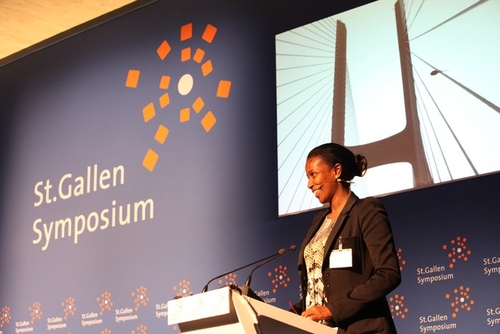
Ayaan Hirsi Ali addresses the St. Gallen Symposium at the University of St. Gallen, Switzerland, in May 2011. (Image source: Wikimedia Commons/International Students' Committee)
|
In case anybody needs reminding of her story, two decades ago the Somali-born Hirsi Ali fled an arranged marriage and gained asylum in the Netherlands. She learned the language, worked for a university education and became a member of the Dutch Parliament all in the space of a few short years. But the country she had integrated into had lost its moral compass. As violent and oppressive inroads were made by some segments of its Muslim minority, Hirsi Ali became one of the few to speak out. She knew there was a price for doing so. And sure enough she was vilified and physically threatened. In 2004 she saw her colleague and friend, the film-maker Theo van Gogh, brutally murdered for his part in a film they had made together that highlighted the plight of many Muslim women.
Much of the Dutch and European cultural and political establishments took the lesson of the van Gogh killing: they shut up. They refrained from ever criticizing elements of Islam, and they pretended instead that there was no problem and nothing to see here. Women's rights and the rights of religious and sexual minorities were ignored as the importance of not disturbing Islamic sensitivities took precedence. Worse, the country turned on those like Hirsi Ali who were trying to warn them about the problem. In the process, they made a fundamental mistake, mixing up the firefighter with the fire. And so the Netherlands turned on the few firefighters they still had. Eventually Hirsi Ali was faced with no other choice but to leave. She became, as Salman Rushdie put it, perhaps the first political refugee from Europe to America of the post-war period.
Now, even her recently adopted homeland is letting her down. Brandeis University was planning to award her an honorary degree at a ceremony next month. But now this offer, and the invitation to address students at their May 18th commencement, has been withdrawn. The university's President, Fred Lawrence, has announced that, "We cannot overlook certain of her past statements that are inconsistent with Brandeis University's core values. For all concerned, we regret that we were not aware of these statements earlier." Lawrence's statement is contemptible. The 'statements' complained of are a few phrases which are critical of Islam. Put the word 'Catholic' in the place of Islam in any of them and you get an average night's comedy on any major television network.
So how did this volte face occur? And at who's instigation? Well there seem to be two forces behind it, one local and one national. The local one consists of a small percentage of faculty members at Brandeis who apparently objected to honouring Hirsi Ali. A public petition opposing the award was also signed by a few thousand people -- on and off campus. A member of the Muslim Student Association, Sarah Fahmy, who set up the petition, described the possibility of the award to Hirsi Ali as "A real slap in the face to Muslim students." Meanwhile Joseph Lumbard, chairman of Islamic and Middle Eastern studies, said, "This makes Muslim students feel very uneasy. They feel unwelcome here."
Funny that; what with setting up public petitions, smearing opponents and successfully forcing a university to avoid honouring one of our era's greatest human rights defenders, Ms. Fahmy does not sound at all uneasy to me. Nor does it strike me that she is a person who feels at all unwelcome or in any other way backward at coming forward. In case anyone needs it spelled out, it is not Ms. Fahmy, but Ms. Hirsi Ali who is being made to feel unwelcome. It is someone who has spent her life campaigning for the rights of women and minorities who has been disinvited, not someone who has asserted her "right" to campaign against that hero.
But of course behind all this is something else, at the national level. Because as with so many things that go wrong in these matters in the US, the Council on American-Islamic Relations [CAIR] is behind it. It was CAIR which appears to have led the campaign of outsiders putting pressure on the university, writing to the President of Brandeis and publicly calling on him to rescind the invitation and honour.
So let's remind ourselves of who these moral arbiters are. CAIR is an organization which was an unindicted co-conspirator in the most serious terror-funding trial in recent American history, the Holy Land Foundation trial. It has been affirmed by this and other legal moves at the highest levels that CAIR is the product of an American support network of the designated terror group Hamas. However, wishing us to forget all this, CAIR's "Communications Director," Ibrahim Hooper, led the public campaign to get Brandeis to disinvite Hirsi Ali and said, "It is unconscionable that such a prestigious university would honour someone with such openly hateful views."
So let's get this straight: Unindicted co-conspirator in a terrorism trial equals good. Woman who campaigns against religious oppression equals bad.
When Hirsi Ali was being persecuted in the Netherlands, I remember scolding the Dutch public in the Dutch media. I wonder now if I might directly address American readers, not with a scold but with a plea? Please make your views known to Brandeis. Make it be known that Brandeis will not get another penny of funding from anyone who believes in actual human rights. Make it known to Brandeis that Americans, at any rate, can still tell the difference between a firefighter and a pack of arsonists. Make it clear to Brandeis that their actions are beneath the dignity of a university in a free country and beneath the contempt of the American people. A university founded on the concept of liberty is offering up its freedoms at the dictate of fanatics. If that catches on it will not only be Americans who will suffer. Between supporters of terrorism such as CAIR and Hirsi Ali, there should not even be a debate over whom free societies should choose.
Douglas Murray
Source: http://www.gatestoneinstitute.org/4259/brandeis-ayaan-hirsi-ali
Copyright - Original materials copyright (c) by the authors.
The Iranian Dream: A Concrete Danger
by Dror Eydar
Professor David Menashri, a top expert on Iran, finds it hard to understand why the West, led by the U.S., has given up its assets against Iran • Menashri: An Iranian nuclear bomb would change the rules of the game in the Middle East and beyond.
|
Professor
David Menashri
|
Photo credit: Ziv Koren
 |
"Before the Islamic Revolution, the United States had
experts inside Iran in every field but the Persians, the people who speak the
language, know the street and the culture. It is no wonder that they were taken
by surprise." The speaker is David Menashri, a professor of Middle Eastern
studies and one of the most prominent experts on Iran in Israel and throughout
the world. Menashri is also the president of the College of Law and Business in
Ramat Gan.
Menashri, who will be turning 70 in October, was born in
Iran and immigrated to Israel at age five. His extensive research includes
historical, political, social, educational and cultural issues with a common
denominator: Iran. One of his areas of specialization is education in Iran and
understanding the young generation of Iranian students, who serve as an overt
and covert opposition to the Islamic Revolution. Menashri teaches that there is
a certain resemblance between Iran and Israel regarding a well-known problem:
the gap in accessibility to higher education. "One of the things I am seeing is
that even after colleges were opened, the gap remained between students of the
colleges and those of the universities." Regarding present-day Iran, Menashri
says that the West understands that there is a cultural difference that dictates
its relationship with the world and its political behavior. "When somebody says
that the situation is complex, the question is what makes up that complexity,
and that must be translated into the language of action."
* * *
IH: What is your opinion of the West's style of
negotiating with Iran? Doesn't the eagerness for an agreement raise the price
among the Iranian merchants?
That is one of the toughest problems of the West, which
has failed to understand Middle Eastern culture time and again. That is why the
West is always surprised -- because that culture does not match its model of
thought. What happened here is that a meeting was created between two countries
with weak leaders.
Iran is weak because of the sanctions, the economic
situation, the young people, the internal tension, the election of [President
Hassan] Rouhani, the attitude toward Ahmadinejad throughout the world, the
decline in the value of its currency and the damage to its national honor. When
Rouhani ran for office, he made two promises to the young people of Iran: that
he would raise the value of the rial, Iran's currency, and that he would restore
the worth of the Iranian passport. He promised to make Iran into a respect
country in the world.
Iran's weakness met with America's weakness. Look at what
happened with Syria. America was weak. [Russian President Vladimir] Putin saved
them. If the United States did nothing in Syria, what will it do in Iran?
President Obama sought a relationship with Iran. That was part of his diplomatic
agenda in his first elections campaign. He wanted a relationship with Iran.
With this mutual weakness, the U.S. did not understand
that by the laws of the Persian bazaar it could have gotten much more, because
Iran needed the U.S. more than the U.S. wanted Iran. And the U.S. did not
collect the proper price. The fact that the Iranians did not agree in the first
round of talks is part of the laws of the bazaar. You have to be stupid to agree
in the first round. An Iranian would not be able to go back home. You have to
get angry, pack your bags and put on the whole show.
IH: What is Obama getting from Iran?
Iran is an important country. It is a big problem for the
West, but also a hope. It has 75 million inhabitants, and seeks technology and
business. The West is waiting for that. Incidentally, as far as lifting the
sanctions -- they cannot be removed for only six months; the moment they are
lifted, you cannot go back. If I were to ask you which was easier for the
Iranians to agree to -- to stop the nuclear project or hold direct talks with
the U.S. -- which answer would you give?
IH: To hold talks with the Americans?
No. To postpone the nuclear program. Not to give it up,
but to postpone it. The concession is reversible. On the other hand, a photo of
Obama with [Iranian Supreme Leader Ayatollah Ali] Khamenei or Rouhani is not
reversible. In the public consciousness, it is crossing a 35-year-old policy of
not talking with the Americans, the Great Satan.
For 35 years, they have been repeating "Death to America"
for a revolution that was a terrible failure and did not supply the needs of the
population. What the Iranian people hoped for in 1979 was not the Islamic
Revolution, but bread and freedom. Today there is no more political freedom than
there was in the time of the shah [Mohammad Reza Pahlavi]. I was in Iran during
the last two years of the shah's regime. At that time, it was a crime to speak
against him. Today, it is a sin to speak against the Iranian regime. Are the
Iranian masses better off? The revolution did not accomplish that.
IH: And the enemy of the revolution is the West, the
Americans?
As far as they are concerned, the Western world stood on
two main principles: Soviet communism and American capitalism. One fell, and the
other's turn is coming. Islam is the ideology of the future. That is how they
see it. For the Iranians, Israel is like the Persian expression, "a low wall"
that can be stepped over. They are using us for their fight to take control of
the region.
IH: You are describing a mutual desire, and that is the
depth of the weakness of the West, which treats Iran as its equal...
That is why Obama's desire to meet with Rouhani is a
mistake. Rouhani should meet with [U.S. Secretary of State John] Kerry, while
Obama should meet with Khamenei, the head of state. Khamenei is not the queen of
England; he is a political figure with constitutional authority who, in the end,
makes Iran's policies on the nuclear program, foreign affairs and defense.
IH: When we meet with the Americans, with all the
disagreements, there is an infrastructure of common values. When a Western
leader meets with an Iranian leader, at what level is the meeting really taking
place? Is there trust, or is it a meeting between merchants?
Both are true. The question is which one takes precedence.
From the start of the revolution in Iran, every time there was a collision
between revolutionary principles and the national interest, the latter won out.
The country's leader must provide bread for 75 million people, so he has to be
pragmatic. So all the political leaders, at one stage or another, got into
friction with the supreme leader because there is a gap between ideological
purity and the one who has to feed the citizens. [Ayatollah Ruhollah] Khomeini
himself said, before he arrived in Iran, that in an Iranian state people would
not pay for water and electricity. Does that mean they don't pay? Of course they
pay.
Both sides know that they have to come out of the meeting
equally dissatisfied. Nobody is yearning here for an agreement in which both
sides get a hundred percent of what they want. But they want to solve problems.
Iran is in trouble. Look how the rial has decreased in value in just the past
two years. The employment situation. The university graduates. Iran has two
million students. Who is going to hire them? They know how people in the world
live. The young people of Iran are the most secular in the Arab world. They no
longer believe the slogan that Islam is the solution. Neither we nor the
Americans are the existential threat to the Iranian regime; it is the young
people of Iran.
The regime cruelly suppressed the Green Revolution in 2009
because the power is in the hands of the others -- Khamenei, the Revolutionary
Guard, the radicals and the Shiite groups. These mystical groups are dangerous;
they are liable to think that a world war must begin to hasten the coming of the
Mahdi. Still, we must make a distinction. There are various colors within the
radical camp.
IH: From what you say, it seems that putting Iran on the
West's permanent agenda, together with the sanctions, helped strengthen the
opposition. So right before the harvest was reaped, the West came and said: No,
don't fall apart; let us help you.
That is why I said I was amazed at how quickly we shed our
advantage and hurried to reach an agreement without getting the maximum benefit
out of the situation. It is true that holding talks with the Iranians is
essential. The time has come for the Americans and the Iranians to sit down
together. But know your power! You represent Western democracies. You are a
superpower and you are not on an equal level with the Iranians!
IH: Is Iran threatening the West and Israel, not only as
far as obtaining the nuclear bomb, but also by serving as an example for the
masses of radicals in the Islamic world that this is the way to go?
Let us make a distinction. The threat to the West is
mainly harm to its clients. If the threat is to destroy the United States, they
cannot do that. As far as Israel, there is certainly a threat. The question of
whether they will use nuclear weapons against us resembles the debates about
[then-Iraqi President] Saddam Hussein during the First Gulf War; some thought he
would fire missiles while others thought he would not. We should not let the
decision of whether to use nuclear arms against us remain in their hands.
But the nuclear threat is broader. We need to think about
how we will live with a nuclear Iran -- even assuming that it does not use the
bomb. How bold will Hamas and Hezbollah be under a nuclear umbrella? Who will
decide oil prices in the Persian Gulf? It is obvious that if Iran has nuclear
arms, it will not be the last to obtain them. A process of nuclear proliferation
will begin in the region. You see the regimes' stability, how one after another
is falling, and into whose hands those weapons could fall in the end. That is a
problem.
There is also the threat of Islamic radicalism, which is
looking for an entry point. The idea that others will imitate the Iranian
example did not work. Iran did not become heaven on earth. Where were they
successful? In places where the central regime collapsed and a power vacuum was
created, and they went in. That happened with Hezbollah and Hamas. Both of them
had no relations with Iran at first, and as the governmental system collapsed,
Iran went in. They went into Afghanistan and Iraq after the Americans.
Ironically, the U.S. served Iran's national interest by breaking the military
power of Iran's enemies.
IH: It seems that if not for Israel's insistence, Iran
would not be on the global agenda either.
True. Here is a dilemma: If Israel does not talk about the
Iranian nuclear bomb, the world will forget about it. And if it does, it
entrenches the idea that Iran's nuclear program is its problem only.
IH: Can we assume that if we allow them to possess nuclear
weapons, we will help protect the regime?
In that situation, it will be much more difficult to make
change. The West has an interest in not allowing them to gain nuclear weapons.
Nuclear arms in Iran's hands are a huge headache for the State of Israel. I do
not say they are an existential threat -- it is not right to use that term,
since in doing so you are telling the young people that if Iran get the bomb,
they need to run away from here...
IH: From the book the Khomeini wrote in exile in the late
1960s, titled "Islamic Government: Governance of the Jurist," one gets the
impression that Islam's biggest problem is Israel. What is it?
The rejection of Israel by fundamentalist groups is based
on an ideological view. They believe that Jews have no right to a state,
certainly not in the Middle East and even more so in Jerusalem, since they see
the Jews as a religion, not a nation. The fight is a total one, and there is no
solution but to annihilate the one so that they other may exist.
In another ideological aspect, they see Israel as an
advance unit of Western imperialism and culture that led to the division of the
Middle East into ephemeral states so that it could rule over them, and put
Israel at the heart of the region to accomplish this goal. Israel's cooperation
with the shah during his time lends strength to this viewpoint: look, the
Israelis supported the Iranian people's enemy.
From a practical and national perspective, they have no
reason to deviate from this line because it does not hurt the national interest.
First, they appear as the representatives of the Islamic world. If you want to
be a leader of the Muslim world, you must wave the flag of Jerusalem. If you
want to be at the heart of the Middle East -- support Hezbollah, Hamas and
Islamic Jihad and talk about the "Palestinian problem." By the way, in Iran some
criticize the fact that "We have become more Palestinian than the Palestinians
themselves." If they are holding talks with Israel, why should we be opposed?
There is a Farsi saying about the plate that became hotter than the soup.
Having to face that at close quarters, Iran acted
pragmatically. For example, in Nagorno-Karabakh, in a conflict between the
Armenian Christians and the Azeri Shiites, Iran backed the Christians. Iran is
more moderate around its border regions. Far from their borders, they can afford
to be fiery. They exported this impassioned ideology not only to Israel. A
suicide action -- going out on an operation knowing in advance that you have no
chance of surviving -- was unknown in the Middle East until Khomeini appeared.
Now, the world has pretty much resigned itself to Islamic terrorism.
IH: From a spiritual and cultural perspective, how is it
that Islam became a religion that frightens and intimidates the world? Is it
their perspective? Is it the way a Muslim stands before his God?
What causes the Islamic anger at the world? If Islam is
the right religion, the last to come down to the world, and Mohammed was the
last of the prophets -- the belief is that the Muslim world is the most
developed and advanced. But they look around and see that this is not the cases,
that the West is the political, military and scientific power. To a certain
extent, this creates frustration and envy. If we have the right religion and oil
reserves too, then how is it that the West is stronger?
That creates a dilemma, and the anger at the West stems
from here -- the inability to connect the ideal of Islam in the New World and
the weakening reality. By all standards, the Islamic states are weaker.
IH: How do you see the future of the Islamic
Revolution?
It is hard to predict. My grandmother would say, "Today,
the future is not what it used to be." The great enemy of the revolution is the
young people of Iran. Rouhani was not elected president to change the
revolution; he was called in to save it. For all practical purposes, he delayed
the inevitable.
The Iranian people have a tradition of taking to the streets to
change policies and administrations. There have been four revolutions in the
past 120 years: in 1891, 1906, 1951 and 1979. I am not even talking about what
happened in 2009, but about the popular movements that ripened into revolution.
Not many countries had two large revolutions in a single century: the Persian
Constitutional Revolution took place in 1906, and the Islamic Revolution took
place in 1979. One never knows when a popular movement will break out into a
revolution. A whole collection of weights is putting a burden on the
administration until the straw appears that breaks the camel's back. We saw
[Egyptian President Hosni] Mubarak and [Libyan President Moammar] Gadhafi fall
before our eyes -- we did not see the shah about to fall. Suddenly something
catches on fire. One day it will happen. When? I do not know. The Iranian
public's dissatisfaction with the Islamic Revolution's ability to fulfill its
desires will finally create that momentum.
Dror Eydar
Source: http://www.israelhayom.com/site/newsletter_article.php?id=16803
Copyright - Original materials copyright (c) by the authors.
Iran Plans to Hang Reyhaneh Jabbari Tuesday
by Shabnam Assadollahi
Rayhaneh was apparently tortured until she confessed.
The following news was posted (in Persian) on Facebook by Reyhaneh Jabbari's mother, Shole Pakravan.
Despite the ongoing strong international and domestic pressure, the executioner regime of Iran has set next Tuesday as the date to hang Reyhaneh Jabbari. The campaign to free her from execution in Iran is calling for immediate intervention of the international community to have the criminal regime of Iran stop this barbaric act.
Background
Reyhaneh Jabbari, an interior designer, was in a coffee shop speaking on the phone about her work, a conversation which was coincidentally overheard by Morteza Abdolali Sarbandi, who approached her for professional advice about renovating his office. They then set a date to meet at his office in order to see and discuss Sarbandi's renovation project.On the day of the meeting, Sarbandi picked up Jabbari in his car. On the way to his office, Sarbandi stopped at a pharmacy, purchased an item (while Jabbari waited in the car), got into the car again and drove to his office. After arriving at their destination, Jabbari realized that the place did not look like a work place at all as it was a rundown house. Inside the house, Jabbari saw two drinks on the table, Morteza went inside and quickly locked the door from inside, put his arms around Jabbari's waist and told her that "she had no way of escaping". A struggle soon ensued. Jabbari trying to defend herself stabbed Sarbandi in the shoulder and escaped. Sarbandi died from bleeding.
Lab analysis showed the drinks Jabbari intended to serve to Jabbari contained sedatives. Regardless, Jabbari was arrested. There she was told by the authorities that the murder had been set up [by them] and was "politically motivated". Nevertheless, Jabbari was tortured until she confessed to the murder, after she was given the death penalty which was upheld by the Supreme Court. As a result she is to be executed at any moment. The Campaign to Save Reyhaneh asks that all individuals and organizations help support us in any way possible to save Jabbari. If you have any contacts or connections with media, human rights organizations, women's rights advocates or government agencies, please support Jabbari's campaign by writing to them.
Please help us save her life by signing this petition.
Nazanin Afshin-Jam
Shadi Paveh
Shabnam Assadollahi
Mina Ahadi
Shabnam Assadollahi is human rights activist in Canada.
Source: http://www.gatestoneinstitute.org/4260/iran-plans-to-hang-reyhaneh-jabbari
Copyright - Original materials copyright (c) by the authors.
New York Times and Reuters Fall for ‘Gaza Runner’ Propaganda
by Elder of Ziyon

CAMERA's billboard in front of New York Times headquarters. Photo: Screenshot / Twitter / @JCCWatch.
From Reuters:
Kicking up dust on the back roads of northern Gaza within sight of the Israeli fence that seals off the enclave, Olympic athlete Nader Al Masri is still training, despite being barred from competing in his people’s largest sporting event.
Masri, who has participated in 40 international contests including the 2008 Olympics in Beijing, was denied a permit by Israeli authorities to travel to the occupied West Bank for the Palestine Marathon on Friday.The New York Times – in a front page story - gives a slightly more accurate account:
“I’m sad. This is a race for all Palestine and I wanted to participate, but unfortunately the Israeli side coldly rejected me,” said the 34-year-old policeman.
In denying Mr. Masri’s permit request — made through Gisha, an Israeli group advocating free movement — the Israeli government said in a March 30 letter that “the present diplomatic/security situation” meant that Gaza residents could cross into Israel only “in exceptional humanitarian cases.”One of the organizers of the marathon disingenuously claims to The New York Times that the event is not political:
“It illustrates the whole concept,” said Lise Ring, one of the two Danish women who founded the Palestine Marathon, which is expected to draw 3,000 runners this year, half from the West Bank. “We want people from around the world to see a Palestine that’s not about the conflict,” she said. “But it’s hard to say ‘Palestine’ without talking politics.”This is of course a lie.
The entire purpose of the marathon is meant to be a political weapon against Israel.
The very course of the marathon was chosen for political reasons - going past two refugee camps and the separation barrier with a turnaround at an Israeli military checkpoint.
Here is how the event is described in the “Right to Movement Palestine Marathon” site:
Running is a means of terrestrial locomotion allowing humans and other animals to move rapidly on foot. Having the right to move means that you have the choice, possibility, and right to move from A to B at any time and for any reason. The right to movement is a basic human right as stipulated in Article 13 of the UN Human Rights Charter: “Everyone has the right to freedom of movement.”The website doesn’t quote the entire sentence in the UDHR, which says, “Everyone has the right to freedom of movement and residence within the borders of each state.” If the PLO would have seriously negotiated a peace plan instead of using the pretense of talks to get the US to force Israel to make unilateral concessions, they would have had a state by now with no restrictions on movement.
Everyone has the right to freedom of movement, but not everyone has the option. Restriction on movement is one of the major challenges for the Palestinian people living under occupation. Palestinians cannot move freely on roads, or from one city to another. The Palestinians right to move is controlled by their ID, permits, which city they live in, or who they are married to. The environment that Palestinians were supposed to move freely in is occupied and thus controlled by a foreign army. An army that controls their movement with roadblocks, checkpoints, military zones, an illegal wall and a complex set of discriminatory laws. Ever been through Qalandia? Then you know why we do this! The EU and the U.S. talks about a two-state solution, an independent Palestine, but we cannot even find the 42 KMs needed for a marathon. This is why we do it.
But that nuance is lost on mainstream media reporters.
Also lost is the difference between Israel not allowing Gazans to enter its territory and “Israel barring Gaza runners from competing.” Could, perhaps, Nader al Masri get to Bethlehem by going through Egypt and Jordan? If he did, would Israel “bar” him from the race? Is adhering to a policy that applies to everyone equally the same as a “bar” on a runner?
Speaking of Egypt, there was a marathon in Luxor, Egypt in January and a half-marathon in Cairo in February. Did al-Masri apply to run in those marathons? I don’t know, but if he did I must have missed the stories about how Egypt “blocked” him by not allowing him to enter the country.
Those Egyptian marathons weren’t political, so no one bothered to call the lazy media to hand-feed them a story tailor made for the front page.
Elder of Ziyon
Source: http://www.algemeiner.com/2014/04/11/new-york-times-and-reuters-fall-for-gaza-runner-propaganda/
Copyright - Original materials copyright (c) by the authors.
Iran’s Gas Exports Rise 258 Percent
by Michael Rubin
In the year prior to the start of the Obama administration’s preliminary talks with Iran, the Iranian Statistics Agency had reported that the Iranian economy had contracted 5.4 percent. Iranian authorities were desperate for cash in order to be able to make payroll; had they not, public protests might have made the 2009 protests look like a stroll in the park.
Providing $7 billion in sanctions relief to get Iran to the table largely fulfilled the Iranian government’s objectives before negotiations really even began: It was the diplomatic equivalent of giving a five-year-old dessert first and then expecting him to come and eat his spinach.
While Obama administration officials say that they can restore the sanctions regime should Iran not comply with its commitments, such a statement is doubtful given the windfall which the Iranian government is currently reaping. Take the latest Iranian report on its gas industry:
Iran’s gas exports reached 195.000 barrels daily over the first 8 months of the last Iranian calender year (started from March 20-November 20). It then climbed to 504.000 barrels daily in the last four months of the year. Iran’s gas exports rose by 258 percent after signing the deal with the five permanent members of the UN Security Council plus Germany in November. Iran’s gas exports earnings totaled $10.295 billion in 2013, raising by 15.93 percent
Albert Einstein quipped that insanity was taking the same action repeatedly, but expecting different results each time. Between 2000 and 2005, the European Union more than doubled trade with Iran in order to encourage reform; what it received was about 70 percent of that hard currency windfall interjected directly into Iran’s ballistic missile and nuclear programs. Alas, rather than cripple and curtail Iran’s nuclear program and breakout capability, Obama’s policies might actually accelerate them should the Iranian regime feign grievance and walk away from the talks.
Michael Rubin
Source: http://www.commentarymagazine.com/2014/04/11/irans-gas-exports-rise-258-percent/
Copyright - Original materials copyright (c) by the authors.
Thursday, April 10, 2014
Jerusalem is not up for Grabs
by Prof. Efraim Inbar
U.S. Secretary of State John Kerry
declared that Israel's plans to build additional apartment houses in Gilo, a
southern Jerusalem neighborhood beyond the Green Line, are partly responsible
for the current impasse in the peace negotiations between Israel and the
Palestinian Authority.
This indicates profound American
misunderstanding of the situation, because Gilo, with more than 40,000
residents, is to be part of Israel under any agreement. Moreover, the peace
negotiations have little chance of succeeding as long as the Palestinians demand
to partition Jerusalem.
The Palestinians and most of the
international community fail to understand that the past offer by Ehud Barak to
divide Jerusalem at the Camp David summit in 2000, which was repeated by Ehud
Olmert in 2007, was divorced from the strong attachment a majority of Israelis
feel towards the eternal city. This incredible concession has continually lacked
the necessary domestic political support. Strategic considerations also dictate
holding on to a greater Jerusalem.
Israeli public opinion is committed
to maintaining the status quo in Jerusalem. All polls show that over two-thirds
of Israelis feel that Jerusalem should remain the united capital of Israel while
only 20 percent favor its division and becoming the capital of both a Jewish
state and a future Palestinian state. The group showing the most support (almost
80 percent) for Jerusalem remaining the undivided capital is the 18- to
24-year-old age cohort. Of this group, the strongest support was expressed by
ultra-Orthodox and religious Israelis, the fastest-growing segments in the
Jewish population. Asked whether Israel should relinquish its control over the
Temple Mount, the holiest place for Jews, over 70 percent of Israelis
disagree.
After Barak's offer in 2000, more
than 250,000 people demonstrated against his violation of the Jerusalem taboo,
in the largest rally ever held in Israel. The electrifying hold of Jerusalem on
the Jewish psyche is not sufficiently appreciated. Moreover, the Orthodox
injunction against visiting the Temple Mount has eroded, allowing a growing
number of Israelis to have the mystical experience of meeting the metaphysical
past and future. Such feelings are politically potent, foreclosing the
possibility that Israelis will sit idly and watch a transfer of sovereignty in
Jerusalem.
In 2000, the division of Jerusalem
lacked the necessary majority in the Knesset, and Barak's coalition
disintegrated (for other reasons as well). Similarly, in 2008, Olmert
experienced coalition difficulties because he placed Jerusalem on the
negotiators' agenda. No Israeli government is likely to survive concessions in
Jerusalem under the current political constellation, which is unlikely to
change. If elections are held in the near future, the strength of the opposition
to any concessions in Jerusalem will only grow.
Jerusalem's importance to the Jews is
not only historical and religious; the city also holds strategic importance in
controlling the only highway from the coast of the Mediterranean Sea to the
Jordan River Valley, along which military forces can move with little
interference from Arab population concentrations. Jerusalem is the linchpin for
erecting a security zone along the Jordan Rift Valley.
If Israel wants to maintain a
defensible border in the east, it needs to secure the east-west axis from the
coast to the Jordan Valley, via an undivided Jerusalem. Keeping Greater
Jerusalem, which includes the settlement blocs that President George W. Bush
recognized as realities that must be accommodated in a future settlement, is a
strategic imperative. Arguments that ignore the immense potential for political
upheaval east of the Jordan River and the fluctuating nature of military
technology in order to minimize the military importance of Jerusalem and its
central role in the eastern line of defense for Israel are opportunistic.
Designing stable defensible borders in accordance with current, but transient,
technological state-of-the-art and political circumstances is strategically
foolish. The turmoil in the past few years in the Arab world only indicates the
need for great caution.
Finally, the partition of Jerusalem
is simply a bad idea when the prevailing zeitgeist dictates uniting cities such
as Berlin, Belfast or Nicosia. Why should Jerusalem be different? Jews have held
a majority in the city for the past 150 years, while Jerusalem has never been
the capital of any Arab or Muslim political entity.
Moreover, the Arab minority in the
city has shown its preference for living under Israeli rule, as many have moved
to the Israeli side of the security barrier being built around Jerusalem. Polls
show clearly that a large majority of Jerusalem Arabs oppose being subject to
Palestinian rule. Their choice is reasonable, as Jerusalem offers the quality of
life of a modern Western city, while only a few kilometers away, a Third World
standard of living, chaos and religious intolerance are the norm. An undivided
Jerusalem is the best guarantee for a better life for all
Jerusalemites.
In sum, the unreasonable Palestinian
demand for dividing Jerusalem is an obstacle for a better future.
Professor Efraim Inbar, director of the
Begin-Sadat Center for Strategic Studies, is a professor of political studies at
Bar-Ilan University and a fellow at the Middle East Forum.
Source: http://www.israelhayom.com/site/newsletter_opinion.php?id=8023
Copyright - Original materials copyright (c) by the authors.
Do Unilateralists Own Israel’s Future?
by Tom Wilson
Israel’s economy minister and leader of the Jewish Home party, Naftali Bennett, has publicly written to Prime Minister Netanyahu advocating that Israel formerly annex key areas of the West Bank so as to bring the 440,000 Israelis who live there fully under Israeli sovereignty. Of course at the moment it is hardly conceivable that the Israeli government would implement these moves—Bennett himself has previously said that there would need to be elections to provide the necessary support in the Knesset—but with some members of Likud theoretically supportive of the plan, this may come to loom increasingly large on Israel’s political agenda.
The latest debacle that has been the U.S. attempt to bring about a final peace agreement between Israel and the Palestinians has convinced many of the need to consider what the other options might be. Following the second intifada, when Prime Minister Ariel Sharon similarly judged there to be no partner for a negotiated peace, Israel began to implement a program of unilateral disengagement. That policy was stopped in its tracks, most immediately by the stroke suffered by Sharon, but also on account of the barrage of rockets that have spewed out of Gaza, the harrowing test case for unilateral disengagement. Since then that approach has been filed away, although it is still occasionally referenced as a last resort by some commentators. In its place, those on the right have begun instead to talk about full or partial unilateral annexation of the West Bank. The most far-reaching incarnation of this strategy is presented by Caroline Glick in her new book The Israeli Solution which not only advocates for fully incorporating all of the West Bank into the Jewish state, but also absorbing all the Palestinians living there.
In addition, there has been talk about various hybrids of current options. At the time of Sharon’s passing, one such option was suggested by former Israeli ambassador to the U.S. Michael Oren: that to avoid the ongoing headache of policing the Palestinians, Israel should still consider a unilateral withdrawal from much of the West Bank. However, Oren also recognized that under such an arrangement Israel would retain most settlements. Another hybrid proposal was recently offered by Hillel Halkin in Mosaic, in what he called his “Two-State-Minus” plan. This proposal advocates creating a Palestinian entity that wouldn’t quite function as an entirely independent state.
Then there have been the suggestions not to push for a final resolution of all disputes, but rather for a semi-negotiated semi-agreement. Nicholas Casey has recently written in the Wall Street Journal about the prospect of scaling back objectives and instead settling for a managing of the situation, as opposed to aiming for a definitive solution. Casey references a proposal by Shlomo Avineri who has suggested that the two sides reach an agreement on those matters that they can, with Israel transferring control of more territory to the Palestinians. Under this scenario the impossibly difficult final-status issues would be put aside and the two parties wouldn’t be obliged to recognize each other. Of course the problem here is that without the Palestinians having recognized either Israel or an end to their grievances, both the campaign of violence and the delegitimization of Israel internationally would likely continue.
There are two obvious problems with almost all of the unilateral proposals. One is security, the other is international opinion. Those plans that call for a near complete withdrawal from the West Bank risk recreating Gaza on a massive scale and on the strategically important high ground overlooking Israel’s population centers and vital infrastructure. Bennett’s plan of annexing Israeli controlled area C of the West Bank may seek to overcome this problem, but in reality it may simply lead to the creation of multiple mini-Gazas throughout the West Bank. And while this proposal might extend sovereignty to territory inhabited by hundreds of thousands of Israelis, it is doubtful the international community would recognize this, just as they refuse to recognize the Israeli annexation of eastern Jerusalem or the Golan Heights. Of course unilateral withdrawal doesn’t solve this problem either, with the international community still wedded to the preposterous position that Israel continues to be the occupying power in Gaza.
The proposal that seeks to address both of these problems is Caroline Glick’s one-state solution. Presumably if Israel was to not only annex the territory but also extend full citizenship to all the Palestinians living there, then depending on the Palestinian reaction, international protest might be more manageable. Many object to this plan on demographic grounds. It may in fact be true that there has been significant Palestinian falsification of census data. Yet even if Glick is correct in saying that Jews would maintain a two-thirds majority, there are still serious questions to be asked about how so many Arabs could be assimilated into a Jewish state, and in the event that they all exercised their right to vote would Zionist parties still be able to hold the Knesset? None of these proposals is by any means flawless.
It is probably unwise to make forecasts here, but assuming international pressure was to considerably intensify, and with a negotiated way out unlikely, it is conceivable that something would eventually give and either left or right might implement their version of a unilateral plan.
Tom Wilson
Source: http://www.commentarymagazine.com/2014/04/10/do-unilateralists-own-israels-future/
Copyright - Original materials copyright (c) by the authors.
UK: Jihadists as "Charity Workers"
by Samuel Westrop
The full truth is a bit more chilling, Sharif and his wife are supporters of ISIS, the leading Al-Qaeda-aligned group in Syria. Al Jazeera reports that in areas under ISIS control, "men [have]... been beheaded, their heads mounted on spikes. Children...slaughtered." Other posts found on the couple's Facebook pages include videos glorifying jihadi fighters; praise for late Al Qaeda leaders such as Abdullah Azzam and Anwar Al-Awlaki; and calls for an Islamic state.
The British media continues to label British Islamist volunteers who support jihadist movements in Syria as "charity workers."
In December, the BBC aired a documentary about aid convoys to Syria, but – as reported by Gatestone Institute – neglected to inform viewers of the convoy volunteers' support for jihadi "martyrs," Al Qaeda operatives and extremist preachers.
Although the UK Charity Commission subsequently started an investigation into these charities, the failure of the media to research their interviewees continues to impair efforts to tackle the abuse of British taxpayers' charitable initiatives.
On April 1, Britain's Channel 4 aired an interview with two "charity workers" in Syria – Tauqir Sharif and his wife, Racquell Hayden-Best. Sharif and his wife work with a number of different charities involved with "aid convoys" to Syria, including One Nation, which is also presently funding a Hamas-run charity in Gaza.
Channel 4 did provide a little bit of background, noting that Sharif has:
...a long history of activism – he was one of those aboard the Gaza aid flotilla which was raided by Israeli forces in 2010. He has campaigned to raise awareness about Syria and met the former Guantanamo detainee Moazzam Begg when Mr Begg visited Syria last year. They were due to speak at a live online "webinar" event about the conflict, but it was cancelled after Mr Begg was arrested and charged with Syria-related offences.The full truth is a bit more chilling: Sharif and his wife are supporters of the Islamic State of Iraq and al-Sham (ISIS), the leading Al Qaeda-aligned group in Syria. ISIS evolved from a group called Al Qaeda in Iraq, which was known for "its butchery and oppression, which included killing Sunni and Shiite civilians with spectacular suicide attacks, bombing Shiite mosques, uploading videos of beheadings on jihadist forums, and forcing local Sunnis to abide by its interpretation of Islamic law."
ISIS is at least as violent as its predecessor. Al Jazeera reports that in areas under ISIS control, "men [have]...been beheaded, their heads mounted on spikes. Children...slaughtered."
Unlike its predecessor, however, ISIS has supplemented its violence with dawa'h programs – a system of social provision, or "soft-power outreach" – in areas under its control. A key component of this dawa'h, the Hudson Institute reports, is providing educational outreach initiatives "as part of its wider strategy to foster a new generation of Syrians in support of its ideological agenda. ... ISIS runs a number of schools in areas where it has consolidated its presence... [and] offers other services to complement their educational outreach, such as their school-bus services in the Aleppo town of al-Bab."
Sharif and his wife appear to be part of this dawa'h effort. As Channel 4 reported, the couple "work with a number of different charities, including a project to build an Islamic school for women and children." Channel 4 failed to report, however, that the logo of the school project, named the Akhwaat Ash Shaam [Sisters of Syria], is the flag of ISIS.
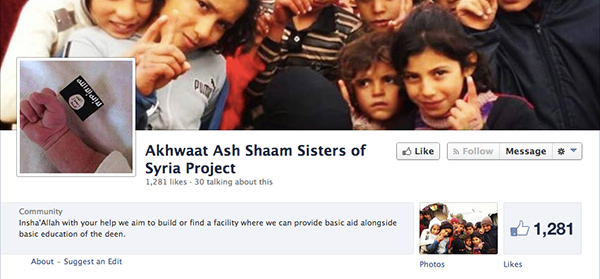
Other Facebook pages established and managed by the couple also prominently display ISIS flags.
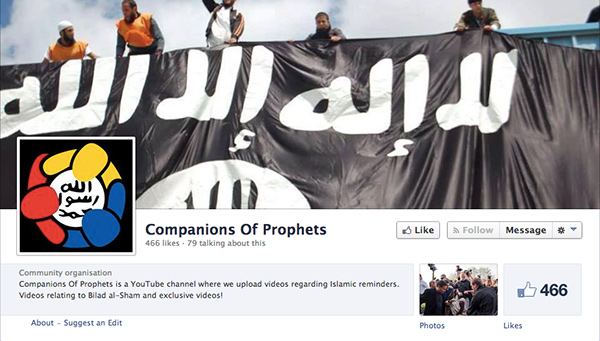
Posts found on the couple's Facebook pages include: videos glorifying jihadi fighters; praise for late Al Qaeda leaders such as Abdullah Azzam and Anwar Al-Awlaki; a number of statements denouncing "Yahoodi" [Jewish] oppression of Muslims; openly anti-Semitic posters; and calls for an Islamic state.
Although Channel 4 broadcast the footage of Sharif and his wife, it was Bilal Abdul-Kareem, an "American Muslim activist living in Syria," who filmed the interview itself. In 2009, it was reported that Abdul-Kareem defended the killing spree carried out by Major Nidal Malik Hasan, at Fort Hood in Texas, as an act against an enemy in a state of war.
The British Charity Commission is already struggling to keep track of charities that are moving money and people into Syria. Tackling the possible misuse of charitable initiatives for anti-democratic ideological purposes is made harder if the media continues to portray extremists as champions fighting against all odds.
Samuel Westrop
Source: http://www.gatestoneinstitute.org/4258/uk-jihadists-charity-workers
Copyright - Original materials copyright (c) by the authors.
Subscribe to:
Posts (Atom)