Saturday, September 20, 2014

Khaled Abu Toameh: Hamas and Fatah Already Fighting Over Gaza Funds


by Khaled Abu Toameh


"Armed robbery in broad daylight." — Palestinians, after Hamas "seized" $750,000 from Gaza bank.
Fatah accused Hamas of "squandering" $700 million of financial aid earmarked for the Palestinian victims of war. Fatah wants to ensure that the millions of dollars intended for the Gaza Strip will pass through its hands and not end up in Hamas's bank accounts. Relying on Fatah in this regard is like asking a cat to guard the milk.
The head of the Palestinian Authority's Anti-Corruption Commission revealed that his group has retrieved $70 million of public funds fund embezzled by Palestinian officials. Arab and Western donors need to make sure that their money does not end up (once again) in the wrong hands. Without a proper mechanism of accountability and transparency, hundreds of millions of dollars are likely to find their way into the bank accounts of both Hamas and Fatah leaders.

As efforts are underway to hold an international conference in Cairo for the reconstruction of the Gaza Strip in the aftermath of Operation Protective Edge, the two major Palestinian parties, Hamas and Fatah, are already accusing each other of stealing funds that were channeled to help Palestinian families.

It is not clear at this stage how much money has made its way into the Gaza Strip since the Egypt-brokered cease-fire was announced late August.

But it is clear by now that both Hamas and Fatah are engaged in a fight over who will control the funds and assume responsibility for the reconstruction of the Gaza Strip.

The war between Hamas and Fatah over the funds earmarked for the residents of the Gaza Strip is being fought over every penny and dollar. This is a power struggle in which the only losers are those Palestinians who lost their homes and family members during the military confrontation with Israel.

Hamas and Fatah know that hundreds of millions of dollars will sooner or later be allocated by Arab and Western donors for the reconstruction of the Gaza Strip. The two parties are determined to lay their hands on the funds, knowing that he who controls the money controls the people.

Both Hamas and Fatah are desperate for cash and are ready to do everything to enrich their coffers, even if that means robbing a bank.

This is exactly what Hamas did last week. Sources in the Gaza Strip said that Hamas security officers raided the Bank of Palestine in Gaza City's Rimal neighborhood and "seized" $750,000 in cash.

The sources said that the cash belonged to the Palestinian Jawwal Cellular Company. They said that the raid on the bank came on the pretext that the company had not paid all its tax debts to Hamas. Palestinians in the Gaza Strip described the raid as an "armed robbery in broad daylight."

The "armed robbery" came shortly after Fatah accused Hamas of "squandering" $700 million of financial aid earmarked for the Palestinian victims of the war. It is not clear where this large sum came from.

Fatah spokesman Ahmed Assaf claimed in an interview with an Egyptian TV station that the funds were donations from many countries. He said that Hamas collected the donations "in the name of children, women and the elderly under the pretext of rebuilding what was destroyed by Israel." The money, he added, did not reach its destination.

Assaf's charges are seen as part of a Fatah-orchestrated campaign to prevent donors from dealing with Hamas. Fatah wants to ensure that the millions of dollars intended for the Gaza Strip will pass through its hands and not end up in Hamas's bank accounts.

During the military confrontation, Fatah leaders in Ramallah issued a strong condemnation of Hamas. They said the Islamist movement was stealing relief aid dispatched to the Gaza Strip and distributing it among its followers in mosques.

But then who said that Fatah could be trusted when it comes to distributing financial aid? Relying on Fatah in this regard is like asking a cat to guard the milk.

The 20-year-old Fatah-dominated Palestinian Authority [PA] is notorious for its financial and administrative corruption.

Earlier this month, Rafik Natsheh, head of the PA's Anti-Corruption Commission, revealed that his department has managed to retrieve $70 million of public funds embezzled by Palestinian officials. He also said that his department uncovered 60 more cases of financial corruption in 2013.

But what is most notable is that some Fatah officials are now accusing their own supporters of stealing funds provided by the PA leadership to the Gaza Strip. A Fatah-affiliated news website revealed that Fatah leaders in the Gaza Strip have been distributing the funds among their family members and friends. The report said that Hamas officials also succeeded in laying their hands on the funds arriving from the office of the Palestinian Authority president in Ramallah.

A Fatah member in the Gaza Strip was quoted as saying, "A Palestinian Authority official bought chocolate for 300 Shekels ($90) while our men are being ignored and cannot afford to use public transportation or feed their children."

He and dozens of Fatah activists in the Gaza Strip wrote a letter to PA President Mahmoud Abbas, asking him to form a commission of inquiry into the embezzlement of financial aid meant for Palestinian families.

The rising tensions between Hamas and Fatah following the war do not bode well for efforts to achieve Palestinian "national unity."

Not only money: On Aug. 22, 2014, Hamas executed 26 Palestinians in Gaza who they claim "spied for Israel". Sources in Gaza revealed that some of the executed men belonged to Mahmoud Abbas's rival Fatah faction and had no connection with Israel. (Image source: Reuters video screenshot)

Some PLO leaders in Ramallah are now talking about a permanent split between the West Bank and Gaza Strip as a result of the Hamas-Fatah power struggle.

PLO Secretary-General Yasser Abed Rabbo said this week that the Gaza Strip was "closer than ever to being separated from the West Bank" due to the ongoing Fatah-Hamas rivalry.

However, what is at stake here is not only Palestinian "unity." Fatah and Hamas will continue to fight and quarrel over everything from financial to political and ideological issues. "Unity" is one victim of this power struggle. The other victim is the effort to rebuild the Gaza Strip and help its residents.

When they are not fighting over political and ideological matters, Hamas and Fatah are scrambling for money. Under the current circumstances, Arab and Western donors who are willing to contribute to helping the Palestinians in the Gaza Strip need to make sure that their money does not end up (once again) in the wrong hands. Without a proper mechanism of accountability and transparency, hundreds of millions of dollars are likely to find their way into the bank accounts of both Hamas and Fatah leaders.


Khaled Abu Toameh

Source: http://www.gatestoneinstitute.org/4716/hamas-fatah-gaza-money

Copyright - Original materials copyright (c) by the authors.

Ari Sofer: UK Pro-Israel Activists Demand Qatar Stop Funding Terror


by Ari Sofer


Activists challenge terror-sponsor Qatar's hosting World Cup; launch campaign with hard-hitting flashmob outside Qatari embassy in London.
 

Protesters outside Qatari embassy in London
Raya Cottrell
 
[Editor: The sign literally reads "No to Qatari funding of Terrorism"]

A coalition of British pro-Israel activists held a hard-hitting flash-mob protest against the Qatari government in London Friday, in what they say is just the opening salvo in their battle to force the oil-rich gulf state to end its funding of Islamist terrorism throughout the Middle East.

Activists from Sussex Friends of Israel (SFI) and the new-formed Israel Forum Task Force (IFTF) donned orange jump suits reminiscent of those seen in execution videos posted by the "Islamic State" (IS) terrorist group, and read an open letter to Qatari leader Sheikh Tamim bin Hamad Al-Thani outside Qatar's London embassy.

Qatar is the leading state sponsor of Hamas, the Islamist group which rules the Gaza Strip and whose charter calls for the destruction of the State of Israel and advocates murdering Jews as a holy duty.

Hamas's actions in Gaza - particularly its summary, public execution of political rivals - have been compared to those of IS by both Israeli leaders and Palestinian officials, and the choice of clothing was a not-so-subtle attempt to remind the public about the similarities between the two groups, organizers said.

"Hundreds" to demand end to Qatar World Cup plans

But the flash mob is just a taste of things to come; on Sunday, the two groups will be leading hundreds in a march demanding an end to Qatar's funding of terrorist organizations.

The rally - which will take place at 2 p.m. tomorrow outside the Qatari embassy on South Audley Street in west London - will seek in particular to highlight the controversial decision by world footballing authority FIFA to allow Qatar to host the prestigious World Cup in 2022.

There have been growing calls for the honor to be withdrawn unless Dubai cuts its ties with a range of radical Islamist groups, most notably Hamas.

"Together with Turkey, Qatar is the main financier of Hamas, the terrorist organisation responsible for launching nearly 4600 rocket attacks against Israeli civilians during the recent Gaza conflict," activists said in a joint statement. "The Hamas covenant calls for the destruction of the State of Israel, the introduction of Sharia law and the creation of an Islamic State 'from the Jordan River to the sea.' Hamas also used Qatar funds for the construction of tens of tunnels, each one costing $3 million (£1.85 million) to build."

"Qatar is also a safe haven for known terrorist leaders and for its support of the Egyptian Muslim Brotherhood, an extremist organisation instrumental in ousting President Hosni Mubarak during the Arab Spring. The organisation’s spiritual leader, Sheikh Youssef al-Qaradawi, uses Qatar as his base, as does Hamas leader Khaled Mashal," the statement added.

Indeed, although Qatar recently responded to international pressure by expelling several exiled Egyptian Muslim Brotherhood leaders, Qaradawi and Mashaal both continue to use Dubai as a base.

The statement also noted allegations that "wealthy Qatari individuals" have backed the Islamic State, also known as ISIS or ISIL, which has led a bloody campaign of ethnic-cleansing through Iraq and northern Syria.

Speakers at the event will include prominent media lawyer Mark Lewis, who uncovered the recent media phone-hacking scandal which rocked the British press.

"When there are so many football-related reasons and so many political reasons why Qatar is not fit to host the World Cup in 2022, ordinary people must stand up and protest the unification of corruption and terrorism," Lewis said. "It is wrong for football, it is wrong for freedom and it is wrong for FIFA."

Using slogans such as "Kick Terrorism out of Football" and "Qatar: Stop Funding Terrorism," organizers are determined to bring Qatar’s financial and political backing of global terror to the attention of both football fans and the wider public.

In what is being hailed as an early coup by campaigners, FIFA's president Sepp Blatter on Friday responded to growing calls online - led by SFI and IFTF - to condition Qatar's hosting of the games, saying soccer fans are "right" to demand that the "global footballing community" act ethically.

Activists believe such public pressure - which undermine Qatar's attempts to portray itself in the west as a "moderate" force - can bring results.

Such pressure is believed to have contributed towards Qatar's decision to expel seven Muslim Brotherhood leaders last week, and experts suggest that Dubai may be reconsidering its links to Hamas - the Brotherhood's Palestinian branch - as well.

"It’s about time that people woke up and looked at those who finance terror, and as such enable terror attacks, not just at the organisations themselves," says IFTF director Anat Koren, who is also the publisher of the British-Israel Alondon magazine and founder of Seret, the Israeli Film Festival held each year in London. "Qatar not only finances known terrorist groups but also harbors their leaders. Such a state cannot be allowed to host a world class event such as the World Cup."

Qatar owns a sizeable chunk of properties and assets in the UK, including the prestigious Harrods department store,  the former Olympic Village, the Shard building, no 1 Hyde Park (the world’s most expensive block of flats),  20% of the London Stock Exchange,  20% of Camden market, shares in Barclays Bank, Sainsbury’s  supermarkets and more.

Simon Cobbs, founder of SFI, said "football fans deserve better than Qatar as the host for such a prestigious  event, noting how "Hamas is committed to the destruction of the State of Israel and instating Sharia law in the region."

He also questioned how FIFA could guarantee that Israelis fans - or even players - would be able to attend the games in a hostile state.

"Given Qatar’s position as a wealthy banker of terrorism, we also have to ask the question if anyone with an Israeli stamp in their passport would be allowed to attend the World Cup. And furthermore, would an Israeli football team be able to enter Qatar?"


Ari Sofer

Source: http://www.israelnationalnews.com/News/News.aspx/185323#.VB2_9RZ6h-g

Copyright - Original materials copyright (c) by the authors.

Ari Yashar: One of Oldest Known Synagogues Seized by ISIS in Syria


by Ari Yashar


Jihadists looting ancient archaeological sites, including 244 BCE synagogue; officials warn 5,000 years of history being erased.
 
 
Wall fresco Dura Europos synagogue in Syria
Reuters
 
Islamic State (ISIS) jihadists not only threaten the current Middle East - according to antiquities officials in Iraq and Syria, the terror group threatens to erase 5,000 years of history and relics in upper Mesopotamia, including one of the earliest Jewish synagogues.

Much of northern Iraq and eastern Syria, which is rich in the archaeological remains of numerous ancient civilizations, is now under the iron fist of ISIS which has been destroying pagan idols as well as selling relics on the international black market to raise funds, reports Associated Press (AP).

Syrian Director-General of Antiquities and Museums Maamoun Abdulkarim says looting from archaeological sites in the country has gone up tenfold since early 2013, with ISIS seizing numerous important ancient sites.

Aside from destroying pagan statues from the Assyrian period in Tell Ajaja, Abdulkarim noted the 2,300-year-old city of Dura Europos has come in for particularly intense looting.

The ancient city lies near the Iraqi border on a cliff overlooking the Euphrates River, and has fallen into ISIS hands; satellite imagery from April shows numerous holes from looter digs littering the site.

Images show hundreds of people, including gunmen, taking part in the excavations from dawn until night in many cases. Abdulkarim notes dealers are present, and "when they discover an artifact, the sale takes place immediately. They are destroying entire pages of Syrian history."

One of the earliest known Jewish synagogues is located at Dura Europos along with numerous pagan temples and churches, making the digging particularly troubling.

The fate of the synagogue, which was discovered in 1932 and dated by an Aramaic inscription to 244 CE, remains unknown.

Meanwhile in Iraq Qais Hussein Rashid, head of the country's Museums Department, reveals that ISIS captured 1,800 of Iraq's 12,000 registered archaeological sites when they seized the northern city of Mosul and Ninevah province in June. They have since captured even more as they pushed south to Baghdad.

ISIS has control of four ancient cities, Ninevah, Kalhu, Dur Sharrukin and Ashura, which were capitals of the Assyrian Empire that arose around 2,500 BCE. In Kalhu, reliefs in the grand palace of Assyrian King Ashurnasirpal II from the 9th century BCE have been heavily looted to be sold on the black market.

Other casualties of the brutal Islamic group in the Mosul area were the tombs of the Jewish Biblical prophets Jonah and Daniel in July; Jonah's tomb reportedly dated from the 8th century BCE.

After destroying Jonah's tomb, thieves are thought to have dug into an unexcavated palace in Ninevah that was located underneath the tomb, according to Rashid who cited local antiquities officials still in Mosul.

The UN's cultural agency UNESCO has been taking steps to try and guard Iraq's relics, with Nada al-Hassan of UNESCO's World Heritage Center telling AP "we are very, very, very concerned that the situation could be aggravated in a way that causes more and more damage."


Ari Yashar

Source: http://www.israelnationalnews.com/News/News.aspx/185308#.VB3CsxZ6h-g

Copyright - Original materials copyright (c) by the authors.

Thursday, September 18, 2014

Ben Cohen: Will Oil Make or Break the Islamic State?


by Ben Cohen


Now, with the Islamic State's self-proclaimed caliphate having captured key oil wells in the Middle East this year, foreign oil has become an even more lethal financial weapon-of-choice for those seeking to destroy democracy and further escalate the War on Terror.
That President Barack Obama failed even to mention oil as a critical factor in the war against IS during his speech to the nation on September 10, is an omission both revealing and dangerous in terms of how his administration wants to depict the stakes involved in this latest confrontation with the jihadis.

America's failure to achieve energy independence over the last 30 years has resulted in exponential oil price increases that have hurt our nation. Trillions of dollars have left, and billions more continue to leave our economy to purchase oil from countries that seek our destruction, and to support madrassas [Islamic religious schools] that teach new Muslim generations how to hate -- and worse.

Now, with the self-proclaimed caliphate of the Islamic State [IS] having captured key oil wells in the Middle East this year, foreign oil has become an even more lethal financial weapon-of-choice for those seeking to destroy democracy and further escalate the War on Terror.

Recent reported developments: The Islamic State accelerated its rampage through northern Iraq at the beginning of the summer. Its terrorists quickly captured seven oil fields in the region with the capacity to produce 80,000 barrels of oil per day – assets worth, at international market prices, around $240 million per month.

The IS met virtually no armed resistance as it seized these fields. Indeed, two of them, Najma and Qayara, had already been abandoned as far back as February, when Sonangol, an Angolan company with a 75% stake in the fields, announced that its operations were no longer feasible because of the prevailing climate of insecurity.

Similar reports came from the other fields seized by IS. In early August, as IS terrorists captured the strategically vital Mosul dam, which provides water and electricity to the region, the Ain Zalah oil fields were taken with little resistance from the surrounding Kurdish peshmerga forces. Significantly, this particular seizure took place at the same time that the Kurdish political leadership was bemoaning the Obama Administration's reluctance to back them with weaponry, military advisers and air strikes. The White House had also attempted to prevent the Kurdistan Regional Government (KRG) from separately trading its own oil, in a bid to arrest the disintegration of Iraq as a federal state.

Kurdish peshmerga soldiers patrol an oil installation on the outskirts of Kirkuk, July 2014. (Image source: VOA video screenshot)

At the Ajeel oil fields near Tikrit, an on-site engineer reported that IS terrorists overran the wells -- which produce 28,000 barrels of oil per day -- as part of a coordinated onslaught against military and oil installations elsewhere in the locale. A few days after Ajeel fell to IS, a local official, Shallal Abdul Baban, reported that smuggling operations had begun. "People who buy the oil use paved roads controlled by militants and take it through the cities of Kifri or Qadir Karam to civil refineries or across the Iranian border," Abdul Baban said.

Despite these battlefield successes, IS remains some distance from Qatari or Saudi levels of oil wealth. Cut off from the international oil market, where a barrel of oil is valued at around $100, the terrorists have no choice but to sell for cash or barter their oil at much lower prices, using the services of Turkish, Iraqi and Iranian middlemen to collect the revenues. Additionally, the oil fields under IS control are, in terms of capacity, extremely modest when compared to the Kurdish-run oil fields around Kirkuk in the north and the Iraqi government-run oil fields around Basra in the south.

As the Wall Street Journal reported at the end of August, the Islamic State sells a barrel of heavy oil for between $26 and $35. A separate report from the London-based Syrian Observatory for Human Rights estimates the price per barrel even lower, at $12. All told, oil analysts calculate that revenues from Iraqi oil fields currently net the terrorists between $1-3 million per day: that is enough to shore up its Shari'a-law based reign of terror, but hardly the sum needed to create a functioning state capable of defending itself from the robust counter-attacks launched by Kurdish and Iraqi forces over the last few weeks.

IS's fragile jurisdiction over its Iraqi oil properties -- Ain Zalah, for example, was reported to have been retaken by the Kurdish peshmerga at the end of August -- is offset, however, by the iron fist it wields in neighboring Syria, where around 60% of the oil fields remain under IS control. Among those fields is Al Omar, which produced around 30,000 barrels per day prior to the outbreak of civil war in 2011. The fall of Al Omar was a key consideration in the decision of fighters previously associated with rival Islamist Nusra Front to throw in their lot with the IS instead. Now, IS is reported to be producing and smuggling approximately 50,000 barrels of oil per day in Syria alone, an amount worth $2 million per day in addition to its monetary gains in Iraq.

As a consequence, IS still retains the potential seriously to disrupt the oil exports upon which the Iraqi economy rests. A successful offensive in the south could significantly multiply the revenues available to the aspiring caliphate. Given the growth-potential for Iraq's oil industry – projected to reach 6.1 million barrels per day by 2020 – both the human rights and national security implications can be judged as disastrous.

For the moment, though, there are three main factors that can hamper the progress of the IS. First, further gains by Kurdish and Iraqi forces against the already-stretched IS will obstruct its ability to send trucks carrying oil into neighboring countries. Second, oil fields require maintenance. Most of the fields and equipment now under the control of the IS are old and decaying; without further investment, production levels will decline.

Finally, the oil with which IS may have intended to build its caliphate could turn out, ironically, to be its undoing. As IS's footprint has grown larger, its dependence on oil revenues has increased, at the expense of other revenue streams such as kidnappings (after the brutal decapitations of journalists James Foley and Steven Sotloff, Western governments may be growing reluctant to pay ransoms), as well as the illicit trade in ancient religious artifacts, and extortion operations against those populations suffering under IS rule (non-Muslim minorities are apparently now forced to pay the special jizya tax to the terrorists.)

Hence it is crucial for the U.S. to provide significant Western assistance to forces, especially the Kurds, who are taking on IS directly. The more manpower and cash the IS is forced to spend to protect its oil fields, the more vulnerable their supply lines stretching from Syria into Iraq become.

Of course, IS can always follow the example of the late Iraqi dictator Saddam Hussein, who set hundreds of oil wells in Kuwait ablaze when his occupation forces were expelled from the Gulf state in 1991. Indeed, when Kurdish peshmerga forces recaptured the Ain Zalah field, the retreating IS terrorists set three wells alight. That partly explains why the Kurds and their allies are wary of any military measures that might provoke the IS into a wider "burn-and-flee" maneuver.

That possibility should also compel western policy-makers to understand that the coming weeks will be critical to ensuring that the Islamist rogue state does not become a petro-state as well. That President Barack Obama failed even to mention oil as a critical factor in the war against IS during his speech to the nation on September 10 is an omission both revealing and dangerous in terms of how his administration wants to depict the stakes involved in this latest confrontation with the jihadis.


Ben Cohen

Source: http://www.gatestoneinstitute.org/4712/islamic-state-oil

Copyright - Original materials copyright (c) by the authors.
Sarah N. Stern: Hatred Masquerading as Scholarship in the Classroom


by Sarah N. Stern


1508654364
“[T]hey will bomb Gaza back to the Stone Age they said, and that they did–and yet there are very few spots on planet earth today nobler to the human spirit of resistance to tyranny and injustice than Gaza–now held like a shining jewel on the loving ring of humanity around the globe–I kiss that noble ground and hold it dearer than cities full of ignoble postmodern architecture built on the stolen land of other people.”

– Hamid Dabashi, Hagop Kevorkian Professor of Iranian Studies and Comparative Literature at Columbia University, referring to Israel’s Operation Protective Edge; Facebook, August 6, 2014. (link to source)

The above quote, replete with biases and omissions, does not simply represent the viewpoint of one lone professor. It represents an extensively held perspective that has become a rigid orthodoxy that permeates through many of our nation’s Middle Eastern Studies Departments. This bias is being spoon-fed to our nation’s college students and sold to them as scholarship. As American parents who save for years for their youngsters’ college tuitions, many of us should be outraged that this bigotry is masquerading as solid erudition to our youngsters. As American citizens, we should be outraged that this sort of thinking is being subsidized by the American government in the form of Title VI grants to universities, and is shaping the thinking of our current and future American thinkers and leaders.

In fact, so blatant are the biases of the program, that 218 scholars from Middle Eastern Studies programs across the country, ranging from Columbia University and New York University on the East, the University of Chicago University of Illinois, and Michigan State University in the Mid-West to University of California in Los Angeles, Berkeley, Davis, Irvine, San Diego, Riverside, Santa Cruz, and hundreds of points in between, have all recently signed a petition for an academic boycott of Israeli Universities and any joint program with Israeli scholars.

How did this come about?

Title VI of the Higher Education Opportunities Act, which had formerly been known as The National Defense Education Act was implemented in 1958, during the height of the Cold War, in order to ensure that we were prepared to confront the challenges of the Soviet threat.  At that time, it was felt that our students were woefully ill-equipped to be competitive in the world against the Soviets in their knowledge of foreign languages and regions. It was then determined that certain universities were to be granted sizeable sums of money from the federal government in order to establish and help maintain regional or area studies centers, such as African Studies, Asian Studies, Latin Studies, and Middle Eastern Studies etc. in order to ensure that our nation had a generation of well-trained regional experts to meet the national security and defense challenges arising out of the former Soviet Union.

Our government therefore provided tax payers’ dollars to give birth to a regional studies industry in order to meet a specific national and security need. However, with the ensuing years, the original legislative intent of Title VI was totally ignored, and the universities simply took the money without any sort of oversight.

Universities have always been the vanguard of the latest political fashions and trends. The very first institutions in Germany to willfully adopt Nazism were the universities. Indeed, Martin Heidegarr who was a famous philosopher and a Nazi sympathizer, fired the James Husserl, the father of phenomenology because he was a Jew.

Many products of the ‘70s, who had been profoundly affected by the anti-Viet Nam war movement, have ended up teaching on college campuses, where a rigid liberal orthodoxy has set in and dominated the classroom instruction.  This was reflected in a classic survey by Prof. Robert Lichter of George Masson University, Professor Stanley Rothman of Smith College and Professor Neil Nevitte of the University of Toronto,  which was based on a survey of 1,643 full-time faculty at 183 four-year schools.

The survey found that 72 percent of those teaching at American universities and colleges are liberal and 15 percent are conservative, says the study being published this week. The imbalance is almost as striking in partisan terms, with 50 percent of the faculty members surveyed identifying themselves as Democrats and 11 percent as Republicans. In elite universities, the disparity is even greater, with 87 per cent of faculty describing themselves as “liberal” and only 13 per cent describing themselves as “conservative.”

Another study that came out in 2012 by Professor Yoel Inbar and Professor Jorris Lammers, indicated that more than one third of the respondents said that they would discriminate against a conservative candidate for a faculty position. One respondent openly admitted that “if faculty members could figure out who was conservative, they would never have hired them.”

Unfortunately, the Middle Eastern Studies programs have enthusiastically embraced this liberal orthodoxy as a knee-jerk sympathy for the Palestinian cause, as the under-dog. Most classes reflect no appreciation for the struggles of the state of Israel, which they often describe in the most distorted, vulgar and hateful of terms, as “racist,” “imperialist,” “colonialist,” even as “war criminals” and “Nazi-like.”

Much of what passes for scholarship in the Academy in the United States has emanated from a simplistic treatise by the late professor of comparative English literature of Columbia University Edward Said, entitled, “Orientalism.”  “Orientalism,” which came out in 1978, is considered a foundational text of post-colonial theory that revolutionized the field. It tends to regard as suspect any scholar who, himself, is not a native of the Arab world. So that means scholars such as Bernard Lewis or Efraim Karsh are castigated as “orientalists” who have no real understanding of the field, and Edward Said, and his disciples, such as Joseph Mossad and Rashid Khalidi, are considered to be the genuine experts.

Much of the scholarship is oriented along this rigid, one-sided political agenda and is of an inferior quality, replete with errors of omission and commission. Students who are Jewish or whose beliefs do not conform to this agenda are often made to feel marginalized, as though their beliefs are antiquated and bigoted. Many students have reported being singled out for harassment in the classroom by professors when they challenge any of these ideas.

On the campus, this pseudo-scholarship has given an intellectual patina for the ancient hatred of anti-Semitism. We see this every year as the “Divest-Boycott-Sanctions,” (BDS) movement grows, and “Palestinian Solidarity Week” or “Israel Apartheid Week” grows in popularity on our nations’ college campuses.

A one-sided political agenda, at taxpayer’s expense, has often become a paltry substitute for a good, solid education in regional studies. Many of this is reported in the late Dr. Gary Tobin’s excellent book, “The Uncivil University: Politics & Propaganda in American Education.”

In many of these departments, not only is Israel portrayed as the cause for all the problems in the Middle East, the United Sates is depicted as “the mother of all ills” in the world. Many students who are graduates of Title VI programs tend to be more sympathetic to some of our nation’s foes than to their own nation. It is almost reflexive to blame America first in these programs for our “colonialism” or “imperialism.”

They are equally likely to blame Israel first when anything, whatsoever, erupts in the Middle East, including the Sunni-Shiite conflict, or ISIS taking over parts of Iraq, saying that this is “the underlying root cause of the problem,” and “our relationship with Israel is the source of our resentment, overseas.”

Of course, the more one studies the Middle East, the more one realizes that this is wholly ludicrous; that the region is replete with many ancient, tribal and atavistic rivalries that are not easily remedied. Yet, when one speaks to most graduates of Middle Eastern programs, they predictably pin the blame for everything that goes awry in the Middle East on this, or as a minimum say, “We will be more likely to win the favor of the parties if we get to the root cause, if we first resolve the Israeli-Palestinian dispute.”

One doubts that it is ever mentioned in the classroom that the Palestinians have been taught to despise and to vilify the Israeli, the Christian and the Jew, and that since 1993, they have been fed a steady diet of anti-Semitism that has metastasized like a cancer throughout the Palestinian body politic. When one of the parties can’t even say they recognize Israel’s right to live as a Jewish state, without choking over the words, that makes the odds of resolving this conflict rather low.

Almost as reflexively, when the United States is forced to enter into any conflict, the United States is almost reflexively blamed in the university classroom for meddling and inflaming the region. President Barack Obama’s policies seem to be almost wholly reflective of this sort of rigid analysis

One readily sees therefore, how the original intent of the Title VI legislation has been turned on its head. By now, many of the students who are graduates of these programs have already entered into positions of leadership, and one does not have to search any further than these programs when one fears that America is in a period of decline in our international standing in the world. Practically any step the United States takes as a moral leader is automatically looked upon with cynicism.

What makes this even more pernicious is that in order to get the Title VI grant from the government, the university professors in these departments must conduct “teacher training workshops” for teachers of kindergarten through twelfth grade, ensuring that these biases get transferred to our most vulnerable and impressionable youngsters who lack critical thinking skills.

From 2004 through 2008, I had been privileged to work with two of the most renowned experts in the field, Martin Kramer, author of many books including the seminal study on Title VI centers, “Ivory Towers on Sand: The Failure of Middle Eastern Studies in America,” and Stanley Kurtz, himself a former scholar of Indian Studies and renowned columnist for National review Online, in order to work with Congress to correct this.

We were successful in passing certain amendments to Title VI in 2008. These included a statuary requirement for: 1.) The Secretary of Education to develop a survey from a wide range of Federal agencies to find out what it is that they need for expertise in world regions and languages 2.) The Secretary of Education is to assist the universities who were recipients of Title VI funding in developing a survey to students to determine their areas of employment or post-graduate study. This survey should be administered by the university once every two years, and the results of the survey should be reported to the Secretary of Education. And most importantly: 3.) Each university which receives Title VI funding is to reflect “an explanation of how the activities funded by the grant will reflect diverse perspectives and a wide range of views and generate debate.”

The funding for this program is up for congressional renewal this year. From our discussions with educational congressional staffers on Capitol Hill, it appears as though it will automatically be put on “continuous resolution,” (which means, that because they don’t have the time or the inclination to take it up, the program, and its funding will remain in place).

However, it does not appear that any of these legally mandated requirements have been taken seriously. There has been zero congressional oversight, zero accountability and zero transparency to the revisions in the law that I had helped to enact.

I strongly suspect that all of these requirements, particularly the one which asks the university to describe what steps they have taken  “to encourage diverse perspectives,” are wholly glossed over, and that the DOE is simply rubber-stamping any university that applies for a grant from this program.

In the meantime, the use of our taxpayers’ dollars to fund these programs which trade flimsy propaganda as a paltry substitute for firm scholarship continues unabated. Much of this has simply served to give an intellectual patina to the ancient virus of antisemtism, a virus that has survived centuries of mutations, and for which there is no known antidote.


Sarah N. Stern is Founder and President of EMET, The Endowment for Middle East Truth, an unabashedly pro-American and pro-Israel think tank and policy shop in our nation’s capital.

Source: http://www.frontpagemag.com/2014/sarahnstern/hatred-masquerading-as-scholarship-in-the-classroom/

Copyright - Original materials copyright (c) by the authors.

Ilan Berman: Putting Islamic State in Proper Context


by Ilan Berman


Quite suddenly, all eyes are riveted on the Islamic State group. Ever since its self-proclaimed "emir," Abu Bakr al-Baghdadi, declared the creation of a new "caliphate" during a speech in Mosul, Iraq, in June, his group has become global Public Enemy No. 1.

Islamic State is "beyond anything that we've seen," both in terms of its ambitions and its capabilities, Defense Secretary Chuck Hagel warned last month. Similar sentiments abound within the global counterterrorism community, which has made Islamic State a near-singular focus in recent weeks. At the recent summit of the International Institute for Counter-Terrorism in Herzliya, one of the pre-eminent gatherings of its kind, Islamic State was the dominant topic of discussion over four days of meetings and workshops. Iran and Hezbollah, both of which remain pressing security challenges for the Jewish state, received remarkably short shrift. And Russia's actions in Ukraine -- which U.S. and European leaders have termed a type of "hybrid" warfare that has significant implications for the West -- got nary a mention.

All of this attention has served to inflate the image of Islamic State, positioning it as the next great adversary of the West. Often overlooked in this discourse, however, is the fact that Islamic State suffers from some real limitations and strategic constraints -- vulnerabilities that need to be understood and exploited as part of any serious Western strategy.

First, Islamic State's size is relative, in both human and territorial terms. The CIA now estimates that Islamic State could have upwards of 31,000 men under arms. That number makes it one of the largest terrorist groups on record. (By way of comparison, the State Department's counterterrorism bureau gauges al-Qaida's "core" and its two most potent affiliates, al-Qaida in the Arabian Peninsula and al-Qaida in the Islamic Maghreb, to number in the low thousands -- although, when indirect affiliates such as Nigeria's Boko Haram and Indonesia's Jemaah Islamiyah are factored in, the number is considerably higher.)

As impressive as this is, however, it is still far too meager to administer the group's current holdings. Experts now estimate that the group controls territory straddling Iraq and Syria exceeding the size of the state of Maryland. Controlling such a land mass requires massive manpower and materiel -- something that Islamic State, even with its growing ranks and current, deep pockets -- will find it difficult to amass and sustain.

Second, Islamic State is less popular than commonly understood among the constituency that really counts: Islamists themselves. As counterterrorism expert J. M. Berger recently pointed out in Foreign Policy, with a few notable exceptions, Islamic State seems to be experiencing considerable difficulty in wooing other significant jihadist groups to its cause despite its battlefield successes. Al-Qaida, in other words, remains the ideological center of gravity for Islamic militants, at least for the moment. That is perhaps why, rather than consolidating control of the territory it already possesses, the group is now actively taking the fight to ideological competitors like the Nusra Front in Syria as a way of burnishing its brand.

Third, there is good reason to believe that the current force strength of Islamic State is "soft," and could diminish quickly. The group may have become a magnet for foreign jihadists eager to fight in the next great holy war, but the growing administrative and policing responsibilities that it will need to assume in the weeks ahead may not appeal to many of these zealots. Nor will all of them stay and fight to the end if Islamic State begins to sustain serious battlefield reverses as a result of U.S. and coalition military operations. As a result, an attrition of forces -- perhaps even a significant one -- is reasonable to expect in the weeks ahead.

None of this means that urgent action is not needed. Like a rising tide, Islamic State's successes so far have elevated its status among extremists the world over. Denting the group's mystique and appearance of invulnerability is therefore key to eroding its global standing. Moreover, the longer al-Baghdadi's "caliphate" remains in existence, the easier it will be for his followers to frame Western action against it as a new crusade, or a civilizational conflict pitting the West against Islam.

For these reasons, time -- and determination -- remains of the essence. But the United States and its allies do themselves no favors by making Islamic State out to be a more formidable foe than it actually is. Just like al-Qaida, the organization from which it sprang, Islamic State has real vulnerabilities that can and should be leveraged.


Ilan Berman is vice president of the American Foreign Policy Council in Washington.

Source: http://www.israelhayom.com/site/newsletter_opinion.php?id=10011

Copyright - Original materials copyright (c) by the authors.
Lawrence A. Franklin: Children as Suicide Bombers in Islamic Countries


by Lawrence A. Franklin


One Pakistani recruiter of child suicide bombers describes these children as "tools provided by God."
Another Muslim cleric in a madrassa [Islamic boys' school] describes child suicide bombers as "a gift from Allah that we have an unlimited number willing to be sacrificed to teach Americans a lesson."
Using children as suicide bombers will stop when... they stop "condoning the killing of innocents."

The most unconscionable form of child abuse is perhaps the least addressed by human rights organizations: the recruitment and indoctrination of children by jihadi extremists who transform them into suicide bombers and child soldiers.

Hamas's intentional targeting of Israel by missiles this summer from within densely populated neighborhoods of Gaza filled with Palestinian children is the most callous form of child-abuse yet devised.

During the recent hostilities between Hamas and Israel, media focus remained on the number of civilians -- especially children -- killed in Gaza. There was almost no mention, however of the cynical intent by Hamas to draw Israeli fire on its own people.

This deliberate infliction of harm and death on one's own populace was likely designed to win the propaganda war in an attempt to demonize Israel in the court of world opinion.

The absolute disregard by Hamas of its own citizenry underscores the brutal nature of this terrorist sub-state. It also raises the question of how, given the opportunity, Hamas would treat Israeli non-combatants. Actually, that can already be seen in the kidnapping and murder of three Jewish boys in Israel -- followed a few days later by intense rocket fire -- which precipitated the recent Gaza War. Hamas's apparent tendency to exploit the lives of innocents should not surprise: Islamic radicals seem to have a long history of abusing children to advance their goals.

Just recently, for instance, there was the mass kidnapping by the Islamist terrorist group Boko Haram of young girls from their school in the northeastern Nigerian state of Borno -- an event covered, at least for a while, by the media. Before that, there was there was the attempted murder of the 15 year old Malala Yousafzsai, the outspoken Pakistani girl shot and wounded in the head by the Taliban because she wanted an education.

Where is the reporting, however, on the approximately 500 honor-killing murders of young girls and women in Pakistan each year?[1]

Apart from these spectacular events, if the media took a more methodical look at the daily crimes against children in the Islamic world, one might see the kidnapping of young boys and girls who are transformed by their terrorist abductors into warriors, sex slaves and often suicide bombers. While the widespread use of child soldiers, particularly in African countries has received prominent coverage by human rights organizations, the abuse of Muslim children in the same fashion is, inexplicably, under-reported.[2]

It is possible that the young girls kidnapped in Nigeria are also undergoing aspects of the indoctrination program mentioned above, if they are not already being married off to members of Boko Haram or sold as slaves. Similar kidnappings of young people occur on a daily basis in countries such as Pakistan.[3]

Sometimes the media attributes the employment of suicide bombers as a weapon of war to the "desperate" nature of an out-matched resistance force or to merely just another "normal" form of asymmetrical warfare. This reasoning is usually accompanied by commentary that underscores "the need to address the root causes of terrorism," such as poverty, unemployment, hopelessness, and political oppression.[4]

On occasion, some commentators also offer a theological justification for the use of children as suicide bombers. One Pakistani recruiter of child suicide bombers describes these children as "tools provided by God."[5] Another Muslim cleric at a madrassa [Islamic boys school] in Lahore, Pakistan refers to child suicide bombers as "a gift from Allah, that we have an unlimited number of youngsters willing to be sacrificed to teach Americans a lesson."[6]

There seems to be an unsettling ease about children in Islamic societies being duped into becoming suicide bombers -- starting with the environment in which the children are reared. The media seem comfortable not to report on the content of the textbooks in elementary level schools, particularly on the Arabian Peninsula and in Pakistani madrassas. Textbooks there, as in the Palestinian territories, are often are laced with hateful language describing Christians and Jews, as well as non-Muslims in general.[7] These textual references to "infidels" -- or any non-Muslim, or often even any Muslim not of one's proclivity -- are reinforced by vituperative sermons delivered by extremist Imams every Friday in mosques. Muslim children are taught to feel victimized by the West. Children are instructed that Islam is under a state of siege and must be resolutely defended even at great cost. It is a religious worldview that plays into the hands of manipulative recruiters.

The recruitment process of child candidates for suicide bombing missions is sophisticated and nuanced. Initially, a "spotter" will select a youngster out of a group for closer scrutiny. A "watcher" will be assigned to observe the daily routine of the child. The boy's family will be "checked out" to determine its probable reaction to its child's potential recruitment. If nominated, the child will usually be given a number of reliability tests. The nominee, for instance, may be assigned to report on the daily activity of a suspected political or religious adversary. The boy might be ordered to visit a mosque more frequently, especially at prayer times. Finally, the child will be encamped in land controlled by the terrorist group where he is placed under the "protection" of an older recruit.[8] So begins the isolation from parents, siblings, and the friends "on the block." His trainers, spiritual guide, and fellow martyr candidates become his new and constant companions and his surrogate family.

Some camps might require a child to perform a prayerful vigil watch even before the dawn prayer[9] -- a practice comparable to the chapel vigils that squires performed before being granted knighthood in medieval Christian Europe. The young recruit is expected to pray five times a day, the norm in Islamic societies.[10] In the late morning the recruits will be familiarized with various small arms, rudimentary surveillance techniques, and taught to operate different types of motor vehicles. The young recruits' free time will no longer be taken up by so-called decadent Western-produced TV shows and computer games. They will watch DVDs of Jihad operations conducted by their fellow combatants against infidel troops who have invaded Muslim countries such as in Iraq and Afghanistan.

Instructors in suicide-bomber training camps, run by al-Qaeda or Afghan Taliban terrorist networks in North Waziristan, Afghanistan, repeatedly reinforce the propaganda themes of sacrifice, heroism, and spiritual rewards, which they allege will be the blissful fate of those soon to be martyred [11] -- a psychological manipulation designed to exploit the young male egos of the recruits

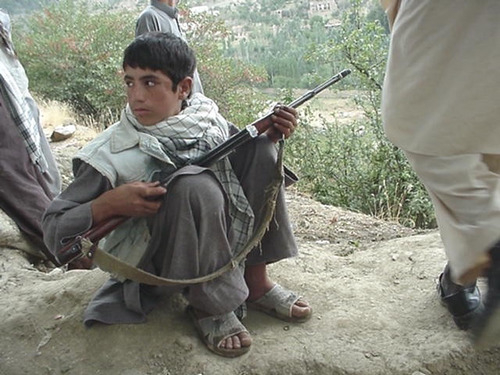
A child soldier in Afghanistan, 2004. (Image source: Robin Kirk/Flickr)

Eventually, the mental isolation and inculcated sense of purpose succeeds in producing an ideologically committed terrorist acolyte who buys into the fantasy painted for him by the recruiter to desire the alleged rewards associated with martyrdom[12] -- perhaps being immortalized by the posting of his picture in his old neighborhood

The young recruit may have been talked out of his knowledge of the finality of death, or he may just be captivated by the glory, the promise of Paradise and financial security he will gain and, he might imagine, how his family will love him even more for such a gift. He probably does not even realize what harm he is doing to his victims: he has probably been taught that if murder is committed to further the cause of Islam, it is good. Daily lectures from spiritual guides will inform the recruits how much honor their sacrifice will bring their families. They will be told that upon their martyrdom, they will be granted immediate arrival in paradise. The recruits will be instructed that once in heaven they will be able to bargain with Allah for the salvation of their family members and friends.[13]

The harsh reality is that this form of child abuse snuffs out the life of a son as well as the victims who also are mourned by family and friends. Child abuse by suicide bombing will decrease only when humanity condemns this type of infanticide as abuse of the human rights of the child, as well as the perverse religiosity that justifies it. Using children as suicide bombers will end, as Golda Meir said, "when they love their children more than they hate us,"[14] and when they stop "condoning the killing of innocents."


[1] Jihad Watch Robert Spencer 2/15/04. Catholic Culture.org blog quotes Pakistani Bishops' Justice and Peace Commission as claiming that about 700 Christian and 300 Hindu girls are kidnapped each year. See Fides News Service, 4/10/14.
[2] According to West Virginia University Professor of Health Sciences Dr. Muazzam Nasrullah, more than 500 women are killed each year. He suggests that the figure is official but there are many which are not reported.
[3] Pakistani Human Rights Commission Chairwoman Zohra Yusuf stated that in 2012, 913 young women were murdered in Pakistan under the rubric of "kala-kali," Punjabi slang for honor killing. Some of these killings are ordered by independent tribal or Sharia Courts. Often male members of families take the initiative in these murders, with only suspicion or accusation serving as justification.
[4] Abdellah Tourabi editor of the Moroccan weekly TelQuel who is an expert on Islamist Movements praises the film "Horses of God" which traces the path of two suicide bombers by commenting: "The reason I like this film is because it lingered on the process; these people didn't just carry out the attacks because they were poor but because of the whole ideological process behind it." AP: 21 May 2014.
[5] "Taliban Child Recruitment" by Sharmeen Obaid-Chinoy. The Independent. 26 May 2014.
[6] "The Making of Pakistan's Suicide Bombers" by Kalsoom Lakhani. CTC Sentinel: Combating Terrorism Center at West Point. 3 June 2010. pp. 2-3.
[7] Nina Shea of Freedom House observes that hatred towards Christians and Jews remains a staple of Saudi Arabia's public education system. "This indoctrination begins in the first-grade texts and is reinforced and expanded each year, culminating in the 12h grade text that (the student's) religious obligation includes waging jihad against the infidel to spread Islam." Washington Post, 21 May 2006. p.B1.
[8] Combating Terrorism Center (CTC), West Point, New York. "Insight Into a Suicide Bomber Training Camp in Waziristan" by S.H. Tajik. CTC Sentinel: 3 Mar 2010.
[9] Ibid. The night vigil is called the tahajjud.
[10] Prepubescent children are not expected to pray five times a day. However, in suicide bomber training camps the candidates are instructed to pray at the normal times: Fajr: pre-dawn, Zuhr: noon, Asr: mid-after-noon, Maghrib: just after sunset, and Isha: after dark night prayer.
[11] Taliban Child Recruitment by Sharmeen Obaid-Chinoy. The Independent, 26 May 2014.
[12] Abdellah Tourabi, Editor of the Moroccan Weekly TelQuel.
[13] "Failed Suicide Bomber Tells of Love of Martyrdom", New York Times, 6 July 2002. Many notes left behind by suicide bombers address their doubts whether some of their relatives would have been able to reach Paradise on their own unless assisted by their act of martyrdom."
[14] Golda Meir, the fourth Prime Minister of Israel uttered these words at a 1957 National Press Club Meeting in Washington D. C. See also A Land of Our Own: An Oral Autobiography, 1973, p. 242.


Lawrence A. Franklin

Source: http://www.gatestoneinstitute.org/4701/child-suicide-bombers

Copyright - Original materials copyright (c) by the authors.