Tuesday, July 16, 2024

The Power of Courage - Christopher Roach


by Christopher Roach

Inches from death, Trump’s mind remained on his mission, and he was conscious of the way the images of him would affect the campaign. This kind of physical courage cannot be faked.


The iconic photo of Donald Trump standing tall and defiantly after an attempted assassination speaks volumes. It reminds the whole world that Trump is a fighter. In his case, it is more than a metaphor, as “fighter” is for most of the political class. He showed real physical courage, and this cannot fail to impress.

As society has gotten more modern and organized, physical courage has become less necessary and less valued. Physical ability in general, such as the brawn and endurance required to be a cowboy or coal miner, doesn’t have much to do with the ability to analyze Excel spreadsheets, run a cash register, or do any number of office jobs. Softer skills are in higher demand and are rewarded accordingly.

We are a wealthy and safe society, but also an antiseptic and, in some ways, inhuman one. Our nature does best with purpose and hardship. The modern quest for comfortable self-preservation is a philosophy of life fit only for an amoeba.

The overreaction to COVID in particular was a testament to the recent, feminized obsession with safety, which downplays the value of risk-taking and enjoying life. When the virus arrived, the people in charge reminded us that they think we’re merely vulnerable and stupid toddlers. At the same time, they showed us that they themselves are cowards in the face of risk, willing to destroy the economy, religious freedoms, and our health in an impossible quest to eliminate a highly communicable disease. Schoolmarms like former CDC head Rochelle Walensky and weasels like Anthony Fauci became avatars of our decadent, dishonest, and cowardly ruling class.

While physical courage never fails to impress, during difficult times, the esteem of physical courage particularly reasserts itself. In the wake of the 9/11 attacks, firemen and other first responders were back in style, displacing the wealthy and well-dressed “masters of the universe” on Wall Street. When the Twin Towers were burning, the order of things became inverted, and now brave working-class men willing to walk into burning buildings were calling the shots and saving the office workers.

This is also the reason, particularly in the era of the all-volunteer military, that our service members have always been held in high regard. Their value does not depend so much on the use to which they are put. Americans have fierce disagreements and a lot of criticism of our foreign policy. But the willingness to risk one’s life over and over again is something that onlookers admire, not least because this is a risk pursued voluntarily.

Trump’s courage extends beyond the moment caught on camera. His candidacy and post-presidency all exemplify, if not physical, then moral courage, including high levels of commitment and resilience. If other politicians come into office poor and leave wealthy, Trump’s experience has been quite the opposite.

By becoming president, he has lost a lot of money and been subject to constant attack, beginning with illegal FBI surveillance of him during his campaign in 2016, the hounding and stress of false Russian collusion allegations, insubordination by senior military and civilian leaders, and two impeachments. Not merely taking a financial loss, he has endured lawfare on a grand scale, including scurrilous attacks on his reputation, a baseless civil judgment against his businesses, and four simultaneous criminal prosecutions.

Even under this degree of pressure and attack, Trump did not quit and did not waver. In times of stress, he remains cognizant that his reactions are part of a broader performance. Such self-consciousness about the performative aspect of one’s actions and reactions is, in fact, an important part of leadership. That is to say, a leader must be aware of his reactions to events and how his supporters’ morale will be affected by such reactions. Trump could have gone passively with the Secret Service, ducked on his own, or panicked. Instead, he demanded to walk out under his own power and shook his fist defiantly, blood streaming down his face, yelling, “Fight! Fight! Fight!”

His supporters, understandably rattled by the incident, cheered wildly. So did his many millions of supporters around the country. It was all very in character, turning a disturbing lapse of security into a demonstration of great physical courage under fire, literally.

Trump’s reaction to the shooting reminded me of documentary footage I saw a long time ago, back when the History Channel actually taught history, involving France’s larger-than-life 20th century leader, Charles de Gaulle. It was important for de Gaulle that his Free French Forces be the tip of the spear for the allied liberation of Paris. The Supreme Allied Commander, General Eisenhower, with his strategic and diplomatic acumen, agreed to this request.

The Free French Forces ended up capturing Paris so quickly after the breakout from the Normandy Beachhead that a handful of German forces and Vichy collaborators remained in the city. During an impromptu victory parade, de Gaulle and the crowd were subject to shots from snipers. When everyone else ducked, ran for cover, or cowered, de Gaulle stood tall, not even so much as flinching. He went on to become a popular and polarizing leader of postwar France.

In our highly regulated and rationalistic age, we sometimes forget the importance of emotions and the primitive gestures that have demonstrated leadership ability (or its absence) since time immemorial. Even today, the best leaders remain sensible of this type of language that communicates powerfully and without words.

Trump is a master of the show and a man of masculine instinct in the age of the verbose blockhead. Inches from death, Trump’s mind remained on his mission, and he was conscious of the way the images of him would affect the campaign. This kind of physical courage cannot be faked, and for a campaign that was already doing well, it now appears unstoppable.


Christopher Roach is an adjunct fellow of the Center for American Greatness and an attorney in private practice based in Florida. He is a double graduate of the University of Chicago and has previously been published by The Federalist, Takimag, Chronicles, the Washington Legal Foundation, the Marine Corps Gazette, and the Orlando Sentinel. The views presented are solely his own.

Source: https://amgreatness.com/2024/07/16/the-power-of-courage/

Follow Middle East and Terrorism on Twitter

Top police group blasts Secret Service for blaming local cops for Trump assassination attempt - John Solomon


by John Solomon

FOP warns criticism will be counterproductive, especially with so many campaign events that will require local, state and federal officials to cooperate.


The nation’s largest police group on Monday night blasted the Secret Service for trying to shift blame for the weekend assassination attempt on former President Donald Trump in Butler, Pa., to local police.

“Whatever happened in Butler, this was not a failure of the local, state, or federal officers on the ground who responded to the shots fired at former President Trump, they acted heroically and put their lives on the line to protect everyone else at the event. We must recognize that,” Fraternal Order of Police President Patrick Yoes said. “This is a failure at the management or command level who failed to secure an obvious weakness in the security of this event.”

Yoes warned that Secret Service efforts to push blame down to local police for failing to secure a building rooftop used by the shooter would be counterproductive, especially with so many campaign events ahead in the election that will require local, state and federal officials to cooperate. 
 
The Secret Service “will need to rely on State and local law enforcement to ensure the protection mission is successful,” Yoes said. “Yet, in the wake of some of the anonymous comments from unknown officials, state and local agencies may wonder if they can rely on the Secret Service.
 
“I am concerned that anonymous statements or media speculation could have a chilling effect on the ability of Federal, State, and local law enforcement to work together through what will certainly be a grueling campaign,” Yoes added. 
 
The FOP is the largest police organization in the United States, with 373,000 members in more than 2,200 lodges.
 
A Secret Service spokesperson was quoted by media outlets as saying the agency did not check the roof of the building where the shooter took aim, and that local law enforcement was tasked with sweeping and guarding the building.
 
Yoes said Secret Service is responsible for ensuring the president and presidential nominees are fully protected. 
 
“While reports and information is still being gathered and developed, a man was able to obtain a shooting perch with line of sight to former President Trump, a protectee of the United States Secret Service,” he said.
 
“It is the primary function of the USSS to provide for the protection and security on sites like the one in Butler, Pennsylvania. In order to carry out this law enforcement mission, the safety and security of the protectee, the USSS relies on the support and assistance of local law enforcement,” he added. “While these local officers do not all have specialized training in individual protection, they are fully capable of assisting at these large events, whomever the protectee may be.”


John Solomon

Source: https://justthenews.com/politics-policy/all-things-trump/top-police-group-blasts-secret-service-blaming-local-cops-trump

Follow Middle East and Terrorism on Twitter

Seismic shift for Trump in 2024 race as Democrats’ rhetoric, presidential debate, lawfare backfire - Natalia Mittelstadt


by Natalia Mittelstadt

Following the shooting, both Elon Musk and former Obama supporter Bill Ackman announced their endorsements of Trump.


A seismic shift has occurred in the 2024 presidential race as the Democrats’ rhetoric, debate performance, and persistent lawfare against former President Donald Trump have appeared to backfire on them, with support for him continuing to increase, including after the assassination attempt.

Trump has been called a “threat to democracy” by Democrats, charged with numerous felony counts in federal and state cases, debated President Joe Biden with CNN moderators, and survived an assassination attempt, all of which have appeared to backfire on Democrats in the presidential race and increase the former president's popularity as he runs to return to the White House.

Trump was shot at in an assassination attempt on Saturday during a campaign rally in Butler, Pa., where a bullet grazed his right ear. One rally attendee, firefighter Corey Comperatore, was killed during the shooting and two others were injured.

Following the shooting, both Elon Musk and former Obama supporter Bill Ackman announced their endorsements of Trump.

Both Biden and former President Barack Obama condemned political violence and wished Trump well after the assassination attempt.

Daily Wire podcast host Matt Walsh posted on the social media platform X on Sunday, “The calls to replace Biden will stop now. No Democrat can beat Trump. They’d rather have Biden lose to him than waste one of their up and coming stars on a fool’s errand. Biden’s job now is to lose, absorb all the blame, then shuffle off to the nursing home and disappear.”

While Democrats have attempted to hurt Trump’s chances of regaining the White House, they appear only to help the former president.

Heated rhetoric

Democrats have repeatedly used heated rhetoric and imagery regarding Trump, including in the days leading up to the attempted assassination.

Biden told donors in a call last Monday that it was “time to put Trump in a bullseye.”

"I have one job and that's to beat Donald Trump," Biden said. "I’m absolutely certain I’m the best person to be able to do that. So, we’re done talking about the debate, it’s time to put Trump in a bullseye."

In an NBC News interview aired Monday, Biden was asked about his “bullseye” comment, as well as his statement that Trump is “an existential threat” during the same call. Biden clarified his comments, saying that by “bullseye,” he meant to “focus on” Trump.

“It was a mistake to use the word – I didn't say ‘crosshairs,’ I meant ‘bullseye.’ I meant focus on him, focus on what he’s doing, focus on his policies, focus on the number of lies he told in the debate,” Biden said.

“How do you talk about the threat to democracy, which is real, when a president says things like he says? Do you just not say anything because it may incite somebody?” he later added.

On Sunday, Donald Trump, Jr., posted screenshots of two posts on the social media platform X from Biden’s account, including one from the day after the debate in June, which reads, “Donald Trump is a genuine threat to this nation. He’s a threat to our freedom. He’s a threat to our democracy. He’s literally a threat to everything America stands for.”

The son of the former president captioned his post, “Don't tell me they didn't know exactly what they were doing with this crap. Calling my dad a ‘dictator’ and a ‘threat to Democracy’ wasn't some one off comment. It has been the *MAIN MESSAGE* of the Biden-Kamala campaign and Democrats across the country!!!”

In 2018, referencing the “Access Hollywood” video of Trump, Biden said, “They asked me would I like to debate this gentleman, and I said no. I said, ‘If we were in high school, I’d take him behind the gym and beat the hell out of him.’”

Sen. J.D. Vance, R-Ohio, who Trump announced as his running mate on Monday, posted on X after the assassination attempt on Saturday, “Today is not just some isolated incident. The central premise of the Biden campaign is that President Donald Trump is an authoritarian fascist who must be stopped at all costs. That rhetoric led directly to President Trump's attempted assassination.”

Presidential debate

Ahead of the CNN presidential debate between Biden and Trump, the former president said he accepted the debate, despite the terms being disadvantageous, because he believed the network thought he would not accept.

“You know, they offered me this debate and they thought I wouldn't take it because it's on CNN. It's Fake Tapper, does anyone know Fake Tapper?” Trump said at a town hall event in Arizona earlier this month. “And I said I'll take it, I'll take it -- because you know what? They thought I wouldn't take it, being on CNN and Dana Bash is very tough to Trump.”

“So I said, I'll take it. They thought what was gonna happen is that I'd say I won't do it, and then they'll say, ‘Trump doesn't want a debate.’ I want a debate,” he insisted. “We should have many debates, frankly.”

The CNN presidential debate saw Biden draw considerable scrutiny from both sides of the aisle over his frequent mumblings, lengthy stares, and often vacant expressions, which collectively renewed concerns over his physical and mental fitness for office.

Following the debate, a CNN poll found that 67% of debate watchers said Trump outperformed Biden, compared to 33% who said Biden outperformed Trump.

The poll also found that 59% of respondents had “no real confidence” in Biden’s “ability to lead the country,” while 44% said the same about Trump. After Biden's performance, many Democrats called for Biden to drop out of the presidential race. As of Friday, 18 congressional Democrats had said the president should end his reelection effort. Despite the calls to drop out, Biden has repeatedly asserted that he will stay in the race.

Prior to the assassination attempt on Saturday, Trump was leading Biden in the RealClearPolitics Poll Average by 2.7 points.

Lawsuits

On Monday, federal Southern District of Florida Judge Aileen Cannon dismissed special counsel Jack Smith’s case against Trump over the classified documents found at Mar-a-Lago.

The judge ruled that no federal statute cited by the Justice Department authorized the appointment of Special Counsel Jack Smith by the Attorney General, meaning he has no authority to prosecute the case. 

Following the dismissal of the classified documents case in Florida, FBI whistleblower Kyle Seraphin posted on the social media platform X, “This isn't over... but yet another of the Leftist snares has snapped shut without catching their prey. @realDonaldTrump is probably the most attacked man in history, and that was even before someone tried to kill him this weekend.”

Smith’s separate case against Trump in Washington, D.C., where the former president has been charged with four counts related to his conduct on January 6, had already been delayed indefinitely pending an appeal to the Supreme Court on presidential immunity grounds.

Fulton County District Attorney Fani Willis’s case is currently on pause.

Meanwhile, on July 2, the sentencing in the “hush money” trial brought against Trump by Manhattan District Attorney Alvin Bragg was delayed until Sept. 18, after initially being set for July 11, four days before the start of the Republican National Convention.

Following Trump’s conviction of 34 felony counts in the “hush money” trial in May, his campaign website crashed, due largely to the volume of attempted donations, the campaign confirmed. The Trump campaign announced the next day that it had raised $34.8 million in small-dollar donations, but later updated the total to $52.8 million. 

Sequoia Capital partner Shaun Maguire donated $300,000 to Trump’s presidential campaign after the verdict, but he wasn’t the only Silicon Valley mogul to donate to the former president’s reelection effort. A week after the conviction, a San Francisco fundraising event with over 100 attendees raised $12 million for Trump. Donors repeatedly cited the “lawfare” against Trump as being a reason for their support for him.

 
Natalia Mittelstadt

Source: https://justthenews.com/politics-policy/all-things-trump/seismic-shift-trump-2024-race-democrats-rhetoric-presidential

Follow Middle East and Terrorism on Twitter

Xi Jinping and China: Running Out of Time, Ready to Strike - Gordon G. Chang


by Gordon G. Chang

Xi is engaged in the fastest military buildup since the Second World War. In addition, he is purging military officers opposed to war, trying to sanction-proof his regime, stockpiling grain and other commodities, surveying the U.S. for nuclear weapons strikes, and mobilizing civilians for war.


  • Why is Chinese President Xi Jinping moving so fast at this time to exert control over peripheral waters? Prominent China analyst Willy Lam wrote last October that China's leader perhaps sees a closing window of opportunity and therefore is in a hurry to annex territory.

  • Whether he goes to war or not, he is getting ready to do so. Both the Financial Times and CNN have reported that businesses have been establishing military units inside their organizations. "Chinese Companies Are Raising Militias Like It's the 1970s," the cable network reported.

  • Xi is engaged in the fastest military buildup since the Second World War. In addition, he is purging military officers opposed to war, trying to sanction-proof his regime, stockpiling grain and other commodities, surveying the U.S. for nuclear weapons strikes, and mobilizing civilians for war.

  • His economic policies emphasize war preparation, and he looks determined to take China into battle, regardless of prospects. "Even if we cannot win, we must fight," Xi is reported to have said to military officers in 2017, in connection with Taiwan.

  • I believe that Xi wants war — or at least a ramping up of tensions — to prevent senior Chinese leaders from moving against him. He is not looking to rally the Chinese people with provocative actions or even an attack; he wants to defang political opponents in the Communist Party.

  • Xi may not yet have made the decision to go to war, but he has clearly made the decision to risk war. That means he can strike when we least expect it.

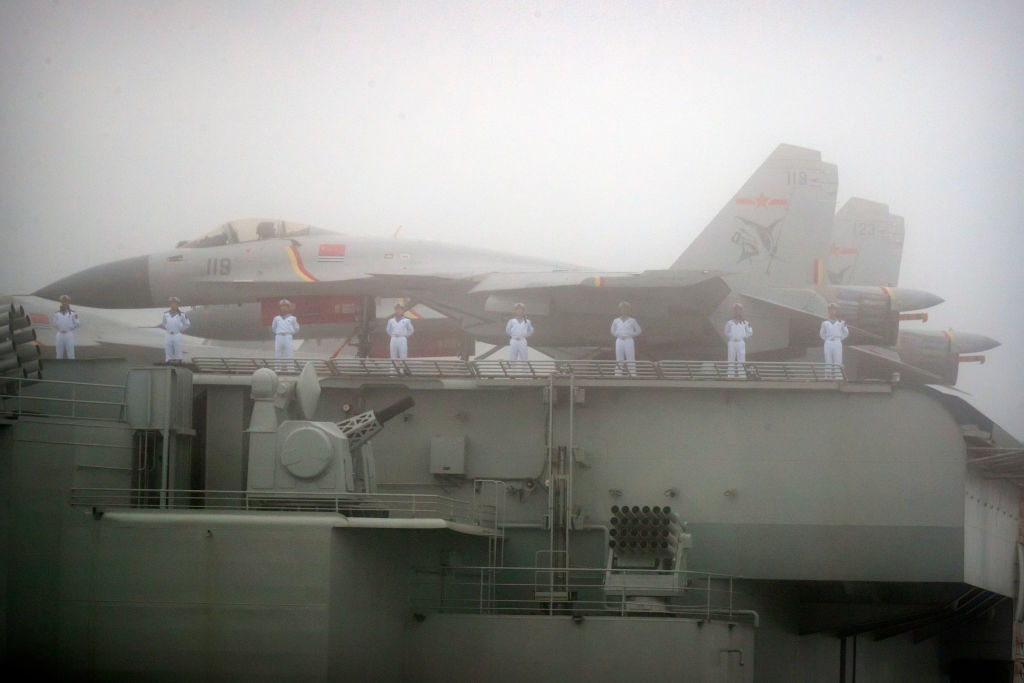
Chinese President Xi Jinping is engaged in the fastest military buildup since the Second World War. In addition, he is purging military officers opposed to war, trying to sanction-proof his regime. Xi may not yet have made the decision to go to war, but he has clearly made the decision to risk war. That means he can strike when we least expect it. Pictured: Sailors and fighter jets on the deck of the Chinese People's Liberation Army (PLA) Navy aircraft carrier Liaoning in the sea near Qingdao, in eastern China's Shandong province on April 23, 2019. (Photo by Mark Schiefelbein/AFP via Getty Images)

In recent weeks, China has surged its naval fleet into both surrounding and far away waters.

Most significantly, the People's Liberation Army Navy sent two strike groups into the South China Sea. The larger, centered on the Shandong aircraft carrier, operated off the main Philippine island of Luzon before transiting into the Western Pacific for blue water flight operations. The other is an Expeditionary Strike Group led by a Type 075 Yushen-class amphibious assault ship, one of China's largest and most advanced. Four of China's Type 055 Renhai-class cruisers, described as "the most lethal surface combatant in the world," escorted the two strike groups.

China's newest aircraft carrier, the Fujian, has been on its third set of sea trials.

China and Russia began "Exercise Joint Sea-2024" at the Zhanjiang port in southern Guangdong province, the headquarters of the Chinese navy's South Sea Fleet.

A total of 56 aircraft — the most ever in a single day, according to Taiwan's Ministry of National Defense — flew into Taiwan's air-defense identification zone, some coming as close as 33 nautical miles of the southern tip of the main island of Taiwan. Another 10 Chinese planes flew outside the zone at the same time.

Chinese Coast Guard cutter 5901, dubbed "the Monster" because of its 12,000-ton displacement, was spotted near Sabina Shoal of the Philippines, in the South China Sea.

Finally, four Chinese naval combatants transited nearby Alaskan islands, staying out of territorial waters but coming inside the U.S. Exclusive Economic Zone, the band of water between 12 and 200 nautical miles from the shoreline. As James Fanell, co-author of Embracing Communist China: America's Greatest Strategic Failure, told Gatestone, this is the fifth time since 2015 that China dispatched warships inside the American EEZ.

"In the past couple weeks, the Chinese Communist Party has demonstrated to the region—and more importantly to Washington—that the People's Republic of China is the master of the seas in the Indo-Pacific," said Fanell, also a former U.S. Navy captain who served as director of Intelligence and Information Operations at the U.S. Pacific Fleet.

Why is Chinese President Xi Jinping moving so fast at this time to exert control over peripheral waters? Prominent China analyst Willy Lam wrote last October that China's leader perhaps sees a closing window of opportunity and therefore is in a hurry to annex territory.

At a June conference of military officers in one of China's most famous revolutionary bases, Xi reportedly made dire-sounding statements. "We are here in Yan'an to hold a military meeting, preparing for a civil war," he said, in one version of his talk. The text of his remarks, now widely circulating, remain unconfirmed.

Whether he goes to war or not, he is getting ready to do so. Both the Financial Times and CNN have reported that businesses have been establishing military units inside their organizations. "Chinese Companies Are Raising Militias Like It's the 1970s," the cable network reported.

Xi is engaged in the fastest military buildup since the Second World War. In addition, he is purging military officers opposed to war, trying to sanction-proof his regime, stockpiling grain and other commodities, surveying the U.S. for nuclear weapons strikes, and mobilizing civilians for war. At the same time, he is reasserting state control over the economy, financial markets, and virtually all other aspects of society. He is, in short, bringing back totalitarian controls to China.

Those controls are, among other things, choking the economy. Beijing on July 15 reported 4.7% year-on-year GDP growth in the second quarter, but that number is hard to reconcile with signs of a stagnating economy. The country, for instance, is flirting with deflation, which is inconsistent with the reported robust expansion.

The problem is that Xi refuses to empower consumers so that they can create a consumption-based economy. Why would he reject near-unanimous advice to put money into the hands of ordinary Chinese? Among other reasons, doing so would undercut his efforts to build a wartime economy.

"Xi Jinping's propagandists desperately try to paper over the fact that there is a growing crisis of confidence in his regime to reverse the economic decline caused by the re-imposition of neo-Stalinist Mao-era policies," Charles Burton of the Prague-based think tank Sinopsis told Gatestone. "His repudiation of the progressive 'opening and reform' agenda of Deng Xiaoping and his successors has led to a severe downward spiral. This is matched by increasingly popular dissatisfaction with Xi's repressive personality cult leadership."

Xi has a chance — perhaps his last — to reverse trends. The Communist Party's Third Plenum, which started on July 15, is held once every five years and is traditionally devoted to economic matters. Optimists had hoped that Xi would signal new policies, but now expectations are exceedingly low as it appears he will instead double down on state-led initiatives to bolster manufacturing and infrastructure spending.

His economic policies emphasize war preparation, and he looks determined to take China into battle, regardless of prospects. "Even if we cannot win, we must fight," Xi is reported to have said to military officers in 2017, in connection with Taiwan.

Why would he say something like that? After all, war, especially war on Taiwan "compatriots," would be exceedingly unpopular with China's unhappy people at this moment.

I believe that Xi wants war — or at least a ramping up of tensions — to prevent senior Chinese leaders from moving against him. He is not looking to rally the Chinese people with provocative actions or even an attack; he wants to defang political opponents in the Communist Party.

"If the upcoming Communist Party Third Plenum fails to come up with dramatic measures to restore faith in the Party's ability to turn things around," Burton, also a former Canadian diplomat serving in Beijing, said, "the sole option for Xi to stave off his inevitable removal from office would be to put China on a nationalistic war footing and engage in precipitous action against Taiwan or some other neighbor."

Xi's hero, Mao Zedong, rallied the Chinese people with the Cultural Revolution not to obtain their support but to use them to take down senior leaders who had been plotting to depose him. Xi might adopt this tactic, except this time looking for a quick seizure of territory or maybe just keeping regional tensions high.

The situation, however, could get out of hand, triggering conflict around the region — or the world. Xi, unfortunately, could become desperate, and if the situation continues to deteriorate he may not care about the odds.

Xi may not yet have made the decision to go to war, but he has clearly made the decision to risk war. That means he can strike when we least expect it.

 
Gordon G. Chang is the author of The Coming Collapse of China and China Is Going to War, a Gatestone Institute distinguished senior fellow, and a member of its Advisory Board.

Source: https://www.gatestoneinstitute.org/20788/china-xi-ready-to-strike

Follow Middle East and Terrorism on Twitter

Former Trump attorney says classified docs decision could lead to scrutiny of Mueller probe - Charlotte Hazard


by Charlotte Hazard

Attorney David Schoen argued that Mueller's appointment violated the appointments clause.


One of former President Donald Trump's attorneys, David Schoen said the dismissal of the former president's classified documents case could lead to renewed scrutiny of special counsel Robert Mueller's probe into Russia collusion. 

"There are people who were convicted under Robert Muller's investigation," Just the News, No Noise host John Solomon said. "Does the legitimacy of any special counsel who wasn't appointed or confirmed by the Senate potentially come under scrutiny as a result of today's opinion?"

"Not necessarily any, but Mueller certainly does," Schoen answered. "In fact, the seminal law review article written by professors Calabresi and Lawson really is directed to the Muller appointment."

On Monday, Judge Aileen Cannon dismissed Trump's classified documents case, arguing that "Special Counsel Smith’s appointment violates the Appointments Clause of the United States Constitution."

Schoen argued that Mueller's appointment also violated the appointments clause. 

"We've always talked about the appointments clause in this, but Judge Cannon's decision really also deals with the appropriations clause: Article One, Section nine, clause seven states that we don't just have unlimited appropriations and an unlimited budget," Schoen said. 

Mueller was the former director of the FBI who led the investigation into alleged Russian interference in the 2016 election.

Last year special counsel John Durham released a report that stated that neither the FBI or DOJ had any evidence Trump colluded with Russia to interfere with the election results.  


Charlotte Hazard

Source: https://justthenews.com/government/courts-law/former-trump-attorney-says-classified-documents-decision-draws-scrutiny

Follow Middle East and Terrorism on Twitter

US, Israeli officials meet in DC to discuss Iran threat - JNS Staff


by JNS Staff

The group "discussed mutual coordination on a series of measures to ensure that Iran can never acquire a nuclear weapon," per the White House.


The inside of an uranium conversion facility just outside the city of Isfahan, about 254 miles south of Tehran, Iran, in 2005. Photo by Getty Images.

U.S. National Security Advisor Jake Sullivan and Secretary of State Antony Blinken on Monday hosted Israeli National Security Adviser Tzachi Hanegbi and Strategic Affairs Minister Ron Dermer at the White House for a U.S.-Israel Strategic Consultative Group meeting.

The American and Israeli leaders “were joined by senior representatives from their respective foreign policy, defense and intelligence agencies” for a discussion about countering the Iranian threat to the Jewish state and the region, the White House said.

The group also addressed “developments with respect to Iran’s nuclear program and discussed mutual coordination on a series of measures to ensure that Iran can never acquire a nuclear weapon,” according to the U.S. readout of the meeting.

“Mr. Sullivan affirmed President [Joe] Biden’s ironclad commitment to Israel’s security, including in the face of ongoing and reckless attacks against Israel by Lebanese Hezbollah. He emphasized that Israel has every right to defend itself against these attacks, and affirmed U.S. support for a diplomatic resolution that permits Israeli and Lebanese families to safely and securely return to their homes,” added the statement.

The U.S.-Israel Strategic Consultative Group (SCG) had not convened since March 2023, most recently having been postponed after Israeli Prime Minister Benjamin Netanyahu accused the Biden administration of withholding arms from Jerusalem amid Israel’s ongoing war against Hamas in Gaza.

Monday’s meeting comes amid growing concern in Israel over Iran’s efforts to weaponize components of its nuclear program.

Late last month, Axios reported that Jerusalem was re-establishing working groups in various government bodies frozen some 18 months ago to discuss the Iran nuclear threat.

The initiative, overseen by Hanegbi, restarts six groups in the Mossad, the Israel Security Agency and in the intelligence and cyber fields, according to the report. The Mossad groups will focus on the nuclear program and weaponization, while the ISA will focus on combating Iranian influence campaigns in Israel. The other teams will combat cyber threats vis-à-vis Hezbollah and the Houthis.

The International Atomic Energy Agency’s latest report showed Iran holding 30 times the stockpile of uranium allowed under the 2015 Joint Comprehensive Plan of Action (JCPOA), commonly known as the Iran nuclear deal.

Iran’s stockpile of 60%-enriched uranium has increased by 20.6 kilograms (45.5 pounds) since February, AFP reported on May 27, citing an IAEA report. The confidential document, which was also seen by the Associated Press, revealed that Tehran had accumulated 142.1 kilograms (313.2 pounds) of uranium enriched up to 60%. This level of enrichment is just a technical step from 90% enrichment, considered weapons grade.

According to the IAEA definition, it is technically possible to create an atomic bomb with roughly 42 kilograms (92.5 pounds) of uranium enriched to 60% if the material is further enriched to 90%.

Israeli Foreign Minister Israel Katz has urged the international community to increase the pressure on the mullahs in Iran, after Masoud Pezeshkian won the Islamic Republic’s second-round presidential vote.

“The people of Iran have sent a clear message of demand for change and opposition to the Ayatollah regime through the elections,” said Katz.

“Now the world must designate the [Islamic Revolutionary Guard Corps] as a terrorist organization and demand the cancellation of the nuclear program and the cessation of support for terrorist organizations. This is the only chance to realize the change,” he added.

Last Tuesday, Katz called for action against Iran in meetings with international leaders at the opening of the NATO summit in Washington. The minister met with his U.S. counterpart Antony Blinken, U.S. Defense Secretary Lloyd Austin, German Foreign Minister Annalena Baerbock, Canadian Foreign Minister Mélanie Joly and Czech Foreign Minister Jan Lipavský, among others.

“Our enemy is also your enemy. The Iranian missiles and UAVs that threaten us are being sent to Russia and threaten you too. Crippling sanctions must be imposed on Iran, and the [Islamic] Revolutionary Guards must be declared a terrorist organization,” said Katz.


JNS Staff

Source: https://www.jns.org/at-white-house-meeting-us-israel-strategic-consultative-group-discusses-iranian-threat/

Follow Middle East and Terrorism on Twitter

IDF intel reveals: 66% Hamas fighter losses, 75% reduced rocket inventory in Shejaia - Yonah Jeremy Bob


by Yonah Jeremy Bob

IDF said that Hamas has been reduced to a mode of survival as opposed to being able to do very much strategic or proactive attack plans.


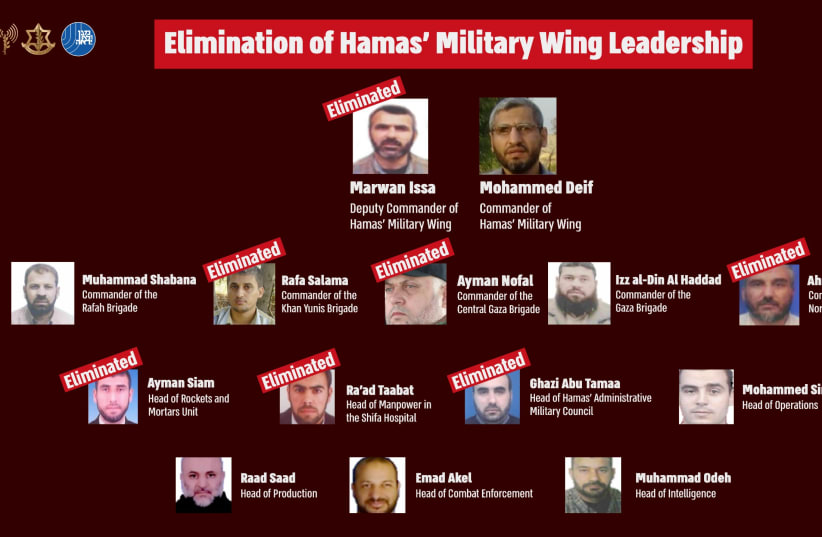
A graph of top senior Hamas officials killed by the IDF since the start of the war. (photo credit: IDF SPOKESPERSON'S UNIT)
A graph of top senior Hamas officials killed by the IDF since the start of the war.
(photo credit: IDF SPOKESPERSON'S UNIT)

IDF intelligence has revealed Hamas's internal estimate of its forces in the once-powerful northern Gaza area of Shejaia.

According to previous secret information shown to the Jerusalem Post and some other media, the internal estimates show that Shejaia forces have dropped pre-war to 435 fighters from an initial 1,235 - a drop of around 66%.

In addition, the estimate was that Hamas rockets in Shejaia were down to 15 rockets from an original inventory of 63, a drop of over 75%.

This effectively ends most of the threat Hamas's forces could present using rockets from Shejaia.

Likewise, the volume of anti-tank missiles and rocket-propelled grenades had fallen to 134 from 652, though due to the larger initial volume of RPGs as opposed to the smaller number of rockets, this still left Hamas with a fairly large inventory of RPGs to conduct ambushes against IDF soldiers nearby.

 IDF reveals 14,000 terrorists have been arrested or killed since the start of the war  (credit: IDF SPOKESPERSON'S UNIT)Enlrage image
IDF reveals 14,000 terrorists have been arrested or killed since the start of the war (credit: IDF SPOKESPERSON'S UNIT)

Further, Hamas was down to 133 improvised explosives from a high point of 662, something which again has depleted long-term or strategic fighting but provides the capability to continue to sabotage nearby IDF soldiers for some time.

In the wider perspective, the IDF said that Hamas is down to between 1,000-1,500 rockets.

Pre-war, Hamas reportedly had around 15,000 rockets,

The IDF is still concerned that Hamas still has a small supply of long-range rockets that could strike Tel Aviv, and on July 1, the terror group showed it could still execute a complex operation in which it fired 20 rockets from the Khan Yunis area into Israeli Gaza border areas and communities.

But overall, the IDF said that Hamas has been reduced to a mode of survival as opposed to being able to do very much strategic or proactive attack plans.

Multiple IDF sources projected continued confidence that Hamas military chief Mohammed Deif is dead.

The Post witnessed videos and photos of visual observation of the target house, nearby makeshift roof-covered areas, and trees both before the IDF struck the area and after.

The explosion was of tremendous strength, and no survivors were seen exiting.

The remaining x-factors are the slight possibility that Deif managed to leave before the attack without surveillance noticing, though he had definitely been on location for some time, and the many times he had somehow rallied from severe injuries from prior IDF assassination attempts to emerge having survived.

Impossible to prove?

There were no signs that the IDF would be able to present new immediate evidence to prove his death in the near future.

Next, IDF sources described how 1.9 million Palestinian civilians have evacuated many areas and moved to the middle Gaza areas of al-Muwasi, Deir al Balach in central Gaza, as well as parts of Khan Yunis closer to central Gaza.  

There are a mere 25,000 Palestinians left in Rafah out of the 1.4 million who were there in early May before the IDF invasion and a mere 250,000 Palestinians in northern Gaza, according to IDF estimates.

IDF sources said that while the main purpose of evacuating civilians is for their own safety when Hamas has embedded itself in safe zone areas, moving the civilian populace also adds exponential pressure to Hamas.

Moreover, IDF sources gave some surprising answers about the number of dead Hamas forces in the war to date.

Already in early May, some Israeli officials had said the IDF had killed 16,000 Hamas fighters.

Others at the time said the number was closer to 14,000.

On Tuesday, IDF sources said that the number remained at 14,000, but what was strange about the number was that the IDF said around 1,000 Hamas fighters had been killed in the last two weeks of fighting.

If true, that would mean that less than 13,000 Hamas fighters had been killed as of early July and possibly another 1,000 or so less back in early May.

Fog of war

The fluctuations in the number of estimated killed Hamas fighters show the continuing uncertainty in that area.IDF sources had no additional news to provide regarding the locations of hostages but were hopeful that the ongoing process of destroying Hamas’s tunnel network would force Gaza Chief Yahya Sinwar and other Hamas officials holding hostages into the open where Sinwar could be struck and hostages could be saved.

IDF sources strongly believe this was how they located Deif, regardless of whether he survived the attack.

Although IDF sources have said that destroying all of Hamas’s tunnels could take years, there was hope that an increased pace of eliminating tunnels could also compel Sinwar or others holding hostages to make an error and expose themselves.


Yonah Jeremy Bob

Source: https://www.jpost.com/israel-hamas-war/article-810555

Follow Middle East and Terrorism on Twitter

CIA: Sinwar under increasing internal pressure to end the war - Joshua Marks


by Joshua Marks

The Hamas leader in Gaza is believed by U.S. intelligence to be hiding in the tunnels underneath Khan Younis.


Hamas leader Yahya Sinwar holds the son of an Al-Qassam Brigades terrorist who was killed in recent fighting with Israel, during a rally in Gaza City, May 24, 2021. Photo by Mahmud Hams/AFP via Getty Images.

Hamas leader in Gaza Yayha Sinwar is being pressed by the terror group’s military commanders to accept a ceasefire deal and end the war with Israel, according to U.S. intelligence.

CIA Director Bill Burns conveyed this message to attendees of a closed-door conference in Sun Valley, Idaho on Saturday, a source present at the meeting said to CNN.

According to the source, the architect of the Oct. 7 attacks and Israel’s top target is not “concerned with his own mortality” but is facing calls for Hamas to lay down its arms because it will be blamed for the growing suffering in Gaza after more than nine months of fighting.

American intelligence officials believe that Sinwar, 61, is hiding in the tunnels underneath his birth city of Khan Younis in southern Gaza, according to the report.

An Israeli airstrike on July 13 targeted Hamas’ second-in-command, Mohammed Deif, leader of the terror group’s armed wing, the Qassam Brigades, and the Israeli military and intelligence have their sights set on Sinwar.

Israel Defense Forces Chief of Staff Lt. Gen. Herzi Halevi on Sunday said that targeted strikes on Hamas leadership were a key part of a military pressure campaign that would result in the return of Israeli hostages.

The increasing pressure comes as negotiators continue to discuss the framework of a ceasefire and hostage release deal that is acceptable to both Israel and Hamas. It was initially reported that Hamas called off ceasefire talks due to the Deif strike, but it was later clarified by both the terror group and its patron Qatar that negotiations would continue.

An Israeli official told Ynet on Monday that a delegation led by Mossad chief David Barnea was scheduled to depart for Doha this week but was waiting for the Qatari invitation. The source also suggested that Barnea might not lead the delegation and that the talks might take place at a different location.

Furthermore, the official said that Prime Minister Benjamin Netanyahu insists on continuing the military pressure on Hamas and is sticking to his red lines in the talks, stressing that it was the “money time” to bring as many live hostages back to Israel as possible at the lowest cost and risk to Israel’s security.

“Whether Deif was killed or not, Hamas suffered a severe blow. They did not say talks would be stalled and have not responded to the assassination attempt by attacking Israel with rockets,” the official said.


Joshua Marks

Source: https://www.jns.org/cia-sinwar-under-increasing-internal-pressure-to-end-the-war/

Follow Middle East and Terrorism on Twitter

Unanswered Questions About the Trump Assassination Attempt - Kenneth R. Timmerman


by Kenneth R. Timmerman

If anything, the events of the past few days have reconfirmed my belief that God has a plan for our nation, and that he has chosen Donald Trump as his instrument.


Donald J. Trump didn’t have to run for president in 2015, or in 2020, or in 2024. He had a magnificent life. Why subject himself to the barbs and arrows of a political class and their media allies well-versed in the politics of personal destruction?

Only one reason: because he loved his country to the extent he was willing to sacrifice his wealth, livelihood and even his life to serve it.

Donald Trump is the only president to have left the White House poorer than when he took office.

I believe God himself protected Donald Trump on Saturday. Just a few millimeters in either direction, and the many bullets his would-be assassin fired at him would have blown his brains out.

I believe that God sends His guardian angels to protect those He chooses. Don’t ask me why or how He chooses whom to protect. But in my own life, I know I have been saved in so many times of great peril by a higher force, certainly not by my own hand. I have recounted some of those “close calls” in my book, And the Rest is History. After a while, saying you have been lucky is just not enough.

God extended a hedge of protection around Donald Trump. He saved him from a would-be assassin’s bullets for a purpose – His purpose. And that purpose can only be to turn His people back to Him.

The morning after the assassination, a blogger I have never met sent me Isaiah 54:17, which reads: 

No weapon that is fashioned against you shall prosper, and you shall confute every tongue that rises against you in judgment. This is the heritage of the servants of the Lord and their vindication from me, says the Lord.

It’s remarkable to watch leading Democrats preach to the nation about forgiveness and tolerance and coming together, when the hate-filled rhetoric they have employed non-stop since Donald Trump descended the escalator in Trump Tower in July 2015 has engendered the very intolerance they now berate.

Just days before the assassination attempt, Joe Biden himself told donors, “we’re done talking about the debate. It’s time to put Trump in a bullseye.”

Just a figure of speech? Sure. But far more explicit than Trump’s comments to supporters on January 6, 2021, that they should “fight” to see justice done.

I won’t remind you of the so-called comedienne who held out a mock-up of Donald Trump’s severed head, or the pop star who said on the day of his inauguration that seeing Trump as president made her want to blow up the White House.

Those comments were just fine, as far as Democrats were concerned.

How about the June 2024 cover of The New Republic, that bastion of liberal Democrats? The shocker headline, “What American Fascism Would Look Like,” accompanied an image of Adolf Hitler morphed into Donald Trump.

Even former Attorney General Bill Barr, who resigned in December 2020 and has spoken many unkind words about Donald Trump, called horse pucky on the Democrats just hours after the shooting in Butler, PA.

“Democrats have to stop their grossly irresponsible talk about Trump being an existential threat to democracy. He is not,” the former AG told Fox News.

The day after the September 11, 2001 attacks on America, the FBI was able to tell the country who had attacked us, and why. In less than 24-hours, they had the names, nationalities, and even the passports of the nineteen hijackers, as well as their motive.

How is it that 48 hours after the assassination attempt on Trump the FBI can’t tell us what motivated a 20-year-old to climb up on a roof, threaten a police officer with an AR-15, and shoot at the president? Could it possibly be Trump Derangement Syndrome?

And why has the media not questioned his parents, undoubtedly the two people who have exerted the greatest influence over him? The shooter’s father, Matthew Crooks, told CNN late Saturday that he was trying to figure out “what the hell is going on,” but wouldn’t speak about his son until after he talked to law enforcement. That was two days ago.

The immediate questions I had on learning of the shooting will be answered in the coming days. A spokesperson for the agency blamed the local police, saying inexplicably it was their responsibility to secure areas outside the immediate security perimeter around the president.

Why didn’t the Secret Service secure that roof? It now appears, despite initial denials, that Trump’s Secret Service detail had indeed requested more resources on several occasions, but was turned down by their director, Kimberly Cheatle, who was more focused on diversity hires than protecting a former president and leading presidential candidate.

If anything, the events of the past few days have reconfirmed my belief that God has a plan for our nation, and that he has chosen Donald Trump as his instrument. And so, to all believers I say, rejoice! God is great, and His will be done.

Dan Scavino, Public domain, via Wikimedia Commons

Image: Public domain.

 POLL: Are you worried that socialism is taking root in America?


Kenneth R. Timmerman

Source: https://www.americanthinker.com/articles/2024/07/unanswered_questions_about_the_trump_assassination_attempt.html

Follow Middle East and Terrorism on Twitter

JD Vance worries Europe, but sounds all the right notes on Israel - David Isaac


by David Isaac

While Europeans are troubled by J.D. Vance's Ukraine stance, he has expressed traditional conservative Republican support for Israel.


Sen. J.D. Vance (R-Ohio) speaks to reporters room after the CNN Presidential Debate between U.S. President Joe Biden and Republican presidential candidate, former President Donald Trump, at the McCamish Pavilion on the Georgia Institute of Technology campus in Atlanta on June 27, 2024. Photo by Andrew Harnik/Getty Images.

The choice of Sen. J.D. Vance (R-Ohio) as Donald Trump’s running mate has sparked concerns among European diplomats fearful of an isolationist America. Should Israel also be worried?

The short answer appears to be no.

Vance, who turns 40 in August, has stumped for Trump’s “America First” foreign policy in recent years. He opposes funding a “never-ending war in Ukraine” and recently told Europe “to wake up to the fact” that the United States needs to pivot toward East Asia.

While such statements naturally trouble Europeans, Vance has expressed traditional conservative, even evangelical-like, support for Israel, though a Roman-Catholic.

Speaking at a foreign policy conference sponsored by the Quincy Institute for Responsible Statecraft and The American Conservative on May 23, Vance said:

“A big part of the reason why Americans care about Israel is because we are still the largest Christian-majority country in the world,” and that means “a majority of citizens of this country think that their Savior, and I count myself a Christian, was born and died and resurrected in that narrow little strip of territory on the Mediterranean.

“The idea that there is ever going to be an American foreign policy that doesn’t care a lot about that slice of the world is preposterous.”

Similarly, he told The Jerusalem Post during his first-ever visit to Israel in 2022 shortly after his Senate election, “I got it intellectually, but emotionally, I didn’t realize. [Jerusalem] is the most important cultural heritage site in the world. If Israel didn’t control this land, I would never understand this experience.”

He also espoused traditional Republican positions, telling the Post, “The Iran deal was a disaster, Israel is our most important ally and Trump was right to move the [embassy] to Jerusalem.”

In his Quincy Institute speech, Vance also advanced practical considerations regarding America’s support for Israel, describing the Jewish state as “one of the most dynamic and technologically advanced countries in the world,” noting that Israel’s work on the Iron Beam system, a laser defense initiative, would give the U.S. “missile-defense parity. That’s a very important national security objective of the United States of America.”

The vice presidential nominee has criticized the Biden administration’s interference with Israel’s Gaza war, telling CNN in May:

“I think that our attitude vis-a-vis the Israelis should be, look, we’re not good at micromanaging Middle Eastern wars, the Israelis are our allies, let them prosecute this war the way they see fit.”

He supports the Abraham Accords model, according to which the U.S. encourages ties between Israel and moderate Arab states.

“Our goal in the Middle East should be to allow the Israelis to get to some good place with the Saudi Arabians and other Gulf Arab states,” he told CNN.

He reiterated that approach to the Jewish Insider at the Quincy Institute conference, saying, “The Abraham Accords model is the perfect way of building a counterpoint to the Iranians in the Middle East.”

He argued for a strong Israel that could act independently of the United States rather than as a client state.

“We have to sort of ask ourselves, what do we want out of our Israeli allies? And more importantly, what do we want out of all of our allies writ large? Do we want clients who depend on us, who can’t do anything without us? Or do we want real allies who can actually advance their interests on their own with America playing a leadership role?” he said. 

When U.S. President Joe Biden combined military aid for Israel and Ukraine in a single $105 billion package, gambling that Republicans opposed to Ukraine aid wouldn’t vote against $14.3 billion to help bolster Israel’s aerial defenses, Vance opposed it.

“What Biden is doing is disgusting. He’s using dead children in Israel to sell his disastrous Ukraine policy to skeptical Americans,” he tweeted last October. “They are not the same countries, they are not the same problems, and this effort to use Israel for political cover is offensive.”

In his Quincy Institute speech, Vance stressed that his opposition to Ukraine aid didn’t extend to Israel: “It’s sort of weird that this town assumes that Israel and Ukraine are exactly the same. They’re not, of course, and I think it’s important to analyze them in separate buckets.”

Vance has defended Trump’s criticism of American Jews who support Biden as not sufficiently supportive of Israel. “Any Jewish person who votes for a Democrat or votes for Biden should have their head examined,” Trump had said.

Vance told CNN, “Do I think it’s reasonable to look at this situation and say that if you’re a Jewish American who cares about the State of Israel, who cares about these antisemitic riots, and say you should be on the side of Republicans in 2024 because they govern effectively on some of the issues that you care about? I think it’s a totally reasonable argument to make.”

At the same time, Vance has defended U.S. Jews as a wave of antisemitism ripped through college campuses in the wake of Oct. 7.

He has criticized the anti-Israel encampments, saying, “You don’t get to turn our public places into a garbage dump. No civilization should tolerate these encampments. Get rid of them.”

And he has advocated for prosecuting antisemitic acts, telling The Jerusalem Post, “If you beat up a Jew and don’t face consequences, the attacks will continue and get worse.”

However, Vance has been criticized for not sufficiently condemning antisemitism on the right, defending Rep. Marjorie Taylor Greene (R-Ga.), saying that she “did nothing wrong,” after she attended a far-right conference organized by notorious antisemite Nick Fuentes.


David Isaac

Source: https://www.jns.org/jd-vance-worries-europe-but-sounds-all-the-right-notes-on-israel/

Follow Middle East and Terrorism on Twitter