Tuesday, May 5, 2026

Iran, U.S. exchange fire amid ceasefire, as Strait of Hormuz standoff exposes Tehran's weakness - Jerry Dunleavy


by Jerry Dunleavy

Project Freedom, announced by President Donald Trump, aims to re-establish freedom of navigation in the Strait of Hormuz as the Iranian regime seeks to control the strategic waterway.


Iran launched missiles at U.S. military ships and the United Arab Emirates, and American forces returned fire amid a fragile ceasefire. But Monday's volley exposed the increasingly limited options Tehran faces with a severely diminished military and economy as it tries to counter the U.S. Navy's assistance to commercial ships passing through the Strait of Hormuz.

While Tehran managed to damage a South Korean tanker and an oil facility in UAE, it suffered the loss of seven gunboats sunk by U.S. return fire and faces increasingly dire circumstances as its drilling wells are near bursting because there is nowhere to ship its oil, experts said.

"This is all sort of coming down to, I believe, the final days here," former Deputy National Security Advisor Victoria Coates told Just the News. "...Iran is obviously still trying to lash out, but the farthest they can get their missiles at this point is UAE. They're looking for proximate targets. They don't even try and shell Israel anymore."

"Their ability to strike others may be very limited, and then they're really out of cards," she added.

Admiral Brad Cooper, the commander of U.S. Central Command, revealed Monday the U.S. military launched an effort to clear the way for dozens of commercial ships trapped in the Arabian Gulf to transit through the Strait of Hormuz off the Iranian coast. The Iranians had responded to this effort by attempting to attack both the commercial ships and the U.S. naval vessels protecting them, he said.

“The cruise missiles were going after those U.S. Navy ships, but mostly after commercial shipping. We defended both ourselves consistent with our commitment,” Cooper explained. “We defended all the commercial ships. We’ve had drone launches against commercial ships, all of which were defended against, consistent with our commitment.

"And then the small boats were all going against commercial ships, and all were sunk by Apaches and Seahawk helicopters," he added.

The admiral said that “there’s been no U.S. military ships hit” and that “there have been no U.S. flagships that have been hit.”

The CENTCOM leader declined to say whether Iran’s attempted strikes were a violation of the weeks-old ceasefire struck between the Trump administration and the remaining Iranian leaders.

“I wouldn’t go into details of whether the ceasefire is over or not. I think the key thing for us is we are merely there as a defensive force and in force to give a very thick layer of defense for commercial shipping to proceed out of the Arabian Gulf," he said. "That is what we are focused on,” the admiral said.

Operation Epic Fury, launched just over two months ago, eliminated a raft of Iranian political and military leaders and did extensive damage to Iranian military capabilities, but the Iranians responded by seeking to control the strait.

President Donald Trump had announced in a Truth Social post on Sunday that the U.S. military would be launching the “Project Freedom” effort to increase freedom of navigation in the Strait of Hormuz. The president had also said there would be consequences if the Iranians tried to interfere.

“Countries from all over the World, almost all of which are not involved in the Middle Eastern dispute going on so visibly, and violently, for all to see, have asked the United States if we could help free up their Ships, which are locked up in the Strait of Hormuz, on something which they have absolutely nothing to do with — They are merely neutral and innocent bystanders!” Trump said.

The president said that “for the good of Iran, the Middle East, and the United States, we have told these Countries that we will guide their Ships safely out of these restricted Waterways, so that they can freely and ably get on with their business.”

The president also warned that “if, in any way, this Humanitarian process is interfered with, that interference will, unfortunately, have to be dealt with forcefully.” Cooper revealed Monday that the Iranians had indeed sought to interfere with this effort.

Mike Waltz, a former Republican congressman and now the U.S. Ambassador to the United Nations, tweeted Sunday that “regardless of how you feel about the conflict over their nuclear program, Iran laying sea mines indiscriminately in international waters and attempting to ‘toll’ civilian commercial shipping is illegal and unacceptable.”

He promised that “the U.S. and our Gulf partners will lead the way to defend global freedom of navigation.”

Admiral says blockade continues — and Project Freedom will pursue freedom of navigation

Cooper explained Monday the U.S. naval blockade of Iran was continuing, and that the new Project Freedom effort to help guide commercial ships safely out of the Strait of Hormuz was purely defensive.

“Today, the U.S. military is taking two separate actions in two separate bodies of water. First, we are enforcing the blockade in the Gulf of Oman. There is no commerce going into and out of Iran, and we will be sustaining this effort,” the admiral said. “Second, we have now opened a passage through the Strait of Hormuz to allow for the free flow of commerce to continue.”

The ongoing blockade “is going exactly as designed, and in fact exceeding my expectations,” Cooper added.

That blockade, experts said, is putting Iran's oil industry in an existential crisis because it will soon have to cap overflowing oil wells with nowhere to export the fuel.

"The second front of this war is economic," Coates told the Just the News, No Noise television show on Monday evening. "It is just complete, systematic dismantlement of the Iranian economy. And they have days, not weeks, left in terms of their oil storage. That's 90% of their economy. They're about to lose that. And their currency has lost 98% of its value over the last 10 years."

She added: "The reality is Iran will not exist the way it did before Operation Epic fury, and they have to realize they can't recover without us."

Cooper said the U.S. was employing ballistic missile-capable destroyers, more than 100 land-based and sea-based aircraft, multi-domain unmanned aircraft, and 15,000 U.S. service members to “extend this defensive umbrella across the Strait of Hormuz to defend our forces and also have committed to defend international shipping.”

He said that the vessels stuck in the Arabian Gulf are from 87 countries, and Project Freedom “has been quite enthusiastically received and we’re already beginning to see movement.”

“The president has said that if the process is interfered with, we will react forcefully,” Cooper said. “And over the last 12 hours, Iran has interfered. The IRGC has launched multiple cruise missiles, drones, and small boats at ships we are protecting. We have defeated each and every one of those threats through the clinical application of defensive munitions.”

The U.S. used helicopters to “eliminate” the Iranian small boats threatening commercial shipping, Cooper said.

CENTCOM said on X on Monday that “Iranian state media claims that Iran's Islamic Revolutionary Guard Corps hit a U.S. warship with two missiles” but called this a lie.

“TRUTH: No U.S. Navy ships have been struck. U.S. forces are supporting Project Freedom and enforcing the naval blockade on Iranian ports,” CENTCOM said.

Cooper noted Monday that “Iranian military capability has been dramatically degraded these past couple of months.”

The admiral added that multiple U.S. naval vessels had traversed the Strait of Hormuz to carry out this new mission.

“We have gone through the Strait,” Cooper said. “We have multiple U.S. Navy guided missile destroyers operating in the Arabian Gulf. And those destroyers are not just there themselves. They are there to protect commercial shipping. They’ve done so already. And they are part of a broad air defense umbrella that includes helicopters, fighter planes over the top, and also ISR [intelligence, surveillance, and reconnaissance].”

Cooper said that “there is not a specific escort” — meaning that U.S. naval vessels were not individually accompanying each of the commercial vessels as they attempted to sail through the strait — but he said the U.S. strategy was more effective than that.

“I think we have a much better defensive arrangement in this process where we have multiple layers that includes ships, helicopters, aircraft, airborne early warning, electronic warfare — we have a much broader defensive package than you would have ever if you were just escorting,” the admiral said.

CENTCOM tweeted on Monday that “two U.S.-flagged merchant vessels have successfully transited through the Strait of Hormuz and are safely headed on their journey.”

Cooper also seemed confident that the mines laid by the Iranians would not be a problem, arguing that “we have cleared an effective pathway for ships to leave there for the first time” and then “put this defensive umbrella on top of it.”

When asked if Project Freedom was just a one-way effort to get ships out of the strait or whether the U.S. would protect ships going in as well, Cooper replied, “In terms of the pathway cleared, it will ultimately be a two-way path. The most important thing in the interim is getting ships out, and then, over time, we will for sure see ships go in." 


Jerry Dunleavy

Source: https://justthenews.com/government/security/iran-and-us-shooting-eachother-again-amidst-ceasefire-and-project-freedom

Follow Middle East and Terrorism on Twitter

Hegseth says Iran ceasefire 'not over,' US guiding ships in Strait of Hormuz 'temporary solution' - Kevin Killough


by Kevin Killough

Secretary of War Pete Hegseth vowed that the ships from around the world that are trapped by the Iranian blockade of the strait would get out.


Defense Secretary Pete Hegseth said Tuesday morning at a Pentagon briefing that the U.S.-Iran ceasefire "is not over," amid the sides exchanging fire at or near the Strait of Hormuz.

Hegseth also said the U.S. guiding vessels through the strait, a global shipping channel off the Iranian coast, is a "temporary solution," according to CBS News. 

"Iran cannot be allowed to block innocent countries and their goods from an international waterway," he said.

Iranian vessels on Monday fired on U.S. ships guiding vessels through the strait, resulting in the U.S. sinking several small Iranian boats, CBS also reports.

Hegseth also said the U.S. effort to guide commercial vessels in the strait, known as "Project Freedom," is "separate and distinct from Operation Epic Fury, which is the U.S. war on Iran that began Feb. 28 with air strikes. 


Kevin Killough

Source: https://justthenews.com/world/middle-east/hegseth-provides-more-details-trumps-project-freedom-aimed-reopening-strait

Follow Middle East and Terrorism on Twitter

The Global Ripples from the Iran War - Victor Davis Hanson


by Victor Davis Hanson

The Iran war didn’t just break Tehran—it shattered old alliances, exposed Europe’s weakness, checked China and Russia, and accelerated an American-led geopolitical realignment.


No one ever quite knows the nature of the aftermath of any war in the Middle East.

The current effort to disarm and neuter the Iranian theocracy is no exception.

But contrary to European and American left-wing consensus, the ripples of the Iran war are already remaking the postwar world as we knew it—and in ways that are all bad.

For more than half a century, OPEC has terrorized the industrial world with threats of oil shortages and sky-high prices, with members often agreeing to cut back to 70–80 percent of their capacities.

But recently, the hard-pressed United Arab Emirates announced—at a time of high oil prices—that it was leaving the cartel and freelancing. The UAE will likely increase its production by 1–2 million barrels per day. Once such a key member departs, it is probable that other oil-exporting nations will defect to take advantage of the current spike in oil prices to avoid missing out on profits as others get richer.

OPEC is no longer the powerhouse monopoly of the 1970s. It now accounts for barely half of the world’s exported oil. Meanwhile, the US, the largest producer of oil and gas in history, is pushing hard to increase daily production to meet increased demand for American oil. A rebooted Venezuela has already reached a seven-year high in its renewed output and promises even faster escalation in oil exports.

Russia’s still-sanctioned oil has suddenly started to appear on the world market, as the Kremlin has upped exports by a quarter-million barrels per day.

Add it all up, and Iran’s 1.5–2 million barrels may not be all that missed, as the world price may fall by summer—regardless of Iran’s status.

The combination of a neutered Iran and its foolish targeting of the Gulf nations is also redefining the Middle East.

It is odd for Arab nations to urge the US to continue its bombing of another Middle Eastern nation. But the Arab nations of the Gulf Cooperation Council (Bahrain, Kuwait, Oman, Qatar, Saudi Arabia, and the United Arab Emirates) are frantically asking America to end the nearby Iranian theocracy for good.

The Gulf states were hit by six times as many Iranian rockets and drones as Israel. And by itself, the Jewish state poses no regional threat to the Persian Gulf exporters.

The result is a more realistic, less ideological Gulf council that is beginning to accept the fact that in the Middle East, Israel alone has the combat aircraft, expertise, and experience to strike Iran and deter it from attacking moderate Arab governments. This raises the specter of a new de facto alliance of mutual advantage between Israel and much of the Arab world, one that would isolate Iran, along with Hezbollah, Hamas, and the Houthis. If the previous catalyst for the Abraham Accords détente was American pressure, it may soon become Arab self-interest.

As for Iran’s three terrorist cabals, cash is in short supply. Will it be feasible for a postwar Iran, even if the regime survives in some form, to spend billions of dollars subsidizing terrorists that increasingly have little support in the Arab world?

Will a destitute Iran be able to replace its half-century-long, half-trillion-dollar investment in its military-industrial complex, now in ruins?

OPEC seems not to be the only loser in the brief two-month war. Having previously lost its Syrian proxy, Russia is now effectively cut off from the Middle East with the loss of its client Iran, a separation that could become permanent should the theocracy fall.

Moscow is still trapped in a four-year quagmire in Ukraine, with dead and wounded approaching two million and an economy on the brink of depression.

Putin’s worries are myriad. His nation is the largest in the world in terms of landmass, but the population has shrunk from the USSR’s high of 290 million to scarcely 145 million people—an aging and declining demographic.

Large countries with abundant natural resources and relatively small, diminishing populations naturally draw the attention of a nearby rapacious China, making Putin more inclined to seek détente with the West.

China itself, under American pressure in Panama and having lost much of its influence with oil-rich Venezuela, is scrambling in vain to find new oil producers desperate to unload their sanctioned oil at a discount to the Chinese. Beijing is as dependent on foreign sources of energy as the US is self-sufficient.

Beijing continues to eye Taiwan as always, but it is now disturbed by the display of high-tech American naval and aerial prowess, just as it has been disappointed by the inability of the Russian army to overrun a much smaller and less well-armed Ukraine.

As a result, China may be absorbing these lessons and rethinking the viability of sending an amphibious fleet across some 110 miles of open sea and then landing hundreds of thousands of People’s Liberation Army soldiers on the beaches of Taiwan—amid skies full of drones and missiles and a sea of maritime drone ships and submarines.

Europe was also a big loser from the war. The temporary closing of the Strait of Hormuz reminded the oil-dependent European Union that its radical green agenda was unsustainable. The continent retains a desperate need to find safe and reliable exporters of affordable fossil fuels.

Many NATO members—Spain, France, Italy, and the United Kingdom in particular—will regret their loud opposition to allowing the US to stealthily use their airspace and joint NATO bases.

True, the Europeans despise Trump. But they still may need the US military to protect them from Russia, any potential anti-Western nuclear power with ballistic missiles, and regional destabilizers like Milosevic-era Serbia.

Of course, most European hearts wanted to restrain or even weaken the now Trump-led Americans. But their heads told them that the American-guided demise of the Iranian theocracy meant fewer existential threats to Europe from the Middle East, fewer violent Arab clients and proxies in the region, and fewer subsidized terrorists in their own backyards.

So the European nations could have kept quiet about allowing the US to use their airspace and basing under NATO privileges, without endangering their opportunistic nonparticipation in the war. They could have shown “concern” without stooping to loud “This is not our war” cheap attacks on the US—and thereby kept the NATO partnership strong. Germany, in this regard, was particularly tone-deaf in its arrogance.

In the end, apparently, many Western European NATO members were more scared of Iranian reprisals, their radical political parties, and internal Islamic terrorists than of losing their cherished special relationship with America.

Moreover, the Arab world is relearning that Britain and France talk a great game but, when words must be followed by action, are often nowhere to be seen.

Where have been the long-promised Anglo-French-led European armadas of blockade breakers in the Strait of Hormuz? Where are the Europeans to protect their Gulf oil suppliers from Iranian attacks? Where is the French help for its former colony, Lebanon, in its hour of need, as it stands up to Hezbollah?

Despite Trump’s threats, NATO will survive, at least in name.

But in reality, American attention will shift eastward to those European members who believe in strong defense, deterrence, Western exceptionalism, and the unquestioned value of American support. It is likely that any future unilateral European expedition—like the 1982 British armada sent to the Falklands or the long French intervention in Chad, or even the unofficial and ad hoc French- and British-inspired NATO “coalitions of the willing” sent to bomb Serbia in 1999 and Libya in 2011—will no longer find American support.

Add it all up, and we see that Iran, which all nations in the region once feared, is now isolated, despised, and weak—likely never again to become the terror of the Middle East.

Israel may well become normalized in the region, largely because of its indomitable military and its high-tech, dynamic economy that poses no threat to the moderate Arab world but offers them lots of advantages.

China’s Belt and Road strategy has hit a wall in the Middle East and the Western Hemisphere. It can no longer slake its thirst for the cheap, sanctioned oil of tyrants.

Russia is more vulnerable than at any time in its long history and more focused on defending its borders than deploying abroad.

For years, European nations have been warned that disarmament, unsustainable cradle-to-grave socialist entitlements, open borders, declining fertility, radical green policies, rising populations of often-illegal aliens from the radical Middle East, and cheap anti-Americanism were a prescription for civilizational decline. The Iran war confirmed all those warnings and revealed Europe as even more listless and impotent than its friends had feared.

For all the global abuse and cheap left-wing attacks, America is emerging from the war perhaps stronger than at any point since the postwar era. 


Victor Davis Hansonn is a distinguished fellow of the Center for American Greatness and the Martin and Illie Anderson Senior Fellow at Stanford University’s Hoover Institution. He is an American military historian, columnist, a former classics professor, and scholar of ancient warfare. He has been a visiting professor at Hillsdale College since 2004, and is the 2023 Giles O'Malley Distinguished Visiting Professor at the School of Public Policy, Pepperdine University. Hanson was awarded the National Humanities Medal in 2007 by President George W. Bush, and the Bradley Prize in 2008. Hanson is also a farmer (growing almonds on a family farm in Selma, California) and a critic of social trends related to farming and agrarianism. He is the author of the just released New York Times best seller, The End of Everything: How Wars Descend into Annihilation, published by Basic Books on May 7, 2024, as well as the recent  The Second World Wars: How the First Global Conflict Was Fought and Won, The Case for Trump, and The Dying Citizen.

Source: https://amgreatness.com/2026/05/05/the-global-ripples-from-the-iran-war/

Follow Middle East and Terrorism on Twitter

Iran's Terror Regime Has Shown Its True Face - Ahmed Charai


by Ahmed Charai

For decades, Tehran has used negotiations to buy time, sanctions relief to rebuild capacity, truces to reposition, and Western hesitation to expand its regional power.


  • The United States cannot continue negotiating with a terrorist regime that violates ceasefires, attacks American allies, and weaponizes diplomacy.

  • By striking the UAE, Tehran has made one point unmistakably clear: it does not respect ceasefires, international law, or restraint.

  • For decades, Tehran has used negotiations to buy time, sanctions relief to rebuild capacity, truces to reposition, and Western hesitation to expand its regional power.

  • The question is whether the United States and Israel are prepared to destroy the regime's ability to wage war, finance terror, intimidate the Gulf, and blackmail the world.

  • The objective is not war against the Iranian people. The Iranian people are the first victims of the Islamic Republic. The objective is to destroy the regime's military, financial, political, and coercive architecture.

  • Each incomplete response teaches Tehran that escalation works.

  • A regime that jails women, executes protesters, tortures dissidents, and silences students cannot be trusted to honor international agreements. The Iranian people must hear a clear message: America's conflict is not with them, but with the system that has stolen their country and converted its national wealth into missiles, militias, corruption, and fear.

  • Pressure should punish loyalty to the regime and reward separation from it.

  • The job is not finished when Hormuz reopens. It is finished when Iran's regime can no longer threaten Hormuz.... It is finished when the regime can no longer rebuild the missile, drone, and proxy networks that allow it to threaten the region.

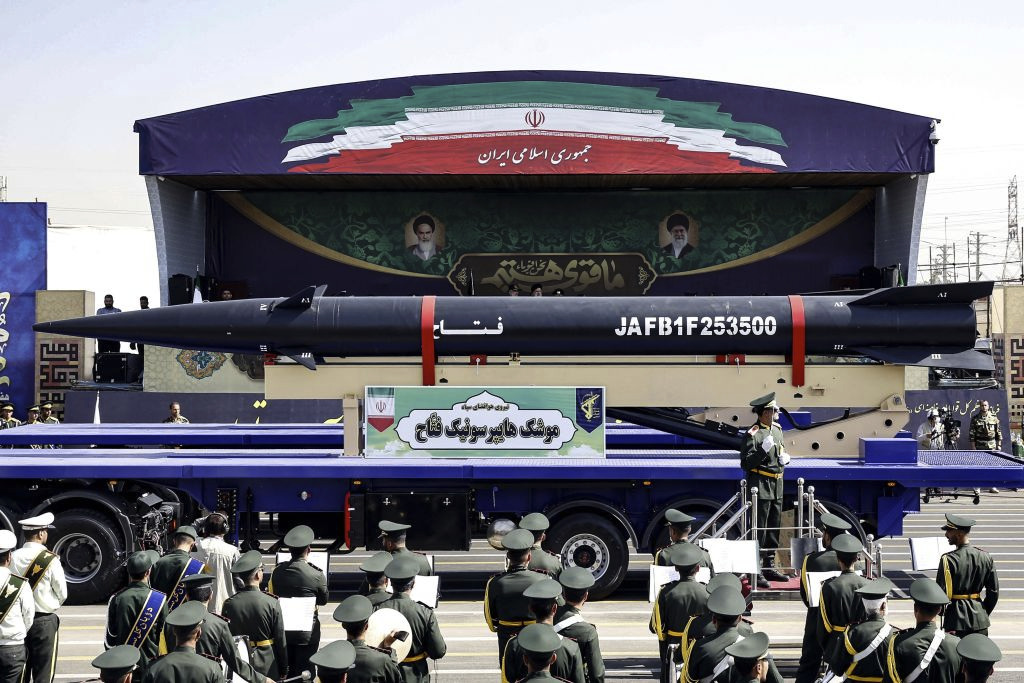
The job is finished when the regime can no longer rebuild the missile, drone, and proxy networks that allow it to threaten the region. Pictured: A Fattah hypersonic ballistic missile is displayed during the annual military parade in Tehran, on September 22, 2023. (Photo by AFP via Getty Images)

Yesterday, the Islamic Republic of Iran launched a new wave of drone and missile attacks on the United Arab Emirates, a close American ally and a country not at war with Iran. This attack came despite the ceasefire agreement agreed on April 8.

By striking the UAE, Tehran has made one point unmistakably clear: it does not respect ceasefires, international law, or restraint.

America has given Tehran many opportunities. The regime has failed every test. It lied about its nuclear ambitions, armed terrorist proxies, destabilized the Middle East, threatened shipping lanes, repressed its own people, and built a regional war machine under the cover of diplomacy.

The question is whether the United States and Israel are prepared to destroy the regime's ability to wage war, finance terror, intimidate the Gulf, and blackmail the world.

The objective is not war against the Iranian people. The Iranian people are the first victims of the Islamic Republic. The objective is to destroy the regime's military, financial, political, and coercive architecture.

The strategic mistake of past policy has been to treat Tehran as a difficult but ultimately manageable negotiating partner. In reality, the regime is a revolutionary security system. Its priority is survival, regional intimidation, and ideological expansion. Weakness encourages it. Concessions finance it. Delay makes the next confrontation more dangerous.

A regime that attacks the UAE today will continue to threaten shipping lanes tomorrow. A regime that survives every crisis with its command structure intact can later test American forces more directly. Each incomplete response teaches Tehran that escalation works.

The United States must therefore move beyond crisis management. Reopening the Strait of Hormuz is necessary but not sufficient. Hormuz is the only instrument of Iranian coercion. The core problem is the regime that uses Hormuz, proxies, missiles, drones, terrorism, and ceasefire violations as tools of pressure.

The Islamic Revolutionary Guard Corps (IRGC) is the regime's central operating system. It commands domestic repression, exports terrorism, manages proxy warfare, controls strategic industries, and protects the ruling elite. Its missile infrastructure, drone production, naval harassment capabilities, command centers, weapons pipelines, and links to foreign militias must be disabled. Temporary degradation is not enough. The regime's ability to rebuild must also be targeted.

The second pillar is the economic architecture that sustains the regime. The Islamic Republic is kept alive by banks, ports, shipping networks, exchange houses, oil smuggling, front companies, gold channels, foundations, privileged merchants, and commercial collaborators. Individual sanctions against commanders are no longer sufficient. Washington must shift to network destruction: mapping, exposing, sanctioning, seizing, and disrupting the commercial universe that feeds the IRGC and the ruling class.

The third pillar is the proxy network. Iran often avoids direct accountability by fighting through militias, terrorist cells, cyber units, and regional clients. That model must be broken. Any Iranian-backed group that threatens American forces, Israel, the Gulf states, or the Abraham Accords countries must understand that the cost will not stop with the proxy. It must reach the regime that arms, trains, funds, and directs it.

The fourth pillar is internal repression. A regime that jails women, executes protesters, tortures dissidents, and silences students cannot be trusted to honor international agreements. The Iranian people must hear a clear message: America's conflict is not with them, but with the system that has stolen their country and converted its national wealth into missiles, militias, corruption, and fear.

The attack on the UAE is a warning. Tehran is testing whether America will defend its allies, protect global commerce, and impose costs beyond symbolic retaliation. It is testing whether President Donald Trump will allow the regime to violate a ceasefire, attack a US ally, and still survive another crisis with its essential machinery intact. That cannot happen.

The job is not finished when Hormuz reopens. It is finished when Iran's regime can no longer threaten Hormuz. The job is not finished when sanctions are announced. It is finished when the regime's financial arteries are cut. The job is not finished when one missile launcher is destroyed. It is finished when the regime can no longer rebuild the missile, drone, and proxy networks that allow it to threaten the region.

The United States has tried patience, warnings, diplomacy, and restraint. Iran has answered with deception, missiles, drones, proxy warfare, and now an attack on the UAE in violation of the ceasefire understanding. Now the answer must be strength.

The Islamic Republic must not be managed, rescued, or rewarded. It must be defeated as a military machine, dismantled as an economic network, isolated as a political regime, and weakened psychologically until the architecture of terror that sustains it collapses.

This article originally appeared in The National Interest  


Ahmed Charai is the publisher of The Jerusalem Strategic Tribune and serves on the boards of directors of the Atlantic Council, the International Crisis Group, the Center for Strategic and International Studies, the Foreign Policy Research Institute, and the Center for the National Interest.

Source: https://www.gatestoneinstitute.org/22498/iran-terror-regime

Follow Middle East and Terrorism on Twitter

Breaking the Architecture of Iran's Regime Power - Ahmed Charai


by Ahmed Charai

The Iranian regime is not sustained by ideology alone. It is sustained by money, contracts, ports, banks, smugglers, foundations, front companies, privileged merchants, terrorist proxies, and commercial collaborators. Washington... must target the networks that feed it.


  • For decades, Tehran has delayed, promised, denied, escalated, and recalibrated — all while rebuilding its capabilities... and preserving the machinery of regime survival.

  • The Iranian regime is not sustained by ideology alone. It is sustained by money, contracts, ports, banks, smugglers, foundations, front companies, privileged merchants, terrorist proxies, and commercial collaborators. Washington... must target the networks that feed it.

  • The regime does not move money through uniforms and official titles. It moves money through family members, front companies, exchange houses, shipping firms, insurance brokers, commodity traders, gold dealers, charities, banks, and offshore accounts. Every one of these channels must be mapped, exposed, and disrupted.

  • [W]holesalers, currency dealers, gold traders, import-export operators, shipping intermediaries, and commercial families who help the IRGC evade sanctions, manipulate markets, launder money, or finance repression should face direct consequences.

  • The objective is not to destroy Iranian commerce. The objective is to liberate it from the regime.

  • The [US] strategy should ...reward defection.

  • [T]he regime's networks do not stop at Iran's borders. They extend across the region through proxies, terrorist cells, cyber units, propaganda platforms, and intelligence operations.

  • The Abraham Accords should not only be a diplomatic framework. They should become a protected strategic architecture against Iranian coercion.

  • The message to the Iranian people must remain clear: the conflict is not with Iran as a nation, nor with Persian civilization, nor with ordinary families struggling to survive. The target is the regime's theft of Iran's economy. Iran is not poor because it lacks resources. Iran is poor because the Islamic Republic has converted national wealth into repression, missiles, militias, corruption, and foreign adventurism.

  • Hormuz must be reopened, but the regime's economic, financial, military, and proxy networks must be dismantled.

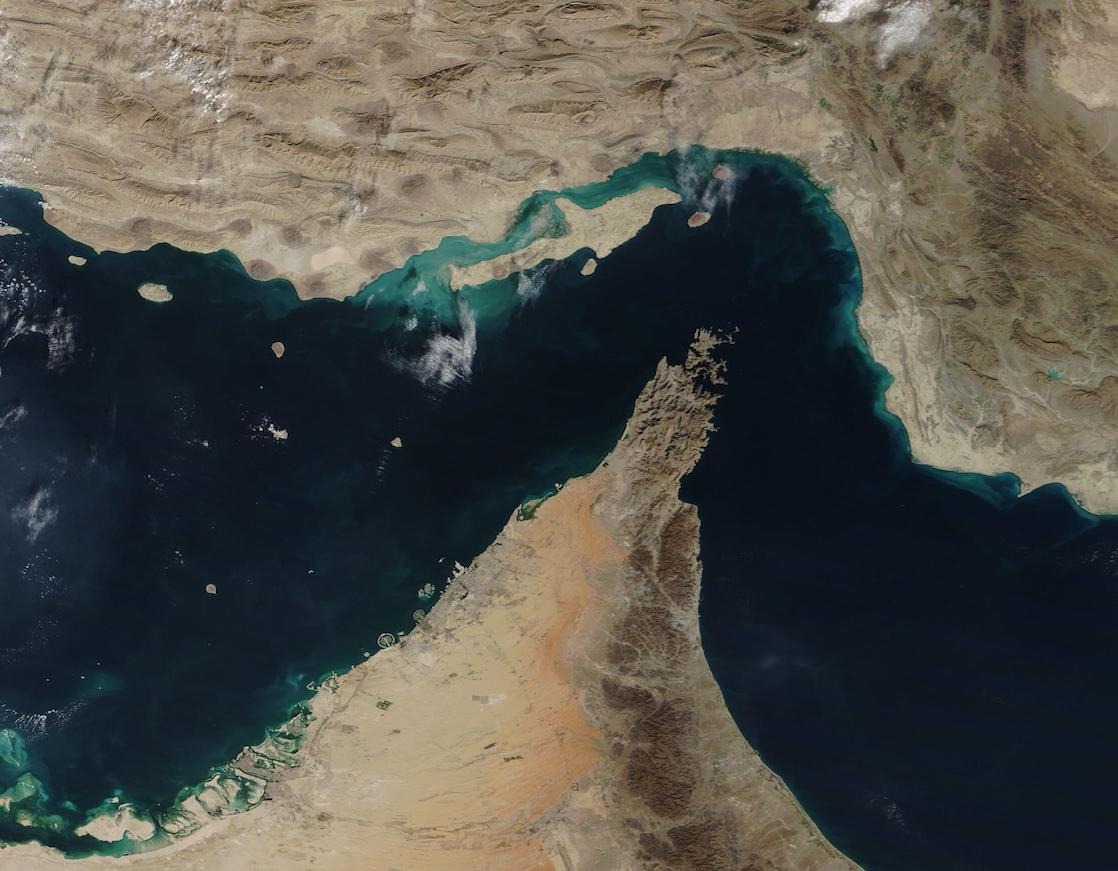
The regime does not move money through uniforms and official titles. It moves money through family members, front companies, exchange houses, shipping firms, insurance brokers, commodity traders, gold dealers, charities, banks, and offshore accounts. Every one of these channels must be mapped, exposed, and disrupted. Pictured: The Strait of Hormuz as seen from NASA's Terra satellite (Image source: MODIS Land Rapid Response Team, NASA GSFC)

As the United States moves to reopen the Strait of Hormuz and restore freedom of navigation, Washington must not lose sight of the larger strategic reality: Hormuz is not the core issue. It is the latest instrument of Iranian blackmail.

The Islamic Republic of Iran has long mastered the politics of manipulation. It uses propaganda to project strength, disinformation to confuse public opinion, threats to intimidate the region, and negotiations to buy time. For decades, Tehran has delayed, promised, denied, escalated, and recalibrated — all while rebuilding its capabilities, consolidating its networks, and preserving the machinery of regime survival.

This is one of the regime's most effective methods: turning the original problem upside down.

At the beginning, the issue was Iran's nuclear program, its ballistic missiles, its terrorist proxies, and the future of the regime itself. Today, Tehran wants the world to discuss something else: how to reopen the Strait of Hormuz, how to avoid energy disruption, how to prevent escalation, and how to negotiate a temporary exit from the crisis. This is not diplomacy. It is strategy.

The regime creates a crisis, then demands to be treated as the indispensable party to solving it. It threatens regional stability, then asks for recognition when it reduces the threat. It uses escalation to shift the agenda from accountability to de-escalation.

Washington should not be fooled again.

The United States and its allies have tried nearly every approach: engagement, sanctions relief, warnings, indirect negotiations, limited pressure, and diplomatic patience. None has changed the essential nature of the Islamic Republic. The regime has used time not to moderate, but to adapt. It has used diplomacy not to reform, but to survive. That is why the next phase of Western strategy must begin from a different premise.

The Iranian regime is not sustained by ideology alone. It is sustained by money, contracts, ports, banks, smugglers, foundations, front companies, privileged merchants, terrorist proxies, and commercial collaborators. To weaken it, Washington must move beyond targeting only the men who command the regime. It must target the networks that feed it.

Break the economic architecture, and the political architecture begins to crack.

The Islamic Republic is not merely a government. It is an ecosystem of coercion. The clerics provide ideological cover. The Revolutionary Guards provide force. The security services provide repression. The propaganda machine provides fear. But the economic networks provide oxygen.

Without that oxygen, the system cannot breathe.

Iran today remains dangerous, but it is not strong. It can still threaten shipping lanes, activate proxies, repress its citizens, and destabilize its neighbors. But these are not signs of confidence. They are symptoms of a regime that has lost the ability to inspire, persuade, or govern.

The Islamic Republic survives by turning loyalty into a business model. Those who serve the regime receive contracts, licenses, access to foreign currency, import privileges, protection, and immunity. Those who oppose it face exclusion, surveillance, prison, exile, or death.

This is not ideological strength. It is organized corruption protected by violence.

At the center of this system stands the Islamic Revolutionary Guard Corps. The IRGC is not only a military institution. It is an economic empire, a political machine, a sanctions-evasion network. Its influence extends through construction, energy, ports, telecommunications, transport, procurement, smuggling, banking, and foreign operations.

To weaken the IRGC, it is not enough to sanction commanders. The commercial universe that sustains them must be dismantled.

The regime does not move money through uniforms and official titles. It moves money through family members, front companies, exchange houses, shipping firms, insurance brokers, commodity traders, gold dealers, charities, banks, and offshore accounts. Every one of these channels must be mapped, exposed, and disrupted.

This requires a shift from individual sanctions to network sanctions.

The same logic applies to the Bazaar. The United States and its allies should not punish Iran's merchant class as a whole. Many ordinary merchants are themselves victims of inflation, corruption, currency collapse, and the IRGC's domination of trade. But regime-linked commercial networks operating inside and around the Bazaar must be treated as part of the regime's survival structure.

There must be a clear distinction between legitimate private commerce and collaboration with the regime economy. Ordinary traders should be separated from the system. But wholesalers, currency dealers, gold traders, import-export operators, shipping intermediaries, and commercial families who help the IRGC evade sanctions, manipulate markets, launder money, or finance repression should face direct consequences.

The objective is not to destroy Iranian commerce. The objective is to liberate it from the regime.

Pressure must also create incentives for separation. Business figures who break with the IRGC economy, expose sanctions-evasion channels, reveal corruption, or stop financing the regime's machinery should have pathways to avoid punishment. The strategy should not only punish loyalty. It should reward defection.

That is how economic pressure becomes political pressure.

But the regime's networks do not stop at Iran's borders. They extend across the region through proxies, terrorist cells, cyber units, propaganda platforms, and intelligence operations.

The recent dismantling of Iran-linked networks in the UAE and Bahrain should be treated as a strategic warning. These were not isolated incidents. They were symptoms of a broader Iranian method: use commerce as cover, finance as oxygen, proxies as weapons, and regional instability as leverage.

The United States should therefore intensify intelligence cooperation with regional partners targeted by Iranian-backed networks, especially countries that have joined the Abraham Accords. These states should receive stronger intelligence-sharing, cyber defense, maritime protection, counterterrorism coordination, financial-investigation support, and early-warning capabilities.

The Abraham Accords should not only be a diplomatic framework. They should become a protected strategic architecture against Iranian coercion.

The message to the Iranian people must remain clear: the conflict is not with Iran as a nation, nor with Persian civilization, nor with ordinary families struggling to survive. The target is the regime's theft of Iran's economy. Iran is not poor because it lacks resources. Iran is poor because the Islamic Republic has converted national wealth into repression, missiles, militias, corruption, and foreign adventurism.

Reopening the Strait of Hormuz is necessary. But it is not enough. Freedom of navigation must not become a substitute for strategic clarity. The United States should not allow Tehran to transform a crisis it created into a diplomatic escape route. Hormuz must be reopened, but the regime's economic, financial, military, and proxy networks must be dismantled.

The Islamic Republic survives because repression is financed, loyalty is purchased, corruption is protected, and national wealth is privatized by the regime's guardians. That fortress can be dismantled.

Break the money machine, break the proxy machine, and the political machine begins to fail.

This article originally appeared in the Jerusalem Strategic Tribune  


Ahmed Charai
is the Chairman and CEO of World Herald Tribune, Inc., and the publisher of the Jerusalem Strategic Tribune, TV Abraham, and Radio Abraham. He serves on the boards of several prominent institutions, including the Atlantic Council, the Center for the National Interest, the Foreign Policy Research Institute, and the International Crisis Group. He is also an International Councilor and a member of the Advisory Board at the Center for Strategic and International Studies.

Source: https://www.gatestoneinstitute.org/22496/iran-regime-power

Follow Middle East and Terrorism on Twitter

Netanyahu holds top-level consultations as Israel readies for collapse of Iran truce - Akiva Van Koningsveld, Amelie Botbol


by Akiva Van Koningsveld, Amelie Botbol

If Iran decides to fight over passage through the Strait of Hormuz, “it will mean a return to hostilities,” a security source said.


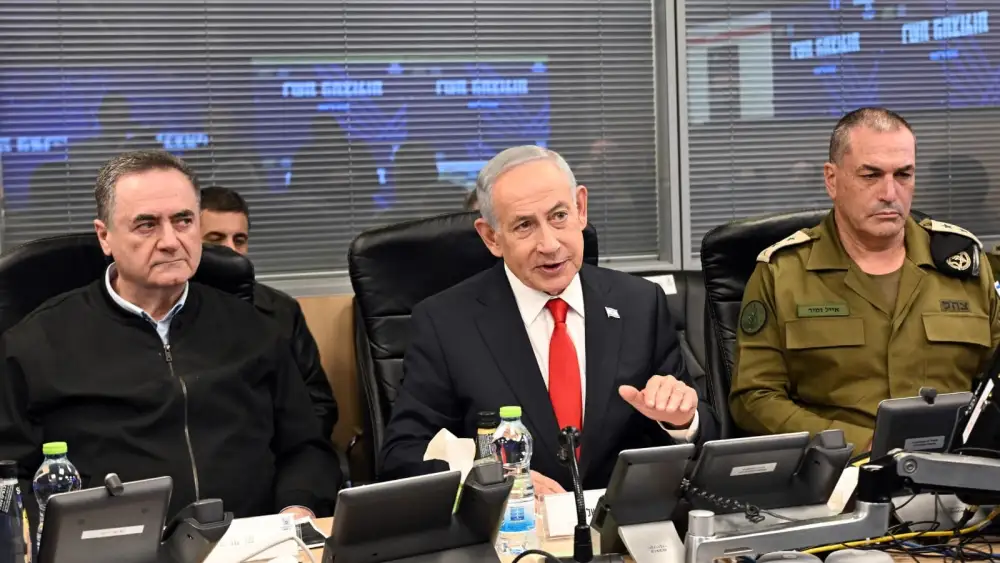
Israeli Prime Minister Benjamin Netanyahu, flanked by Defense Minister Israel Katz and Chief of Staff Lt. Gen. Eyal Zamir, conveys a message to the Iranian people from the Israeli Air Force command center, March 17, 2026. Credit: Haim Zach/GPO.

Israeli Prime Minister Benjamin Netanyahu held top-level security talks on Monday to prepare for the collapse of the ceasefire between Iran and the United States, officials told the Channel 12 News outlet on Tuesday.

Monday evening’s consultations with senior political and security officials deliberately excluded some Cabinet ministers to prevent leaks, according to the Hebrew outlet.

“We are aware of the possible implications of the American action, including renewed Iranian hostilities against Israel,” said one unnamed official, referencing U.S. President Donald Trump’s “Project Freedom” to ensure the free flow of commercial shipping through the Strait of Hormuz.

Tehran launched missile and drone attacks on the United Arab Emirates on Monday for the first time since the U.S.-brokered ceasefire took effect last month, moderately injuring three.

Also on Monday, the U.S. military sank seven Islamic Revolutionary Guard Corps boats in the Strait of Hormuz after a South Korean cargo vessel came under Iranian fire.

An anonymous Israeli security source who spoke to Channel 12 said that, “until now, the ball was in Trump’s hands—now it has moved to the Iranians.”

“If they decide to fight over passage through the Strait of Hormuz, it will mean a return to hostilities,” the source added.

Tally Gotliv, a lawmaker for Netanyahu’s ruling Likud Party, told JNS on Monday evening that Trump was “managing the situation very wisely.”

“After a 40-day joint coalition campaign against Iran, he identified the critical issue for Tehran—the Strait of Hormuz—and that is where he stepped in and maintained pressure,” said Gotliv.

“Iran is making proposals, and he is rejecting them because he understands that Iran must not be allowed to entrench a form of tyranny or maintain control that could influence the global economy. That is why he remains engaged, showing both strength and patience,” she continued.

Iran, Gotliv told JNS, is unaccustomed to the patience currently being demonstrated by its adversaries. Israel has severely damaged Tehran’s missile systems and nuclear facilities, and has shown significant intelligence capabilities in targeting the leadership of the IRGC, she continued.

“Right now, patience is required because the negotiations are being conducted with great wisdom. Iran will no longer be able to control the Strait of Hormuz at will. Trump will not allow this and is responding accordingly,” she said.

“I believe countries around the world are recognizing the need for alternative solutions, with Israel playing a role—for example, through the port of Haifa—which would further strengthen Israel’s position,” she concluded. 


Akiva Van Koningsveld, Amelie Botbol

Akiva Van Koningsveld is a news desk editor for JNS.org. Originally from The Hague, he made the big move from the Netherlands to Israel in 2020. Before joining JNS, he worked as a policy officer at the Center for Information and Documentation Israel, a Dutch organization dedicated to fighting antisemitism and spreading awareness about the Arab-Israel conflict. With a passion for storytelling and justice, he studied journalism at the University of Applied Sciences Utrecht and later earned a law degree from Utrecht University, focusing on human rights and civil liability.  

Source: https://www.jns.org/news/israel-news/netanyahu-holds-top-level-consultations-as-israel-readies-for-collapse-of-iran-truce

Follow Middle East and Terrorism on Twitter

Supreme Court allows Voting Rights ruling to take effect immediately - Misty Severi


by Misty Severi

Supporters of the Supreme Court ruling urged the court to allow it to take effect immediately so Louisiana has time to redraw the maps, but opponents urged the court to push it until after the election because voting in the primary had begun.


The Supreme Court decided Monday to let its recent ruling limiting a key part of the Voting Rights Act take effect early instead of holding it for a month, per tradition. 

The Supreme Court last week narrowed the scope of Section 2 of the Voting Rights Act to bar race-based districts, ruling that Louisiana's map was unconstitutional and prompting the state to reschedule its upcoming House primaries while its lines are redrawn.

Supporters of the Supreme Court ruling urged the court to allow it to take effect immediately so Louisiana has time to redraw the maps, but opponents urged the court to push it until after the election because voting in the primary had begun.

The court's ruling was unsigned but Justice Samuel Alito wrote in a concurring opinion that Louisiana should not have to use a map found to be unconstitutional and there is still time for a new map to be redrawn, according to USA Today. 

Justice Ketanji Brown Jackson said in a dissenting opinion that the court's decisions have "spawned chaos" in the south.

“To avoid the appearance of partiality here, we could, as per usual, opt to stay on the sidelines and take no position by applying our default procedures,” Jackson wrote. "But, today, the Court chooses the opposite.”

Louisiana officials said that the high court's timeline for the new map does not matter and that it will be able to redraw the maps regardless of when it takes effect.


Misty Severi
is a news reporter for Just The News. You can follow her on X for more coverage.

Source: https://justthenews.com/government/courts-law/supreme-court-allows-voting-rights-ruling-take-effect-immediately

Follow Middle East and Terrorism on Twitter

U.S. Supreme Court’s landmark voting rights ruling ignites redistricting scramble ahead of midterms - Just the News


by Just the News

The Supreme Court’s April 29 decision in Louisiana v. Callais narrows the scope of the Voting Rights Act and sends Republican-led states rushing to redraw congressional maps.


The Supreme Court recently handed down one of its most consequential voting rights decisions in decades, striking down Louisiana’s congressional map in a 6–3 ruling that significantly curtails the power of Section 2 of the Voting Rights Act of 1965. The decision in Louisiana v. Callais, written by Justice Samuel Alito and joined by Chief Justice John Roberts and Justices Clarence Thomas, Neil Gorsuch, Brett Kavanaugh, and Amy Coney Barrett, has already triggered a rush of political condemnation and legislative action across the country, with governors calling special sessions and primaries being suspended in the final stretch before the 2026 midterm elections.

What the Court decided

The case centered on a Louisiana congressional map drawn in 2024 that included two majority-Black districts, created after years of court-ordered redistricting. A three-judge federal panel had previously struck down the map as an unconstitutional racial gerrymander, finding that the map’s second majority-minority district—which stretched roughly 250 miles from Shreveport in the northwest corner of the state to Baton Rouge in the southeast, connecting pockets of Black voters across several cities—was drawn with race as the predominant factor.

The Supreme Court agreed. Writing for the majority, Justice Alito framed the ruling as a correction of courts that had “sometimes applied” the Court’s own precedents “in a way that forces States to engage in the very race-based discrimination that the Constitution forbids.” The majority held that while compliance with the Voting Rights Act could theoretically serve as a compelling interest in redistricting, it did not require Louisiana to add the second majority-Black district in this instance and therefore could not justify the race-based line-drawing the map employed.

Not struck down, but standards heightened

Critically, the Court did not strike down Section 2 of the Voting Rights Act outright, as some legal observers had suspected might happen. However, it dramatically raised the bar for plaintiffs challenging maps under the law, requiring proof of “present-day intentional racial discrimination regarding voting” rather than allowing courts to infer discrimination from statistical disparities or historical patterns. The ruling also reworked the 40-year-old framework from Thornburg v. Gingles (1986), which had long guided lower courts in evaluating claims of minority vote dilution.

The three liberal justices—Sonia Sotomayor, Elena Kagan, and Ketanji Brown Jackson—dissented in sharp terms. Civil rights organizations condemned the ruling in stark terms. NAACP President Derrick Johnson said in a statement that the decision is a “devastating blow to what remains of the Voting Rights Act [...] The Supreme Court betrayed Black voters, they betrayed America, and they betrayed our democracy.”

A decision years in the making

The path to Wednesday’s ruling was long and winding. The underlying dispute began after Louisiana redrew its congressional districts following the 2020 census, initially creating only one majority-Black district. Federal courts found that this map likely violated Section 2 and ordered Louisiana to add a second. When the legislature complied by drawing the contested SB8 map, a separate group of plaintiffs—white voters who argued the new district constituted an illegal racial gerrymander—successfully challenged it before a different federal appellate panel.

The cases were consolidated at the Supreme Court as Louisiana v. Callais. After initial oral arguments in March 2025, the Court took the unusual step of ordering reargument for the following term, instructing all parties to address the broader constitutional question of whether creating a second majority-minority district violated the Fourteenth or Fifteenth Amendments. Notably, the state of Louisiana itself switched sides during that interval, filing a brief arguing that all race-based redistricting is unconstitutional. The Court ultimately issued its decision on the last day of April.

Southern governors react and mobilize

Within hours of the ruling, Republican governors across the South began positioning their states to take advantage of the new legal landscape. 

Louisiana Gov. Jeff Landry and Attorney General Liz Murrill announced Thursday that the state would suspend its May 16 primary elections to give the legislature time to draw a new, compliant map. The move drew immediate controversy, as mail-in ballots had already been sent to overseas and early-voting residents. Landry’s administration defended the decision as necessary to preserve the integrity of the eventual map.

Tennessee Gov. Bill Lee called a special legislative session on Friday, directing lawmakers to convene as soon as possible. “After consultation with the Lieutenant Governor, Speaker of the House, Attorney General, and Secretary of State, I believe the General Assembly has a responsibility to review the map and ensure it remains fair, legal, and defensible,” Lee said. The target is widely understood to be the Memphis-area 9th Congressional District, the state’s sole Democratic seat, held by Rep. Steve Cohen. Tennessee’s state code prohibits mid-decade redistricting, meaning lawmakers would first have to repeal that provision before redrawing any lines. President Trump amplified the call, posting that the move “should give us one extra seat” and urging Lee to “push hard.” 

In Alabama, Gov. Kay Ivey initially took a more cautious posture on Wednesday, citing ongoing litigation stemming from the 2023 Allen v. Milligan decision, in which the Supreme Court had ordered Alabama to create a second majority-Black district. “While we are not in a position to have a special session at this time, I hope in light of this new decision, the court is favorable to Alabama,” Ivey said. 

By Thursday, Alabama had filed an emergency motion seeking to lift a federal injunction that had blocked the legislature’s preferred maps. And on Friday, Ivey reversed course and called a special session to begin Monday. Alabama Attorney General Steve Marshall said the state “will act as quickly as possible” to apply the Callais ruling and “ensure that our congressional maps reflect the will of the people, not a racial quota system the Constitution forbids.”

Mississippi Gov. Tate Reeves announced that a redistricting session would be held 21 days after the ruling. His initial call was technically focused on the state’s Supreme Court districts, but Republican operatives in the state said congressional redistricting could be added to the agenda—potentially targeting the state's heavily Democratic 2nd Congressional District, held by Rep. Bennie Thompson. Reeves was less measured than some of his peers in his public reaction. “First Dobbs. Now Callais. Just Mississippi and Louisiana down here saving our country!” he posted on social media.

Kemp: "Electoral maps that reflect the will of the voters, not the will of federal judges"

Georgia Gov. Brian Kemp signaled that his state would not redraw its maps before November but acknowledged change was coming. “The Supreme Court’s decision in Louisiana v. Callais restores fairness to our redistricting process and allows states to pass electoral maps that reflect the will of the voters, not the will of federal judges,” Kemp said. “Voting is already underway for the 2026 elections, but it’s clear that Callais requires Georgia to adopt new electoral maps before the 2028 election cycle.” 

South Carolina Gov. Henry McMaster also weighed in, suggesting his state would examine its options in light of the ruling.

No state moved more swiftly than Florida. Gov. Ron DeSantis had been anticipating the Callais ruling for months, calling a special legislative session in late April specifically to redraw the state’s congressional map. When the decision dropped on Wednesday, Florida lawmakers were already mid-session. Both chambers approved DeSantis’ new map the following day— the Florida House on an 83–28 vote, the Senate 21–1 — with the entire process from map proposal to passage taking just three days and drawing criticism from Democrats who noted that previous redistricting efforts had included weeks of public hearings. 

The new map is designed to give Republicans up to four additional congressional seats by targeting Democratic-leaning districts in the Tampa Bay area, greater Orlando, and the Miami metropolitan area. “This is a great day,” said Republican state Rep. Alex Andrade after the House vote. “I got to read [the Callais decision], and it perfectly summarizes exactly why we could, and should, change our 2022 maps.”

The map does not entirely eliminate the state’s two majority-Black districts, but it does weaken their boundaries. DeSantis framed the map as correcting an improperly apportioned system, telling Fox News that it “more fairly represents the makeup of Florida today.” 

Democrats and voting rights groups immediately announced plans to file suit once the governor signs the legislation. Legal experts noted that Florida’s state constitution contains a “Fair Districts” amendment that explicitly prohibits partisan gerrymandering.

What’s at stake

Callais could prove to be the decisive thumb on the scale. Analysts estimate that if Republican-led states successfully redraw their maps in states like Alabama, Tennessee, Florida, and Mississippi, the GOP could net anywhere from one to nine additional House seats in 2026 alone—potentially expanding the party’s existing majority. 

The obstacles, however, are formidable. Time is the most pressing constraint: several states have primaries scheduled in May and June, with filing deadlines long since passed and early voting already underway. Courts may also intervene to block new maps before they take effect, and any freshly drawn district lines are certain to face immediate legal challenges. 

Civil rights advocates have vowed to fight the ruling on every front. The NAACP Legal Defense Fund said the decision “eviscerated Section 2 of the Voting Rights Act,” while FairVote declared that the ruling imposes “a new test for drawing districts that makes it nearly impossible for voters of color to win fair representation.” Congressional Democrats have called for legislation to restore Section 2’s protections, though such efforts face little prospect of advancing in the current Congress.

For now, the immediate fight is in state legislatures, courtrooms, and election offices—playing out in real time just months before an election that will determine who controls the House of Representatives. 


Just the News

Source: https://justthenews.com/government/courts-law/supreme-courts-landmark-voting-rights-ruling-ignites-redistricting-scramble

Follow Middle East and Terrorism on Twitter

Newsom faces a series of setbacks that could complicate a potential 2028 presidential run - Nicholas Ballasy


by Nicholas Ballasy

The state's budget deficit could land anywhere between $20 billion and $30 billion


California Democratic Gov. Gavin Newsom is facing a series of political and policy challenges that critics argue amount to a string of late-stage setbacks for his administration that could damage his potential 2028 presidential run.

Conservatives recently secured enough support to place a voter ID initiative on the fall ballot in California, which was an outcome that would have been unlikely in the state just a few years ago.

A yes vote on the ballot measure would "require voters to present a government-issued ID for in-person voting or provide the last four digits of a government-issued ID designated during voter registration for mail-in voting," according to Ballotpedia.

"Voters are not required to present a government-issued ID when voting; and voters must attest to their citizenship under penalty of perjury and provide identifying information when registering; election officials are not required to use government data to verify those attestations or to report citizenship verification rates," Ballotpedia also noted.

The development adds to mounting pressure on Newsom as California confronts a significant budget shortfall. 

The budget deficit could land anywhere between $20 billion and $30 billion, according to the latest reports.

At the same time, the state’s high-speed rail project has been scaled back amid escalating costs and delays, fueling criticism about Newsom's fiscal management.

The California High-Speed Rail Authority missed a key deadline of May 1 to "submit a report to the Legislature about the long-delayed project and its estimated cost of $126.2 billion," according to The Center Square.

“The authority now anticipates a revised timeline for adoption of the business plan, with board consideration at its planned June 1, 2026 meeting and transmittal to the legislature on that same day,” a spokesperson with the High-Speed Rail Authority said. 

“This adjustment will allow the authority to better align the business plan with the fiscal year 2026-27 budget cycle. This alignment is particularly important given ongoing project delivery discussions that will help inform the final business plan," the spokesperson added.

Legal uncertainty is also on the horizon after the Supreme Court ruling on Louisiana's maps. 

Experts have said that California's Prop 50 is now in shambles due to the ruling. 

Matt Rexroad, president of the firm Redistricting Insights, said the ruling won't immediately halt the Prop 50 map prior to the 2026 election this November. However, he said it opens the door to the high court blocking the maps in the future. 

“It changes redistricting law substantially and will likely impact most every corner of California,” said Rexford.

“Some of the first lines that came out of the author of the maps, Paul Mitchell, was ‘We’ve created a new VRA district down in in Los Angeles County,'” said Rexroad. “Well, if it’s a VRA district, it wasn’t done for a political gerrymander. It was a racial gerrymander because that is now not allowed.” 


Nicholas Ballasy

Source: https://justthenews.com/government/state-houses/newsom-faces-series-setbacks-could-complicate-potential-2028-presidential

Follow Middle East and Terrorism on Twitter

'Israel, the Dreyfus of Nations': Interview with Joël Rubinfeld – Part 1 - Grégoire Canlorbe


by Grégoire Canlorbe

In Brussels, given its specific demographics, antisemitism has become an electoral asset.


  • We have been living through a kind of endless "Dreyfus trial," but with one major difference: the state has replaced the person. In the past, Dreyfus stood on trial; today, the Jewish state has taken his place.

  • The "prosecutors" in this permanent trial are UN agencies, "rapporteurs," Amnesty International, Human Rights Watch, Oxfam, the Human Rights League — which, ironically, was founded in 1901 in the wake of the Dreyfus Affair. There is also a whole ecosystem of organizations claiming to speak in the name of human rights, along with their relays in the newsrooms, in academia, in activist and cultural circles, and on the street.

  • When I see these so-called "pro-Palestinian" demonstrators, it seems as if many of them could not care less about the Palestinians. If they were truly pro-Palestinian, they would first call for the eradication of Hamas, which is the poison and the nightmare first of all of the Palestinian people. The poison, unfortunately, was widely embraced by Hamas's absolute majority (56%) in the last Palestinian legislative elections in 2006.

  • This fever in the streets weighs on political leaders. The great problem is that many of them think in purely arithmetical terms. They tend to hold a simplistic, and therefore racist, view of communities: "Jews" equals "Israel," and "Muslims" equals "Palestine." Once they do the math, skewed conclusions follow.

  • The votes are what make the situation almost irreversible. It has been called "Islam's Rule of Numbers": when you are in the minority, you keep relatively inconspicuous, but the larger one's percentage of the population becomes, the more assertive one gets.

  • Look at Nigeria, which is roughly half Muslim and half Christian. Since at least 2000, there has been an extremist Muslim genocide underway....

  • In Brussels, given its specific demographics, antisemitism has become an electoral asset.

  • [S]ome might hope, out of terror and a wish to survive, that if they are just nice to their tormentor, he will soon come around and see how "good" they are. They can even convince themselves that if they agree with their tormentor, he will appreciate and admire them –then they will no longer be in danger. They might even adopt his point of view, like a child whose parent is angry with him. It is easier for him to think that the parent is right and the problem must be with himself. It is an attempt to cope with, or somehow get through, a terrifying situation -- and it usually does not work. Tormentors torment; it is what they like to do. As the psychiatrist Dr. Kenneth Levin noted in his important book, The Oslo Syndrome: The Delusions of a People Under Siege, a child is dependent on his parent, and wants to feel safe. "If I just stop wetting my bed," the child might think, "then maybe he will like me." It is too terrifying to see that, say, the bed-wetting may not be the problem, just a pretext. We saw in World War II that people can rationalize anything.

  • Deep down, I think they know that this break amounts to a surrender: they leave Judaism to escape the pressure, to gain social respectability.... But from that point on, the Jews who remain — those who continue to embrace their identity despite the attacks—become an unbearable mirror for them.

  • Every Jew who stands firm reflects back an uncomfortable image to them. The one who has broken away sees himself as a coward... so now he turns against the Jews to show everyone else, "See? I am not like them. I am good! Now do you like me?"

"The 'prosecutors' in this permanent trial are UN agencies, 'rapporteurs,' Amnesty International, Human Rights Watch, Oxfam, the Human Rights League..." — Joël Rubinfeld. Pictured: Rubinfeld (center) helps carry a banner at a march against anti-Semitism in Brussels on December 10, 2023. (Photo by Simon Wohlfahrt/AFP via Getty Images)

Joël Rubinfeld is a founding member and president of the Belgian League Against Antisemitism and president of the Jewish Coalition for Kurdistan. He was president of the Coordinating Committee of Jewish Organizations in Belgium, vice-president of the European Jewish Congress, and co-chairman of the European Jewish Parliament.

Canlorbe: You have described Israel as the "Dreyfus of nations." What does that mean?

Rubinfeld: Since October 7, 2023, we have been living through a kind of endless "Dreyfus trial," but with one major difference: the state has replaced the person. In the past, Dreyfus stood on trial; today, the Jewish state has taken his place.

The "prosecutors" in this permanent trial are UN agencies, "rapporteurs," Amnesty International, Human Rights Watch, Oxfam, the Human Rights League — which, ironically, was founded in 1901 in the wake of the Dreyfus Affair. There is also a whole ecosystem of organizations claiming to speak in the name of human rights, along with their relays in the newsrooms, in academia, in activist and cultural circles, and on the street.

When I see these so-called "pro-Palestinian" demonstrators, it seems as if many of them could not care less about the Palestinians. If they were truly pro-Palestinian, they would first call for the eradication of Hamas, which is the poison and the nightmare first of all of the Palestinian people. The poison, unfortunately, was widely embraced by Hamas's absolute majority (56%) in the last Palestinian legislative elections in 2006.

These demonstrations in Europe — 300,000 people in London, 100,000 in Brussels, and hundreds of thousands in France—remind me, of the marches in the early 1930s in Germany. Of course, it is not an exact historical equivalence, but there seems a resemblance in the occupation of public space, crowd dynamics, and the pressure exerted on political life. There are also the hateful slogans, yesterday targeting Jews; today the Jewish state and its supporters: "Death to the Jews" becomes "Death to Israel," "Boycott the Jews" becomes "Boycott the Zionists," the new polite, "politically correct" word for hating Jews.

This fever in the streets weighs on political leaders. The great problem is that many of them think in purely arithmetical terms. They tend to hold a simplistic, and therefore racist, view of communities: "Jews" equals "Israel," and "Muslims" equals "Palestine." Once they do the math, conclusions follow.

In Belgium, there are about 30,000 Jews and 900,000 Muslims—a ratio of one to thirty. Cynics conclude: "I have everything to lose by defending Jews or Israel, and everything to gain by supporting 'Palestine'—by riding the wave of what Hamas has become in the activist imagination—because it wins me votes."

In Brussels, given its specific demographics, antisemitism has become an electoral asset. Not the "old" antisemitism of those nostalgic for Auschwitz, but a revised, contemporary form—one that equates Gaza with Auschwitz.

The votes are what make the situation almost irreversible. It has been called "Islam's Rule of Numbers": When one is in the minority, one keeps relatively inconspicuous, but the larger one's percentage of the population becomes, the more assertive one gets. The expert on Islam, Raymond Ibrahim, notes that in Europe, where Muslim minorities are larger than in the United States, open violence has become common – but always framed as a grievance because that word pacifies the West. He cites London, where Muslims currently make up about 15% of the population, the murderer of Fusilier Lee Rigby, with his hands still covered in blood declared , "We swear by the almighty Allah we will never stop fighting you until you leave us alone.... You will never be safe," and then blamed the murder on avenging the deaths of Muslims at the hands of British troops.

Look at Nigeria, which is roughly half Muslim and half Christian. Since at least 2000, there has been an extremist Muslim genocide underway, in which, according to data from a 2025 report from the International Society for Civil Liberties and Rule of Law (Intersociety), "since 2009, approximately 185,009 Nigerians have been killed, including 125,009 Christians and 60,000 'liberal Muslims'" -- and they continue to be killed.

For months, I have been warning that we may be living through the last time there is a "significant" Jewish community in Belgium. It is already tiny: 0.25% of the Belgian population. Possibly, by 2050 it will no longer be 30,000, but under 10,000. The exodus is already underway—and accelerating.

Canlorbe: How do you explain those Jews who join the prosecutors in this "Dreyfus trial" against Israel?

Rubinfeld: It is an intriguing question. My interpretation of "Jewish self-hatred"—a concept popularized a century ago by Theodor Lessing in Der jüdische Selbsthaß (Jewish Self-Hatred)—is that the history of the Jewish people is anything but quiet. To be a Jew has meant, for 4,000 years, being confronted with the most delirious accusations: causing famines, poisoning wells, desecrating the host, spreading epidemics, "ritual murder," controlling the world... However deranged they may be, any accusations, it seems, can find an audience, at times even a majority one. As someone put it: "The problem is not what Jews are, but what you are ready to believe they are."

To live as a Jew in an environment where one is blamed for everything requires resilience, self-denial, and a spirit of resistance. Not everyone is capable of that. Rather than holding firm, some might hope, out of terror and a wish to survive, that if they are just nice to their tormentor, he will soon come around and see how "good" they are. They can even convince themselves that if they agree with their tormentor, he will appreciate and admire them – then they will no longer be in danger. They might even adopt his point of view, like a child whose parent is angry with him. It is easier for him to think that the parent is right and the problem must be with himself. It is an attempt to cope with, or somehow get through, a terrifying situation -- and it usually does not work. Tormentors torment; it is what they like to do. As the psychiatrist Dr. Kenneth Levin noted in his important book, The Oslo Syndrome: The Delusions of a People Under Siege, a child is dependent on his parent, and wants to feel safe. "If I just stop wetting my bed," the child might think, "then maybe he will like me." It is too terrifying to see that, say, the bed-wetting may not be the problem, just a pretext. We saw in World War II that people can rationalize anything.

Sometimes one finds individuals born Jewish who break with their heritage, decide to "no longer be Jewish," and become antisemites to prove their "good faith."

Deep down, I think they know that this break amounts to a surrender: they leave Judaism to escape the pressure, to gain social respectability, sometimes to protect their descendants. But from that point on, the Jews who remain—those who continue to embrace their identity despite the attacks—become an unbearable mirror for them.

Every Jew who stands firm reflects back to them an uncomfortable image: "I stay, I take the blows, but I remain what I am." The one who has broken away sees himself as a coward. That tension turns into aggression: he gives way to antisemitism, adopting a scorched-earth policy. He has left Judaism — so now turns against the Jews to show everyone else. "See? I am not like them. I am good! Now do you like me?"

This pattern appears in several historical examples: Nicholas Donin (13th century), a convert from Judaism and the instigator of the trial that led to the burning of the Talmud in Paris; Pablo Christiani (Paul Christian), a converted Jew who became a Dominican and took part in religious campaigns against the Jews in the 13th century, persuading Louis IX to restore the use of the rouelle—the precursor of the yellow star; Bernard Lazare, an interesting case: he authored an antisemitic work before the Dreyfus Affair, but later became one of the earliest and most steadfast defenders of the Jewish captain, stating that the affair had "saved his life"; Gilad Atzmon, a British pro-Palestinian jazz musician born in Israel and a virulent antisemite who later claimed to have converted to Christianity—without this preventing him from continuing his attacks; Karl Kraus, an Austrian anti-Dreyfusard writer who broke with Judaism and developed an obsessive critique of what he called the "Jewish press."

At bottom, all of this points to a simple idea: it is not easy to be Jewish. Some experience their identity as a burden. In the 19th century, even after emancipation and access to citizenship, strong social barriers remained. Many chose conversion not out of hostility, but out of a longing to get along, to be "like everyone else" – like the child, to be loved.

For me, to be clear, leaving Judaism is not reprehensible. I take a liberal view of the matter: one may enter, leave, choose—everyone does as they wish with their life. That being said, leaving Judaism is one thing; sliding into antisemitism is another. At that point, it becomes my problem: we are no longer dealing with a personal choice, but one has crossed over into active, sometimes fierce hostility directed at others—in this instance, against what one once was before.


Grégoire Canlorbe, a journalist, currently lives in Paris.

Source: https://www.gatestoneinstitute.org/22483/joel-rubinfeld

Follow Middle East and Terrorism on Twitter