Sunday, November 2, 2014

President Putin's Mirage of Russian Empire - Michael Curtis


by Michael Curtis


In a speech at West Point on December 5, 1962, the former U.S. secretary of state Dean Acheson candidly remarked, “Great Britain has lost an empire and has not yet found a role.  The attempt to play a separate power role … is about played out.”  The actions of President Vladimir Putin today suggest he, like Britain fifty years ago, is searching even more desperately for a role to replace the empire that ended in 1991.

That search had involved both aggressive military activity in Ukraine and the creation of a trade and political bloc that is supposed to stretch from China to the borders of the European Union (EU).  Emulating the EU itself, the bloc claims to be a step toward the creation of a supranational union of sovereign states, but it may be the forerunner of an empire.

The Russian empire was a reality, starting with the annexation of Novgorod in 1478, then Kazan in 1552, Astrakhan in 1554, east to Siberia in 1582, west to Ukraine in 1667, and south to the area of warm water and agriculture, to Crimea in 1783, where Catherine the Great set up the naval base for the Black Sea Fleet at Sevastopol and developed the coal and iron industries.

Russia therefore has been bifocal – part Western, part Slavic.  A symbolic synthesis might be the ballets of the Ballets Russes, devised under the direction of Sergei Diaghilev – part tradition, part Western modernity.  Yet Putin’s political objectives are clear, based on his statement in 2005 that the demise of the Soviet Union, the USSR, in 1991 was the greatest geopolitical catastrophe of the 20th century.  In his eyes, for the Russian people, it became a genuine tragedy.

The tragedy would be overcome be creating two new structures in December 1991.  The Commonwealth of Independent State (CEI), a group of sovereign and independent states, was established.  It now has 9 members, and 2 participants, one of which is Ukraine, which does not regard itself as a member.  The real successor to the USSR is the Russian Federation, now a body of 22 republics including Crimea in 2014 but not Ukraine.

Putin aims to end that “genuine tragedy” by assertion of Russian power.  In his address on June 17, 1992 to a joint meeting of the U.S. Congress, Boris Yeltsin said it was Russia that had put an end to the imperial policies of the past and was the first country to recognize the independence of the Baltic Republics.  His chosen successor, Putin, however, held that after the difficulties of the 1990s Russia was a major player on the international stage.  Russia should count because of its size and its natural resources.  If it could not challenge the U.S., or prevent the expansion of NATO that now includes member-states of the USSR, at least it could be on an equal footing with the EU.

To reach that level, Putin organized a series of agreements among friendly states, leading to a Customs Union on January 1, 2010, with hopes that it would spread from Europe to the Pacific.  His ambitions have grown, resulting in the signing on May 29, 2014 of a Eurasian Economic Union (EEU) among Russia, Belarus, and Kazakhstan.  It is officially due to go into effect on January 1, 2015.  The three countries in the EEU account for 173 million people and have a GDP of $2.4 trillion.  But the EEU is unlikely to attract other countries, except Kyrgyzstan and Armenia.

It is membership of this projected union that has led to the conflict with Ukraine.  Putin realized that the European Union was interested in stronger relations with Ukraine and had proposed an association agreement on March 30, 2012.  Ukraine would become integrated into Europe.  Such an event would make the Eurasian Economic Union less powerful.  As a result of Putin’s pressure, the then president of Ukraine, Viktor Yanukovych , in February 2014 decided not to sign the association agreement. In return, Putin promised a stimulus of $15 billion and cheaper gas exports to Ukraine.

Russian troops then marched into Crimea and annexed the area, and then aided the pro-Russian insurgents in areas in eastern Ukraine to rebel against the official government.  Two of those areas held referendums and declared independence in May 2014.  Fighting between these insurgents, helped by Russian “freelance volunteers,” and Ukraine have resulted in at least 4,000 killed and 5,000 injured.

Russia has acted illegally in annexing Crimea and invading Ukraine.  Putin may have envisaged Ukraine in the future joining NATO, which would then have access to the naval base in Sevastopol.  The NATO meeting at Newport on September 5, 2014 denounced that invasion.  But the Western response has been inadequate.  It has so far been limited to travel bans, to prevent export of certain services and technological materials to Russia, and imposing economic sanctions on businesses, banks, senior officials, and individuals said to be close to Putin and part of the ruling elite in Russia.  The West should do more.

Admittedly, the issue is mixed.  Ukraine has a long history and has been under the control of foreign powers for most of that time, including the brutal regime of Stalin, whose agricultural policies of collectivization led to the Holodomor, or extinction by hunger in 1932-33 during which millions of Ukranians died of famine.   The country is divided by language, politics, and ethnicity.  About one third of its population speaks Russian as a native language, and many others speak it.  About one sixth is believed to be ethnic Russians.

Yet the presence of this important minority group and protection of it do not justify Putin’s actions.  Nor do these excuse the timidity of European response.  For the West, the economic dilemma is understandable for two reasons.  More than one quarter of Europe’s gas comes from Russia, and half of that goes through Ukraine.  Four countries get all their gas from Russia.  Yet the EU countries need not submit to any Russian threat to cut off the energy supplies.  In a world now flush with oil, and with Saudi Arabia maintaining its large production, alternative oil is readily available, as is liquefied natural gas that comes from Lithuania. 

But a second reason is the considerable business, about $350 billion, between the EU countries and Russia, far more than U.S.-Russian trade.  German exports to Russia in 2013 amounted to $51 billion.  Total EU-Russian trade is about $275 billion.

Ukraine, though having only 46 million citizens, is the largest state in Europe and the breadbasket for the area, a source of food for Russia.  It has shown in the October 26, 2014 election that the pro-Western political parties dominate the political system.  Indeed, no member of the Communist Party was elected to the parliament.  The EU should appreciate that Ukraine has taken a stand different from other groups and units – Transnistria, South Ossetia and Abkhazia, Russian minorities in Baltic states, and the areas of Donbass and Lugansk – that are associated with Russia.

Western countries must help ensure the independence of Ukraine.  More than one commentator has remarked that without Ukraine, Russian cannot be a Eurasian empire.  The creation of such an empire is dangerous, as Russian actions have shown.  Pressure is being exerted by Russia on Moldova and Georgia not to join the EU.  Almost certainly, Russian separatists in Eastern Ukraine were responsible for using a surface-to-air missile on July 17, 2014 to shoot down Malaysian aircraft MH 17, killing all 298 people on board.  It is admirable that Russia seeks regional cooperation with its neighbors, but it is menacing if Russian domination of that cooperation means the recreation of empire.


Michael Curtis

Source: http://www.americanthinker.com/articles/2014/10/president_putins_mirage_of_russian_empire.html

Copyright - Original materials copyright (c) by the authors.

Israel must act to Secure her safety, even at the cost of International Isolation - Caroline Glick


by Caroline Glick


Originally published by the Jerusalem Post. 


BN-FH124_1029GL_P_20141029214811
Yehudah Glick has spent the better part of the last 20 years championing the right of Jews to pray on the Temple Mount in Jerusalem – Judaism’s holiest site. On Wednesday night, the Palestinians sent a hit man to Jerusalem to kill him.

And today Glick lays in a coma at Shaare Zedek Medical Center.

Two people bear direct responsibility for this terrorist attack: the gunman, and Palestinian Authority President and PLO chief Mahmoud Abbas. The gunman shot Glick, and Abbas told him to shoot Glick.

Abbas routinely glorifies terrorist murder of Jews, and funds terrorism with the PA’s US- and European-funded budget.

But it isn’t often that he directly incites the murder of Jews.

Two weeks ago, Abbas did just that. Speaking to Fatah members, he referred to Jews who wish to pray at Judaism’s holiest site as “settlers.” He then told his audience that they must remain on the Temple Mount at all times to block Jews from entering.

“We must prevent them from entering [the Temple Mount] in any way…. They have no right to enter and desecrate [it]. We must confront them and defend our holy sites,” he said.

As Palestinian Media Watch reported Thursday, in the three days leading up to the assassination attempt on Glick, the PA’s television station broadcast Abbas’s call for attacks on Jews who seek to enter the Temple Mount 19 times.

While Abbas himself is responsible for the hit on Glick, he has had one major enabler – the Obama administration. Since Abbas first issued the order for Palestinians to attack Jews, there have been two terrorist attacks in Jerusalem. Both have claimed American citizens among their victims. Yet the Obama administration has refused to condemn Abbas’s call to murder Jews either before it led to the first terrorist attack or since Glick was shot Wednesday night.

Not only have the White House and the State Department refused to condemn Abbas for soliciting the murder of Jews. They have praised him and attacked Israel and its elected leader. In other words, they are not merely doing nothing, they are actively rewarding Abbas’s aggression, and so abetting it.

Since Abbas called for Palestinians to kill Jews, the White House and State Department have accused Israel of diminishing the prospect of peace by refusing to make massive concessions to Abbas. The concessions the Americans are demanding include accepting the ethnic cleansing of all Jews from land they foresee becoming part of a future Palestinian state; denying Jews the rights to their lawfully held properties in predominantly Arab neighborhoods; and abrogating urban planning procedures in Jewish neighborhoods in Jerusalem built within the areas of the city that Israel took control over from Jordan in 1967.

The US claims that it has great influence over the Palestinians. If this is true, then as Fatah’s official celebrations of Glick’s attempted murder make clear, that influence is being intentionally exercised in a negative way. The Americans are encouraging the Palestinians to be more violent, more radical and more extreme in their demands of Israel and propagation of Jew-hatred.

The Obama administration is abetting Palestinian terrorism today. And it is doing so after it spent last summer siding with Hamas and its state sponsors Qatar and Turkey in its illegal war against Israel.

Moreover, it is important to note that the most outrageous statements the administration has made to date against Israel came after the first terrorist attack in Jerusalem directly inspired by Abbas’s call to murder Jews.

The most outrageous statements the administration has made about Israel came of course this week with The Atlantic’s Jeffrey Goldberg’s report that senior unnamed Obama administration officials called Prime Minister Benjamin Netanyahu “a chickensh*t” and a “coward.” They also described an administration in a state of “red hot anger” against Netanyahu and his government. Those statements were made after three-month old Chaya Zissel Braun, an American baby, was murdered by a Palestinian terrorist in Jerusalem in an Abbas-incited attack.

The most distressing aspect of Goldberg’s quotes is that in and of themselves, these profane, schoolyard bully personal attacks against Israel’s elected leader were the mildest part of the story.

The most disturbing thing about the gutter talk is what they tell us about Israel’s role in Obama’s assessments of his political cards as they relate to his nuclear negotiations with Iran.

The senior administration officials called Netanyahu a coward because, among other reasons, he has not bombed Iran’s nuclear installations.

And now, they crowed, it’s too late for Israel to do anything to stop Iran.

They are happy about this claimed state of affairs, because now Obama is free to make a deal with the Iranians that will allow them to develop nuclear weapons at will.

The obscene rhetoric they adopted in their characterization of Netanyahu didn’t come from “red hot anger.” It was a calculated move. Obama knows that he has caved in on every significant redline that he claimed he would defend in the nuclear talks with Iran.

Obama has chosen to demonize Netanyahu and castigate Israel now as a means to transform the debate about Iran into a debate about Israel. The fact that the trash talk about Netanyahu was a premeditated bid to capture the discourse on Iran is further exposed by the fact that Obama has refused to take any action against the officials who made the statements.

He isn’t going to punish them for carrying out his policies.

Obama knows that after next week’s midterm elections, he will likely be facing a Republican-controlled House and Senate. He has no substantive defense against attacks on his policy of enabling the world’s most active state sponsor of terrorism to acquire nuclear weapons. The threat a nuclear- armed Iran poses to the US is self-evident to most people who pay attention to foreign affairs.

Since he can’t win the substantive debate, he wants to change the subject by pretending that the only country that opposes Iran’s nuclear weapons program is Israel, which, his senior advisers insinuated to Goldberg, was apparently bluffing about its danger. After all, if it was a reason for concern, Netanyahu would have bombed Iran three years ago rather than try to accommodate Obama.

As a consequence, any congressional opposition to his deal makes no sense and therefore must be the result of the nefarious Israel’s lobby’s control of Congress. Loyal Americans, like Obama, must stand up to the cowardly, power grabbing, warmongering Jews, led by the coward in chief Netanyahu.

In other words, in castigating Netanyahu and Israel, the Obama administration has decided to use Jew-hatred as a political weapon to defend its policies of abetting Palestinian terrorism and enabling Iran’s nuclear weapons program.

There are critical messages to the Israeli people and our leaders embedded in the Goldberg article.

First, the unbridled attacks against Israel’s democratically elected – and popular – prime minister show us that when we are faced with an inherently hostile administration, the wages of appeasement are contempt.

No Israel leader has done more to appease a US administration than Netanyahu has done to appease Obama. Against the opposition of his party and the general public, Netanyahu in 2009 bowed to Obama’s demand to embrace the goal of establishing a Palestinian state.

Against the opposition of his party and the general public, in 2010 Netanyahu bowed to Obama’s demand and enacted an official 10-month moratorium on Jewish property rights in lands beyond the 1949 armistice lines, and later enacted an unofficial moratorium on those rights.

And Netanyahu bowed to Obama’s pressure, released murderers from prison and conducted negotiations with Abbas that only empowered Abbas and his political war to delegitimize and isolate Israel.

And for all his efforts to appease Obama, today the administration abets Palestinian terrorism and political warfare.

As to Iran, Netanyahu agreed to play along with Obama’s phony sanctions policy, and bowed to Obama’s demand not to attack Iran’s nuclear installations. All of this caused suffering to the Iranian people while giving the regime four-and-ahalf years of more or less unfettered work on its nuclear program.

Netanyahu only cut bait after Obama signed the interim nuclear deal with Iran last November where he effectively gave up the store.

And for Netanyahu’s Herculean efforts to appease Obama, Netanyahu found himself mocked publicly as a coward by senior administration officials who snorted that now it is too late for him to stop Obama from paving Iran’s open road to nuclear power.

One of the assets that Netanyahu’s continuous attempts to please Obama was geared toward securing was US support for Israel at the UN Security Council. And now, according to the senior administration officials, Obama has decided to spend his last two years in office refusing to veto anti-Israel Security Council resolutions.

Before formulating a strategy for dealing with Obama over the next two years, Israelis need to first take a deep breath and recognize that as bad as things are going to get, nothing that Obama will do to us over the next two years is as dangerous as what he has already done. No anti-Israel Security Council resolution, no Obama map of Israel’s borders will endanger Israel as much as his facilitation of Iran’s nuclear program.

As unpleasant as anti-Israel Security Council resolutions will be, and as unpleasant as an Obama framework for Israel’s final borders will be, given the brevity of his remaining time in power, it is highly unlikely that any of the measures will have lasting impact.

At any rate, no matter how upsetting such resolutions may be, Goldberg’s article made clear that Israel should make no concessions to Obama in exchange for a reversal of his plans. Concessions to Obama merely escalate his contempt for us.

Bearing this in mind, Israel’s required actions in the wake of Goldberg’s sources’ warnings are fairly straightforward.

First, to the extent that Israel does have the capacity to damage Iran’s nuclear installations, Israel should act right away. Its capacity should not be saved for a more propitious political moment.

The only clock Israel should care about is Iran’s nuclear clock.

As for the Palestinians, whether Netanyahu’s willingness to stand up to Obama stems from the growing prospect of national elections or from his own determination that there is no point in trying to appease Obama anymore, the fact is that this is the only pragmatic policy for him to follow.

The proper response to the assassination attempt on Yehudah Glick is to allow Jews freedom of worship on the Temple Mount. The proper response to Obama’s nuclear negotiations is a bomb in Natanz. Obama will be angry with Israel for taking such steps. But he is angry with Israel for standing down. At least if we defend ourselves, we will be safe while isolated, rather than unsafe while isolated.


Caroline Glick

Source: http://www.frontpagemag.com/2014/caroline-glick/being-safe-while-isolated/

Copyright - Original materials copyright (c) by the authors.

A Kurdish state: A Serious Obstacle to ISIS Threat - Dr. Kobi Michael


by Dr. Kobi Michael


The Islamic State group has become a phenomenon with ripple effects that are felt in three circles: local, regional and international. On the local level, Islamic State is an existential threat to the residents of northern Syria, specifically the Kurdish minority, as well as regions in north-eastern Iraq. On the regional level, we have witnessed the enlistment of various jihadist groups joining Islamic State. And on the international level there is the ongoing phenomenon of foreigners volunteering to join Islamic State, including Western nationals.

The international coalition formed to fight Islamic State has increased the awareness of the group and cannot truly eliminate the threat. Islamic State does not have territorial continuity nor borders, it exists on "islands" throughout a large swath of land. Its fighters move from place to place, showcasing their brutality at every stop, an efficient tool in suppressing the local populace, getting new volunteers and "convincing" local groups to join it. Islamic State is also a savvy user of social media networks when it comes to spreading its message.

The fact that groups throughout the Middle East have joined arms with Islamic State, including groups in Sinai and an extremely short-lived representation in the Gaza Strip, is upsetting and could turn into a threat to Israel, especially in the case of an incident in southern Syria. 

What, if anything, can diminish this threat? It is important to note that the numerous jihadist groups are not homogenous, and there are differences, in some cases significant, in their outlook. These differences will hamper the coherence of Islamic State in the future; whenever a group joins Islamic State, it splits in two, with one portion of it turning into a different faction that opposes merging with Islamic State. Also, Islamic State's ability to capture and hold territory is very limited. It is faced with a series of obstacles: Turkey in the north, the Assad regime in Syria in the west, Shiite Iraq and Saudi Arabia in the south, and Jordan.

In this complex situation, there is a gleaming opportunity to curb Islamic State's spread and weaken the group. Creating a Kurdish state in northern Iraq and Syria, connecting the two autonomous regions, could pose a significant threat to Islamic State. The formation of a Kurdish country could be seen as historic justice for the large oppressed ethnic minority, one that is a natural ally to the West and Israel.

Maybe the Kurds' dire situation in northern Syria could create new hope. The creation of a Kurdish state could prompt the restructuring of the region's architecture, as the old one falls apart. It is quite possible that the establishment of a Kurdish state could lead to a federation-style political body, which could be an alternative method of government, based on ethnic nations as opposed to artificial ones, which demand unity and compliance between rival ethnic groups.

Prime Minister Benjamin Netanyahu publicly supported the creation of an independent Kurdish state. Perhaps now is the time for other world leaders to join that call. Maybe a change to the regional makeup will yield new opportunities for cooperation, regional security and perhaps some peace for an area plagued by crises.


Dr. Kobi Michael is a researcher and senior lecturer at Ariel University and senior analyst at the Institute for National Security Studies.

Source: http://www.israelhayom.com/site/newsletter_opinion.php?id=10437

Copyright - Original materials copyright (c) by the authors.
Qatar pares support for Islamists but careful to preserve ties - Reuters


by Reuters


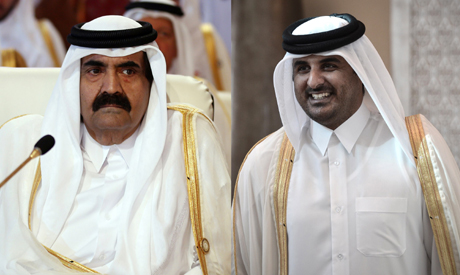
Hamad bin Khalifa , Sheikh Tamim bin Hamad al-Thani
From left to right: A March 26, 2013 file photo shows Qatar’s Emir Hamad bin Khalifa al-Thani attending the opening of the Arab League summit in the Qatari capital Doha, and his son, Qatari Crown Prince Sheikh Tamim bin Hamad al-Thani smiling as he arrives in the Bahraini capital of Manama on December 24, 2012. (AFP File Photo)
Qatar has joined the American-led coalition to fight Islamic State, yet the emirate is a haven for anti-Western groups and foreign diplomats have reported seeing cars with Islamic State logos in an affluent bay district.

Such ambiguity runs through Qatari policy.

When the United States sought allies against Islamic State in Sept, Qatar was among the Gulf Arab states that sent its warplanes into action. But while Saudi Arabia and the United Arab Emirates welcomed media coverage, Qatar was silent.

There was talk among diplomats that Qatari planes merely flew a reconnaissance mission on the first night of the attacks.

In fact, a security source close to the government said, its planes did attack Islamic State targets in Syria later in the campaign, although that has not been officially confirmed.

Diplomats and analysts said the episode showed two things:

First, Qatar's decision to join the hostilities was a pragmatic response to pressure from fellow Gulf Arabs, who have rebuked Qatar for backing Islamists during Arab Spring revolts.

Second, diplomats say, Qatar's reticence about its role suggests that it is also being careful to preserve influence with Islamist forces it believes are the long-term future.

Three years after the start of the Arab Spring, the Middle East is experiencing a backlash against political Islam, and Qatar is trimming its policies. In so doing, the contradictory nature of those policies is being exposed.

Qatar hosts the largest U.S. air base in the Middle East, owns swathes of Western real estate and is an enthusiastic customer for Western weaponry.

Yet it also provides haven to anti-Western groups such as the Afghan Taliban, Palestinian Hamas and Algeria's Islamic Salvation Front.

Their members frequent downtown shopping malls, rubbing shoulders with Western expatriates, and worship in mosques attended by Qataris and Muslim guest workers.

They live out of town in secluded districts.

North of Doha lies the town of Umm al-Amad, a huddle of farms and small mosques, which shelters a number of Syrians belonging to the al-Tawhid, one of dozens of armed Islamist factions fighting the government of President Bashar al-Assad.

Opinions that would invite the attention of the police in pro-Western Bahrain or UAE, are commonplace here.

In Umm al-Amad, the Egyptian director of a private religious school teaching young girls the Koran, said the Qatari government did not interfere with the school's teaching.

"What's happening these days is a war against Islam," she said. Then, apparently referring to Islamic State or the al Qaeda-aligned Nusra Front, she added: "Those fighters in Syria and Iraq fighting against the crusaders... have a just cause."

Suspicion

The breadth and resilience of Qatar's links to Islamist groups fuels suspicions in many other Gulf states.

Three of them - the UAE, Saudi Arabia and Bahrain - withdrew ambassadors from Qatar earlier this year in protest at what they saw as Doha's interference in their internal affairs.

That allegation - denied by Qatar - centres on Doha's backing for Egypt's Muslim Brotherhood and sister organisations that oppose the absolute rule of the Gulf's hereditary rulers.

The open rift among the Arab world's wealthiest countries has ramifications across the Middle East, because Qatar and its Gulf Arab critics find themselves backing rival forces in struggles from Libya and Egypt to Lebanon and Gaza.

Qatar has sought to soothe tensions.

In September, Qatar asked seven senior Brotherhood figures to leave the country, following months of pressure from neighbors to stop backing the Islamists.

Ibrahim Munir, a senior Brotherhood official based in London, told Reuters at the time that the departures did not mean a rupture in ties between Qatar and the Brotherhood.

However diplomatic sources in the Gulf say that to placate Saudi Arabia, another batch of Islamists including Brotherhood members would be leaving soon.

Other sources of dispute are Youssef al-Qaradawi, a prominent cleric associated with the Brotherhood, and Doha-based Al Jazeera news channel, which is accused by some Gulf states of promoting the Brotherhood, a charge the channel denies.

Qaradawi, whose sermons have often criticised Egypt's rulers, has spoken less frequently in public in recent months. Still, mistrust remains.

"The Muslim Brotherhood expulsions helped, and Qaradawi has been quiet," said a senior Western diplomat in the Gulf,

"But the Qataris are trying to do the absolute minimum."

Like members of foreign Islamist groups, Brotherhood people live in Qatar on condition that they do not cause any political disruption to the country's security or leadership.

But there is a grey area in the deal that worries Qatar's Gulf Arab neighbours.

"Qatar says that these Islamists cannot engage in political activity, but that's only related to their (Qatari) security, not to others' (security).

"Islamists here use Doha as an active launch pad for their media campaigns, communications and logistics which directly have an impact on the security of other Arab states," said an Arab diplomat in Doha.

Logos And Ransoms

Western diplomats in Doha say they have spotted cars with Islamic state logos driving around West Bay, one of Qatar's most affluent areas where the majority of expats live and work.

"Of course we were alarmed when we saw the logos, but we were told they were being watched closely by authorities and there isn't much to worry about," said a diplomat who spotted the logos.

The recent pragmatic tone in Qatari policy, diplomats and analysts say, is attributable to its new ruler, Sheikh Tamim bin Hamad al-Thani. His style is in contrast to that of his father Sheikh Hamad, who abdicated last year after steering the nation to global prominence in media, sports, finance and energy.

The extent to which Tamim is prepared to reduce ties to Islamists is not clear.

"The new emir is pragmatic, he doesn't want trouble ... sometimes you need to stay quiet for a while, to come back stronger," said a Qatari government consultant.

Qatar's critics say Doha continues to back militant Islamists in Libya and elsewhere and pays ransoms to militants for the release of hostages, helping to enrich radical groups, a charge Qatar denies.

Qatar's relationship with Nusra Front is a case in point.

Qatar was more hesitant than fellow Gulf states about the bombing campaign in Syria, in part because it was keen to avoid targeting sites of Nusra, an al-Qaeda affiliate with which Qatar has kept contact since the start of the uprising against Assad, said the security source close to the Qatari government.

Nusra was hit by U.S. planes on the campaign's first night.

Militant funding was brought up by Saudi Arabia's King Abdullah when Sheikh Tamim flew to meet him in Jeddah earlier this month to try to mend the rift in relations.

A senior Jeddah-based source said the king questioned Qatar's methods of freeing hostages and asked for tighter control on individuals in Doha financing "terrorist" groups.

Qatari officials deny paying ransom for hostages, but Western diplomatic sources in Doha say otherwise. Payment for captives is discouraged by Saudi Arabia and Washington.

A Qatari source involved in charity work and coordination of freeing political hostages told Reuters that in the case of the 13 Greek Orthodox nuns who were released in March by Islamist fighters in Syria, Qatar had paid for their release.

In August a German cabinet minister accused Qatar of financing IS militants. The United States has repeatedly expressed concern about funding from Arab states.

To try to put an end to the criticism, the Gulf state's leadership has spoken out.

"What is happening in Iraq and Syria is extremism and such organizations are partly financed from abroad, but Qatar has never supported and will never support terrorist organizations," said Sheikh Tamim during a visit to Germany in September.

The emir later issued a law to regulate charities involved in politics, as well as those that sent money abroad or received foreign financing, to try to crack down on any terror financing.

But in Qatar, what constitutes extremism is open for debate.


Reuters

Source: http://english.ahram.org.eg/NewsContent/2/8/114549/World/Region/Qatar-pares-support-for-Islamists-but-careful-to-p.aspx

Copyright - Original materials copyright (c) by the authors.

Obama vs. Netanyahu: Who’s the Real Coward? - Ari Lieberman


by Ari Lieberman


Young Obama Young Bibi On May 8, 1972, while “Barry” Obama was soaking up the Hawaiian sun, Palestinian terrorists (who else?) hijacked Sabena flight 571 from Vienna to Tel Aviv. A plan was quickly devised to rescue the hostages utilizing Israeli Special Forces of the vaunted Sayeret Matkal. Benjamin Netanyahu and his brother Yoni, both members of Sayeret Matkal, volunteered for the operation and fiercely argued with each other over which one would participate. The final decision was left to Sayeret Matkal’s commander, Ehud Barak, who chose Bibi.

The commandos boarded the plane dressed as airline technicians and quickly overpowered and neutralized the terrorists while securing the hostages. Bibi was wounded during the assault and while carried off to the tarmac was greeted by his brother who half-jokingly stated, “You see, I told you, you shouldn’t have gone.” Yoni was tragically killed four years later while leading the successful Entebbe rescue mission.

Obama of course never served in the military and one could even say harbors disdain for our servicemen and women. While Benjamin Netanyahu was charging terrorists and freeing hostages, Obama was busy smoking marijuana and attending prep school. The contrast between these two leaders, one fearless and self-sacrificing, the other perpetually narcissistic and self-absorbed, could not be greater.

Obama’s minions, however, see it differently. The Atlantic’s Jeffrey Goldberg in a recent column revealed the deep level of animus the administration holds for Netanyahu with senior White House aides disparaging the prime minister with boorishly offensive pejoratives. One profanity in particular – “chickensh*t” – attributed to a senior official, has caused a storm and stands out as rather ironic considering Obama’s lack of military service and pusillanimous foreign policies.

Goldberg’s analysis of Israel’s policies with respect to both Iran and the so-called settlements is fundamentally flawed on several levels but the salient point of the article concerning Obama’s visceral dislike for Netanyahu remains accurate. What is perhaps even more disturbing than the current state of affairs between the two leaders is that Obama wishes to air the dirty laundry, which in turn emboldens Israel’s enemies like the Islamic Republic of Iran and encourages Palestinian intransigence. There is no question that the official, who courageously hid behind the veil of anonymity, knew that Goldberg would write about rupture and disclose the abusive and undiplomatic terminology employed.

Goldberg, accurately described by Ben Shapiro as a man whose nose is permanently embedded in Obama’s colon, places most of the blame for spiraling relations squarely on Netanyahu. While acknowledging that the creation of a Palestinian state at present would be dangerous, Goldberg nevertheless chides Netanyahu for initiating construction beyond the Green Line and continues with the tired line that such initiatives undermine the prospects for a so-called “two-state solution.”

Omitted in Goldberg’s analysis, however, is the fact that it was Netanyahu who in 2009 declared an unprecedented unilateral 10-month settlement freeze in the hope of spurring on the anemic “peace process.” Also omitted is the fact that in 2013 at Obama’s urging, Netanyahu phoned the Islamist anti-Semite Recep Tayyip Erdogan to apologize for the deaths of IHH terrorists during the Mavi Marmara incident. Both of these goodwill gestures, extremely unpopular among Netanyahu’s political base, backfired.

In the case of the former, instead of embracing Netanyahu’s bold peace initiative, Mahmoud Abbas, dragged his heels for nine months before responding, ensuring that there would be virtually no time for substantive progress. In the case of the latter, Netanyahu’s apology was reciprocated with an avalanche of anti-Semitic vitriol.

On Iran, Obama has caused the unravelling of an effective sanctions regimen, all while formulating a plan that virtually ensures and legitimizes Iranian enrichment initiatives, despite that regime’s penchant for lying through its teeth. Obama knows that his plan won’t sit well with Congress and is therefore formulating ways to sidestep the legislative branch. That maneuver not only demonstrates contempt for U.S. allies, but, more troubling, contempt for the United States Constitution.

If Obama, by employing profanity toward Israel’s prime minister, was attempting to influence Israeli political discourse, he is in for a rude awakening. Israelis cherish their 66-year, mutually beneficial relationship with the United States, which is based on shared moral values and strategic interests. But as has been demonstrated countless times, Israelis are no pushovers and don’t take kindly to threats. Menachem Begin’s popularity soared when he faced off against Jimmy Carter and the same thing will likely happen in this unfortunate and needless confrontation.

As for the anonymous senior official, my experience has taught me that there is no greater coward than the anonymous complainer.  He will whine and moan behind the veil of anonymity but in this instance has brought yet more shame and disgrace upon a quickly unraveling administration unable to cope with its own disastrous shortcomings and failures.


Ari Lieberman

Source: http://www.frontpagemag.com/2014/ari-lieberman/obama-vs-netanyahu-whos-the-real-coward/

Copyright - Original materials copyright (c) by the authors.
The "Explosive Growth" of Jihadism in the Netherlands - Soeren Kern


by Soeren Kern


"The increasing momentum of Dutch jihadism poses an unprecedented threat to the democratic legal order of the Netherlands." — Dutch intelligence service, AIVD.
"For adherents unable or unwilling to join the armed struggle in Syria or elsewhere, social media offers a form of involvement that allows them to identify themselves as jihadists... without actually having to fight. After all, the movement also considers 'dawah' -- preaching the 'call to Islam" -- a form of jihad." — Dutch intelligence service, AIVD.
"Social media has made it possible for a person to go far more quickly from being a passive recipient of jihadist propaganda messages to a sympathizer and then a supporter... Some are also known to have been involved in atrocities, such as beheading prisoners... social media has changed the structure of the and cohesions of the jihadist movement... it has taken on the characteristics of a swarm (in the group behavior sense)." — Dutch intelligence service, AIVD.
"The jihadist movement can only genuinely be disrupted, in a way that prevents the emergence of new guiding figures and structures, if such efforts [not one-off actions] are maintained over an extended period." — Dutch intelligence service, AIVD.
"Dutch jihadists are convinced that the caliphate is not some utopian dream but an achievable reality for Syria and other Muslim nations -- and even for the Netherlands." — Dutch intelligence service, AIVD.

The home-grown jihadist movement in the Netherlands is experiencing sudden and explosive growth, according to a new report published by the Dutch intelligence service, AIVD.

The Dutch jihadist movement is not only growing in size and strength, it is also becoming increasingly open and provocative, both online and on the streets, according to the report, which warns that the increasing momentum of Dutch jihadism poses an unprecedented threat to the democratic legal order of the Netherlands.

The 58-page report, entitled "The Transformation of Jihadism in the Netherlands: Swarm Dynamics and New Strength," provides an in-depth analysis of the various factors underlying the "new dynamism" of the jihadist phenomenon.

According to the AIVD, the Dutch jihadist movement began a process of far-reaching change in late 2010, when several jihadists were prevented from leaving the Netherlands to join fellow jihadists in Pakistan and Somalia.

Their subsequent interactions with Dutch police and judicial authorities prompted the jihadists and other members of their networks to improve their modus operandi, which eventually led to a wholesale internal professionalization of the movement.

At the same time, Dutch jihadists began adopting propaganda methods developed by fellow jihadists in Britain. Inspired by Islam4UK, a now-banned jihadist group founded by the British Islamist firebrand Anjem Choudary, Dutch jihadists launched their own activist movements, namely Sharia4Holland and Behind Bars/Street Dawah (Straat Dawah).

"By making use of activist techniques like demonstrations and leafleting to disseminate provocative jihadist propaganda openly, these groups were able to mobilize some fellow Muslims and attract new recruits," according to the AIVD. "Many young people, in particular, found a way of venting their jihadist ideals through such activities."

Social media has added another entirely new dynamic into Dutch jihadism. Beyond allowing far more intensive flows of information and communications between jihadists, both domestically and internationally, social media has also changed the nature of those flows.

Before the emergence of social media, information flowed vertically (hierarchical) from one to many. By contrast, information on social media platforms such as Facebook and Twitter flows horizontally (peer-to-peer) from many to many, thus greatly expanding opportunities for interactivity. According to the AIVD:
"Jihadists are constantly influencing one another through social media. Young people undergoing radicalization trawl Facebook in search of like-minded individuals and post jihadist material on their own profiles, thus influencing their own circle of friends. On Twitter, jihadists debate quite openly with each other and with their critics, who often face abuse or worse. They also post photographs of Dutch fighters in Syria on Facebook, which are then shared by members of jihadist communities. Lectures are announced as Facebook events, too, so that potential attendees can see whether people they know will be there as well. The Dutch jihadist world has become simultaneously large, small and fast-moving."
Social media has also enhanced jihadist recruitment efforts:
"For adherents unable or unwilling to join the armed struggle in Syria or elsewhere, such activity provides another form of involvement that allows them to identify themselves as jihadists. It is their way of being part of 'Syria,' or the 'holy war' in general, without actually having to fight. After all, the movement also considers 'dawah'—preaching the 'call to Islam'—a form of jihad. This parity strengthens the links between those who stay at home to practice dawah and those who leave to fight.
"There is no doubt that the chance of coming into contact with jihadism—particularly on social media—has increased substantially in recent years. Consequently, it has become possible for a person to go far more quickly from being a passive recipient of its propaganda messages to a sympathizer and then a supporter. There is also a real danger that such new 'online jihadists' might continue radicalizing to the point where they actually commit acts of violence or leave for a conflict zone. In fact, this is exactly how many of the Dutch fighters now in Syria came to be there. They evolved very quickly from followers at home to front-line jihadists. The AIVD has established that a large proportion of them have been trained in Syria in the use of weapons and have taken part in actual combat. Some are also known to have been involved in atrocities, such as beheading prisoners."
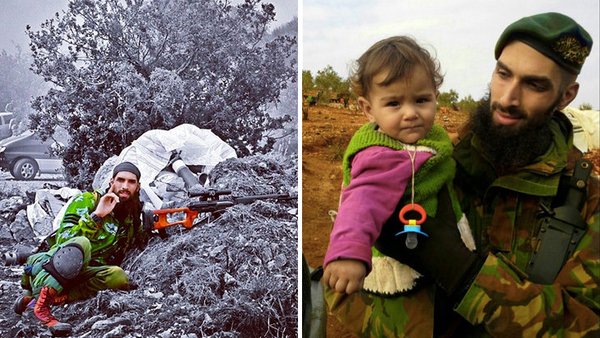
The Dutch-Turkish jihadist known as Yilmaz, pictured in Syria, has proven adept at the use of social media for jihadist "public relations".

According to the AIVD, social media has changed the structure and cohesion of the jihadist movement in the Netherlands to such an extent that it has taken on the characteristics of a "swarm" (in the group behavior sense of the word). This means that it is highly decentralized, with numerous individual elements that are largely autonomous. Collectively, however, they maintain their cohesion and direction almost as if a single entity.

"The jihadist swarm may be very dynamic and changeable, but it still knows how to move like one tightly ordered body, despite sometimes seeming capricious and unpredictable," the report says, adding:
"The upshot of all this is that government attempts to tackle particular jihadist individuals or structures will probably have considerably less effect now upon the movement as a whole than they previously would have done. Particularly when they are one-off actions. The movement can only genuinely be disrupted, in a way that prevents the emergence of new guiding figures and structures, if such efforts are maintained over an extended period."
In addition to the internal and structural developments that have transformed Dutch jihadism, several contextual factors, both domestic and international, have also contributed to its growth.

Domestically, Dutch Salafism has undergone an important ideological shift.

Salafism is a movement that calls on Muslims to return to the form of Islam that was practiced at its inception. Its adherents reject many of the ideas and customs that have become part of Islamic tradition in subsequent centuries.

Present-day Salafism has three main strands: apolitical, political and jihadi. All three pursue the same ultimate objective: the establishment of a society based solely upon the tenets of "pure" Islam.

Unlike their jihadi counterpart, however, the apolitical and political strands argue that the principal means of reaching this goal should be "dawah," or the "call to Islam" in the form of preaching and proselytization. By contrast, jihadi Salafism prioritizes the "necessity" of violent jihad.

In recent years, a new group of dawah Salafist preachers has emerged in the Netherlands who are more radical than their predecessors, and who have effectively blurred the lines between dawah Salafism and jihadism. The AIVD explains:
"Theirs is a radical message, which not only promulgates intolerance but also smooths over the ideological differences between dawah Salafism and jihadism in respect of the legitimacy of the 'holy war.' These preachers do not consider themselves part of a movement separate from that of the jihadis (a distinction the established dawah Salafists draw far more clearly). And it is they who exert the greatest influence over young people with jihadist tendencies or sympathies.
"Due in part to the emergence of preachers operating outside the established non-violent tradition, dawah Salafism has now become something of a breeding ground for jihadism in the Netherlands."
Internationally, the conflict in Syria, which began in March 2011, has acted as a catalyst, amplifying the effects of all of the other developments to produce an explosive growth of jihadism in the Netherlands.

According to the AIVD, the large numbers of Dutch jihadists travelling to Syria show that "this particular conflict has significantly reduced the barriers to active participation in jihad." It adds that the propaganda generated by the conflict is fuelling the growth of an "assertive Dutch jihadism" in which jihadist groups are "deliberately pushing at the boundaries of what is permissible under Dutch law."

The AIVD concludes with a warning:
"Already, reports of jihadists' supposed progress in Syria in establishing an Islamic caliphate under Sharia law are having a visible effect in the Netherlands, in that they are further radicalizing backers of that ultimate goal. Emanating primarily from groups like [the Islamic State], such stories convince supporters and sympathizers that the caliphate is not some utopian dream but an achievable reality for Syria and other Muslim nations—and even for the Netherlands."

Soeren Kern is a Senior Fellow at the New York-based Gatestone Institute. He is also Senior Fellow for European Politics at the Madrid-based Grupo de Estudios Estratégicos / Strategic Studies Group. Follow him on Facebook and on Twitter.

Source: http://www.gatestoneinstitute.org/4835/netherlands-jihadism

Copyright - Original materials copyright (c) by the authors.

Don't give up the holiest place of all - Prof. Aryeh Eldad


by Prof. Aryeh Eldad


A day after an attempt was made on the life of activist Yehuda Glick, I was sitting in the Jerusalem District Court. A few months earlier, on a date set long ahead of time, I had submitted a petition under the Freedom of Information Law in the name of Professors for a Strong Israel.

Jerusalem, as we know, has multiple authorities, not only judges. A number of them are responsible for issues related to the Temple Mount. The municipality must concern itself with building permits and ensuring that the planning and construction laws are enforced; the Israel Antiquities Authority is supposed to oversee what many, including the High Court of Justice, have defined as "the most important antiquities site in Israel"; and the police are supposed to enforce public order and public security. 

Between 1995 and 2001, the Temple Mount -- under the tightly closed eyes of the authorities -- was the site of one of the worst instances of antiquities vandalism in the country. The Muslim Wakf took over the huge underground spaces (4 dunams, or 43,000 square feet) known as King Solomon's Stables, and turned them into the biggest mosque in Israel. They employed enormous bulldozers to dig on the Temple Mount, and were careful to eradicate any trace of Jewish history. They cleared out hundreds of trucks' worth of debris from the holiest place to the Jewish people, including many archaeological finds that were thrown on the trash heap. 

When the extent of the destruction was discovered by citizens whose eyes -- unlike those of the authorities -- were open, the State Comptroller's Committee charged the comptroller with investigating and reporting on the matter. When the report was submitted, government representatives sought to have it classified because its publication could damage foreign relations (U.S. Secretary of State John Kerry could discover that Israel had given up sovereignty over the Temple Mount) and expose the police's approach of sitting with their hands folded or running away when a police station on the mount was set on fire. 

The full report is being kept secret from the people, or at least from those who are too lazy to Google "State Comptroller's Secret Report on the Temple Mount" and read it all. At any rate, the various authorities swore that they learned lessons from it, and are now supervising, monitoring and enforcing. There is no more damage, no more destruction, no more illegal building taking place. 

Since I, and many like me, visit the Temple Mount from time to time, I've seen that the situation is just getting worse. The destruction continues. The Arabs have dubbed the entire mount "Al-Aqsa mosque" and do whatever they like there. They build, wreck and riot, and the government in effect is giving up all its sovereignty on the mount and not enforcing the law. I know that the Arabs see the Jewish forgoing of sovereignty over the holiest place to the Jewish people as a sign that we are not truly bound to the land of Israel, and can be ousted like the Crusaders. 

A few months ago, I approached those same authorities and asked them: How many investigative visits have you held? How many construction applications have you received? And how many of those have you approved? What have you done with the criminals? The authorities replied quickly that they did not want to answer because everything was extremely sensitive and a matter of "national security." I hope that the court will limit the cynical use of this expression. Parroting the "sensitivity" of the Temple Mount gives coverage to every despicable act that dismantles our sovereignty and attacks the Jews' right to pray on the Temple Mount, giving a prize to the rioters. 

Senior police officials have already determined that Yehuda Glick is "the most dangerous person on the Temple Mount," and the police have ignored the Arab rioters, agitators, and rabble-rousers. The latest Arab terrorist just pulled the trigger. The police are trying to "contain" the Arab violence, a policy that more than anything shows a fundamental misunderstanding of the forces at work in the Jewish-Arab conflict. 

Only if we make it clear to ourselves and the rest of the world that this is the holiest place to the Jewish people and we will not give it up from fear of Arab terrorism do we have a chance to win. You don't contain terrorism -- you fight it until it is defeated. Our giving up the Temple Mount is the strongest incentive for the Islamic terrorism working against us. The Temple Mount isn't the problem. It's the solution.


Prof. Aryeh Eldad

Source: http://www.israelhayom.com/site/newsletter_opinion.php?id=10435

Copyright - Original materials copyright (c) by the authors.