Monday, August 3, 2015

Schumer leaning against Obama on Iran agreement - Rick Moran


by Rick Moran

Schumer's vote against the deal would give cover to the other dozen or so Democrats who would be inclined to vote against the agreement. And depending on how hard he lobbied against it, he could personally swing 5 or 6 Democrats his way.

Senator Chuck Schumer, considered the lynchpin in President Obama's strategy to defeat opposition to his Iran deal, is apparently leaning against supporting the agreement, according to Politico.

Schumer is being inundated with emails from an organized effort to convince him to oppose the deal, and anti-agreement forces have already spent hundreds of thousands of dollars on ads in the New York area trying to convince constituents to contact the Senator and urge him to oppose the president.
People who have spoken with the senior New York senator believe the pressure campaign is having an effect: They say there is a growing sense inside and outside the Capitol that Schumer will vote against the deal when the Senate considers it in September. The bigger question many have now is this: How hard will he push against it?
Schumer is one of about 15 Democratic senators who will decide the fate of President Barack Obama’s Iran nuclear deal in Congress. The president can afford to lose no more than a dozen Democrats on the Senate floor, and as the next Democratic leader, Schumer may be the most critical of them all.
In an interview with POLITICO, Schumer insisted he’s still weighing his vote. He said he would decide based on the merits of the deal, not lobbying from either side.
“I haven’t made up my mind,” said Schumer, who is in line to be the first Jewish Senate leader next Congress. “There are expectations all over the lot. I’m doing what I’m always doing when I have a very difficult decision: Learning it carefully and giving it my best shot, doing what I think is right. I’m not going to let pressure or politics or party get in the way of that.”
He wouldn’t say if he would forcefully advocate his position once he makes his stance clear.
“I’ve got to first decide how I’m voting,” Schumer said.
Opponents have been much louder than supporters. If that trend continues over the break at town hall meetings, it will only amplify pressure on swing Democrats to vote against the deal.
Sen. Chris Coons, who was personally lobbied by President Barack Obama and national security adviser Susan Rice to back the deal during a trip to Africa in July, said the view of the accord was about evenly split in his home state of Delaware in the first few days after the announcement. But the Democrat now says telephone calls against the deal outnumber those in favor by 10-to-1 in his state, an avalanche of opposition he has no choice but to listen to.
“I am a Democrat, and I would like to be able to support this agreement,” Coons said. “But I have serious reservations about it.”
Schumer's vote against the deal would give cover to the other dozen or so Democrats who would be inclined to vote against the agreement. And depending on how hard he lobbied against it, he could personally swing 5 or 6 Democrats his way. Conversely, if he supports the deal, the resolution opposing the agreement would be doomed after a presidential veto.

Internal Democractic politics is playing a bigger role in this debate than many thought. With Schumer in line to become the next party leader in the Senate in 2016, some back bench Democrats might want to curry favor with the New York Senator by siding with him on the deal. The more Democratic members oppose the deal, the easier it becomes for fence straddlers to vote against it.

There are about 40 days to go before Congress must vote on the agreement. The White House will steadily amp up the pressire on Schumer, convincing key donors and advisors to urge him to vote "no." Opponents of the deal will continue to grass roots campaign and intensify the TV ad buys. 

And if you're familiar with Schumer, you know he's loving every minute of all the attention he's getting.


Rick Moran

Source: http://www.americanthinker.com/blog/2015/08/schumer_leaning_against_obama_on_iran_agreement.html

Copyright - Original materials copyright (c) by the authors.

Burqa Ban Expanding In Africa - Stephen Brown


by Stephen Brown

Cameroon latest country to outlaw Islamic garment after Boko Haram suicide bombers launch string of deadly attacks.


Only a month after the Muslim-majority nation of Chad announced in June a ban on the burqa and full-face veils, neighbouring Cameroon has done likewise. And for the same reason – to save lives.

Female suicide bombers wearing the Islamic garments left a trail of death and destruction in July in Cameroon, a West African nation of 22 million. Forty-three people perished in different attacks and dozens more were injured in the first suicide bombings ever to take place there.

The previous month, Chad had experienced the same devastation from suicide bombers, involving both men and women dressed in the all-concealing religious clothing. A twin suicide attack on June 15 in the country’s capital of N’Djamena, the first also for Chad, left 38 people dead. Another suicide attack in N’Djamena on July 12, involving a male bomber disguised in the Islamic dress, claimed an additional 15 lives. Chad announced its burqa and veil ban right after the June attack.

In Cameroon, the first strike, also a twin suicide bombing, took place July 13 in Cameroon’s Muslim-majority Far North region, one of the country’s ten, semi-autonomous administrative areas. Two women dressed in “religious garments” blew themselves up in Fotokol, a Far North town bordering Nigeria. Thirteen people perished in the blasts and many more were wounded.

The next attack occurred almost two weeks later in Maroua, the Far North’s capital. Like the Fotokol attack, it was also to be a twin suicide bombing carried out by female attackers wearing Islamic garb. Their target was a popular market where one bomber succeeded in killing 20 people. It was reported another was apprehended before she could detonate her explosives. She revealed that a third accomplice was sent to the hospital to blow herself up among the medical personnel and family members of the many wounded who would have gathered there. Fortunately, she was also apprehended before fulfilling her mission. Reports state the “successful” bomber was “a nine-year old girl disguised as a beggar.”

Another terrorist strike three days later, also in Maroua, saw yet another female human bomb blow herself up at a bar patronised by locals, killing “at least 10” and injuring more than 60.

Boko Haram, which has pledged allegiance to the Islamic State, is strongly suspected of having organised the murderous assaults, although the jihadist organization has not claimed responsibility. The Nigeria-based group is known worldwide for its slaughter of innocent civilians, suicide bombings and enslavement of young women. It has killed at least 15,000 people since 2009 in a murderous jihad to establish an Islamic caliphate in Muslim-majority, northern Nigeria

Like in Chad, right after the attacks different administrative regions in Cameroon outlawed the burqa and full-face veil. The Far North was the first, as Boko Haram was concentrating its suicide attacks there. Most of Cameroon’s Muslims, who constitute 20 percent of the country’s population, reside there (Forty percent of Cameroonians are Christian, while the remainder follow traditional African religions).

Far North Governor Midjiyawa Bakari announced the ban after the July 13 attack. Bakari reported the heads of the two suicide bombers involved in that strike were found and that they “were women wearing face veils.”

“I took this measure because of the security situation prevailing in the region,” he said.

The ban was soon extended to two other regions, the Eastern and Western, although they had experienced no suicide bombings. A spokeswoman for the Western region told Agence France Press (AFP) that the ban in her district covers “the manufacturing, sale and wearing of the burqa.”

Far North authorities have also adopted other security measures in the hope of preventing further suicide attacks. Muslims, for example, are not allowed to meet “in large groups without permission,” and cars may no longer have tinted windshields. Motorbikes are also not allowed on the road at night.

“We are also systematically checking all vehicles, and controlling all luggage and the population should collaborate because there is a serious security threat to our nation,” said Bakari.

Cameroon and Chad both belong to an anti-Boko Haram coalition of African countries that includes Nigeria, Benin and Niger. Boko Haram had controlled an area of northern Nigeria “about the size of Belgium” until earlier this year when Chad and Cameroon sent troops to help Nigerian government forces cope with the insurgency. Their combined efforts won back large areas from Boko Haram, causing the jihadists to switch to guerilla tactics. The recent suicide bombings are viewed as Boko Haram’s revenge against the two nations for helping Nigeria.

Boko Haram has also been conducting for two years bloody, cross-border raids against the two states. In late July, its jihadists decapitated three Far North residents after attacking an isolated mountain village near the Nigerian border and burning a Catholic church.

The threat of suicide bombers dressed in female Islamic garb is now deemed so great that even African countries possessing small Muslim populations and having experienced no suicide attacks or “any religious extremist violence” have instituted burqa and veil bans. Congo-Brazzaville in Central Africa is a case in point. With Muslims making up less than five percent of the population, Congo-Brazzaville nevertheless banned the burqa and veil last May, being the first African country to so. The measure was described as being necessary “to prevent violent extremism.” Another African country with a small Muslim population, Gabon, did the same after the Cameroon attacks.

Viewing the expanding burqa and veil ban in Africa, it is perhaps time that Western countries consider a similar security strategy. After all, Islamic beheadings arrived in France last month. And soon after, another terrorist plot against a minor French military base that was to end with the commander’s head cut off was thwarted. Since this particular jihadist practice is now here, one can safely assume it is only a matter of time before Islamic suicide bombings involving “religious garments” will also appear within our borders. It already has in Russia – several times - and with devastating consequences.

To their credit, a few Western countries like France, Belgium, and parts of Switzerland have banned burqas and veils, but mainly for societal rather than security reasons. But paralysed by political correctness, intimidated by accusations of Islamophobia, many Western governments will likely not act in this direction until there is blood on the ground, if even then. And if such is the case, then those leaders who neglected to take timely action should themselves don a burqa or veil – to cover their shame.


Stephen Brown

Source: http://www.frontpagemag.com/fpm/259642/burqa-ban-expanding-africa-stephen-brown

Copyright - Original materials copyright (c) by the authors.

The Jewish-Arab Demographic Balance: No Demographic Time Bomb! - Yoram Ettiniger


by Yoram Ettiniger

Jewish-Arab demographics are often cited as an urgent factor forcing Israel to make concessions, lest the Jewish state be overcome by Arabs. The truth, however, is revealed here.


Yoram Ettiniger

Source: https://www.youtube.com/watch?v=b4nlk5UPaFQ

Copyright - Original materials copyright (c) by the authors.

Fight with Islamic State at 'Stalemate': US Intel - Ryan Mauro


by Ryan Mauro
The U.S. intelligence community has determined that the campaign against the Islamic State terrorist group is failing to make progress and is, at best, at a "strategic stalemate." The assessment confirms Clarion Project’s analysis in May that the flow of foreign fighters to the Islamic State means the group is making up for all of its casualties and is probably growing in number.


(Photo: Screenshot from an Islamic State video)
The U.S. intelligence community has determined that the campaign against the Islamic State terrorist group is failing to make progress and is, at best, at a "strategic stalemate." The assessment confirms Clarion Project’s analysis in May that the flow of foreign fighters to the Islamic State means the group is making up for all of its casualties and is probably growing in number.

The campaign has killed about 10,000 Islamic State terrorists over the one-year campaign but, as one defense official put it, "We see no meaningful degradation in their numbers." We pointed out in May that the coalition was killing about 1,200 per month. The current count of 10,000 brings that down to about 830. Estimates of the flow of new foreigners joining the fight range from 850 to 1,250 per month and that doesn't even include the Islamic State's recruitment within the territory it controls.

The Islamic State's recruiting pool is far from drained. Polling data about the group's popularity is available for 11 Arab countries and it indicates that about 6% view the group positively. The statistic increases to about 12% if you include those who view it somewhat positively. That equates to about 42 million supporters, with 22 million being strong supporters. All the Islamic State needs to do is get them to act on their beliefs.

The number of 10,000 is even less impressive when you consider the overall strength of the Islamic State. An official quoted in an Associated Press article continues to use the deceptive number of 20-30,000 when sizing up the group. That governmental estimate is only referring to "fighters." As we wrote, fairer estimates bring the number to 100,000 to as high as 200,000.  That doesn't even include all of its international affiliates, like its absorption of Boko Haram in Nigeria.

The Associated Press article breaking the story states that the Islamic State's caliphate has suffered a 9.4% decrease in size this year, particularly due to the effectiveness of the Kurds in northern Syria. However, the Islamic State is bigger than just Iraq and Syria. The 9.4% decrease does not appear to include gains in other countries. Major gains in Afghanistan and Pakistan should be expected with the Taliban announcing the death of Mullah Omar.

The U.S. will need non-Kurdish Syrian rebels that will fight the Islamic State outside the Kurdish areas, but the U.S. program to support "moderate" rebels is a disaster. One U.S.-backed group, Division 30, was just smashed by Al-Qaeda and had to flee to the Syrian Kurds for safety. Another was crushed by Al-Qaeda in February and its remnants joined Islamist rebels.

 Other personnel on the ground are needed but the U.S. effort to support "moderate" Syrian rebels is pathetic. The Pentagon program to train 5,000 this year has only produced 54 fighters. There's a major recruitment problem because defeating the Syrian dictatorship takes precedent over defeating the Islamic State for most rebels and the U.S. requires that its support only go towards the latter.

In addition, rebels complain of being inadequately supported and Islamists dominate the rebel ranks. The Free Syria Army's Southern Front is seen as the best rebel force, but it includes 50 factions that includes Islamist radicals and forces that coordinate with Al-Qaeda against their common enemy.

The campaign against the Islamic State is in a major state of disrepair. U.S. policy discriminates against the oppressed Christians and Sunni and Kurdish allies complain about a lack of support and reliance on Iranian proxies. Pilots are frustrated over rules of engagement that are so restrictive that even Iraqi allies say the U.S. is being overly cautious.

The intelligence community's conclusion that we are at a stalemate in the war against the Islamic State is optimistic. The current trends are in the Islamic State's favor.


Ryan Mauro is ClarionProject.org’s national security analyst, a fellow with Clarion Project and an adjunct professor of homeland security. Mauro is frequently interviewed on top-tier television and radio.

Source: http://www.clarionproject.org/analysis/fight-islamic-state-stalemate-us-intel

Copyright - Original materials copyright (c) by the authors.

Articles In Egypt: Turkey, Qatar Fund Terror, Are Responsible For Bloodshed In Arab World - MEMRI


by MEMRI

Following the assassination of Egypt's prosecutor-general, Hisham Barakat, on July 29, 2015, and ISIS's terror attack in Sinai two days later, in which some 70 Egyptian soldiers were killed, the Egyptian press directed harsh criticism at Qatar and Turkey, accusing them of financing terror in Egypt and other Middle East countries. Articles stated that Turkey under President Recep Tayyip Erdogan, and Qatar under Sheikh Tamim Aal Thani, support the extremist terrorist organizations in the region and fund them, and thus "sow destruction in the Middle East" and "turn Arab countries into hell for their citizens." They called to expand the war on terror to include drying up its sources of funding, and to take legal measures against the leaders of Qatar and Turkey, who were described as responsible for the bloodshed in the Arab world and as dancing over the bodies of innocent victims.
It should be noted that claims of this kind against Qatar and Turkey have been heard in Egypt since the ouster of president Muhammad Mursi in July 2013. These countries, which support the Muslim Brotherhood (MB), hold that Mursi's rule was toppled in a military coup, and therefore regard President Al-Sisi's rule as illegitimate. Egypt, for its part, accuses the two countries of supporting the MB, which is outlawed in the country, as well as jihad organizations like ISIS. These mutual accusations caused Egypt's relations with Turkey and Qatar to deteriorate, to the extent that in November 2013 Egypt expelled the Turkish ambassador and recalled its own ambassador from Ankara.[1] In January 2014 it also recalled its ambassador from Doha,[2] and the latter, in turn, recalled its ambassador from Cairo in February 2015. Saudi Arabia's efforts to broker a reconciliation between Egypt and Qatar, which began in late 2014 as part of its attempts to form a broad Sunni coalition against Iran, did not bear fruit.
The following are excerpts from Egyptian articles accusing Qatar and Turkey of sponsoring terror and calling for a diplomatic campaign against them.


Qatari Emir Sheikh Tamim Aal Thani and Turkish President Recep Tayyip Erdogan and (image: Arabi21.com)


'Al-Ahram' Editor: President Erdogan, Sheikh Tamim Turn Arab Countries Into Hell, Dance Over The Bodies Of The Innocent 

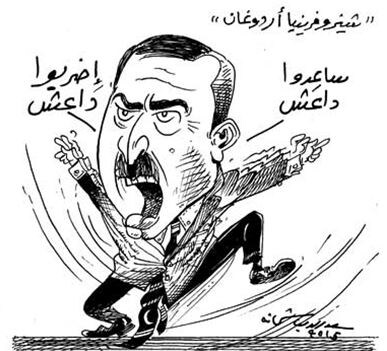
Following the Qatari Emir's July 13, 2015 visit to Turkey, during which he met with Erdogan and discussed, among other topics, the war on terror, the editor of the government Egyptian daily Al-Ahram, Muhammad 'Abd Al-Hadi Allam, wondered how the leaders of two  countries that are known for sponsoring terror can discuss the war against terror. He wrote in a July 17 article: "Sponsoring the armed organizations in the Arab world has become an ideology for certain governments that sow destruction across the Middle East. In the absence of any regional or international element to deter them, some of them imagine that their money is enough to protect them from [these] terror organizations, but they are surely deluding themselves. In the recent days, in the latest scene of this tragedy, the media reported that the Emir of Qatar, Sheikh Tamim, visited Ankara and discussed various issues with Turkish President Recep Tayyip Ergodan, among them 'the war on terror.' This is surprising, for we have no idea what terror is referred to by [these] official announcements that came out of the Qatari-Turkish summit, especially considering that the two governments [of Qatar and Turkey] insist on funding and arming these [terror] organizations out of their own narrow interests, and pay no heed to the voices that oppose their interference, which ignites more and more fires in the Middle East...

"The dubious Qatari-Turkish coordination peaked recently with the announcement that Qatar will host a large Turkish military base, the first [Turkish base to be built] outside Turkey, as part of agreements that were signed between the [two] countries. This will even further serve their interest to support terror, and fuel the policy of 'absolute evil' that they are employing towards the peace-loving peoples of the Middle East, namely [the policy of] hatching conspiracies in closed rooms and then coming out to face the cameras with false smiles and dance over the severed limbs of the innocent. The day will come when all the despicable cards [of Qatar and Turkey] will be revealed, [those states] that have turned the Arab countries into hell for their citizens..."[3]  

Al-Ahram cartoon: "Erdogan's Schizophrenia": on the one hand he calls to "help ISIS" and on the other to "fight ISIS" (July 6, 2015)

'Al-Ahram' Editorial: Even Europe Understands That Qatar Finances Terror; A Joint International Struggle Needed Against Terror-Sponsoring States

A July 6, 2015 editorial in Al-Ahram stated that today, even France, Spain and Britain understand that certain states, including Qatar, are transferring funds to radical terrorist organizations. The article urged the West and the Arab states to work together to stem the funding of terror and to fight countries that support it: "France, Spain and Britain have not only begun taking firm measures against those who travel [to join] ISIS and those who have returned from Syria and Iraq. They have also initiated a serious investigation into the role of states such as Qatar, which transfer funds to radical terrorist groups. The Spanish newspaper El-Mundo reported that the Spanish police has identified six Islamist Salafist organizations that receive funds from Arab states, chiefly from Qatar… The Egyptian military establishment [also] understands the magnitude of the terrorist threat against Egypt… This obligates Europe, Egypt and [other] Arab states to cooperate and launch a coordinated war not only against the armed terrorists but also against their international sources of funding and dry them up…"[4]

'Al-Ahram' Editorial: Qatari Emir And His Mother Are Responsible For Blood Spilled In The Arab World

Several days later, following a July 10, 2015 interview that Sheikha Mozah, the wife of the former Qatari emir and the mother of the present ruler, gave to the Financial Times, an Al-Ahram editorial again accused Qatar and the ruling Aal Thani family of financing terror in the Arab world. The Financial Times interview stated that it is "widely assumed the Sheikha shared, if not encouraged, her husband’s enthusiasm for the Arab revolutions of 2011, particularly his backing for Islamists in Egypt, where she grew up, and Libya where her father worked," but that "she insists she had no say in his policies." However, the Al-Ahram editorial, published three days after the interview, misrepresented what was said in it, claiming that Sheikha Moza had admitted supporting her husband's efforts to aid the Islamists with the outbreak of the Arab Spring, especially in Egypt, and that this constituted proof that Qatar supports terrorist organizations in the Arab world. 

The editorial stated: "Now nobody can rebuke Egypt [any longer] for accusing Qatar of being behind the terror that is plaguing the country. Sheikha Mozah, the mother of  Qatari Emir Sheikh Tamim, revealed in an interview with the British Financial Times that when the Arab Spring revolutions erupted, she supported with all her might the efforts of her husband, the former Qatari ruler Sheikh Hamad bin Khalifa Aal Thani, to help the Islamists, particularly in Egypt. Her confessions are proof for all those who refused to believe that Qatar is complicit [in encouraging terror], including for the Iranians [and for everyone else] who stubbornly refuse to accept that a small country like Qatar is capable of harming countries in the Arab world, especially Egypt. In fact, the complaint regarding Qatar's grave offenses has been repeatedly made not only by Egypt but by additional countries, such as Libya, Tunisia, Syria, etc.

"It is amazing that [Sheikha Mozah], the strong woman in the Qatari corridors of power, insists on being bothered by the criticism directed at her country! It must be asked: should others applaud Qatar while it extends financial, political and diplomatic assistance to the terror organizations, and should Egypt cheer [Qatar's] brazen  media incitement and its constant justification of acts of violence and terror? It is ironic that the Al-Jazeera network, the media mouthpiece of terror and terrorists, accuses [Egypt of employing] excessive force against the terrorists of the ISIS organization… In the current situation, Sheikha Mozah and her husband Hamad must understand that they are responsible for the blood that flowed and continues to flow in the Arab streets".[5]
 
Egyptian Columnist: The Turkish And Qatari Regimes Should Be Prosecuted In International Courts

Yousuf 'Ayyoub, a columnist for the Egyptian daily Al-Yawm Al-Sabi', also accused Qatar and Turkey of financing and supporting terror. He wrote that there was no point in seeking reconciliation with these countries, which are hostile to the Egyptian people, and that they should be prosecuted in international tribunals. He wrote: "Today, the Egyptian government must find new ways to contend with the repeated violation of [Egypt's sovereignty] by Qatar and Turkey. The recalling of ambassadors, a measure which [Egypt] has employed with these two countries, and which is the most severe of diplomatic measures, is effective only with regimes that understand the importance and severity of this step in terms of their foreign relations. But the Erdogan regime in Turkey and the Tamim [bin Hamad Aal Thani regime] in Qatar are aware of nothing but their consistent hostility towards Egypt and the Egyptian people.

"The government must think outside the box when it contends with regimes that are concerned only with their own interests and with stabilizing their failed rule, [and who pursue these interests] over the corpses and remnants of the victims, who are felled every day, one after the other, by terrorist groups that receive assistance, support and military and civil financing from Doha and Ankara [for their activity] in Syria, Libya, Iraq, Egypt and additional Arab capitals. These countries suffer from the [effects of the] loathsome Qatari funds that are stained with the blood of the dead and the victims.

"The [Egyptian] government, represented by the foreign ministry, may have to seek a legal mechanism to bring the Turkish and Qatari governments before the International Criminal Court or before [other] European and American courts, on charges of supporting and assisting terror in the region, especially in Egypt. [This,] especially since we have copious proof and evidence to tie the two countries to the terror that the Muslim Brotherhood is currently waging in Egypt with their support. The hospitality that Qatar and Turkey extend to the leaders of this terrorist group [the MB] is evident and does not require [further] proof, nor does these leaders' incitement to sow death and destruction in Egypt… All we need is to pick up the reins of initiative and take legal measures against Tamim and Erdogan, and the members of these two regimes, in all European countries, until each and every one of them is punished.

"What we need at this stage is bold action, especially since the policy of reconciliation has been ineffective and will remain ineffective against those who view terror as their ideal tool for toppling regimes and replacing them with regimes loyal to them and their money. Along with this boldness, we must seek experienced attorneys to pursue the Tamim and Erdogan regimes…"[6]


Endnotes:

[2] Al-Masri Al-Yawm (Egypt), February 4, 2015.
[3] Al-Ahram (Egypt), July 17, 2015.
[4] Al-Ahram  (Egypt), July 6, 2015.
[5] Al-Ahram  (Egypt), July 13, 2015.
[6] Al-Yawm Al-Sabi'  (Egypt), July 8, 2015.

MEMRI

Source: http://www.memri.org/report/en/0/0/0/0/0/0/8689.htm

Copyright - Original materials copyright (c) by the authors.
Khamenei reportedly pens manual on destroying Israel - Eli Leon and News Agencies


by Eli Leon and News Agencies


According to New York Post report, Iranian Supreme Leader Ayatollah Ali Khamenei is author of 416-page book advocating long-term, low-intensity warfare to wear down Israeli Jews and make them leave the country • Book calls Holocaust a "propaganda ploy."


Ayatollah Ali Khamenei delivers a speech last month with his hand resting on a rifle Photo credit: AP


Eli Leon and News Agencies

Source: http://www.israelhayom.com/site/newsletter_article.php?id=27317

Copyright - Original materials copyright (c) by the authors.

Sunday, August 2, 2015

Iran on Steroids: What Happens When the Dollars Start Rolling In - Ryan Mauro


by Ryan Mauro

We've been dealing with the consequences of an Iranian regime that was poor. Get ready for an Iranian regime armed with an economic boom.


A march of the Iranian Basij militia (Photo: © Reuters)

The Western powers’ nuclear deal with Iran will give the regime access to $100-150 billion in unfrozen funds and lifts the U.N. arms embargo within five years. In addition, Iran says it can accommodate $200-300 billion in foreign investment as sanctions are eased. The danger of this revenue can only be properly understood if you consider the cheap cost of Iran's terrorist operations.

The Israeli ambassador to the U.S. put the deal in perspective by comparing the economies of Iran and the United States: If Iran's Gross Domestic Product is $300 billion and it gets an influx of $150 billion in unfrozen assets, that's like the U.S. receiving $8 trillion.

There's been some criticism of these numbers, so let's take the best case scenario presented by the critics. Let's take the low number of $100 billion (not even including the $200-300 billion in foreign investment), a high estimate of Iranian GDP at $415 billion and put the U.S. economy at $18 trillion. That's still an equivalent influx of $4.3 trillion—again, not including the foreign investment and the wealth created by it.

Either way, that funding will go mostly into the hands of the terrorism-sponsoring, freedom-oppressing, "Death to America"-chanting Iranian regime. In short, it will go towards saving the dying Iranian Islamic Revolution.

About 80% of Iran’s economy is state-owned. The Iranian Revolutionary Guards Corps alone owns at least one-third of the economy and is the third richest organization in the country, surpassed only by the regime-owned National Iranian Oil Company and Imam Reza Endowment.

The regime is so corrupt that a Reuters investigation found that Supreme Leader Khamenei owns a $95 billion empire. A detailed Arab newspaper reported in June that Khamenei’s family has billions more, with his son and possible successor, Mojtaba, having over $3 billion himself.

What will $100-150 billion in unfrozen funds and an additional $200-300 billion in foreign investment mean for the Iranian government's shopping list? Consider the numbers below:

$30 Billion: The Iranian Defense Budget
This estimate, calculated by calculated by U.S. President Obama,  appears to include undisclosed spending because "moderate" President Rouhani increased the budget by about one-third this year to an official amount of $10 billion. The regime is so radical that it increased its budget for violent jihad and theocratic oppression during times of economic hardship.

$6.5 Billion: Budget of the Iranian Revolutionary Guards Corps
The Iranian Revolutionary Guards Corps is the elite security force that keeps the Iranian regime in power by oppressing the population and sponsors terrorism around the world. It is responsible for providing advanced IEDs that killed at least 500 U.S. troops in Iraq and Afghanistan.
"Moderate" President Rouhani increased the IRGC's budget by almost half in 2015 at a time when Iran is strapped for money.

$6 Billion: Iran’s Yearly Donation to Syrian Dictator Bashar Assad
This figure was stated by the U.N.'s envoy to Syria. Other experts put it as high as $15 billion. Assad is a state sponsor of terrorism whose rule helps fuel Al-Qaeda and the Islamic State. His determination to cling onto power has resulted in 320,000 dead and over 4 million refugees in a population of only 23 million since 2011.

$4-5 Billion: Estimated Spending By Iran on Terrorist Proxies
This figure was calculated by the Israeli Defense Forces' Chief of Staff, who emphasized that this support is limited only by the current "economic limitations" of Iran, which will be expanded under the deal.

$2 Billion: Iran's Annual Assistance to Extremist Shiite militias in Iraq and Syria
These militias have killed U.S. servicemen in the past and may target the 3,500 troops in Iraq now. The 140,000 members get $300 per month salary and $900 per month for arms and accommodations. The militias are brutal towards innocent Sunnis, indirectly assisting the Islamic State and Al-Qaeda.

$800 Million: Purchase Price of Five Advanced S-300 Air Defense Systems
Iran paid Russia for these systems that could severely complicate military action against the nuclear program. Russia has frozen the delivery of the system only due to extremely heavy Western pressure.  

$790 Million: Budget of the Iran’s Ministry of Intelligence and Security
Described as "one of the largest and most dynamic intelligence agencies in the Middle East," this ministry has been sanctioned by the U.S. for supporting Al-Qaeda and other terrorists, aiding the terrorism-sponsoring dictatorship of Syria and abusing the human rights of Iranian citizens.

"Moderate" President Rouhani increased the ministry's budget by 40% this year, despite the regime's thin wallet. That shows where his priorities are.

$430 Million: Budget of the Brutal Basiji Internal Militia
This figure was the 2009-2010 budget of this militia that suppresses dissent and was largely responsible for crushing the Green Revolution of 2009. Each of the 11.2 million members is paid only around $40. Additional funding is likely acquired off-the-books through front organizations.

$100-200 Million: Yearly Support for Hezbollah
This is the estimated amount of support that Iran provides to the Lebanese terrorist group annually, according to a Pentagon report in 2010. Sanctions reportedly forced Iran to cut its support by 40% that year. Hezbollah’s financial hardship is so high that a Newsweek article in January was titled, "Is Hezbollah going broke?"

$580 Per Month: Monthly Salary Paid to Taliban Terrorists
In addition to providing arms and supplies, Iran also pays Taliban members. About 10,000 U.S. troops are in Afghanistan right now with a complete withdrawal scheduled for completion by the end of 2016.

$150 Per Month: Monthly Salary to Shiite Militiamen Targeting U.S. and British Troops by Iranian Revolutionary Guards Corps
The reported payments were made by the Iranian Revolutionary Guards Corps to Shiite militiamen in Iraq when they were targeting U.S. and British servicemen. In 2007, Iran was paying members of one Shiite militia $300 a month to attack British troops.

Think about those expenditures and what has resulted from them. And then imagine what Iran will do with $100-150 billion in unfrozen assets, $200-300 billion in foreign investment and the wealth subsequently produced by that investment.

We've been dealing with the consequences of an Iranian regime that was poor. Get ready for an Iranian regime armed with an economic boom.


Ryan Mauro is ClarionProject.org’s national security analyst, a fellow with Clarion Project and an adjunct professor of homeland security. Mauro is frequently interviewed on top-tier television and radio.

Source: http://www.clarionproject.org/analysis/iran-steroids-what-happens-when-dollars-start-rolling

Copyright - Original materials copyright (c) by the authors.

Sunni Arab States and Israel: Allies? - IsraelDefense


by IsraelDefense

With Iran and the agreement becoming the common enemy in the Middle East, the Director of Israel’s foreign ministry, Dore Gold, referred to the Sunni Arab states in the region as Israel’s allies


The Director of Israel’s foreign ministry, Dore Gold, referred to the Sunni Arab states in the region as Israel’s allies. The comment was made during a presentation in New York. Referring to common complaints about the Iran deal and the dangers that it poses to the people that are traditionally rivals with Iran, Gold said, “and it’s not Israel talking, that is our Sunni Arab neighbors, and you know what? I’ll use another expression: that is our Sunni Arab allies talking.”

Speculation of the effects that the Iran deal would have on Israel’s foreign policy with its Arab neighbors has been rampant. There has been the widespread theory that Israel may be able to cut through old hatreds with this deal, with Iran and the agreement becoming the common enemy in the Middle East. Israel continues to poster in this way, with rhetoric that sounds very promising, especially regarding Saudi Arabia.

Saudi Arabia used to be one of Israel’s favorite targets for accusation of state sponsored terrorism. Animosity was the kindest way to put the relationship between the two states. This summer, though, has seen rumors of secret talks and even a visit to Israel by the Saudi Prince, and warming relationships between the two states. This public statement of trust in the Sunni Arab states of the region, in particular Saudi Arabia, is a major step forward, and for some can be seen as a silver lining to a deal they might not approve of.

Speaking of the path moving forward for Israel with the Iran agreement, Gold detailed what he saw as his state’s job. Right now he feels there is a need for Israel to warn the world of what they see as a dangerous agreement for the world. If approved though, Israel must work with the international community, especially the United States, and deal with any repercussions. 


IsraelDefense

Source: http://www.israeldefense.co.il/en/content/sunni-arab-states-and-israel-allies

Copyright - Original materials copyright (c) by the authors.
Oops! Top French diplomat contradicts Kerry, says a 'no' vote could lead to a better deal with Iran - Thomas Lifson


by Thomas Lifson

On Friday, two more members of Congress who met with Audibert, Republicans Paul Cook of California and Tom Marino of Pennsylvania, issued a statement that they "can confirm that Congresswoman Sanchez’s account of the meeting is accurate.

The major premise of Obama administration efforts to force acceptance of the Iran deal by one third plus one of the Senate and House just got blown out of the water.

The word “gaffe” comes from the French language and famously was defined by Michael Kinsley as accidentally telling the truth.  That appears to be what happened when the France’s team at the P5+1 negotiations with Iran met with Democratic congresswoman Loretta Sanchez and Republican representative Mike Turner.  The official, Jacques Audibert, is now the senior diplomatic adviser to President François Hollande, and before that, he was the director general for political affairs in the Foreign Ministry from 2009 to 2014.  This makes him a top career diplomat, not a trifling nonentity.

Josh Rogin of Bloomberg reports:
According to both lawmakers, Audibert expressed support for the deal overall, but also directly disputed Kerry’s claim that a Congressional rejection of the Iran deal would result in the worst of all worlds, the collapse of sanctions and Iran racing to the bomb without restrictions.
“He basically said, if Congress votes this down, there will be some saber-rattling and some chaos for a year or two, but in the end nothing will change and Iran will come back to the table to negotiate again and that would be to our advantage,” Sanchez told me in an interview. “He thought if the Congress voted it down, that we could get a better deal.”
This is precisely what the “vote no” forces are arguing.  The alternative is a better deal.  The Obama administration position is that the alternative is war.

You can imagine the telephone calls and cables that went back and forth between Foggy Bottom and the Orsay.  It didn’t take long for denials to be issued:
(Before the publication of this article on Thursday, Jacques Audibert, the Elysee Palace office and the French Embassy in Washington were asked for comment, and did not respond. After its publication, the embassy released a statement saying it "formally denies the content of the remarks" attributed to Audibert by the two members of Congress, and U.S. Ambassador Hartley described them as "inaccurate." Audibert tweeted that he "never said or suggested that a no vote from Congress … might be helpful or lead to a better deal," and has not responded to requests for an interview. On Friday, two more members of Congress who met with Audibert, Republicans Paul Cook of California and Tom Marino of Pennsylvania, issued a statement that they "can confirm that Congresswoman Sanchez’s account of the meeting is accurate. We disagree with recent claims that seek to refute her account.” Representative Turner said that he stands by his description of the meeting.)
Let’s hope that Secretary Kerry testifies again and is confronted with this statement.  If the four representatives are present at the hearing, all the better.


Thomas Lifson

Source: http://www.americanthinker.com/blog/2015/08/oops_top_french_diplomat_contradicts_kerry_says_a_no_vote_could_lead_to_a_better_deal_with_iran.html

Copyright - Original materials copyright (c) by the authors.

The secret of Iran's success - Dr. Ofer Israeli


by Dr. Ofer Israeli

Despite the sophistication, guile and resolve exhibited by the Persians, the Islamic republic can be defeated.

Persian civilians and government representatives have been giving and taking with foreigners for thousands of years, employing a different type of business or political discourse than the West is familiar with. Due to its basic principles these negotiations will, more often than not, primarily serve the Persian interest.

Therefore, we should not be surprised this was the case throughout the negotiations between Iran and the United States and other world powers. The Iranian delegation won significant results through its dogged adherence to the four negotiating principles of the Persian bazaar.

Firstly, the Persian bazaar approach to negotiating aims to secure the maximum result, which is predetermined and from which there is no intention of backing down. From the Persian point of view, the negotiating process is not designed for facilitating a compromise between the opposing sides. It is also not designed for reaching a middle ground between the sides' original proposals. Its goal is singular in purpose, which is to allow the Persian side to meet its objectives. If not -- the negotiating process is delayed until an unknown future date, when the conditions are deemed more favorable to achieving the objectives. In the meantime, the Persians will buy time and learn to live with the situation, as difficult as it may be. 

Secondly, the only measuring stick for success in negotiations is achieving the goal, which as stated has been predetermined. Any other outcome will be perceived as a stinging defeat, which will eventually be rejected by the highest echelons of power. No attention, therefore, is paid to the high price of the negotiating process. Iran avoided compromising its goals despite the draconian sanctions imposed on it for years, which were some of the harshest sanctions ever imposed on one country by the international community. 

While Western negotiators may give in on certain issues in order to shorten the process, which also means paying a larger price and losing more, the Persians will hold steadfast to their positions until their goal is achieved and until they completely exhaust the opposing negotiators. 

Thirdly, while the Western economic approach sanctifies the "win-win" principle, the Persian approach sanctifies the imposition of its objectives on the adversary. Any compromise on the basic principles, even a compromise that seemingly serves the Persian interest, is considered weakness that sullies the good name of the chief Persian representative, who has bent for the foreign representative. Success, on the other hand, will enhance the representative's prestige and personal status, while also illustrating the supremacy of the Persian nation.

Fourthly -- honesty and truth telling is the norm for Persians in the closer circles of family and business associations. In contrast, these rules almost completely do not apply to the world of international politics. And if they do apply -- it is only because it is temporarily fitting. Therefore, any problem raised by the other side will be met with a future solution, which will be backed up by impressive promises that will supposedly bridge the gaps. After all, there is no honest and truthful intention to stick to the deal, which will be violated at a time deemed suitable -- most likely when the other side no longer has the leverage with which to enforce the main points of the deal.

Throughout the negotiations between Iran, the U.S. and other world powers, the Iranian representatives operated in accordance with these four principles of negotiation. Of course, we can identify certain points in time where the Iranian negotiators gave in and supposedly acted in contradiction to these fundamental principles, but this was only to create the appearance of a positive dynamic while absolutely adhering to their national interests, outlined by Supreme Leader Ayatollah Ali Khamenei.

Despite the bitter defeat of signing the deal, which is bad for Israel, Jerusalem must examine the possible avenues of action at its disposal and act with determination to make them happen. Despite the sophistication, guile and resolve exhibited by the Persians, the Islamic republic can be defeated. One way to do so is to adopt some of the Persian strategies described here, and is a subject worth expanding on separately.


Dr. Ofer Israeli is a senior adviser on international strategy and teaches foreign policy decision-making at the Lauder School of Government, Diplomacy and Strategy at the Interdisciplinary Center Herzliya.

Source: http://www.israelhayom.com/site/newsletter_opinion.php?id=13365

Copyright - Original materials copyright (c) by the authors.