Saturday, December 17, 2016

Islamism in Europe - Khadija Khan


by Khadija Khan

Governments across Europe seem to be switching into panic mode to prevent the rise of European radicalism through the rise of the far-right, racism and nationalism throughout the entire continent.

  • Ironically, those who dare to speak out against extremists either face severe consequences, such as death threats, or are called anti-Muslim bigots. This kind of response often discourages progressive voices from speaking out, and understates the progress of counter-extremism even within the Muslim community. Opposition voices still might be there -- more than ever. They just go underground.
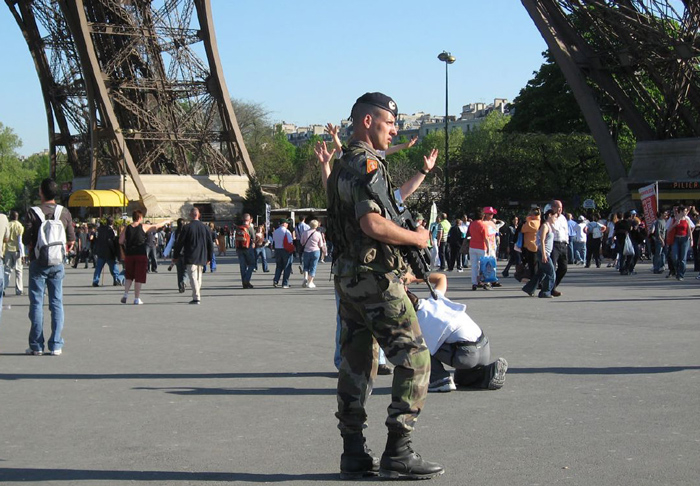
  • Since the unprecedented terror attacks in France, Belgium and Germany, citizens across the Europe have been living in constant fear. They seem to be sick and tired of the Muslim extremists; children might be in danger on their way to school, and shopping takes place under the protection of soldiers.
  • With Brexit, the election of Donald Trump, and Italy's referendum, there seems to be a snowball effect. The growing influence of Alternative for Germany (AfD), the National Front in France, the Party for Freedom in the Netherlands, the Freedom Party Austria and the Five Star Movement in Italy all appear to be byproducts of the same rhetoric.
  • The dull reaction of a vast number of European Muslims to the rising wave of terror and violence has also contributed to this shift. Increasing numbers of native-born Europeans seem angry and distrustful of their fellow Muslim citizens, especially when everyone else has come out loud and clear in denouncing terrorist crimes.
German authorities and those across Europe seem finally to be strengthening their campaign against the militant far-right, including Muslim extremists, during the past few weeks.

This awakening, however, seems to be coming after a major price that Europe had to pay in terms of death and chaos unleashed by terrorists in Germany, Belgium, France, Denmark, and so on.


Governments across the Europe seem to be switching into panic mode to prevent the rise of European radicalism through the rise of the far-right, racism and nationalism throughout the entire continent.

German Chancellor Angela Merkel sounds as if she is backing down a bit from championing the influx of migrants and her slogan of "We can do it!" in developing a multicultural society. She not only vowed to Germans in an address last week that the migrant crisis must never be repeated; she also called for an all-out ban on the full-face veil covering in Germany.

Following Merkel's lead, Interior Minister Thomas de Maizière also proposed a partial ban on veils, and pronounced them contrary to assimilation.

The dramatic shift in policy might be a consequence of the planned and perpetrated acts of terrorism by extremist Muslims, many of whom are the migrants on whom Merkel placed her hopes. It might also be the result of the resultant rise of European neo-Nazis. More likely, it would appear to come from an eye to re-election.

Merkel was declared by many the only defender of the free world after the election of Donald Trump as U.S. president. Perhaps, after the surprising victory of Donald Trump, she realized that it might be a good idea finally to address the grievances of her fellow countrymen.

The brutal rape and murder of a 19-year-old German woman, Maria Ladenburger, apparently by Afghan migrant who claims to be 17 years old, seems to have been the last nail in the coffin of Merkel's open-door migrant policy, which she had promised to not to let go even after extreme opposition from within her own party's leadership.

Ladenburger had been a medical student volunteering at a migrant housing facility. Her murderer had reportedly seen her in the shelter. The incident set off shockwaves not only in the Germany but also across Europe, especially after promises by Germany's interior ministry to deport as many Afghan citizens as possible after failing to confirm any credible claims for asylum.

In the meanwhile, authorities in Berlin last weekend announced the arrest of an Afghan citizen who was actively involved in terrorist attacks in Afghanistan, while living part-time in Germany.

German police a few weeks back also launched an operation against a Salafist group in the country, whose members were brainwashing Muslim youths, mostly in Germany, to get jihadist training and join the Islamic State's battle against the world in Syria and Iraq.

The Salafist organization had registered itself as a social work entity under the cover of distributing the Quran in markets and public places, and claiming to be bridging the gap between the West and Islam.

One suspect was arrested in Aschaffenburg and another was detained in Mannheim, on the allegation of plotting an Islamically motivated attack on a public place.

This recent shift in strategy is also a lesson that the West has learnt a bit too late, despite having experienced similar assaults not that long ago by the Nazis, Mussolini, Lenin, Stalin as well as terror organizations such as Baader Meinhof, al-Shebaab, ETA, the Red Brigades, Hamas, Al Qaeda, Palestinian Islamic Jihad and Hezbollah, to name just a few.

Since the unprecedented terror attacks in France, Belgium and Germany, citizens across the Europe have been living in constant fear. They seem to be sick and tired of the Muslim extremists; children might be in danger on their way to school, and shopping takes place under the protection of soldiers.


Since the unprecedented terror attacks in France, Belgium and Germany, citizens have been living in constant fear. In France, soldiers are deployed in the streets. Pictured: A soldier on guard at the Eiffel Tower in Paris. (Image source: Kirsteen/Flickr)

With Brexit, the election of Donald Trump, and Italy's referendum, there seems to be a snowball effect. The growing influence of Alternative for Germany (AfD), the National Front in France, the Party for Freedom in the Netherlands, the Freedom Party Austria and the Five Star Movement in Italy all appear to be byproducts of the same rhetoric.

The dull reaction of a vast number of European Muslims to the rising wave of terror and violence has also contributed to this shift. Increasing numbers of native-born Europeans seem angry and distrustful of their fellow Muslim citizens, especially when everyone else has come out loud and clear in denouncing terrorist crimes.

Ironically, those who dare to speak out against extremists either face severe consequences, such as death threats, or are called anti-Muslim bigots. This kind of response often discourages progressive voices from speaking out, and understates the progress of counter-extremism even within the Muslim community. Opposition voices still might be there -- more than ever. They just go underground.

The majority of Muslims in the West seem oblivious to the fact that they would be the greatest victims of empowered lunatic extremists such as ISIS or neo-Nazis, because both would try to punish progressive Muslims either for remaining silent about terrorist attacks or for not joining the bandwagon for ISIS.

Progressive Muslims should realize that their voices matter at this sensitive time if they do not want to end up being losers between those two extremes.

The failed political policies of the global powers have started to translate into a dreadful future for humanity where a clone of Abu Bakr al-Baghdadi, Anders Breivik or a Neville Chamberlain clone might be calling the shots, and the civilized world would become a hell for those caught in the middle, the rest of us.
Khadija Khan is a Pakistan-based journalist and commentator.
Source: https://www.gatestoneinstitute.org/9566/islamism-europe

Follow Middle East and Terrorism on Twitter

Copyright - Original materials copyright (c) by the authors.

To the Muslim Brotherhood: Quit Shouting Islamophobia and Quit Attacking Muslim Families - Saied Shoaaib


by Saied Shoaaib

Unfortunately, disagreeing with the Muslim Brotherhood and its front groups can be dangerous and even fatal.

  • Islamists, including Majzoub, have a long history of dragging prominent people and organizations into their arguments about extremism, terrorism and radicalization. These Islamists do not use their influence to drain the resources of Islamic terrorism in Canada and elsewhere, nor do they seek to stop young Canadians from joining ISIS. They do not use their knowledge or money to dismantle the infrastructure of extremism, nor do they attempt to dismantle the historical and religious arguments in favor of terrorism. Rather than do any of this, they instead make it their priority to intimidate, harass or sue those who speak out against Islamist extremism and its accompanying terrorism.
  • The prevailing religious interpretation of groups such as the Muslim Brotherhood and its adherents is that anyone who objects to their interpretation of Islam is to be considered a disbeliever. Because of their disbelief, they deserve to be killed in the present life and should then suffer the punishment of Allah in the next life. If killing them in this life is not an option, then spreading hate and anger against them is acceptable.
  • The other main problem the Parliamentary action against "Islamophobia" is that it gives the false impression that groups such as the Canadian Muslim Forum or the Muslim Brotherhood can speak for Muslims. In fact, they do not. In the UK, it was recently revealed that only about 2% of UK Muslims feel that the Muslim Council of Britain represents them.
  • It is not just that they have extremist literature in Canadian schools and mosques, it is that in some instances they have nothing but extremist literature. The Ottawa Public Library, for instance, has nothing but extremist literature in its Arabic language collection.
  • The first victims of this will be secular and modernist Muslims who oppose extremism -- and their families.
Islamist front groups in Canada and the West have dragged the media and the political "elites" into their extremist messaging. Rather than learning about why extremism and terrorism come out of their religion, Islamists instead concentrate on preventing the victims of their violence from speaking out. They do this by shouting "Islamophobia" at every opportunity, and do so most loudly at modernist or secular Muslims.

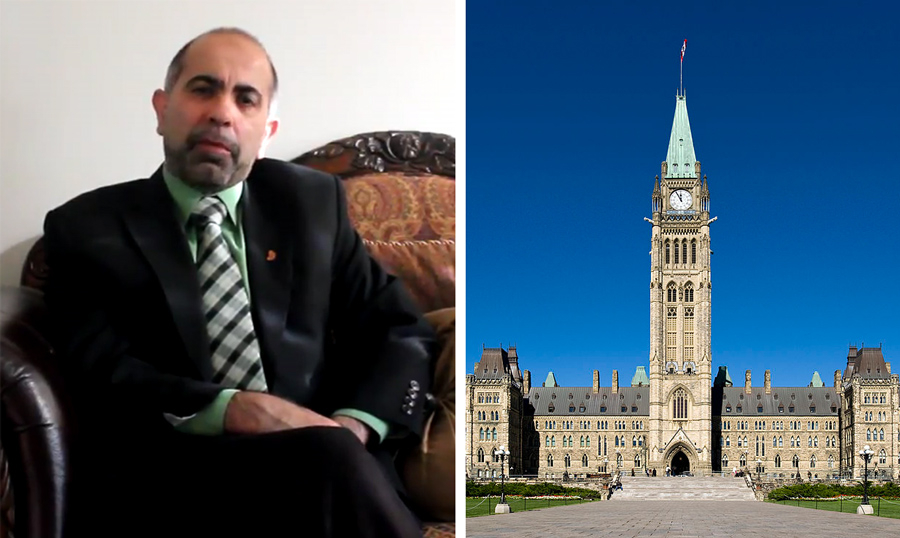
The Parliament of Canada, for example, passed an "anti-Islamophobia" motion on October 26, 2016. Samer Majzoub, the president of the Canadian Muslim Forum, was the person behind the Parliamentary petition against "Islamophobia"; it generated some 70,000 signatures. The sponsor of the motion in the House of Commons was MP Frank Baylis.

Both Majzoub and the Canadian Muslim Forum have a rather long list of dubious connections to Islamist groups and the foreign money used to support them. This includes the Muslim Brotherhood.

What is the real intent of Samir Majzoub, the Canadian Muslim Forum and its exploitation of the over-hyped concept of "Islamophobia"? As noted, Islamists, including Majzoub, have a long history of dragging prominent people and organizations into their arguments about extremism, terrorism and radicalization. These Islamists do not use their influence to drain the resources of Islamic terrorism in Canada and elsewhere, nor do they seek to stop young Canadians from joining ISIS. They did not stop suicide bombers in Canada such as Aaron Driver or Calgary-based Salma Ashrafi, who became a suicide bomber in Iraq. They do not use their knowledge or money to dismantle the infrastructure of extremism, nor do they attempt to dismantle the historical and religious arguments in favor of terrorism. Rather than do any of this, they instead make it their priority to intimidate, harass or sue those who speak out against Islamist extremism and its accompanying terrorism.


Samir Majzoub (left), the Islamist president of the Canadian Muslim Forum, was the person behind the recent Canadian Parliamentary petition against "Islamophobia." Both Majzoub and the Canadian Muslim Forum have a long list of dubious connections to Islamist groups and the foreign money used to support them. This includes the Muslim Brotherhood. (Image sources - Majzoub: Canadian Muslim Forum video screenshot; Parliament: Saffron Blaze/Wikimedia Commons)

Why should life be dangerous for Muslims, their families and others who reject the charges of Islamophobia?

The prevailing religious interpretation of groups such as the Muslim Brotherhood and its adherents is that anyone who objects to their interpretation of Islam is to be considered a disbeliever. Because of their disbelief, they deserve to be killed in the present life and should then suffer the punishment of Allah in the next life. If killing them in this life is not an option, then spreading hate and anger against them is acceptable.

The side effects of the supposed "Islamophobia" activity is an increased threat to Muslim families in Canada and the USA. Modernist and secular Muslims are afraid to speak out against extremism, for fear of being labelled as traitors to their own community. They also fear for their businesses and their children, who may come under verbal and physical attack. Because of petitions and Parliamentary actions such as those in Canada, modernist and secular Muslims and their families are forced either to agree with the false precepts of "Islamophobia" as advanced by extremist front groups, or to disagree with them but remain silent. Unfortunately, disagreeing with the Muslim Brotherhood and its front groups can be dangerous and even fatal.

The other main problem with the Parliamentary action against "Islamophobia" is that it gives the false impression that groups such as the Canadian Muslim Forum or the Muslim Brotherhood can speak for Muslims. In fact, they do not. Groups such as the Canadian Muslim Forum or the Council on American-Islamic Relations (CAIR) have little evidence to show they have anything approaching majority support. In the UK, it was recently revealed that only about 2% of UK Muslims feel that the Muslim Council of Britain represents them. Moreover, CAIR, despite its claims of moderation, was declared to be a terrorist entity by the United Arab Emirates.

With no mandate to speak on behalf of Muslims, Islamists such as Majzoub should not be regarded as "leadership" figures. They intimidate other Muslims and work to silence anyone who speaks against them. This is a sort of intellectual fraud: no one elected them to speak on behalf of Muslims. From an Islamic religious perspective, it should be noted that Allah has no agents or representatives on Earth, so their claim to speak on behalf of Muslims is theologically weak, at best.

At the same time, these Islamists do all they can to hide their finances; they refuse to show how much money they receive from Saudi Arabia or Qatar. They are constantly caught financing terrorism and their front-group members are often charged with criminal offences related to extremism and terrorism.

In Canada, Islamist-run schools use extremist literature from the Middle East to teach their children. It is not just that they have extremist literature in Canadian schools and mosques; it is that in some cases they have nothing but extremist literature. It is also not just Islamist-run schools and mosques that are the problem. The Ottawa Public Library, for instance, has nothing but extremist literature in its Arabic language collection.

Conclusions

The Parliamentary motion condemns all forms of "Islamophobia," without making any attempt to define what that means. As Judith Bergman put it:
The questions need to be asked: What exactly are they condemning? Criticism of Islam? Criticism of Muslims? Debating Mohammed? Depicting Mohammed? Discussing whether ISIS is a true manifestation of Islam? Is any Canadian who now writes critically of Islam or disagrees with the petitioners that ISIS "does not reflect in any way the values or the teachings of the religion of Islam now to be considered an "Islamophobe"?
The Canadian Parliamentary motion on "Islamophobia" is indeed a large stick that is designed to be swung at anyone who makes even the vaguest criticism of extremist Islam and its front groups. Rather than draining the extremist swamp or defunding their centers of activity, motions such as this are intended to weaponize words so that critics can be silenced by criminalizing anything that varies from political correctness, as in the clearly politically-motivated conviction of Dutch MP Geert Wilders last week.

The first victims of this will be secular and modernist Muslims who oppose extremism -- and their families.


Saied Shoaaib is a journalist and author originally from Egypt. He was the editor and manager of the Alyoum7 news website and the manager of "United Journalist." In 2007, a leader of the Muslim Brotherhood in Egypt raised questions about his work in the Egyptian Parliament. The questions were specifically aimed at the Attorney General of Egypt. For many years, his life and his family have been at risk because of constant threats aimed at his writings against and Islamists, terrorism and Islamic extremism. He has written several books on extremist Islam, journalism and the electronic media.

Source: https://www.gatestoneinstitute.org/9577/muslim-brotherhood-shouting-islamophobia

Follow Middle East and Terrorism on Twitter

Copyright - Original materials copyright (c) by the authors.
Muslim-Zionist Activist: ‘Antisemitism Is the Norm in the Islamic Community, But the World Will Come to Realize Its Mistake About Israel’ - Rachel Frommer


by Rachel Frommer

Israel has a lot of enemies, but I believe things will change. The world will one day realize its mistake


Nadiya Al-Noor. Photo: Courtesy.

Antisemitism and Israel-hatred is the norm among Muslims, including in the United States, even though the Koran can be read as a “Zionist text,” a devout American Muslim told The Algemeiner this week, explaining how she came to work to promote interfaith dialogue and understanding and how she thinks the world will come to see the Jewish state in a different light.

Nadiya Al-Noor — a graduate of Maryland’s Goucher College studying for her master’s degree at Binghamton University in upstate New York — was explaining her evolution into a person who warmly embraces both Jews and the Jewish state. On and off campus, Al-Noor said she constantly finds hypocrisy about antisemitism and Israel, and she has made a mission of letting the world know about these incidents through social media.

Recently, Al-Noor posted a picture on Facebook of a drop-down menu on an online Binghamton emergency contact form that listed “Occupied Palestinian Territories” as a location option. She told The Algemeiner, “Israel was also included, so that was a relief, but no other location was labeled ‘occupied.’ Not Northern Cyprus or Kosovo [both under military occupation]. Just the Palestinian territories.”


December 15, 2016 12:48 pm
0
Raised in Stony Brook, Long Island, Al-Noor had many Jewish friends, but said antisemitism was still imbued in her at an early age. In an hour-long interview, she spoke of the journey that led to her change in outlook and why she started blogging about being a Muslim Zionist.

The Algemeiner: How did you get into pro-Israel activism?

Al-Noor: When I was at Goucher, I was trying to sign up for access to the Hillel’s kosher kitchen — because that was the closest thing to halal — but I filled out the wrong form. I had actually signed up for the pro-Israel committee, and then I was too scared to tell the Israel fellow my mistake. At that point, I was still pretty anti-Israel, but I had become very interested in Judaism, so I began going to the programs. I met Israelis and IDF veterans, started reading material from sources other than anti-Israel ones — before that, I was getting my information from places like Electronic Intifada and Al-Jazeera — and I realized how wrong I had been about it all.

The Algemeiner: What had drawn you to Judaism?

Al-Noor: One day I woke up with yearning in my chest to learn about Judaism. I just had to. It felt like a call from God.

The Algemeiner: What has it been like to be a Zionist at university?

Al-Noor: As soon as undergraduate students get on campus, they are bombarded by anti-Israel rhetoric and activists, and there is a light trained on you by such movements when you are Muslim. You are expected to join.

When I was at Goucher, the Students for Justice in Palestine (SJP) had disbanded, but its former members were still active and their perspective was festering. The pro-Israel group planned a program featuring Assi Azar [an Israeli television personality and LGBT rights activist], and the SJP tried to get the school to cancel the event. The college refused, so SJP stormed the event and protested so intensely that the program had to be stopped early. After I saw how SJP treated my Jewish friends, making them scared to be openly Jewish or go to class — one of my friends got his kippah knocked off his head while he was walking on campus — I decided that I had to do something, I had to act. I started with a blog post, “Open Letter from a Muslim Woman.”

Binghamton — which is 30% Jewish and far more pro-Israel than not — once had a very active SJP, but it has since disappeared. Today, the biggest problem facing advocates of Israel is apathy from the general student population.

The Algemeiner: Would you say those instances of your friends being afraid to be visibly Jewish on campus are isolated cases?

Al-Noor: Antisemitism is a problem at universities, and it goes unrecognized because people see Jews as white. They think white people can’t be oppressed, so it follows, in their minds, that Jews cannot be persecuted. Antisemitic tropes feed this thinking: Jews are seen as wealthy and powerful, as JAPs (Jewish American Princesses) with privilege. Even though 60% of religion-based hate crimes in the US are antisemitic, no one really talks about it. They say, “But there are Hillels on campus,” or, “A Jew almost became president [Democratic primary contender Bernie Sanders],” and so they conclude that there is no antisemitism.

Meanwhile, anti-Zionism is not counted as antisemitism at all. People say they are protesting and against Israel, not Jews. The deeply antisemitic tone of anti-Zionism and the antisemitic by-products of the movement are not considered valid examples of antisemitism.

The Algemeiner: How do you see your role in combating this way of thinking?

Al-Noor: When someone like me speaks out for Israel, I challenge everybody’s idea of what they think they know about Zionism and the country. It changes minds. Whenever non-Jews are pro-Israel, they get more attention and credibility, and are taken much more seriously. I can also speak to Muslims at a theological level that is rarely ever reached or talked about.

But, the Jewish and pro-Israel world needs to do more to reach out to people like me, to bring us into the community and make us allies. You have to start educating the public about Israel, because you aren’t getting anywhere when you’re only talking to Jews, while the majority of the public isn’t Jewish.
You have to communicate with Muslims, in particular. I’m actually pushed away by many Jews who are suspicious of my motives. I’ve been called a “lying terrorist” many, many times by people who think I only talk about peace so that I get infiltrate the Jewish community and attack from the inside.
This breaks my heart, because I’m here and trying to be an ally. I’ve devoted my life to this work.

The Algemeiner: What should the pro-Israel and Jewish world know about the Muslim community?

Al-Noor: First, that there is a big difference between Islam and Islamism. Islam is a religion that can exist in secular society; Islamism is the violent attempt to force that on other people, like ISIS.
Terrorism is a cycle: there is a terrorist attack, then the Muslim community is marginalized, which breeds more terrorism, and so on. We need more dialogue to stop this sequence, and not to give up on changing things before we even start.

It actually says in the Koran that some of its verses are metaphorical and some literal — and it states outright that there will be people who will select verses in order to harm others. It’s all about interpretation and education.

The Algemeiner: What is the attitude of mainstream Muslims?

Al-Noor: Antisemitism is entrenched in the community. Growing up, I had antisemitic thinking so ingrained in me, I didn’t even notice it until I was older and had learned more. Even though most of my friends were Jewish or Christian, not Muslim, I remember thinking, “Why are all the Jews rich? Why do they have big noses?”

And the community’s deep-set antisemitism only got much worse, exploded, after the establishment of Israel. We are all taught that the county is evil, that it’s a Nazi and apartheid state, committing genocide. In America, where there are a lot of Palestinians, it is particularly bad.

Muslims stand with our Ummah, the term for Muslim peoplehood. So, Palestinians are seen as our brothers and we are taught that they are being oppressed. I really don’t think Muslims would care about Palestinians if they weren’t Muslim — but, even more, if their “oppressors” weren’t Jewish. The Muslim world doesn’t care about what’s going on in Pakistan — and that’s an actual apartheid state — because the oppressors there aren’t Jewish. But Muslims need to start looking at the facts about Israel and stop getting their information from anti-Israel sources.

The Koran says — and I’m paraphrasing here — “The holy land belongs to the Jewish people and one day all the Jews from the corners of the earth will converge on Israel.” What is that if not the state of Israel?
The Algemeiner: So, what can be done to try and change these perceptions?

Al-Noor: I am the social media intern for the Institute for Jewish Muslim Action (IJMA), a young organization started by two Rabbis and a Muslim to educate people about the Judeo-Islamic tradition and what makes the two nations natural partners. I also work at Binghamton’s Center for Civic Engagement, where I help students volunteer and get politically engaged. I’m getting a double Masters in Public Administration and Student Affairs Administration, so I’ll be able to work in government or at universities to build interfaith dialogue.

The Algemeiner: How do you view the future of Zionism?

Al-Noor: Israel has a lot of enemies, but I believe things will change. The world will one day realize its mistake, like it realized with the Holocaust, and will become much more friendly to Israel. Don’t give up on hope and peace, because it can still happen. Try to build bridges, and if you can change one person’s mind, that will start a chain reaction.


Rachel Frommer

Source: https://www.algemeiner.com/2016/11/10/muslim-zionist-activist-antisemitism-is-the-norm-in-the-islamic-community-but-the-world-will-come-to-realize-its-mistake-about-israel/

Follow Middle East and Terrorism on Twitter

Copyright - Original materials copyright (c) by the authors.

Obama’s passivity in the face of genocide in Syria - Thomas Lifson


by Thomas Lifson

It turns out that it was easier posturing as indignant than doing something about it at the UN.

The world once again is watching genocide mass slaughter, despite having as our UN Ambassador Samantha Power, who parlayed a book denouncing American passivity in the face of genocide into a professorship at Harvard and her post at the UN. It turns out that it was easier posturing as indignant than doing something about it at the UN.

Resigning in protest when her boss failed to enforce the red line he proclaimed over chemical weapons apparently was out of the question for Power. And then all hell broke loose in Syria, with mass carnage.

A friend writes:
Thinking about self-described “genocide chick” Samantha Power and her boss and his wife and her hashtag responses to genocide, there was something gnawing at me. So, I did a bit of research and came up with this list:
Armenians in Turkey 1915-1918 1,500,000 killed
Stalin’s Forced Famine in Ukraine 1932-1933 7,000,000 killed
Rape of Nanking 1937-1938 300,000 killed
Holocaust 1938-1945 6,000,000 killed
Pol Pot in Cambodia 1976-1979 2,000,000 killed
Rwanda 1994 800,000 killed
Bosnia-Herzegovina 1992-1995 200,000 killed
Syria 2014 - present 500,000 killed

Eight genocides in the past 100 years.
Do you notice a pattern here?
Hmm, a clue might be found in American politics….

Thomas Lifson

Source: http://www.americanthinker.com/blog/2016/12/obamas_passivity_in_the_face_of_genocide_in_syria.html

Follow Middle East and Terrorism on Twitter

Copyright - Original materials copyright (c) by the authors.

The Media Game: Creating the Hound Pack of the Day - Yves Mamou


by Yves Mamou

The problem begins when people not on the radar become the majority of the population, and when this majority become "dissidents."

  • To be published on the front page of your own newspaper, to open the news on your own television program, you must bring the "killer news" -- the news that kills all others -- and, more importantly, the news that all other media will copy and paste.
  • Journalists are obsessed with creating the hound pack of the day and then enjoying the status of top dog. In hound-pack logic, there can be only one news item a day -- repeated and reprinted infinitely.
  • Poverty can make a headline when data are officially released, but who cares about what poor people think?
  • The problem begins when people not on the radar become the majority of the population, and when this majority become "dissidents." Then, when the invisible people (in the media sense of the term) engage in the democratic process and protest with a vote, it sounds like a bomb: No one saw it coming! No one could have predicted it!
  • According to the media, the only poor who need help, support and attention are immigrants. Other people who are poor -- especially whites -- do not, for the media, exist. And if they did protest, presumably they would have no right to.
  • "Representing the middle and working classes as "reactionary" or "fascist" is very convenient. This avoids asking critical questions. When someone is diagnosed as fascist, the priority becomes to re-educate him, not to question the economic organization of the territory where he lives." – French geographer, Eric Guilluy, in Le Point.
  • Trump understood well this disconnect of the people from the media. During the campaign, in fact, Trump spoke to very few from the media: He made his own media: tweeting every day, obliging the mainstream media to amplify his words. The more the lying media treating him as a liar, the more he was trusted.
  • Democracy depends for its survival on journalists doing correctly the job for which they are paid: reporting facts and not stigmatizing people who do not resemble them. It is not the "noble" duty of journalists to prevent things from happening. Just report facts, propose analysis, and let people think for themselves.
  • New media have appeared on the internet, in the mold of Breitbart in the U.S. and Riposte Laïque in France -- many dozens across the U.S. and Europe. Their audiences consist of millions of readers.
There is something wrong with the media -- internationally.

In Great Britain, they were unable to listen to British people who wanted to "Brexit." In the US, they were unable to listen to American people who wanted Trump. And in France, they were unable to predict the victory of François Fillon who "unexpectedly" won the presidential primary election of the center-right party.

In each country, the media and journalists stigmatized and labeled the majority of the people -- those who wanted to Brexit, such as Trump and Fillon -- idiots and racists.

So the question is: are journalists and media still people and companies paid to describe the world as it is? How did they go so wrong on such important questions? And go wrong so massively, with almost no exception? The corollary question is: are the media just playing a game? If so, what is the game? And why?

For an answer, it is necessary to understand how the media works. First, it is important to abandon conspiracy theories. Many "experts" explain the lack of diversity -- the one-sided orientation of information -- by pointing to a supposedly oligarchic concentration of TV channels and newspapers in a few hands. This may sometimes be part of the problem, but only marginally. Media corporation owners want content that they can monetize, and much of the time they might not even care about the content. They just want an audience, as big as possible. As the French philosopher, Marcel Gauchet, put it: "in the manner of the adage that 'money does not smell,' one might add that the audience has no content."

How does one then explain, in a period of multiplying media outlets, the uniformization of information?

Fear: Journalists live with the daily fear of being not "good enough." In this very competitive job, professional recognition comes with scoops and sensational information. To be published on the front page of your own newspaper, to open the news on your own television program, you must bring the "killer news" -- the news that kills all others -- and, more importantly, the news that all other media will copy and paste. If you are not that type of journalist -- if you are interested in nuance -- you do not exist on television, and are relegated to the inside pages of a newspaper, preferably at the bottom.

Good journalists bring "killer news" and killer news creates The Trend. Once The Trend is created -- that a politician is insane or racist, for example -- it is useless to write anything different. The only choice is to join the swarm and bring news that will prove that he is "in fact" even more insane and racist than he was the day before.

In a world where the audience is fragmented between the internet, social media, newspapers, radio and television, the "good," recognized, journalists are obsessed with creating the hound pack of the day and then enjoying the status of top dog. The more forms of media there are, the more journalists are in competition -- inside the same organization and among other forms of media -- to print or air the same information. Because in hound-pack logic, there can be only one news item a day -- repeated and reprinted infinitely.

We can even state a "law": the more the competition between journalists and different forms of media, the more information gets homogenized. The competition is not for differentiated information, but for deadline: each journalist is running be the first to bring back the information that all his competitors will have no choice but to reprint and repeat.

Emotion and Sensation: Do you know why Google is investing untold millions of dollars to perfect the technology of the self-driving car? Not for safety, nor for easier driving; they are doing it because it is stupid to let hundreds of millions of people concentrate on a road instead of on surfing the internet. This is the next revolution in technology: if cars and trucks can drive themselves, the available time for news, shopping, entertainment and advertisement online is maximized.

Google, Facebook and hundreds of television stations and newspapers are actually fighting for our available time and our attention. The available time is the time not devoted to work, to driving, and to family: a few hours a day. It is a zero-sum game: each second on Facebook is stolen from a newspaper or television station.

This fierce competition for our attention dramatically has changed the way information is produced, in television, then in newspapers.

Rule 1: The more sensational the television news, the larger the audience you get. Transposed to the press, this became: The more sensational the news, the more it is considered relevant. Sensational here means a strategy of packaging headlines and news in a way to mobilize attention and emotion.
Pierre Le Coz, a philosopher working at the National Center of Scientific Research (CNRS) says:
"We are caught in a frenzy logic amplified by the digital revolution. The "reign of emotions" is the advent of a society plagued by what I call "emotional captivity," a sensory stimulation... continuum -- visual, audio -- that mobilizes our emotions at the expense of our thinking."
Rule 2: For television and the press, this "emotional captivity" led to another rule: Information is not what is important to the reader, but what can attract attention of the greatest number of readers.
For the press, what is "fit to print" is not what is relevant, but what is new and what might please a crowd. As a prominent French philosopher, Marcel Gauchet, explained more than ten years ago:
If you read the headlines of daily newspapers, it is striking to see that they align with the logic of the mainstream media [TV]. There is a hierarchy of information that is not necessarily the same as that of television, but that follows the same principle... This does not mean that they are the same topics covered, but the approach is similar. I'll take a famous one that concerned me -- it's not narcissistic but typical. You had a little column on an attack in Jerusalem. But the biggest title, about "the new [intellectual] reactionaries," majestically occupied the central square of the front page. An attack in Jerusalem is routine! It is important, but we are used to it. While the new reactionary is a new topic, exciting...."

The Obsession with Immediacy

This obsession was accelerated by the internet, which has immediacy. Frederic Filloux, one of the most perceptive experts on the media, explained in his weekly column, The Monday Note, the "immediacy obsession" of the web.
About ten years ago, the new breed of digital publishers started to change the news cycle's pace. Speed and reactivity became the norm. Spurred by a fear of falling behind, under pressure from advertisers and readers, legacy media jumped on that train.
That fear was amplified by a dual management failure:
At the newsroom level no one was thoughtful enough to understand that obsessing over clicks and producing value added news might not be compatible.
By the same token, those in charge of the revenue side, waving "eloquent" Excel spreadsheets, convinced everyone that the page views churn machine actually printed money. They were comforted by sales teams that found much easier to sell eyeballs — regardless of the quality of the brain attached to it, than to demand higher prices for higher quality. Instead of thinking in terms of long term value-building, the ad community embraced the simplistic idea of valuing traffic above audience. This turned out to be an unfortunate choice: both the sell-side and the buy-side realized (too late) that a set of machines were thousands time better at selling and optimizing ad space than a bunch of conventional sales people working from an old-fashioned playbook.

Money

To be The First to Publish the Same News, it is not necessary to hire people from Harvard. You just need to be young, ambitious, and accept a low salary for an extremely competitive job. The only hope in this profession is to become a star. The media is like Hollywood: millions apply, few are chosen. But there is a consequence: because they are young, they often do not take time to evaluate information, think and become cultivated. Because they have to compete against colleagues both inside the same form of media and in other forms of media, they need to move fast and they need to be sensational. Intelligence by itself does not pay.

Power

Can fear, sensationalism, immediacy, obsession and low salaries explain why journalists missed Brexit, Trump, Fillon and so on?

In a certain way, yes. But not only. Journalists are busy with power (political, economic, institutional, cultural). They are busy with prominent people able to do things -- people in charge. Powerful people in charge make news. A sentence from the President, the merger of two multinational companies, a murder in the street after a robbery, the latest Hollywood movie, the latest bestseller book... and journalists are overly busy with political consequences of the President's declarations, the economic consequences of the merger, the police statements after the murder, etc. And day after day, it is, in a way, the same story.
In this system, the media cannot pay attention to the less-prominent, less-visible people. The media do not talk to people on welfare, they do not notice the desertification in France, for instance, or the concentrations of population in big cities. Power lies in big cities and media likewise. Poverty can make a headline when data are officially released, but who cares about what poor people think? They are not in a position to change things, except if they use guns or find a leader and organize themselves in a way to catch attention. In the case of revolt only, they become an element of power, and if they do not, they stay off the radar.

The problem begins when people not on the radar become the majority of the population, and when this majority become "dissidents." Then, when the invisible people (in the media sense of the term) engage in the democratic process and protest with a vote, it sounds like a bomb: No one saw it coming! No one could have predicted it!

Perception

In Germany, France, Britain, the United States and all big economies, globalization has produced the same consequences. Each of these countries has been divided in two: a network of big wealthy globalized cities vs. poor, downgraded and de-industrialized small cities and rural areas. The French geographer, Eric Guilluy, has published many books about the adverse effect of globalization. In an interview with the weekly, Le Point, he said:
The "peripheral America" who voted Trump stick to the de-industrialized and rural areas, which are also the America of the workers, employees, independent workers or peasants. Those people were yesterday in the heart of the economic machine from where they were banished... France is becoming an American society; there is no reason to escape to the adverse effects of the economic model of globalization.
According to Guilluy, the network of big and wealthy cities relegated poor white people to the margins of the society, but the same big-city network integrated well millions of immigrants who accepted undesirable jobs and poor housing. Paradoxically, immigrants had a better possibility of finding a good job in big cities than white workers in small cities, especially when the only employer of the area was closing his doors because he could not compete with products coming from China. According to Guilluy, the real ghetto is not the one you think.

To return to the media: how can one fail to notice how their perception is biased? Their perception of the poor is reduced to the poor they have in front of their eyes: immigrants. Guilluy added:
"Yes, the perception of the dominant classes -- journalists above all -- is reduced to their immediate field of vision. ... What remains today of the common classes in big cities are immigrants living in the suburbs, which is to say minorities: in France, they are immigrants from the Maghreb and Africa; in the United States they are rather blacks and latinos."
In other words, in globalized countries, poor people "of color" have replaced poor whites. They replaced them not only in the economy, but also in terms of representation of the poor, as if there are no -- or only few -- desperately poor whites. According to the media, the only poor who need help, support and attention are immigrants. Other people who are poor -- especially whites -- do not, for the media, exist. And if they did protest, presumably they would have no right to, because their skin color has supposedly (and often correctly) "privileged" them.

Then, when anger grows in the "peripheral areas" or "flyover country" against uncontrolled immigration, the media become a guilt-machine accusing whites of being racists. A few examples:
Guilluy added:
Representing the middle and working classes as "reactionary" or "fascist" is very convenient. This avoids asking critical questions. When someone is diagnosed as fascist, the priority becomes to re-educate him, not to question the economic organization of the territory where he lives. Anti-fascism has become a weapon for upper social classes.
The Italian filmmaker Pasolini had already explained it in his Private Writings: Since the left has succumbed to free market ideology -- pro-EU and pro globalization -- we are in a process where old distinctions do not work. "Left" and "Right" are transferable, which explains why white workers are not voting socialist but for anti-immigration far-right parties. There remains, therefore, only one thing for them [the Left] to do to keep their "Left-ish" posture: to fight against a "fascism" that does not exist. This is exactly what is happening...."

Conclusion? The Next Media Generation is on its Track

The problem for the media is coming: Brexit, Trump and Italy's referendum were a victory for millions of citizens from the "working class" against the elites, who seem to have become increasingly disconnected from them. They were also a victory for millions of people totally disconnected from the mainstream media, people liberated from "political correctness," people liberated from "ready-made answers and thinking." U.S. President-elect Donald Trump understood this disconnect so well that he has not even held a press conference since his victory, telling the press without a word that he does not need them. During the campaign, in fact, Trump spoke to very few from the media: He made his own media: tweeting every day, obliging the mainstream media to amplify his words. The more the lying media treating him as a liar, the more he was trusted.


(Image source: Young Turks video screenshot)

Christiane Amanpour, a CNN anchorwoman, said: "We face an existential crisis. A threat to the very relevance and usefulness of our profession."

Arthur Sulzberger, publisher of the New York Times, understood quickly that empires -- and especially his empire -- can die. The day after Trump's election, he admitted the paper failed to appreciate Donald Trump's appeal:
"After such an erratic and unpredictable election there are inevitable questions: Did Donald Trump's sheer unconventionality lead us and other news outlets to underestimate his support among American voters?"
While insisting that his staff had "reported on both candidates fairly," he also vowed that the paper would "rededicate ourselves to the fundamental mission of Times journalism. That is to report America and the world honestly, without fear or favor." (It has not.)

Sulzberger also launched an appeal to the "loyalty" of Times subscribers -- because thousands of people abruptly cancelled their subscriptions. The disaffection with biased information is growing, and fewer and fewer people are ready to subscribe to propaganda, especially when the facts on the ground so visibly contradict it.

Democracy depends for its survival on journalists doing correctly the job for which they are paid: reporting facts and not stigmatizing people who do not resemble them. It is not the "noble" duty of journalists to prevent things from happening. Just report facts, propose analysis, and let people think for themselves.

New media have appeared on the internet, in the mold of Breitbart in the U.S. and Riposte Laïque in France -- many dozens across the U.S. and Europe. Their audiences consist of millions of readers. The mainstream media is still alive, but for how long? It had better move fast; a generation of new media is on its way.


Yves Mamou is a journalist and author based in France. He worked for two decades for the daily, Le Monde, before his retirement.

Source: https://www.gatestoneinstitute.org/9585/media-hound-pack

Follow Middle East and Terrorism on Twitter

Copyright - Original materials copyright (c) by the authors.
Aleppo's end is just the beginning - Prof. Eyal Zisser


by Prof. Eyal Zisser

The war will apparently endure for quite a while, but if Syrian President Bashar Assad continues to enjoy unlimited support from Russia and Iran, and Washington continues to exhibit weakness and indifference, Assad stands a good chance of emerging victorious.


Aleppo's future remains bleak despite the end of the fighting
|
Photo credit: AFP


Prof. Eyal Zisser

Source: http://www.israelhayom.com/site/newsletter_article.php?id=38823

Follow Middle East and Terrorism on Twitter

Copyright - Original materials copyright (c) by the authors.

Forty-seven Years of Domestic Terror against Jews and Israelis - Stephen Schwartz


by Stephen Schwartz

A chronicle of vicious plots, through the decades, is more disturbing when compiled in a single document, and leaves the impression that anti-Jewish fanaticism has been overlooked consistently

Originally published under the title "White Supremacist and Radical Islamist Terror Against American Jews and Israelis."


A chronicle of vicious plots through the decades.


Founded in 2007, the Community Security Service (CSS) is a low-profile, nonprofit organization based in New York City and concerned with protection of American Jewish institutions and public activities. CSS has trained thousands of volunteers in professional security methods, provides physical security where needed, and acts otherwise to improve public awareness of security issues

CSS has now prepared an 80-page report titled Terrorist Incidents and Attacks Against Jews and Israelis in the United States, 1969-2016. The study was authored by Yehudit Barsky, a leading counter-terrorism expert, and includes a foreword by Mitchell D. Silber, director of terrorism investigations in the New York Police Department's Intelligence Division from 2005 to 2012.

This thorough and scrupulous documentation is alarming without being alarmist. America cannot be described as threatened today by a significant antisemitic tendency. Yet across almost fifty years of analysis, CSS enumerates 104 "most serious incidents" that demonstrate the persistence of prejudice expressed in violence.

A chronicle of vicious plots, through the decades, is more disturbing when compiled in a single document, and leaves the impression that anti-Jewish fanaticism has been overlooked consistently, with assault upon assault covered briefly by media, and then forgotten. The report points out that FBI hate-crime statistics show Jews are "the most targeted religious group" in America.

Anti-Jewish fanaticism in the U.S. is often overlooked, with assaults covered briefly by media, then forgotten.

The CSS survey concludes that the ideologies of white supremacy and radical Islam are the "central influencing factor" in anti-Jewish lawlessness. Silber writes that the perpetrators "include white extremists, Neo-Nazis, Palestinian terrorist groups, Al Qaeda and its varied offshoots and progeny, Iranian supported agents, as well as lone actors." Adherents to these doctrines and groups may differ on details, but they agree in focusing their venom on Jews.

Synagogues are the most-favored target, accounting for 51 percent of the cases examined, followed by Jewish communal institutions (14 percent), Jewish individuals (13 percent), schools (10 percent), and Israelis (7 percent). Terror weapons include arson, shootings, and bombings in more-or-less equal occurrence. The report warns that while the rate of attacks has diminished, recent episodes have been more lethal, killing, and intending to kill, more victims.

White supremacist Jew-baiting, which had been a pernicious phenomenon during the Depression, was revived in the 1970s and 1980s in reaction to the social changes of the civil rights era. Holocaust denial emerged then as a theme in anti-Jewish propaganda. Radical Islamic efforts were encouraged at the same time by a global Russian Communist campaign portraying America as a Zionist power seeking to make Muslims servants of Jewish domination. In this, the Muscovites were hardly original; they widened a trail set out by the German Nazis in their attempt to recruit supporters in the Islamic lands.


Louis Farrakhan


The "Black Muslims" or Nation of Islam (NOI), led currently by the demagogue Louis Farrakhan, promoted "pseudo-Islamic, African American nationalist, anti-white and anti-Semitic" attitudes, in the words of the CSS report. NOI is criticized by both moderate and radical Muslims for alleging that it is an Islamic trend, given its belief in prophetic powers granted, supposedly, to its leaders. For normative Muslims, whatever their ideology, Muhammad was the last prophet. But NOI generated splinter factions that while asserting their Islamic authenticity, plunged further into delusion.

In a historical chapter that transpired nearly 40 years ago, and that only older Washingtonians may now remember, on March 9-11, 1977, 11 African American men invaded the B'nai B'rith national office; the Islamic Center of Washington, a sumptuous structure known as "the diplomats' mosque," at 2551 Massachusetts Avenue NW; and the District Building (now the John A. Wilson Building), the seat of municipal authority on Judiciary Square. The occupation of these buildings led to a 40-hour standoff.

The jihadists—a term unknown then to most Americans—carrying firearms, machetes, and hatchets, were led by a man who called himself the "caliph" Hamaas Abdul Khaalis. They claimed to be "Hanafi Muslims," identifying with the dominant, mainstream legal school in Islam. At the B'nai B'rith office, the intruders seized more than 120 hostages, capturing some 30, additionally, in the District Building. Radio news reporter Maurice Williams was killed by the "Hanafis" at the District Building. A municipal security guard and a city council aide were injured there, along with the late Marion Barry, then a councilman, later the mayor, who was struck by a ricochet.


Self-styled "caliph" Hamaas Abdul Khaalis during the 1977 siege.


Hostages in the B'nai B'rith building were beaten and stabbed. The "Hanafis" had surveilled the B'nai B'rith facility by gaining construction work on the building's expansion. "Hanafi" demands, after they besieged the three offices, had an illogic that nonetheless provided a harbinger of atrocities later to come, as did the "caliphal" pretensions of Khaalis. The "caliph" called on U.S. cinema operators to refuse screening of the 1976 film The Message, originally titled Muhammad, Messenger of God, as ostensibly blasphemous in its depiction of early Islam.

So would Ayatollah Khomeini in Iran condemn Salman Rushdie to death in 1989 for the same offense in writing The Satanic Verses. And an identical impulse among Islamic radicals produced the 2005 denunciation of the Danish newspaper Jyllands-Posten for printing cartoons satirizing Muhammad, and the 2015 slaying of 12 staff members and wounding of 11 more in the Paris mass homicide at Charlie Hebdo. The common element was (and remains) the fantasy that Islamic legal practices may be imported from abroad and from far in the past, for imposition on non-Muslim societies.

The "Hanafis" demanded that the U.S. government hand over eight members of the NOI (from which they had broken off), for beheading – the habitual method of execution of Saudi Wahhabis, al Qaeda and the so-called "Islamic State" (ISIS). Fortunately, the "Hanafis" surrendered to D.C. Metropolitan Police. "Caliph" Khaalis and his accomplices were found guilty of armed conspiracy and kidnapping, and the "caliph" himself was sentenced to 41-123 years in prison. He died behind bars in 2003. When his punishment was handed down, Dr. Mostafa Momen, the adviser to the Islamic Center in the United Arab Emirates, sent a message to Khaalis' defense attorney, stating "We . . . in the Arab world bear witness that Khalifa [caliph] Hamaas is a true Muslim leader who stood for the character and respect of Islam."

One might think that this and other outrageous misdeeds against American Jews would have sharpened the ability both of political leaders and law enforcement to respond to a menace that has grown to include repeated white supremacist murders and radical Islamist bloodshed in the U.S. But much of this depravity seems to slip quickly over the edge of public consciousness. As Mitchell Silber declared in his foreword to the CSS compendium, "this report provides the reader with an invaluable tool for conceptualizing the nature and breadth of the threats to the Jewish community."

Stephen Schwartz, a fellow at the Middle East Forum, is executive director of the Center for Islamic Pluralism in Washington, DC.

Source: http://www.meforum.org/6428/47-years-of-terror-against-jews-israelis

Follow Middle East and Terrorism on Twitter

Copyright - Original materials copyright (c) by the authors.