Sunday, November 4, 2018

Understanding the Threats from Iran - Udi Evental

​
by Udi Evental

The probability of Iran promoting proxy Shiite militia attacks against vessels in the Strait of Bab el-Mandeb or U.S. forces and interests in the region is expected to increase as American pressures intensify.

Institute for Contemporary Affairs
Founded jointly with the Wechsler Family Foundation
Vol. 18, No. 28

  • Following the U.S. decision to withdraw from the nuclear agreement and to restore sanctions on Iran, senior Iranian officials have been making an unusual series of distinct threats, accompanied by a media campaign on state-run channels.
  • The exaggerated Iranian response to U.S. moves is also intended for domestic consumption, part of efforts by the regime to place responsibility for the country’s domestic situation upon “a foreign conspiracy” in order to unite the people around the flag, while deflecting criticism of the regime.
  • After the U.S. announced that it would ask Iran’s oil consumers to completely halt purchases of Iranian crude oil, starting in November, Tehran threatened to stop the traffic of oil tankers through the Strait of Hormuz. However, Tehran would be the party most seriously damaged by such a move since it is almost completely dependent upon the Strait of Hormuz for exporting its oil.
  • On the other hand, Saudi Arabia and the Emirates have alternative pipelines and ports on the Red Sea (Yanbu) and in Fujairah, which bypass the Strait, through which they can continue to export large quantities of oil, even when traffic in Hormuz is interrupted.
  • The case of the Straits of Bab el-Mandeb is different. There, the Houthis can act on Iran’s behalf, as demonstrated by their attack on Saudi oil tankers in July. Iran also has the capability of instigating various proxies to act (with an emphasis on Shiite militias), with a high level of denial, in various areas of the Middle East where U.S. military forces are present.
  • The probability of Iran promoting proxy Shiite militia attacks against vessels in the Strait of Bab el-Mandeb or U.S. forces and interests in the region is expected to increase as American pressures intensify.
The men who rule the Islamic Republic of Iran
The men who rule the Islamic Republic of Iran (khamenei.ir)
A wave of threats from senior Iranian officials during the summer of 2018 has opened a window into the crisis in which the regime in Tehran finds itself, as well as its objectives and some of its considerations regarding strategy and deterrence.

These Iranian threats reflect increasing concern within the regime regarding the connection between growing U.S. pressure, especially since the United States decided to withdraw from the nuclear agreement and restore sanctions, and internal, domestic discontent. The regime’s tension is expressed through combative rhetoric, resentment, and hypersensitivity to messages from Washington.
Iranian warnings have been directed abroad at the United States, the Europeans and OPEC members.   Nonetheless, they are also intended for internal consumption, to rally the public. They are part of efforts by the regime and its various components to deal with the economic crisis and ongoing unrest in Iran.

Iran’s threats to close the Strait of Hormuz serve immediate objectives, but they appear to be hollow because Tehran is the player that would be the most seriously damaged by their execution. They could even cause Iran to be drawn into a direct military conflict with the United States, which Iran is trying to avoid. Despite the caution that Iran has demonstrated in this regard, the tension that its threats are creating could lead to a miscalculation or to an unplanned escalation of localized incidents in the waters of the Gulf.

It seems that Iran is not too bothered that its threats over the Strait of Hormuz may be seen as empty. Just as in other cases, it places much value on promoting harsh rhetoric as it is looking after its short-term interests, even though its threats are not realistic and are at the expense of its credibility.
As opposed to its desire to avoid the consequences of direct action against the United States, Iran has demonstrated it is willing to trigger proxies against U.S. allies in the Gulf and the traffic of oil tankers in the Straits of Bab el-Mandeb. Moreover, if the regime feels its stability is jeopardized by American pressure, it might be inclined to generate concentrated efforts to support Shiite militias’ terror attacks against U.S. forces and interests in the region.

The U.S. Administration should seek to utilize the strategy of “maximum pressure” to the fullest in order to increase the currently slim chance of pushing Tehran to agree to return to negotiations over an improved nuclear agreement, and to ensure that Tehran does not break through the restraint of the pressure upon it. Therefore, the U.S. administration should, on the one hand:
  • Increase pressure upon the importers of Iranian oil to reduce their purchases and upon the members of OPEC to increase their production;
  • Enhance the level of U.S. military presence and strategic clarity in the straits of Hormuz and Bab el-Mandeb.
  • Act upon recent declarations warning Iran it will be held responsible for hostile actions of the Houthis in Bab el-Mandeb Strait and for proxy attacks against American interests and forces in the region. The United States must be prepared to exact a price from Tehran for any such action. The right model in this respect is the American strikes in the al-Tanf area and east Syria since 2017 when American forces were threatened with attack by pro-regime forces.
  • On the other hand, the administration should continue to reassure Tehran that “regime change” is not an objective the United States is pursuing. The administration should also keep open tactical (naval) and diplomatic channels to Iran to avoid any miscalculation or entanglement of tactical incidents on the ground.

A Wave of Iranian Threats in Response to Messages from the United States

During the summer that followed the U.S. administration’s decision to withdraw from the nuclear agreement and to restore sanctions on Iran, senior Iranian officials have been making an unusual series of distinct threats. At least some of the threats were coordinated in advance, and most were a direct response to U.S. statements and measures. The threats of these officials were accompanied by a media campaign on state-run channels in Iran and were supported publicly by mid-level echelons in the Iranian military and political establishment.

American Statements and Warnings, and the Main Responses from Iran (In Chronological Order)

United States – On June 18, 2018, the U.S. government announced that it would ask Iran’s oil consumers to completely halt their purchases of Iranian crude oil, starting in November, or they would risk exposure to U.S. sanctions.1

Iran – In response, Tehran threatened to stop the traffic of oil tankers through the Strait of Hormuz. President Hassan Rouhani was the first to hint to this on July 3 and 4, 2018, when he made a veiled threat2 that Iran would not be “the only oil producer unable to export its oil,” and that the Trump administration “has not thought about the ramifications of this action.”  The commander of the Quds Force of the Iranian Revolutionary Guard, Gen. Qasem Soleimani, praised Rouhani’s statements and emphasized that he is prepared to execute them if ordered to.3 In the end, to remove all doubt, the commander of the Revolutionary Guard, Ben. Ali Jafari, declared4 that “either all can use the Strait of Hormuz, or no one.”

In response to the Iranian threats, the U.S. Central Command (CENTCOM)5 clarified that it was prepared to take action to ensure the freedom of shipping in the straits in accordance with international law.

Several weeks later, the rhetoric between both countries intensified.

United States – An animated discussion took place in Washington regarding the promotion of democracy and a change of the Iranian regime6 before an address by Secretary of State Mike Pompeo to a group of Americans of Iranian origin in Los Angeles.

Iran – On July 21, 2018, Rouhani warned7 President Trump, “don’t play with the lion’s tail,” and that, “America should know that … war with Iran is the mother of all wars.” He also cautioned Trump, “You are not in a position to incite the Iranian nation against Iran’s security and interests.”
Additionally, Rouhani explained, “Iran is in a dominant position in the Persian Gulf and the Strait of Hormuz… and we have been the guarantor of the regional waterway’s security throughout history.”
United States – The following day, June 22, 2018, President Trump tweeted:8 “To Iranian President Rouhani: Never, ever threaten the United States again or you will suffer consequences the likes of which few throughout history have ever suffered before.  …Be cautious!”

Iran – On July 25, 2018, in a speech broadcast on state media channels in Iran,9 Soleimani responded directly and defiantly to President Trump. He expressed his surprise that the United States dared to threaten a power like Iran after its military failure in a poor country like Afghanistan and in Iraq. He warned, “We are near you, where you can’t even imagine. We are the nation of martyrdom; we are the nation of Imam Hossein. Come, we are ready. We are the man of this arena. You know that this war would mean annihilation of all your means. You may begin the war, but it is us who will end it… are you aware of our power in the region and capability for [launching] asymmetrical war?”
Soleimani emphasized that also in Yemen, the United States (which is arming Saudi Arabia) could not manage to deal with “a mere organization (the Houthis),” in spite of its military might. He claimed that its actions have undermined the security of the Red Sea and exposed Saudi Arabia to missile strikes.

Furthermore, Soleimani explained that U.S. support for a “terror organization,” the Mujahideen-e-Khalq, had failed, and it would not be able to shake the inner stability of Iran.

On the same day, the Houthis attacked two Saudi oil tankers in the Straits of Bab el-Mandeb, apparently with C-802 anti-ship missiles. After the attack, the Saudis temporarily halted the movement of oil tankers in the straits. Later, on August 7, 2018, a senior officer in the Revolutionary Guard10 was quoted as admitting that Iran instructed the Houthis to fire on the oil tankers. The Fars news agency, which initially quoted the officer and the spokesman of the Revolutionary Guard, hurried to deny the report and remove it from the agency’s site.

At the beginning of August, the Revolutionary Guard navy launched a naval exercise in the waters of the Persian Gulf that appeared to reinforce Iran’s public threats to close the Strait of Hormuz. At the same time, unusually, and in spite of the exercise being identified by CENTCOM, Iran did not officially confirm its existence until it was finished, and it did not receive any media coverage.11
United States – On July 30, 2018, President Trump slightly eased the tension when he announced that he was prepared to meet with Rouhani. Later on, National Security advisor John Bolton explained that the objective of the United States was not to bring about a regime change in Iran, but only a significant change in its policies.12

Why Is Iran Making Threats, and What Is the Purpose of Its Messages?

The threat to stop traffic in the Strait of Hormuz (which handles around 30 percent of the world’s naval transportation of oil and gas) and the Straits of Bab el-Mandeb (around 8 percent) is directed at the main buyers of Iranian oil, and particularly toward European countries, Turkey, China, and India. It is intended to discourage them from cooperating with the U.S. administration’s demand to stop purchasing Iranian oil and to encourage them to stand against U.S. sanctions in order to avoid a serious glitch in the world energy market.

This message is also directed toward the members of OPEC, and Saudi Arabia in particular. Tehran is demanding that they do not increase production to compensate for the shortage that may be created as a result of diminished Iranian oil exports. In August 2018, Iran warned13 that according to the rules of the organization, no member is allowed to increase its amount of exports at the expense of a decline in the quotas of another member.

On the other hand, Saudi Arabia, in response to American pressure, recently announced it intends to raise output from 10.7 million barrels per day (BPD) to 11 million, and added it could increase production up to 12 million BPD if need be.14

In addition to the growing conflict between Iran and Saudi Arabia at OPEC, it seems that Iran hopes that saber-rattling rhetoric over the transportation of oil through the Strait of Hormuz and the actions of the Houthis in Bab el-Mandeb will increase tension in the region, leading to a rise in oil prices that will offset the losses to the Iranian economy that are expected as a result of a decrease in oil exports. It should be remembered in this context that in the past, Iran’s threats to obstruct the passage of oil tankers and its tensions with the United States in the Strait of Hormuz caused localized increases in oil prices.15

Vis-a-vis the United States, the Rouhani and Soleimani messages had a dual purpose: to warn the administration not to exploit Iran’s weakness to declare war, and to dissuade the Americans from encouraging efforts to change the regime. Soleimani was more specific when he also explained the price that the United States would have to pay for war: sinking into the Iranian morass, asymmetrical warfare, casualties as a result of attacks against U.S. forces in the region (“We are near you, where you can’t even imagine”), and attacks against America’s allies, such as Saudi Arabia, which has already sustained missile strikes.

At the same time, while these warnings are directed abroad, they are also intended for domestic consumption and are combined with the efforts of the regime to deal with continuing unrest in Iran.  Since the end of 2017, the regime has been facing protests and demonstrations. These are sporadic but stubborn and encompass many sectors in Iran. They center on calls against the religious leadership, led by Supreme Leader Ali Khamenei, and against the Rouhani government, with demands to take care of the problems of the economy, reduce corruption, and focus on urgent domestic needs instead of foreign intrigues in the region and adventures across the sea. The demonstrations are fueled by a serious economic crisis, focusing on galloping inflation, the crash of the rial, the rising cost of basic products, unemployment, and social problems.

The reference of Iranian senior officials to potential war with the United States seems to be an exaggerated response to Trump’s warnings, and Rouhani alluded to war even before Trump’s Tweet. However, it is commensurate with efforts by the regime on different levels (the government, conservatives) to place responsibility for the country’s domestic situation upon “a foreign conspiracy.” Intimidating the public with an American threat of an all-out war against Iran is intended to unite the people around the flag, while deflecting criticism of the regime.

Furthermore, the public and conservatives in Iran attacked Rouhani following the U.S. withdrawal from the nuclear deal and the worsening economic situation. Rouhani, who had promised economic improvement following the nuclear deal, was forced into a defensive position. Therefore, it is not surprising that he was the one who has been leading the threatening rhetoric. Soleimani and senior officials of the Revolutionary Guard followed this line to show a united front among the ranks of the regime against the threat. The regime’s attempt to present this united front did not last long when, facing the worsening crisis of rial value, Khamenei diverted the fire and threw the blame upon Rouhani,16 claiming that he “crossed red lines” when he compromised during the nuclear deal negotiations.

What Is the Probability of Iran Carrying Out Its Threats?

It is not the first time that Iran has threatened to use oil as a weapon and obstruct traffic through the Strait of Hormuz. Similar threats have been issued by senior Iranian officials since the 1980s, including during the past decade, on several occasions: in 2011-201217 (accompanied by extensive naval maneuvers in the Gulf) and in 2016.18

Since the direct conflict in the Gulf between Iran and the United States in the “Tanker War” (1987-1988) during the Iran-Iraq war, Iran has never carried out its threats, following severe warnings from the United States. Nevertheless, over the years it has developed and refined its military capabilities for seriously hindering traffic through the Strait of Hormuz.19

The navy of the Iranian Revolutionary Guard has advanced anti-access/area denial (A2/AD) capabilities, such as land-to-sea cruise missiles deployed along the length of the shores of the straits and the nearby islands, a large arsenal of thousands of naval mines, destroyers armed with anti-ship missiles and torpedoes, hundreds of speedboats, and unmanned naval vessels that can be employed in “swarms,” midget submarines, naval UAVs, and more. Iran would not need to activate all these capabilities if it decided to act, because a direct hit on even a small number of loaded tankers would cause environmental damage and a rise in insurance rates, which would hinder traffic.

Iranian speedboats
Iranian speedboats training their swarm tactics
Despite its capabilities for seriously upsetting passage through the Strait of Hormuz and a range of possible scenarios for activating them, Iran has too much to lose from actually putting this process into motion, from the military, economic, and political point of view, especially in terms of current circumstances and the incumbent U.S. president, who is perceived as unpredictable.

Experience over the past few decades has taught that Iran is cognizant of U.S. military dominance in the Gulf, understands that freedom of shipping in the Strait of Hormuz is an essential U.S. interest that the American government is prepared to fight for, and it therefore seeks to avoid direct military conflict with U.S. forces. Such a battle and the toll it would take goes against the modus operandi of Iran, which always prefers action and the creation of leverage for deterrence and influence through proxies in an indirect manner, giving it plausible deniability. 

From the economic point of view, closing the Strait of Hormuz is a double-edged sword for Iran. In the absence of alternative export routes, Iran is almost completely dependent upon the Strait of Hormuz for exporting its oil, which makes up around 80 percent of its export revenues and 50 to 60 percent of the Tehran government’s income.20 On the other hand, Saudi Arabia and the Emirates have alternative pipelines and ports on the Red Sea (Yanbu) and in Fujairah, which bypass the Strait, through which they can continue to export large quantities of oil, even when traffic in Hormuz is interrupted.

Iranian Oil Flows
Source: “Iran Sanctions at the Halfway Point,” by Andrew J. Stanley, Sarah Ladislaw, and Frank Verrastro, Center for Strategic and International Studies, August 8, 2018.21

Additionally, politically, Iran will think twice before taking a step such as closing the Strait of Hormuz, which could seriously damage the interests of the P4+1 countries and stymie Tehran’s efforts to rally them to stand against U.S. sanctions, to provide assurances to international companies to be able to operate in Iran, ensure its ability to continue exporting oil, and maintain access to international banking and financial systems.

Under these circumstances, the chance that Iran will use military strength to shut down the Strait of Hormuz is low, even if its oil exports are harmed significantly as a result of the sanctions. According to forecasts,22 exports will not fall to zero in the foreseeable future, due to the current positions of China, Turkey, Europe, and to a certain extent, India.

At the same time, the growing pressure of the Iranian regime and its threatening rhetoric is increasing the danger of mistakes and miscalculations in the straits, including attempts to disrupt traffic without any fingerprints (by the use of mines), independent moves by Iranian naval forces, which could over-interpret the public threats of their leaders, or Iranian failure to control its forces and proxies in an escalation of localized episodes of friction.

In this regard, the caution that Tehran has demonstrated during the exercise that it launched in the Gulf at the beginning of August, which was intended to validate its threats, can be understood. Iran did not publicly admit the exercise’s existence and has refrained from discussing it in the media to ensure that it will not create unplanned, unwanted friction with U.S. forces in the Gulf, and not only because of possible domestic criticism over dangerous provocations, as various commentators have assessed.23 It is likely that similar considerations are partly connected to a sharp drop, over the passing year, in the number of harassment events24 Iran has caused in the Gulf (such as getting dangerously close to international vessels).

The case of the Straits of Bab el-Mandeb is different. While Iran does not have any available proxies in the area of the Strait of Hormuz that it can activate, and any military action would be immediately associated with it, in Bab el-Mandeb, as demonstrated by their attack on Saudi oil tankers in July, the Houthis can act on Iran’s behalf using its capabilities to project power and threaten traffic in the straits.

The remains of the United Arab Emirate High Speed Vessel HSV 2 Swift
 A U.S. Navy Swift boat on loan to the UAE Navy hit by a Houthi missile when sailing through the Bab al Mandeb Strait in October 2016.

Iran also has the capability of instigating various proxies to act (with an emphasis on Shiite militias), with a high level of denial, in various areas of the Middle East where U.S. military forces are present. In the previous decade, Iran has displayed its high potential to cause damage by providing know-how and means, especially in the field of roadside bombs and IEDs, to local forces in Iraq and Afghanistan, leading to many casualties among U.S. forces.

It would seem that Soleimani’s threats reflect awareness of the deterrent that Iran has created for the United States over the years in such contexts and of strong U.S. sensitivity to the security of its forces in the region. Furthermore, the United States itself occasionally shows signs of weakness in this regard, which has been picked up in Tehran. An example of this was when, in an apparent move to prevent revenge attacks against U.S. forces, American sources revealed in the media on several occasions25 that strikes in Syria were carried out by Israel and not by the United States.

The probability of Iran promoting proxy Shiite militias attacks against vessels in the Strait of Bab el-Mandeb or U.S. forces and interests in the region (such as the U.S. consulate in Basra, attacked in September 2018) is expected to increase as American pressures intensify, and Tehran feels more threatened by external actions that it may interpret as efforts aimed to accelerate regime change.

Conclusion and Policy Recommendations

Iran’s threats reflect increasing anxiety among the ranks of the regime in Tehran over the connection with growing U.S. pressure, especially since the United States decided to abandon the nuclear agreement and restore sanctions, and internal domestic unrest.

While the emphasis on the price that the United States would pay in a war is meant to push off such a development and is more likely intended primarily for home consumption, Iran’s threats to close the Strait of Hormuz serve, within themselves, immediate objectives. Yet they appear to be hollow.
It would seem that Iran is not bothered that its threats over the Strait of Hormuz may be seen as empty. Just as in other cases, it places much value on promoting harsh rhetoric as it is looking after its short-term interests, even though its threats are not realistic and are at the expense of its credibility.
As opposed to its desire to avoid the consequences of direct action against the United States, Iran has demonstrated it is willing to activate proxies against U.S. allies in the Gulf and the traffic of oil tankers in the Straits of Bab el-Mandeb. Moreover, if the regime feels its stability is risked by American pressure, it could be inclined to generate concentrated efforts to support Shiite militias’ terror attacks against U.S. forces and interests in the region.

The clear tension of the regime in Tehran, which is reflected by its fiery rhetoric, anger, its hypersensitivity to messages from Washington, and the sensitivity of the Iranian economy to sanctions, is among other things a result of the Trump administration’s strategy of maximum pressure, making an easy basis for it to progress.

To utilize this strategy to the fullest to increase the currently slim chance of pushing Tehran to agree to return to negotiations over an improved nuclear agreement, and to ensure that Tehran will not break through the restraint of the pressure upon it by changing the diplomatic context into a military one, the U.S. administration should on the one hand:
  • Maintain and even increase pressure on the importers of Iranian oil in order to move toward the target of zero Iranian exports as soon as possible;
  • Make sure that the Arab members of OPEC, and Saudi Arabia in particular, increase production and export quotas to cover the deficits in the market and keep oil prices low in spite of the decrease in Iranian exports;
  • Significantly increase the level of its military presence in the straits and give Iran a clear strategic impression that the United States has zero tolerance for and will thwart any attempt to disturb the freedom of shipping through the Strait of Hormuz;
  • Act upon recent declarations, warning Iran it will be held responsible for hostile actions of the Houthis in the Bab el-Mandeb Straits and for proxy attacks against American interests and forces in the region, and exact a price from Iran for any such action. The right model in this respect is the American strikes in the al-Tanf area and east Syria since 2017 when American forces were threatened with attack by pro-regime forces.26
On the other hand, the U.S. administration should also:
  • Reassure Iran that the United States has no intention of acting to change the regime (as National Security Advisor John Bolton stated during his visit to Israel). If Iran estimates that the United States is attempting to promote this objective, it is likely to reject any diplomatic dialogue and will be more inclined to seek to incite proxies against U.S. forces in the region.
  • Keep open the channels of tactical (naval) and diplomatic communication to Iran to prevent miscalculations or complications caused by friction in the Gulf.
* * *
Notes
1. https://www.cnbc.com/2018/06/26/oil-buyers-must-cut-all-iranian-crude-imports-by-november-state-dept-.html
https://www.nytimes.com/2018/07/02/world/middleeast/us-iran-oil-imports-sanctions-.html
2. https://www.reuters.com/article/us-iran-nuclear-usa-oil/irans-rouhani-hints-at-threat-to-neighbors-exports-if-oil-sales-halted-idUSKBN1JT0NB
3. https://edition.cnn.com/2018/07/04/middleeast/iran-guards-rouhani-intl/index.html
4. https://www.reuters.com/article/us-iran-oil-usa-irgc/irans-guards-say-strait-of-hormuz-is-for-all-or-no-one-idUSKBN1JV231
5. https://www.cnbc.com/2018/07/05/reuters-america-reacting-to-irans-threat-to-block-strait-of-hormuz-u-s-central-command-spokesman-says-u-s-and-its-partners-provide.html
6. https://www.rferl.org/a/pompeo-reaches-out-to-iranian-americans-amid-hard-line-on-iran/29378840.html
7. https://www.reuters.com/article/us-iran-nuclear-usa-rouhani/irans-rouhani-warns-trump-about-mother-of-all-wars-idUSKBN1KC07Z
8. https://twitter.com/realdonaldtrump/status/1021234525626609666?lang=he
9. https://www.presstv.com/Detail/2018/07/26/569305/Iran-Soleimani-TRump
10. https://www.terrorism-info.org.il/app/uploads/2018/08/H_213_18.pdf
11. https://www.washingtoninstitute.org/policy-analysis/view/responding-to-irans-new-weapons-and-naval-drills-in-the-gulf
12. https://www.reuters.com/article/us-iran-nuclear-syria-bolton/bolton-reaffirms-u-s-not-seeking-regime-change-in-iran-idUSKCN1L70O1
13. https://www.reuters.com/article/us-iran-oil-opec/iran-says-some-opec-members-act-in-accordance-with-u-s-policy-report-idUSKCN1L91LO
14. https://www.reuters.com/article/us-oil-opec-saudi/saudi-arabia-has-no-intention-of-1973-oil-embargo-replay-tass-idUSKCN1MW0JU
15. https://www.theguardian.com/business/2012/jan/03/oil-price-iran-us-gulf
16. https://www.nytimes.com/2018/08/13/world/middleeast/iran-khamenei-rouhani-sanctions.html
17. https://www.bbc.co.uk/news/world-middle-east-16344102
18. https://www.aljazeera.com/news/2016/05/iran-warns-close-strait-hormuz-160504090814909.html
19. http://www.inss.org.il/publication/the-strait-of-hormuz-assessing-and-neutralizing-the-threat/
20. https://www.csis.org/analysis/new-estimates-iran%E2%80%99s-petroleum-exports-and-income-after-nuclear-implementation-day-and-0
21. https://www.csis.org/analysis/iran-sanctions-halfway-point
22. https://oilprice.com/Energy/Energy-General/Can-The-US-Bring-Iranian-Oil-Exports-To-Zero.html
23. https://www.washingtoninstitute.org/policy-analysis/view/responding-to-irans-new-weapons-and-naval-drills-in-the-gulf
24. https://www.maritime-executive.com/article/iranian-attack-boats-approach-amphib-carrying-top-u-s-general
25. https://edition.cnn.com/2018/06/18/politics/israel-us-strike-syria/index.html; https://www.jpost.com/Breaking-News/US-officials-We-knew-about-the-forthcoming-Israeli-strike-in-Syria-549256; https://www.wsj.com/articles/as-israel-targets-iran-in-syria-u-s-officials-warn-of-reprisals-1540728001
26. https://www.theguardian.com/world/2017/may/18/us-iran-jet-attack-syria; https://www.nytimes.com/2017/06/08/world/middleeast/syria-drone-shot-down.html


Udi Evental is a colonel in the Israeli Defense Forces who will soon be retiring after long years of military service. View

Source: http://jcpa.org/article/what-is-hidden-under-the-iranian-turban/

Follow Middle East and Terrorism on Twitter


San Francisco Treats Illegals, Tricks Citizens - Lloyd Billingsley

​
by Lloyd Billingsley

California’s “motor voter” scheme may be sending one million illegals to the polls.


On Tuesday, San Francisco will become the largest city in the nation to allow noncitizens to vote, and the city has spent $310,000 on a “new registration system” specifically aimed at illegals. As the San Francisco Chronicle reports, the plan is the first in the state and follows Proposition N, a 2016 ballot measure allowing votes by noncitizens over the age of 18, reside in the city, and have children under age 19.

By the count of the Chronicle, only 49 noncitizens have signed up to vote on Tuesday, which works out to $6,326 for every illegal voter, but there’s more to the story. City officials are worried that voting could expose illegals to ICE, who might come looking and possibly deport somebody. So supervisor Sandra Lee Fewer, a backer of Proposition N, urged the city to spend $500,000 to warn the illegals.

Whatever San Francisco spends, their effort pales in comparison with the state’s Department of Motor Vehicles. The DMV’s 2015, “motor voter” law allowed the DMV automatically to register as voters those who get driver’s licenses. Secretary of State Alex Padilla claimed that protocols and “firewalls” would keep ineligibles from voting, but there was room for reasonable doubt.

After the 2016 election, Padilla refused to release any information to a federal probe of voter fraud, which he called a “false and debunked” claim. In 2015, on the other hand, Padilla told the Los Angeles Times, “at the latest, for the 2018 election cycle, I expect millions of new voters on the rolls in the state of California.” True to form, by March, 2018, the DMV had given licenses to more than one million illegals. 

In September, the DMV announced 23,000 “erroneous” registrations, but it quickly emerged that from April to August, the DMV had registered 182,000 “new voters.” Some legislators pushed for an audit but that is being handled by the department of finance, under the control of governor Jerry Brown, who supports the state’s sanctuary legislation.

Californians could be forgiven for believing that the “erroneous” registrations are a dodge and that one million or more illegals will be going to the polls on Tuesday. That could tip the scales in several key races.

In June, Democrat Ammar Yasser Najjar changed his name to Ammar Joseph Campa-Najjar. He is the grandson of Palestinian terrorist Muhammad Yusuf al-Najjar, of the 1972 Munich massacre, and seeking to unseat Rep. Duncan Hunter in San Diego. The Democrat’s father, Yasser al-Najjar, has served as a de-facto ambassador for the Palestinian Authority. His son Ammar worked for the reelection of POTUS 44 in 2012 and at this writing the race with Hunter is tight. Illegal votes could make the difference.

In Orange County, Democrat Gil Cisneros vies with Republican Young Kim for the seat of retiring Ed Royce. Navy veteran Cisneros won $266 million in the California lottery in 2010 and decided to go into politics. The lucky guy supports DACA and opposes President Trump’s immigration policies. Kim holds a slight edge but “new voters,” code for illegals, could tip the race.

Back in 1996, 642 illegals voted for Democrat Loretta Sanchez, who defeated Republican Robert Dornan by fewer than 1,000 votes. As a State Department investigation discovered, false-documented illegals have been voting in local, state, and federal elections for decades. Now San Francisco is up front about it and funding the illegal voters.   

The noncitizens will be allowed to vote only for school board members, but that limitation is  temporary. As school commissioner Shamann Walton told the Los Angeles Times, “Trump will not always be president,” and “hopefully we’ll have leaders who are inclusive and really believe that if you are a resident of this country, you should have the same rights as other people.”

Those “other people,” as it happens, are legitimate citizens and legal immigrants. As they might note, California gives illegals welfare, driver’s licenses, and in-state tuition. In college admissions California even prefers illegals over out-of-state American students, a violation of state law, the 1996 Proposition 209.

California’s sanctuary state law gives protection to violent criminal illegals such as racist Mexican Luis Bracamontes, who in 2014 gunned down police officers Danny Oliver and Michael Davis in Sacramento. In 2014 San Francisco released criminal illegal Garcia Zarate, or whatever his real name is, rather than hand him over to federal immigration authorities. In short order, the repeatedly deported Mexican national gunned down Kate Steinle on a San Francisco pier. Governor Jerry Brown was rather quiet about that.

In Mendota, near Fresno, the criminal illegals of MS-13 have imposed a reign of terror, hacking people to death, as ruling Democrats look the other way. That’s the way it is in California, where Democrats have made false-documented illegals a privileged, protected class. Those “other people” should not be surprised if more than a million illegals return the favor by showing up at the polls on Tuesday. 


Lloyd Billingsley is the author of Barack ‘em Up: A Literary Investigation, recently updated, and Hollywood Party: Stalinist Adventures in the American Movie Industry.  Bill of Writes: Dispatches from the Political Correctness Battlefield, is a collection of his journalism.

Source: https://www.frontpagemag.com/fpm/271825/san-francisco-treats-illegals-tricks-citizens-lloyd-billingsley

Follow Middle East and Terrorism on Twitter


The ever-expanding, ever-burgeoning definition of 'racist' - Rick Moran

​
by Rick Moran

Ag Secretary Sonny Perdue utters a common southern colloquialism that is deliberately interpreted as "racist."

Agriculture Secretary Sonny Perdue is in trouble for uttering a "racist" colloquialism. Or maybe he didn't say anything wrong. Or maybe, his political oppopents decided that saying the Florida governor's race is so "cottonpickin' important" constitutes an egregious breach of racial etiquette, for which he should be cast into the outer darkness.

Poor Sonny. He's fallen victim to "racism creep" - the modern day phenomenon where the definition of "racism" bobs and weaves like Muhammed Ali, eventually ensnaring anyone that the racialists believe deserves to be laid low in the public mind.

Oooh. Is that "racist" to mention the greatest heavyweight boxer in history who happens to be black?? So sorry.

Politico:
During a Saturday rally for Florida Republican gubernatorial candidate Ron DeSantis, President Donald Trump’s top agriculture official used the term “cotton-pickin'” to describe the importance of Florida’s gubernatorial race, which also features Democrat Andrew Gillum, who is running to be Florida's first black governor.
“Public policy matters. Leadership matters,” said Agriculture Secretary Sonny Perdue said at a Lakeland rally, according to audio provided by American Bridge. “And that is why this election is so cotton-pickin' important to the state of Florida. I hope you all don’t mess it up.”
There are other things that matter, including definitions, context, and common usage. Words matter. It matters how they are used. It matters what context they are used in. And it matters that the definition of those words is generally accepted by most English speaking peoples on the planet.

What doesn't matter is changing the definition of a word or a phrase entirely for purposes of political attack. That's what's happening here, and has been happening for at least a decade.

For 8 years under America's first black president, the terms "racist" and "racism" lost their enormous power to shame, to injure, to humiliate by sheer overuse. What used to be words intended to shock morphed into just another line of political attack. Applying the epithet "racist" to someone whose only transgression was disagreeing with a black president had the unintended effect of inuring the American people to the power of the word itself.

"Cottonpickin'" is only racist if someone chooses to make it so. Not to be too esoteric, but Politico mistakenly - or deliberately - hyphenated the words - "cotton-pickin'"- thus rendering the phrase more racially suggestive. Instead, many dictionaries combine the two words - "cottonpickin" to suggest a common colloquialism. As it is, no dictionary identifies the phrase - hyphenated or not - as a racial slur.

When language is abused in this manner, we all lose. It cheapens our politics and renders political discussions meaningless. But that's the point, isn't it? The goal isn't discussion. It's chastizement. And in the process of berating political opponents and scoring meaningless points, we lose the basic ability to communicate with each other.


Rick Moran

Source: https://www.americanthinker.com/blog/2018/11/the_everexpanding_everburgeoning_definition_of_racist.html

Follow Middle East and Terrorism on Twitter


Pushing Iran to its breaking point - Prof. Avraham Ben-Tzvi

​
by Prof. Avraham Ben-Tzvi

Iran is no longer expected to retaliate harshly to the new economic sanctions, giving U.S. President Donald Trump another win for deterring a perilous collision with the American superpower.

This Monday, one day before midterm elections in the U.S., the second round of economic sanctions will be imposed on Iran as a result of the Trump administration's withdrawal from the nuclear deal in May 2018. These sanctions will comprise a wide range of economic and financial measures, intended primarily at decreasing the regime's oil exports and financial transactions via the country's central bank to a bare minimum. Consequently, the Trump administration hopes to inch the regime closer to its breaking point and threshold of willingness to accept the inevitable and radically alter its "operational code" – whether in regard to its plans and ambitions for its nuclear and ballistic missile programs or its far-reaching and unrelenting subversive activities across the Middle East.

In contrast to early prognostications, whereby Iran is expected to retaliate swiftly, defiantly and provocatively to the newly imposed sanctions, U.S. President Donald Trump notched another win in his favor by deterring the Iranian adversary from breaking the rules of the game and heading for a head-on, perilous collision with the American superpower. With that, the regime still hasn't shown any signs it is ready to temper its fanatical positions or sponsorship of terrorist groups such as Hezbollah and Hamas.

The main reason for this is the regime's disposition and willingness to continue paying an increasing price for its intransigence (particularly in light of the country's plummeting currency and soaring cost of living) – but also the limited nature of the sanctions apparatus. Not only are they not a declaration of all-out economic war by the administration; other key players in the international arena, such as China and India, still don't fully support this strategy.

Moreover, although the threat of punishment continues to deter large corporations from Europe, Japan and South Korea from making wide-ranging deals with Iran, countries in the European Union have recently created a joint system to bypass the sanctions and continue doing business with Tehran. To be sure, the sanctions campaign is far from its full potential and illustrates the difficulties still preventing hermetic, comprehensive enforcement. All this being said, and although it's hard to assume these harsher American sanctions will trigger an immediate diplomatic breakthrough without broad international consensus regarding their breadth and scope, the new sanctions package is significant and potentially potent, very much in the image of America's 45th president – who has methodically and consistently kept the promises he has made to his electorate.


Prof. Avraham Ben-Tzvi

Source: http://www.israelhayom.com/opinions/pushing-iran-to-its-breaking-point/

Follow Middle East and Terrorism on Twitter


Right decries 'shameful leftist demonstration' at memorial for slain PM Rabin - Noam Dvir

​
by Noam Dvir

Protesters use plastic "vuvuzela" horns to disrupt speech by Regional Cooperation Minister Tzachi Hanegbi at memorial ceremony for slain PM in Tel Aviv


Organizers say 80,000 people attended a unity rally marking the 23rd 
anniversary of Prime Minister Yitzhak Rabin's assassination, in Tel Aviv, 
Saturday
Photo: Gideon Markowicz 

What was touted as a moderate political rally in honor of late Prime Minister Yitzhak Rabin and against division and incitement quickly turned into a left-wing demonstration on Saturday.
Protesters gathered in the front rows at Tel Aviv's Rabin Square and used plastic "vuvuzela" horns to disrupt a speech by Regional Cooperation Minister Tzachi Hanegbi (Likud). Others carried signs accusing him of incitement.

In his remarks, Hanegbi said that "On that night [when Rabin was assassinated],  I felt that if I could have, I would have jumped between the killer and his victim and taken the bullet instead of the prime minister.

"One can and should argue about the path," he said. "Disagreement and criticism are the strength of a free society. But the incitement and violence must be totally rejected. If we want to survive, if we are unwilling to give the despicable killers a victory, we have only one path before us: to prefer what unites us over what divides us."

Education Minister and Habayit Hayehudi party head Naftali Bennett took to Twitter to condemn the crowd's treatment of Hanegbi.

"This was a shameful leftist demonstration. It was not the Right that murdered [late Prime Minister Yitzhak] Rabin but Yigal Amir. I am sick of the annual baseless accusations from the Left. People on the Right do not need to come to a rally aimed at condemning the Right."

Prime Minister Benjamin Netanyahu also criticized the attack on Hanegbi.

"It is unfortunate that they have turned the rally into a political convention. Those who exalt the freedom of speech are trying to silence all those who do not agree with them."

Asked whether he regretted attending the rally, Hanegbi replied that he was glad he had delivered his remarks.

The first speaker at the event was Zionist Union faction leader Avi Gabbay, who said, "In the years that have passed since the murder, a generation was born and grew that did not get to know the Israel of Yitzhak Rabin. You did not get to know the prime minister who cared about our lives. You did not get to know the prime minister who put security before everything else but bravely strove for peace.
He said, "I see our young soldiers lying on the batteries across from [the] Gaza [Strip]. I see the pain of the parents running anxiously to the security room. They already understand there is a political battle in the cabinet for votes. They know Rabin chose peace and fought Hamas. Netanyahu gave up on peace and gave in to Hamas!" He said, "Under Rabin, they never would have closed the emergency room in Kiryat Shmona." Calling on the crowd to raise their heads and not live in fear, Gabbay said, "We can win if we follow Rabin's path."

  Photo:Gideon Markowicz
Protesters use vuvuzelas to interrupt a speech by Regional Cooperation Minister Tzachi Hanegbi at Tel Aviv's Rabin Square, Saturday

Yesh Atid party leader Yair Lapid also drew boos from the crowd during his speech, in which he said, "The murder did not bring us closer. The incitement has gone back to being a tool. We are run by paranoia. All of the claims are black and white: us and them, good and bad. Hatred and fear and violence are political tools. … Rabin's murder was not just a murder, it was also a threat - the threat of the next murder. When the prime minister was murdered, it became an option. It is a gun lying on the table. The gun is here again."

Lapid, a political centrist, said, "It is actually because I am not on the Left, because I have disagreements with [the Left], that I feel obligated to warn that when the government says that anyone who thinks differently from it is a traitor and aiding the enemy, it takes us down a dangerous path and that must end.

"There are extremes on the Right; there are extremes on the Left. We have an obligation to stand against them. But not everyone who thinks differently is radical and an existential threat. Not everyone who thinks differently is an enemy. It is not the entire Right that murdered Rabin. It is not the Left that is responsible for the attacks and the terrorism."

Opposition Leader and Zionist Union MK Tzipi Livni and Meretz party head Tamar Zandberg also spoke at the protest.

Under the headline "The moderate majority stands up to division and incitement at the [Rabin] Square," rally organizers Darkenu and the National Union of Israeli Students said some 80,000 people took part in the rally, a questionable claim given that the square was not packed during the event and nearby streets were empty.


Noam Dvir

Source: http://www.israelhayom.com/2018/11/04/right-decries-shameful-leftist-demonstration-at-memorial-for-slain-pm-rabin/

Follow Middle East and Terrorism on Twitter


Why Do Middle Eastern Refugees Vandalize Christian Structures? - Burak Bekdil

​
by Burak Bekdil

Muslims in this part of the world view the Christian West as 'evil;' yet they know Christian lands are the most decent places to live economically and politically." — Burak Bekdil, 2015.

  • Turkish President Recep Tayyip ErdoÄŸan has often argued that Christian Europe should admit more Muslim refugees.
  • "I'll tell you strictly Muslim-to-Muslim. These (European social workers) are funny. I don't know why on earth they are in love with a Muslim cause that even we Muslims despise." — Syrian migrant to the author, Lesbos, Greece.
  • "The Syrian refugee crisis in lands stretching from the Middle East into the heart of Europe is another episode in a grandiose, multi-faceted Middle Eastern dilemma: Muslims in this part of the world view the Christian West as 'evil;' yet they know Christian lands are the most decent places to live economically and politically." — Burak Bekdil, 2015.

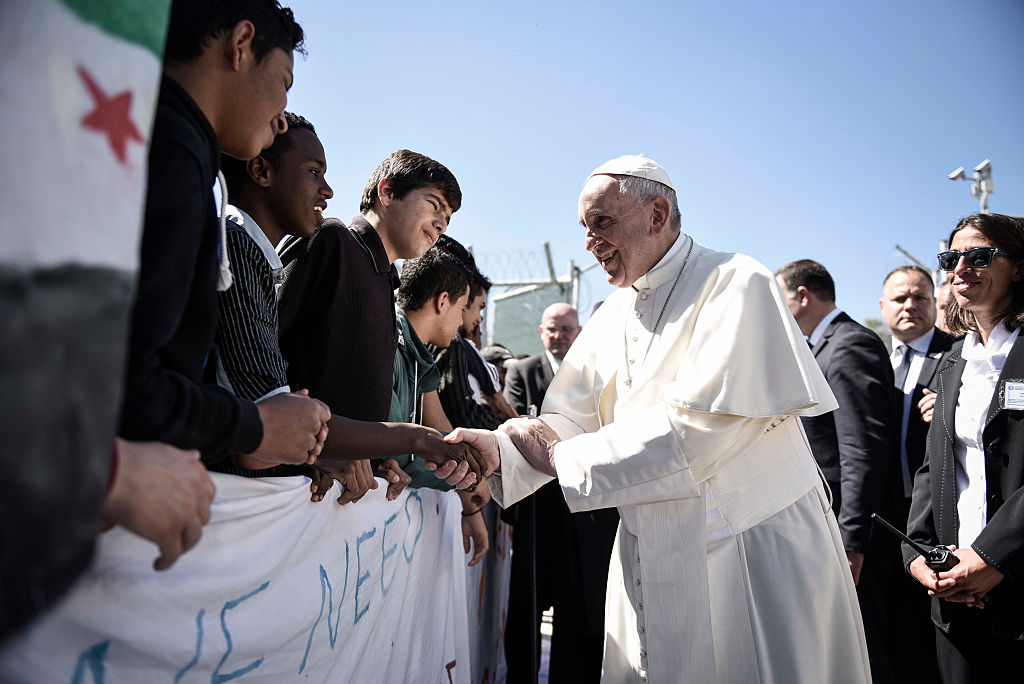
The local population on the Greek island of Lesbos has been extremely helpful to all Muslim migrants, but recent clashes there show the more realistic side of the Muslim immigration into Christian lands. Pictured: Pope Francis meets migrants at the Moria migrant camp on Lesbos, April 16, 2016. (Photo by Andrea Bonetti/Greek Prime Minister's Office via Getty Images)

Turkish President Recep Tayyip ErdoÄŸan, in his speech at the United Nations General Assembly in September, launched a scathing attack on the European Union. He accused the EU of having not done enough to support the refugees and claimed that the EU should pay Turkey more than it pledged (three billion euros).

ErdoÄŸan has often argued that Christian Europe should admit more Muslim refugees. In a 2016 speech, he angrily threatened to open the floodgates of migrants into Europe again (in 2015 alone, three quarters of a million migrants passed through Turkey on their way to Europe).

Is ErdoÄŸan using the mostly Syrian migrants as a bargaining chip to recalibrate his country's failed admission to the EU? Is he simply carpet-trading by trying to maximize the amount of European money coming as aid into Turkey? No doubt, but not only that. His Islamist ideology dictates that the number of Muslims living in all corners of the Old Continent should one day herald a demographic victory for Islam.

"Occupying infidel lands" by the force of sword was an Ottoman idea. Occupying infidel lands through demographics is one of the features of post-modern Islamism, as Muslim nations, unlike the Ottoman Empire, lack the military might needed for military invasion.

Recent events on the Greek island of Lesbos, where the welcoming local population has been extremely helpful to all Muslim migrants, show the more realistic side of the Muslim immigration into Christian lands. Even Pope Francis visited the mostly Syrian migrants in two camps on the island of Lesbos in April 2016 to express his solidarity with them and raise awareness regarding their plight.

In April, however, serious clashes between migrants and locals were reported in the main square of Mytilene, the chief port town of Lesbos. For about a week, migrants occupied the main square to protest their conditions. The demonstrations first sparked the anger of locals, and then some far-right groups who wanted the square cleared.

The clashes were followed by more serious news. A television report by Deutsche Welle claimed that criminal gangs of Syrians sympathetic to the Islamic State (ISIS) had established a reign of terror in the Moria migrant camp on Lesbos. The report, partly shot in secret, showed pro-ISIS slogans on the walls of the overcrowded camp.

Apparently, it was not only the inhumane conditions at the Moria camp about which the migrants felt sick. Unidentified migrant groups vandalized a crucifix on Lesbos. Only a few days later, and in a second act of desecrating Orthodox symbols, extremist Muslims on the island vandalized and destroyed a small proskinitari (a small shrine that holds an icon).

This much tension on an otherwise peaceful Greek island does not happen without a reason. In 2017, a Syrian migrant on Lesbos told this author, "I'll tell you strictly Muslim-to-Muslim. These [European social workers] are funny. I don't know why on earth they are in love with a Muslim cause that even we Muslims despise."

The same year on the same island to the same author, an Afghan said, "One day, we good Muslims will conquer their infidel lands."

At the start of the refugee crisis in 2015, you can read in this journal:
"The Syrian refugee crisis in lands stretching from the Middle East into the heart of Europe is another episode in a grandiose, multi-faceted Middle Eastern dilemma: Muslims in this part of the world view the Christian West as 'evil;' yet they know Christian lands are the most decent places to live economically and politically. Wealthy Arab states rigidly turn their back on the plight of fellow Muslims who are in need of a helping hand; and Islamist hypocrites blame it all on the West."
Three years later, it is truer than ever.

Burak Bekdil, one of Turkey's leading journalists, was recently fired from the country's most noted newspaper after 29 years, for writing in Gatestone what is taking place in Turkey. He is a Fellow at the Middle East Forum.

Source: https://www.gatestoneinstitute.org/13195/refugees-vandalism

Follow Middle East and Terrorism on Twitter


Tale of a Christian Mother in a Non-Christian Land - Majid Rafizadeh

​
by Majid Rafizadeh

Everyone should be free to practice any faith he or she desires without threats, without fear that their children will be tormented and ultimately executed for their beliefs.

  • It is time for the international community and human rights groups to turn their focus on the plight of these children, held hostage by a faith they are never given an option to choose.
  • Everyone should be free to practice any faith he or she desires without threats, without fear that their children will be tormented and ultimately executed for their beliefs.
  • One can only hope that one day this will be true for her family, and the multitudes of other families faced with the same oppression.
The Christian mother said it had all started out as a young woman might hope: with romance. She had fallen in love with a Muslim man and was certain that she wanted to spend the rest of her life with him. She moved with him to his country, a place where radical Islamist laws govern the society. It seemed to her an adventure, a chance to see another part of the universe. But after the consequences it had for her and her family and their safety, she asked to remain anonymous.

As she entered into the dreamed-of wedded bliss with her husband, she had no idea, she said, of the legal and religious ramifications of her marriage that would follow. Yes, she noticed differences about her new way of life, but it was not until she gave birth to two children that these differences began to set in.

Her husband was away most of the time; she spent her days at home caring for her children. She raised them as she herself had been raised, the most natural way she knew, practicing Christianity. Although she had her own beliefs, she allowed her children the freedom to choose whatever faith they preferred. Their father was a Muslim, and the country they were born into practiced Islam, but they chose to follow the Christianity.

One day, as her children grew, she was confronted by a radical Muslim preacher who insisted that she needed to bring them to the mosque to pray. They were Muslims, he said. What she did not know, not then, and not when she agreed to marry her husband, was that in the eyes of a sharia court, her children had been considered Muslim from the day they were born.

While many religious traditions require a commitment to a faith, in Islam, a child does not need to state the Shahaadatayn ("There is no god but Allah, and Muhammad is his Messenger") to become a Muslim.

In Islam, the Muslim preacher explained, if even only one parent is Muslim and the other parent practices another religion, the children are considered Muslim.

He referred her to Al-Mawsoo'ah Al-Fiqhiyyah ("The Encyclopedia of Islamic Jurisprudence"), which points out that Islam prevails over all other religions:
"Muslim jurists have unanimously agreed that if a father embraces Islam and has young children, or someone who is legally like them, such as an insane child who has reached puberty, then they are considered Muslims, as a consequence of the father. The majority of Muslim scholars (Hanafis, Shaafi'is and Hanbalis) maintained that the key factor in this regard is that either parent is Muslim, be it the mother or father; the children are then Muslims as a consequence of their Muslim parent, because Islam prevails and no other religion prevails over it, since it is the religion of Allaah which He is pleased with for His slaves."
Her children and she are now are forced to live two different lives. While out during the day, especially at school, they must adhere to Islamic beliefs, but at home, and apparently in their hearts, they continue to be faithful to Christianity. As confusing as this is for the children, it is necessary for their safety. If they are ever suspected of rejecting their Muslim status, in the eyes of extremist Muslims, they will be considered kufaar (unbelievers) -- apostates. When the fundamentalist preacher informed her of this, he proved it by quoting the instructions from a source:
"... if after reaching puberty he says or does something that indicates that he is not content with Islam, then he is to be regarded as an apostate and is to be treated as one who has apostatised from the religion of Islam."
What would be the punishment for these children? They would be put to death and further humiliated with a dishonorable funeral.

It is stated:
"If a Muslim apostatizes and meets the conditions of apostasy – i.e., he is of sound mind, an adult and does that of his own free will – then his blood may be shed with impunity. He is to be executed by the Muslim ruler or by his deputy – such as the qaadi or judge, and he is not to not be washed (after death, in preparation for burial), the funeral prayer is not to be offered for him and he is not to be buried with the Muslims."
They will also be stripped of all basic rights such as inheritance.

The teachings of most religious instructors encourage acceptance of the beliefs of others; they do not demand punishment for choosing a different faith. In many families in the U.S., when one parent is, say, Christian and the other Jewish, the children grow up practicing any or some or none of their parents' religions. They are free to explore and to believe as they choose. Sometimes, one child will practice Christianity and the other Judaism.

It is time for the international community and human rights groups to turn their focus on the plight of these children, held hostage by a faith they are never given an option to choose.

While the Christian mother holds her breath and hopes her children will be safe, many other families share her fear.

Women and children in Muslim-majority countries are all too familiar with these strictures. Subjected to the dictates of the most rigid interpretation of Islam at the hands of their patriarchal societies, they live as second-class citizens across the Middle East. Those who dare to go against the grain in any fashion -- even by belonging to another religion -- can meet the cruelest fate.

Everyone should be free to practice any faith he or she desires without threats, and without fear that their children will be tormented and ultimately executed for their beliefs. One can only hope that one day this will be true for her family, and the multitudes of other families faced with the same oppression.

  • Follow Majid Rafizadeh on Twitter

Dr. Majid Rafizadeh is a Harvard-educated scholar, businessman, political scientist, board member of Harvard International Review, and president of the International American Council on the Middle East. He has authored several books on Islam and US Foreign Policy. He can be reached at Dr.Rafizadeh@Post.Harvard.Edu

Source: https://www.gatestoneinstitute.org/13197/christian-mother-children

Follow Middle East and Terrorism on Twitter