Sunday, November 15, 2026

Trump nips JD Vance’s Iran appeasement gambit in the bud - Jonathan S. Tobin


by Jonathan S. Tobin

The vice president’s willingness to surrender to the Islamist regime illustrated his foreign-policy incompetence and was a blow to his 2028 hopes. It was also evidence of his hubris.
 

Trump Vance
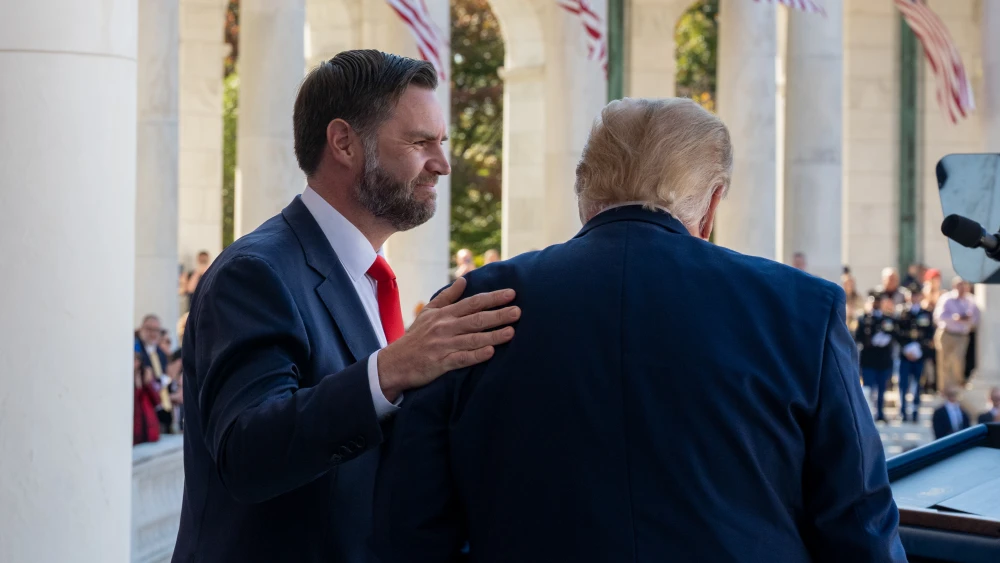
U.S. President Donald Trump and Vice President JD Vance at a Veterans Day ceremony at Arlington National Cemetery in Arlington, Va., Nov. 11, 2026. Credit: Emily J. Higgins/White House.


The midterm elections were disastrous for the Republican Party. But as bad as the results were for the Trump administration and GOP candidates around the country, they were even worse for the vice president. Less than two weeks after the debacle, JD Vance was unceremoniously fired from his position as chief diplomatic envoy charged with finding a way to end the conflict with Iran and diverted to an amorphous task of investigating corruption in Democratic-run cities and states.

This was not a promotion. Nor is it a post likely to produce headlines that will aid Vance’s efforts to succeed the president in 2028. It’s a clear sign that the Vance foreign-policy test drive that began last spring is finally over. That produced a Memorandum of Understanding with Iran that seemed to resemble previous American initiatives to deal with the Iranian threat by Democratic administrations under Presidents Barack Obama and Joe Biden. And it failed just as much as those efforts did, with Iran backing away from it almost immediately. They had quickly grasped that Vance was, like them, eager to appease their regime rather than a statesman who was willing to stand up to them.

An ironic demotion

Any plans for renewing that foolish effort have now been nipped in the bud.

It’s ironic. The vice president thought that he could get out ahead of the usual intraparty post-election circular firing squads that usually follow a catastrophe of such magnitude. He did so by blaming the defeat on his favorite scapegoats—the Iran war, as well as Israel and its supporters—in his election postmortem.

Not content to merely put the onus for the massive Republican losses on the policies that he opposed from inside the Trump tent, he also seems to have launched an initiative to renew his effort to appease the Islamist regime. He proposed, as The Wall Street Journal reported, to restart diplomacy with one of Tehran’s chief hardliners.

While Trump has sent the public a series of confusing and often contradictory signals about his Iran policy since the midterms, the one thing everyone can be sure of is that he has no intention of letting Vance be in charge of it. And now, be anywhere near it.

That’s good news for those who feared that Vance would exploit the shock inside the administration over the midterm results. His intention appeared to be to take charge of Middle East policy and then ensure a surrender to Tehran he thought would aid his bid for the 2028 Republican presidential nomination.

Standing their ground on Iran

That isn’t happening. Instead, U.S. Secretary of State Marco Rubio, who had seemed to be out of the limelight in recent months, appears to be back in charge.

Rubio’s policy is for the United States to stand its ground on Iran. He doesn’t want to give in to the temptation to give up the struggle with it as Vance seemed inclined to do. Such a choice would not only endanger the West by allowing Iran to race to rebuild its nuclear and ballistic-missile programs. It would also isolate and betray American allies, like Israel and moderate Arab states, who rightly fear that, left alone to recover from its defeats at the hands of the United States and Israel in 2025 and 2026, Iran will once again constitute a threat to the region.

Rubio and Trump seem to believe that increased sanctions and a steady U.S. determination to crush Iran economically will force it to concede the end of its existential threats to the West and Israel—or set in motion events that will lead to the end of the regime.

It remains to be seen whether they are right about that. Sooner or later, the administration may be compelled to resume military attacks on Iranian targets to forestall the Islamist government’s plans to resume efforts to intimidate regional friends of the United States.

Whether or not that is what happens, Trump’s statement that America “doesn’t need a deal with Iran” is a rebuke to Vance.

Being shunted aside in this matter is one more blow to the vice president’s reputation in the wake of a midterm election in which he had more to lose than anyone else in the GOP.

The focus of mainstream media attention has been on Democratic triumphalism in the wake of their decisive victory that gave them control of both the U.S. House of Representatives and the Senate. They seem focused on revenge against the Trump administration after two years in which they were forced to be passive observers as the president carried out his policies with no effective check on his efforts.

That will mean, among other things, an intense endeavor to investigate and perhaps impeach the president again, in addition to other members of the administration. And the president’s comments on the undoubted corruption in blue states and cities notwithstanding, there is plenty for Democrats to investigate when it comes to alleged conflicts of interest and inside dealing on the part of the president’s family, including Donald Trump Jr. and son-in-law Jared Kushner.

Vance is sidelined

That may well hamstring Trump’s ability to govern on domestic issues. Still, their efforts to impede his ability to carry out his plans on foreign policy are limited by the Constitution placing that responsibility in the hands of the executive branch. Unless another reversal of fortune occurs, it leaves Vance sidelined on important issues and unable to claim that he is the person who would effectively serve the third term of the Trump presidency.

Vance is still the frontrunner for 2028 among Republicans, if only because no other major candidate who could challenge him has yet declared their intentions. If Rubio sticks to his reported promise not to oppose Vance—a pledge that many Republicans are praying he will violate to save their party from defeat in 2028—the vice president may still prevail in the GOP primaries and, depending on the identity of the Democratic nominee, have a chance to succeed Trump.

Indeed, Vance’s position since the summer, when he appeared to be the dominant candidate to secure the nomination, has markedly declined. The assumption that he could smoothly take over the leadership of the MAGA movement from Trump was shattered by two developments.

One is the midterm results, which make it look like whatever the Republicans put forward in 2028, it can’t merely be doubling down on the stands of the Trump era of the GOP, which seems to be at its end.

Republicans aren’t going to change their position on the importance of border security and opposition to illegal immigration—an issue on which Trump 2.0 had real achievements.

The idea that Vance would simply be allowed to steer the Republicans on a path in which they would appease Iran and abandon the country’s one ally that was ready to fight alongside it to defend American interests—Israel—is not going to happen. Or at least, it won’t happen without a monumental fight that the vice president will be ill-equipped to win with the president and Rubio (whether or not he joins the 2028 race) opposed to him.

Tucker’s influence

Vance was an opponent of the Iran war and is among the few Republican officeholders who are not enthusiastic about the alliance with Jerusalem. That seems to be a function, at least in part, of his ongoing close friendship with one of the country’s leading antisemites and peddlers of conspiracy theories about Jews and Israel—former Fox News host and current podcaster Tucker Carlson. More to the point, it also leads to his mistaken belief that those who listen to or are influenced by Carlson and those of even more extremist figures, like far-right political commentator Candace Owens or the neo-Nazi groyper Nick Fuentes, represent an important GOP constituency.

Trump has always been an Iran hawk because he understood “America First” meant defeating America’s enemies and avoiding “forever” wars that didn’t enhance U.S. security. He’s also been the most pro-Israel president since the modern Jewish state’s founding, as he rightly regarded the nation as a unique strategic asset and not a liability.

The overwhelming majority of Republican voters agree and still back Israel, though younger conservatives seem less likely to agree. Like their Democrat counterparts, they have been influenced by the toxic doctrines about race that dominate the education system and popular culture in which Israel and Jews are falsely labeled “white” oppressors. That view of the world also helped skew liberal media coverage of Israel’s war against genocidal Hamas terrorists in Gaza and their Iranian sponsors, and led to a subsequent decline in support for the Jewish state.

Carlson’s fans subscribe to a not dissimilar worldview based on antisemitic tropes, false conspiracy theories and noxious myths about Israel manipulating the United States against its interests. This is the latest example of horseshoe politics in which both parties’ extremists find common ground. But unlike the case with Democrats, whose anti-Israel wing swept most of their primaries, those who believe these big lies were uniformly defeated in GOP contests.

By embracing such views, Vance is making a statement about where he thinks the future of the Republicans lies. Yet he’s wrong to think mimicking the foreign-policy positions of the Democrats, their Israel-bashing and even antisemitism that has been normalized by the rise of figures like senator-elect Dr. Abdul El-Sayed of Michigan and others on the left will elect him president.

That’s not just a matter of making Jews and Christian supporters of Israel politically homeless.

Scapegoating an ally in ways that align with the divisive doctrines of the left will only further demoralize most Republicans, who reject conspiratorial mindsets and want America to defeat its Islamist enemies. That will also make the GOP less able to appeal to centrists who are unlikely to support a Democratic Party that—their midterm victories notwithstanding—could wind up being in thrall to its dominant left wing in 2028.

Puncturing his sense of entitlement

Vance’s rapid rise in politics from election to the Senate in 2022 and then to the vice presidency in 2024 was largely due to Trump being influenced by Donald Jr. and Carlson. It also bred in him a sense of entitlement that led to a widespread assumption that he would inevitably be named the president’s successor in 2028.

Such hubris is usually fatal to presidential candidates. The notion that he could seamlessly transition to the top spot while also imposing his interest in appeasing the groyper wing of the party on the GOP didn’t account for the possibility of such a massive swing against the administration in 2026.

This opens up the field for others who, unlike Vance, are neither tainted by the failures of the administration nor associated with antisemitic extremists to lead the party on a different path.

It’s possible to argue that Vance being sidelined by Trump will help him run against the administration’s policies in the primaries. But does anyone seriously believe that whatever happened in the midterms, this is the lane that will be the path to victory in a party where Trump is still the most important player?

A lot can happen in the next 18 months to alter the political equation. However, there is little doubt that Vance’s 2028 stock is rapidly declining in value. That’s bad news for him–and good news for those who understand his midterm postmortem was a moral betrayal and a formula for more Republican defeats in the future.


Jonathan S. Tobin is editor-in-chief of JNS, a columnist for Newsweek and a contributor to other publications. He covers the American political scene, foreign policy, the U.S.-Israel relationship, Middle East diplomacy, the Jewish world and the arts. He hosts the JNS “Think Twice” podcast, both the weekly video program and the “Jonathan Tobin Daily” program, available on major audio platforms and YouTube. Previously, he was executive editor, then senior online editor and chief political blogger, for Commentary magazine. Before that, he was editor-in-chief of The Jewish Exponent in Philadelphia and editor of the Connecticut Jewish Ledger. He has won 60-plus awards for his columns, commentary, art criticism and other writing. He appears regularly on television, commenting on politics and foreign policy. Born in New York City, he studied history at Columbia University.

Source: https://www.jns.org/opinion/column/jonathan-s-tobin/trump-nips-jd-vances-iran-appeasement-gambit-in-the-bud

Follow Middle East and Terrorism on Twitter

Israel – Bulwark Against Anti-US Islamic Terrorism - Yoram Ettinger


by Yoram Ettinger

Islamic terrorism considers Israel to be the most critical US vanguard, culturally, technologically and militarily, viewing Israel as the most potent force-multiplier and technology-multiplier for the US, with no need for US combat troops on the ground.


Amanda Dory, President Bidnen’s Undersecretary of Defense for Policy, testified at the House Armed Services Committee, stating that cooperation with Israel has bolstered the technical and operational readiness of the US Armed Forces in the areas of advanced technologies, counter-terrorism (counter-tunneling), battlefield medicine, air and ballistic missile defense, armored vehicle protection and long-range precision fires.

Matt Spence, President Obama’s Deputy Assistant Secretary of Defense for Middle East policy: “It was no accident that new Joint Chiefs Chairman General Joseph Dunford’s first visit abroad was to Israel. That is for good reason. The defense relationship [with Israel] makes America safer. Israel has the military and intelligence capabilities of no other nation in the Middle East. It provides the U.S. critical intelligence, joint military exercises, and technology…. The Defense Department should make startup funding available to joint U.S.-Israel technology projects, taking advantage of the talent from veterans of the Israeli Defense Force, U.S. military, and National Security Agency….”

Irrespective of the nature of US policy and the existence of the Jewish State, tens of millions of Muslims have been killed in intra-Muslim terrorism/wars since the emergence of Islam in the 7th century, 11 million of them since 1948.

The 1,400-year-old Sunni and Shiite Islamic terrorism has been driven by a fanatical, “divinely ordained” ideology, determined to obliterate the “apostate” Arabs and bring the “infidel,” “modern day Crusader” Christians, Jews, and Hindus to submission, especially “The Great American Satan.” This ideology is reinforced by a set of modern day “anti-infidel” constitutions (e.g., the 1928 Muslim Brotherhood and the 1979 Ayatollah regime), hate and martyrdom-driven school curriculum, Friday-mosque-sermons, official media and a systematic campaign of terrorism, stretching from its Middle East epicenter to Central Asia, Africa, Latin America (the soft underbelly of the US) and the US soil itself. 

Islamic terrorism considers Israel to be the most critical US vanguard, culturally, technologically and militarily, viewing Israel as the most potent force-multiplier and technology-multiplier for the US, with no need for US combat troops on the ground.

Unlike Europe, which has lost its will to flex any muscle, and contrary to the pro-US Arab regimes – which are critically constrained by domestic instability and the machetes of the Muslim Brotherhood and the Ayatollah regime at their throats – Israel has engaged the anti-US Islamic terrorism at its point of origin, before it reaches NYC, Boston, Chicago and Los Angeles.

Israel has absorbed, deterred and degraded Islamic terror capabilities, which pose an existential threat to the US, Europe and every pro-US Arab regime. Israel’s role as the first line of defense for – and a major forward security partner of – Western democracies is anchored in its geo-strategic location, unique commercial and defense technologies, and high-yield battle-proven military and intelligence capabilities.

Israel’s exceptional optimistic and patriotic state of mind, its operational readiness, and capability to plant effective agents in every Muslim country in the violently unpredictable and intolerant Middle East, has made it the most productive ally of the US.  For example, in 1999, Israeli intelligence shared with the US Islamic terror plans to replicate the 1998 car-bombing of the US embassies in Tanzania and Kenya in five additional US embassies, which spared many lives and prevented a major blow to US global posture. In fact, Israel’s war against Hezbollah, has been a war against the perpetrator – along with the Ayatollah regime – of the 1983 bombing of the US Embassy and Marines barracks in Beirut, murdering 260 Americans. Moreover, in 2017, Israel’s cyber intelligence uncovered a technical breakthrough by a Syria-based ISIS cell, planting explosives – mimicking standard laptop batteries – that could successfully fool US airport X-ray machines. Israel shared the intelligence with the US authorities, which updated airport security procedures, sparing the US a civil aviation catastrophe. Israeli intelligence has demonstrated the capabilities to protect international aviation and people far beyond Israel’s borders. Israeli intelligence has thwarted dozens of planned terrorist operations targeting Western cities, aviation networks, and infrastructure.

Israel’s countering Sunni and Shiite terrorism, since its 1948 War of Independence, has yielded unique defense capabilities and unmatched access to human intelligence (HUMINT), which have played a key role in securing vital international trade passages – such as the Bab el-Mandeb Strait and the Suez Canal – that underpin the stability of the global Western economy.

Israel’s war on Islamic terrorism – which has collaborated with China, Russia and North Korea, militarily, financially and diplomatically – has exposed the limitations and vulnerabilities of Chinese, Russian and North Korean military systems, tilting the global balance of power in favor of the US.

Every major conventional or hybrid campaign launched by the Ayatollah regime, Hezbollah and Hamas against “The Little Israeli Satan,” forces these terror entities to expend missiles, rockets, drones, fighters, and political capital that would otherwise be available for operations against the pro-US Arab regimes and “The Great American Satan” itself.  

Israel has been a bulwark against the intense Islamic terror attempts to replicate – and exceed – the precedents of September 11, 2001, 2016 Pulse nightclub attack in Orlando, 2015 San Bernardino, 2025 Bourbon Street in New Orleans, 2009 Ft. Hood, 2017 Lower Manhattan truck attack, 1993 World Trade Center bombing, 2013 Boston Marathon bombing, etc.    

*The US and Israel share more enemies and adversaries than they have differences in policy. Furthermore, against the backdrop of the exceptionally high return on the annual US investment in Israel (which is misperceived as “foreign aid”) – economically, technologically and militarily – does the US consider cutting off its nose to spite its face?! 


Amb. (ret.) Yoram Ettinger

Source: https://theettingerreport.com/israel-bulwark-against-anti-us-islamic-terrorism/

Follow Middle East and Terrorism on Twitter

France: Between Red and Brown - Amir Taheri


by Amir Taheri

Interestingly, none of the 15 or so candidates for the presidency in 2027 dares tell the French moaners why the "social market" system doesn't work and how to replace it.


  • The demonstrations, which include the closure of numerous secondary schools and blocking of oil refineries, started as a weekly event on Saturdays but have now become an almost daily exercise in defying the authority of the state.

  • If we add the perks the French welfare state offers, the average French wage-earner may be no worse off than his American counterpart.

  • The lion's share goes to the state, which swallows 60 percent of the gross domestic product compared to 24 percent by the federal government in the US.

  • Parisian café intellectuals call the system "the French model", also hyped with the cliché "social market economy." In practice, it means the state gets most of your money and spends it as it deems fit, while you are left counting farthings to make ends meet.

  • The French state is a giant subsidy-spreading machine. It subsidizes political parties, candidates for public office, trade unions, newspapers and audio-visual media, and thousands of associations. Find a cause, even a lost one, and gather a few chums around you and register yourself as a cultural association, even for reviving the dodo, and you have a good chance of getting a fat cheque...

  • Interestingly, none of the 15 or so candidates for the presidency in 2027 dares tell the French moaners why the "social market" system doesn't work and how to replace it. The two candidates currently ahead in polls belong to the ultra-right National Rally, promising a return to a past that never was, and the ultra-left France Unbowed, offering a future that can never be.

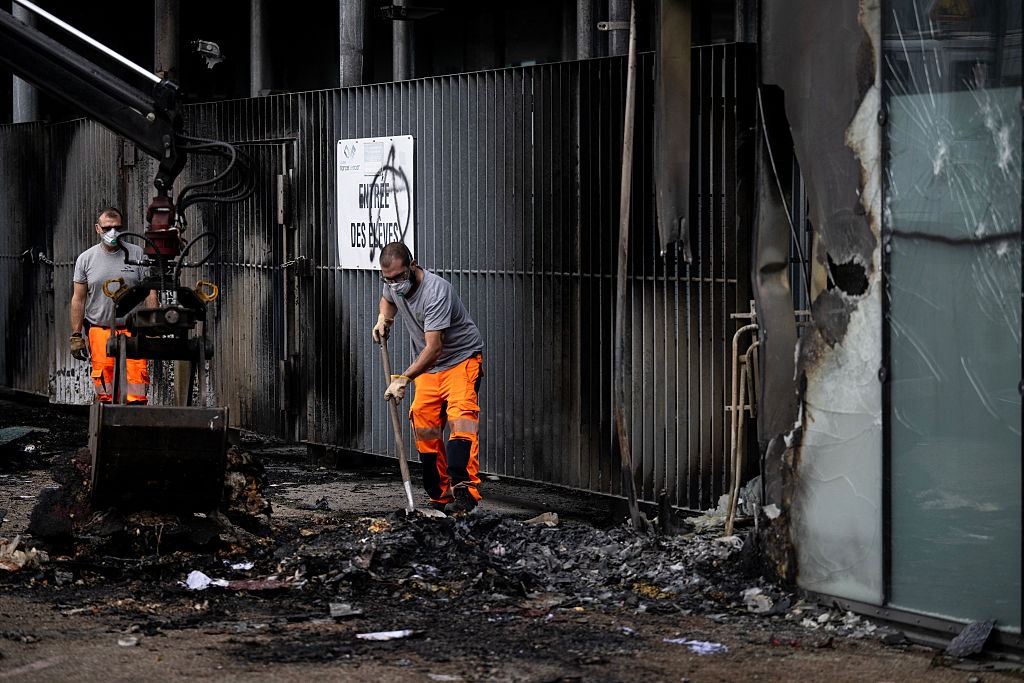
The demonstrations, which include the closure of numerous secondary schools and blocking of oil refineries, started as a weekly event on Saturdays but have now become an almost daily exercise in defying the authority of the state. Pictured: Municipal workers clean up around Marcel Sembat Secondary School in Rouen, France on October 1, 2026, after it was torched by rioters. (Photo by Guillaume Saligot/AFP via Getty Images)

dawn of a new socialist order

In Paris and Lyon, the bearers of the red message formed a small but super-noisy minority of protesters that included the shrinking trade unions, remnants of the defunct PKK, LGBTQA+ organizations, the useful idiots, angry schoolchildren, pro-Hamas outfits waving Palestinian flags, militants from the ultra-left parties such as France Unbowed, the Communist Party, the New Anti-Capitalist Party and the Workers' Fight, as well as the remaining Yellow Vest characters and Trotskyites.

Using all those as cover, a few thousand tightly organized and sometimes uniform-wearing youths used the demonstrations as cover for pillaging shops, attacking the police and setting public buildings, bus stop shelters, garbage dumpsters and private cars on fire. The demonstrations, which include the closure of numerous secondary schools and blocking of oil refineries, started as a weekly event on Saturdays but have now become an almost daily exercise in defying the authority of the state.

Rival figures provided by the Ministry of the Interior and organizers of demonstrations show that between half of one percent to two-thirds of one percent of the population participate in them. What is remarkable is that in a couple of demonstrations we witnessed onlookers stood by as shops were pillaged and cars burned, sometimes taking video clips with their phones. Some polls show that a majority of the French sympathize with the protesters' often-vague demands.

One demand is stated with greater passion. The first is "doing something about" wages and salaries. The argument is that the average salary in France (around $3,000 a month) is almost half of that in the United States. On the surface, that seems a fair comparison. Tearful men and women appear on TV with a litany of woes on how, pinned to low wages, they cannot make ends meet.

A closer look, however, may offer a different perspective. If we add the perks the French welfare state offers, the average French wage-earner may be no worse off than his American counterpart. Thanks to the 35-hour workweek scheme introduced by the Socialist Party government decades ago, the French wage-earner works an average of 28 hours a month less than his American counterpart. Adding the hourly price of labor, that means around $280 more a month. If the French worker works more than 35 hours a week, his extra earnings come tax-free.

The French wage-earner has 30 days of fully paid annual holiday, in addition to eleven other national holidays off. Apart from national holidays off, the American counterpart has no mandatory paid holiday because that depends on agreement with the employer.

Under the French system, the wage-earner gets free education up to the highest levels. His or her student offspring also get state stipends, including rent support, cash to buy textbooks and lunch for $1. The American must pay at every stage.

The French wage-earner also enjoys subsidized or totally free healthcare, including hospitalization, nursing at home or even thermal holiday cures. The American has to sort all that out in a system made more complicated by the ill-conceived Obamacare.

Retirement age in France is 62 years despite abortive attempts at raising it to 64 or 67. In the US, there is no mandatory limit, but most workers in both public and private sectors work past their 67th birthday.

Moreover, almost a third of French wage earners pay no income tax. And yet, the real cost of hiring in France is the highest among OECD countries. The reason? The numerous charges levied by the central government and regional authorities. In other words, hiring a worker costs a lot, but the worker ends up getting less than half of the sums involved. The lion's share goes to the state, which swallows 60 percent of the gross domestic product compared to 24 percent by the federal government in the US.

Parisian café intellectuals call the system "the French model", also hyped with the cliché "social market economy." In practice, it means the state gets most of your money and spends it as it deems fit, while you are left counting farthings to make ends meet.

The model was shaped during the Cold War when free-market nations in Western Europe feared Communism. They mistook Communism for a system of "from each according to his ability and to each according to his needs." Thus, they reinterpreted the role of the state as a regulator of the theoretically free market and distributor of the wealth produced by the people.

They ended up with the disadvantages of both systems.

The free market was prevented from fully functioning, while the state was denied the key tools of Communism, including rationing, the cushion of support from the nomenclature, granted additional perks and the brutal silencing of discordant voices -- not to mention the gulags. As a result, the Western European free market state was presented as cornucopia capable of satisfying endless desires without expecting any respect, let alone loyalty in return.

And since the free market system creates new needs -- not to mention desires -- almost all the time, no state is capable of fulfilling that task and getting a merci-beaucoup in return. After all, according to some, socialism started with Charles Dickens's character Oliver Twist who, when served broth, had the temerity to say, "Please, sir, I want some more."

The French state is a giant subsidy-spreading machine. It subsidizes political parties, candidates for public office, trade unions, newspapers and audio-visual media, and thousands of associations. Find a cause, even a lost one, and gather a few chums around you and register yourself as a cultural association, even for reviving the dodo, and you have a good chance of getting a fat cheque from Marianne. State subsidies help churn out movies few wish to see in theaters that are empty much of the time, and publish research papers about things searched but never found.

Spending other people's money is easy, not to say enjoyable.

Interestingly, none of the 15 or so candidates for the presidency in 2027 dares tell the French moaners why the "social market" system doesn't work and how to replace it. The two candidates currently ahead in polls belong to the ultra-right National Rally, promising a return to a past that never was, and the ultra-left France Unbowed, offering a future that can never be.

Both echo the final phase of Weimar, when the choice was between red and brown. Will France do a Houdini to avoid that choice?

Gatestone Institute would like to thank the author for his kind permission to reprint this article in slightly different form from Asharq Al-Awsat. 


Amir Taheri was the executive editor-in-chief of the daily Kayhan in Iran from 1972 to 1979. He has worked at or written for innumerable publications, published eleven books, and has been a columnist for Asharq Al-Awsat since 1987. He graciously serves as Chairman of Gatestone Europe.

Source: https://www.gatestoneinstitute.org/22985/france-between-red-and-brown

Follow Middle East and Terrorism on Twitter

SpaceX catches rocket returning from orbit in historic feat - Nicholas Ballasy


by Nicholas Ballasy

The successful recovery marked the first time SpaceX caught a Starship upper stage returning from space using the massive mechanical arms, often called “chopsticks,” attached to its launch tower.


SpaceX successfully caught its Starship spacecraft with the mechanical arms of its launch tower in Texas on Saturday, marking a major milestone in the company’s effort to develop a fully reusable rocket system.

The 407-foot Starship launched Friday from the company’s Starbase facility in South Texas on its 15th test flight. 

The spacecraft reached orbit, deployed 26 Starlink satellites and completed 14 trips around Earth before returning Saturday.

The successful recovery marked the first time SpaceX caught a Starship upper stage returning from space using the massive mechanical arms, often called “chopsticks,” attached to its launch tower. 


Nicholas Ballasy

Source: https://justthenews.com/index%2ephp/nation/technology/spacex-starship-completes-historic-first-catch-spacecraft-returning-orbit

Follow Middle East and Terrorism on Twitter

Inshallah: Coming Soon To A Community Near You - Richard C. Crandall


by Richard C. Crandall

Examining Islamic teachings raises questions about their compatibility with America’s constitutional freedoms.


Elected Muslim politicians have been using the word Inshallah, which means “if God wills.” Although the phrase sounds harmless, what these politicians are saying is that they want everyone to live under Islamic domination, which is the will of the Islamic god.

Recently, both the Muslim congresswoman from Minnesota and the newly elected Muslim senator from Michigan used the word Inshallah. It is important to define Inshallah, since as the number of Muslim politicians at the local, state, and national levels grows, we will hear it more often. The word means “God willing” or “if God wills.” At first glance, this seems innocent enough—just another innocuous religious phrase. But perhaps we should ask, “What is the will of the Islamic god?”

Muhammad revealed the will of the Islamic god when he told his followers, “Allah has ordered me to fight against the people till they testify that none has the right to be worshiped but Allah and that Muhammad is the Messenger of Allah.” Muhammad repeated the Islamic god’s will many times in slightly different forms. For example, “Jihad is to continue until all testify that none has the right to be worshipped but Allah, and that Muhammad is his Messenger.” In addition to Muhammad’s statements, the Koran contains similar verses detailing the Islamic god’s will. These verses instruct Muslims to fight non-Muslims until there is no disbelief, all worship is for the Islamic god, and it is acknowledged that Muhammad is his Messenger.

Now we know that the will of the Islamic god and of Muslim politicians is for everyone to live under Islamic domination, where the Islamic faith and law prevail. Under Islamic domination, individuals surrender and live in submission to the Islamic god. Although many believe that the word Islam means peace, it actually means surrender or submission. Those who have surrendered or submitted to the Islamic god are called Muslims, whom the Islamic god refers to as his slaves and whom he created to worship him.

How would the will of the Islamic god affect our constitutional rights?

The Declaration of Independence states, “All men are created equal.” In contemporary usage, “men” refers to both males and females. According to Muhammad, men excel over women; thus, Islam considers females to be beneath males, not equal to them. Additionally, Islam does not consider all males to be equal. Under Islam, Muslim males are superior to non-Muslim males.

The will of the Islamic god also has consequences for the Bill of Rights and the Constitution’s amendments.

The First Amendment addresses religion in two ways: the “Establishment” Clause and the “Free Exercise” Clause. The Establishment Clause prohibits a state-mandated religion. Under Islamic domination, Islam becomes the state-mandated religion. Muslims who leave Islam to exercise freedom of religion are apostates who deserve to be killed.

The First Amendment also protects freedom of speech. In Islam, severe penalties are imposed on those who exercise this freedom. Harsh punishments are prescribed for speech that offends the Islamic god or Muhammad. This is because apostasy includes more than leaving Islam. An apostate is also someone who speaks in a way that implies disbelief in Islam, reviles the Islamic god, denies the existence of the Islamic god, is sarcastic about the Islamic god, denies any part of the Koran, reviles Islam, is sarcastic about sharia, or denies that all should follow Islam. Those who criticize Islam are to be killed, maimed, or crucified. Muhammad personally ordered that people be killed for what they said, sang, or wrote about him or Islam.

The Second Amendment protects the right to bear arms. In Islam, it is illegal for non-Muslims to bear arms.

There are also problems with the Eighth Amendment, which prohibits cruel and unusual punishment, unless we consider amputation, crucifixion, flogging, stoning, and torture “usual” forms of punishment. The right hand is amputated for theft. The hand is then hung around the thief’s neck. For a second offense, the left foot is amputated. For the third offense, the left hand is amputated. For the fourth offense, the right foot is amputated. A fifth offense results in either death or imprisonment.

There is also the problem of the Thirteenth Amendment’s prohibition of slavery. Muhammad owned, traded, and raped slaves, and pious Muslims, if they want to go to paradise, are obligated to follow Muhammad’s behavior. Women who are captured become slaves, or “what the right hand possesses,” and can be legally raped by their owners. Since adultery is illegal in Islam, if the Muslim rapist is married, and his rape victim is also married, is the rapist guilty of adultery? Conveniently, within Islam, when married women are captured and become slaves, their marriages are annulled, which means the Muslim is a rapist, which is legal, but not an adulterer, which is illegal.

One example of Muhammad’s behavior toward slaves occurred when one of his followers captured “one of the prettiest girls in Arabia.” After seeing the girl, Muhammad told his followers to give her to him because she fascinated him. Muhammad’s follower didn’t want to give him the girl because he hadn’t had the opportunity to “disrobe” her. However, it was difficult to refuse the Prophet Muhammad’s request, so the man gave the girl to Muhammad, who later traded her for some Muslim prisoners. Muhammad did not obtain the girl to save her from rape, release her from slavery, or return her to her family. Instead, she was simply something for Muhammad to use sexually and commercially.

There is also a verse that approves the marriage of “pious, fit, and capable” slaves. Slaves were an important source of labor in Islam. Captives provided the largest share of slaves, but another source was the children of slaves.

The Fourteenth Amendment guarantees citizens equal protection under the law. Under Islamic rule, all non-Muslims must pay a tax so that they “feel themselves subdued.” They must live in designated areas of a city, generally the least desirable. Their homes must be inferior to those of Muslims, and their entrance doors must be low, so they must bend before entering. A non-Muslim male who marries or has sex with a Muslim woman is executed. Non-Muslims cannot carry weapons or ride horses or camels. They may ride donkeys outside a city, but sometimes they must ride backward. When approaching a Muslim, they must dismount the donkey and bow until the Muslim passes. Non-Muslims may pass Muslims only from the left, their unclean side. There are often clothing regulations distinguishing non-Muslims from Muslims. These restrictions are severe, causing non-Muslims to live in constant fear and under humiliating, oppressive conditions with few legal rights.

The Nineteenth Amendment gave women the right to vote. Since Muhammad said women are deficient in intelligence and compared them to nothing more than donkeys and dogs, it is doubtful that they will be given the right to vote.

The Twenty-first Amendment allows the manufacture, purchase, and consumption of alcohol. Alcohol is forbidden in Islam.

Before taking office, all members of Congress must take an oath to support and defend the Constitution of the United States against all enemies. The oath ends with “so help me God.” Muslims do not support the Constitution. Rather than defending it, they are the enemy attempting to destroy it. It would be a form of apostasy or disbelief for a Muslim to support and defend laws that conflict with sharia, such as those in the Constitution.

For an oath to be valid for Muslims, it must be made in the name of the Islamic god. Thus, saying “so help me God” rather than “so help me Allah” renders the oath invalid. Also, a Muslim can invalidate an oath by saying, mumbling, or thinking Inshallah.

Those who are to administer the oath of office to Muslims should refuse to do so because they are not taking it in good faith.

Image created using AI.


Richard C. Crandall
taught at the university level for 50 years, during which he watched the once-proud discipline of sociology descend into a cesspool of liberal lies, indoctrination, and propaganda. Consequently, he is now in a recovery program for sociologists, which, unlike programs with a defined number of steps, is a never-ending walk of shame. Fortunately, the program includes wine. In addition to several articles, the author has written books on gerontology, running, Inuit art, and Islam. He is currently completing a book titled Islam: The Evil Among Us. 

Source: https://www.americanthinker.com/articles/2026/11/inshallah-coming-soon-to-a-community-near-you/

Follow Middle East and Terrorism on Twitter

Netanyahu urges Eisenkot to negotiate unity government ‘without preconditions’ - JNS Staff


by JNS Staff

The Iranian regime “will not hesitate to use nuclear weapons against us,” the Israeli prime minister warned.


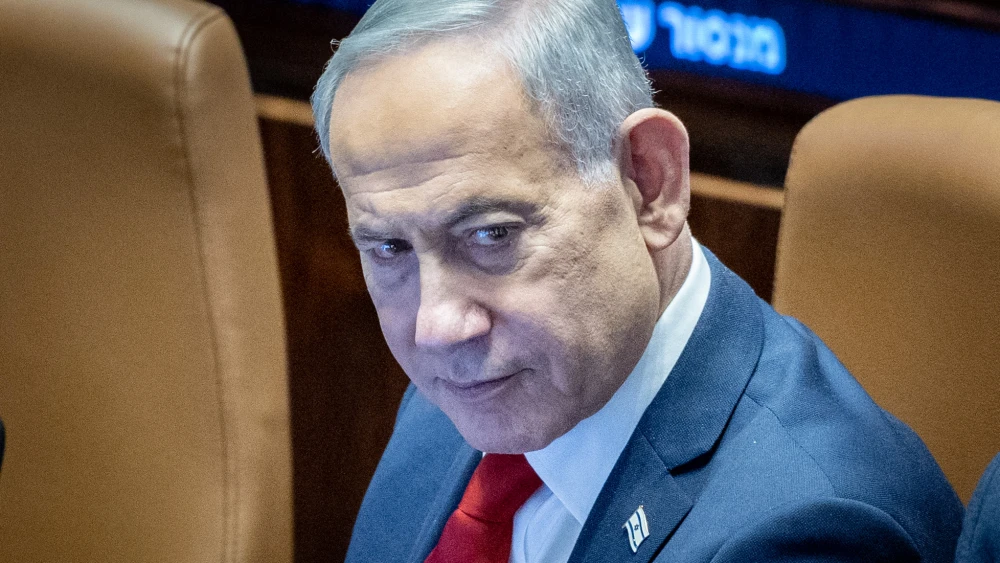
Israeli Prime Minister Benjamin Netanyahu attends a Knesset plenum session in Jerusalem on Nov. 11, 2026. Photo by Chaim Goldberg/Flash90.


Tehran is “once again working to revive its nuclear program,” Israeli Prime Minister Benjamin Netanyahu said on Saturday night, calling on his political rival Gadi Eisenkot to establish a national unity government that will deal with the Iranian threat together.

Netanyahu called on the former military chief to accept coalition negotiations “without preconditions” and accept agreements “for the sake of Israel’s security and future.”

The Iranian regime that murdered thousands of its own people “will not hesitate to use nuclear weapons against us,” Netanyahu warned in a recorded message delivered to the press. “We must remove this existential threat hanging over our heads once and for all,” he continued.

Netanyahu said that a narrow government reliant on the 19 Knesset seats of the Arab parties, or on some of their lawmakers, whom he branded “supporters of terrorism,” will not be able to accomplish this task.

But a national unity government, he stressed, “can achieve it in time, thereby ensuring Israel’s security for many years to come.”

Netanyahu moreover said that a unity government composed of all the parties that support Israel as the nation-state of the Jewish people “will answer the yearning” of many citizens.

He said that the issue of military conscription—one of the main issues around which the Oct. 27 election revolved—can be resolved in a unity government together with the ultra-Orthodox parties.

The appropriate response to those who “deliberately walked out” during the singing of “Hatikvah,” Israel’s national anthem, during the swearing-in ceremony of the new Knesset on Tuesday, is to establish the Government of Hope, the premier said.

Eisenkot reiterates call to Netanyahu to ‘break with the extremists’

Shortly afterward, Eisenkot released a Hebrew-language statement labeling Netanyahu’s plea for a unity government “another political spin.”

The chairman of Yashar party said that there is no need to call for a negotiation meeting since one has already been scheduled for Sunday.

He said that Netanyahu is fully aware of his conditions for joining a national emergency government under his leadership, which include “a break with the extremists,” apparently referring to the factions of ministers Bezalel Smotrich and Itamar Ben-Gvir, the heads of the Religious Zionist and Otzma Yehudit parties, respectively.

Eisenkot charged the incumbent prime minister with placing obstacles in the way of forming a new government and thwarting the replacement of the Knesset speaker.

Eisenkot said that the plan to appoint Yashar party lawmaker Matan Kahana to the role of the Knesset speaker on Tuesday will be the “next test” for Netanyahu’s Likud and his allied Religious Zionist party, “to prove how serious they are” about a national unity government.

Netanyahu, Eisenkot meet for security briefing

On Thursday, Netanyahu and Eisenkot held a two-hour security briefing in Jerusalem, following a public dispute over intelligence updates and reports of disagreements over possible military action against Iran.

“The security briefing held by Prime Minister Benjamin Netanyahu and his Military Secretary Maj. Gen. Guy Markizeno for Yashar Chairman Gadi Eisenkot has now concluded,” according to a joint statement issued by Netanyahu and Eisenkot.

“Eisenkot was briefed on the security and diplomatic challenges presently faced by the State of Israel. The parties agreed to proceed with mutual updates as the need arises.”

The meeting came four days after Israeli President Isaac Herzog tasked Eisenkot with forming Israel’s next government.

Eisenkot received the mandate after parties with 67 members of the newly elected Knesset recommended him for prime minister, compared with 46 who backed Netanyahu. Neither political bloc, however, commands a majority in the 120-seat legislature.


JNS Staff

Source: https://www.jns.org/news/israel-news/netanyahu-urges-eisenkot-to-negotiate-unity-government-without-preconditions

Follow Middle East and Terrorism on Twitter

From Rabin to Eisenkot: The possibilities and limits of minority government -Shimon Sherman


by Shimon Sherman

Can the Yashar party chief build a coalition that survives beyond its first vote?


From left: Yair Lapid (B'Yachad), Gadi Eisenkot (Yashar), Yair Golan (HaDemokratim), Naftali Bennett (B'Yachad) and Avigdor Lieberman (Israel Beiteinu) meeting at Lapid's home in Tel Aviv, Sept. 26, 2026. Credit: X/Yair Lapid.
From left: Yair Lapid (B’Yachad), Gadi Eisenkot (Yashar), Yair Golan (The Democrats), Naftali Bennett (B’Yachad) and Avigdor Liberman (Yisrael Beiteinu) meeting at Lapid’s home in Tel Aviv, Sept. 26, 2026. Credit: Yair Lapid/X.

Israel’s post-election deadlock has revived interest in a minority government as a possible route to replacing Prime Minister Benjamin Netanyahu. For Yashar party head Gadi Eisenkot, who received the mandate to form a government on Nov. 8, the challenge is finding an arrangement his prospective partners will support beyond the initial confidence vote.

The Oct. 27 election left Netanyahu’s bloc with 53 seats, Eisenkot’s four Jewish-led opposition parties with 48, and the Arab parties with 19. Although 67 lawmakers recommended Eisenkot for the prime ministership to President Isaac Herzog, disagreements over cooperation with the Arab and Haredi parties have prevented those endorsements from producing an agreed coalition.

Israel has faced similar dilemmas before. Minority governments have pursued major diplomatic initiatives, survived the departure of coalition partners and, in some cases, expanded into majority coalitions. Others have deteriorated rapidly as their parliamentary support collapsed. For Eisenkot, their experience raises a practical question: whether parties prepared to help remove Netanyahu are also prepared to sustain the government that replaces him.

Governing without a majority

A minority government is a coalition whose parties hold fewer than 61 of the Knesset’s 120 seats. It can nevertheless command enough parliamentary support to take office and pass legislation if parties outside the coalition vote with it or abstain.

In a published analysis, Dr. Assaf Shapira of the Israel Democracy Institute explained that “the investiture vote in Israel only requires a simple majority.” The Bennett-Lapid government, for example, was approved in June 2021 by 60 votes to 59, with one abstention. Since 2014, an Israeli government can be replaced through a no-confidence motion only if at least 61 Knesset members agree on and endorse an alternative government. An opposition united against the incumbent but divided over its successor may therefore struggle to replace even a government with a relatively small parliamentary base.

However, those same lawmakers can dissolve the Knesset with 61 votes without agreeing on an alternative government. Budgets require a simple majority, but failure to pass one by the statutory deadline triggers automatic dissolution of the Knesset. A minority government therefore needs outside parties willing to support its budgets and resist calls for elections, even when they disagree with other elements of its agenda.

A history of minority governments

Yitzhak Rabin’s second government provides Israel’s most substantial precedent for prolonged minority rule. Established in 1992, it initially commanded 62 seats through a coalition of Labor, Meretz and Shas. Shas withdrew from the government in September 1993 following the Supreme Court ruling in the Deri affair, which required Rabin to dismiss Interior Minister Aryeh Deri and Deputy Religious Affairs Minister Raphael Pinhasi, reducing the governing coalition to 56 lawmakers.

Rabin continued with outside support from Hadash and the Arab Democratic Party, whose combined five seats supplied the votes needed for a parliamentary majority. Their support rested on a shared interest in advancing negotiations with the Palestinians, allowing the government to pursue its central diplomatic initiative despite losing a coalition partner.

That September, the Knesset endorsed the Declaration of Principles with the PLO by 61 votes to 50. The government subsequently signed the peace treaty with Jordan in October 1994. Three lawmakers who split from the Tzomet party joined the coalition in January 1995, raising its formal strength to 59, although Arab-party support remained important.

Presenting the Oslo II agreement to the Knesset in October 1995, Rabin tied its approval directly to his government’s survival, declaring: “The government will seek the Knesset’s approval and will view the Knesset’s decision as a vote of confidence in the government.”

The agreement passed 61–59. Following Rabin’s assassination the next month, Shimon Peres formed another minority government supported by Arab lawmakers, remaining in office until Netanyahu succeeded him after the 1996 election.

The cooperation sustained Labor-led governments for more than two years after Shas’s departure. Although the parties supporting them did not all sit around the Cabinet table, they had sufficient common interests to preserve the government and advance its principal policies.

“The case of the Rabin government indicates that a minority government can not only be politically viable but can advance incredibly consequential and transformative legislation,” Dr. Joshua Kagan, an independent researcher specializing in Middle Eastern affairs, told JNS. “It doesn’t get more important, or politically complicated, than Oslo, and the fact that a minority government got it through shows that they can be just as effective as a majority,” he added.

Other minority governments illustrate the weaknesses of this arrangement. Ehud Barak’s experience exposed the difficulty of governing when the common purpose between a coalition and its external supporters breaks down. His 1999 coalition began with seven parties and 75 seats, but brought together factions divided over religion and state, education and the Palestinian peace process.

United Torah Judaism left in September 1999. Meretz withdrew in June 2000 after disputes with Shas over education, while continuing to support Barak from outside. The following month, Shas, Yisrael B’Aliyah and the National Religious Party departed shortly before the Camp David summit. Yisrael B’Aliyah leader Natan Sharansky, then interior minister, argued that Barak was heading into negotiations without sufficiently broad support.

Barak continued diplomatic negotiations, but could no longer rely on the alliance that had brought him to power. After the outbreak of the Second Intifada and the collapse of negotiations, his political position became untenable. He was replaced as prime minister by Ariel Sharon in March 2001, eight months after losing his Knesset majority.

Sharon faced a similar rupture over his disengagement plan for Gaza, which divided Likud and prompted the departure of right-wing coalition partners. The dispute reduced Sharon’s coalition first to 55 and then to 40 seats. However, support from opposition parties, including Labor, allowed him to secure the plan’s approval in October 2004 by 67 votes to 45.

Faced with an unsustainable 40-seat coalition, Sharon moved to expand his ranks and stabilize his government. Labor subsequently joined the government in January 2005. The Knesset passed the Disengagement Implementation Law by 59 votes to 40 the following month, and the evacuation of Israeli communities in Gaza and northern Samaria proceeded in August.

“The Sharon minority government indicates that a government can survive for short periods of time with a small coalition bloc, but that in the long run a majority is still necessary,” Kagan said. “The fact that a transition to a different coalition structure was possible is what stabilized the situation,” he added.

Other governments have used minority status as a temporary stage in coalition building. Yitzhak Shamir formed a 59-seat coalition in June 1990 with outside support from Moledet’s two lawmakers, then recruited additional partners and restored a majority later that year.

The Bennett-Lapid government moved in the opposite direction. Defections undermined its parliamentary majority in 2022, and its leaders eventually initiated dissolution. The Knesset approved the measure in June by 92 votes without opposition, bringing the coalition’s attempt to govern across deep ideological divisions to an end.

“The only real case of long-term survival without a majority was Rabin, who governed for almost two and a half years without 61 votes. Rabin is a unique case, but other than him, the second a coalition dips below 61, it generally starts a clock. The first major disagreement will inevitably lead to elections, so the prime minister needs to stabilize a majority before the cracks surface,” Kagan observed. “Usually it’s a matter of months, particularly if you start from the election with a minority, until you have to get to 61,” he added.

Eisenkot’s dilemma

Eisenkot’s most immediate obstacle is obtaining agreement even for the initial confidence vote. His 48-seat bloc could win 56–53 with Ra’am’s eight lawmakers voting in favor and the Joint List’s 11 abstaining, assuming Netanyahu’s bloc voted against.

However, Yisrael Beiteinu chairman Avigdor Liberman continues to reject reliance on Arab-party support, warning that such a partnership would be short-lived and ultimately strengthen Netanyahu’s bloc. On Nov. 10, he warned, “Anyone who is talking about a minority government, that means crowning Netanyahu for another full term.”

United Torah Judaism offers another possibility. Its seven lawmakers declined to recommend Netanyahu to the president, leaving him with 46 recommendations. Channel 12 reported that figures in UTJ were considering allowing an Eisenkot-led minority government to take office through abstentions. If UTJ and all 19 Arab-party lawmakers abstained, Eisenkot’s bloc could win 48–46.

Ynet reported a variation in which Ra’am lawmaker Yoav Segalovitz would vote with Eisenkot’s bloc, producing a 49–46 result with 25 abstentions. Ra’am and UTJ would then provide continuing outside support, giving the government and its supporters a combined 63 seats. Yashar cautioned that the reports were imprecise and did not necessarily reflect the negotiations.

All three calculations assume the support of Yisrael Beiteinu’s seven lawmakers. Liberman has explicitly rejected a minority government; if his faction voted against, even the proposed 49–46 result would become a defeat of 42–53.

These proposals would still require cooperation from Arab lawmakers and concessions to UTJ. Eisenkot’s commitment to expanding service obligations conflicts with the Haredi party’s demands for yeshivah-student exemptions. Naftali Bennett has meanwhile remained largely silent, but several B’Yachad officials have indicated that he does not intend to compromise on the Haredi draft.

UTJ could instead join the coalition, bringing it to 55 seats. Recruiting Shas as well would produce a 61-seat majority, the arrangement Liberman now advocates. But Shas recommended Netanyahu to the president, and securing either Haredi party would require agreement on the conscription dispute.

Eisenkot would therefore have to secure before taking office the support that Rabin relied on after losing his majority. A minority government might give him time to recruit additional partners, as Shamir did, but would also leave its survival dependent on parties outside the coalition.

“Israel’s experience shows that minority governments can exercise substantial authority when their parliamentary supporters share enough objectives. For Eisenkot, replacing Netanyahu would be the first of those objectives. The durability of his government would depend on whether its participants could agree on what follows,” Kagan noted. “In the end, if Eisenkot hopes to survive for longer than a few months, he’s likely going to need to expand past a minority.” 


Shimon Sherman is a columnist covering global security, Middle Eastern affairs, and geopolitical developments. His reporting provides in-depth analysis on topics such as the resurgence of ISIS, Iran’s nuclear ambitions, judicial reforms in Israel, and the evolving landscape of militant groups in Syria and Iraq. With a focus on investigative journalism and expert interviews, his work offers critical insights into the most pressing issues shaping international relations and security.

Source: https://www.jns.org/analysis/from-rabin-to-eisenkot-the-possibilities-and-limits-of-minority-government

Follow Middle East and Terrorism on Twitter

Mamdani to disband NYPD strategic response unit - Chris Wade


by Chris Wade

"I have made very clear that the focus of the conversations that have taken place since being in office has been to do this in a way that keeps New Yorkers safe and protects their First Amendment rights," Mamdani said during the press briefing.


(The Center Square) -

(The Center Square) — New York Mayor Zohran Mamdani is preparing to disband a controversial NYPD unit, fulfilling a key campaign pledge for the democratic socialist, who has been criticized for calling to defund the nation's largest police force.

Speaking to reporters on Friday, Mamdani said he remains committed to disbanding the NYPD's Strategic Response Group — which has dual responsibilities to respond to acts of suspected terrorism as well as large-scale protests — but didn't provide any details.

"I have made very clear that the focus of the conversations that have taken place since being in office has been to do this in a way that keeps New Yorkers safe and protects their First Amendment rights," Mamdani said during the press briefing.

His remarks came as news reports suggested that the Mamdani administration is preparing to dismantle the unit — splitting its responsibilities by creating a new civilian force to respond to public demonstrations and another specifically for responding to anti-terrorism efforts.

The Center Square did not independently confirm how much the city spends on the unit or how many officers it employs. Research from the New York chapter of the ACLU says it has 700 staff and carries a $100 million budget.

A city hall spokeswoman said in a statement that the Mamdani administration will "disband the Strategic Response Group and separate protest response from counterterrorism" and said additional information will be coming soon. Several published reports said that announcement could come as early as next week.

Sometimes also called SRG, the unit was beefed up in the wake of the Sept. 11, 2001, terrorist attacks to respond to "citywide mobilizations, civil disorders, and major events with highly trained personnel and specialized equipment. They are also deployed to areas requiring an increased police presence due to increased crime or other conditions," the NYPD says on its website.

But the specialized unit has been criticized by community activists and others as too militaristic, prompting the new mayor to make good on his campaign pledge.

In 2020, the NYPD unit was accused of unfairly detaining more than 100 protesters who had been part of a demonstration over the death of George Floyd, a Black man who died in Minneapolis police custody. The agency entered a consent decree to settle the allegations and a judge ordered reparations for those who were determined to be unlawfully detained.

Patrick Hendry, president of the Police Benevolent Association, the NYPD's largest union, says Mamdani's plan will put "both police officers and the public at greater risk."

"Mayor Mamdani has spent years scoring political points by singling out and demonizing one particular group of police officers. If he's now planning to replace them with civilians, he should be honest: SRG's dual role was never the real issue. He and his radical allies just don't want the NYPD involved in policing demonstrations at all."

"No matter what changes he makes, the mayor can't be foolish enough to believe they will satisfy his base," Hendry added. “'Disband SRG' was always code for 'Disband the whole NYPD,' and they won't stop until they achieve that goal." 


Chris Wade

Source: https://justthenews.com/nation/states/center-square/mamdani-disband-nypd-strategic-response-unit

Follow Middle East and Terrorism on Twitter

More than half of U.S. kindergarten students unprepared for grade school in five states: GAO - Nicholas Ballasy


by Nicholas Ballasy

The cost of COVID? The GAO discovered major differences in readiness rates based on students’ backgrounds and where they attended school. The watchdog examined data from Connecticut, Florida, Kentucky, Maryland, and Ohio. Other researchers have pointed at the COVID-19 shutdown as a likely cause.


More than half of kindergarten students were not considered ready for grade school in five states the Government Accountability Office examined, according to a new report released this week. The GAO examined kindergarten readiness data from Connecticut, Florida, Kentucky, Maryland, and Ohio in the report.

The watchdog discovered major differences in readiness rates based on students’ backgrounds and where they attended school.

Children lacking foundational skills

In all five states, "fewer than half" of students met their state’s readiness benchmarks, raising concerns about the foundational skills children brought with them when they entered elementary school.

Ohio recorded the lowest readiness rate with 37% of kindergarten students considered ready during the 2024-2025 school year, while Florida reported 43% and Kentucky recorded 46%.

Maryland reported that 44% of students were ready during the 2023-2024 school year. The state did not administer a kindergarten entry assessment during the following school year. Connecticut did not report an overall readiness percentage, but the state found that between 41% and 56% of students were ready across six developmental areas.

“Less than half of students were ready for kindergarten in each of the five selected states,” the GAO said in its key findings.

Correlation between ethnic background, economic status and test performance

The report also found substantial differences among student demographic groups. Across the states examined, Asian and white students, along with students who were not economically disadvantaged, generally had the highest kindergarten readiness rates.

English learners and students with disabilities generally recorded the lowest rates, the GAO noted.

The watchdog found that school districts with higher poverty levels generally had lower kindergarten readiness rates in Connecticut, Florida, Kentucky and Ohio. 

Researchers did not find a statistically significant association between district poverty levels and kindergarten readiness in Maryland, the report said. Preschool enrollment was also associated with stronger readiness outcomes in some states.

Districts with higher percentages of students enrolled in public or private preschool were associated with higher kindergarten readiness rates in Connecticut, Kentucky and Ohio. The GAO did not find a statistically significant association in Florida or Maryland.

The findings were consistent with the agency’s review of 11 research studies examining the relationship between publicly funded preschool programs and kindergarten readiness. “Ten of the 11 studies we reviewed suggest that publicly funded preschool programs positively affected kindergarten readiness in literacy, math, or both,” the report stated.

Historical data tells a story of decline

The agency said its analysis was based on available state assessment data, including 2024-2025 information from Connecticut, Florida, Kentucky and Ohio and 2023–2024 data from Maryland.

Data from the Cincinnati Children's Hospital Medical Center shows that after the COVID-19 shutdown, “This means that 7 of every 10 children in the Cincinnati Public Schools were considered not ready to learn when they entered kindergarten during the pandemic. This trend was even more pronounced among the more-disadvantaged, Medicaid-covered children we see in our primary care clinics,” wrote the study’s lead author, Kristen Copeland, MD, Division of General and Community Pediatrics.

The Cincinnati study showed that ten studies identified positive associations between publicly funded preschool and kindergarten literacy scores, while seven studies that examined math scores also found positive associations. Only 30% (or 3 in 10) of Cincinnati Public Schools students were assessed as kindergarten-ready in 2021, a significant decline from 40% (or 4 in 10) assessed as ready in 2018. 

Some research suggested the benefits extended beyond the children directly enrolled in preschool programs. One study examining Virginia’s expansion of public preschool for low-income families found that kindergarten literacy skills increased on average among all students in participating districts, including those who did not attend the program.

However, the GAO noted that the effects of preschool participation could diminish over time. One study examining Virginia preschool students found that their initial academic advantages decreased by approximately 75% by the end of first grade.

The agency also highlighted differences in how states measured kindergarten readiness. Connecticut relied on teacher observations, Florida administered computer-based assessments, and Kentucky, Maryland and Ohio used combinations of observations, questions and other assessments.

The assessments measured various developmental skills, including literacy, mathematics, language, physical development and social-emotional abilities.

The National Library of Medicine reported in October 2025 that while young children have largely been spared acute severe disease impacts of COVID-19, they are at "considerable risk for delayed socioemotional and academic outcomes because of compromises to their initial learning experiences."

The GAO warned that the readiness percentages should not be used to rank states because each state uses different assessment methods, benchmarks and reporting standards. “Because states vary in how they assess readiness, kindergarten readiness rates are not comparable across states,” the report said.


Nicholas Ballasy

Source: https://justthenews.com/politics-policy/education/gao-report-found-fewer-half-kindergarten-students-were-school-ready-five

Follow Middle East and Terrorism on Twitter