Sunday, July 21, 2024

Secret Service admits denying Trump protective resources in the past despite complaints - Terrance Kible


by Terrance Kible

The Secret Service admitted resorting to 'utilizing state or local partners' when it had insufficient resources


The Secret Service admitted on Saturday to denying former President Donald Trump's team protective resources in the past and instead "utilizing state or local partners" to supplement insufficient Secret Service resources.

Trump's protective detail previously complained about receiving insufficient resources and personnel from the Secret Service.

Secret Service Chief of Communications Anthony Guglielmi admitted the agency denied some requests from Trump's protective detail in years past.

"In some instances where specific Secret Service specialized units or resources were not provided, the agency made modifications to ensure the security of the protected," Guglielmi told CNN.

Guglielmi said the agency made substitutions "utilizing state or local partners . . . to reduce public exposure of a protected."

The Secret Service, however, asserted it "added protective resources & technology & capabilities" in the leadup to the July 13 rally where a gunman killed one rallygoer, seriously injured two others, and wounded Trump, according to CNN.

 
Terrance Kible

Source: https://justthenews.com/politics-policy/all-things-trump/secret-service-admits-denying-trump-protective-resources-past

Follow Middle East and Terrorism on Twitter

Operation 'Outstretched Arm' demonstrates Israel's F-35's stealth striking capabilities - Udi Etzion


by Udi Etzion

Almost 30 years after Operation "Wooden Leg," Israel’s Air Force used advanced F-35s in a similar long-range attack on Yemen.


(Illustrative) An Israeli F-35 near the scene of the IAF strike on H Hodeidah, Yemen. (photo credit: FLASH90, VIA REUTERS)
(Illustrative) An Israeli F-35 near the scene of the IAF strike on H Hodeidah, Yemen.
(photo credit: FLASH90, VIA REUTERS)

Almost 30 years ago, the Israel Air Force carried out Operation “Wooden Leg” to attack the PLO headquarters in Tunis, a distance of 2,200 kilometers from Israel, the most extended attack it had carried out until then.

A group of eight F-15 aircraft was assisted by two aerial refueling planes to cover the distance, and professionals around the world were impressed by Israel’s ability to attack with fighter jets at ranges commonly used by bombers, which Israel does not have.

The attack on the Houthi targets in Yemen is very reminiscent of that operation, with an almost identical range but with different aircraft. In 2024, the air force operates a squadron of F-15I Ra’am aircraft, which is more advanced and better suited for long-range attack missions than the F-15s used in the Tunis attack.

According to reports, this time, the air force used the newer F-35 aircraft, known as Adir, which led the attack. The 100 F-16I Sufa aircraft operated by the air force are even more advanced than the Ra’am, which arrived here 26 years ago. Likely, the Ra’am and Sufa aircraft were also integrated into the operation, even if only for refueling protection.

Unlike the F-15 and F-16, the F-35 is a single-engine aircraft with a single pilot rather than a pilot and navigator crew who can assist in operating advanced attack munitions. However, it has several significant advantages in long-range attacks.

Lockheed Martin's logo is seen during Japan Aerospace 2016 air show in Tokyo, Japan, October 12, 2016. (credit: REUTERS/KIM KYUNG-HOON)Enlrage image
Lockheed Martin's logo is seen during Japan Aerospace 2016 air show in Tokyo, Japan, October 12, 2016. (credit: REUTERS/KIM KYUNG-HOON)

The first of these advantages is stealth; radars find it very difficult to detect the F-35 due to its structure and the materials it is coated with, which absorb most of the electromagnetic waves. An attacking F-35 will be detected much later than an F-15 or F-16, usually too late to respond. This is also important concerning the attack on Yemen, as the Houthis have already demonstrated that they possess anti-aircraft missile systems, and they have already shot down American UAVs.

Israel already purchased 50 aircraft from Lockheed Martin

Israel has already purchased 50 aircraft from Lockheed Martin.

The aircraft also has electronic warfare systems, including Israeli systems, which the air force insisted on integrating into the purchased aircraft. These systems are designed to protect the plane when it carries under its wings weapons and fuel tanks that make it less covert.

The second advantage is the aircraft’s array of sensors. Israel has already purchased 50 Lockheed Martin aircraft, with most already delivered, and is currently acquiring a third squadron. The list includes advanced radar, optical, and thermal sensors; the ability to intercept radar transmissions; and especially the capability to fuse this information to cross-reference it.

This allows it to locate targets, identify the safest flight path with minimal chances of detection and interception, and share its information with other aircraft and rear command centers. The F-35 is not just an attack aircraft; it has capabilities that, until recently, required a series of surveillance and intelligence-gathering aircraft to achieve.

The third feature is its carrying capacity: 8.1 tons of bombs and missiles, including about 1.4 tons in two internal weapon bays for stealth mode flight, with the rest on external hard points on the wings. This is a lot for a single-engine fighter of this size – not much less than the twin-engine F-15I (11 tons). The F-35 can carry a variety of intelligent bombs, which it can release from dozens to sometimes hundreds of kilometers away from the target, making it possible for a single quartet of Adir aircraft to attack dozens of targets.

The fourth feature is its range: the F-35A model operated by the air force can fly about 1,150 kilometers each way – about 150 kilometers less than the approximately 1,300 kilometers of the F-15 and the F-16 Sufa. All three can be refueled in the air by the IAF’s older refueling aircraft, or they can use long-range missiles and bombs, as was done in the attack on the Iranian radar attributed to Israel after the missile and drone attack on April 14.

Either way, eight years after the first F-35s landed at Nevatim Airbase, Israel’s first stealth aircraft marks an important milestone.


Udi Etzion

Source: https://www.jpost.com/israel-hamas-war/article-811196

Follow Middle East and Terrorism on Twitter

European Union Is Funding Iranian Aggression - Majid Rafizadeh


by Majid Rafizadeh

While the EU loves to portray itself as a front-runner in human rights, often lecturing the world about those values and global security, its actions -- all mercenary, all the time -- tell a very different story.


  • The continued funding of Iran's regime by the EU is crucial in bolstering Iran's ability to attack its neighbors and US troops in the region, both directly and through its proxies -- Hamas, Hezbollah, Palestinian Islamic Jihad and the Houthis -- and to accelerate enriching uranium to complete its nuclear weapons program.

  • The regime's actions appear part of a broader strategy aimed at ultimately annihilating not only Israel but also oil-rich Saudi Arabia and the United Arab Emirates.

  • While the EU loves to portray itself as a front-runner in human rights, often lecturing the world about those values and global security, its actions -- all mercenary, all the time -- tell a very different story.

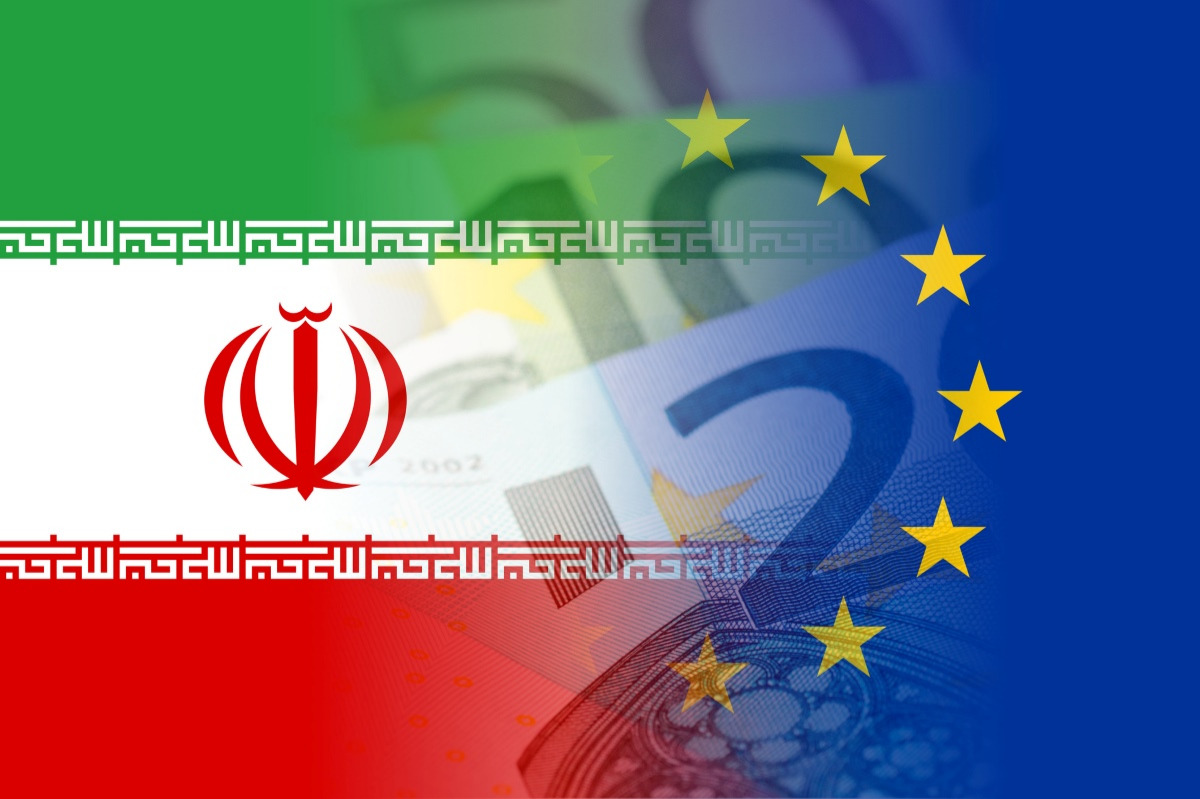
Iran's strategy is aimed at ultimately annihilating not only Israel but also oil-rich Saudi Arabia and the United Arab Emirates. The continued funding of Iran's regime by the EU is crucial in bolstering Iran's ability to attack its neighbors and US troops in the region, both directly and through its proxies -- Hamas, Hezbollah, Palestinian Islamic Jihad and the Houthis -- and to accelerate enriching uranium to complete its nuclear weapons program. (Image source: iStock/Getty Images)

The Iranian regime, largely thanks to the backing of a powerful ally, the European Union, has managed to sustain and even increase its revenue streams.

The continued funding of Iran's regime by the EU is crucial in bolstering Iran's ability to attack its neighbors and US troops in the region, both directly and through its proxies -- Hamas, Hezbollah, Palestinian Islamic Jihad and the Houthis -- and to accelerate enriching uranium to complete its nuclear weapons program.

Support from the EU has enabled Iran to continue its regional and international militaristic endeavors without the looming threat of financial insolvency.

The EU continues to engage, shamelessly it seems, in business transactions with Iran, which simply uses the revenues to further its expansionist ambitions, such as launching an aggressive war against Israel and firing on US troops in the region more than 170 times just since October, close off maritime shipping in the area, and bring its nuclear weapons program to near completion. The regime's actions appear part of a broader strategy aimed at ultimately annihilating not only Israel but also oil-rich Saudi Arabia and the United Arab Emirates. This ongoing relationship raises serious ethical and political questions about the EU's stance on global security and its commitment to standing against a regime that threaten peace and stability in the region.

Iran's regime, since the onset of the Russian invasion of Ukraine, has also extended significant support to Russia, both diplomatically and militarily. Iran has also consistently voted against United Nations resolutions condemning Russia's actions, and has actively contributed to the Russian military effort by supplying weapons, including advanced attack drones such as the Shahed 131 and Shahed 136. Iran's unwavering support for Russia underscores its broader geopolitical strategy and its alignment with other authoritarian nations that desire to disrupt the existing international order.

Some countries within the EU have actually increased their trade with Iran. There has been a substantial growth of imports from Iran by several EU member states. Iran's state-controlled outlet Mehr News even boasted regarding January's trade figures:

"Greece's imports from Iran tripled and reached €2.3 million. Dutch imports from Iran have also almost doubled, from €3.5 million in January 2023 to €6.8 million in January this year. Romania's imports from Iran also increased by 47 percent to €3.4 million, and Italy's imports by two percent to €12.2 million."

Iran's top trading partner in Europe continues to be Germany, followed closely by Italy and the Netherlands as the second and third-biggest European trade partners of the Iranian regime.

To maintain its trade relations with Iran, the EU has apparently thought nothing of offering condolences for the death of President Ebrahim Raisi, a mass murderer, known as the "Butcher of Tehran." He was a key figure on the "Death Committee" in Iran, responsible for the execution of tens of thousands of people, including pregnant women and children. This gesture by the EU, ostensibly to avoid disrupting its trade with Iran, once again underscores a willingness to overlook human rights violations for economic gains.

By continuing to do business with Iran, European countries knowingly fuel Russia's attacks on Ukraine, and even potentially on themselves, as Russia extends its aggressive ambitions across the continent.

Europe's trade relationships with Iran also provide the regime with the financial means to further its hostile actions against its neighbors, arm its proxies, further the regime's legitimacy on the international stage; intensify its repression of domestic dissent, and complete its nuclear weapons.

Instead of engaging in business with a country ruled by a predatory and rogue regime, the EU would do itself and everyone else an existential favor: instead of financing Iran's regime and its military, to curb Iran's destabilizing activities. The EU should immediately halt all trade with Iran, designate the Islamic Revolutionary Guard Corps as a terrorist organization, and sever diplomatic ties with Iran.

While the EU loves to portray itself as a front-runner in human rights, often lecturing the world about those values and global security, its actions -- all mercenary, all the time -- tell a very different story.

 
Dr. Majid Rafizadeh is a business strategist and advisor, Harvard-educated scholar, political scientist, board member of Harvard International Review, and president of the International American Council on the Middle East. He has authored several books on Islam and US Foreign Policy. He can be reached at Dr.Rafizadeh@Post.Harvard.Edu

Source: https://www.gatestoneinstitute.org/20791/eu-funding-iranian-aggression

Follow Middle East and Terrorism on Twitter

Nearly four out of five Americans are worried about their sky-high home energy bills, survey shows - Kevin Killough


by Kevin Killough

The survey also found that 32% of the respondents say they are using credit cards, payment plans and loans to make ends meet.


More than 78% of U.S. adults say they are concerned about the energy bills, according to a recent CNET Money survey.

The survey also found that 32% of the respondents say they are using credit cards, payment plans and loans to make ends meet. About a third of the respondents said they are concerned about the cost of energy-efficiency projects, such as upgrades to their HVAC system or installing solar panels, and 70% were taking steps to become more energy efficient. 

The portion of adults concerned about energy bills was mostly consistent across regions of the United States. 

According to the Bureau of Labor Statistics, the cost of energy services was up 4.3% in June over the previous 12 months. Electricity costs were up 4.4% and utility gas service was up 3.7%.

 
Kevin Killough

Source: https://justthenews.com/politics-policy/energy/nearly-four-out-five-americans-are-concerned-about-their-sky-high-home

Follow Middle East and Terrorism on Twitter

Shin Bet thwarts terror attack planned by Bir Zeit University students - Jerusalem Post Staff


by Jerusalem Post Staff

The attack was directed by Hamas's base in Turkey.


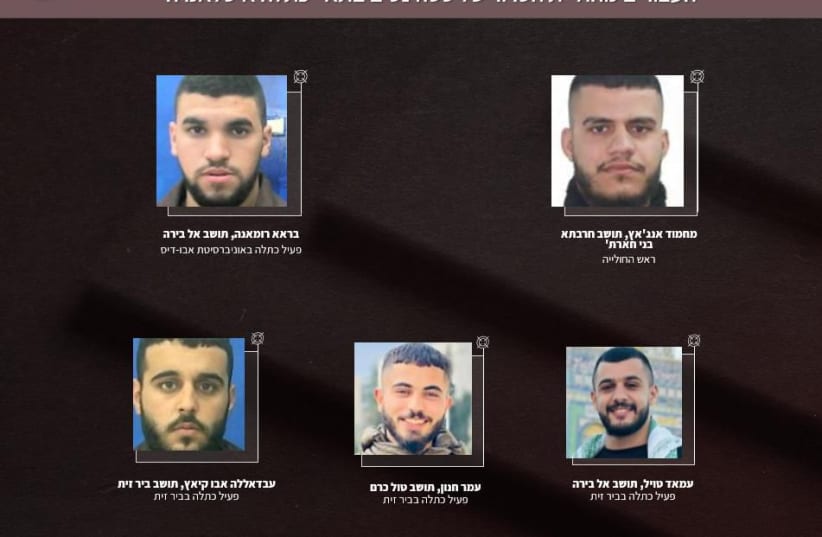
Shin Bet thwarts terror attack plans by students from the Bir Zeit University. July 21, 2024. (photo credit: SHIN BET)
Shin Bet thwarts terror attack plans by students from the Bir Zeit University. July 21, 2024.
(photo credit: SHIN BET)

The Shin Bet (Israel Security Agency) thwarted a terror attack that had been planned by the student Hamas cell in Bir Zeit University, north of Ramallah, the Shin Bet said. 

The attack was directed by Hamas's base in Turkey. 

Contacting Hamas in Turkey

According to the Shin Bet, the head of the cell, Mahmoud Anjas, from the West Bank, recruited activists from Katala, the term designating those partaking in Hamas cells in institutions of higher learning in the West Bank to form a military cell.

Money confiscated by the Shin Bet. July 21, 2024. (credit: SHIN BET)Enlrage image
Money confiscated by the Shin Bet. July 21, 2024. (credit: SHIN BET)

Anjas also used his connections with Baraa Romana, a Katala activist for the Abu Dis University, a resident of Ramallah, in order to receive from the Hamas base in Turkey funding to buy weapons for the attack. 

During the examination, the Shin Bet added, the entirety of the cell was arrested. An M16 weapon was confiscated along with thousands of dollars, which had been received from Hamas in Turkey. 


Jerusalem Post Staff

Source: https://www.jpost.com/breaking-news/article-811217

Follow Middle East and Terrorism on Twitter

Plot Twists and Power Plays: The Changing Face of Global Politics - Roger Kimball


by Roger Kimball

Donald Trump, despite the many plot twists he has been central to, is the overwhelming favorite to win the presidency in 2024.


Aficionados of old-style mystery novels savor the skill with which their authors ravel and then unravel the plot twists that fuel their books.  The simple rule that the culprit is generally the least likely person can be spun out in so many different ways. A large part of the pleasure afforded by the genre is in trying to unscramble the puzzle that the writer has constructed for us.  Agatha Christie was a great master of the clever plot twist, as readers of Who Killed Roger Ackroyd? (to take just one example) will know.

True, the magic is not universally effective. The critic Edmund Wilson, for example, hated mystery novels, as he explains in his essay “Who Cares Who Killed Roger Ackroyd?” and elsewhere. But, to adapt Lincoln, for those who like that sort of thing (and I include myself in that group), Christie offers the sort of thing one likes.

Padding about London for the last week or so, I have been struck by the sense of impending plot twists. There are some local entertainments. Most of those are offered by Keir Starmer, the new, well-groomed, neo-Socialist Prime Minister.

As with the left-wing National Front in the recent election in France, Starmer’s Labor Party did not actually get a very large percentage of the vote. But because of the first-past-the-post proportional scheme that both Great Britain and France employ, he enjoys a huge majority in the Commons.  Among the plot twists Starmer has in mind are nationalizing the railroads, abolishing the hereditary peerage, raising taxes, and, in general, making government bigger in order to serve the government.

Starmer is also a conspicuous friend of the EU, which is another way of saying that he is a Brexit skeptic. Opinions differ on what he will be able to do about Brexit.  Most people I have spoken with, including a few EU enthusiasts, believe that, on that score at least, his influence will be modest. Indeed, many people see the next five years as a sort of penance enacted by Tory incompetence on the country.  The optimists believe that when the next election rolls around,  the Tories will roll back into office and straighten out the mess Labor will inevitably leave in its wake.

I am not so sure, not least because England is rapidly becoming a Muslim country, replete with demands for Sharia courts and all that follows. My own hope is that Nigel Farage or some kindred spirit who succeeds will introduce his own, more salubrious plot twist and save Britain for the British.

I hope, but I am not holding my breath.

The news from home has been full of plot twists.

Contemplate, if your constitution is up to it, the spectacle of Joe Biden, the first certifiably senile leader of the soi-disant free world.

Some commentators have suggested that Biden went to his home in Rehoboth, New Jersey, not to recover from COVID, as the official line would have it, but to prepare himself for his political ostracism. Some say it will happen as soon as this weekend.

The volume and size of the democratic chorus calling for Biden to withdraw have been growing.  Senator Chuck Schumer, House Minority Leader Hakeem Jeffries, Madame-Tussaud stand-in Nancy Pelosi—these and other top Democrats have called on Biden to “preserve his legacy” and resign.

No one knows what plot twists await us in the unraveling of Joe Biden. Even as cries for his departure grow, his own communications indicate a resolve to carry on.  It’s not even clear, short of invoking the 25th Amendment, exactly how the Dems could engineer Biden’s political defenestration.

The biggest plot twist waiting in the wings where Joe is strutting and fretting his hour upon the stage is carried by no one named Biden, not even dear old son Hunter, but Madam Vice President,  person-of-color Kamala Harris.  Everyone knows that Harries could not win against Donald Trump (or even against Donald Duck). But no one I have seen has put forward a plausible plan to replace Harris in the unlikely event that Biden exits stage left.

Of course, the biggest plot twist of the last couple of weeks was the attempted assassination of Donald Trump last weekend at his rally in Butler, PA.

Thomas Matthew Crooks managed to get off six shots before being taken out by a sniper in Trump’s security detail. He killed one innocent rallygoer and seriously injured two others. The shot that mattered, the shot “heard round the world,” was the one that grazed Donald Trump’s right ear, delivering him the campaign’s historic photograph and changing the fundamental metabolism of American politics.

What plot twists followed?  There was Trump’s extraordinary speech at the Republican National Convention.

Other twists are unfolding before us.  One was articulated by the most intelligent and politically wily Democratic pollster, Doug Schoen. Writing in FoxNews about the former president’s speech, Schoen noted that Trump “may well have sealed the outcome of the 2024 election with a performance . . . that has largely been unmatched in recent American political history.”

The former president eschewed the polarization and division that has marked much of his rhetoric in the past. In his speech officially accepting the Republican Party’s nomination there were only a couple of references to the 2020 election. Trump was able to hit on key messages when speaking about topics like inflation, and especially immigration, in ways that were compelling and arguably responsive to the fundamental concerns of Americans.

It wasn’t supposed to be this way.  Eight months ago, many pundits had written off Trump.  But here he is, leading everywhere in the polls. Schoen is not, as he notes, a Trump partisan. On the contrary.  But he is a partisan of reality. And the reality is that Trump is on the cusp of a historic victory.  The election is just over three months away. One can imagine plot twists that result in a Trump loss. But probability—the “very guide of life,” as Bishop Butler put it—suggests that Schoen is right.  Donald Trump, despite the many plot twists he has been central to, is the overwhelming favorite to win the presidency in 2024.


Roger Kimball

Source: https://amgreatness.com/2024/07/21/plot-twists-and-power-plays-the-changing-face-of-global-politics/

Follow Middle East and Terrorism on Twitter

Trump and the Return of the Republicans - Amir Taheri


by Amir Taheri

Trump is able to attract a vote of adhesion to an agenda which, although chaotic, at least hints at some of the reforms the US political system needs.


  • Eight years ago, millions of Americans voted for Trump because he didn't look or sound like regular politicians. Many called that a protest vote, which it certainly was to some extent.

  • This time, however, Trump is able to attract a vote of adhesion to an agenda which, although chaotic, at least hints at some of the reforms the US political system needs. These include a rebalancing of the powers of the federal government and the states and the authority of the president as head of the executive power in the context of a debate that started at the birth of the new nation.

Pictured: Former US President Donald Trump is joined by his wife Melania Trump after accepting his party's nomination on the last day of the 2024 Republican National Convention in Milwaukee, Wisconsin, on July 18, 2024. (Photo by Angela Weiss/AFP via Getty Images)

Last week, Republicans were back under the Republican Party's convention limelight in Milwaukee. This time they looked as determined to send Donald J. Trump to the White House in November as they were in 2016.

Eight years ago, Trump looked like a bolt out of the blue that, though threatening the serenity of American political sky, would prove a passing nuisance.

Then Trump didn't fit the mold shaped over almost two centuries of American nationhood. He was the first businessman to enter the inner circle of aspirants to the presidency.

Unlike the previous 44 presidents, he had no record of public service, civilian or military, and had never held any public office. Nor was he a graduate of the Ivy League elite universities, nor a winner of many chic scholarships.

By all accounts, Trump's four-year tenure was a breathtaking if not nerve-wracking rollercoaster which, to everyone's surprise, led to none of the disasters predicted by professional doomsters. The economy did well as unemployment dropped and inflation remained under control. When leaving the White House after four years, Trump was the only US president in over a century not to have involved the US in a war.

Trump's "MAGA revolution" didn't lead to the palingenesis promised, but nor did it trigger the Apocalypse that the ruling elite had warned against.

Fast-forward to Milwaukee last week. This time Trump, wearing the halo of the one who was saved, led his cheering supporters to presumption of sailing to victory in November.

The "MAGA" slogan remained, but the post-assassination attempt Trump also presented a 16-page program.

To such un-Trumpian novelties one might add the presence this time of scores of "regular" Republicans, many of whom had sworn they would never join his dance. He even chose one of them, US Senator JD Vance of Ohio as his vice-presidential running-mate.

Trump set aside the "humdinger" text he had prepared for the convention and came out with a speech that, though fiery, had a soothing undertone.

Pundits are already speculating about the possibility of a Trump-II model that might soften his rougher edges, act in a more disciplined way, accept a larger measure of teamwork and, even name a token Democrat as part of his putative Cabinet in a tradition respected by several presidents since the 1960s -- in short, become less-Trumpian.

Will such a transformation increase Trump's chances of winning back the White House?

My answer is: no. Eight years ago, millions of Americans voted for Trump because he didn't look or sound like regular politicians. Many called that a protest vote, which it certainly was to some extent.

This time, however, Trump is able to attract a vote of adhesion to an agenda which, although chaotic, at least hints at some of the reforms the US political system needs. These include a rebalancing of the powers of the federal government and the states and the authority of the president as head of the executive power in the context of a debate that started at the birth of the new nation.

The Trump camp also talks of reforming the educational system, especially at university level, where wokism is seen as a growing gangrene.

Promising to end the war in Ukraine and designating China as a potential foe may be headline-catching but do not amount to a coherent foreign policy.

Despite its many shortcomings, Trump's term at the White House didn't end badly, partly because he acted on instinct rather than pseudo-sophisticated "strategic thinking". A businessman, Trump realized that time is a key element in pursuit of any goal and that achieving small successes is better than chasing big but unattainable goals.

Reading and understanding the 922-page Project 2025 and the 16-page RNC platform paper alone may take the four years that a president has in the White House. Turning even a fragment of that hefty wish-list into reality would also require control of the Congress and the Senate, which is not always a given for the many in the White House.

In 2016, few pundits believed that Republicans could capture the White House. They were proved wrong this time; however, more and more pundits predict Trump's victory. President Joe Biden is not in the best shape, and the coalition of minorities that has provided the backbone of the Democrat Party since the 1950s is no longer so solid.

Latest polls show that at least 40 percent of Hispanics may vote for Trump this time. He may also get an incredible 30 percent of African-American vote and more than a quarter of Jewish vote.

However, it isn't over until it is over. The attempt on Trump's life has increased his chances of winning in November, but other events could do the opposite.

As Harold MacMillan liked to say: "In politics watch out for events; my boy! Events!"

This article originally appeared in Asharq Al-Awsat


Amir Taheri was the executive editor-in-chief of the daily Kayhan in Iran from 1972 to 1979. He has worked at or written for innumerable publications, published eleven books, and has been a columnist for Asharq Al-Awsat since 1987. He is the Chairman of Gatestone Europe.

Source: https://www.gatestoneinstitute.org/20794/trump-republicans-return

Follow Middle East and Terrorism on Twitter

J. D. Vance’s astonishing journey to the top of Republicanism - Douglas Altabef


by Douglas Altabef

J.D. Vance's extraordinary journey from a harsh childhood to being the Republican vice-presidential nominee highlights resilience, family influence, and the potential for transformative leadership.


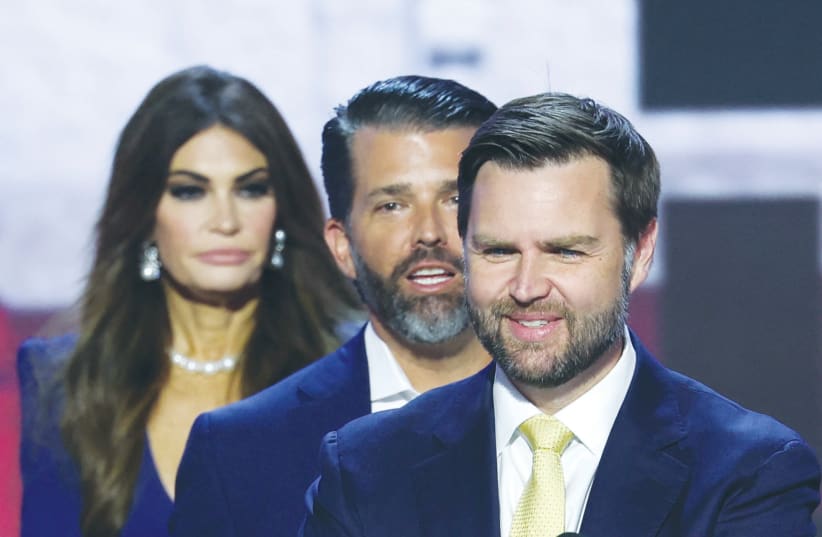
VICE PRESIDENTIAL nominee J.D. Vance stands at the Republican National Convention at the Fiserv Forum in Milwaukee, Wisconsin, last week. His life was literally saved by his Hillbilly grandparents, the writer notes.   (photo credit: REUTERS/MIKE SEGAR)
VICE PRESIDENTIAL nominee J.D. Vance stands at the Republican National Convention at the Fiserv Forum in Milwaukee, Wisconsin, last week. His life was literally saved by his Hillbilly grandparents, the writer notes.
(photo credit: REUTERS/MIKE SEGAR)

An extraordinarily difficult childhood was the crucible for the man who someday might become the leader of the free world. Few have as much cringe worthiness and random nuttiness as does the amazing coming of age story of J. D. Vance, the recently nominated Republican candidate for vice president of the United States.

I had read Vance’s story, Hillbilly Elegy, soon after it was published in 2016, but thought that it made good sense to revisit the book in light of current events. It is a homage, warts and all, to his Appalachian forebears and the community he grew up in. Above all, it is the story of how key people can make all the difference in a life.

While it is clear to Vance that there are larger forces that can help or impede us, there are also individuals who can play formative, indeed salvational roles in the lives of others. Vance is clear-eyed and empathetic but also unsparing as to the Hillbilly culture that he was grew up in: a code of honor, a culture of violence and one that looked after its own, but in the process, could crush them.

Four different “fathers”

In Vance’s case, his life was literally saved by his roughhewn grandparents who provided him with an essential haven from a constantly shifting, uncertain, and randomly violent home life. His well-meaning mother was a serial addict who had five husbands and other men as well. As Vance noted, in one two-year period he had four different “fathers.”

Vance is candid about the people around him and about his reactions, actions, and attitudes to it all as a child. Basically, like all children, he wanted stability, and he was only able to find that with his “Mamaw” and “Papaw,” people that would have scared most of us on a first encounter.

He writes extensively about the cultural mores and the Hillbilly mindset that provided a powerful antidote to upward mobility. Similar to what we read about inner city culture, there was a bias against boys doing well in school or succeeding in a conventional way. This was not manly; it was what girls did. Mamaw and Papaw, though uneducated themselves, had no truck with this orientation and very much encouraged Vance to apply himself.

For all the myriad differences, there is a marked similarity between Hillbilly culture and Israeli society. The role of the extended family is key in both communities, and the strong sense of internal cohesion defines both. Vance writes that Hillbillies are God fearing but not particularly religiously observant. But there is a closeness to God and a solid connection to Christian values that are not suspended even when one’s conduct completely deviates from them.

Blessed with divine providence 

My Jewish reading of Vance’s life story left me with a strong sense that he was blessed with haschahah pratit, divine providence. He was blessed to have people in his life who literally and figuratively rescued him and provided him with the stability and sanity that would allow him to grow and thrive. And he was blessed with an awareness and keen appreciation of the role that they played.

 The Dome of the Rock and the Western Wall, Jerusalem, and Senator JD Vance (R-OH) attends an event held by the national conservative political movement, 'Turning Point' in Detroit, Michigan, US, June,16, 2024.  (credit: Canva, REUTERS/REBECCA COOK, Wikimedia Commons)Enlrage image
The Dome of the Rock and the Western Wall, Jerusalem, and Senator JD Vance (R-OH) attends an event held by the national conservative political movement, 'Turning Point' in Detroit, Michigan, US, June,16, 2024. (credit: Canva, REUTERS/REBECCA COOK, Wikimedia Commons)

While Vance’s story was a jaw dropping saga when it was written in 2016 by a successful venture capitalist, it now takes on iconic significance given his elevation, not only as the prospective vice president, but also as the heir apparent to Trump’s America First political movement.

Certainly, the book was not written with this context in mind. Ironically, it contains a lengthy exoneration of former president Barack Obama, and exhibits nothing that would lead one to conclude that Vance would end up where he is now.

Unlike the stump speeches he is likely to make on the campaign trail, there is not a visceral indictment of corporate America, nor of the “system.” There is a healthy skepticism, but certainly no disinterest in the role that government or public institutions can play in the lives of individuals and their communities.

But at the end of the day, Vance looks to each of us individually as being capable, if so desired, of changing, elevating and, indeed, rescuing ourselves. This is an old fashioned, very traditional American notion of how we should regard ourselves. It is anti-victimization, while recognizing that many of us are brought up in communities where there are few advantages or legs up.

Yes, the Hillbillies had terrible diets, were prone to violence based on perceived honor codes, and had a pessimistic outlook on their ability to succeed or move up the mobility ladder. But at the end of the day, individuals, regular people, could help make the difference.

New generation of leadership

Vance is only 39, turning 40 next month. He is a veritable babe in arms compared to all the other nominees on the stage, and he, like former presidents John Kennedy and Barack Obama, might become the personification of a new generation of leadership that could profoundly reshape the social and political landscape in North America and the West.

To the extent that that might be so, there is reason for optimism. Vance himself is an optimist, a man who believes that we each and all can do better and become productive and fulfilled 

This implicit world view is a tonic that we should all welcome. I for one believe that the incredible road of J. D. Vance’s life is likely to lead to amazing new twists and turns.


Douglas Altabef is chairman of the Board of Im Tirtzu and a director of the Israel Independence Fund.

Source: https://www.jpost.com/opinion/article-811129

Follow Middle East and Terrorism on Twitter

Saturday, July 20, 2024

Dems return to Tammany Hall tactics with backroom dealings to boot Biden - Ben Whedon


by Ben Whedon

Smoke-filled rooms? Should Biden opt to step aside, it is far from certain that Vice President Kamala Harris would be the automatic stand-in on the party ticket.


As Democratic powerbrokers attempt to pressure President Joe Biden into bowing out of reelection, his departure could set up a messy selection process for his replacement that circumvents the primary electorate and threatens to send the party back to the days of Tammany Hall.

Biden, 81, has faced calls to step aside as the party nominee in the wake of his disastrous performance in a CNN presidential debate against former President Donald Trump. During that event, Biden often appeared lost on stage and stumbled over both stairs and his answers, which reignited longstanding concerns over his age, mental acuity, and fitness for office.

Should Biden opt to step aside, it is far from certain that Vice President Kamala Harris would be the automatic stand-in on the party ticket. The imminent approach of the party convention, moreover, could lead to last-minute jockeying for the top slot.

For much of the 19th and 20th centuries, Democratic Party politics were dominated by Tammany Hall, a New York City-based executive committee that maintained political control through mafia-like tactics and behind-the-scenes power-broking. 

A potentially brokered convention post-primary with little voter influence could see the party return to such machine politics, an ironic development in light of the party’s repeated insistence that Trump, the Republican nominee, represents a “threat to Democracy.”

"President Biden's campaign manager saying he is absolutely staying in the Presidential race sets the stage for a drama of 'the bosses versus Biden'," former House Speaker Newt Gingrich posted on Friday. "He got 14,500,000 votes in the primaries. The bosses got zero."

"The spirit of Tammany Hall has returned to the Democratic Party as Boss Pelosi, Boss Obama, Boss Schumer and Boss Jeffries seek to repudiate over 14 million Democrats and replace the sitting President," he continued. "There is no precedent for Washington bosses throwing out the votes of the American people to impose their will on the nation."

Heavy hitters seeking his ouster

Major Democratic lawmakers have publicly called on Biden to step aside, while several more power brokers have reportedly done so in private. Thus far, however, those seeking his ouster remain a minority.

Among the most high profile lawmakers urging Biden to step aside are Democratic Sens. Jon Tester of Montana and Peter Welch of Vermont. Rep. Adam Schiff, D-Calif., this week also called on Biden to “pass the torch,” warning that "[a] second Trump presidency will undermine the very foundation of our democracy, and I have serious concerns about whether the President can defeat Donald Trump in November."

Reports also emerged this week that Rep. Nancy Pelosi, D-Calif., had shown Biden unfavorable polling data while Senate Majority Leader Chuck Schumer had privately urged Biden to reconsider his election bid.

Biden not leaving

But Biden, the White House, and his campaign have been adamant that he has no plans to step aside and will carry forward to the general election.

Campaign chair Jen O’Malley Dillon on Friday asserted that "Absolutely the president is in this race, you've heard him say that time and time again… He is the best person to take on Donald Trump."

"That is not happening, period," White House spokesperson Andrew Bates said of plans for Biden to exit the race. "The individuals making those claims are not speaking for his family or his team – and they will be proven wrong. Keep the faith."

Biden himself wrote to Democratic lawmakers earlier this month.

"Let me say this clear as I can. I’m staying in the race,” he wrote. “I wouldn’t be running again if I did not absolutely believe I was the best person to beat Donald Trump in 2024.”

The “voters voted”

“Joe Biden is going to be the Democratic nominee, period. End of story. Voters voted. He won overwhelmingly,” the campaign declared in late June.

Though the Democratic National Convention has yet to formally declare Biden the party nominee, the process has essentially concluded. Biden won every nominating contest with the notable exception of American Samoa.

Facing challenges from Minnesota Democratic Rep. Dean Phillips and Hollywood guru Marianne Williamson, Biden overwhelmingly won the most delegates in the primary, notching 3,896 of the necessary 1,976. “Uncommitted” trailed with a mere 36 while Phillips placed third with only four.

Writing to Capitol Hill Democrats earlier this month, Biden highlighted his performance in the primary, asserting that “the voters have spoken clearly and decisively.”

“I received over 14 million votes, 87% of the votes cast across the entire nominating process. I have nearly 3,900 delegates, making me the presumptive nominee of our party by a wide margin,” he said. “This was a process open to anyone who wanted to run. Only three people chosen to challenge me. One fared so badly that he left the primaries to run as an independent. Another attacked me for being too old and was soundly defeated.”

“The voters of the Democratic Party have voted. They have chosen me to be the nominee of the party,” he went on. “Do we now just say this process didn’t matter? That the voters don’t have a say? I decline to do that.”

Biden’s gaffes and age concerns aren’t new

While Biden’s awkward and stumbling answers during the debate have been widely cited as the immediate impetus for the calls to stand aside, such mannerisms from the president are hardly new and neither are concerns over his age. The only new thing is mainstream media finally broke their silence on the issue after Biden's disastrous debate performance.

New York magazine's Olivia Nuzzi, a long-time Democratic stalwart, wrote that there was a "conspiracy of silence" regarding Biden's infirmities, and that although reporters knew about Biden's issues, they refused to acknowledge it to readers for fear of echoing "right-wing media." 

The president’s reference to a candidate who “attacked me for being too old” was an apparent knock at Phillips, who repeatedly highlighted Biden’s age throughout the campaign. Phillips in January told Axios he believed that Biden would be unable to complete another term in office.

"At that stage of life, it is impossible ultimately to conduct, to prosecute the office of the American presidency in the way that this country in the world needs right now,” he said. “That is an absolute truth."

Biden’s penchant for making awkward gaffes or telling questionable stories, moreover, is a longstanding matter, and significantly predates the 2024 Democratic primary.

The University of California at Santa Barbara catalogued his record of plagiarism and fabrications going back to at least the 1980s, including allegations from the Trump camp that as a student at Syracuse Law School in 1965, Biden plagiarized five pages from a law review journal "without quotation or attribution."

During his failed 1988 presidential campaign, Biden plagiarized from speeches by British politician Neil Kinnock, Robert Kennedy, and President John F. Kennedy.

His awkward utterances, moreover, have been so frequent that Trump has compiled them for campaign materials, last month releasing a supercut of Biden’s awkward phrasings.

"America is a nation that can be defined in a single word: aseemfhuuthimaafuutheemscuseme," he said in one. "All men and women created by the go you know... you know the thing," Biden said in another.

Current polling looks bad, but it’s only July

Polling data currently show Trump with a modest lead over Biden, earning 47.7% support to the incumbent’s 44.7% in the RealClearPolitics polling average.

But July polling has generally not reflected the overall outcome of the November election. At this point in 2020, for instance, Biden led Trump by 8.6%, but only won by about 4.5%. 

In 2016, moreover, former Secretary of State Hillary Clinton led Trump by 2.7% in the same metric. Though she ultimately won the popular vote by roughly 2.1%, Trump won the election.

Key blocs are lining up behind Biden

Even with Democratic calls for Biden to step aside growing, some key Democratic blocs have lined up behind the incumbent president, potentially reinforcing his resolution to remain in the race.

BOLD PAC, the political wing of the Congressional Hispanic Caucus, on Friday offered its endorsement to the commander-in-chief, with PAC chair Rep. Linda Sánchez, D-Calif., saying “President Biden and Vice President Kamala Harris have delivered for the Latino community and CHC BOLD PAC is proud to endorse them for re-election,” according to The Hill.

Rep. Alexandria Ocasio-Cortez, D-N.Y., meanwhile, held an Instagram Live on Thursday evening in which she insisted that those pushing for Biden to leave the ticket would not necessarily support Harris for the ticket.

“If you think that there is consensus among the people who want Joe Biden to leave that they will support Vice President Harris, you would be mistaken,” she said, according to The Hill. “A lot of people don’t love that we have the same exact match-up all over again, which is to say that the debate didn’t change much at all. It didn’t really change a lot in terms of people’s perceptions, in terms of where the electorate is at and going into the debate.”

She further warned that replacing Biden could prompt Republican legal challenges to the choice of another nominee.


Ben Whedon is an editor and reporter for Just the News. Follow him on X.

Source: https://justthenews.com/politics-policy/wkddems-return-tammany-hall-tactics-backroom-dealings-boot-biden

Follow Middle East and Terrorism on Twitter

Israel's attack on Yemeni oil infrastructure is a strategic warning to Iran - opinion - Morielle I. Lotan


by Morielle I. Lotan

The strike on Yemen’s oil infrastructure is a microcosm of a larger strategic narrative.


Smoke rises from a fire following an Israeli air strike in Hodeidah, Yemen in this handout photo released on July 20, 2024.  (photo credit: HOUTHI MEDIA CENTRE/Handout via REUTERS)
Smoke rises from a fire following an Israeli air strike in Hodeidah, Yemen in this handout photo released on July 20, 2024.
(photo credit: HOUTHI MEDIA CENTRE/Handout via REUTERS)

Israel’s attack on a strategic oil refinery in Yemen is more than a tactical strike in the complex conflict between Israel and Yemen. It sends an unambiguous message to Iran: Israel can and will disrupt the energy lifeline of the Middle East. Energy, as a critical element of national and regional security, is at the heart of this strategic maneuver. By targeting essential energy assets, Israel underscores the vulnerability of its adversaries' economic and military capabilities, which heavily depend on a stable energy supply.

The Yemeni oil facility, while significant, is not the primary target of Israel’s strategic calculations. Instead, it demonstrates what can be achieved on a larger scale—precisely, a hint at the potential vulnerability of Iran’s critical oil infrastructure, most notably Khark Island. 

Khark Island, located in the Persian Gulf, is Iran’s principal oil export terminal, handling most of the country’s crude oil exports. This facility is not merely an economic asset but a critical node in Iran’s geopolitical leverage and capacity to fund regional activities and proxies. By showcasing its ability to strike similar targets in Yemen, Israel is effectively placing Iran on notice that Khark Island and other vital infrastructure could be next.

This maneuver aligns with Israel’s broader strategic doctrines of deterrence and preemption. Israel has long been aware of the multifaceted threats posed by Iran, ranging from nuclear ambitions to the support of militant groups in the region. In targeting critical Yemeni oil infrastructure, Israel demonstrates its willingness to engage in unconventional and asymmetric warfare, disrupting supply chains and economic resources that fuel hostile activities.

 An Israeli F15 Fighter Jet taking off is seen at an unidentified location in this screen grab from a video released July 20, 2024. (credit:  Israeli Army/Handout via REUTERS)Enlrage image
An Israeli F15 Fighter Jet taking off is seen at an unidentified location in this screen grab from a video released July 20, 2024. (credit: Israeli Army/Handout via REUTERS)

Moreover, the attack highlights Israel’s operational reach and intelligence capabilities. Yemen is not a neighboring country, and the logistics of such a strike are complex. By successfully executing this operation, Israel underscores its ability to project power across the region, reinforcing its strategic posture and deterring adversaries through demonstrated action rather than mere rhetoric.

Regional instability

This move also reminds the international community of the broader implications of regional instability. The global economy is intricately linked to the steady flow of oil from the Middle East. Any significant disruption, especially involving major export terminals like Khark Island, would have profound economic consequences worldwide. By illustrating the potential for such disruptions, Israel is implicitly urging global powers to take the Iranian threat seriously and to support efforts to curb Tehran’s destabilizing activities.

The strike on Yemen’s oil infrastructure is thus a microcosm of a larger strategic narrative. It is a clear indication that Israel is prepared to take decisive action to protect its national security interests and to ensure the stability of the region. By connecting this action to the vulnerability of Khark Island, Israel communicates a potent warning: the lights in the Middle East can be turned off, and those who threaten regional peace and security will face significant consequences. The role of energy in maintaining security is paramount; disrupting an adversary's energy supply is a powerful method of undermining their ability to operate and project power.

In the volatile and interconnected world of Middle Eastern geopolitics, such messages are essential. They serve not only to deter adversaries but also to galvanize allies and neutral actors to acknowledge and address real threats. As the international community watches these developments, the clarity of Israel’s message should resonate: the era of unchecked aggression and proxy warfare must end, and those who perpetuate it will find themselves vulnerable to the very tactics they employ. The centrality of energy in these dynamics underscores the profound impact that control over energy resources and infrastructure has on the security and stability of nations.


Morielle I. Lotan is the founder of Mile Advisory and an expert on energy and security.

Source: https://www.jpost.com/israel-hamas-war/2024-07-20/live-updates-811091

Follow Middle East and Terrorism on Twitter