Wednesday, May 14, 2014

Believing Obama on Iran


by Caroline Glick


Obama_Iran

Originally published by the Jerusalem Post.

Brig. Gen. (ret.) Uzi Eilam is an octogenarian who served as the director general of Israel’s Atomic Energy Commission from 1976 until 1985.

Last Friday Eilam gave a head-scratching interview to Yediot Aharonot’s Ronen Bergman in which he claimed that Iran’s nuclear weapons program is a decade from completion. He said it is far from clear that the Iranians even want a nuclear arsenal. He accused Prime Minister Binyamin Netanyahu of cynically exaggerating the threat from Iran in order to strengthen himself politically.

Perhaps the most interesting aspect of Eilam’s interview was his absolute certainty in his judgment.

Eilam, who hasn’t had any inside knowledge of nuclear issues since 1985, would have us believe that he knows better than active duty Israeli intelligence chiefs and US intelligence directors about the status of Iran’s nuclear weapons program. He even thinks he knows better than the UN’s nuclear watchdog, the International Atomic Energy Agency.

Israel assesses that Iran already has sufficient quantities of enriched uranium to produce five atomic bombs. As Netanyahu has said, the interim nuclear deal the US and its allies signed with Iran last November only delays Iran’s bomb making capacity by six weeks.

In January, James Clapper, the director of US national intelligence, agreed with Israel’s assessment. In testimony before the Senate’s Select Committee on Intelligence Clapper said that Iran is already a nuclear breakout state. In his words, “Tehran has made technical progress in a number of areas – including uranium enrichment, nuclear reactors and ballistic missiles – from which it could draw if it decided to build missile- deliverable nuclear weapons.”

Clapper argued that this doesn’t matter because the US’s monitoring capabilities are so trustworthy and advanced that Iran wouldn’t be able to put nuclear weapons together without the US noticing.

Unfortunately there is no reason to believe Clapper is right. Indeed, Netanyahu said as much to US National Security Advisor Susan Rice when she repeated Clapper’s claim during her visit to Israel last week.

And the UN agrees with Netanyahu.

In two reports released in recent days, UN officials have stated that Iran has developed an advanced capacity to hide its importation of components of its nuclear program. According to a Reuters report, this includes hiding titanium tubs in steel pipes and using its petrochemical industry as a cover to obtain valves and other items for its heavy-water nuclear reactor.

According to an AP report, the IAEA is also concerned because Iran is not cooperating with the watchdog group in revealing information about possible military applications of its nuclear program, or allowing the IAEA unfettered access to all nuclear sites.

Iran’s lack of transparency puts paid to the US’s claim that it can monitor all of Iran’s activities. It is far from clear that the US is even aware of all of Iran’s nuclear sites. So even if the US is capable of perfectly monitoring the known sites, it cannot know what it doesn’t know, and so may very well be monitoring the wrong sites.

And yet, despite US’s acknowledgment that Iran already has breakout capacity, and despite the UN’s conclusion that the Iranians are cheating on their international commitments and bypassing sanctions through smuggling activities, Brig. Gen. Eilam, who left the nuclear business 28 years ago, feels comfortable accusing Netanyahu of deliberately misleading the public and the world community.

What gives? It is hard to escape the feeling that there may be a connection between Eilam’s unhinged broadside against Netanyahu and the US’s assault on the credibility of Israel’s nuclear warnings.

On Sunday Iran’s dictator Ayatollah Ali Khamenei visited a Revolutionary Guards Corps base. There he was shown what the IRGC claims is a reverse-engineered clone of an advanced US espionage drone that Iran captured in 2011. According to Fox News, after the RAQ-170 Sentinel drone landed in Iran in 2011, the Pentagon presented US President Barack Obama with three different plans to destroy or retrieve the drone.

Obama rejected all of them because “he didn’t want to do anything that could be perceived as an act of war.”

During the same visit, to the IRGC base on Sunday, Khamenei told the commanders to begin mass producing ballistic missiles to use against the US.

In his words, the Americans “expect us to limit our missile program while they constantly threaten Iran with military action. So this is a stupid, idiotic expectation.

The Revolutionary Guards should definitely carry out their program and not be satisfied with the present level. They should mass produce. This is a main duty of all military officials.”

In other words, on Sunday, a declared enemy of the US, that the director of national intelligence acknowledges already has the independent capability to produce nuclear weapons, humiliated and threatened the US.

At a minimum Iran’s capture of the US drone indicates that the US capacity to monitor Iran’s nuclear capabilities is vulnerable and imperfect.

As for the ballistic missiles, they should be of utmost concern to the Europeans and the Americans. Iran doesn’t need ballistic missiles to attack Israel with nuclear weapons.

It can use artillery, not to mention a human being playing the role of Enola Gay.

But rather than condemn Iranian espionage and aggression, over the past week, Obama administration officials have launched a full court press against Israel.

In back-to-back articles in Newsweek, unnamed US former intelligence officials and congressional staffers presented an utterly false and deeply malicious portrait of alleged Israeli spying on the US. The reports were presumptively targeting Israel’s attempts to end State Department discrimination against Israeli tourists in the US and allow Israel to join the US visa waiver program.

But it is hard to ignore the timing of the unbridled, untrue and hysterical allegations of “rampant” Israeli spying.

The stories were released in the lead-up to this week’s newest round of nuclear talks between the US, the other permanent members of the Security Council and Germany, and Iran. Those talks were billed as a diplomatic means of preventing Iran from acquiring a nuclear arsenal. Indeed, after Rice’s meeting with Netanyahu last week the White House released a statement claiming that “the US delegation reaffirmed our commitment to prevent Iran from acquiring a nuclear weapon.”

But the terms of the deal that is being negotiated with Iran advance the opposite of its stated goal. The deal on the table will enable Iran to develop nuclear weapons, virtually unopposed, and allow Iran to develop delivery systems for its nuclear arsenal entirely unopposed.

Israeli officials have been outspoken in their opposition to the agreement and the terms the US and its partners are offering Iran. Over and over, Netanyahu and his colleagues warn that the terms will not prevent Iran from acquiring nuclear weapons.

The White House knows what it is doing, and it wants to continue on course. Consequently, for the administration to sell a deal that enables Iran to acquire nuclear weapons, it needs to discredit Israel among sufficient swaths of the general public to enable Obama to move forward with Iran against Israel.

In this context, the administration’s willingness to turn a blind eye to Iran’s brazen threats and acts of contempt while sending out anonymous sources to castigate Israel as a US enemy whose actions are hostile and antithetical to the US makes sense.

The malevolent slander of Israel’s actions and intentions is of course only the opening act in this new administration campaign to discredit Israel ahead of a nuclear deal with Iran. Speaking to The Washington Free Beacon, former Bush administration deputy national security advisor Elliott Abrams said he believes the administration will frame the issue “saying that it’s this deal or war.”

He’s doubtlessly correct. After all that what the administration did in November when it signed the interim deal and when it forced the Senate to mothball its sanctions bill against Iran.

The truth is that the choice isn’t between war and an agreement. It is between doing something to stop Iran from becoming a nuclear power, or doing nothing to prevent that from happening. The administration has opted to do nothing. Unfortunately for the world, the price for doing nothing to prevent Iran from acquiring nuclear weapons is exponentially higher – in the cost of lives that would otherwise be saved – than the price of doing something.

But hey, at least an 80-year-old who led Israel’s Atomic Energy Commission nearly 40 years ago is willing to take Obama at his word.


Caroline Glick

Source: http://www.frontpagemag.com/2014/caroline-glick/believing-obama-on-iran/

Copyright - Original materials copyright (c) by the authors.

Unanswered Questions for Benghazi Special Committee to Ask


by Adm. James "Ace" Lyons (Ret.)


the-benghazi-liars
  
Source: The Washington Times
Recent exposure of the deliberate lies and the false talking points used by our then-U.N. Ambassador Susan Rice on the Sunday media disinformation campaign is only the tip of the Benghazi iceberg. While lying to the American public in itself is a serious offense, apparently much more serious offenses were committed by the Obama administration leading up to the fatal attack at our Benghazi special mission compound on Sept. 11. 2012.
 
Shocking new information was revealed by the Citizens Committee on Benghazi at a news conference on April 22. First, the Obama administration was accused of “switching sides” on our global war on terrorism by facilitating the arming of known al Qaeda jihadist militias. How could this happen when U.S. law is quite explicit about providing material support to terrorists? In short, it’s prohibited. However, on March 29, 2011, President Obama announced a “Presidential Finding” for covert operations support to Libyan rebels who were the al Qaeda-affiliated jihadist militias under the political control of the Muslim Brotherhood.
 
It should be remembered that this is the same Muslim Brotherhood that has infiltrated all our national security agencies and the White House.
 
The second extraordinary revelation was that on March 20, 2011, Libya’s Moammar Gadhafi was willing to discuss abdicating and going into exile. According to retired Rear Adm. Charles R. Kubic, Gen. Abdulgades Yusef Dibri, head of Gadhafi’s personal security, conveyed to him the Libyan leader’s willingness to consider direct talks with the United States under a “white flag of truce.” Gen. Kubic immediately telephoned the U.S. Africa Command with this sensitive information. It should be recalled that as late as March 18, this is what Mr. Obama was insisting Gadhafi do.
 
Gen. Carter Ham, commander of U.S. Africa Command, immediately responded with interest in setting up a direct military-to-military line of communication with Gen. Dibri. On March 21, Gen. Ahmed Mamud (a senior aide to Gadhafi) called U.S. Africa Command and stated the following:

The Libyans wished to declare a 72-hour truce for the purpose of conducting negotiations on the terms of a formal cease-fire. The talks could be held in Tripoli between the Libyan defense minister, Maj. Gen. Yunis Jahr, and Gen. Ham. If those conditions are acceptable, the Libyans will stop all combat operations immediately and withdraw all military forces to the outskirts of all cities and assume a defense posture. The Libyans recommended observers from the African Union be invited to ensure the truce is honored.
 
By March 22, Gadhafi verifiably had begun to pull his forces from the rebel-held cities of Benghazi and Misrata. He reportedly sought only two conditions: Permit him to go after the al Qaeda militias in the Maghreb and remove all sanctions against him, his family and those loyal to him.
 
Regretfully, Gen. Ham was not given authorization to proceed. It is understood that this decision was made well above the Pentagon level. It is interesting to note that the president, who had been awarded the Nobel Peace Prize, was unwilling to pursue this legitimate peace opportunity. The subsequent war with the loss of tens of thousands of lives, plus the tragic attack on our Benghazi compound, could have all been avoided.
 
The Citizens Committee on Benghazi also pointed out that there were military assets that could have responded to the attacks. The 130-man Marine Force Recon Team at Sigonella, Italy, was within an hour’s flight time of Benghazi. The F-16s at Aviano that were on “awareness alert” were already loaded with 20-millimeter ammunition should have been able to be airborne within one hour, according to a former vice commander of the U.S. Air Force in Europe.
 
A confidential informant who had spent several months in Libya prior to the tragic Sept. 11, 2012, attack told me that the normal procedures for dealing with a threat to the U.S. compound in Benghazi were not followed. My informant, who has participated in these rehearsals, said Ambassador J. Christopher Stevens was to be taken to the “safe room.” The bars on the safe-room window were to be unlocked from the inside, then the ambassador and his people were to exit through the window and get into a car that was always parked outside the window and speed to a nearby CIA annex. The plan failed the night of the attack because there was no parked car outside the window. We need to know who moved the car and on whose orders.
 
The denial of all requests for increased security by the State Department and the systematic drawdown of security assets in country starts to fit a pattern. According to a report in The Guardian, even the readiness of the ambassador’s five-man security detail raises questions. Three of the four agents with Stevens left their weapons, helmets and body armor in another area under orders from the secretary of state, which was confirmed by the Accountability Review Board report. It’s shocking, since in that environment, weapons must be kept at the ready all the time.
 
My informants have confirmed that Stevens was to be kidnapped and held hostage for the release of the Sheik Omar Abdel-Rahman, currently serving a life sentence in a U.S. prison for his role in the 1993 World Trade Center bombing. This needs to be further investigated by the select congressional committee, along with the other issues exposed by the Citizens Committee on Benghazi.


Adm. James "Ace" Lyons (Ret.)

Source: http://www.centerforsecuritypolicy.org/2014/05/13/unanswered-questions-for-benghazi-special-committee-to-ask/

Copyright - Original materials copyright (c) by the authors.

Nigeria's Boko Haram Shows Radical Islam is Growing in Africa


by John Price


Former U.S. Ambassador John Price told Fox News' Lauren Green the U.S. is putting "blinders on" and ignoring the threat posed by the Nigeria-based terrorist group Boko Haram.

He says the militant group's current violent streak is a result of Africa "not being on our radar screen."

"Congressional [leaders] don't know much about what is going on there," Price said. "We don't get in there and talk about the real issue which is radical Islam is growing."

Price was the former U.S. ambassador to three African nations, Mauritius, Seychelles, and Comoros, during the Bush Administration and is an expert on the Islamist threat in West Africa.

Suspected Boko Haram gunmen kidnapped nearly 300 teenage schoolgirls from a school in April. Their leader is threatening to attack more schools and abduct more girls.

"There have been thousands of people killed, many attacks mostly against Christian churches and now even Muslim children are being attacked in schools," Price said.

The U.S. announced Tuesday it will send military and law enforcement personnel to Nigeria to help rescue the kidnapped girls. Price suggests the U.S. also send drones stationed in nearby Niger for intelligence gathering.

"There are a fleet of drones sitting in Niger," Price said. "We should be using those drones to check out the northern part of Nigeria to [monitor] the Islamist activities."

Looking at the militants' previous movements, he believes the abducted schoolgirls are in a neighboring country. "The concern is if you try and find the camps they are in … the Islamists will start killing the girls," Price said.

Price believes the girls are being used as a "bargaining chip" in exchange for Boko Haram militants currently in jail. He believes this is a more likely scenario than the extremists selling or marrying them off, as claimed by their leader.

Watch the full interview with former U.S. Ambassador John Price above.
Read the article on Fox News.


John Price

Source: http://www.investigativeproject.org/4385/nigeria-boko-haram-shows-radical-islam-is-growing

Copyright - Original materials copyright (c) by the authors.

Run it up the Flagpole


by Doris O'Brien


“Let’s run it up the flagpole and see if anyone salutes,” was a popular advertising catchphrase back in the ‘50s and ‘60s. And it’s about to be adopted as a Democrat slogan for the upcoming election.

Without the office of the presidency at stake, many voters will feel less incentive to vote in November. Motivating people to participate in the democratic process in off-year elections is always a harder sell, perhaps for the same reason that we are more likely to buy into a lottery when the payoff is big and driven by media frenzy.

Typically, Republicans vote at higher rates than Democrats in such elections. If this holds true in 2014, it would pose a significant dilemma for this administration. Aware of the consequences of a possible Senate takeover next January, Democrat spinmeisters are conjuring ways to combat lethargy and propel the faithful to the polls on election day, now less than half a year away.

To add to the urgency, pollsters have been delivering a steady stream of disappointing news for Democrats. The results of last month’s joint survey by Pew Research and USA Today indicate that Democrats are losing ground over a similar survey conducted last October. For starters, President Obamas’s approval rating has slipped from what it was in the midterm election four years ago. Still, he is supported by 44% of likely voters, which is higher than George Bush’s numbers in the midterm election of 2006.

Two of the most contentious policies hounding Democrats on the stump will be the anemic economic recovery and the unpopularity of the Affordable Care Act. Despite the supposed surge in signups, Obamacare is still a thorn in the side of candidates whose party passed it into law.

As a result, they will be forced to put the focus of their campaigns elsewhere, the goal being to make Republicans look like bad apples who will (a) reverse all economic progress and plunge us back into another recession; (b) deny hard-earned rights for minorities, women, and gays; (c) stop at nothing to use bogus scandals for political gain; and (d) lead our country into another war.

No stone will be left unturned -- or unthrown. As Obama is fond of saying, all options will remain on the table. And some will even lurk under it. Hoisted to the yardarm will be anything that has the remotest chance of resonating with constituents, many of whom seem to have puzzlingly tuned out completely.

But Democrats know they cannot continue to hang on the ropes, battered by a barrage of current blows like IRS prejudicial treatment, NSA spying, Putin’s power plays, Benghazi’s unsolved mysteries, and the VA’s incompetence. So far, their retaliatory charges of trumped-up scandals haven’t resonated with voters. 
  
Let’s be clear. The liberals’ appeal will not be grounded in fact-based evidence. Their “proof” of choice will be personal and anecdotal. They much prefer to put a “face” on an issue in order to bypass the brain and head for the heartstrings. In elections, their objective will be to find enough partisan voters who believe whatever they are told, whether it is the Republican war on women or America’s shameful responsibility for global warming. Expect to hear them use the term “Tea Party” a lot, by way of defining the GOP. In the liberal vernacular, what could be scarier?

Well, here’s what might be: a Republican Party that stays on message. A GOP campaign that continues to pummel its Democrat opponents on the issues that resonate most with voters, like the economy, the ACA, the Keystone XL pipeline, and a foreign policy that spawned the dangerous decline of our credibility across the globe. A savvy party that knows the political price of getting mired in matters that swing wide the door to charges of bush-beating and overreaction. Placing the Benghazi scandal at the forefront of the coming campaign, for example, could prove to be a political blunder. Yet when candidates speak out about that travesty of incompetence and deceit, it should be with candor and directness in the manner of subcommittee chairman Trey Gowdy.

Republicans must guard against wandering aimlessly into potentially lethal minefields of so-called “social” issues, like abortion, wage inequality between the sexes, the minimum wage, gay marriage, and immigration reform tantamount to amnesty. If they do not maneuver carefully, their opponents will delight in making them appear bigoted, mean-spirited and out of touch. Judging by the results of recent primaries, Republicans seem to be learning the lesson of past elections, and choosing competitive candidates who know the high price of imprudence.

Above all, Republicans need to go beyond complaint and criticism of this administration. Pummeling the provisions of the Affordable Care Act is meaningless if the GOP does not offer an alternative. Sniggering at a sluggish economy is far less effective than touting proposals to get it moving again.

The GOP has to roll up its sleeves. Or -- to continue the original analogy -- it needs to start running a few ideas up its own flagpole to see if anyone salutes.


Doris O'Brien

Source: http://www.americanthinker.com/2014/05/run_it_up_the_flagpole.html

Copyright - Original materials copyright (c) by the authors.
NYPD Commissioner: Seeking Suspects' Intel "An Essential Element"


by IPT News


A New York Times story Sunday calling attention to the New York Police Department's policy of seeking intelligence from Muslims its officers arrested won't affect the program, Commissioner William Bratton said Tuesday.

"Not at all," Bratton said in an interview with the Jerusalem Post. "[T]his is an essential element of policing. I created this policy back in 1994, in New York City last time I was commissioner where every person arrested was interviewed by detectives about not necessarily the crime they committed but do they have information about other crimes and is there an ability to develop these people into confidential informants."

The Times story, which ran above the fold on Sunday's front page, cast the program – which also tries to enlist suspects to be informants – as a form of inappropriate policing.

Iran's Press TV was quick to publicize calls for a Justice Department investigation from the Council on American-Islamic Relations (CAIR). "It is chilling to note that any Muslim who comes in contact with the NYPD will either be spied on or will be pressured to become a spy," said CAIR Executive Director Nihad Awad. "Seeking information about crimes and criminals is appropriate. Coercing people who have no knowledge of criminal activity to spy on law-abiding members of their faith is not."

But Bratton and Deputy Commissioner John Miller sounded unmoved. "We have to get back to planet Earth for a minute," said Miller, who runs the NYPD's intelligence division. "If you don't talk to people you don't get good intelligence," Miller said. Any controversy "is driven by how the program is characterized" more than its execution. That's because "the basic tenant [sic] of policing is that when you take people into custody you try to get information from them, this is how we take guns, this is how we seize narcotics this is how we solve murders every single day."

Bratton's comments underscore what Patrick Dunleavy pointed out Monday. Using suspects to try to learn about other crimes and conspiracies is an everyday police practice, has been for years, and simply is common sense. The Times tried to make that a scandal.


IPT News

Source:  http://www.investigativeproject.org/4386/nypd-commissioner-seeking-suspects-intel

Copyright - Original materials copyright (c) by the authors.

Wife of Terror Victim Recalls Facing Attackers


by Danny Brenner

 
"The terrorists searched for me so that they could murder me too. They stood only feet away, speaking Arabic. I heard them breathing. I saw death before my eyes, but they didn't see me and left," terror attack survivor Monique Ofer tells Israel Hayom.       

                                   
"I did not just love him. I looked up to him," Monique Ofer says of her late husband Sraya who was killed by terrorists in October

|
Photo credit: Moshe Shai


Danny Brenner

Source: http://www.israelhayom.com/site/newsletter_article.php?id=17499

Copyright - Original materials copyright (c) by the authors.

Tuesday, May 13, 2014

Have Kerry and Indyk Pushed Abbas into the Arms of Hamas?


by Harold Rhode and Joseph Raskas


Abbas correctly calculated that so long as he continued to negotiate with Israel, the U.S. and the Europeans would continue to prop him up with political backing and financial support in the mistaken belief that a peace deal could be reached.
Thus Kerry and Indyk have been pushing Abbas into a corner by trying to tempt him to commit suicide in the name of permanently solving the Arab-Israeli dispute.
While Israeli leaders seek peace, Palestinian leaders seek an endless peace process.
 
Palestinians say that for Muslims, Palestinian land reaches "from the [Jordan] river to the [Mediterranean] sea" -- that is, over all of what is now Israel. In their view, Tel Aviv is illegally occupied territory just as much as any of the settlements in the West Bank. This view is based on the Muslim doctrine, deeply rooted in Islamic jurisprudence, called "waqf" (religious endowment). Any territory once under the control of Muslims, must forever be controlled by Muslims.[1] According to Islamic law, "If a person makes something waqf, it ceases to be his property and neither he nor anybody else can gift or sell it to any other person.[2]

Unfortunately, the premises on which American negotiations -- led by U.S. Secretary of State John Kerry and U.S. Special Envoy for Israeli-Palestinian Negotiations, Martin Indyk[3] -- are based are completely at odds with the premises on which Middle Eastern negotiations are based.

Americans seem to believe that all problems are solvable; if there is no solution, it simply means one has not tried hard enough. Americans generally are prepared to compromise on particular points to attain other points that are more important to them. When both sides reach an agreement, Americans usually are prepared to put past disagreements to bed. By making concessions, neither side has compromised its personal honor. Americans focus on the goal, which is to attain an agreement both sides can live with. We negotiate, arrive at an agreement and let bygones be bygones.

Not so in the Middle East. The mere concept is inconceivable in the winner-take-all culture of that part of the world.

Middle Easterners live with problems they know are unsolvable. For most, their immediate problems are never solved. Furthermore, any compromise is regarded solely as a backsliding that reduces personal honor and results only in indelible public shame. Far preferable is to paint a beautiful, if fictitious, patina over festering problems that cannot be solved, rather than to endure shame, dishonor and public humiliation.

For many in the Middle East, perceived wrongdoings are never in the past and the past is never over. Wrongs – such as the Christian conquest of Muslim Spain, regardless of when they occurred -- must be righted.[4] Given the choice between war and shame, Middle Easterners will often choose war, even if that choice will result in both war and shame.

Because Muslims ruled Spain from 712-1492 C.E., today, over five hundred year later, Muslim organizations there are still preparing to reconquer it in the name of Islam.

Osama Bin Laden also repeatedly spoke about righting a perceived wrong he felt the West had imposed on the Muslim world more than 80 years ago: Turkey's then-leader, Mustafa Kemal Ataturk, expelled the entire family of the Ottoman Sultan, the Caliph, leader of the world's Sunni Muslims.

So too with much of the area the Romans conquered in 6 A.D. The Emperor Hadrian renamed it Palestina in 135 A.D, but the area was then taken from the Eastern Roman Empire by the Muslims in 637 A.D.

Today, any Palestinian Muslim leader who would sign a final peace agreement recognizing as Jewish any part of what had once been part of the Muslim World would be violating a core tenet of Islam.[5] And any Palestinian leader who agreed to surrender land held in trust by the Muslim waqf would not only be humiliated, but very likely assassinated.

Abbas's predecessor, Yasser Arafat, faced this dilemma at Camp David in 2000, when Israel's Prime Minister, Ehud Barak, offered Arafat all of the West Bank and East Jerusalem, with the exception of what was under the Temple Mount. Arafat, knowing that he could never accept such an agreement, rejected Barak's offer. He then asserted that, "There never was a Jewish Temple there,"[6] and is reputed to have said, "Do you want see me up there having tea with Sadat?"[7] -- a reference to the assassination by Islamists of Egypt's President Anwar Sadat, who had signed a peace treaty with Israel.

Kerry, Indyk and their staff, even with the best intentions, seem unaware that Muslims cannot ever, under any conditions, cede territory regarded as rightfully belonging to Muslims -- or, more aptly, to Allah -- to non-Muslims.

So even with Kerry's and Indyk's -- or anyone's -- best efforts, any attempt to coax Abbas into signing a permanent agreement that would undermine this Muslim requirement is futile.

Abbas undoubtedly understood the nature of his engagement with Kerry and Indyk from the outset.[8] He correctly calculated that so long as he continued to negotiate with Israel, the Americans and Europeans would continue to prop him up with political backing and financial support in the mistaken assumption that a solution can be reached.

Looking at the public record of these negotiations, it seems apparent that the more the President and Secretary of State pressured Abbas to accept a final peace agreement with Israel, the more fearful he became that if he were to sign such an agreement, he too would find himself "having tea with Sadat."

Given that Islam cannot accept a Jewish state, the Palestinians win peace talks by "not losing." While Israeli leaders seek peace, Palestinian leaders seek an endless peace process. Abbas simply needs to find a way to draw out the negotiations as long as possible, without ever coming to a final agreement.[9]

Abbas, in all likelihood, knows he cannot rely on the Jordanians or Saudis to back him. Leaders of both nations have publicly said that they would agree to any agreement the Palestinians accepted with Israel -- the equivalent of firing blanks. The announcement was an excellent tactical move on their part: any Muslim leader who would permanently hand over Muslim territory to non-Muslims -- especially to Jews -- would be subject to public humiliation and almost certain assassination. Far better to let Abbas suffer the consequences rather than they, and meanwhile absolve themselves from any shame or blame in the process.

Abbas's other out seems to have been embracing his mortal Palestinian enemy, Hamas. Abbas was doubtlessly aware that Hamas would also never consent to the conditions previously imposed on it by the Middle East Quartet: rejecting violence, recognizing Israel and accepting previous accords. Hamas could be counted on never to accept any treaty with Israel, as evidenced by the Hamas charter, which repeatedly calls not only for the destruction of Israel, but also of the Jews.

This rapprochement with Hamas, however, not only enables Abbas to continue receiving funds from the U.S. and Europe, but later to be able to blame Hamas for any subsequent failure of the talks. Abbas now does not have to choose between either possible death or certain dishonor in the eyes of his fellow Palestinians. Hamas therefore provides the perfect cover Abbas needs not to sign any permanent peace agreement that Kerry & Co. still seem so determined to deliver.

Thus, Kerry and Indyk have been pushing Abbas into a corner by trying to convince him to commit suicide in the name of permanently solving the Arab-Israeli dispute. Their inability or unwillingness to structure their framework accordingly has, in fact, enabled Abbas to entrench his negotiating positions even further.
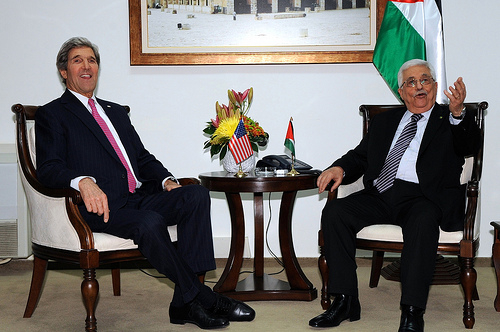
U.S. Secretary of State John Kerry and Palestinian Authority President Mahmoud Abbas in happier times, at a press conference in Ramallah on January 4, 2013. (Image source: U.S. State Department)

The problem seems again to come from a clash between Western culture and Islamic Middle Eastern culture. As one can see from Egypt, Sudan, Nigeria and Iraq, many Muslims cannot even accept the existence of a Muslim state ruled by Christians or, it often seems, a state in which more than a handful of Christians, except foreign workers, even exist.

Any agreement, such as a hudna ["truce"], is understood to be only temporary, until adequate forces can be built up with which to launch yet another attack.

Abbas, cloaking his apparent rapprochement with Hamas as an attempt to unify the Palestinian people, is meanwhile also bolstering his declining status among his West Bank constituents. Although the Palestinian Authority is popular internationally -- in 2012, it achieved upgraded status as a non-member state in the United Nations -- it is weak domestically, with Abbas in the ninth year of his four year term in office.

Conversely, Hamas is relatively weak internationally – designated a terrorist organization by Israel, the US, Egypt, the EU, Canada, Japan, and Australia -- but strong domestically. In 2007, Hamas expelled most Fatah members in a bloody coup and consolidated its control over Gaza.

From Abbas's position, the unity bid probably represented a win-win, permitting him to dodge Kerry diplomatically while appealing to his constituents domestically.

If anything, Kerry and Indyk should blame themselves for undermining their own well-intentioned efforts to achieve peace.

[1] For an example of this principle, see Article 11 of the Hamas Charter, which states: "The Islamic Resistance Movement believes that the land of Palestine has been an Islamic Waqf throughout the generations and until the Day of Resurrection, no one can renounce it or part of it, or abandon it or part of it."
[2] For more on the concept of waqf, see https://www.princeton.edu/~achaney/tmve/wiki100k/docs/Waqf.html
[3] "What did Indyk contribute to peace talks?" Reuters, Newsletter 11.05.2014
[4] Notes of a Century, Bernard Lewis, p. 247-8.
[5] For more on this principle and how it is understood today, see Knowing the Enemy: Jihadist Ideology and the War on Terror, By Mary R. Habeck, p. 115, and Basic Principles of Islam, Principle #6.
[6] Camp David: An Exchange - The New York Review of Books, September 20, 2001
[7] "Do you want me to be up there having tea with Sadat?"
[8] "Israel to U.S. and EU: Palestinians Deceived Kerry", Haaretz, May 7, 2014.
[9] "Inside the talks' failure: US officials open up", YNet News, May 2, 2014.


Harold Rhode and Joseph Raskas

Source: http://www.gatestoneinstitute.org/4314/kerry-indyk-abbas-hamas

Copyright - Original materials copyright (c) by the authors.

New UN Report Shows how Iran Evades Sanctions


by Reuters and Israel Hayom Staff

Confidential report by U.N. panel finds that Iran's methods of deception range from concealing titanium tubes inside steel pipes to using its petrochemical industry as a cover to obtain items for the heavy-water reactor in Arak.
The heavy-water reactor in Arak
|
Photo credit: AFP

The heavy-water reactor in Arak
|
Photo credit: AFP


Reuters and Israel Hayom Staff

Source: http://www.israelhayom.com/site/newsletter_article.php?id=17473

Copyright - Original materials copyright (c) by the authors.

Slow and Steady


by Zalman Shoval


Martin Indyk, the U.S. administration's special envoy to Israeli-Palestinian peace talks, landed back in Washington last week and quickly declared that Israel was to blame for the diplomatic failure. He reiterated the Palestinian claim that Israeli construction plans and nullification of the fourth phase of the prisoner release were the cause for Palestinian Authority President Mahmoud Abbas' decision, contrary to all prior understandings, to turn and apply to 15 international bodies. Indyk's comments came despite Palestinian confirmation, based on documents acquired by the press, that they made their decision in advance of said Israeli decisions.
 
Supposedly to balance his accusation, Indyk added that both sides "do not feel the pressing need to make the gut-wrenching compromises necessary to achieve peace," but forgot to mention that while Israel is prepared to concede large parts of its territory, the Palestinians refused to concede on any one of their demands. One can wonder why Indyk ignored the facts when reaching his conclusion (which, incidentally, is not the same conclusion reached by many other American officials involved in the talks), but it is more important now to focus on the reality of the situation as it stands, or could become in the coming months. U.S. President Barack Obama spoke of a hiatus, but, as evidenced from National Security Adviser Susan Rice's visit here last week, we can assume it won't last long.
 
U.S. Secretary of State John Kerry said in the past that it was time for the sides to "take inventory," and he is right. On the Palestinian side, the picture has become clearer: Abbas' "reconciliation" deal with Hamas is perhaps the first stage in integrating the Islamist group into the Palestine Liberation Organization, and testifies to Abbas' inclination to continue the struggle against Israel rather than come to terms with it.
 
In the meantime, the PA president has repeated his preconditions for renewing negotiations: a complete construction freeze for three months (in this context, the Palestinians do not distinguish between Jerusalem and the settlement blocs and other areas of Judea and Samaria), and completion of the fourth phase of releasing terrorists. However, even if Israel would agree to these demands -- even if only to test the Palestinians -- there is no indication that the Palestinians intend to abandon their present strategic course of bypassing any real negotiations by taking unilateral steps via the United Nations and other international bodies. Past experience teaches us that any positive Israeli or American response to their demands only leads to the Palestinians adding further conditions.
Coincidentally, it is quite possible that in the coming weeks it will actually be Israel offering proposals for "kick-starting" negotiations, but for there to be any chance of pulling the diplomatic wagon out of the mud of Palestinian rejectionism, the U.S. will have to employ different methods.
 
Firstly, the serious ramifications for pursuing his current course of action must be clarified to Abbas. As we have seen, when Washington wants to apply pressure, it provides results. More importantly, the Americans need to re-examine many of their basic assumptions. Kerry at the time delineated a rigid time frame for reaching a comprehensive agreement to resolve the conflict entirely, but even if he had doubled or tripled this allotted time frame the results would not have been any different. Not only is there no concrete possibility of bridging the fundamental gaps on the core issues of the conflict, but as long as the Palestinians believe that time is on their side (and comments like Indyk's only encourage them to maintain this belief), they will continue to drag their feet and make a mockery of American efforts.
 
The Talmudic idiom "if you have seized a lot, you have not seized" also applies to the Israeli-Palestinian conflict. A comprehensive deal to "end the conflict," which Washington declared as the immediate objective and which we would also prefer in principle, is simply not within reach.
 
The necessary conclusion, therefore, is that to make progress we must borrow from the wisdom of Winston Churchill: "Be quick, but don't be in a hurry" -- and outline a strategy of partial arrangements on issues such as security, economic cooperation, the establishment of more effective and fair governmental and judicial institutions for the Palestinians -- without repeating the mistake of hitching a wagon with no wheels before the horse.
 
The Palestinians must be told: "While you are not required to give up on your dreams of being independent, if you continue pursuing your current course, you will simply never attain them."


Zalman Shoval

Source: http://www.israelhayom.com/site/newsletter_opinion.php?id=8373

Copyright - Original materials copyright (c) by the authors.