by Herb Keinon
By pushing Gafni out of the next Knesset, the party's rabbinic leadership has served notice that Netanyahu will have to win the haredim back rather than simply count them in.
 |
You think Prime Minister Benjamin Netanyahu has been in power for a long time? Consider Degel Hatorah’s Moshe Gafni.
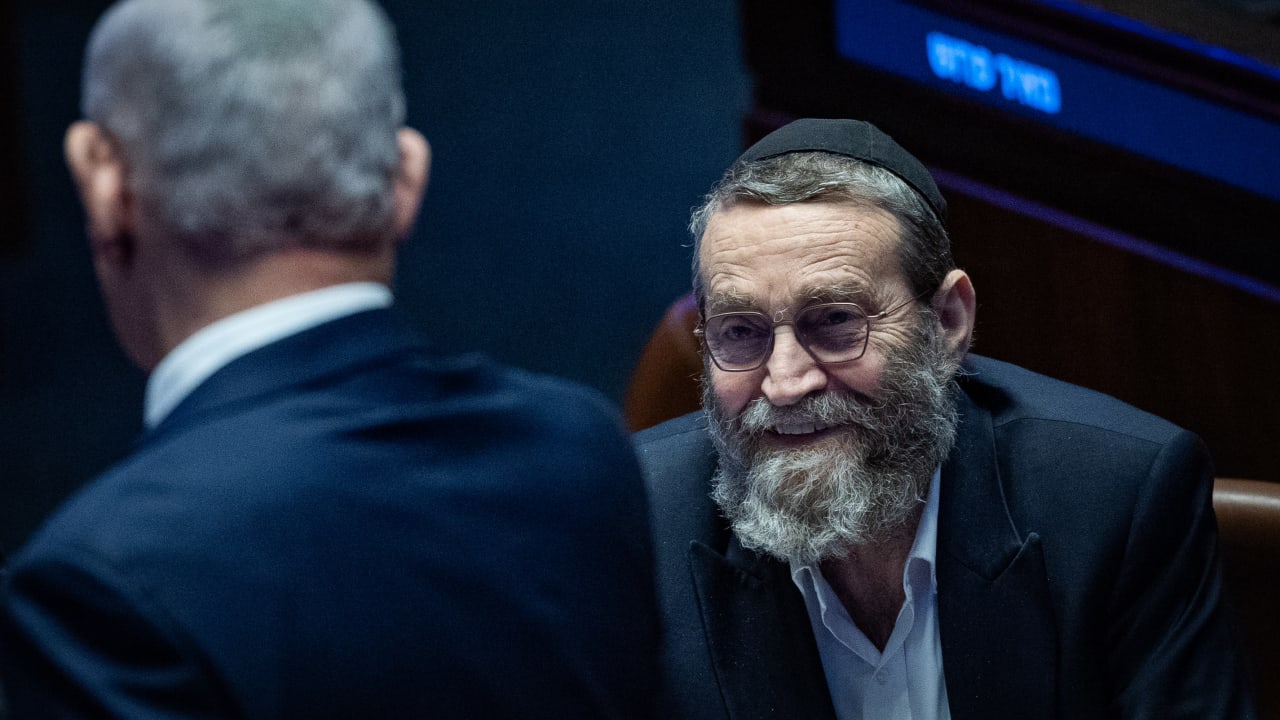
Gafni, the Knesset’s longest-serving MK, was unceremoniously dropped from the party’s Knesset slate on Saturday night, along with Uri Maklev, on the instructions of Degel Hatorah’s spiritual leader, Rabbi Dov Lando.
When Gafni first entered the Knesset in 1988, Israel had only one national television channel; Rabbi Elazar Menachem Shach led the Lithuanian haredi (ultra-Orthodox) world with which Gafni is associated; Yitzhak Shamir was prime minister; Ronald Reagan occupied the White House; and Mikhail Gorbachev led the still-intact Soviet Union.
Netanyahu and Gafni were first elected together in 1988. Netanyahu left the Knesset in 1999 and returned in 2003. Gafni, apart from a two-year absence from 1992 to 1994 and a brief break in 1998-99, has served almost continuously for close to 38 years.
And while he obviously never wielded anything approaching Netanyahu’s power, Gafni became one of the country’s ultimate power brokers and kingmakers, a symbol of the disproportionate influence that haredi parties have often exercised over Israel’s political system.

The era of haredi influence over Israeli politics may be coming to an end
As October’s election approaches, that era may be coming to an end. Several opposition parties have made military or national service for all a central condition for joining the next government. And now the man who, perhaps more than anyone else, came to represent the old system is also on his way out.
Degel Hatorah’s rabbinic leadership thanked Gafni and Maklev for their years of loyal service but said they would not be included on the party’s next Knesset list, citing the need to “refresh” its parliamentary representation.
Gafni will also be replaced as Degel Hatorah chairman by Yakov Asher, slated to head both Degel Hatorah and United Torah Judaism (UTJ), the party it forms with the hassidic Agudat Yisrael. This is therefore not merely the departure of a veteran MK; it is a changing of the guard.
The reference to “refreshing” the list is a courteous formulation. The obvious inference is that Gafni and Maklev are being held responsible for the failure of the haredi parties to secure the comprehensive legislation their rabbinic leadership demanded to protect the status of yeshiva students from conscription – even in a Knesset in which the haredi parties repeatedly held the balance of power.
There is a considerable irony here. As a longtime MK and seemingly permanent chairman of the powerful Knesset Finance Committee, Gafni was perhaps the most accomplished parliamentary tactician in haredi politics. He mastered the political system, knew how to work its levers, and succeeded in channeling tremendous budgets to his constituents.
Yet all that parliamentary mastery could not deliver the one result his community – or at least its most respected rabbis – considered essential. And that raises a broader question: Has the traditional haredi method of working within the parliamentary system to protect and preserve the yeshiva world run its course?
For decades, the model worked.
The haredi parties generally avoided taking strong positions on diplomacy and security, were willing to align themselves with whichever major party could best meet their communal needs, and they used their pivotal position to secure budgets and preserve military exemptions.
But the war, the IDF’s manpower shortage, repeated court rulings, and mounting public anger over the unequal sharing of the security burden have made that model increasingly difficult to sustain.
What was once viewed by much of the public as an irritating but tolerable political arrangement is now seen by many as immoral, fundamentally unjust, and a long-term threat to a country that is badly in need of more soldiers amid a prolonged, multi-front war.
Is Degel HaTorah breaking away from Netanyahu?
The removal of Gafni and Maklev may also be intended as a message to Netanyahu that the alliance between Likud, the haredim, and the religious Right can no longer be taken for granted.
Lando said as much earlier this year, during the failed effort to secure the draft-exemption legislation, declaring that Degel Hatorah no longer trusted Netanyahu and that, as far as the party was concerned, the old right-wing bloc no longer existed.
Netanyahu and Gafni entered the Knesset together, and their relationship came to symbolize the Likud-haredi alliance. The arguments could be fierce, but both men knew that, at the end of the day, they needed one another and would find a way to get back to business.
Taking Gafni off the list deprives Netanyahu of a key ally in the haredi world and of his most dependable political channel to the Lithuanian haredi leadership. It also leaves him dealing with new political leaders who may feel less bound by decades of shared history and personal commitments.
That should not necessarily be interpreted as Degel Hatorah abandoning the prime minister. Ideologically, culturally, and politically, the party remains far more comfortable with Likud and the religious Right than with most of the parties in the anti-Netanyahu camp.
It does suggest, however, that Netanyahu can no longer assume that history and personal relationships will automatically restore the alliance to what it once was.
Does this mean that Degel Hatorah is winking at Gadi Eisenkot and Naftali Bennett?
Possibly. The leadership change may be a signal that the party is open to working with the “change bloc” – or at least wants Netanyahu to believe that it is. By portraying itself as potentially available to either side, Degel Hatorah could try to regain the kingmaker status the haredi parties once enjoyed.
If, as recent polls indicate, the anti-Netanyahu bloc finishes a few seats short of the magic 61 needed to form a government, UTJ – with the seven it has been receiving consistently in the polls – could theoretically push it over the finish line.
But “theoretically” is the operative word.
Such a move would depend not only on what Degel Hatorah and its new political leadership want but also on whether Bennett, Eisenkot, and Avigdor Liberman – who have all made haredi conscription central to their campaigns, though with somewhat different nuances – would agree to in order to bring UTJ into a coalition without a fundamental change in its position.
A change in Degel Hatorah’s position on this matter is very unlikely. Gafni’s departure does not mean Degel Hatorah is softening its opposition to the conscription of haredim. Nor does Asher’s elevation – even though he served for several months in the IDF’s abbreviated Shlav Bet framework – signal a more accommodating position on the draft.
The change is therefore less about ideology than political positioning. Degel Hatorah is trying to move from being perceived as a captive part of the Netanyahu camp to being seen once again as a potential swing vote between the blocs.
The party has not crossed the political aisle. But by pushing Gafni out of the next Knesset, its rabbinic leadership has served notice that Netanyahu will have to win the haredim back rather than simply count them in.
Herb Keinon
Source: https://www.jpost.com/israel-election-2026/article-907743

No comments:
Post a Comment