by Amir Taheri
[The Khoneinists] need the war to continue to justify their failure in all domains and their repression of dissidents.
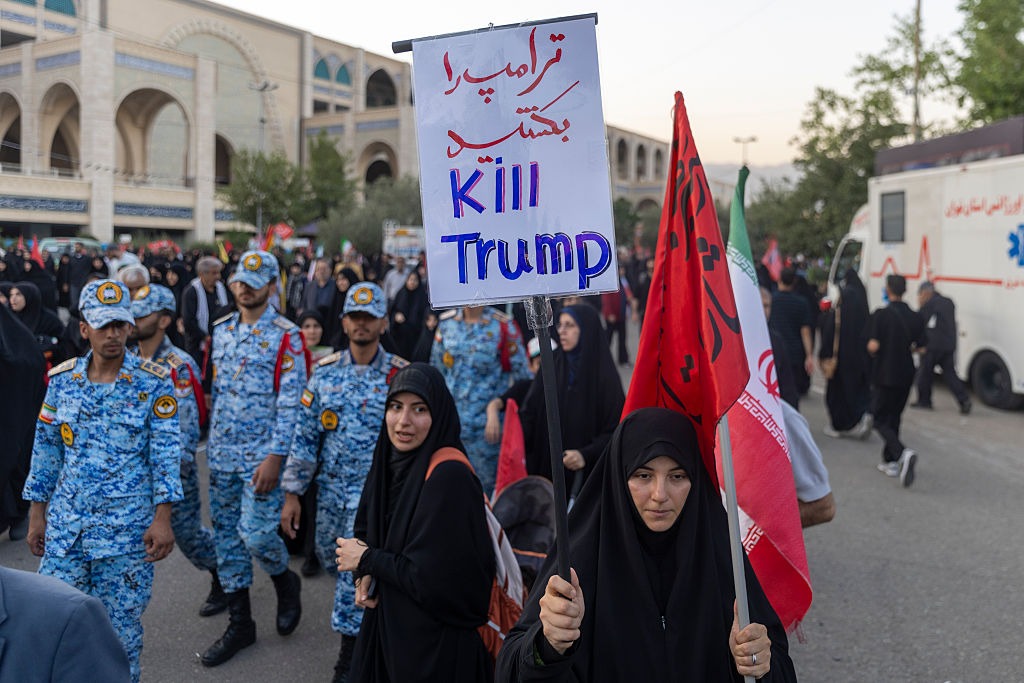
The leftover Khomeinists... want the war to continue at a low intensity to keep their claim of "resistance" alive and postpone the inevitable volcano of popular anger against their ramshackle rule.
They need the war to continue to justify their failure in all domains and their repression of dissidents.
Long before some American politicians and pundits were beating the drums for war against Iran, Victor Davis Hanson reminded his readers that two of the nine "landmark battles in the rise to Western power" were against Persia.
The battles mentioned by the respected military historian were in Salamis, where the Greek city-states, led by Athens, sunk the Persian fleet, and Gaugamela, where Alexander of Macedonia defeated Darius III.
The late Republican Senator Lindsey Graham, a vocal advocate of an attack on Iran, wrote in March 2026 that neutralizing Iran was the key to "ending a 2,000-year-long conflict."
Last week, Trump ordered a strike on rocket launchers on the Iranian island of Larak, which was supposed to be the opening salvo in a fresh round of attacks.
However, it quickly became apparent that Trump had ordered the strike to send a signal to China and Russia, which were leading a summit of the Shanghai Cooperation Organisation (SCO) in Kyrgyzstan, that the war with Iran, also attending the summit, wasn't yet over.
A war that had started with unprecedented shock-and-awe intensity has morphed into a low-intensity one that could go on for months, if not years, with the protagonists losing track in the fog of war.
One might also wonder about the Ukrainization of the current war on Iran in the sense that the conflict continues at a lower, though still deadly, level with no clear objective in sight.
For the past three months, Trump at least has given top billing to his demand that the Strait of Hormuz be opened.
Regardless of punctual hitches, that has been the case for at least three weeks.
According to international navigation sources, an average of 50 to 60 ships pass through the strait daily, not yet up to what it was before the war, but far from a total shut-down.
Despite braggadocio by the aging teenagers who run the curtailed Khomeinist show in Tehran, the backlog of ships trapped in the strait is almost cleared. Oil is also flowing out at a daily average of over 8 million barrels a day.
According to Trump, all sea mines, probably imaginary, laid Iran in the strait have been cleared.
As for Tehran's boast about turning the strait into a money tree, so far no ship has paid a penny for a passage.
Israel, which the usual suspects blame as the instigator of the war, is now at the ringside wondering what to make of Trump's pirouetting.
The leftover Khomeinists have understood this and halted attacks on Israel, targeting Jordan, Bahrain and the UAE.
They want the war to continue at a low intensity to keep their claim of "resistance" alive and postpone the inevitable volcano of popular anger against their ramshackle rule.
They need the war to continue to justify their failure in all domains and their repression of dissidents. The national currency is in free fall; they blame the war. GDP has fallen by almost 6 percent in a year; they blame the war. The number of Iranians below the poverty line has jumped to 58 percent; they blame the war. Inflation has topped 60 percent; they blame the war. The central bank governor admits he is ordered to print money on a no-tomorrow basis; they blame the war.
If the war ends, the thinly disguised struggle for power within the ruling clique could break into the open. Rival factions may be forced to appeal to the people in the hope of tipping the balance in their own favor.
People may ask why the declared "Supreme Guide" -- who is in purdah, supposedly for security reasons -- doesn't show his face.
There are many cases where the end of a war leads to a change of leadership or even regime change.
Winston Churchill and Charles de Gaulle were victors in World War II, but both lost power soon after they had uncorked the champagne bottle.
In the US, President Harry S. Truman was at the helm when the last arm of the Axis was broken. But in the first post-war midterm elections, Democrats lost the House and Senate.
Today, I doubt if Volodymyr Zelensky or Vladimir Putin would be able to hang on to power for long once their war is over.
In 1981, Ruhollah Khomeini described the war started by Saddam Hussein as "a divine gift." His right-hand man, Akbar Hashemi Rafsanjani, said that without the war he wasn't sure the Islamic regime could have lasted more than a couple of years.
The leftover Khomeinists need the war, but Trump doesn't.
To start with, this is a war of choice, not of necessity, which means the average American doesn't feel threatened by ending it, nor would he feel elated by winning it.
Next, Trump won't be seeking re-election, and anyone he picks as his putative successor would be judged on his own merits and many other issues than this strange war.
Finally, Trump doesn't need a war victory to preach his gospel. Regardless of some obvious setbacks, he has a reasonable story to tell on the economy.
His campaign against illegal immigration is still popular, and his efforts to curtail elitism, often dressed as pseudo-leftist pretensions, have appeal beyond his support base once described by Hillary Clinton as a "basket of deplorables."
Since neither Trump nor anyone else knows what winning this war might mean, he has no interest in staying in the game, especially when he knows that declaring victory would expose the adversary to mortal -- possibly fatal -- danger at home.
He has weakened the Khomeinist regime to an extent unimaginable a year ago. He should now pass the ball to the Iranian people to settle their account with it.
Gatestone Institute would like to thank the author for his kind permission to reprint this article in slightly different form from Asharq Al-Awsat.
Amir Taheri was the executive editor-in-chief of the daily Kayhan in Iran from 1972 to 1979. He has worked at or written for innumerable publications, published eleven books, and has been a columnist for Asharq Al-Awsat since 1987. He graciously serves as Chairman of Gatestone Europe.
Source: https://www.gatestoneinstitute.org/22840/war-with-iran-rethink

No comments:
Post a Comment