by Amir Taheri
Interestingly, none of the 15 or so candidates for the presidency in 2027 dares tell the French moaners why the "social market" system doesn't work and how to replace it.
The demonstrations, which include the closure of numerous secondary schools and blocking of oil refineries, started as a weekly event on Saturdays but have now become an almost daily exercise in defying the authority of the state.
If we add the perks the French welfare state offers, the average French wage-earner may be no worse off than his American counterpart.
The lion's share goes to the state, which swallows 60 percent of the gross domestic product compared to 24 percent by the federal government in the US.
Parisian café intellectuals call the system "the French model", also hyped with the cliché "social market economy." In practice, it means the state gets most of your money and spends it as it deems fit, while you are left counting farthings to make ends meet.
The French state is a giant subsidy-spreading machine. It subsidizes political parties, candidates for public office, trade unions, newspapers and audio-visual media, and thousands of associations. Find a cause, even a lost one, and gather a few chums around you and register yourself as a cultural association, even for reviving the dodo, and you have a good chance of getting a fat cheque...
Interestingly, none of the 15 or so candidates for the presidency in 2027 dares tell the French moaners why the "social market" system doesn't work and how to replace it. The two candidates currently ahead in polls belong to the ultra-right National Rally, promising a return to a past that never was, and the ultra-left France Unbowed, offering a future that can never be.
dawn of a new socialist order
In Paris and Lyon, the bearers of the red message formed a small but super-noisy minority of protesters that included the shrinking trade unions, remnants of the defunct PKK, LGBTQA+ organizations, the useful idiots, angry schoolchildren, pro-Hamas outfits waving Palestinian flags, militants from the ultra-left parties such as France Unbowed, the Communist Party, the New Anti-Capitalist Party and the Workers' Fight, as well as the remaining Yellow Vest characters and Trotskyites.
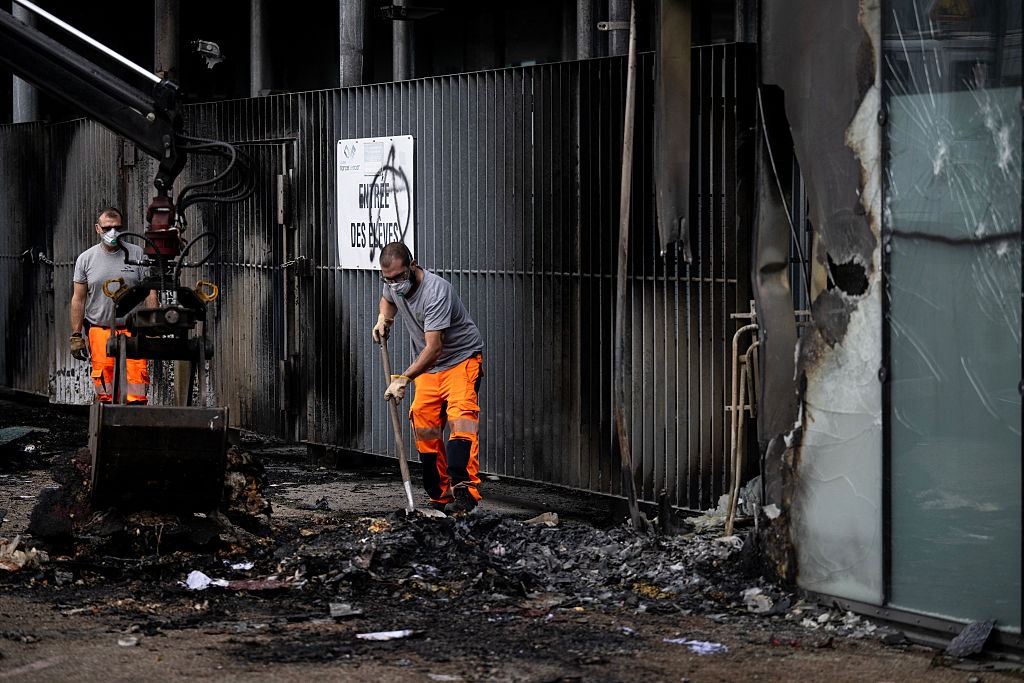
Using all those as cover, a few thousand tightly organized and sometimes uniform-wearing youths used the demonstrations as cover for pillaging shops, attacking the police and setting public buildings, bus stop shelters, garbage dumpsters and private cars on fire. The demonstrations, which include the closure of numerous secondary schools and blocking of oil refineries, started as a weekly event on Saturdays but have now become an almost daily exercise in defying the authority of the state.
Rival figures provided by the Ministry of the Interior and organizers of demonstrations show that between half of one percent to two-thirds of one percent of the population participate in them. What is remarkable is that in a couple of demonstrations we witnessed onlookers stood by as shops were pillaged and cars burned, sometimes taking video clips with their phones. Some polls show that a majority of the French sympathize with the protesters' often-vague demands.
One demand is stated with greater passion. The first is "doing something about" wages and salaries. The argument is that the average salary in France (around $3,000 a month) is almost half of that in the United States. On the surface, that seems a fair comparison. Tearful men and women appear on TV with a litany of woes on how, pinned to low wages, they cannot make ends meet.
A closer look, however, may offer a different perspective. If we add the perks the French welfare state offers, the average French wage-earner may be no worse off than his American counterpart. Thanks to the 35-hour workweek scheme introduced by the Socialist Party government decades ago, the French wage-earner works an average of 28 hours a month less than his American counterpart. Adding the hourly price of labor, that means around $280 more a month. If the French worker works more than 35 hours a week, his extra earnings come tax-free.
The French wage-earner has 30 days of fully paid annual holiday, in addition to eleven other national holidays off. Apart from national holidays off, the American counterpart has no mandatory paid holiday because that depends on agreement with the employer.
Under the French system, the wage-earner gets free education up to the highest levels. His or her student offspring also get state stipends, including rent support, cash to buy textbooks and lunch for $1. The American must pay at every stage.
The French wage-earner also enjoys subsidized or totally free healthcare, including hospitalization, nursing at home or even thermal holiday cures. The American has to sort all that out in a system made more complicated by the ill-conceived Obamacare.
Retirement age in France is 62 years despite abortive attempts at raising it to 64 or 67. In the US, there is no mandatory limit, but most workers in both public and private sectors work past their 67th birthday.
Moreover, almost a third of French wage earners pay no income tax. And yet, the real cost of hiring in France is the highest among OECD countries. The reason? The numerous charges levied by the central government and regional authorities. In other words, hiring a worker costs a lot, but the worker ends up getting less than half of the sums involved. The lion's share goes to the state, which swallows 60 percent of the gross domestic product compared to 24 percent by the federal government in the US.
Parisian café intellectuals call the system "the French model", also hyped with the cliché "social market economy." In practice, it means the state gets most of your money and spends it as it deems fit, while you are left counting farthings to make ends meet.
The model was shaped during the Cold War when free-market nations in Western Europe feared Communism. They mistook Communism for a system of "from each according to his ability and to each according to his needs." Thus, they reinterpreted the role of the state as a regulator of the theoretically free market and distributor of the wealth produced by the people.
They ended up with the disadvantages of both systems.
The free market was prevented from fully functioning, while the state was denied the key tools of Communism, including rationing, the cushion of support from the nomenclature, granted additional perks and the brutal silencing of discordant voices -- not to mention the gulags. As a result, the Western European free market state was presented as cornucopia capable of satisfying endless desires without expecting any respect, let alone loyalty in return.
And since the free market system creates new needs -- not to mention desires -- almost all the time, no state is capable of fulfilling that task and getting a merci-beaucoup in return. After all, according to some, socialism started with Charles Dickens's character Oliver Twist who, when served broth, had the temerity to say, "Please, sir, I want some more."
The French state is a giant subsidy-spreading machine. It subsidizes political parties, candidates for public office, trade unions, newspapers and audio-visual media, and thousands of associations. Find a cause, even a lost one, and gather a few chums around you and register yourself as a cultural association, even for reviving the dodo, and you have a good chance of getting a fat cheque from Marianne. State subsidies help churn out movies few wish to see in theaters that are empty much of the time, and publish research papers about things searched but never found.
Spending other people's money is easy, not to say enjoyable.
Interestingly, none of the 15 or so candidates for the presidency in 2027 dares tell the French moaners why the "social market" system doesn't work and how to replace it. The two candidates currently ahead in polls belong to the ultra-right National Rally, promising a return to a past that never was, and the ultra-left France Unbowed, offering a future that can never be.
Both echo the final phase of Weimar, when the choice was between red and brown. Will France do a Houdini to avoid that choice?
Gatestone Institute would like to thank the author for his kind permission to reprint this article in slightly different form from Asharq Al-Awsat.
Amir Taheri was the executive editor-in-chief of the daily Kayhan in Iran from 1972 to 1979. He has worked at or written for innumerable publications, published eleven books, and has been a columnist for Asharq Al-Awsat since 1987. He graciously serves as Chairman of Gatestone Europe.
Source: https://www.gatestoneinstitute.org/22985/france-between-red-and-brown

No comments:
Post a Comment