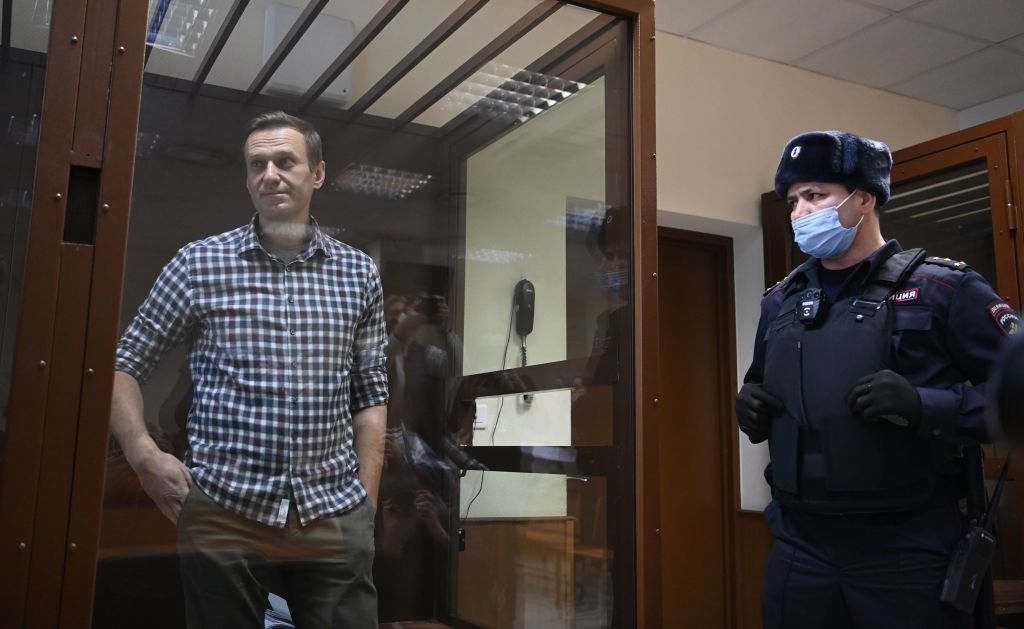
 Russian
opposition politician Alexei Navalny was nearly murdered in August by
poisoning with the nerve-agent novichok, and on February 2 was sentenced
to two and a half years in a penal colony for an alleged parole
violation. The resultant protests in support of Navalny have been
attended by tens of thousands of citizens in more than a hundred Russian
cities. Pictured: Navalny attends a hearing inside a glass cell at the
Babushkinsky District Court in Moscow on February 20, 2021. (Photo by
Kirill Kudryavtsev/AFP via Getty Images) |
The near-murder of Russian opposition politician Alexei Navalny by the nerve-agent novichok last August, his return to Moscow in January, and the resultant protests attended by tens of thousands
of citizens in more than a hundred Russian cities, raise the question
of how long the Russian people will continue to tolerate President
Vladimir Putin's repressive acts against political enemies and rivals.
The crowds were rallying in support of Navalny after his return to Moscow on January17, 2021 from medical treatment in Germany, some in temperatures of -60 degrees Fahrenheit. The police, attacking the protestors with batons, arrested more than 3,300 people.
While recuperating in Germany, Navalny, aided by an investigative organization,
filmed himself calling Konstantin Kudryatsev, a toxins expert in
Russia's Federal Security Service (FSB). Using a disguised telephone
number, Navalny posed as an aide to the chairman of Russia's Security
Council. He asked Kudryatsev for the details of his poisoning. In the
49-minute conversation that followed, Kudryatsev divulged full details
of the poisoning, including how the novichok poison had been placed in
Navalny's underpants in a hotel in Tomsk.
In December, Navalny's Anti-Corruption Foundation (FBK) released the video of the telephone call.
After his January arrest in Moscow, Navalny released a nearly two-hour documentary entitled, "Putin's palace. History of world's largest bribe," that has drawn more than 100 million views on YouTube. The billion dollar plus residence was financed, claims FBK, through a corruption scheme run by oligarchs in Putin's inner circle.
On January 23, Navalny was arrested for allegedly violating the terms
of his parole -- which was imposed in 2014 under a suspended sentence
for what he calls a "fabricated" charge of embezzlement. The European
Court of Human Rights in 2016 had already ruled that the 2014 conviction was unlawful.
According to the BBC:
"The case against Navalny was based on his failure to
report regularly to police during 2020 - an absurdity, his legal team
argued, as the authorities knew full well that he was getting emergency
treatment in Berlin for the Novichok nerve agent attack. He reminded the
court that for part of that time he was in a coma."
In a speech to the court on February 2, when the judge sentenced him
to two and a half years in a penal colony for the parole violation,
Navalny said:
"[Putin's] main gripe with me is that he'll go down in
history as a poisoner. We had Alexander the Liberator, Yaroslav the
Wise, and we will have Vladimir the Underpants Poisoner."
In the courtroom, Navalny drew a heart with his finger on the glass wall of his enclosure for his wife, Yulia.
Navalny, the next week, was hauled back to court
for allegedly "slandering a World War II veteran who took part in the
promotional video in support of last year's constitutional amendments
that cleared the way for President Vladimir Putin to run for two more
terms in office..." Navalny had "described those in the video as
'traitors,' 'people with no conscience,' and 'corrupt lackeys.'"
Meanwhile, nationwide protests continued.
In the freezing winter, Russians gathered in groups and held up their
mobile phone flashlights in a display of support for Navalny.
Why is this outpouring of support for Navalny significant?
Since 2018 he has headed a political party, "Progress," also known as "Russia of the Future." Its platform
stands for, among other things, the decentralization of power; the rule
of law; ending censorship; reducing government interference in the
economy, and partnering with Western countries.
It is also no secret that Putin has a history of allegedly taking revenge on journalists -- such as Anna Politkovskaya, Paul Klebnikov or Natalia Estemirova -- as well as enemies or opponents.
In 2004, Viktor Yushchenko, a pro-Western candidate for president of
Ukraine was left with his face pock-marked and disfigured by a poisoning
attack.
In 2006, Russian double agent Alexander Litvinenko was killed with radioactive polonium. Popular political reformer Boris Nemtsov was assassinated in 2015. His friend, Vladimir Kara-Murza,
was poisoned twice, in 2015 and 2017, but survived. Sergei Skripal, a
former Colonel in Russian military intelligence and allegedly a
double-agent working for Britain, was also poisoned with novichok, along
with his daughter Yulia, while living in the UK, presumably to
underscore that no one was out of reach.
How did Navalny to rise to prominence in Russia? In 2007, holding a
small number of shares in Russian state-owned oil and gas companies,
Navalny obtained information on their corruption and misuse of funds, which he then publicized on his widely-read LiveJournal blog.
In 2011, he founded his Anti-Corruption Foundation. He also ran for mayor of Moscow but lost. The same year, he led a series of protests against election fraud. In addition, his organization created a "smart" voting platform, which advises the public of alternatives to Putin's candidates.
In the 2012 parliamentary elections, Navalny's party lost out to
Putin's United Russia Party by a large margin. In 2020, however, thanks
to Navalny's growing influence, Putin's party lost seats in Moscow,
Khabarovsk, Tomsk and Novosibirsk.
In 2018, Navalny campaigned and sought to run against Putin
in the presidential election. Navalny obtained 200,000 signatures and
opened 81 campaign offices nationwide. But unlike less well-known
candidates, he was barred from running against Putin because of his 2014
conviction for embezzlement and money-laundering, a case he called "trumped up."
Since then, waves of protests have swept Russia, along with growing admiration for Navalny worldwide.
Navalny has made some telling comments about former President Donald
J. Trump and censorship. Indeed, comparisons between underdogs Trump and
Navalny are hard to avoid, particularly as both are censored. Navalny tweeted on January 9:
"I think that the ban of Donald Trump on Twitter is an unacceptable act of censorship...
"The election is a straightforward and competitive process. You can
participate in it, you can appeal against the results, they're being
monitored by millions of people. The ban on Twitter is a decision of
people we don't know in accordance with a procedure we don't know...
Don't tell me he was banned for violating Twitter rules. I get death
threats here every day for many years, and Twitter doesn't ban anyone
(not that I ask for it)...
"Among the people who have Twitter accounts are cold-blooded
murderers (Putin or Maduro) and liars and thieves (Medvedev). For many
years, Twitter, Facebook and Instagram have been used as a base for
Putin's "troll factory" and similar groups from other authoritarian
countries.
"Of course, Twitter is a private company, but we have seen many
examples in Russian and China of such private companies becoming the
state's best friends and the enablers when it comes to censorship.
"If you replace 'Trump' with 'Navalny' in today's discussion, you
will get an 80% accurate Kremlin's answer as to why my name can't be
mentioned on Russian TV and I shouldn't be allowed to participate in any
elections.
"This precedent will be exploited by the enemies of freedom of speech
around the world. In Russia as well. Every time when they need to
silence someone, they will say: 'this is just common practice, even
Trump got blocked on Twitter'."
Navalny had previously commented on the fact that unlike many other
world leaders, Trump was unusually quiet about his poisoning. According to CNN:
Speaking to CBS on Sunday, Navalny said "I think it's
extremely important -- that everyone, of course, including and maybe in
the first of all, President of United States, to be very against using
chemical weapons in the 21st Century."
In 2018, President Trump expelled
60 Russian diplomats from the US days after the British government
positively identified the nerve agent used in the Skripal poisonings as
novichok. He also ordered the closure of the Russian Consulate in
Seattle. European Union countries, Canada and Ukraine followed suit in
expelling Russian diplomats.
The use of novichok is banned by the Chemical Weapons Convention, an international treaty of which Russia is a state party.
Before Navalny, opposition figures who survived attacks have retreated or fled. Navalny, physically attacked, jailed and released many times, has refused flight, emigration and silence.
So far, Navalny, now in the IK-2 penitentiary in the city of Pokrov, said "he had seen no violence in his new surroundings," which he called a "friendly concentration camp," in a message posted to his Instagram account on March 15.
"I have not yet seen any violence or even a hint of it,
although due to the stiff posture of the convicts, standing at attention
and afraid to turn their heads, I easily believe the numerous stories
that here, in IK-2 'Pokrov', quite recently people were beaten half to
death with wooden hammers. Now the methods have changed, and, to be
honest, I don't even remember a place where everyone speaks so politely
and in a way, kindly."
"He is prepared to lose everything," said
the economist Sergei M. Guriev, a Navalny confidant who in 2013 fled to
France after coming under pressure from the Kremlin. "That makes him
different from everyone else."
On March 2, 2021, the Biden administration imposed sanctions on Russian officials and companies and are presently considering further steps. According to The Guardian:
"Senior administration officials described the measures
taken, which are also a response to Navalny's continued imprisonment, as
catching up with sanctions imposed on Moscow by the EU in October..."
They are not likely to be sufficient. Russia has already imposed sanctions of its own against European officials in reprisal.
Voices worldwide need to continue to call for Navalny's release.
Putin, of course, is still popular with much of Russia. Polls show
his approval rating in the mid-60s. Russian media are portraying
Navalny's supporters in a negative light amidst footage of violence
directed against the police. Crackdowns on supporters are anticipated.
Yet Navalny has hope that his movement can carry on without him. Reacting to his sentencing, he addressed his followers in the courtroom:
"This [imprisonment] is happening to intimidate large
numbers of people. They're imprisoning one person to frighten millions.
This isn't a demonstration of strength — it's a show of weakness."
Dr. Jiri Valenta is a senior research associate at the BESA Center
for Strategic Studies at Bar Ilan University, Ramat Gan. A former
tenured associate professor at the U.S. Naval Postgraduate School, he
also served as coordinator of Soviet and East European Studies for the
Master's program for intelligence officers of all armed forces. A member
of the U.S. Council on Foreign Relations, he is the recipient of the
Jan Masaryk Silver Medal for his directorship of a post-revolutionary
think tank in the Czech Republic. A recipient of several distinguished
fellowships, he is the author of several books, some based on on-site
research and covering Grenada, Nicaragua, Afghanistan, Syria and
Cambodia. For the last decade, he has worked with his wife, Leni, who
holds a 3-year Masters from the Yale School of Drama in playwriting.


 First, there is

 VP Joe was in and out of China. As we know, he took Hunter with him and they came back